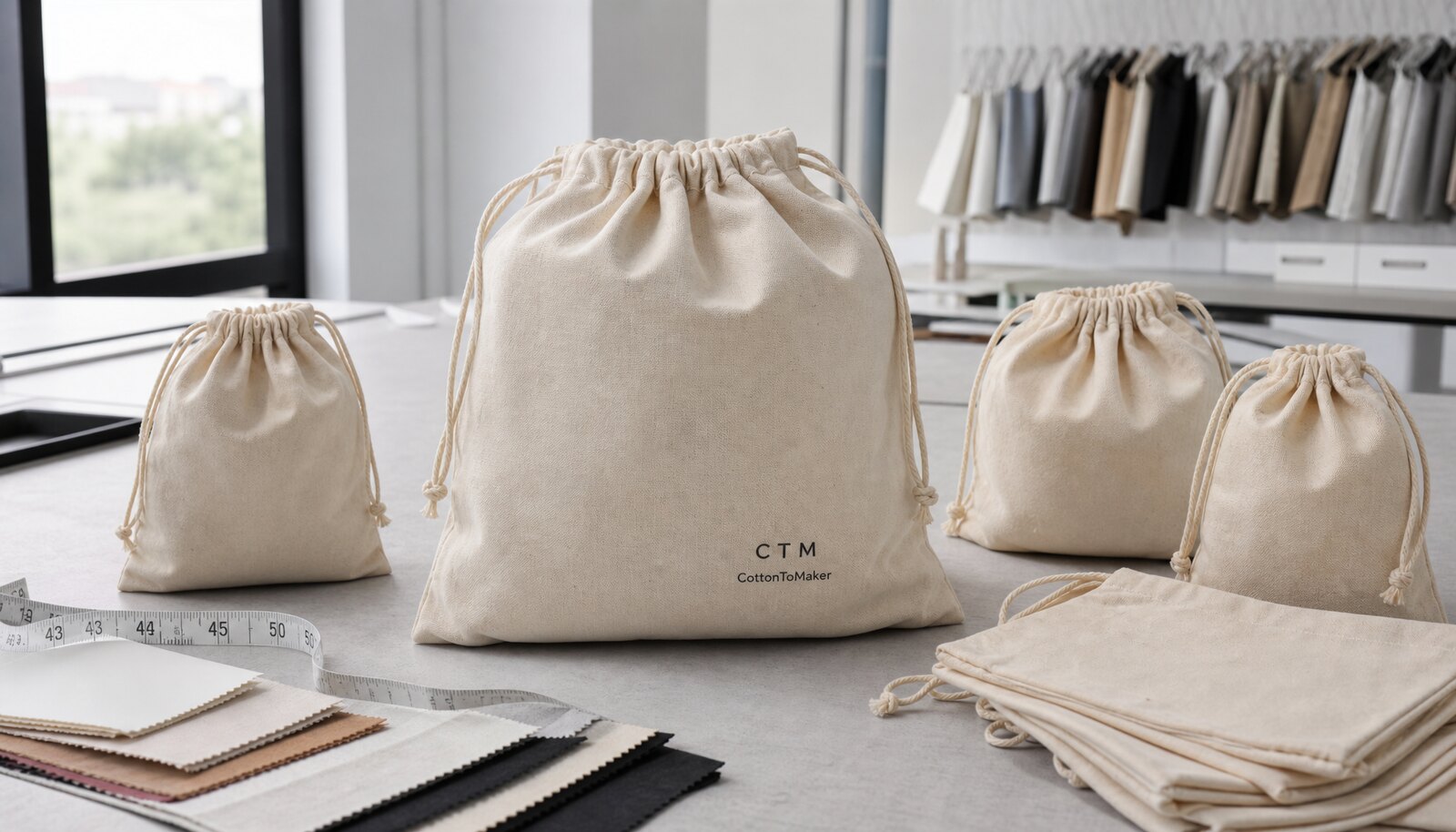
Why handbag brands care about cotton dust bag material choice
A cotton dust bag is not just an accessory pack. For handbag brands, it is part of product protection, storage convenience, and the first physical impression after purchase. When the fabric is too thin, hardware can press through, the bag loses shape, and the dust bag looks cheap beside the handbag. When the fabric is too heavy, the pack becomes bulky, more expensive to ship, and less flexible for retail folding.
The material decision should start from the handbag itself. A soft nylon pouch may be enough for a lightweight fashion bag, but a structured leather tote with metal feet and chain handles needs more abrasion resistance. Procurement teams should write the RFQ around use case, not around a vague 'cotton dust bag' description. That one change usually makes supplier quotes easier to compare and prevents the common mistake of receiving a soft but weak pouch that fails in warehouse handling.
- Match the bag to the handbag weight, surface finish, and hardware profile.
- Treat the dust bag as packaging plus protection, not decoration alone.
- Compare supplier samples by feel, stitching, and fit against the actual handbag.
Choose the right cotton construction before you compare quotes
For most handbag brands, the practical shortlist is plain weave cotton, cotton muslin, or cotton twill. Plain weave is usually the most economical and easy to source in bulk, but it may feel basic if the weave is too open. Muslin can work for lighter handbags and lower-price programs, though it often needs a higher GSM to avoid transparency. Twill has a denser surface and better drape, which helps premium brands, especially when the bag must protect coated leather, embossed finishes, or polished hardware.
The most useful spec is finished GSM, not just fabric name. For standard handbag dust bags, 120–180 GSM covers most needs. Below 120 GSM, the bag may look thin, wrinkle heavily, and show print strike-through. Above 180 GSM, the unit cost rises, but the hand-feel and protection improve. If the handbag is oversized, heavily structured, or sold at a premium price point, 200 GSM or even higher may be justified. That higher weight should be tied to a real function: better scuff protection, better stand-up appearance, or a more premium retail reveal.
- Use 120–180 GSM for standard retail handbag dust bags.
- Move to 200 GSM+ when the bag must protect heavy hardware or premium leather.
- Confirm finished GSM after finishing or washing, not only mill greige weight.
How fabric choice affects unit cost and MOQ logic
Cotton bag pricing is driven by fabric consumption, labor, print method, and packaging. A heavier fabric increases raw material cost immediately, but it can also increase sewing time because thicker seams are slower to close and inspect. A simple one-color screen print is usually the most cost-efficient branding method when the order is large enough to spread out plate or screen setup. Woven labels are often cleaner for small logos, but they add a separate trim component and sewing step.
MOQ should be discussed by size and print version, not just by total order quantity. A factory can sometimes quote 3,000 pieces total, but if you need three sizes and two logo placements, the real minimum per SKU may become too small to be efficient. Procurement teams should ask whether the MOQ applies to the fabric lot, the print screen, or the final finished bag. This detail matters because a low headline MOQ can hide multiple setup charges that make the landed price worse than a larger, cleaner order.
- Heavier GSM usually means higher fabric cost and slower sewing throughput.
- One-color screen print is usually cheaper at scale than complex logo decoration.
- Split MOQ by size, color, and artwork version before comparing suppliers.
Supplier routes: direct factory, trading company, or packaging specialist
A direct factory is usually the best route when you need custom dimensions, control over stitching, and repeatable specification. You get more visibility into fabric source, production line, and sample room corrections. That is especially useful for handbag brands because fit and finish matter more than with generic promo pouches. The drawback is that direct factories may push you toward their standard material library unless your RFQ is specific and visual references are clear.
A trading company can be useful when you need faster communication across several factories or when the order includes multiple packaging items. The tradeoff is quote consistency. Some trading companies will source the lowest-cost factory for each run, which can create variation between reorders. A packaging specialist is often strongest on print and packing detail, but may not know handbag-specific requirements unless you give them exact size, fabric, and finish criteria. The best route depends on how much control you need versus how many product lines you are consolidating.
- Direct factory works best for repeat handbag collections and custom sizes.
- Trading company can help consolidate multiple packaging items but may reduce process transparency.
- Packaging specialists can be efficient for simple dust bags if the spec is already locked.
Comparison table: sourcing routes for cotton dust bags
The right sourcing route is not the one with the lowest quote line. It is the one that gives you the lowest risk of shade variation, stitching defects, and packing mistakes at the volume you need. Use the table below to compare how each route behaves in real procurement terms.
A useful quote should show the same base fabric, same size, same print method, same packing method, and same MOQ basis. If those inputs differ, price differences are not meaningful.
- Write decisions in measurable language, not only descriptive wording.
- Ask for sample photos plus one physical approval sample for important orders.
- Keep quotation, sample approval, and inspection notes tied to the same spec version.
Sample approval: what should be signed off before bulk cutting
The sample stage should prove more than appearance. The approved sample needs to show actual fabric hand-feel, drawcord function, seam strength, and print legibility. When a supplier sends only a flat swatch or a photo proof, that is not enough for a handbag brand. Cotton behaves differently after sewing, and a bag that looks acceptable on screen can become too sheer or too stiff in hand.
For sample approval, procurement teams should record the exact measurement of the finished bag, the accepted tolerance, and whether the sample is pre-wash or post-wash. If you skip that step, a supplier may deliver a bag that is technically 'the same' but not suitable for your handbag fit. The best practice is to keep one signed sample at the brand office and one at the factory, both marked with date, version, and approval notes.
- Approve actual sewn samples, not only artwork files or fabric swatches.
- Record size, GSM, print position, and drawcord specification on the approval note.
- Mark whether the sample is pre-wash, post-wash, or production-matched.
Print methods that work on cotton dust bags without hurting the fabric
For most handbag-brand dust bags, the practical print options are screen print, heat transfer, woven label, and embroidery in limited cases. Screen print is usually the best balance of cost, durability, and clean logo visibility when the logo is simple. It works especially well on plain weave or twill, but the ink load must be controlled so the print does not sit stiffly on the fabric. For luxury positioning, a woven side label can look cleaner than a large front print and avoids ink cracking during repeated folding.
Heat transfer can be acceptable for short runs or multicolor logos, but procurement teams should treat it as a higher-risk method for long-term handling. It may crack or peel if the dust bag is folded tightly in carton packing, then re-opened many times by retail staff. Embroidery is usually too costly and too heavy for most dust bags unless the logo is tiny and the brand wants a premium textile finish. The core question is not which method looks nicest in a sales sample. It is which method survives handling, storage, and repacking without degrading the brand presentation.
- Use screen print for simple logos and repeat orders.
- Use woven labels when you want a clean, durable brand mark without ink issues.
- Limit heat transfer to short-run or complex-color programs where durability is acceptable.
What a realistic factory quote should include
A serious quote for cotton dust bags should separate fabric, sewing, printing, packing, and setup fees. If a supplier gives only a unit price, the quote is incomplete. Buyers need enough data to compare apples to apples: finished size, fabric construction, GSM, cord type, print method, carton packing, and lead time. Otherwise one supplier may look cheaper only because they quietly switched to thinner fabric or omitted inner packing.
If the order is for several handbag SKUs, ask for a price ladder by quantity and a clear explanation of how the MOQ changes when dimensions change. A 15 x 20 cm pouch and a 25 x 35 cm pouch are not interchangeable in fabric usage or labor. The quote should also state whether price includes a pre-production sample, how many revisions are included, and whether there is a setup charge for each print color or each size. This is the only way to compare landed cost instead of headline unit cost.
- Quote should break out fabric, labor, print, packing, and setup fees.
- Ask for size-based price differences, not one blended unit cost.
- Make sure sample cost, revision cost, and print plate cost are disclosed.
Packing and carton planning for handbag distribution
Dust bags often get damaged not in sewing, but in packing and warehouse handling. Cotton absorbs moisture and picks up lint if cartons are packed loosely or stored in humid conditions. For retail and distributor programs, flat packing with a clear SKU label is usually the safest route. Inner packs should keep the bags separated by size and print version, especially if you are running multiple handbag lines in the same shipment.
Carton size matters because over-compressed dust bags can crease hard, and underfilled cartons waste freight. Buyers should ask for an estimated carton specification early in the quoting stage. If the order ships with handbag inventory, the dust bags must be packed in a way that avoids contamination from metal dust, cardboard fibers, or textile lint from other product lines. A simple polybag insert may be acceptable for long ocean freight, but if your brand position is eco-forward, the packing route should stay as lean as possible while still preventing dirt and mix-ups.
- Prefer flat packing with SKU labels and inner separation by size.
- Align carton size with freight efficiency, not just sewing convenience.
- Control moisture and lint exposure during storage and transit.
Lead time risk: where cotton dust bag schedules slip
Cotton dust bag lead times usually break into sampling, bulk material booking, sewing, inspection, and carton packing. A common mistake is assuming all suppliers can start immediately after order confirmation. If the fabric is not in stock, the mill lead time can push the whole schedule. If the bag requires custom dyeing, washing, or special finishing, the calendar extends again. For a standard custom bag, a practical working range is often 7–10 days for samples and 25–40 days for bulk after sample approval, but the real number depends on fabric availability and the season.
Procurement teams should pay attention to the handoff points. Delays often happen when artwork is not final, sample revisions are left open, or the carton specification changes after sewing starts. Seasonal peak periods can also slow stitching capacity, especially before holidays or major trade fairs. The cleanest way to protect the schedule is to freeze the size, fabric, print, and packing format before bulk material purchase. Once materials are cut, changes become expensive and slow.
- Sampling and bulk production need separate time allowances.
- Custom-dyed or finished fabric increases schedule risk.
- Late artwork or packing changes are frequent causes of delay.
Specification comparison for buyers
| Spec decision | Recommended option | When it fits | Buyer risk to check |
|---|---|---|---|
| Fabric route | Unbleached 100% cotton twill or plain weave | Most handbag brands that want a natural hand-feel, better abrasion resistance than thin muslin, and a cleaner retail presentation | Some mills call very different constructions 'cotton'; confirm weave, yarn count, and finished GSM, not just the fiber content |
| Weight target | 120–180 GSM for standard dust bags; 200 GSM+ for premium or heavy handbags | Best for structured leather bags, hardware-heavy bags, and higher perceived value packs | Too light will show bag outlines and pill faster; too heavy can add cost, bulk, and longer drying time after washing tests |
| Closure style | Single drawstring channel with cotton cord and reinforced opening | Works for most handbag sizes, especially when the pouch is opened and closed repeatedly in warehouse and retail handling | Weak channel stitching causes tearing at the mouth; cord diameter must match channel width or it jams |
| Print method | One-color screen print or woven side label for low-to-mid volumes; heat transfer only for short runs | Good when you need a clear logo, low ink cost, and repeatable branding across sizes | Fine detail can blur on textured cotton; heat transfer may crack or look cheap if the bag is handled heavily |
| Supplier route | Direct factory with sample room and bag-specific QC | Best for buyers needing customized dimensions, controlled quality, and repeat orders | Factories that mainly sew apparel may quote low but miss bag construction details like seam allowance, cord locking, and shrinkage control |
| MOQ logic | 1,000–3,000 pcs per size/color for custom production; 300–500 pcs for stock fabric with simple branding | Fits launch programs, seasonal collections, and multi-SKU handbag assortments | MOQ can hide setup costs; if you split sizes and prints, each variant may trigger its own minimum and tooling fee |
| Packing route | Flat packed with size sticker, carton inner pack, and master carton by SKU | Useful for e-commerce fulfillment, warehouse counting, and retail distribution | Loose bulk packing creates dust, mixed sizes, and counting errors; overpacked cartons can crease fabric and weaken cords |
| Supplier evidence | Pre-production sample plus inline photo approval and final AQL-based inspection | Best for importers who need traceability and a paper trail for claims | Without approved samples and measurement tolerances, quotes are hard to compare and disputes become subjective |
| Lead time plan | 7–10 days sampling, 25–40 days bulk after approval | Typical for custom cotton dust bags with standard print and materials available in stock | Longer if the fabric must be woven, dyed, washed, or special-finished; holiday peaks can stretch sewing capacity |
Buyer checklist before sampling
- Bag dimensions are based on the actual handbag, including handle height and hardware clearance, not just the product length.
- Fabric spec states fiber content, weave, and finished GSM, not only 'cotton' or 'organic cotton'.
- Drawcord diameter, channel width, and reinforcement stitching are all specified together.
- Print artwork includes size, Pantone target if needed, and the approved print placement on the sample.
- MOQ is broken out by size, color, and print version so hidden setup charges are visible.
- Packing method states inner quantity, carton quantity, carton size target, and barcode or SKU label needs.
- A pre-production sample is approved in writing before mass cutting starts.
- Lead time separates sampling, bulk production, and transit time.
- Inspection criteria include measurement tolerance, print alignment, seam strength, and fabric defects.
Factory quote questions to send
- What is the finished GSM after washing or finishing, and what tolerance do you hold on the fabric weight?
- Is the bag made from plain weave, muslin, twill, or another construction, and what yarn count do you use?
- What are the exact size tolerances for body length, width, and drawstring channel after sewing?
- Which print method do you recommend for this artwork, and what is the unit cost difference by one-color, two-color, or woven label?
- How is the drawcord reinforced at the mouth, and what seam allowance do you use on the side and bottom seams?
- What is the MOQ per size/color/print version, and what tooling or plate charges apply once versus per order?
- How will the bags be packed inside the carton, and can you provide the carton dimensions and gross weight estimate?
- What sample stages are included before bulk, and how long does each stage take?
- What inspection standard do you follow for measurement, stitching, print registration, and fabric defects?
- What is your production lead time after sample approval, and what are the main causes of delay on similar orders?
Quality-control points to confirm
- Finished GSM must match the agreed range, typically within +/- 5% for standard cotton bags unless the buyer approves a wider tolerance.
- Bag dimensions must fit the handbag with enough clearance for handles, dust cover folding, and closing without strain.
- Seam strength at side seams and bottom corners must hold during repeated opening and pull tests without puckering or thread breakage.
- Drawstring must move smoothly without catching in the channel, and both ends should be even after closing.
- Print must be centered and consistent from bag to bag; light cotton fabric should not show severe strike-through on the reverse side.
- Fabric should be free from major slubs, oil stains, broken yarns, and visible shade variation within the same carton.
- Shrinkage after a wash or steam test should stay within the buyer's accepted range, especially for premium handbag packaging.
- Carton packing must keep sizes separated, count accurate, and labels readable for warehouse receiving.