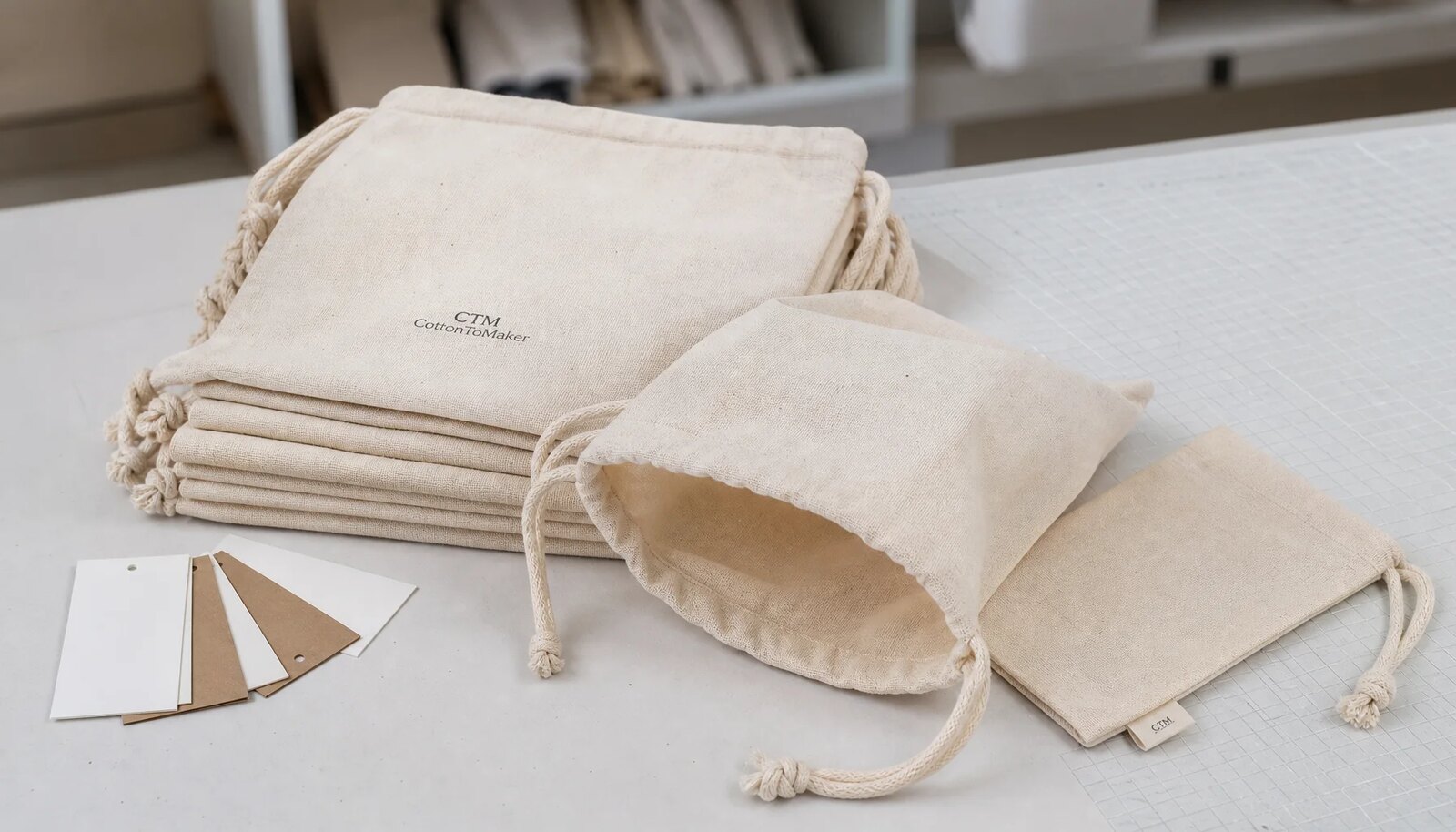
Start With the Market Use Case
A cotton drawstring pouch on a farmers market table has a job to do. Sometimes it is simple product packaging. Sometimes it is gift wrap, refill packaging, an inner pouch for a boxed set, or a branded item the customer will keep using after the purchase. Those roles may look similar in a catalog photo, but they do not source the same way. A pouch for seed packets can be light and flat. A pouch for soap needs better opacity and cleaner lint control. A pouch for spice jars or candle tins needs stronger seams, a wider opening, and a cord that closes without wrestling the fabric.
Before asking for a unit price, write down what the pouch must survive. Will customers open it repeatedly? Will the pouch sit outside during humid mornings? Will scented goods be packed inside for several days? Will the logo need to stay visible when pouches are stacked in a basket? These are procurement questions. They affect GSM, drawcord material, stitch quality, printing method, packing format, and inspection criteria.
Good suppliers can work from a clear use case. They cannot do much with only a photo and a target price. If the pouch must hold a wrapped soap bar, send the bar size and wrapper thickness. If it holds jars, send the combined weight and widest point. If seasonal staff will fill hundreds of pouches before a weekend market, make opening width and closure speed part of the spec. A flat sample can look fine and still fail once it is filled, closed, carried, displayed, and reopened.
- Define the pouch role: retail packaging, gift set, refill pack, inner protection, checkout add-on, event giveaway, or reusable customer pouch.
- List product dimensions, fill weight, sharp corners, oils, scent, dust, moisture exposure, and direct-contact or secondary-packaging status.
- Describe the selling environment, such as outdoor tables, humid mornings, stacked baskets, open bins, co-packer handling, or customer reuse.
- Separate must-pass requirements from preferences so the supplier knows where cost can be adjusted without weakening the pouch.
- Ask suppliers to quote against the use case, not only against a catalog size or product photo.
Translate Fit Into Finished Size
Size problems usually start with measurement language. A supplier may quote the cut fabric size. A buyer may expect the finished size. A packer may care only about usable space below the drawstring. Cotton pouches lose area through side seams, bottom seams, top folding, the drawstring channel, pressing, and sometimes washing. For wholesale buying, the purchase order should state finished width x finished height after sewing and pressing. It should also say whether total height includes the drawstring channel.
Usable height is especially important for farmers market products that must sit below the cord line. A pouch can technically hold the item but still pinch the product, hide the label, or leave the top unable to close cleanly. Opening width matters too. If staff have to force jars, wrapped soaps, or folded inserts into the pouch, the true cost shows up as slower packing and damaged presentation. Test the sample using the real product and the real workflow: insert, settle, close, reopen, and place it in the display container.
Tolerance should be realistic, written, and tied to function. Small pouches often need tighter control because a few millimeters can affect fit and logo balance. Larger pouches may allow more variation if the closure still works and the display remains neat. A common target for small and medium fabric pouches may be around +/- 5 mm, but the right number depends on product fit and factory capability. If the pouch must fit inside a gift box, display tray, or shipping insert, confirm tolerance before approving the sample.
- Specify finished width x finished total height after sewing and pressing, not cut size.
- Define usable height below the drawstring channel when contents must sit fully under the cord line.
- Set tolerance for width, height, channel depth, drawcord length, print placement, and label placement.
- Check fit with the real product, wrapper, insert card, and full set weight before bulk approval.
- Record the measurement method in the PO so the buyer, factory, and inspector measure from the same points.
Choose GSM, Weave, and Shade
Fabric weight changes more than unit cost. It affects opacity, handfeel, sewing stability, carton volume, and how the pouch hangs on a table display. Lightweight cotton around 110 to 130 GSM can work for seed packets, jewelry, dried herbs, sachets, small samples, and low-stress promotional use. It folds compactly and may keep costs down, but it can look transparent, wrinkle easily, or feel too limp for a retail gift set.
For many reusable farmers market pouches, 140 to 180 GSM is a safer starting range. It usually gives better handfeel, stronger table presentation, and more opacity without making the pouch bulky. Still, GSM alone is not enough. Two fabrics marked 150 GSM can feel different because of yarn count, weave density, finishing, washing, and cotton source. Ask whether the fabric is plain weave, muslin, canvas, twill, washed cotton, natural unbleached cotton, bleached cotton, dyed cotton, or another construction.
Natural cotton variation can be attractive, but it needs limits. Slubs and seed flecks may fit handmade soaps, herbs, preserves, and farm-branded products. Stains, oil marks, mildew odor, severe panel mismatch, and heavy dark contamination should not be waved through as natural character. Approve fabric physically with a sealed sample or swatch. If the pouch may be washed, steamed, stored with scented goods, or exposed to moisture, ask about shrinkage and odor behavior before mass production.
- Use 110-130 GSM for lightweight sachets, jewelry, seed packets, small inserts, and low-fill-weight goods.
- Use 140-180 GSM for most retail market pouches, reusable packaging, soap, jars, gift sets, and display baskets.
- Ask for GSM tolerance, cotton finish, shade, weave, and whether the cloth is stock, washed, pre-shrunk, bleached, or dyed.
- Approve fabric with a sealed pouch sample or swatch, not only by supplier description.
- Define acceptable natural cotton variation and reject contamination, odor, severe shade jumps, or fabric substitution.
Specify Cord and Construction
The pouch body gets most of the attention, but closure details often decide whether the packaging feels reliable. The top channel must be wide enough for the cord to move smoothly. The side seams must hold under the expected fill weight. The bottom corners should not twist, pucker, or open after handling. Ask how the factory makes the channel: single fold, double fold, overlocked edge, or another method. A double-fold channel often looks cleaner and reduces fraying, while a narrow or rough channel can make closing the pouch feel cheap.
The drawcord is part of the spec. Cotton cord fits the natural look many farmers market vendors want, but weak end finishing can fray. Polyester cord can slide easily and resist abrasion, but it may not match a natural product story. Cord diameter should fit the pouch size and fabric weight. Too thin can look insubstantial. Too thick can bunch the channel and make small pouches hard to close. Define cord material, diameter, color, single or double draw, knot type, end finish, and exposed cord length when closed.
Test closure before mass production. Fill the sample, close it, reopen it, and repeat the action several times. Watch for tearing at the channel openings, shedding cord fibers, slipping knots, uneven top gathers, and stress on the side seams. For heavier sets, such as small jars or candle tins, agree on a simple pull test using expected fill weight plus a handling margin. The point is not to overbuild every pouch. The point is to make sure the weakest part is strong enough for the real product.
- Confirm single-draw or double-draw construction and whether both cords pull evenly.
- Specify cord material, diameter, color, knot style, end finish, and minimum cord length outside the channel.
- Inspect stitch density, seam allowance, channel width, corner strength, and thread trimming on the approval sample.
- Test opening and closing for at least five cycles on random samples during QC.
- For heavier contents, define a pull test and failure criteria before production starts.
Match Branding to the Artwork
The best branding method depends on artwork complexity, order volume, and how the pouch will be displayed. Screen printing is often the strongest wholesale option for simple logos, solid marks, and one to three colors. It works well for repeat programs because setup cost can be spread across units. The main risk is detail loss on cotton texture. Fine lines, tiny text, distressed effects, and heavy ink coverage should be tested at final print size, on the actual fabric, before bulk release.
Digital printing is useful when farmers market vendors need smaller batches, full-color graphics, or seasonal artwork versions. It offers flexibility, but the print still needs to survive folding, rubbing, outdoor handling, and the way customers open and close the pouch. A digital print that looks clean on a flat sample can behave differently when the pouch is filled or flexed. Ask for dry rub checks, wet rub checks if moisture is likely, and fold behavior on the approved cotton.
Sewn or woven labels can be a smart choice when the pouch should feel reusable and restrained. They work well for soaps, candles, herbs, preserves, and giftable goods where a large ink print may feel too loud. The label still needs a complete spec: size, material, fold type, thread color, placement, orientation, and sewing tolerance. Approve the label sewn onto the pouch, not loose on a table. A small placement shift can make the brand disappear in a basket or sit awkwardly near the drawstring.
- Use screen print for simple vector logos, solid graphics, repeat orders, and stronger unit economics at volume.
- Use digital print for color-rich or seasonal artwork, but test rub, fold, and moisture resistance on production fabric.
- Use sewn or woven labels for subtle reusable branding and lower ink coverage.
- Set placement tolerance from fixed points such as bottom edge, side seam, centerline, or top edge.
- Approve smallest text, line weight, and logo size on real cotton before releasing bulk production.
Break Down MOQ and Price
MOQ for cotton drawstring pouches is not always one clean number. It can be driven by fabric purchase minimums, dye lot size, cutting efficiency, cord sourcing, print setup, woven label MOQ, sewing setup, and packing labor. A supplier may quote 1,000 pieces, but that may mean one size, one fabric color, one logo, one label, and bulk packing. If the order becomes three sizes, two artwork versions, and individual bags, the real MOQ may move.
A lower unit price is only useful if the specification remains intact. Common cost-saving substitutions include lighter GSM, looser tolerance, cheaper cord, reduced stitch quality, smaller print size, bulk packing instead of inner packing, or a different stock fabric lot. Better negotiation starts with the cost drivers. If fabric MOQ is the issue, stock natural cotton may help. If print setup is expensive, reduce artwork versions. If packing labor is high, inner bags of 50 or 100 may be more practical than individual retail bags.
Ask for realistic quote tiers. For many vendors, 500, 1,000, 3,000, and 5,000 pieces are more useful than a dramatic volume level that will never be ordered. Request separate lines for blank pouch, branding, setup fees, sample fees, packing, cartons, and freight basis. This makes supplier comparison cleaner. A single all-in unit price can still be valid, but the buyer should know exactly what is included before it becomes the purchase order number.
- Ask MOQ by size, color, artwork version, label version, cord color, and packing method.
- Request tiered pricing at practical quantities and compare cost breaks against the sales forecast.
- List setup fees for screen print, digital artwork, woven labels, special cord, cutting dies, and packing work.
- Compare quotes using the same incoterm, GSM, finished size, branding method, packing format, and carton plan.
- Do not negotiate only on unit price unless the approved spec and tolerance remain unchanged in writing.
Read Quotes Like Production Specs
A wholesale quote should be specific enough that a production manager could make the pouch from it. It should include finished size, fabric GSM and finish, cotton shade, cord material and diameter, branding method, color count, print or label placement, packing method, carton information, sample route, production lead time, incoterm, payment terms, and quote validity. A photo plus a price is fine for early budgeting. It is too vague for controlled procurement.
Normalize every supplier quote before comparison. One supplier may quote EXW, another FOB, and another delivery to a forwarder. One may include screen setup while another lists it separately. One may pack 1,000 pieces per carton and another 500, changing freight volume and receiving work. One may quote stock natural cotton while another quotes custom dyed cotton. Put each quote into the same comparison sheet so differences become visible instead of confusing.
Landed cost needs carton data. Cotton pouches are light, but packing format, cord thickness, hang tags, labels, and individual bags can change volume. Ask for carton quantity, carton dimensions, gross weight, net weight, and CBM before booking freight or comparing suppliers. Also ask how long the quote is valid. If the buying decision is tied to a market season, the quote should connect to an approval calendar: artwork, sample, deposit, production, inspection, balance payment, shipment booking, and delivery.
- Require each quote to state what is included and excluded, including setup fees and packing materials.
- Confirm whether the price is for blank pouches, printed pouches, sewn-label pouches, or retail-packed sets.
- Check incoterm, local charges, carton dimensions, CBM, and expected shipping method before comparing landed cost.
- Attach the approved quote and final spec sheet to the PO so assumptions cannot shift after sample approval.
- Ask for quote validity and the approval milestones required to hold price and production slot.
Use Samples as Controls
A sample is not a decoration for the buyer's desk. It is a production control. Each sample should have a purpose. A blank fit sample checks size, capacity, stitching, cord movement, and product fit. A print sample checks artwork, placement, color, ink feel, and durability. A preproduction sample should use actual bulk fabric, cord, print method, label, and packing materials whenever possible. If substitute materials are used, mark the sample clearly and do not approve those attributes.
Sample testing should copy the real farmers market workflow. Fill the pouch with the actual product, close it, open it, stack it, place it in a basket, and check whether the logo remains visible. If the pouch is part of a gift set, pack the full set. If staff will fill hundreds before a weekend, test speed and ease. If the pouch will be mailed inside a carton, test the box fit. Many failures appear only when the sample stops being flat and starts acting like packaging.
Approval should leave a record. Keep one sealed sample with the buying team and ask the supplier to keep a matching reference sample. Record measurements, GSM, cord details, print placement, label placement, packing, and defect rules. Approve with comments, photos, and marked references rather than a short email that says approved. If a later shipment arrives with lighter fabric, crooked print, or a different cord, the sealed sample and approval sheet become the standard for resolving the issue.
- Request the right sample: blank size sample, printed sample, preproduction sample, or sealed approval sample.
- Measure the sample after pressing and after washing or steaming if the pouch will face those conditions.
- Test filled fit, closure function, display presentation, packing speed, and box or carton fit.
- Record approvals with photos, measurements, artwork marks, and written acceptance or rejection comments.
- Do not release bulk production until open sample issues are corrected or formally accepted as deviations.
Control Packing and Cartons
Packing affects cost, cleanliness, freight volume, and receiving efficiency. Bulk packing is usually the lowest-cost option and may be right when vendors fill pouches themselves. The tradeoff is more wrinkling, possible count confusion, and extra handling at the buyer's location. Inner bags by 50 or 100 pieces help keep counts organized. Individual polybags protect each pouch and can support retail presentation, but they add material cost, labor, carton volume, and unpacking waste.
Farmers market vendors often buy multiple pouch sizes or artwork versions in one purchase order. Carton sorting needs to be obvious. Ask for inner-bag labels, SKU labels, artwork version labels, carton marks, and carton numbering. A good production run can still become expensive if receiving teams must open every carton to separate sizes or labels. If the pouches ship to a co-packer, warehouse, shop, or event location, carton marks should match the PO and packing list exactly.
Pre-shipment packing checks are simple and useful. Ask for photos of inner packing, master carton labels, random carton contents, and carton count before balance payment or shipment release. If barcodes, hang tags, set packs, or retail labels are involved, inspect those details before cartons leave the factory. Receiving problems are harder to fix after shipment because the supplier no longer controls the goods and replacement timelines may miss the selling season.
- Decide bulk pack, inner polybag, individual polybag, set pack, hang tag, barcode sticker, or header card before final quote approval.
- Define inner-bag count, master carton count, carton number format, SKU label, size label, artwork version, and PO number marks.
- Request carton dimensions, gross weight, net weight, and CBM before shipment booking.
- Check pre-shipment photos of packing, carton labels, carton contents, and any retail labels or hang tags.
- Make packing requirements part of the PO and inspection checklist, not a casual instruction after production.
Build Lead Time Around Approvals
Lead time is more than sewing time. A realistic schedule includes RFQ clarification, artwork review, fabric confirmation, lab dip approval if dyed, sample making, sample shipping, buyer review, deposit, bulk material preparation, printing, sewing, trimming, inspection, packing, payment release, export booking, transit, and receiving. Stock natural cotton pouches can move faster than custom dyed or multi-label programs, but each custom detail adds an approval point.
Ask the supplier what starts the production clock. Some count from deposit. Others count from sample approval, artwork confirmation, fabric arrival, or packing confirmation. If the market launch date is fixed, build backward from the latest acceptable arrival date. Then reserve time for inspection and possible rework. A shipment that needs sorting or remake time can still be usable if that time was planned before the PO was placed.
Reorder planning belongs in the first sourcing conversation. If the first run sells quickly, can the supplier repeat the same fabric, cord, label, and print? Will the screen be stored? How long can the supplier hold the same cotton lot or match the approved shade range? Can a partial reorder be produced below normal MOQ? A vendor that depends on consistent packaging should treat reorder capability as part of supplier qualification, not as a later favor.
- Ask what starts sample lead time and bulk production lead time: deposit, artwork approval, sample approval, fabric arrival, or packing confirmation.
- Build deadlines for artwork, sample comments, lab dips, deposit, inspection, balance payment, and shipment booking into the PO timeline.
- Identify long-lead items such as dyed cotton, custom cord, woven labels, hang tags, barcode labels, or retailer-specific packing.
- Reserve time for inspection, sorting, rework, and receiving before the product is needed at market.
- Ask how reorders are matched and how long the supplier can repeat the approved fabric, cord, print, and label standard.
Specification comparison for buyers
| Spec decision | Procurement recommendation | Best fit for farmers market vendors | Risk to control before PO |
|---|---|---|---|
| Direct factory OEM | Use when size, GSM, cord, print, label, carton marks, and reorder consistency need to be controlled in one written spec | Established product lines, planned seasonal launches, private-label packaging, and repeat pouch programs | MOQ can apply by size, fabric color, artwork, label, and packing format; require a sealed sample and final spec sheet |
| Trading company or sourcing agent | Use when several packaging items must be coordinated under one supplier contact | Mixed packaging orders that include pouches, totes, hang tags, labels, tissue, cartons, or several lower-volume SKUs | A factory change can alter shade, GSM, seam quality, and cord feel; ask who makes the goods and how reorders are matched |
| Stock wholesale pouch with added label | Use when the buying window is short and customization can stay minimal | Pop-ups, market trials, small batches, short replenishment windows, and early assortment testing | Stock fabric, cord, shade, and dimensions may change by lot; confirm the actual lot before labels are applied |
| Factory using stock natural cotton | Use when custom printing is needed but supplier-standard fabric is acceptable | Most mid-volume pouch programs where small natural shade variation is acceptable | Mill lots can vary; define GSM tolerance, shade range, opacity, handfeel, and reorder matching rules |
| Custom dyed cotton fabric | Use only when pouch color is part of the brand standard or matched retail set | Gift sets, premium launches, coordinated collections, and brand-critical color programs | Higher MOQ, lab dip approval, bulk shade variation, and longer lead time; set an approved shade range or Delta E target if color is critical |
| 110-130 GSM cotton | Specify for lightweight packaging with low stress on seams and closure | Seed packets, jewelry, dried herbs, sachets, samples, inserts, and small low-fill-weight products | May be semi-transparent or limp; test opacity, print show-through, seam strength, and closure with the real product inside |
| 140-180 GSM cotton | Use as the default retail-safe range for many reusable market pouches | Soap, spice jars, small gift bundles, refill packs, candles, display baskets, and customer reuse | Higher unit cost and carton volume than light cotton; confirm finished size after pressing and shrinkage if washing is expected |
| Screen print | Use for simple vector logos, solid marks, and one to three colors | Repeat orders where setup cost spreads across volume and consistent logo placement matters | Fine lines can fill on cotton texture; define Pantone target, print size, placement tolerance, curing, and rub test expectations |
| Digital print | Use for short runs, seasonal artwork, or full-color graphics | Small batches with multiple artwork versions or color-rich designs | Unit cost and durability can vary; test dry rub, wet rub if relevant, fold cracking, and color shift on the actual fabric |
Buyer checklist before sampling
- State finished pouch size as width x height after sewing and pressing. Clarify whether height includes the drawstring channel, and set a written dimensional tolerance such as +/- 5 mm for tight small pouches.
- List intended contents, approximate fill weight, sharp edges, oils, scent, dust, moisture sensitivity, and whether the pouch touches the product directly or works as secondary packaging.
- Specify fabric weight in GSM or oz/yd2, weave if required, cotton finish, natural or bleached shade, dyed color standard, pre-shrink requirement, and acceptable shade variation.
- Ask for fabric weight tolerance, not only nominal GSM. For example, request quoted 150 GSM cotton with an agreed production range and verify by swatch comparison or lab result when order value justifies it.
- Define opacity and handfeel with a sealed reference sample. Natural slubs and seed flecks may be acceptable, but stains, oil marks, mildew odor, and severe panel mismatch should be defects.
- Specify drawstring details: cotton or polyester cord, diameter, cord color, single or double draw, channel style, knot style, end finish, and minimum exposed cord length when closed.
- Provide vector artwork, final print size, placement from fixed edges, color count, Pantone or ink target, side count, label placement, and artwork tolerance before asking for final pricing.
- Split order quantity by size, fabric color, artwork version, label version, and packing format so MOQ and price are calculated against the variables that drive production.
- Ask for quote tiers at realistic volumes, such as 500, 1,000, 3,000, and 5,000 pieces, and require setup fees, sample fees, packing fees, and carton cost to be listed separately.
- Define the sample route before production: blank fit sample, printed sample, preproduction sample, sealed approval sample, sample lead time, courier cost, approval deadline, and who keeps the reference sample.
Factory quote questions to send
- What exact finished pouch size are you quoting, and is the height measured to the top edge or only to the usable space below the drawstring channel?
- What dimensional tolerance is included for width, height, channel depth, drawcord length, print placement, and label placement?
- What fabric GSM, GSM tolerance, weave, cotton finish, and shade are included in the quoted price? Is the fabric natural, bleached, dyed, washed, pre-shrunk, or untreated?
- Is the price based on current stock fabric, newly purchased fabric, or custom dyed fabric? If stock fabric is used, how will reorder matching be controlled?
- Can you provide a swatch or sample from the actual production fabric lot before bulk cutting, and will both buyer and factory keep a sealed reference sample?
- What shrinkage range should we expect after washing, steaming, or pressing, and is that range based on your internal test or general experience?
- What cord material, cord diameter, cord color, draw construction, knot style, end finish, and exposed cord length are included? Is there a surcharge or MOQ for custom cord color?
- Which branding method is quoted, how many colors and placements are included, what setup charges apply, and what is the print or label placement tolerance?
- For screen print, what process is suitable for our smallest line width and text height? For digital print, what rub, fold, or moisture resistance can you test?
- Can you confirm MOQ by size, fabric color, artwork version, label version, and packing method instead of only giving a total order MOQ?
Quality-control points to confirm
- Measure finished width, total height, usable height below channel, channel depth, bottom seam allowance, side seam allowance, and drawcord length after pressing. Use the same measurement points on every inspection sample.
- Verify fabric GSM against the approved spec using an agreed method. If lab testing is not practical, compare cut swatches, opacity, handfeel, weave density, and drape against the sealed approval sample.
- Check fabric condition carton by carton for stains, oil marks, dark contamination, mildew smell, excessive lint, holes, heavy slubs outside the approved range, and obvious panel shade mismatch.
- Inspect side seams, bottom seams, top hem, and drawstring channel for skipped stitches, broken thread, loose thread ends, puckering, twisted panels, needle damage, and uneven seam allowance.
- Test closure function by opening and closing random samples at least five cycles. The cord should slide smoothly, close evenly, and not tear or distort the top channel.
- Pull-test cord, knots, and channel openings with the expected fill weight plus a handling margin agreed in the PO. For lightweight pouches this can be a simple functional test; for heavier sets, record the test weight.
- Check print or label placement from fixed reference points such as bottom edge, side seam, top edge, and centerline. Confirm placement tolerance before production, commonly within a few millimeters for small pouches.
- Review print quality for registration, ink coverage, edge sharpness, pinholes, crocking, curing, color target, readability of small text, and cracking when folded or flexed.
- If the pouch will be washed, steamed, refrigerated near moisture, or handled outdoors, test shrinkage, dry rub, wet rub if relevant, odor, colorfastness, and print behavior before mass release.
- Verify packing count accuracy in inner bags and master cartons. Check barcode, SKU, size, artwork version, set count, carton number, PO number, and carton marks against the packing list.