Why This Checklist Matters
Cotton drawstring pouches look simple, which is exactly why wholesale orders can drift. A supplier may quote a thin unbleached pouch with basic stitching, while another prices a heavier fabric, cleaner sewing, and a more controlled print. Both quotes may say cotton drawstring pouch. They are not the same item.
For eco apparel brands, the pouch is also part of the packaging message. It can support a reduced-plastic direction and improve unboxing, but it is not automatically organic, recycled, compostable, or chemical-free. Those words need documents, and the documents need to match the specific order.
A strong buying checklist turns the pouch into a repeatable textile spec. It gives procurement, design, compliance, warehouse, and the factory the same reference point. That makes prices easier to compare, samples easier to approve, and bulk defects easier to manage.
- Treat the pouch as a controlled packaging component, not a generic giveaway bag.
- Compare suppliers only after fabric, size, cord, print, packing, and documents are aligned.
- Use the first order to build a reorder standard with a spec sheet and golden sample.
- Keep sustainability language tied to evidence that applies to the actual production lot.
Start With Product Fit
Begin with the item going inside the pouch. A spare-button pouch can be light and soft. A pouch for socks, underwear, activewear, cosmetics, jewelry boxes, or sample kits needs more structure and better closure behavior. Record the packed dimensions, loaded weight, and whether the product has sharp corners or a rigid box.
The commercial role changes the tolerance. A pouch hidden inside an e-commerce parcel can be simpler. A retail-facing pouch needs better shape, cleaner stitching, and consistent logo placement. A reusable accessory should survive repeated opening, closing, and handling without loose seams or slipping cords.
If the pouch is replacing a polybag, test the packaging system honestly. Cotton is breathable and attractive, but it is not a moisture barrier. Apparel may still need dust protection, clean cartons, controlled warehouse handling, and a plan for humid shipping routes.
- Record the actual contents, maximum packed dimensions, and loaded weight.
- State whether the pouch must look good flat, filled, on shelf, or during unboxing.
- Ask for a filled sample photo or video when the factory cannot test with your product.
- Leave enough headroom for the cord channel to close without crushing the contents.
Fabric GSM, Weave, and Finish
GSM drives cost, opacity, hand-feel, and carton volume. For light apparel inserts, 120-140 GSM is often a practical starting range. For firmer retail presentation or a reusable pouch, 160-180 GSM is usually safer. Higher GSM is not automatically better; it can make the top stiff and the drawcord harder to close around small items.
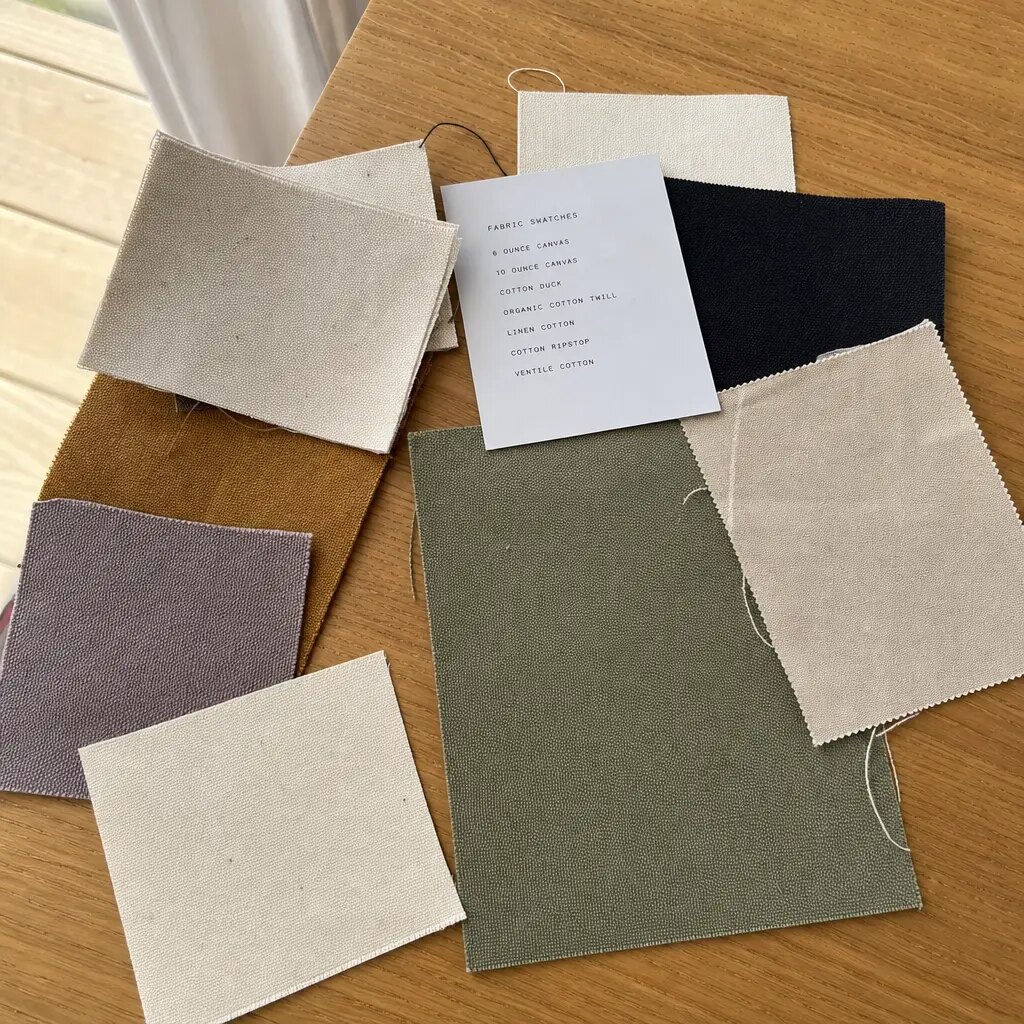
Weave and finish matter as much as weight. A tight 140 GSM fabric may print more cleanly than a loose 160 GSM fabric. Unbleached cotton gives a natural look, but seed specks and shade variation should be expected within an approved range. Bleached cotton gives a cleaner logo base. Dyed cotton needs clearer shade control.
Write fabric requirements in buying language, not mood-board language. Use composition, GSM, weave, finish, shade reference, and tolerance. A common commercial GSM tolerance is around +/-5%, but brands with stricter packaging standards should state their own requirement and confirm the supplier can meet it.
- Choose 120-140 GSM for light inserts and 160-180 GSM for more structured pouches.
- Approve a physical swatch for shade, weave density, opacity, hand-feel, and surface hairiness.
- State whether the fabric is unbleached, bleached, dyed, washed, or pre-shrunk.
- Ask how GSM and shrinkage will be tested, especially if consumers may wash or steam the pouch.
Sustainability Documents Buyers Should Request
Eco claims need careful wording. A cotton pouch may help reduce plastic packaging, but it should not be called organic, recycled, compostable, biodegradable, non-toxic, or chemical-free unless that exact claim is supported. Procurement should collect the documents before the claim appears on a product page, retailer form, hangtag, or packaging insert.
For organic cotton, request GOTS or OCS documentation where relevant. A scope certificate shows that a facility is certified for certain processes, while a transaction certificate or product-level document may be needed to support a specific shipment. For recycled cotton, ask about GRS or RCS certification, recycled-content percentage, blend composition, and whether chain of custody covers the finished pouch or only the yarn or fabric.
Restricted-substance compliance can be just as important as fiber origin. Ask for OEKO-TEX Standard 100 where appropriate, or send your brand RSL for review before sampling. If selling into regulated markets, check whether your team needs REACH, CPSIA, California Prop 65, or retailer-specific chemical declarations. Dyes, inks, labels, cords, and finishes should be included in the review, not only the base fabric.
Packing claims also need discipline. If individual polybags are removed, specify the replacement protection. Paper bands, carton liners, inner cartons, sealed master cartons, and clean handling instructions can reduce stains and dust without leaving the factory to improvise.
- Request certificate copies early, then check scope, validity dates, product categories, and certified entity names.
- For organic claims, clarify whether GOTS or OCS documentation supports the specific order.
- For recycled claims, clarify recycled percentage, blend content, and GRS or RCS chain-of-custody coverage.
- For chemical safety, review OEKO-TEX Standard 100, brand RSL, REACH, Prop 65, CPSIA, or retailer forms as market needs require.
Size, Closure, Cord, and Sewing
Finished size means width by height after sewing, not cutting size. Side seams, bottom construction, shrinkage, and the cord channel all reduce usable space. If the product must close fully, measure the pouch while filled, not only flat on a table.
For small pouches, a tolerance around +/-5 mm may be workable. For larger pouches, a percentage tolerance can be more realistic. The tighter the fit, the more important it is to test a pre-production sample with the real product or an equivalent block and weight.
Cord choice affects both look and function. Cotton cord supports a natural presentation, but it may create more friction and fray more than polyester or cotton-poly cord. Many retail pouches use 3-5 mm cord, but the right diameter depends on pouch size, fabric weight, and channel height. The cord should pull evenly and close without jamming.
Sewing should be recorded in the spec. Confirm whether the pouch is one folded panel with side seams or two cut panels with a bottom seam. Note seam allowance, stitch density, channel construction, reinforcement at exits, and loose-thread trimming. Channel exits and bottom corners deserve extra attention because they fail first in repeated use.
- Specify finished width, finished height, channel height, usable opening, and finished cord length.
- Test the pouch filled and closed, then opened and closed several times.
- Define cord material, diameter, color, knotting, tipping, or other end finish.
- Record seam type, stitches per inch or centimeter, seam allowance, and reinforcement points.
Branding Method and Artwork Control
Screen printing is usually efficient for simple one- to three-color logos and repeat wholesale runs. It can provide good opacity on cotton when ink and curing are controlled. The cost risk is setup: screens, color separations, and minimums can add up when a brand has many seasonal graphics.
Digital printing and heat transfers can suit gradients, fine detail, or shorter runs. They may reduce setup complexity, but they can affect hand-feel, edge quality, and durability. Transfers also need heat control; poor application can leave scorch marks or visible borders.
Color should be approved on the actual fabric. Unbleached cotton has a warm base, so brand colors may print duller or darker than they appear on a digital proof. Provide Pantone or brand references, but expect the final approval to happen through a physical strike-off.
A woven label, printed side label, or small tag can fit a quieter eco packaging style. Labels still need detailed control: size, fold type, placement, text direction, stitch quality, and whether the label material has its own certification or RSL requirement.
- Use screen print for stable simple logos and larger repeat quantities.
- Use digital or transfer print when artwork complexity matters more than lowest setup cost.
- Approve strike-offs on the selected fabric, not only PDF mockups.
- Set logo size, placement tolerance, color reference, print side, and durability checks.
RFQ Details That Make Quotes Comparable
A useful RFQ removes hidden assumptions. Send every supplier the same spec sheet: fabric composition, GSM, finish, finished size, cord, sewing, artwork, print method, packing, target quantity, certification needs, and inspection standard. Then ask each supplier to restate what they are quoting.
MOQ should be broken down by size, color, artwork, print side, packing format, and certification requirement. A total MOQ of 5,000 pieces is different from 5,000 pieces per artwork. A certified organic or recycled order may also carry different minimums than a conventional cotton order.
Separate the costs that sit outside the unit price. Screen charges, transfer setup, label development, sample fees, testing fees, certification documents, special cartons, and inland freight can change the real landed cost. Delivery terms matter too; EXW, FOB, and delivered quotes cannot be compared without freight and duty assumptions.
- Request price breaks that match your forecast, such as 1,000, 3,000, 5,000, and 10,000 pieces where relevant.
- Ask for unit price, setup charges, sample fees, document fees, packing cost, and delivery terms as separate lines.
- Require MOQ by SKU, artwork, color, and packing method.
- Have the supplier restate the specification in the quotation to expose mismatches early.
Sample Approval Sequence
Sample approval should match order risk. Start with a fabric swatch when color, hand-feel, GSM, or certification matters. Use a print strike-off when logo color, opacity, edge sharpness, or curing is important. Approve a complete pre-production sample before bulk cutting when size, closure, sewing, label, and packing all need control.
Handle the sample the way a customer will. Fill it, close it, open it repeatedly, check whether the logo remains visible, and look at the channel after the cord is pulled. A pouch can be beautiful when flat and still fail the product fit test.
Once approved, create a golden sample set. Keep one sealed sample for dispute resolution and one working sample for factory reference. Label both with buyer name, PO or style number, revision date, fabric GSM, finished size, print method, and approval date.
Any substitution should trigger review. A new fabric lot, cord supplier, ink system, label source, or packing method can change the finished pouch. The PO should require notice before substitutions enter bulk production.
- Approve fabric swatch, print strike-off, and pre-production sample when risk warrants it.
- Check the sample flat, filled, closed, opened, and handled.
- Keep sealed and working golden samples with revision details.
- Treat material, cord, ink, label, or packing substitutions as approval events.
Quality Control Before Shipment
Final inspection is easier when the standard is agreed before production. For cotton drawstring pouches, key checkpoints include incoming fabric, cutting, printing, sewing, trimming, packing, and carton verification. The factory should be able to show how each checkpoint is controlled.
Use defect categories. Critical defects may include wrong material, wrong artwork, contamination that makes the pouch unusable, severe odor, or mold. Major defects may include open seams, missing cords, wrong finished size beyond tolerance, obvious print misalignment, stains, mixed SKUs, and incorrect carton counts. Minor defects may include small loose threads, light wrinkles, or shade variation within the approved range.
An AQL plan gives both sides a common inspection language. Many soft goods buyers use zero tolerance for critical defects and AQL limits such as 2.5 for major and 4.0 for minor defects, but the right level depends on order value, customer expectations, retailer requirements, and risk. Agree on the plan before cutting starts.
Measurement should be practical and repeatable. Define how many pieces are measured, where the pouch is laid, whether it is smoothed by hand, and which points are used for width, height, channel height, cord length, and logo placement.
- Define critical, major, and minor defects in the PO or quality appendix.
- Check fabric, finished size, print, sewing, cord function, cleanliness, SKU separation, and carton counts.
- Ask for inspection photos, measurement records, and defect summaries, not only pass/fail language.
- Agree AQL level, sample size, and acceptance limits before bulk production.
Packing and Receiving Control
Packing is part of the purchase, not an afterthought. Cotton pouches are usually shipped flat, but inner counts and carton counts should be fixed before production. Common structures include 50 or 100 pieces per bundle, then a master carton count based on pouch size, carton strength, and warehouse handling.
Carton marks should match the PO and packing list. At minimum, include PO number, SKU or item code, pouch size, fabric color, artwork reference, quantity, carton number, and lot reference if used. If your warehouse scans barcodes or requires pallet labels, add those requirements to the RFQ.
Avoid mixed cartons unless receiving has approved them. Mixed cartons can create counting errors, kitting delays, and inventory confusion. If mixed cartons are unavoidable, the outer mark and packing list should show the exact breakdown.
Eco packing needs a real protection plan. If individual polybags are not allowed, use paper bands, carton liners, inner cartons, or other agreed methods. Loose pouches in rough cartons can arrive dusty, creased, or stained, which creates waste even when the material choice was well intentioned.
- Set units per bundle, bundles per carton, carton dimensions, and gross weight target.
- Mark cartons by PO, SKU, size, color, artwork, quantity, carton number, and lot reference.
- Avoid mixed cartons unless the packing list and warehouse process support them.
- Replace restricted polybags with defined dust and moisture protection, not open-ended factory choice.
Specification comparison for buyers
| Buying decision | Practical recommendation | Best fit | Risk to control |
|---|---|---|---|
| Fabric GSM | 120-140 GSM for light apparel inserts; 160-180 GSM for firmer retail pouches or reusable packaging; write the tolerance into the PO, often +/-5% unless your standard is tighter | Socks, underwear, tees, jewelry, cosmetics, gift-with-purchase, sample kits | Thin fabric can look translucent and weak. Heavy fabric raises cost, carton volume, and closure stiffness. Confirm whether GSM is tested before or after finishing. |
| Cotton claim | Use plain cotton for a natural pouch; use organic or recycled cotton only when the order can be supported by relevant chain-of-custody or material documents | Eco apparel brands with public sustainability claims, retailer compliance forms, or product-page wording | A supplier certificate does not always prove the shipped lot. Check scope certificate, transaction certificate, recycled-content document, and whether the claim covers fabric, finished pouch, or facility only. |
| Fabric finish | State unbleached, bleached, dyed, washed, pre-shrunk, or other finish; approve a swatch for shade, seed specks, hand-feel, and print base | Natural-brand packaging, bright-logo programs, dyed seasonal packaging | Unbleached cotton varies by lot. Bleached and dyed goods need shade control. Pre-shrunk language should be backed by shrinkage test data, not assumed. |
| Finished size | Specify finished width x height after sewing, plus channel height and usable opening; use +/-5 mm for small pouches or a written percentage tolerance for larger sizes | Orders where fit, retail presentation, or closure performance matters | Cutting size is not finished size. Seam allowance, bottom construction, fabric shrinkage, and the cord channel reduce usable space. |
| Cord and channel | Cotton cord 3-5 mm for a natural look; cotton-poly or polyester cord where smoother sliding or abrasion resistance is more important; match channel height to cord diameter | Reusable pouches, apparel bundles, retail gift packs | Too-thin cord feels cheap and can cut into the channel. Too-thick cord can jam. Test filled closure, not only flat appearance. |
| Sewing construction | Lockstitch or overlock construction with clean top-channel stitching; record seam allowance, stitch density, and reinforcement at channel exits where needed | Pouches used for heavier contents or repeated customer handling | Open seams, skipped stitches, weak channel exits, and loose thread trimming create the most visible quality failures. |
| Branding method | Screen print for simple repeat logos; digital or transfer print for gradients and fine detail; woven or printed label for subtle branding | Eco apparel brands balancing logo clarity, MOQ, hand-feel, durability, and natural presentation | Cotton texture affects edge sharpness and color. Approve strike-offs on the actual fabric and define placement tolerance. |
| MOQ and quote basis | Quote by finished size, fabric color, cord color, artwork, print side, packing method, and certification requirement; request price breaks that match forecast | First wholesale order, annual replenishment, multi-SKU packaging programs | A low unit price can hide setup charges, screen fees, testing, document fees, or per-artwork MOQs. |
| Packing format | Flat-packed in fixed inner counts, such as 50 or 100 pieces, then master cartons marked by PO, SKU, quantity, lot, and carton number | Distribution centers, e-commerce kitting, retail receiving | Loose mixed cartons cause miscounts, creasing, contamination, and receiving delays. If polybags are restricted, define paper bands, carton liners, or inner cartons. |
Buyer checklist before sampling
- Define the pouch role: apparel insert, reusable accessory, retail gift pouch, sample kit, event giveaway, or plastic-reduced packaging replacement.
- Measure the packed product, not only the folded garment. Record maximum dimensions, loaded weight, and whether the pouch must close fully without strain.
- Choose fabric composition and claim level: conventional cotton, organic cotton, recycled cotton blend, or another documented material.
- State fabric GSM, weave, finish, shade target, GSM tolerance, and whether shrinkage testing is required.
- Specify finished width, finished height, channel height, seam allowance target, usable opening, and measurement tolerance after sewing.
- Define cord material, diameter, color, finished length, knotting or tip finish, and pull performance after repeated opening and closing.
- Record seam type, stitch density, reinforcement points, loose-thread standard, and whether the pouch is one folded panel or two cut panels.
- Send print-ready artwork with logo size, side count, placement, Pantone or brand color reference, and acceptable placement tolerance.
- Identify the quoted branding method and all related charges: screens, transfers, digital setup, label development, sampling, and reprint costs.
- Set MOQ by size, color, artwork, print side, packing format, and certificate requirement so suppliers quote the same order structure.
Factory quote questions to send
- What exact fabric composition, GSM, weave, and finish are included in this price?
- Is the cotton unbleached, bleached, dyed, washed, pre-shrunk, or finished after weaving? What shade and shrinkage tolerances can you hold?
- Which documents can you provide for this order: fabric specification, GSM test, composition test, OEKO-TEX Standard 100, GOTS scope or transaction certificate, GRS or RCS certificate, or supplier declaration?
- Do your certificates cover the facility, raw fabric, finished pouch, or the specific production lot we are buying?
- Are quoted dimensions finished dimensions after sewing? What tolerance applies to width, height, channel height, and cord length?
- Is the pouch made from one folded panel or two cut panels? What seam allowance, seam type, and stitch density are used?
- What cord material, diameter, color, and end finish are included? Can you test closure with our packed product weight?
- Which print or label method is included in the unit price, and what setup fees apply?
- What maximum print area and placement tolerance can you hold on this pouch size?
- What print checks can you run: dry rub, wet rub, tape adhesion, wash simulation, colorfastness, visual cure check, or inspection under agreed lighting?
Quality-control points to confirm
- Fabric composition, GSM, weave, shade, and hand-feel match the approved swatch and golden sample. GSM variation stays within the written tolerance.
- Finished dimensions are measured after sewing and before packing. Width, height, channel height, usable opening, and cord length meet the approved standard.
- Fabric is clean and commercially acceptable: no oil stains, dirt, mildew odor, severe slubs outside the approved natural character, or foreign fibers that affect presentation.
- Shrinkage risk is controlled when relevant. If the pouch may be washed, steamed, or handled in a damp environment, sample testing confirms size and print change before bulk release.
- The drawcord pulls smoothly from both sides, closes the mouth evenly, and does not jam in the channel when the pouch is filled.
- Cord ends are secure. Knots do not slip under normal hand pull, cut ends are not excessively frayed, and left-right cord length variation is within the agreed standard.
- Stitching is consistent with no open seams, skipped stitches, broken threads, needle cuts, or unraveling at channel exits, side seams, and bottom corners.
- Seam allowance and reinforcement match the approved construction sample. Stress points survive a practical fill-and-pull test using the intended product weight or agreed load.
- Logo artwork is correct in size, placement, orientation, and color. Print placement is measured from fixed reference points, not judged only by eye.
- Print quality is acceptable: no smearing, ghosting, severe pinholes, weak opacity, ink bleeding, edge feathering, misregistration, transfer scorch marks, or poor curing.