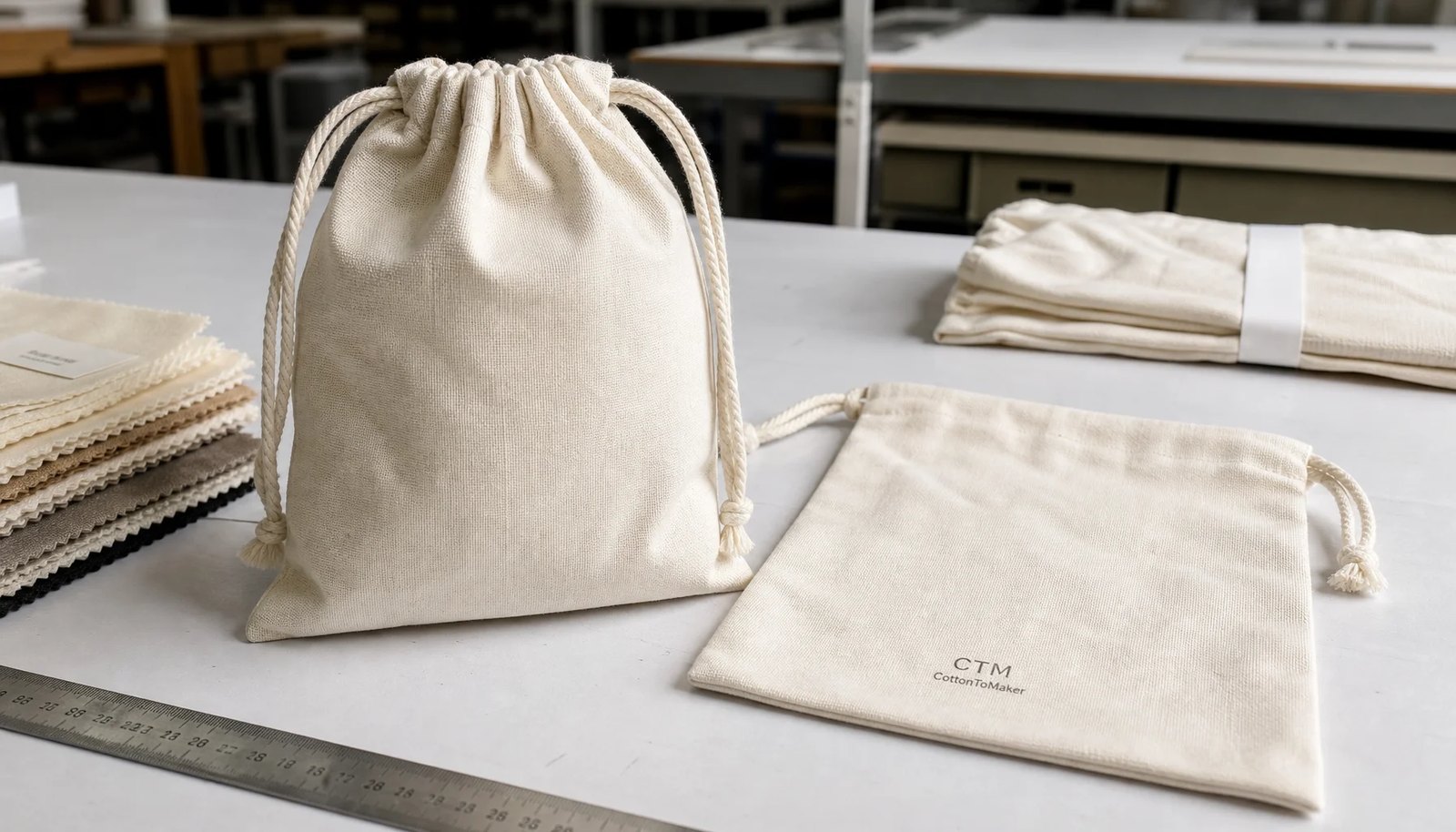
Start With the Bookstore Use Case
A university bookstore order for cotton drawstring pouches is rarely just a small fabric bag order. The same pouch may be used for graduation gifts, orientation kits, campus jewelry, stationery bundles, bookstore private-label items, or online fulfillment inserts. Each use changes the acceptable fabric weight, drawcord strength, print durability, packing method, and compliance paperwork.
The buying problem is that many RFQs describe only size, logo, and quantity. That creates quotes that look comparable on price but are not comparable in production risk. A light 100 gsm pouch with stock cord and bulk packing is not the same product as a 180 gsm retail pouch with a dyed cord, barcode sticker, side label, and pre-production sample approval. Before asking for price, define the sales channel and the handling environment.
- For event giveaways, prioritize schedule certainty, simple one-color printing, and efficient carton packing.
- For retail resale, prioritize fabric hand feel, print alignment, barcode handling, and consistent folding.
- For gift packaging, prioritize drawcord closure, fabric opacity, and a neat presentation after unpacking.
- For online fulfillment, prioritize SKU labeling, individual packing, and carton count accuracy.
Fabric GSM and Construction Choices
Cotton drawstring pouches are commonly quoted from about 100 gsm to 240 gsm, but the correct range depends on what the pouch must carry and how it will be displayed. A 100 to 120 gsm plain cotton pouch can work for low-cost packaging and lightweight giveaway items. A 140 to 160 gsm fabric gives better opacity and a cleaner print base for bookstore merchandise. A 180 to 220 gsm pouch feels more substantial, but it also increases fabric cost, sewing bulk, carton weight, and sometimes MOQ.
Natural cotton is popular because it looks familiar, accepts screen print well, and avoids dyed-fabric shade risk. However, natural cotton is not automatically uniform. Slubs, cotton seed flecks, yarn shade variation, and small dark fibers can appear. If the bookstore expects a clean retail appearance, approve a fabric standard instead of simply writing natural cotton. For dyed cotton, request a lab dip or fabric swatch approval and state whether shade tolerance follows a Pantone target or a physical approved swatch.
- 100-120 gsm: suitable for light packaging, but can look transparent with dark contents.
- 140-160 gsm: balanced choice for bookstore branded pouches and general retail handling.
- 180-220 gsm: stronger hand feel for premium merchandise, but higher unit cost and freight weight.
- Organic or recycled cotton: possible, but certification claim, label wording, and document availability must be quoted separately.
Size, Drawcord, and Sewing Details
Pouch size should be written as finished flat width by finished height, with the drawcord channel included in the height unless otherwise stated. Buyers often send only a target item size, such as a mug, notebook, or accessory bundle. The factory then estimates pouch dimensions, and the sample may close poorly or look oversized. For products with thickness, request a fit sample or provide the product dimensions and target closure height.
Drawcord design affects both function and compliance perception. Cotton cord gives a natural look and matches bookstore sustainability positioning. Polyester cord can be smoother and more color stable. Twill tape looks premium but may require a wider channel. The channel seam must allow smooth pulling without fraying at the openings. For small pouches, cord length and knot size matter because long dangling cords can look messy on retail shelves.
- State finished size tolerance and whether shrinkage after washing is relevant to the program.
- Confirm single drawcord or double drawcord closure; double cord usually closes better but adds labor.
- Specify cord material, color, diameter or width, end finish, knot style, and pull length.
- Require bar-tack or secure backstitching where the channel and side seam meet if the pouch will be handled repeatedly.
Print Method and Logo Approval
For university bookstores, the logo is often the most sensitive part of the order. Campus marks, bookstore names, department logos, and mascot art may have strict brand rules. Screen printing is usually the practical choice for one to three solid colors on cotton pouches. It gives good opacity and a durable result when the ink is cured correctly. The cost drivers are screen setup, number of colors, print size, ink coverage, and whether printing happens before or after sewing.
Heat transfer can be useful for full-color artwork, gradients, or small runs where screen setup is inefficient. The tradeoff is hand feel and edge behavior. Transfers may feel more like a patch on lightweight cotton and can show a border if the artwork is not prepared correctly. Embroidery is possible on heavier cotton, but small pouches may pucker and embroidery costs can exceed the value of the item. The RFQ should not say only custom logo; it should name the print method or ask the factory to quote alternatives with reasons.
- Provide vector artwork, Pantone references, print size, placement from pouch edges, and orientation.
- For screen print, approve ink opacity, edge sharpness, color match, curing, and print hand feel.
- For heat transfer, review adhesion, edge lift, flexibility, and whether the transfer changes pouch folding.
- For campus brand control, approve a print strike-off before bulk production fabric is cut.
MOQ Logic Behind Supplier Quotes
MOQ is not one fixed number for cotton drawstring pouches. It changes by fabric availability, size, color, printing method, cord color, packing, and whether the supplier can combine production with other orders. A stock natural cotton pouch may have a low MOQ because blank pouches are already made. A custom size in natural cotton has a higher MOQ because cutting and sewing must be arranged. A dyed cotton pouch has another MOQ layer because fabric dyeing and shade control require batch volume.
When comparing supplier quotes, separate the MOQ for the pouch body from the MOQ for customization. A factory may accept 500 pieces for printing on stock pouches but require 2,000 or 3,000 pieces for custom cut-and-sew. If the bookstore wants three campus department logos, the total quantity may meet sewing MOQ, but each print design may still carry separate screen and setup charges. This is why the quote sheet should show quantity breaks and setup charges clearly, not just one unit price.
- Stock blank pouch MOQ is driven by warehouse availability and print setup.
- Custom size MOQ is driven by cutting efficiency, sewing line setup, and fabric consumption.
- Dyed fabric MOQ is driven by dye lot size, shade control, and fabric mill rules.
- Multiple logos increase screen charges, sample work, packing separation, and inspection complexity.
Supplier Compliance Evidence That Matters
A supplier compliance checklist should focus on evidence that reduces production and import risk. For cotton drawstring pouches, useful evidence includes material declarations, country-of-origin marking plan, restricted substance policy, labeling capability, packing control, and production traceability. Buyers should not rely on a general sales statement that the product is compliant. The supplier must understand the destination market, sales channel, and whether the bookstore will make sustainability claims.
Certifications should be handled carefully. If a supplier quotes organic cotton, recycled cotton, or audited production, the quote should state what documents are included and whether the claim can appear on the product label or only in internal records. Do not allow a sustainability claim to be added by assumption. If the bookstore cannot support the claim with documents, keep the retail language simple, such as cotton pouch, natural cotton pouch, or reusable cotton pouch, depending on the approved compliance position.
- Request fiber content and country-of-origin label plan before approving retail packing.
- Clarify whether any organic, recycled, or responsible sourcing claim is documented for this exact order.
- Confirm the supplier can provide production photos, inspection records, and packing list details by SKU.
- Require written approval before any subcontracted printing or sewing workshop is changed.
Sampling Workflow and Approval Gates
A good sample process prevents most production arguments. The first sample may be a blank size sample to verify dimensions, fabric hand feel, cord pull, and item fit. The second stage may be a print strike-off to approve logo color and print technique. The pre-production sample should combine the approved fabric, size, cord, print, label, and packing method. Production should not start until this final sample is approved in writing.
The sample should be judged against measurable acceptance criteria, not only appearance. Measure width and height at multiple points. Pull the cord repeatedly to see whether the channel distorts. Rub the print with a dry white cloth to catch weak curing or surface dust. Place the intended bookstore item inside the pouch and close it. Pack the sample as intended for shipment to see whether creasing, sticker placement, or folding affects the retail presentation.
- Approve fabric swatch or blank sample before print color is judged.
- Approve print strike-off under consistent lighting, preferably against a physical Pantone or brand standard.
- Approve packed sample if the order includes barcode stickers, individual bags, or retail display folding.
- Keep one signed or photographed approved sample at the factory and one with the buyer for inspection reference.
Packing, Cartons, and Bookstore Receiving
Packing is a cost and compliance item, not an afterthought. Bulk packed pouches may be acceptable for event teams or internal kit assembly. Retail buyers usually need cleaner folding, SKU separation, barcode labels, and carton markings that match the purchase order. If pouches arrive mixed by logo, size, or color, the receiving team loses time and inventory accuracy suffers. The RFQ should state packing before final price comparison.
Carton planning also affects landed cost. Cotton pouches are soft but not weightless. Heavier GSM, individual polybags, inserts, hangtags, and barcode labels increase carton volume and labor. Overpacked cartons may crush product presentation, while underfilled cartons waste freight space. For importers and distributors, carton dimensions and gross weight are needed early to estimate freight, warehouse intake, and palletization. A supplier quote without packing data is incomplete.
- Define units per inner pack and units per export carton.
- State whether individual polybag, paper band, hangtag, barcode sticker, or no retail packaging is required.
- Require carton marks with PO number, SKU, color, size, quantity, gross weight, net weight, and carton count.
- For assorted campus logos, require separate inner packs and a packing list that matches the SKU structure.
Lead Time and Schedule Risk
Lead time starts after the correct trigger, not after the first email. A realistic supplier schedule separates artwork confirmation, sample making, sample transit, sample approval, material purchasing, cutting, printing, sewing, trimming, inspection, packing, and export handover. For stock pouches with a simple logo, the schedule is shorter because fabric and sewing are already complete. For custom size, dyed cotton, special cord, or retail packing, schedule risk increases.
University bookstore calendars can be unforgiving because orientation, homecoming, graduation, and semester start dates do not move. The buyer should build approval time into the project instead of pressuring production after artwork delays. If the campus brand office needs several days to approve logo proofs, that time belongs in the schedule. The cleanest approach is to set a purchase order date, sample approval deadline, production completion date, inspection window, and shipping cutoff.
- Stock pouch plus one-color print is usually the lowest schedule risk route.
- Custom dyed fabric adds lab dip approval, dyeing time, and possible shade correction.
- Multiple logo versions add proofing, screen setup, packing separation, and final count checks.
- Retail packing adds barcode proofing and carton label approval before shipment.
Quote Data for Landed-Cost Comparison
A low unit price can be misleading if the quote excludes setup, sample cost, packing labor, inner bags, barcode labels, carton upgrades, inspection support, or export handling. For cotton drawstring pouches, the price difference between suppliers may come from GSM, fabric width utilization, print method, sewing construction, cord type, and packing. The buyer needs enough quote data to compare the same product, not just the cheapest line item.
Build the quote sheet with cost drivers visible. Request unit price at two or three quantity breaks, setup charges per print color, sample charge and refund policy if applicable, packing cost, carton quantity, carton size, gross weight, and Incoterm. If the supplier quotes FOB, ask which port and what export documents are included. If the supplier quotes EXW, add inland transport, export handling, and forwarder charges before comparing against another supplier’s FOB price.
- Compare the same GSM, same size, same cord, same print size, and same packing method.
- Separate one-time setup costs from repeat-order unit costs.
- Request carton CBM and gross weight to estimate freight before approving a heavier fabric.
- Record quote validity because cotton fabric, freight, and exchange rates can change between sampling and PO release.
Specification comparison for buyers
| Supplier option | What to verify | Commercial advantage | Buyer risk to control |
|---|---|---|---|
| Direct sewing factory | cord material proof, reinforcement close-ups, load-test photos, approved sample tag, and bulk-line first-piece record | Better sample-to-bulk control and faster production feedback | May be weaker on export paperwork or branded packing unless checked early |
| Trading company | Factory name, production photos, trim-source proof, and who owns QC decisions | Can coordinate small mixed orders and extra services | Markup can hide real factory capability and slow defect decisions |
| Specialized bag workshop | cord diameter, eyelet or reinforced channel, bottom corner reinforcement, seam allowance, bar-tack position, and load target | More practical for detailed construction, trims, and repeat programs | Capacity may be limited during peak seasons |
| Low-price general supplier | 6-10 oz cotton canvas, 210D polyester, rPET, or blended cotton with shrinkage and colorfastness expectations set before sampling | Useful for simple promotional runs with loose specs | Material downgrades, weak packing, and vague inspection scope can erase savings |
| Retail-ready supplier | fold direction, cord protection, bundle count, carton compression, moisture bag, and retail label position | Can handle labels, SKU separation, carton marks, and receiving rules | Higher unit cost must be compared against reduced warehouse work |
| Compliance-focused supplier | Fabric records, labeling review, test plan, and production traceability | Safer for retail programs and repeat brand orders | Documentation claims need evidence, not only sales language |
| Local sample room plus bulk factory | Signed sample, bulk factory handoff, first-piece photos, and deviation owner | Good for complex branding before large production | Sample room quality may not match bulk line unless handoff is controlled |
Buyer checklist before sampling
- Define pouch use first: gift packaging, retail resale, course kit, alumni event, jewelry, tech accessory, or bookstore private-label merchandise.
- State finished size tolerance, not only nominal size; include whether measurements are taken flat before or after washing.
- Specify cotton fabric weight in GSM and construction preference, such as 120 gsm plain weave for light packaging or 180 gsm for retail handling.
- Confirm drawcord material, diameter, color, length, knot style, and whether the opening must close fully without gaping.
- Provide logo artwork as vector files with Pantone references, print size, print position, and acceptable color deviation.
- List compliance needs for the selling market, including labeling, fiber content, country of origin, packaging warnings, and restricted substance expectations.
- Require a pre-production sample made in production fabric, production cord, production print method, and intended packing style.
- Set QC acceptance criteria for seam strength, print adhesion, size tolerance, cord security, stains, odor, and mixed-SKU packing.
- Request carton dimensions, gross weight, units per carton, inner pack method, pallet recommendation, and barcode or SKU labeling plan.
- Compare quotes using the same Incoterm, same packing, same print colors, same sample basis, and same lead-time trigger.
Factory quote questions to send
- Is the quoted price based on stock fabric or a fresh fabric order, and what GSM tolerance applies to that fabric?
- What is the minimum order quantity for the pouch size, the fabric color, and the print method separately?
- Are cutting, sewing, printing, drawcord insertion, trimming, inspection, and packing handled in-house or subcontracted?
- What sample stages are included: blank sample, print strike-off, pre-production sample, or full packed sample?
- What size tolerance, print position tolerance, and seam allowance will the factory use during production inspection?
- Which print method is quoted, what ink or transfer type is used, and what tests are practical for adhesion and rubbing?
- What packing method is included in the unit price, and what is the cost impact of individual bags, barcode stickers, or carton labels?
- What documents can be supplied with shipment, such as packing list, commercial invoice, country-of-origin marking confirmation, and material declaration?
- What are the lead-time assumptions for artwork approval, sample approval, fabric purchasing, production, inspection, and export booking?
- How does the supplier handle failed inspection findings: sorting, rework, replacement quantity, discount, or shipment hold?
Quality-control points to confirm
- Finished size should stay within the agreed tolerance, commonly plus or minus 5 mm for small pouches and plus or minus 10 mm for larger sizes unless a tighter retail fit is required.
- Fabric GSM should match the approved swatch within the agreed tolerance; a large downgrade often changes opacity, hand feel, and print sharpness.
- Drawcords should pull smoothly, close the mouth evenly, and remain secure after repeated opening and closing during sample review.
- Seams should be straight, locked at stress points, and free from skipped stitches, loose threads, needle holes, or puckering at the top channel.
- Logo print should match approved size, position, color range, opacity, and edge sharpness, with no pinholes or ink buildup that changes the fabric hand too much.
- Natural cotton pouches should be checked for oil stains, mildew odor, dark slubs beyond the approved standard, and excessive shade variation across cartons.
- Packing inspection should verify SKU separation, barcode readability, carton count accuracy, polybag requirements, and carton strength for export handling.