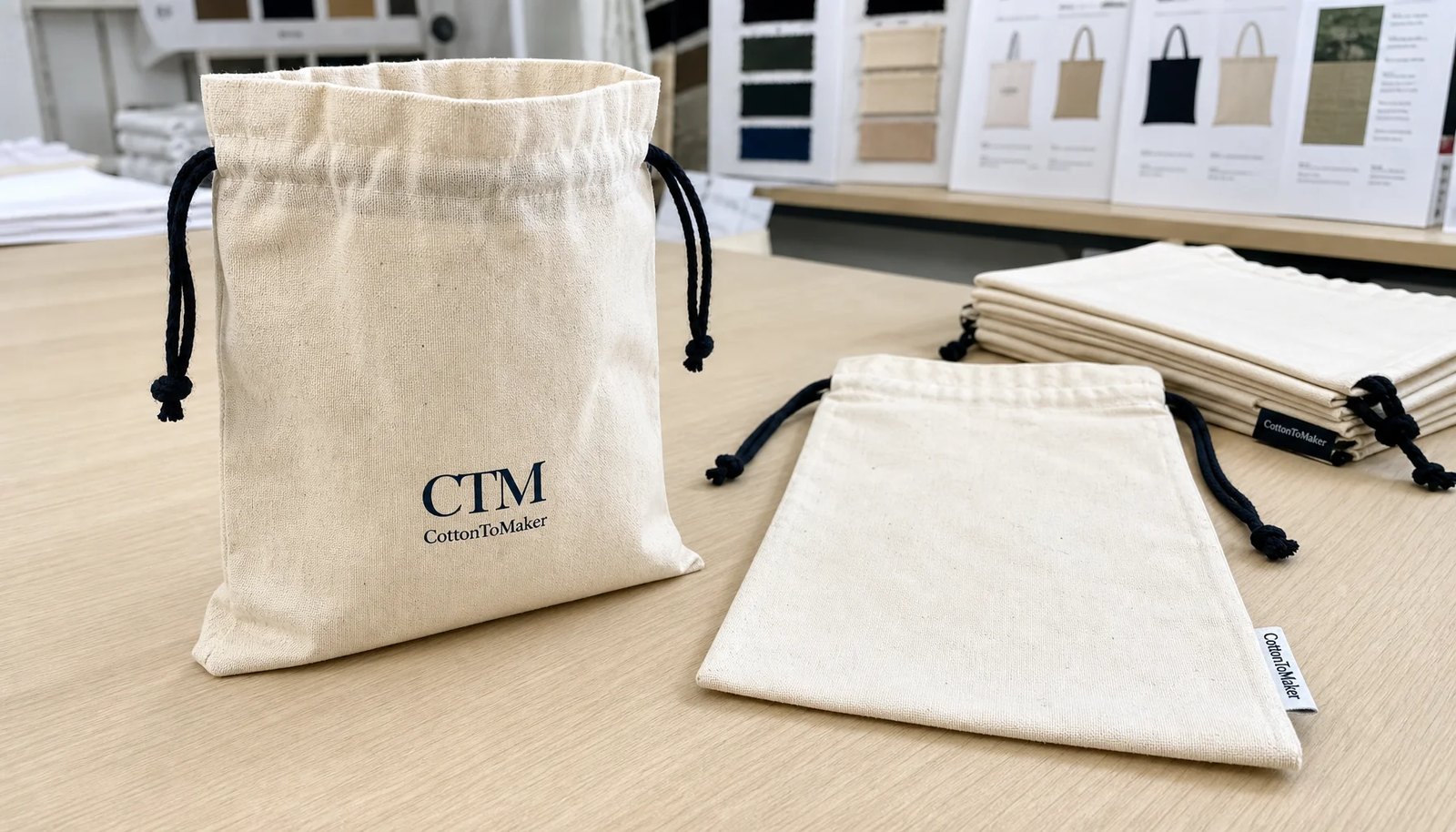
Use the proof as the control point
Cotton drawstring pouches for university bookstores look simple at first glance. They are soft bags with cords, seams, and a logo. In procurement, though, they carry a surprising amount of risk: official brand marks, tight event dates, department approvals, retail presentation, and receiving requirements all meet in one small product. A crest printed 8 mm too low may not ruin the pouch function, but it can make the finished merchandise feel careless.
That is why the proof should do more than show a logo on a pouch image. It should become the shared production record. The buyer, supplier, print team, sewing line, inspector, and receiving team should all be able to look at the proof and understand the same details: finished size, cotton GSM, fabric finish, cord color, print method, artwork revision, actual print size, placement measurements, tolerances, packing method, and carton identification.
This is especially important when several suppliers are quoting the same RFQ. If the request only says custom cotton pouches with university logo, one supplier may quote a lightweight stock pouch, another may quote a made-to-order 180 GSM pouch, and a third may assume a cheaper print process. The unit prices may sit side by side in a spreadsheet, but the products are not equivalent.
- Use the proof to control specifications, not only to approve the visual mockup.
- Approve actual print size in millimeters or inches; avoid scale to fit wording.
- Record fabric color, GSM, cord color, print method, artwork revision, and approval date with the proof.
- Treat bookstore, alumni, orientation, sponsor, and department artwork as separate controlled versions.
- Keep approved sample photos with a ruler visible for size and placement reference.
- Release bulk production only after the supplier confirms that the proof matches the quoted construction and print method.
Define the use before the size
Start with the item’s job. A pouch for a pin set has different needs from a pouch for graduation cords, a notebook bundle, a donor gift, a small apparel accessory, or an orientation kit. The same 15 x 20 cm pouch may work beautifully for stationery and poorly for a boxed tech accessory because cotton flexes around thickness, corners, and top gather.
Quote by finished flat size after sewing. A specification such as 15 x 20 cm should mean the completed pouch measured flat from finished side edge to finished side edge and from finished top edge to finished bottom edge. If the height includes the drawstring channel, say it plainly. If the buyer needs a specific usable internal height below the channel, state that separately. On a small pouch, a deeper top fold can steal useful space and push the logo closer to the cord.
Before approving the sample, put the real contents inside the pouch. Include hangtags, inserts, tissue, cords, boxed items, folded cards, or any kit components that will ship with the product. A pouch that looks right empty can look cramped when filled. For bookstore resale, the filled presentation matters because customers judge the product in their hands, not on a flat technical drawing.
- 10 x 15 cm often fits pins, stickers, jewelry-style gifts, compact welcome-kit items, or gift cards with insert sleeves.
- 15 x 20 cm often fits pen sets, stationery, small tech accessories, compact bookstore merchandise, or multi-item gift bundles.
- 20 x 25 cm often fits notebooks, cosmetics sets, donor packs, larger gift packaging, or orientation kits with several components.
- 25 x 30 cm and larger often fits apparel accessories, scarves, premium alumni bundles, graduation items, or bulkier merchandise.
- Use +/- 5 mm size tolerance for many small pouches and +/- 10 mm for larger pouches unless the contents require tighter control.
- Ask the supplier to confirm finished flat size, usable internal height, and whether the quoted height includes the drawstring channel.
Choose cotton by performance, not habit
Fabric weight changes the whole product. It affects opacity, print absorption, stitch stability, closure feel, carton weight, and perceived value. Around 140 GSM can work for light secondary packaging, especially when the pouch is not carrying a heavy or sharp item. Around 180 GSM is often a practical starting point for bookstore retail, orientation programs, stationery bundles, and gift packaging. Around 220 GSM gives more body for premium sets, but it may feel stiff on very small pouches and may not gather as softly at the drawstring channel.
Finish matters just as much as weight. Natural unbleached cotton has a warm cream tone, seed flecks, and a relaxed campus-merchandise feel. Bleached white cotton gives brighter contrast and usually supports cleaner-looking school-color prints. Dyed cotton can match a campaign or school-color theme, but it brings shade-lot approval, crocking checks, and MOQ questions. Washed cotton may feel softer, yet it can change shrinkage, texture, and print edge definition.
Buyers should also define what normal cotton character means. Seed flecks and minor slubs may be acceptable on natural cotton if they match the approved sample. Oil stains, mildew odor, holes, severe yarn faults, mixed shade panels, or foreign fibers in the logo area are different issues. That distinction keeps inspection realistic without allowing visibly defective goods into bookstore inventory.
- Use about 140 GSM when the pouch is mainly light packaging and the contents are not sharp, heavy, or premium-positioned.
- Use about 180 GSM for general bookstore retail, orientation programs, stationery bundles, and gift pouches with moderate contents.
- Use about 220 GSM or higher when the pouch is part of a premium set or must support heavier contents without feeling flimsy.
- Choose bleached white cotton when color brightness, crest contrast, and a clean print appearance matter most.
- Choose natural unbleached cotton when seed flecks and a warm background support the sustainability, vintage, or casual merchandising concept.
- Record whether the approved sample is natural, bleached, dyed, washed, organic-certified, recycled-blend, or another fabric; do not treat these options as interchangeable.
Match the print method to the artwork
Screen printing is usually a strong choice for solid bookstore logos, athletic marks, alumni designs, one- to three-color department artwork, and repeat programs. It can provide good coverage on cotton and efficient production when each design has enough quantity. The RFQ should still define color count, Pantone targets, print side, maximum print size, underbase needs on dark fabric, and curing expectations.
Digital printing or transfer printing can be useful for short event runs, gradients, complex graphics, or artwork that changes often. These methods are not automatically better or worse; they simply have different proofing points. Buyers should review hand feel, edge sharpness, opacity over cotton texture, rub resistance, and whether the finished surface fits the bookstore’s retail standard.
Small pouches punish overly detailed artwork. A university crest, fine mascot line, motto, trademark symbol, or sponsor logo may look sharp in a brand file but close up when printed 50 to 90 mm wide on textured cotton. Reduce the artwork to final print size before approval. If required details disappear, adjust the artwork with brand approval, increase the print size, or choose a larger pouch.
- Use screen print for solid logos, bookstore marks, alumni designs, and repeat orders with stable artwork.
- Use digital print for short runs, many colors, gradients, or event-specific graphics where screen setup is inefficient.
- Use heat transfer only after approving hand feel, edge durability, film appearance, and overall fit for a cotton bookstore product.
- Request an underbase recommendation when printing light ink on dyed, black, navy, maroon, or other dark cotton.
- Require an actual-size printed proof for crests, small text, sponsor marks, or mascot details that may fill in on cotton texture.
- Ask the factory to state curing or setting requirements and how long printed pouches must rest before stacking or packing.
Make artwork instructions hard to misread
A strong proof file should remove guesswork. It should include pouch size, fabric GSM, fabric color, cord color, print method, artwork file name, logo version, print dimensions, placement measurements, print side, and approval date. University artwork often has strict rules, so the factory should not redraw, stretch, recolor, outline, simplify, or replace fonts unless the buyer requests that work and approves the revised file.
Placement should be measured from finished construction points. For example: front print only, logo centered horizontally, print width 90 mm, top of logo 45 mm below finished top edge, placement tolerance +/- 3 mm. That is far clearer than centered on pouch. The top channel, side seams, bottom seam, and filled shape all affect how centered the print appears.
File control becomes critical when one order contains many logos. The supplier should not have to guess whether the alumni mark, bookstore mark, orientation design, department version, or sponsor version is final. Use names that identify department, color, print size, and revision. For split orders, attach a design matrix that connects each artwork file to quantity, pouch size, fabric color, cord color, print method, packing code, and carton marking code.
- Send AI, EPS, or vector PDF files whenever possible; avoid screenshots or low-resolution PNGs for production approval.
- Convert fonts to outlines or provide written font handling instructions that comply with university brand rules.
- List Pantone references for target colors, then approve final color on cotton because fabric base and texture affect appearance.
- Define print size as actual width x height, such as 90 x 42 mm, rather than fit to front panel or same as mockup.
- Define placement from a finished edge, such as top of logo 45 mm below top edge or logo center 80 mm above bottom edge.
- Use controlled file names such as Bookstore_PrimaryLogo_Navy_90mm_R2.pdf or Orientation_2026_WhiteInk_75mm.pdf.
Approve samples in the right order
A digital mockup is useful, but it is not a production sample. It cannot show cotton shade, seed flecks, fabric opacity, ink absorption, print hand feel, cord thickness, seam construction, closure smoothness, or packing creases. For official bookstore merchandise, licensed marks, alumni programs, and retail goods, a physical pre-production sample is the safer approval basis.
Different samples answer different questions. A blank sewing sample can confirm finished size, seam construction, cord pull, and filled shape. A printed strike-off can confirm color direction and print edge behavior on fabric. A full pre-production sample confirms the combined result: actual fabric, cord, sewing construction, print method, ink or transfer, finished size, and placement.
Review the sample like a small inspection. Measure it flat. Pull the drawstrings several times. Check cord exits and backstitching. Put the intended product inside. Compare print size and placement with the proof. Lightly rub the print after curing. Check the reverse side for print-through, pressure marks, or ink transfer. If the pouch will be sold as a gift item, judge it filled, closed, and handled.
- Keep one approved sample with the buyer and one with the factory when schedule and freight timing allow.
- Photograph the approved sample with a ruler showing finished pouch size and logo placement.
- State approval clearly as approved as is, approved with correction, or rejected for resample; avoid informal approval language.
- Do not approve bulk production from a blank sample when artwork accuracy, school color, or print placement is the main risk.
- If corrections are needed, list each change separately and require an updated proof, revised sample, or controlled sample photo.
- Confirm that bulk production will use the same fabric lot or an approved equivalent if the sample lot cannot be used.
Plan MOQ around artwork splits
Many university bookstore orders look like one purchase order but behave like several production runs. The base pouch may be the same, yet the prints may include the main bookstore logo, alumni association mark, orientation design, college department logo, campus event graphic, and sponsor artwork. Sewing may be efficient at the total quantity. Printing is where the splits create setup, proofing, registration, inspection, and packing work.
A practical RFQ separates base pouch quantity from artwork quantity. Five thousand total pouches split into ten designs of 500 pieces is not the same as five thousand pieces of one design. Screen charges, digital setup, ink changes, placement setup, sample approvals, packing separation, and carton labels can all affect price. Ask suppliers to quote both the single-design scenario and the actual split-design scenario.
Standardization reduces cost and mistakes. Keep pouch size, fabric GSM, fabric shade, cord color, and ink color consistent across departments when possible. If every campus group chooses a different size, fabric color, cord, print method, and packing style, the project becomes many small custom jobs instead of one controlled bookstore program.
- Ask whether MOQ applies per pouch size, fabric color, cord color, print design, print color, packing method, or shipment destination.
- Quote one-design quantity and multi-design split quantity separately so setup, sampling, and packing costs are visible.
- Group department logos that use the same ink color and pouch base to reduce color-change time and production complexity.
- Use one base pouch specification across designs unless the actual product inside requires different dimensions or fabric weight.
- Confirm whether screens are charged one time, per reorder, or again after a defined storage period.
- Ask whether artwork revisions after proof approval trigger new setup fees, sample fees, or lead-time resets.
Compare quotes beyond the unit price
The lowest unit price is not always the lowest delivered cost. Some quotes exclude screen charges, Pantone matching, artwork cleanup, sample cost, sample freight, inner packing, carton labels, separated design packing, export cartons, inspection photos, or pre-shipment support. The better quote tells procurement what is included, what is optional, and what changes will affect price.
Logistics details belong in the comparison too. Cotton pouches are relatively light, but carton volume, cord bulk, folding method, and packing density affect freight estimates. Carton dimensions, gross weight, net weight, pieces per carton, and pieces per inner bag help the buyer estimate landed cost and receiving labor. When several artwork versions are involved, carton labeling and design separation are not small details; they determine whether the bookstore can allocate goods quickly.
A slightly higher unit price can be the stronger buy if it includes accurate sampling, defined printing, separated packing, carton marking, and inspection documentation. A cheap quote that leaves those items vague can create surprise charges later, especially when another department logo is added after the first proof round.
- Separate blank pouch cost, print cost, screen or setup cost, sample cost, packing cost, and artwork cleanup charges.
- State whether sample cost is refundable, credited to the bulk order, or charged separately from production.
- Include carton quantity, carton dimensions, gross weight, net weight, and pieces per inner bag for freight and receiving planning.
- Confirm lead time after artwork approval and sample approval, not only after deposit or purchase order release.
- Record quote validity when cotton prices, exchange rates, or freight costs may affect final landed cost.
- Confirm incoterm, export port, export packing, pre-shipment photo support, and inspection scope before comparing suppliers.
Set QC thresholds before cutting fabric
Quality control works best when the standard is written before production starts. Cotton naturally has slubs, seed flecks, and small shade variation, especially in natural unbleached fabric. Those features may be acceptable when they match the approved sample. Oil stains, holes, severe weaving faults, wrong logos, open seams, wet ink transfer, and incorrect cord color should not pass.
For print proofing, the core checks are artwork version, print size, placement, color, registration, ink coverage, curing, and readability. A small crest motto may look fine on screen and still become unreadable on cotton. If the pouch has two-sided printing, front/back orientation must be verified. If several designs are in one order, QC must confirm that the right artwork is packed in the right carton.
For sewing, focus on finished size, top channel depth, cord exit points, side seams, bottom corners, stitch security, loose threads, and closure performance. For packing, check count accuracy, clean folding, dry print surfaces, separated design versions, carton strength, and carton labels that match the design matrix. A well-made pouch in the wrong department carton still creates a procurement failure.
- Use print placement tolerance such as +/- 3 mm for many small pouches and +/- 5 mm for larger pouches when the artwork and process can support it.
- Use finished-size tolerance such as +/- 5 mm for many small pouches and +/- 10 mm for larger pouches unless product fit requires tighter control.
- Reject wrong logo versions, upside-down prints, major registration errors, wet ink transfer, severe smears, and unreadable required text.
- Trim loose threads beyond the agreed limit, especially near the drawcord channel, side seams, and bottom corners.
- Check cord pull repeatedly to confirm the channel does not bind, tear, slip excessively, or open at the seam.
- Label cartons with PO number, item code, pouch size, artwork code, quantity, carton number, and destination when applicable.
Control packing before receiving day
Packing is part of the sourcing specification, not a warehouse afterthought. University bookstore teams may need to send pouches to campus stores, online fulfillment, alumni events, orientation tables, departments, or seasonal displays. If multiple logos arrive mixed in unmarked cartons, the supplier has pushed sorting labor, count risk, and allocation errors onto the buyer.
Flat packing is common for cotton drawstring pouches, but the inner packing method should match the handling path. Bulk inner polybags reduce labor and material cost. Counted bundles or paper bands make receiving counts faster. Individual bags add cost and packaging waste, but they may protect printed surfaces, support e-commerce fulfillment, or keep gift-set components clean.
Carton planning also affects appearance. Overpacked cartons can create deep creases, cord pressure marks, or distorted printed areas. Underfilled cartons may collapse in transit. Before production finishes, request carton dimensions, gross weight, pieces per carton, and the exact carton label format. The receiving team should be able to identify each design without opening every carton.
- Define pieces per inner bag or counted bundle, such as 50 or 100 pieces, for faster receiving verification.
- Pack each artwork version in separate inner bags and separate cartons whenever practical for allocation and count control.
- Avoid overpacking cartons so cords do not press deep creases into the cotton or printed logo area.
- Request estimated carton dimensions, gross weight, net weight, and pieces per carton before freight booking.
- Use carton marks that match the bookstore’s PO, department code, event code, internal item number, or destination plan.
- If plastic bags are used, specify warning text only when required by destination regulations, retailer policy, or campus procurement rules.
Specification comparison for buyers
| Spec decision | Recommended option | When it fits | Buyer risk to check |
|---|---|---|---|
| Finished pouch size | Specify finished flat width x finished flat height after sewing, including the measurement point and tolerance on the proof | Gift packaging, orientation kits, alumni merchandise, stationery bundles, graduation add-ons, bookstore resale items | A quote based on cut panel size can reduce usable space after seam allowance and top-channel folding; even 5 mm can affect boxed product fit or logo balance on small pouches |
| Size tolerance | Use +/- 5 mm for many pouches under 20 cm high and +/- 10 mm for larger pouches, unless a rigid item requires tighter approval | Programs where pouches must fit pins, jewelry cards, pen sets, notebooks, cords, boxed gifts, or kit components | No written tolerance leaves receiving teams arguing subjectively about whether a short pouch, crooked channel, or shifted print is acceptable |
| Fabric weight | Select 140 GSM, 180 GSM, or 220 GSM cotton based on product weight, opacity, retail value, and closure feel | 140 GSM for light secondary packaging; 180 GSM for general bookstore retail; 220 GSM for premium gift sets or heavier contents | Thin fabric can show contents and distort print; heavy fabric can feel stiff at small sizes, increase carton weight, and reduce drawstring gather |
| Cotton finish | Natural unbleached for warm campus merchandising; bleached white for brighter contrast; dyed cotton only with shade-control approval | Natural works for vintage, eco-style, alumni, and welcome-pack programs; white works for crests and brighter school colors | Natural cotton has seed flecks and a cream base, so Pantone colors will not look identical to coated paper; dyed lots can vary if not approved against a swatch |
| Print method | Screen print for solid brand marks and repeat orders; digital print or transfer for short runs, gradients, or many colors | Screen print suits bookstore logos, mascots, one- to three-color department marks; digital supports event art and complex graphics | Unspecified printing makes quotes non-comparable and can change setup cost, edge sharpness, ink hand feel, curing time, and rub resistance |
| Artwork proof format | Use vector AI, EPS, or PDF with outlined fonts, Pantone references, actual print dimensions, placement measurements, and revision number | Official university crest, bookstore logo, athletic mark, alumni design, department mark, sponsor logo, or licensed art | Low-resolution PNG approvals can hide jagged edges, missing trademark symbols, thin line dropout, incorrect clear space, and small-text readability problems |
| Print placement | Define placement from fixed finished edges, such as logo centered horizontally and top of print 45 mm below finished top edge | Small pouches where the drawcord channel, bottom seam, and logo scale affect perceived centering | A visual mockup that says center front can produce prints too close to the cord, too low when filled, or inconsistent across operators |
| Drawstring and channel | Approve cord material, diameter, color, knot style, channel width, cord exits, and pull smoothness | Retail pouches handled repeatedly by students, parents, alumni, staff, and online customers | A cheap or undersized cord lowers perceived value; tight channels bind; weak stitching at cord exits is a common failure point |
| Sample approval | Approve a pre-production sample using actual bulk fabric, cord, sewing construction, print method, ink or transfer, and finished size | Licensed marks, retail sale, alumni programs, multi-design orders, or any order where color and placement matter | A digital mockup cannot verify cotton shade, ink absorption, print curing, seam quality, closure feel, packing crease behavior, or filled appearance |
Buyer checklist before sampling
- Define the pouch use before requesting a quote: retail resale, gift packaging, orientation kit, alumni event, stationery bundle, graduation item, department giveaway, online-order insert, or sponsor merchandise.
- State the finished flat pouch size as width x height after sewing; clarify whether height includes the drawstring channel and whether measurements are taken empty, flat, and before packing.
- Set a written size tolerance before sampling, such as +/- 5 mm for many small pouches and +/- 10 mm for larger pouches, with tighter tolerances only when a rigid product must fit.
- Test the proposed size with the actual contents, including product thickness, hangtags, insert cards, tissue, cords, notebooks, boxes, or kit components that affect closure.
- Choose fabric weight by use: about 140 GSM for light packaging, 180 GSM for most bookstore retail and orientation programs, and 220 GSM or above for premium sets or heavier contents.
- Confirm fabric finish: natural unbleached, bleached white, dyed cotton, washed cotton, organic-certified cotton, recycled-blend cotton, or another specified material if procurement requires documentation.
- Define acceptable natural-cotton characteristics, such as seed flecks and minor slubs, and separately define unacceptable defects such as oil marks, holes, mildew odor, severe shade mixing, or visible stains.
- Provide vector artwork with outlined fonts, Pantone references, actual print width x height, print side, placement from finished edges, artwork revision number, and whether the design is one-sided or two-sided.
- Check brand compliance before factory release, including crest line weight, mascot detail, clear space, trademark symbols, department naming, licensed-art approvals, and whether the mark may be printed on natural cotton.
- Approve the print proof on the same fabric color and GSM planned for bulk production whenever school-color accuracy, small text, crest detail, or retail presentation matters.
Factory quote questions to send
- What exact material composition, fabric weight in GSM, weave, finish, cotton shade, and shrinkage or washing treatment are included in the quoted price?
- Is the quoted dimension the finished flat pouch size after sewing, and what measurement method and production tolerance will be applied at inspection?
- Does the height include the top drawstring channel, and what is the planned channel depth or fold allowance for this pouch size?
- Is the pouch produced from stock fabric, custom-dyed fabric, bleached fabric, washed fabric, organic-certified cotton, or another material, and how does each option affect MOQ and lead time?
- What cord material, cord diameter, cord color, knot finish, channel construction, and cord-exit reinforcement are included in the quote?
- Which print method is quoted, how many colors are included, and what is the maximum recommended printable area for the requested pouch size and fabric weight?
- Are Pantone matching, underbase printing, screen charges, digital setup, film charges, artwork cleanup, sample freight, revision fees, or packing separation included or charged separately?
- Will the pre-production sample use bulk fabric, bulk cord, final sewing construction, actual print method, final ink or transfer material, and the same curing process planned for production?
- How will logo placement be controlled in production: printed jig, placement template, registration mark, operator measurement, or inline inspection?
- What print placement tolerance do you recommend for this pouch size, and can you hold +/- 3 mm on small pouches or +/- 5 mm on larger pouches if required?
Quality-control points to confirm
- Finished pouch size should match the approved sample within the agreed tolerance, measured flat before packing by finished width and finished height, with the measurement method recorded.
- Fabric GSM should be checked against the quoted range because meaningful deviation changes opacity, print absorption, closure feel, sewing behavior, carton weight, and perceived retail value.
- Fabric shade should be compared with the approved swatch or sample; natural cotton variation may be acceptable, but mixed shade lots, yellowing, mildew marks, and stains should be controlled.
- Fabric surface should be inspected for holes, broken yarns, heavy slubs, oil spots, foreign fibers, and dirt, while distinguishing normal seed flecks on unbleached cotton from defects.
- Print placement should be measured from fixed finished edges, such as top edge, bottom edge, centerline, or side seam, rather than judged only by eye on a soft pouch.
- Logo color should be compared with the approved cotton proof under consistent lighting, not only against a paper Pantone chip, digital PDF, or phone photo.
- Small text, crest details, mascot lines, registration marks, trademark symbols, and sponsor logos should remain readable at the approved print size and normal handling distance.
- Ink coverage should be even for the approved artwork style; severe pinholes, smears, missing strokes, wet transfer, poor underbase coverage, and obvious gaps in key logo areas should be rejected.
- Ink should be dry, cured, and resistant to light rubbing before packing so printed pouches do not mark adjacent pieces or inner bags during transit.
- Multi-color prints should be checked for registration shift, color contamination, incorrect sequence, underbase misalignment, and edge halos that were not present on the approved sample.