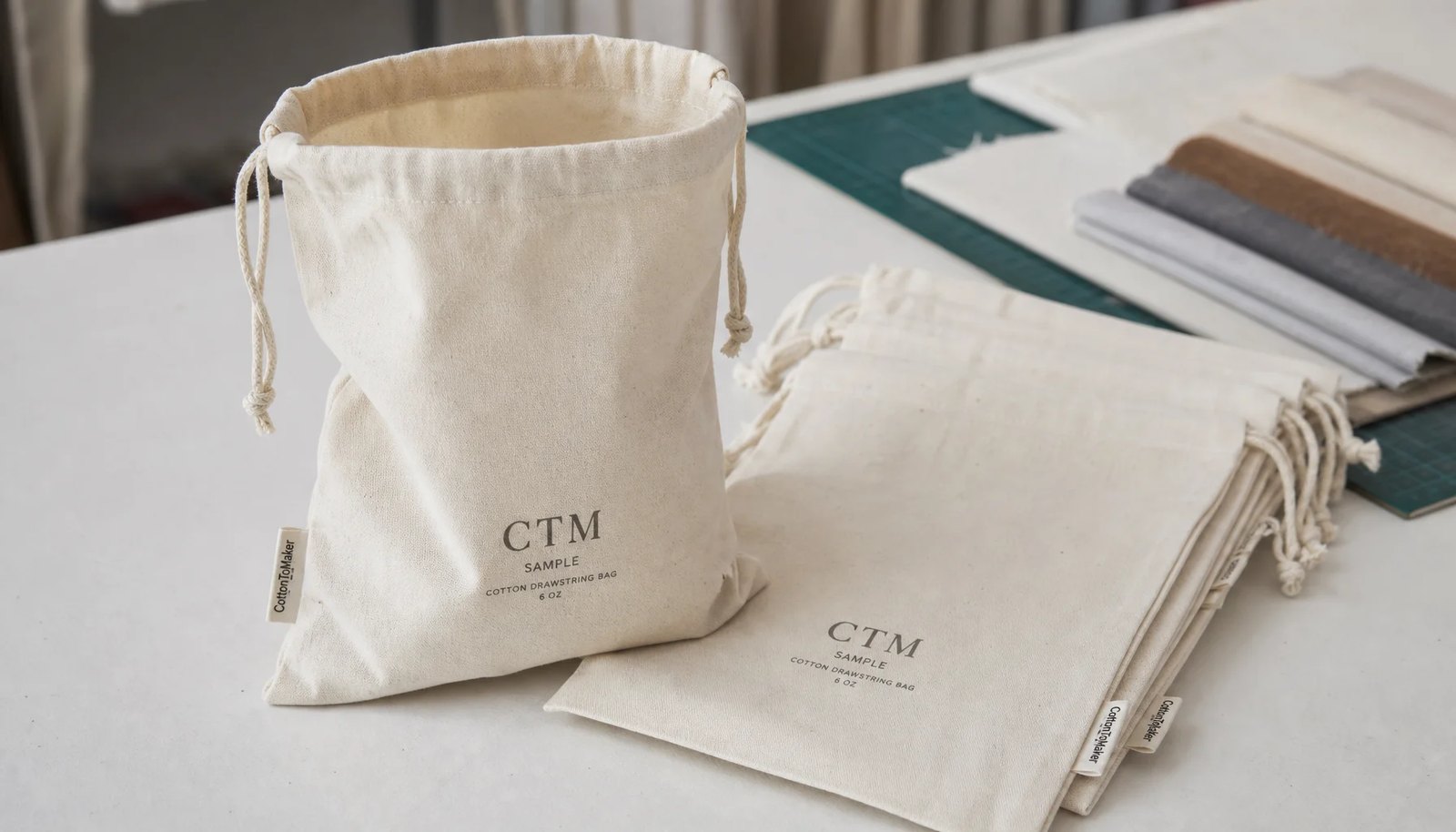
Start With the Campus Selling Date
Cotton drawstring pouches for university bookstores are usually tied to fixed campus calendars: orientation, move-in, graduation, homecoming, admitted-student events, alumni weekends, holiday gift tables, and semester-start rush. The procurement mistake is treating the factory's production lead time as the full schedule. A quote that says 25 days after approval may still require several weeks for artwork approval, sampling, freight, customs, receiving, and in-store setup.
Work backward from the date the pouch must be counted, labeled, and ready for sale or distribution. A bookstore may need the goods several days before orientation because cartons must be received, reconciled against the PO, moved to storage, split by department, or kitted with lanyards, notebooks, mugs, tech accessories, or apparel add-ons. If cartons arrive on campus the morning of the event, the order is late even if the carrier delivered on the requested date.
Separate the schedule into three dates: required in-store date, latest warehouse delivery date, and latest supplier ship date. This helps procurement discuss reality with stakeholders. Marketing may care about the launch date, receiving may care about labor and carton labels, and the supplier can only control production and export handover once approvals are complete.
- Set the in-store date before requesting a quote.
- Give receiving teams time for counting, relabeling, kitting, or shelf placement.
- Treat sample approval, not PO issue date, as the real production trigger.
- Protect fixed events with extra buffer because a late sample cannot always be solved by air freight.
Use a Backward Schedule
A backward schedule converts a campus deadline into buying actions. The exact timing depends on fabric availability, supplier capacity, SKU count, freight mode, and approval speed, but the buyer should always map the gates before placing the PO. The schedule should show who owns each step, not only how many days the factory needs.
For a new import order using stock natural cotton and ocean freight, 10 to 14 weeks before the in-store date is a safer planning window. Dyed fabric, custom cord, many SKU splits, or complex artwork can extend this. A repeat order with approved artwork can be shorter, especially if fabric is stocked and the pouch body is unchanged. Rush schedules are possible only when the buyer removes uncertainty: one size, one fabric, fast artwork approval, simple packing, and realistic freight funding.
- Orientation ocean plan: week 14-12 lock quantities, specs, budget, and RFQ; week 11-10 approve construction sample and artwork proof; week 9 approve printed sample and release bulk; week 8-5 production, printing, sewing, and packing; week 4 inspect and ship; week 3-1 transit, customs, domestic delivery, receiving, and merchandising.
- Graduation retail plan: start earlier if the pouch is sold as branded merchandise because quality and shelf presentation matter more than giveaway packaging.
- Rush air plan: use only stocked fabric, simple print, limited SKUs, and confirmed airport-to-campus delivery; do not assume air freight fixes unresolved sample or artwork issues.
- Repeat-order plan: reuse the signed sample, but still confirm fabric lot, logo version, packing labels, and production slot before approving bulk.
Choose Fabric by Use and Risk
A quote for a cotton pouch is not useful unless the cotton weight and finish are defined. A 3 oz pouch and an 8 oz pouch can both be called cotton drawstring pouches, but they differ in opacity, hand feel, print result, seam bulk, carton volume, and cost. For most university bookstore programs, 5 oz to 6 oz cotton is a practical starting point because it looks retail-appropriate without becoming too bulky.
Stock natural cotton is usually the lowest-risk option for schedule because it avoids dye approval and can move directly to cutting after sample approval. Dyed cotton adds brand control but also adds lab dip review, shade matching, dye-lot management, and possible color-fastness checks. Organic cotton or documented sustainable materials may require certificate review and should not be added late if the event date is fixed.
Heavier fabric can make the pouch feel more premium, but it is not automatically better. Small pouches in 8 oz cotton can become stiff, thick at the channel, and more expensive to ship by volume. Lighter fabric can work for welcome kits or giveaways, but it may show contents and wrinkle more heavily.
- 3 oz to 4 oz cotton: light, lower bulk, better for giveaways than premium retail.
- 5 oz to 6 oz cotton: balanced for bookstore gift pouches, stationery kits, and accessory bundles.
- 7 oz to 8 oz cotton: stronger look for heavier contents, with higher cost and carton volume.
- Stock natural fabric: faster and lower color-approval risk.
- Dyed fabric: better brand-color control, but requires more approval time and shade management.
Size the Pouch Around Contents
Pouch sizing should start with the product, not with a generic dimension from a catalog. Finished usable space is smaller than the flat panel because of side seams, bottom seam, fabric thickness, and the gathered drawstring top. A pouch that fits an item when open may not close cleanly once the drawstring channel is pulled.
Bookstore programs often include mixed contents: pens, notebooks, decals, charging cables, lanyards, folded tees, mugs, or small gift bundles. Each use affects the opening, height, and fabric strength needed. If the pouch is sold as a retail item, it should also look balanced when empty on a table or peg display. If it is used as packaging for a kit, the buyer should test the filled sample and confirm how many units can be packed per carton after filling.
State finished size after sewing and include a tolerance. For common small and medium pouches, +/-0.5 cm may be practical, while larger or heavier constructions may need a different tolerance agreed with the supplier. If the order includes multiple sizes, label them clearly by SKU and do not rely on terms such as small, medium, and large without dimensions.
- Measure the largest product and add room for seams and drawstring gathering.
- State finished width x height, usable opening, and tolerance.
- Confirm whether the pouch must lay flat, hang, stand, or hold a kit.
- Approve at least one sample filled with real bookstore contents.
Control Artwork and Print Timing
Screen printing is usually the right choice for solid university logos, bookstore marks, mascot graphics, department names, and event text. It is cost-efficient for repeat programs and works well for one to three spot colors. The buyer should provide vector artwork, Pantone references, print size, and exact placement from pouch edges. A PDF mockup alone is not enough for production control.
Heat transfer can be useful for gradients, many colors, or small runs, but it may affect hand feel and can add proofing steps. On small cotton pouches, a stiff transfer or slightly crooked placement is noticeable. If the pouch will be handled often in-store, ask about rub resistance, edge durability, and the supplier's normal adhesion check.
University artwork approval often involves more stakeholders than expected. Brand teams may revise mascot position, admissions may change event wording, and departments may request separate logos after the RFQ. These changes create new screens, new proofing, and sometimes new SKU packing rules. For lead-time protection, lock artwork before bulk material is cut and before screens are made.
- Send vector artwork with Pantone colors, not only a mockup image.
- Define print size, placement, and tolerance such as +/-0.5 cm where appropriate.
- List every logo version as a separate SKU before pricing.
- Ask whether screen setup, print proof, and sample freight are included.
- Reject rushed approval if logo color, scale, or position affects retail acceptability.
Plan MOQ and SKU Splits
MOQ is driven by setup, not only total quantity. A 5,000-piece order can be efficient when it uses one pouch size, one fabric, one cord, and one logo. The same 5,000 pieces can become inefficient if it is divided among ten department logos, several fabric colors, custom labels, and different packing rules. Each split may require separate printing, sorting, inspection, and carton labeling.
University bookstore buyers often coordinate demand from admissions, athletics, alumni relations, student affairs, and bookstore private label. The best procurement strategy is to group shared construction wherever possible. Use the same fabric, pouch size, cord, and base packing, then separate the print version and carton labels by department. This gives the factory a cleaner production flow while allowing the campus to manage internal budgets and SKUs.
Ask the supplier to state MOQ by fabric color, pouch size, print design, and packing method. Also ask how overruns and underruns are handled. For small SKU splits, a 3% overrun may be easy to absorb on a general bookstore SKU but unacceptable for a department-funded event with a fixed headcount.
- Break the PO by size, color, logo, department, and event.
- Group common pouch bodies to improve price and scheduling.
- Expect higher unit costs for many small print versions.
- Confirm overrun and underrun rules per SKU.
- Freeze SKU additions before cutting and print setup.
Compare Quotes for Lead Time and Landed Cost
A supplier quote should help the buyer make a decision, not simply show a low unit price. For cotton drawstring pouches, the quote should identify fabric weight, cotton type, print method, pouch size, cord type, sample route, MOQ, packing, carton dimensions, gross weight, Incoterm, lead-time trigger, and excluded charges. Without those details, procurement cannot compare suppliers fairly.
Landed cost is affected by more than unit price. Individual polybags, heavier fabric, thick cords, and low carton density can increase freight cost. Many textile pouches are light but bulky, so carton CBM matters. If one supplier quotes FOB and another quotes delivered, normalize the comparison before choosing. Also compare risk: stock natural fabric may be less expensive in time, while dyed fabric may be better for brand presentation but requires earlier approvals.
For deadline-driven orders, ask suppliers to quote the production timeline in milestones. The most important phrase is usually 'after sample approval.' If the supplier says 30 days after approval, the buyer must still schedule the sample, the review, and the approval decision. A quote that starts timing from deposit but ignores artwork approval may not be reliable.
- Normalize quotes by fabric weight, print method, MOQ, packing, and Incoterm.
- Separate unit cost from screens, samples, trims, labels, inspection, and freight.
- Request carton CBM and gross weight for landed cost planning.
- Compare stock fabric, dyed fabric, domestic production, air freight, and ocean freight as different risk profiles.
- Confirm whether lead time begins after deposit, artwork approval, or signed sample approval.
Use Sampling as a Schedule Gate
Sampling should remove risk before bulk production starts. For a new bookstore pouch, a two-step approach is often safest: first approve a plain construction sample for size, fabric, cord, and opening; then approve a printed pre-production sample for logo color, scale, placement, and print feel. This prevents the buyer from discovering fit problems after print screens or transfers are already prepared.
Repeat orders can move faster, but only if the supplier uses the same approved construction and the buyer confirms any artwork changes. If the print changes from one-color bookstore branding to multi-color graduation artwork, the sample approval requirement changes. If the fabric lot changes, natural cotton shade should still be checked.
Keep written approval records. Photos are useful for print placement and carton packing, but they cannot prove hand feel, fabric weight, or drawstring function. For a first order, physical sample approval is worth the time because it protects the event date from bulk rework.
- Approve construction before approving print if the pouch body is new.
- Use a printed pre-production sample for new logos or color changes.
- Test samples with real contents and planned packing.
- Keep one signed sample with the factory and one with the buyer.
- Record approved deviations before bulk production begins.
Specify Packing for Receiving
Packing affects landed cost, receiving speed, and retail execution. Cotton drawstring pouches can be flat packed in bundles, individually polybagged, packed by inner carton, or sorted into master cartons by SKU. The cheapest packing is not always the best if the campus receiving team must spend hours sorting mixed logos or correcting missing labels.
Individual polybags may be needed for barcode control, retail cleanliness, or kit assembly, but they add material, labor, and carton volume. Bulk bundles can be efficient when the bookstore counts by carton and replenishes from storage. If the pouches will be shipped onward to multiple departments, carton labels should show department code, SKU, pouch size, logo version, PO number, carton count, and piece count.
Carton dimensions should be reviewed before shipment because freight may be charged by dimensional weight or volume. Also set a practical carton gross-weight limit so bookstore or campus warehouse staff can handle cartons safely. If ocean freight or long warehouse storage is involved, moisture protection and clean carton sealing become part of the quality plan.
- Define pieces per bundle, inner carton, and master carton.
- Label cartons by SKU, logo version, PO number, and carton sequence.
- Limit carton weight to a practical receiving target.
- Avoid individual polybags unless retail or barcode handling requires them.
- Request packing photos before final shipment release.
Set Inspection Standards Before Production
Cotton drawstring pouches are simple products, but simple does not mean risk-free. Common defects include uneven size, shade variation, loose threads, skipped stitches, weak bottom corners, twisting cords, rough drawstring channels, print skew, ink stains, poor adhesion, wrong SKU labels, and carton count errors. These issues are easier to prevent when the purchase order includes acceptance criteria.
For B2B procurement, the inspection plan should include sample-size logic. Many buyers use ANSI/ASQ Z1.4 or ISO 2859-1 with General Inspection Level II for pre-shipment inspection, then agree on AQL limits for critical, major, and minor defects. The exact AQL should match the order's risk, but the principle is important: the inspector checks a statistically selected sample instead of only the top pieces in a carton.
Define critical defects as issues that make the product unsafe, unusable, or clearly wrong, such as incorrect logo, wrong size SKU, severe contamination, or broken drawstring function. Major defects may include obvious print skew, open seams, color mismatch beyond approved range, or incorrect packing labels. Minor defects may include trimable loose threads or slight wrinkles that do not affect saleability. Align these definitions before bulk starts, not after a failed inspection.
- Inspect against the signed sample, purchase order, and approved artwork proof.
- Measure size, print placement, drawstring length, seam quality, shade, and packing count.
- Use agreed AQL levels and defect classifications for objective shipment decisions.
- Check multiple cartons and SKU versions, not only the easiest carton to open.
- Release shipment only after count, carton marks, and critical quality points are confirmed.
Specification comparison for buyers
| Quote or delivery option | Best use case | Typical schedule impact | Procurement risk to verify |
|---|---|---|---|
| Stock natural cotton, screen print, ocean freight | Planned orientation, graduation, alumni, or semester-start programs with 10 to 14 weeks available | Usually the most balanced option when fabric is already available and artwork approval is fast | Confirm fabric weight, natural shade range, MOQ per print version, production lead time after sample approval, carton CBM, and booked vessel cut-off |
| Stock natural cotton, screen print, air freight | Event-critical programs with late artwork approval but stable pouch size and simple logo | Can reduce transit time, but does not remove sampling, production, inspection, or export document time | Check whether air freight cost erases unit-price savings; confirm carton volume, airport handover date, and campus receiving deadline |
| Dyed cotton fabric, custom cord, ocean freight | Retail programs needing exact school color fabric, department color coding, or premium coordinated trims | Adds fabric approval and dyeing time before cutting, often making early color approval the main schedule gate | Require lab dip or strike-off approval, color-fastness expectation, dye-lot control, and clear policy for shade variation |
| Multiple SKUs from shared fabric and one-color prints | Bookstores serving admissions, athletics, alumni, and departments with related pouch bodies | Efficient if the factory can cut and sew common bodies, then print and pack by SKU | Confirm MOQ per design, print setup charges, SKU sorting labor, carton labeling, and overrun or underrun allowance per SKU |
| Domestic or nearshore production | Very tight rush programs, low quantity reorders, or situations where import timing is too risky | Can shorten freight and customs exposure, but may have higher unit cost or fewer fabric choices | Compare total landed cost, available cotton weights, print capability, packaging options, and real capacity before assuming faster delivery |
| Low-cost quote with unspecified fabric and packing | Only suitable for early budget screening, not for purchase order placement | May appear faster or cheaper because key work is excluded from the quote | Do not compare until fabric weight, print method, sample route, carton data, Incoterm, inspection plan, and lead-time trigger are stated |
Buyer checklist before sampling
- Set the required in-store date, latest campus warehouse delivery date, and latest supplier ship date as three separate deadlines.
- Define finished pouch size after sewing, including width, height, drawstring channel position, usable opening, and tolerance such as +/-0.5 cm for standard sizes.
- List the contents the pouch must hold, including the largest item dimensions and whether the pouch must close fully when filled.
- Specify cotton fabric weight in oz or GSM, fabric color, natural or dyed finish, shrinkage expectation, and any organic or recycled-content requirement that must be documented.
- Provide vector artwork with Pantone references, print size, logo position, maximum acceptable placement variation, and whether each SKU uses the same or different artwork.
- Break quantity by size, fabric color, print design, department, event, and retail SKU so the supplier can price setup and packing labor accurately.
- Request separate charges for fabric, cutting, printing, cords, labels, sample making, screen or tooling, packing, inland freight, export handling, inspection, and international freight when applicable.
- Define packing by SKU, pieces per bundle, pieces per master carton, carton marks, barcode or retail labels, carton weight limit, and whether individual polybags are allowed.
- Schedule approval gates for construction sample, artwork proof, printed pre-production sample, bulk fabric approval, first-off production, and pre-shipment inspection.
- Keep one sealed approved sample for inspection reference and one working sample for the bookstore or procurement team to compare fit, shade, print, and cord feel.
Factory quote questions to send
- What is the lead time for each stage: fabric sourcing, dyeing if needed, cutting, printing, sewing, trimming, internal QC, packing, final inspection, export documentation, and freight handover?
- Which cotton weights and colors are in current stock, and which options require greige fabric booking, dyeing, or mill scheduling?
- What is the MOQ by total order, fabric color, pouch size, print design, cord type, and packing format?
- Can multiple university departments share the same fabric and pouch construction while using separate logos, and how does that change setup cost and lead time?
- Can you quote screen print and heat transfer separately, including setup cost, unit print cost, minimum print run, approval sample time, and expected print tolerance?
- What finished size tolerance, seam tolerance, print placement tolerance, drawstring length tolerance, and shade tolerance do you recommend for this pouch specification?
- How many pieces will be packed per inner bundle and master carton, and what are the estimated carton dimensions, gross weight, net weight, and CBM?
- Which inspections do you perform before packing, and can the buyer or a third-party inspector use General Inspection Level II with agreed AQL limits?
- Can you provide bulk fabric photos, first-off production photos, print position measurements, packing-line photos, and sealed carton photos before shipment release?
- What Incoterms can you quote, and can you separate FOB unit cost from sample freight, screen charges, inspection charges, international freight, duties estimate support, and domestic delivery charges?
Quality-control points to confirm
- Use the approved sealed sample as the inspection standard for fabric hand feel, pouch size, cord type, print appearance, and packing presentation.
- Measure finished pouch width and height after sewing and pressing, not flat cut panels before stitching, and record results by carton or production lot.
- Verify fabric weight by GSM or ounce conversion and compare natural or dyed shade against the approved sample under consistent lighting.
- Check print color against Pantone or signed proof, then measure print placement from top edge and side seam, including skew and off-center variation.
- Run a basic print adhesion or rub check suitable for the chosen print method, especially for pouches handled frequently in store displays.
- Pull drawstrings repeatedly to confirm smooth closure, even gathering, secure cord ends, and no channel tearing or fraying.
- Inspect side seams, bottom seams, channel stitching, and any bartacks for skipped stitches, open seams, loose threads, broken stitches, or puckering that affects appearance.
- Check mixed-SKU cartons carefully so size, logo version, department code, barcode label, PO number, and carton marks match the purchase order.
- Use a defined inspection approach such as ANSI/ASQ Z1.4 or ISO 2859-1 sampling, commonly General Inspection Level II, with agreed AQL limits for critical, major, and minor defects.
- Confirm carton count, pieces per carton, gross weight, carton condition, moisture protection, and export marks before shipment release.