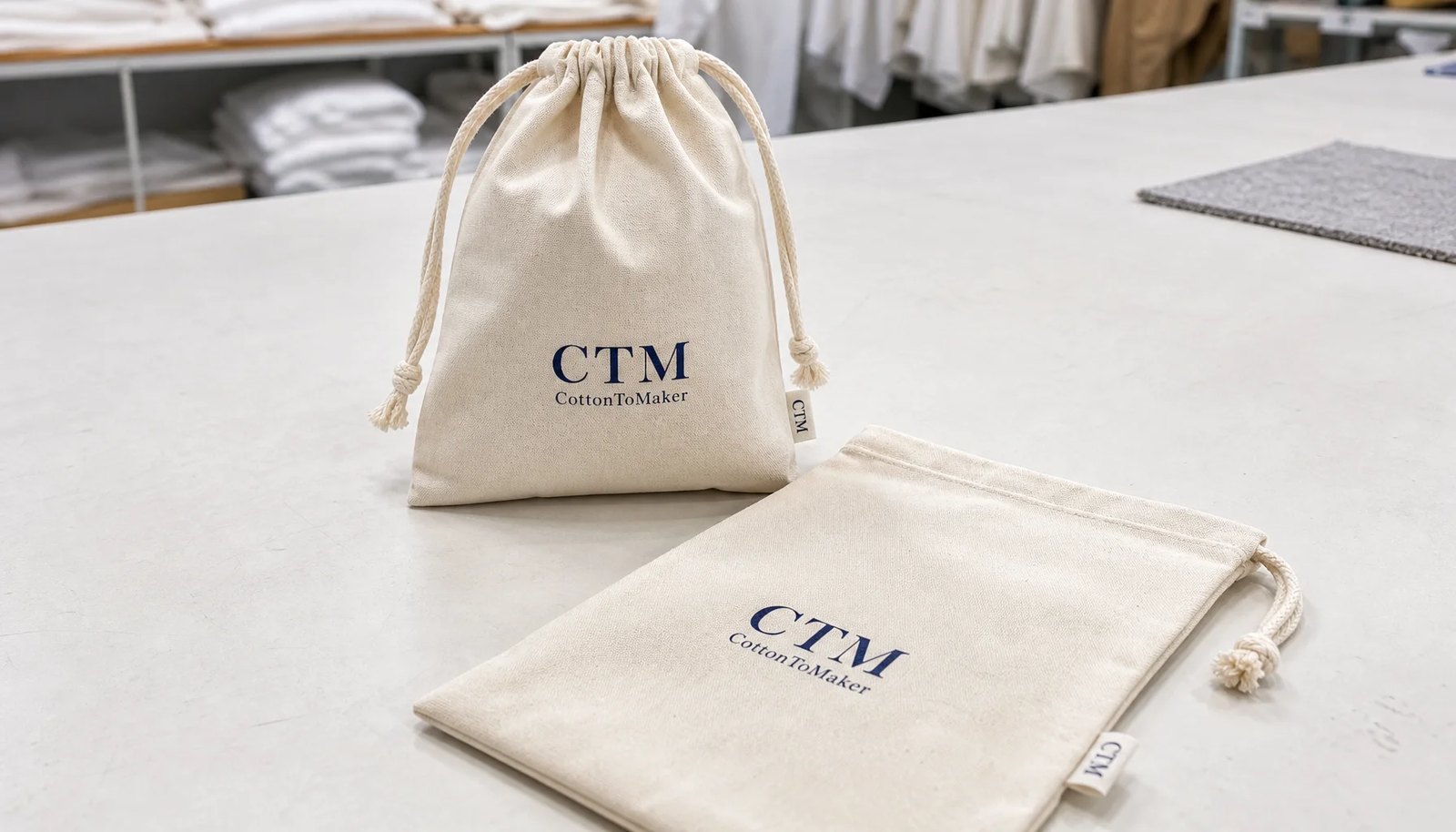
Start With the Bookstore Use Case
Cotton drawstring pouches for university bookstores look simple, but they are rarely one-purpose items. The same base product may support admissions events, freshman orientation, alumni gift sets, athletics retail, department giveaways, bookstore private-label collections, tech accessory kits, graduation merchandise, dorm essentials bundles, or small retail gift packaging. Each use case changes the right specification. A giveaway pouch for stickers and a lanyard can be lighter, simpler, and bulk packed. A pouch sold with a campus gift set needs better opacity, cleaner stitching, tighter artwork control, and more careful presentation.
Most procurement problems begin when artwork is approved before the pouch itself is defined. Drawstring pouches are soft goods. They gather at the top, curve around contents, and change shape as soon as they are filled. A university seal that looks perfectly centered on a flat digital mockup can wrinkle into the drawcord channel after closure. A bookstore logo that looks crisp in a brand guide can lose detail on textured canvas. A pouch sized only around product dimensions can also become hard to close because the cord channel and seam allowance reduce usable height.
Before requesting price, define the commercial and operational job of the pouch. Is it retail packaging, a giveaway, a reusable merchandise component, or a fulfillment kit? Who receives the cartons: the central bookstore warehouse, a campus department, a distributor, a fulfillment center, or a store location? Will the goods be counted in bulk, bundled by event, packed by destination, or labeled for resale? These answers affect MOQ, labor, packing cost, carton size, inspection, and lead time. They also help suppliers quote the same product instead of filling in missing details with their own assumptions.
- Orientation programs usually prioritize economical GSM, simple one-color artwork, easy counting, and reliable delivery date.
- Retail bookstore merchandise should prioritize handfeel, opacity, print clarity, seam finish, cord quality, and shelf-ready packing.
- Fixed gift kits require fit testing with the actual contents before final logo size and placement are approved.
- Multi-department programs need SKU control so logo versions, event dates, and destination cartons do not get mixed.
- Licensed campus artwork should follow the university’s brand approval process before screens, transfers, or labels are prepared.
Size the Pouch Around Fill Volume
The RFQ should state the finished pouch size as width x height, measured after sewing. Avoid vague descriptions such as “fits a mug” or “for stationery kit.” A 20 x 30 cm pouch does not give the buyer 30 cm of usable vertical space. The drawcord channel, top fold, seam allowance, closure gathering, and fabric thickness all take room. If rigid contents must close comfortably below the cord, specify both the finished size and the usable content area.
Start with the largest item in the kit. Measure length, width, thickness, and fill weight, then add clearance for insertion and removal. Soft items such as scarves, socks, folded T-shirts, or caps can compress and tolerate less clearance. Rigid items such as mugs, boxed pens, water bottles, chargers, electronics accessories, or award medals create pressure points. They can distort the print panel, push the logo toward the side seam, or make the bottom curve more visible. Sharp corners can also show through lighter cotton and stress the seams when the fit is too tight.
Bookstore programs often use several standard size ranges. Small pouches around 10 x 14 cm or 13 x 18 cm can work for pins, jewelry-style souvenirs, ID cards, small welcome items, and token gifts. Medium sizes such as 15 x 20 cm, 18 x 24 cm, and 20 x 30 cm are practical for lanyards, stickers, notebooks, tech accessories, admissions kits, and small apparel accessories. Larger sizes such as 25 x 35 cm can hold bulkier merchandise, but they increase fabric consumption, carton volume, print scaling risk, and freight cost.
Sample approval should never stop at a flat table view. Check the pouch flat to confirm finished dimensions, stitching, cord channel, and print placement. Then fill it with the intended contents. The filled check shows the real customer-facing shape. If the bookstore sells the pouch with contents inside, the filled condition matters more than the flat proof because that is how students, alumni, parents, or retail buyers will see it.
- Measure length, width, thickness, and fill weight for the largest intended item, then add handling clearance.
- Allow approximately 20–35 mm or more for the drawcord channel depending on cord diameter and construction.
- Keep the logo below the gathered closure and above the area that bends around rigid or bulky contents.
- Request a fit sample for mugs, tech accessories, boxed stationery, caps, water bottles, and dorm bundles.
- State finished size tolerance in the PO so the factory and inspector measure the pouch the same way.
Choose GSM, Fabric, and Color Carefully
Fabric GSM affects far more than unit price. It changes opacity, handfeel, print appearance, carton weight, and perceived retail value. Very light cotton around 100–120 GSM can work for short-term giveaways and low-weight contents, but it may feel too thin for a sellable bookstore product. A 120–140 GSM plain cotton pouch is often a practical middle range for admissions kits, bookstore accessories, and event programs where cost and usability both matter. For premium retail packaging, heavier contents, or repeated handling, 180–220 GSM cotton canvas is usually a stronger starting point.
Do not treat GSM as the full fabric specification. Plain cotton, muslin-style cotton, and cotton canvas can behave differently at similar weights. Yarn count, weave density, finishing, and shrinkage all affect the surface. Smooth plain cotton can hold simple screen print cleanly. Coarse canvas may make small text, thin crest lines, or registration details less sharp. Heavier canvas improves opacity and structure, but it can require stronger sewing control and may increase carton weight enough to affect freight planning.
Color deserves the same level of control. Natural cotton usually has an off-white tone with small flecks and shade variation. That look can work well for sustainable-looking campus merchandise, but it changes how navy, burgundy, gold, black, or white ink appears. Bleached white cotton gives a cleaner base for color matching, though it may show dirt more easily during handling. Dyed school-color fabric or dyed cords can make the pouch feel more branded, but they need colorfastness review and may carry higher MOQ or longer lead time.
Ask suppliers to quote the exact fabric construction, target GSM, and expected GSM tolerance. For many textile orders, a written tolerance such as target GSM ±5% is more useful than a general promise of “good quality.” Request swatches before sample approval. Keep the approved fabric swatch with the approved pre-production sample, because inspectors and receiving teams need a physical reference when bulk goods arrive.
- 100–120 GSM fits budget giveaways, low-weight contents, and short-term event distribution.
- 120–140 GSM is a balanced option for admissions pouches, stationery kits, lanyards, stickers, and accessory packaging.
- 180–220 GSM cotton canvas improves opacity and handfeel for premium retail packaging and heavier merchandise.
- Natural cotton should be approved for shade, flecks, and the way brand colors look on an off-white base.
- Dyed fabric and dyed cords should be checked for color consistency and rubbing transfer before bulk approval.
Build a Measurable Logo Placement Rule
A useful logo placement guide gives the supplier numbers, not just a mockup. For most cotton drawstring pouches, the safest default is to center the logo horizontally on the front panel and keep it below the drawcord channel. The print should avoid channel stitching, side seams, bottom seams, seam bulk, fabric folds, and the area that gathers when the cord is pulled. Too high, and the top of the mark can disappear into wrinkles. Too low, and the lower part may curve around the filled base.
For medium pouches such as 18 x 24 cm or 20 x 30 cm, a practical starting point is placing the top edge of the logo 40–55 mm below the drawcord channel seam. Smaller pouches may need a proportionally shorter distance, but the artwork should still stay clear of the closure. For small and medium sizes, keep at least 15–25 mm side clearance from the finished side seams. Increase that clearance when the pouch will be filled with bulky contents. A 120 mm wide logo may work on a 15 x 20 cm pouch; on a 10 x 14 cm pouch, 70–90 mm may be safer depending on the artwork shape.
Placement must reference the finished pouch, not the unsewn fabric panel. Panels may look symmetrical before sewing, but the available print area changes after folding, stitching, cord-channel construction, and side seam formation. The PO should state whether placement is controlled by logo center point, top edge distance, or top-left artwork position. A clear instruction might read: “Logo centered horizontally on front panel; top edge of printed logo 50 mm below drawcord channel seam; finished placement tolerance ±5 mm.”
If the order includes several pouch sizes, create a separate placement template for each size. Mark the finished outline, drawcord channel seam, side seams, bottom seam, safe print area, logo width and height, centerline, and measurement reference points. This matters even more when bookstore logos, athletics marks, department names, alumni artwork, and event dates run together in one production order.
- Use finished pouch dimensions as the measurement reference because sewing changes the print panel.
- Specify logo width, logo height, and placement distance in millimeters rather than relying on visual mockups.
- Keep artwork clear of the drawcord channel, seam bulk, side seams, bottom curve, and closure gathering zone.
- Use ±5 mm as a common placement tolerance for small and medium pouches unless tighter control is justified and priced.
- Approve logo placement on a filled sample when the pouch holds mugs, caps, chargers, boxed gifts, or rigid merchandise.
Select the Branding Method by Artwork Risk
Screen printing is usually the most practical method for cotton drawstring pouches with one- to three-color university artwork. It works well for solid bookstore marks, department names, simple event graphics, and repeat programs. Cost depends on print area, number of colors, number of sides, ink coverage, screen setup, and logo version count. A one-color logo on one side is a different job from a three-color athletics crest printed on both sides across several small departmental splits.
Heat transfer or digital transfer can make sense when artwork includes gradients, many colors, photo-style graphics, or short runs where multiple screen setups are inefficient. Transfers can reproduce detail sharply, but they change the handfeel. A large transfer on light cotton may feel stiff. A weak transfer can crack, lift at the edge, or show wear after folding and repeated drawcord use. If transfers are used, require a physical sample and test folding, rubbing, and closure movement before approval.
Embroidery should be used selectively. It can look premium for initials, small marks, or private-label details on heavier fabric, but it may pucker light cotton and is usually not ideal for detailed university seals or small text. Woven labels are useful when the front panel should stay clean or when the bookstore wants a retail brand detail. Labels add their own variables: MOQ, lead time, label artwork approval, sewing placement, and seam-strength checks.
Artwork needs a technical review before sampling. Fine lines, small text, tight registration, gradients, and trademark symbols can all create risk on cotton. As a practical review point, question text below about 5 mm high, especially on canvas. Ask the supplier for minimum line weight, minimum text height, and safe registration guidance for the chosen fabric and method. A vector file is important, but it does not guarantee that the print will look like the brand guide PDF on woven cotton.
- Use screen print for solid campus logos, bookstore marks, simple event artwork, and repeat quantity programs.
- Use heat or digital transfer for gradients, many colors, complex graphics, or small logo-version splits.
- Use embroidery only on suitable heavier fabric and with simple artwork that can tolerate stitch thickness.
- Use woven labels for minimalist branding, private-label collections, or secondary marks away from the main print.
- Test dry rub, folding, filled shape, closure use, and edge lifting before approving bulk production.
Control MOQ Across Logo Versions
University bookstore orders often involve several internal buyers: admissions, alumni relations, athletics, residence life, student organizations, academic departments, and retail operations. Procurement may see one project. The factory sees many variables. MOQ can apply by pouch size, fabric color, cord color, print method, print color count, logo version, label version, packing style, and destination split. A 5,000-piece order divided into ten 500-piece logos is not the same production job as one 5,000-piece logo.
The easiest way to reduce MOQ pressure is to standardize the physical pouch before adding artwork variations. Keep one finished size, one fabric GSM, one fabric color, one cord style, and one packing method where possible. Changing only the printed artwork is usually easier than changing fabric, cord, construction, and packing for each campus department. If the budget is tight, reduce physical SKU variation before weakening quality standards.
Screen printing adds setup complexity because each logo version and each print color may require its own screen. A one-color bookstore logo is straightforward. A three-color athletics mark across small quantities needs more screen preparation, registration control, cleaning, sorting, and inspection time. Transfers may simplify multi-color artwork, but they still require artwork preparation, transfer production, version control, and packing separation.
Present the order as a SKU matrix. Each line should show finished size, GSM, fabric color, cord color, drawcord type, print method, print colors, logo version, quantity, packing method, barcode needs, carton destination, and required delivery date. This format helps suppliers quote accurately. It also helps procurement compare bids without hidden assumptions.
- Lowest complexity is one size, one natural fabric, one cord color, one-side one-color print, and single-SKU cartons.
- Higher complexity comes from multiple sizes, dyed cords, custom labels, two-side prints, multi-color artwork, and small split quantities.
- Screen charges may apply per logo version and per color even when the pouch construction is identical.
- Custom woven labels, dyed cords, dyed fabric, and special retail packing may carry separate MOQs and lead times.
- A SKU matrix reduces quote revisions, packing mistakes, wrong-logo shipments, and receiving disputes.
Write an RFQ Suppliers Can Price Accurately
A strong RFQ makes supplier quotes comparable. If one supplier quotes 120 GSM natural cotton with one-color screen print and another quotes 200 GSM canvas with two-color print, the unit prices do not describe the same product. Define the base specification first. Then request optional upgrades as separate lines. This makes the tradeoffs visible: cost, handfeel, print quality, packing labor, freight, and lead time.
The base RFQ should include finished size, size tolerance, fabric construction, target GSM, fabric color, drawcord material, cord color, single or double drawcord, print method, number of print colors, logo size, logo placement, print side, quantity by logo version, packing method, carton marks, sample requirement, inspection requirement, target delivery date, and shipping terms. If the bookstore needs barcode labels, individual polybags, kraft paper bundles, hang tags, price stickers, or destination-specific cartons, include those details before quotation. They affect labor and packing cost.
Use optional quote lines where the decision is not final. Good options include 120 GSM versus 140 GSM cotton, 200 GSM canvas upgrade, dyed cord, double drawcord, two-side printing, woven side label, inner bundles of 50 pieces, individual polybag, barcode sticker, and single-SKU cartons. Separate options prevent suppliers from burying assumptions in the unit price. They also give the buyer cleaner information for internal budget approval.
Request freight data before issuing the purchase order. Ask for carton quantity, carton dimensions, gross weight, net weight, and estimated CBM by packing method. Cotton pouches are light, but high quantities, individual packing, or inefficient carton loading can change landed cost and warehouse planning. A slightly lower unit price may not be better if the cartons are poorly marked, overpacked, difficult to count, or expensive to ship.
- Quote the base item as a stated size, stated GSM, stated fabric color, stated cord, and one-side one-color print.
- Quote upgrades separately for heavier GSM, two-side print, dyed cord, woven label, barcode sticker, individual polybag, and special cartons.
- List setup charges, screen charges, sample charges, artwork cleanup fees, courier costs, and label fees separately.
- Request carton dimensions, gross weight, net weight, carton quantity, and CBM before PO approval.
- Ask suppliers to confirm safe print area, minimum text height, line weight limits, and placement tolerance for each pouch size.
Approve Samples Like Production Standards
A sample is only useful if it represents the bulk order. Early development samples may use available cotton, substitute cord, or a similar print method to show construction quickly. That can help with size and style decisions, but it should not become the final approval standard. For university bookstore orders, the pre-production sample should use the bulk fabric, final GSM, final cord, final print method, approved logo size, approved placement, and intended packing when practical.
Review the sample with measurements, not only with a quick visual check. Measure finished width and height flat. Measure drawcord channel height, cord length, and cord pull function. Measure logo width, logo height, distance from the channel seam, distance from side seams, and distance from the bottom seam. Pull the drawcord several times and check whether the logo stays visible after closure. Place the intended contents inside and review the pouch from the angle customers will see it on a shelf, event table, or kit insert.
Print quality should be tested under realistic handling. Rub the print lightly with a dry white cloth. Fold the pouch through the printed area. Open and close the cord. Inspect for cracking, flaking, edge lifting, ink transfer, stiffness, bleeding edges, or color mismatch. Natural cotton can mute or warm ink colors, so final color approval should be based on a physical print sample, not only a digital proof.
After approval, seal one sample as the production standard. Keep the final artwork file, Pantone references, measurement photos with ruler marks, placement template, fabric swatch, cord swatch, and packing instruction together. If there are multiple logo versions, create one approval record per version or clearly state which construction standard applies across all versions.
- Use bulk fabric, final GSM, final drawcord, final print method, and final placement for the pre-production sample.
- Check flat appearance, filled appearance, cord function, seam security, logo visibility, and print handfeel.
- Reject samples where the logo touches the gathered top, seam bulk, unstable wrinkles, or bottom curve.
- Record approved deviations such as natural cotton flecks, shade variation, or slightly muted ink on unbleached fabric.
- Seal the approved sample and use it as the physical standard for production and inspection.
Inspect Dimensions, Print, Sewing, and Colorfastness
Quality control should be written into the PO before production starts. For soft cotton pouches, inspection needs to cover more than general appearance. Dimension tolerance, logo placement, logo size, print color, print adhesion, seam strength, drawcord function, loose threads, fabric defects, colorfastness, packing accuracy, and carton labeling should all be defined. If the buyer uses AQL inspection, the PO should state the inspection level and defect classifications instead of relying on a generic “standard QC” phrase.
For dimensions, a common working tolerance for small and medium cotton pouches is ±5 mm on finished width and height, unless the supplier and buyer agree otherwise. Very tight tolerances can be unrealistic for manually sewn soft goods, especially after washing, pressing, or compression packing. Logo placement often uses the same practical tolerance of ±5 mm. If the artwork is small, centered, and critical to licensed brand appearance, discuss tighter tolerance before quotation because it may require extra handling and rejection control.
Print inspection should compare bulk production to the approved physical sample under consistent lighting. Check actual printed width and height, not only artwork file size. Review color against Pantone references or approved ink drawdowns, while allowing for the approved base shade of natural cotton. Test dry rub, light folding, and repeated cord closure. For transfers, inspect edges for lifting and the surface for cracking or excessive stiffness. For screen print, inspect ink coverage, registration, bleeding, pinholes, and fine-line legibility.
Sewing inspection should include side seams, bottom seams, and drawcord channel seams. Look for skipped stitches, open seams, needle damage, loose thread clusters, seam slippage, uneven top channels, and rough cord ends. Drawcords should close evenly and should not jam in the channel. If cords or fabric are dyed, check rubbing transfer against light cotton, white paper, and representative inserts. Packing inspection should verify that logo versions and SKUs match the packing list and carton labels.
- Define critical defects such as wrong logo, wrong university mark, missing print, unusable closure, open seam, severe color transfer, or wrong SKU packing.
- Define major defects such as logo out of tolerance, visible print damage, poor seam security, severe stains, mixed logo versions, or incorrect carton labels.
- Define minor defects such as loose threads, small shade variation within approved range, slight cotton flecks, or minor packing wrinkles.
- Use the approved sample, placement template, artwork file, and packing list as inspection references.
- Inspect cartons for PO number, SKU, logo version, quantity, carton number, destination, and inner bundle labeling.
Specify Packing and Lead Time Early
Packing is a major control point for university bookstore programs because orders often include several logos, departments, events, and destinations. Bulk flat packing is economical and reduces packaging material. It works when the buyer or fulfillment partner will assemble kits later. Inner bundles of 25, 50, or 100 pieces make counting easier and help keep logo versions separated. Individual polybags may be needed for retail cleanliness, barcode labeling, e-commerce fulfillment, or multi-location distribution, but they add labor, material, carton volume, and environmental considerations.
Carton marks should be part of the product specification, not an afterthought. At minimum, carton labels should show PO number, SKU, pouch size, fabric color, cord color, logo version, quantity, carton number, and destination if applicable. If mixed cartons are allowed, inner bundles must be labeled and the packing list should identify the contents of each carton. For multi-logo bookstore orders, single-SKU cartons are usually safer for receiving, even if they are slightly less space-efficient.
Lead time should be planned around approvals, not sewing time alone. Production usually starts after final artwork, sample approval, payment arrangement, material confirmation, and packing instructions are complete. University bookstore deadlines often connect to orientation, semester opening, graduation, athletics seasons, alumni weekends, and holiday retail. If delivery misses the event, the commercial value of the pouches can drop even if the goods are technically acceptable.
Build the schedule around decision gates. Lock the pouch size, fabric, GSM, and drawcord first. Then approve artwork, print method, logo size, and placement. Next approve the pre-production sample. Finally confirm packing, carton labels, barcodes, destination splits, and shipping terms. This sequence keeps the supplier from preparing materials against incomplete information and gives the bookstore buyer a cleaner internal approval path.
- Use single-SKU cartons when the order includes several logo versions, departments, or destinations.
- Use inner bundles of 25, 50, or 100 pieces for easier receiving counts and event distribution.
- Finalize carton marks, barcodes, destination labels, and mixed-carton rules before bulk packing begins.
- Request carton dimensions, gross weight, net weight, and CBM for landed-cost and warehouse planning.
- Reserve time for trademark approval, artwork cleanup, sample production, sample shipping, revision cycles, and final inspection.
Specification comparison for buyers
| Spec decision | Recommended option | When it fits | Buyer risk to check |
|---|---|---|---|
| Finished pouch size | Specify width x height in mm or cm, measured after sewing and before packing; confirm usable height below the drawcord channel | Bookstore kits, admissions packs, alumni gifts, stationery bundles, tech accessory packaging, and small retail merchandise | Nominal size can overstate capacity because the channel, seams, closure gathering, and fabric thickness reduce usable space |
| Logo position on front panel | Center horizontally; on 18 x 24 cm to 20 x 30 cm pouches, keep the top of the logo typically 40–55 mm below the drawcord channel seam; keep 15–25 mm side clearance | Most one-logo university bookstore pouches, campus seals, department names, event marks, and alumni designs | Artwork placed too high can wrinkle into the channel; artwork placed too wide can bend into the side seam or distort when filled |
| Logo size | 70–110 mm wide for 10 x 14 cm to 13 x 18 cm pouches; 120–180 mm wide for 15 x 20 cm to 20 x 30 cm pouches; verify on a filled sample | Keeps campus logos readable while avoiding seams, curves, and gathered fabric | A logo that looks balanced on a flat PDF can look oversized after the pouch holds a mug, cap, charger, boxed pen set, or apparel accessory |
| Placement tolerance | Commonly ±5 mm for small and medium cotton pouches; discuss ±3 mm only when construction, handling, and inspection controls support it | Licensed marks, retail programs, and multi-logo orders where repeatable presentation matters | Overly tight tolerances can raise rejection rates, inspection time, and cost on soft goods handled manually |
| Fabric weight | 120–140 GSM plain cotton for light bookstore or event use; 180–220 GSM cotton canvas for premium retail packaging or heavier contents | 120–140 GSM suits pens, pins, cards, lanyards, stickers, and low-weight kits; 180–220 GSM suits mugs, tech items, gift bundles, and repeated handling | Thin fabric may show contents or ink strike-through; heavy canvas costs more, ships heavier, and may soften fine print detail |
| Print method | Screen print for one- to three-color solid artwork; heat or digital transfer for gradients, photos, complex color, or small logo splits | Screen print suits repeat bookstore programs and standard campus marks; transfer suits detailed seasonal artwork or departmental variations | Fine text under about 5 mm high, thin crest lines, and tight multi-color registration can fill in, blur, or shift on textured cotton |
| Drawcord style | Natural cotton cord for standard orders; dyed school-color cord for retail impact; double drawcord for smoother closure | Natural cord is economical; dyed cord reinforces school identity; double cord suits gift packaging and sellable merchandise | Dyed cords need crocking and colorfastness checks, especially against natural cotton, paper inserts, and light-colored merchandise |
| MOQ structure | Quote by size, fabric color, cord color, print method, logo version, and packing style | University bookstores ordering one base pouch with multiple department, athletics, admissions, or alumni logos | A large total order split into many small logo versions can still trigger setup charges and higher unit pricing |
| Packing method | Single-SKU cartons or labeled inner bundles of 25, 50, or 100 pieces; carton labels should show PO, SKU, logo version, quantity, carton number, and destination | Distributors, central bookstore warehouses, campus departments, event teams, and fulfillment partners handling multiple logo versions | Mixed cartons without labeled inner packs create receiving errors, shortages, wrong-logo shipments, and delayed event distribution |
Buyer checklist before sampling
- Define the finished pouch size as width x height, measured after sewing and before compression packing.
- List the intended contents, approximate fill dimensions, fill weight, and whether the pouch will be displayed flat, filled, hanging, bundled, or packed inside another kit.
- Specify usable height requirements if the contents must sit below the drawcord channel without forcing the closure.
- State the fabric construction and GSM target, such as 120 GSM plain cotton, 140 GSM cotton, or 200 GSM cotton canvas.
- Confirm whether the fabric should be natural, bleached, dyed, custom-colored, organic, recycled blend, or standard conventional cotton, and request swatches before sample approval.
- Provide vector artwork for each university, bookstore, department, athletics, alumni, admissions, or event logo with Pantone references and trademark usage rules.
- Specify actual logo width and height in millimeters, not only percentage scale on a mockup.
- Mark logo placement from measurable points: drawcord channel seam, finished top edge, side seams, and bottom seam.
- Set acceptable logo placement tolerance, commonly ±5 mm for small and medium cotton pouches unless the construction and inspection plan support tighter control.
- Define the safe print area for each pouch size so artwork does not cross seams, folds, bottom curves, or closure gathering zones.
Factory quote questions to send
- What exact fabric is included in the quote: plain cotton, cotton canvas, muslin-style cotton, recycled cotton blend, organic cotton, or another construction?
- What GSM tolerance do you control in bulk, for example target GSM ±5% or another agreed range?
- What finished size tolerance can you hold for this pouch style after sewing, and how should width and height be measured?
- What is the drawcord channel height, cord diameter, cord material, cord length, knot style, and whether the pouch has single or double drawcord closure?
- What is the maximum recommended print width and height for each pouch size without touching seams, the bottom curve, or the drawcord channel?
- What logo placement tolerance can you hold in bulk production for this fabric weight and construction?
- Is the price based on screen print, heat transfer, digital transfer, embroidery, woven label, or another branding method?
- For screen print, how many colors are included, what is the screen charge per color or logo, and what minimum line weight or text height do you recommend?
- For transfer printing, what transfer type is used, what handfeel should we expect, and what folding, rub, and edge-lift tests do you recommend before approval?
- What is the MOQ per size, fabric color, cord color, logo version, print color count, label version, packing style, and delivery destination?
Quality-control points to confirm
- Finished pouch dimensions should match the PO tolerance, commonly ±5 mm for small and medium cotton pouches, measured flat after sewing and before heavy compression packing.
- Fabric GSM should be checked against the approved swatch or agreed specification, with a realistic bulk tolerance such as ±5% if accepted in writing.
- Logo placement should match the approved sample and placement diagram within the agreed tolerance and should not cross seams, channel stitching, unstable wrinkles, bottom curves, or the expected gathered area.
- Logo size should be measured by actual printed width and height, not only by digital artwork scale, because handling and fabric tension can change the print result.
- Print color should be compared with the approved Pantone reference, ink drawdown, or physical print sample under consistent lighting, allowing for the approved effect of natural cotton base shade.
- Print adhesion should pass agreed handling checks such as dry rub, light folding, and repeated opening/closing, with no severe cracking, lifting, flaking, or excessive ink transfer.
- Fine details should remain readable, especially university names, dates, department text, shield lines, and registered marks that were approved for production size.
- Drawcords should pull smoothly, close evenly, and show no severe fraying, broken strands, loose knots, missing knots, sharp cut ends, or major left-right length differences.
- Side seams, bottom seams, and drawcord channel seams should be secure, with no skipped stitches, open seams, needle damage, loose thread clusters, or seam slippage under light manual pull.
- Dyed fabric and dyed cords should be checked for dry rubbing transfer and, when relevant, damp rubbing transfer against natural cotton, white inserts, paper tags, and light-colored merchandise.