Why Trade Show Pouches Need Procurement-Level Inspection
Cotton drawstring pouches for trade show exhibitors are low-complexity products, but they move through a high-pressure supply chain. The pouch may hold a sponsor gift, product sample, charger cable, badge accessory, cosmetic tester, snack pack, literature set, or launch kit that must arrive before a fixed show date. If a defect appears after delivery, replacement production may be impossible. The recovery options are usually expensive: manual resorting, air freight, reprinting, repacking, or extra booth labor.
The procurement risk is not only whether the pouch looks acceptable on a table. For exhibitors, the pouch is part of timed kitting and brand presentation. It must fit the real insert, close quickly, keep the logo readable when filled, survive repeated opening, and arrive in cartons that warehouse staff can identify without opening every box. A good cotton drawstring pouches for trade show exhibitors quality inspection checklist covers product quality and event-readiness in the same document.
This matters even more when agencies or distributors manage several sponsor versions. One order may include the same cotton pouch with ten logos, three destinations, and staggered delivery windows. If version separation is not controlled before packing, the cost of sorting can exceed the savings from a low unit price. Inspection should therefore verify the pouch, the print, the version, the count, and the carton label before shipment is released.
- High-risk defects include wrong logo version, wrong size, skewed print, weak drawcord channel, stained natural cotton, mixed carton packing, and carton labels that do not match the event destination.
- Inspect the pouch as a finished promotional packaging item, not only as a sewn fabric product.
- For exhibitor kits, test the approved sample with the actual insert before bulk production.
- For distributor programs, separate versions by logo, booth, region, sponsor, or destination in the packing plan.
- For brand launch events, judge the pouch against presentation standards as well as basic workmanship standards.
Define the Insert Before Defining the Pouch
A flat pouch drawing can look correct and still fail during kitting. Procurement should start with the product or item group going inside: length, width, thickness, weight, shape, sharp corners, and whether the item is flexible or rigid. A 150 x 200 mm pouch may work for a brochure and cable, but the same size may be too tight for a boxed cosmetic sample, a glass jar, a folded T-shirt, or a multi-piece electronics kit. Thickness consumes internal space and can prevent the drawcord from closing smoothly.
The critical measurement is not just finished external size. Buyers should define usable internal height below the drawcord channel. The channel fold, seam allowance, top gather, and fabric thickness all reduce the space available for the product. When an item sits too close to the drawcord, the pouch bulges, the cord binds, and the logo may wrinkle around the curved surface. For event staff packing hundreds or thousands of kits, a pouch that is slightly too tight slows the whole operation.
A practical RFQ should include insert dimensions and a fit requirement. Many buyers add 15-25 mm of side clearance for small rigid items, then increase the allowance for thicker boxes, bottles, jars, or sharp-cornered components. Soft items can tolerate a closer fit, but a fitted pouch is not always best when booth staff must insert products quickly. If insertion happens at a factory or fulfillment center with jigs and trained packers, a tighter presentation may be acceptable. If insertion happens on site, more clearance is usually safer.
- Measure the actual item, not only the packaging artwork, catalog dimensions, or carton drawing.
- Specify finished external size and usable internal height below the drawcord channel.
- Add extra clearance for rigid boxes, jars, bottles, cable sets, sample tubes, and sharp corners.
- Test whether the filled pouch closes without excessive force and whether the logo remains visible.
- Avoid placing the print where the pouch will fold sharply around the inserted product.
- For heavier inserts, upgrade fabric weight and inspect side seams, bottom seam, and lower corners.
Cotton GSM, Finish, and Shade Standards
Fabric weight is one of the first quote drivers, and it is also one of the easiest places for suppliers to quote differently. For cotton drawstring pouches, 100-120 GSM is light and can look transparent, especially in natural or white fabric. It may work for a short-life literature insert or budget handout, but it is usually weak for premium exhibitor kits. A 140-180 GSM cotton fabric is a more practical range for many trade show pouches because it improves opacity, handfeel, print support, and durability while keeping carton volume manageable.
A 200 GSM or heavier pouch can be appropriate for retail-style samples, electronics accessories, wellness kits, or sponsor gifts where the pouch may be reused after the show. The tradeoff is higher fabric cost, bulkier cartons, higher volume weight, slower drying for some print methods, and a stiffer closure. Heavier fabric is not automatically better if the drawcord channel is too narrow or the pouch must be packed tightly in event cartons.
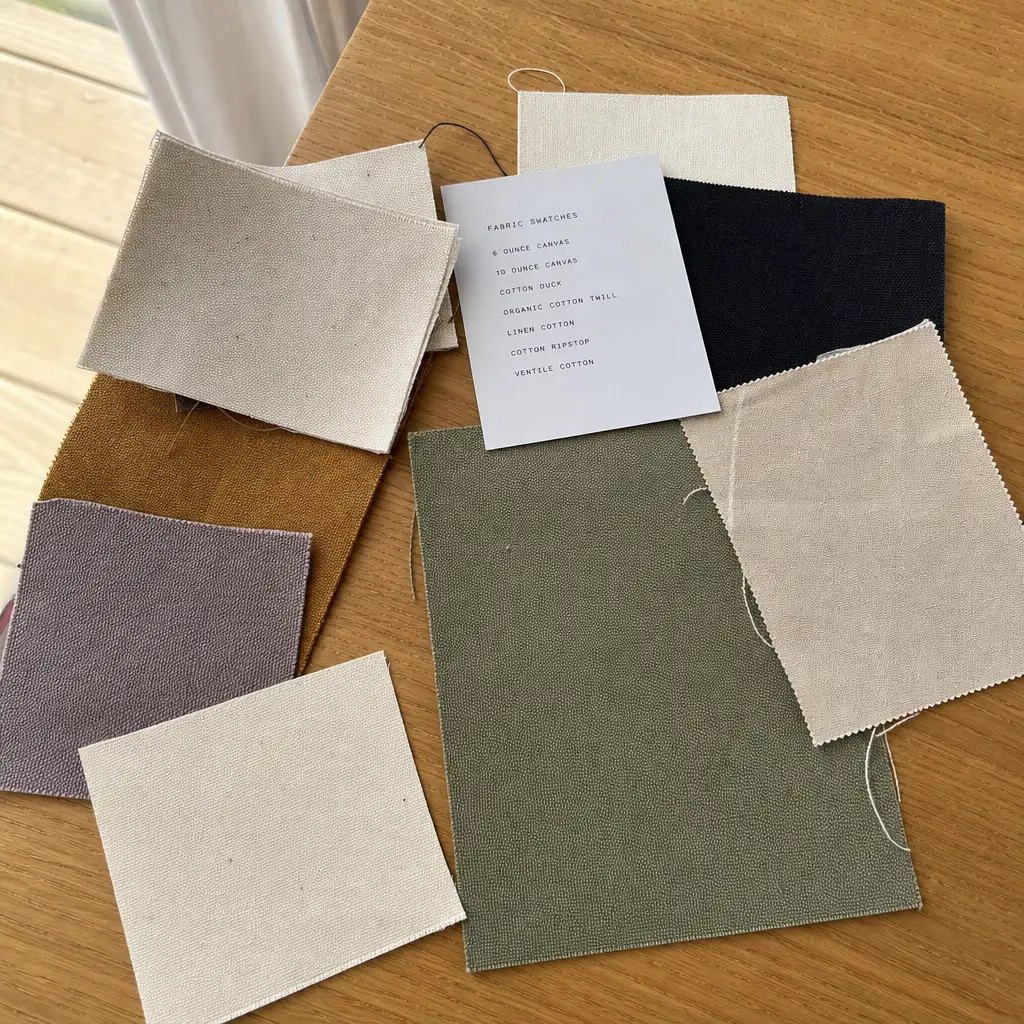
Finish and color need early decisions. Natural cotton gives an unbleached look, but buyers should approve a swatch standard for shade, seed flecks, and acceptable fabric character. Bleached cotton gives a cleaner white base but can show dirt and handling marks more clearly. Dyed cotton improves brand coordination but adds lab dip approval, shade control, and possible colorfastness checks. Organic or recycled cotton can support sustainability requirements, but the buyer should specify certificate scope, transaction documentation, label claim, and any logo-use rules instead of using vague environmental language.
- 100-120 GSM: budget handout range, light contents, lower opacity, higher risk of transparent fabric and weak presentation.
- 140-160 GSM: common exhibitor giveaway range with usable print support and controlled freight volume.
- 180 GSM: stronger handfeel for sponsor gifts, cosmetics, wellness products, and branded sample kits.
- 200 GSM and above: better structure and reuse value, but higher carton volume and stricter closure checks.
- Natural cotton: approve the swatch standard for shade, seed flecks, lint level, and acceptable variation.
- Dyed cotton: request lab dips and check shade consistency across cutting rolls and production lots.
- Organic or recycled cotton: define certificate scope and claim wording before the supplier quotes.
Construction Details That Decide Durability
A drawstring pouch has few components, so every construction decision is visible. The drawcord channel should be folded cleanly, stitched evenly, and strong enough to resist repeated opening and closing. The side seams should be secure near the channel opening because pulling force concentrates there. The bottom seam and lower corners need attention when the pouch carries heavier samples or when the insert has hard edges. A pouch can look fine in a product photo and still fail after several pulls if stress points are weak.
Double-fold channel construction is usually preferable for trade show orders because it gives cleaner edges and better resistance to fraying. A raw or poorly folded channel can shed threads, catch the cord, or look unfinished when the pouch is open. Stitch density should be consistent enough to hold the fabric without creating puckering that distorts the print area. Loose threads can often be trimmed, but skipped stitches, broken seams, raw edges, and uneven side seams should be counted as workmanship defects.
Cord choice affects both function and perceived value. A 3-5 mm cotton cord is common for standard exhibitor pouches. Flat cotton tape feels softer and more premium but usually needs a wider channel and more careful folding. Very thin cord may reduce cost, but it can cut into fabric, slip through knots, or make the pouch feel cheap. The RFQ should state cord material, cord diameter or tape width, cord color, knot style, finished cord length range, and whether the pouch is one-sided or two-sided draw.
- Use double-fold channel construction for cleaner appearance and better resistance to fraying.
- Inspect cord exit points for tearing, raw fabric, skipped stitches, and uneven folding.
- Open and close sampled pouches repeatedly instead of checking only the closed appearance.
- Check whether the pouch closes symmetrically and whether cord lengths match within the approved range.
- Review stitch density, side seam straightness, bottom corner strength, and puckering around the print area.
- For promotions involving children or regulated categories, confirm drawcord safety expectations with the buyer's compliance team before production.
Logo Printing and Placement Controls
Most cotton drawstring pouches for trade show exhibitors use screen print because it performs well for solid logos, sponsor names, event marks, and one to three color designs. The buyer should specify print size, print side, placement, Pantone or brand color target, number of colors, and whether the logo must be centered on the flat pouch or centered on the visible filled pouch. That distinction matters because fabric shifts when the pouch is filled, especially around bottles, boxes, jars, and rounded samples.
Procurement should ask whether printing happens before sewing or after sewing. Printing before sewing can improve flat print quality and production efficiency, but placement must account for cutting and sewing tolerance. Printing after sewing can help align the logo to the finished pouch, but seams, folds, and drawcord channels may limit screen placement. Either process can work if the supplier states the method and agrees on measurable placement tolerance before bulk printing.
Heat transfer can be useful for gradients, full-color artwork, small details, or many low-quantity sponsor versions. It needs closer testing on cotton texture because transfer edges may lift, feel glossy, appear plastic, or crack when folded. Digital printing can suit short runs or complex artwork, but buyers should test color consistency, pretreatment marks, and rub resistance. The safest print method is usually the one the supplier runs frequently on the selected cotton fabric and can prove through a strike-off.
- Require vector artwork for logos, sponsor marks, QR codes, and small text where possible.
- Set print placement tolerance, often +/-3-5 mm for smaller pouches when tight centering matters.
- Approve a printed strike-off on actual fabric, not only a paper proof or digital mockup.
- Measure logo position from fixed reference points such as side seam, bottom edge, drawcord channel, or approved centerline.
- For dark dyed cotton, confirm whether an underbase is needed to keep the logo color accurate.
- For sponsor logos, approve Pantone target, clear space, minimum text height, and print side before screens or transfers are made.
- Check dry rub, bend, stacking behavior, and odor before mass packing printed pouches.
MOQ, Version Splits, and Event Complexity
Trade show programs often include many versions: one event logo, several sponsor logos, private-label distributor marks, regional versions, booth-specific packs, or different destination labels. The lowest practical unit price usually comes from keeping fabric, size, construction, cord, print side, and print position the same while changing only the logo. When every exhibitor requests a different size, cotton color, cord color, print method, and packing style, the order becomes many small productions instead of one efficient bulk run.
A strong RFQ separates the base pouch order from the version split. For example, a buyer might request 10,000 pieces of the same 160 GSM natural cotton pouch, split into five one-color logos of 2,000 pieces each. The factory can then calculate fabric cutting efficiency, screen charges, print changeover, and packing separation. If the same order becomes twenty versions of 500 pieces with different print positions, setup cost rises and inspection becomes more complicated.
Version control should be planned before cutting and printing start. The buyer should tell the supplier whether cartons must be separated by logo, booth number, region, kit type, sponsor, or destination. If the order will go to a kitting center, carton sequence may matter as much as carton count. For distributor programs, a small approved overrun per version can help with sponsor approvals, replacement kits, sales samples, and event damage. The overrun should be intentional, labeled, and invoiced clearly.
- Group versions by same size, same fabric, same cord, same print side, and same print position whenever possible.
- Ask the supplier to quote both total quantity and per-version quantity so setup cost is visible.
- Expect separate screen, setup, or transfer charges for each logo and print color change.
- Use transfer or digital print only when it fits the artwork, quantity, handfeel, and quality standard for low-version runs.
- Keep inner packs and cartons separated by version unless the mix is planned and clearly marked.
- Build a controlled spare quantity into important sponsor, distributor, and event versions.
Sample Approval That Mirrors Bulk Production
A pre-production sample is only useful if it represents the real order. It should use the actual GSM fabric, cotton color, drawcord, sewing construction, print method, and packing method. A sample made from stock fabric can help confirm rough size or shape, but it should not be treated as final approval for fabric handfeel, color, print result, or drawcord behavior. For show-critical shipments, the approved sample becomes the inspection standard, so shortcuts at this stage create risk later.
A two-step sample process often works well. First, approve a blank fit sample using the actual insert or a dimensionally accurate substitute. This confirms finished size, internal height, opening width, cord function, and logo area before artwork production cost is locked in. Second, approve a printed strike-off or full pre-production sample on actual fabric. This confirms color, print position, ink handfeel, drying, flex behavior, and appearance when the pouch is filled.
The buyer should document sample approval with measurements and photographs. A ruler photo helps avoid disputes about finished size and logo position. The approval file should record fabric GSM, shade reference, drawcord length, channel height, print dimensions, Pantone target, packing method, and any approved exceptions. One sealed sample should stay with the factory production team, and one should be available to the buyer or inspection team for final comparison.
- Test the sample with the actual product, insert card, coupon, cable, bottle, jar, tube, or boxed item.
- Open and close the pouch repeatedly to check drawcord sliding, knot security, and channel strength.
- Photograph the approved sample flat and filled, with a ruler showing size and logo placement.
- Perform a simple dry rub test and bend test on the print before bulk approval.
- Record acceptable natural cotton flecks, shade characteristics, and handfeel against the approved swatch.
- Seal one approved sample for factory reference and keep one for final inspection comparison.
- Do not approve bulk cutting until material, size, construction, print standard, and packing plan are aligned.
Inspection Levels, Defect Classes, and AQL Use
Inspection criteria should be measurable. Words such as good quality, clean sewing, or acceptable print are too vague when a third-party inspector or factory QC team must decide whether goods can ship. For cotton drawstring pouches, the inspection plan should cover finished size, usable internal height, fabric appearance, sewing workmanship, drawcord function, print position, print durability, packing count, version separation, and carton condition. The buyer should define critical, major, and minor defects before production starts.
For most trade show orders, wrong logo, wrong size, missing drawcord, broken seam, severe stain, wet print, and mixed carton versions should be treated as major or critical because they can stop kitting or make the pouch unusable at the booth. Small loose threads may be minor if they can be trimmed without damage. Oil marks, mildew odor, dirty handling marks, and obvious shade bands are more serious on natural cotton because the pouch is part of the brand presentation.
AQL sampling can provide the statistical framework for shipment acceptance, but cotton pouches also need targeted functional checks. An inspector should measure sampled pieces, compare print placement to the approved reference, pull the cords, inspect the channel opening, check bottom corners, and verify inner pack counts. If the order includes many logo versions, the inspector should sample each version instead of only checking the largest batch. Version mistakes are operational defects, not cosmetic details.
- Finished size: define tolerance by pouch size, commonly +/-5 mm for small pouches and +/-8 mm for larger pouches.
- Usable height: measure below the drawcord channel to confirm the product can fit and close.
- Print placement: measure from fixed reference points such as side seam, bottom edge, or approved logo centerline.
- Seam strength: pull lightly at side seams, bottom corners, and cord channel openings.
- Cord function: open and close sampled pouches several times to detect tight channels, slipping knots, and uneven cord length.
- Fabric appearance: reject obvious stains, holes, severe slubs, dirty marks, shade bands, odor, and fabric damage.
- Packing accuracy: count inner packs and cartons by version before cartons are sealed for shipment.
- Inspection photos: require front, back, inside seam, cord channel, print close-up, carton label, and packed carton views.
Packing and Carton Marks for Event Warehouses
Packing is not an afterthought for trade show exhibitors. Many orders ship directly to event warehouses, booth builders, fulfillment centers, distributor cross-docks, or sales teams that do not have time to sort unclear cartons. If carton marks are incomplete, the buyer may pay extra labor to open, identify, and repack cartons under deadline pressure. The factory quote should state whether pouches are bulk packed, bundled, individually polybagged, paper banded, barcoded, or grouped by exhibitor kit.
Flat packing is usually better than aggressive compression because it protects printed panels and makes the pouches easier to handle during kitting. Over-compressed cartons can crease the logo area, deform cords, and make natural cotton look messy when unpacked. Printed pouches must be fully cured before stacking; otherwise ink transfer, blocking, odor, or carton staining can appear after transit. If the buyer requests individual polybags, the specification should include bag material, warning requirements where relevant, barcode position, and whether cords must be tucked inside.
Carton marks should be practical for warehouse teams. At minimum, they should show PO number, item name, pouch size, cotton color, logo version, quantity, carton number, and destination if the shipment is split. For event programs, adding booth number, sponsor name, region, or kitting sequence can reduce receiving errors. If mixed cartons are unavoidable, the carton label should clearly list the mix by version and quantity. Unmarked mixed cartons are one of the easiest ways to create avoidable event-day problems.
- Separate inner packs by logo version, destination, booth, region, sponsor, or kit type as required by the event plan.
- Do not mix different sponsor logos unless the mix is intentional and printed on the carton label.
- Use carton labels that match the purchase order and packing list exactly.
- Confirm pieces per inner bag, inner bags per carton, carton quantity, gross weight, and carton dimensions.
- Keep printed panels flat enough to avoid permanent creasing, blocking, or ink transfer.
- Request carton photos before shipment when the goods move directly to a show warehouse.
- For air freight, confirm carton dimensions early because volume weight can change landed cost significantly.
Quote Comparison and Lead Time Discipline
The cheapest pouch quote is not always the best trade show quote. Procurement should compare unit price together with sample time, material readiness, bulk production time, print curing time, inspection window, packing time, export handling, and freight cutoff. Natural cotton stock fabric may shorten the schedule, while dyed cotton, custom cord color, complex logo printing, individual packing, and barcode labeling can add days. If the event date is fixed, the schedule should include approval buffers and possible rework time, not only factory sewing time.
Quote comparison should expose costs that often sit outside the headline unit price. These include screen charges, artwork adjustment, sample fees, dyed fabric minimums, lab dips, transfer setup, inner packing, individual polybags, barcode labels, carton marking, export carton upgrades, inspection support, and freight estimates. A supplier who gives clear quote data makes landed-cost comparison easier and reduces late surprises. For importers and distributors, clarity around schedule and packing can be more valuable than a small unit price difference.
The final RFQ should connect the pouch specification to the event deadline. Ask when lead time starts: deposit date, artwork approval, material approval, sample approval, or receipt of the final version list. Then build the calendar backward from the required arrival date. Include time for buyer review, sponsor approval, sample shipping, final inspection, carton correction if needed, and freight booking. This schedule discipline turns a simple cotton pouch into a controlled procurement item.
- Request unit price by quantity tier, such as 1,000, 3,000, 5,000, and 10,000 pieces.
- Separate pouch cost, print setup, sample cost, packing upgrade, carton labeling, inspection support, and freight estimate.
- Confirm whether lead time starts after deposit, artwork approval, sample approval, material readiness, or final version list.
- Reserve time for final inspection and possible rework before vessel, courier, or air shipment cutoff.
- Request estimated CBM, gross weight, carton dimensions, and pieces per carton for landed-cost comparison.
- For show-critical goods, compare sea freight savings against the risk and cost of late arrival.
- Require the final proforma invoice, packing plan, and artwork version list to match before bulk production starts.
Specification comparison for buyers
| Spec decision | Recommended option | When it fits | Buyer risk to check |
|---|---|---|---|
| Fabric weight | 140-180 GSM cotton for most exhibitor giveaways; 200 GSM or heavier for reusable sponsor gifts, electronics accessories, or heavier retail samples | Good balance for cosmetics samples, cables, literature packs, badge accessories, snack kits, and post-show reuse | Below 120 GSM may be transparent and weak; above 200 GSM increases carton volume, freight cost, and closure stiffness |
| Fabric finish | Natural cotton for an unbleached look; bleached cotton for a cleaner white base; dyed cotton when brand color control is required | Natural works for wellness, organic, craft, sustainability-led, and general event kits; dyed fabric suits coordinated sponsor programs | Natural cotton can show seed flecks and shade variation; dyed fabric needs lab dip approval, shade band checks, and colorfastness review |
| Finished size | Specify finished external size plus usable internal height below the drawcord channel | Works when the pouch must hold a real sample, box, jar, cable kit, card set, or giveaway bundle | Flat size alone can mislead; thickness can prevent closure or distort the logo when the pouch is filled |
| Size tolerance | Usually +/-5 mm for small pouches and +/-8 mm for larger pouches, unless the buyer approves another tolerance | Useful for kitting accuracy, product fit, and logo alignment across bulk production | Loose tolerances can create mixed fit results, especially when the insert nearly fills the pouch |
| Pouch construction | Double-fold drawcord channel, locked side seams, secure bottom seam, clean corners, and consistent stitch density | Best for repeated handling during booth setup, visitor distribution, and reuse after the event | Raw or single-fold channels can fray; weak stitching near cord exits can tear during pulling |
| Drawcord type | 3-5 mm cotton cord for standard use; flat cotton tape for a softer premium feel; two-sided draw for faster closure on larger pouches | Cotton cord suits high-volume exhibitor giveaways; flat tape fits beauty, wellness, lifestyle, and boutique sampling | Thin cords can slip through knots or cut into the channel; oversized cords can bind if the channel is too narrow |
| Print method | Screen print for 1-3 solid colors; heat transfer or digital print only after rub, flex, and adhesion checks on actual cotton | Screen print is usually efficient for trade show quantities, repeat sponsor marks, and solid color logos | Heavy ink can crack on folds; transfer edges can lift on textured cotton; digital color may vary between runs |
| Version control | Keep the same pouch size, fabric, cord, print side, and print position; split only by logo or destination where possible | Helps agencies, distributors, and event buyers consolidate production while supporting multiple sponsors or exhibitors | Too many small variants increase setup cost, mixed packing risk, inspection time, and rework cost |
| Packing method | Flat pack in inner bags by logo version, with carton labels showing PO, item, size, color, logo version, quantity, carton number, and destination | Best for event warehouses, booth builders, fulfillment centers, distributor cross-docks, and direct-to-show shipments | Mixed logos in one carton create pick errors; over-compressed cartons can crease prints or deform drawcords |
Buyer checklist before sampling
- Confirm the real packed item first: dimensions, thickness, weight, sharp corners, surface texture, and whether insertion will happen at the factory, kitting warehouse, distributor, or booth.
- Specify finished external pouch size and usable internal height below the drawcord channel; include tolerance instead of relying on a flat mockup.
- Define cotton fabric weight in GSM, fabric state, weave if required, and finish: natural, bleached, dyed, organic, recycled, washed, or unwashed.
- Request fabric swatches for shade, handfeel, weave, opacity, lint level, and seed fleck standard before approving a quotation for bulk production.
- Specify drawcord material, diameter or tape width, color, knot style, cord length range, channel width, and whether the pouch uses one-sided or two-sided draw.
- Attach vector artwork and confirm print method, Pantone or brand color target, number of colors, logo dimensions, print side, and placement tolerance.
- Request a printed strike-off on actual fabric before the full pre-production sample when logo color, small text, transfer adhesion, or ink handfeel matters.
- Approve a pre-production sample made with actual fabric, actual cord, actual construction, actual logo method, actual size tolerance, and actual packing method.
- Test the approved sample with the real insert for closure, logo visibility, pouch bulging, fabric transparency, cord sliding, and kitting speed.
- Define inspection thresholds for stains, holes, shade bands, broken stitches, skipped stitches, raw edges, loose threads, drawcord defects, print skew, tacky ink, and carton mislabeling.
Factory quote questions to send
- What cotton GSM, weave, yarn style if known, and finish are you quoting, and is the GSM measured before or after washing, dyeing, or finishing?
- Is the quoted size the finished external pouch size, the flat cut size, or the usable internal size below the drawcord channel?
- What finished size tolerance, cord length tolerance, print placement tolerance, carton quantity tolerance, and shade tolerance are included in your standard production?
- Which print method is included in the unit price, and how many colors, screens, transfer sheets, artwork setups, or print changes are included?
- Will the pouch be printed before sewing or after sewing, and how does that affect logo placement near side seams, bottom seams, or the drawcord channel?
- What is the MOQ for the same size and fabric if the order is split across several exhibitor, sponsor, distributor, or regional logo versions?
- What separate charges apply for screens, artwork cleanup, sampling, dyed fabric, lab dips, custom cord color, individual packing, barcode labels, carton marks, and export cartons?
- Can you provide fabric swatches, cord samples, lab dips, printed strike-offs, and a sealed pre-production sample before bulk production?
- How many working days are required for material sourcing, sample making, sample revision, bulk cutting, printing, curing, sewing, final inspection, packing, and export handover after approval?
- What packing is included: bulk carton, inner polybag, individual polybag, paper band, barcode label, destination label, carton mark, or master carton only?
Quality-control points to confirm
- Finished size should normally be controlled within +/-5 mm for small pouches and +/-8 mm for larger pouches unless the buyer approves wider tolerance in writing.
- Usable internal height must be checked below the drawcord channel because total pouch height can look correct while the packed item still prevents proper closure.
- Fabric weight should match the approved swatch and quoted GSM; random rolls should be checked for shade difference, slubs, holes, oil marks, stains, excessive lint, odor, and handling dirt.
- Natural cotton seed flecks should be judged against the approved swatch; severe dark marks, oil stains, mildew odor, dirty smudges, or color bands should not be accepted as normal natural variation.
- Seams should be straight, locked at stress points, and free from skipped stitches, broken threads, raw edges, puckering, and distortion that affects the printed panel.
- Drawcord channels should be folded evenly, stitched securely, and wide enough for the cord or tape to slide without binding during repeated opening and closing.
- Drawcords should close the pouch evenly and resist a practical pull test without tearing the channel, slipping through the knot, or leaving one side visibly shorter than the other.
- Print position should be measured from fixed pouch edges or approved reference points, not judged by eye; trade show logo tolerance should be agreed before production.
- Ink or transfer should pass dry rub testing and reasonable bend or flex testing, especially where the pouch folds during flat packing or kitting.
- Printed pouches should be fully cured and dry before stacking to avoid ink transfer, blocking, odor, smearing, or carton staining.