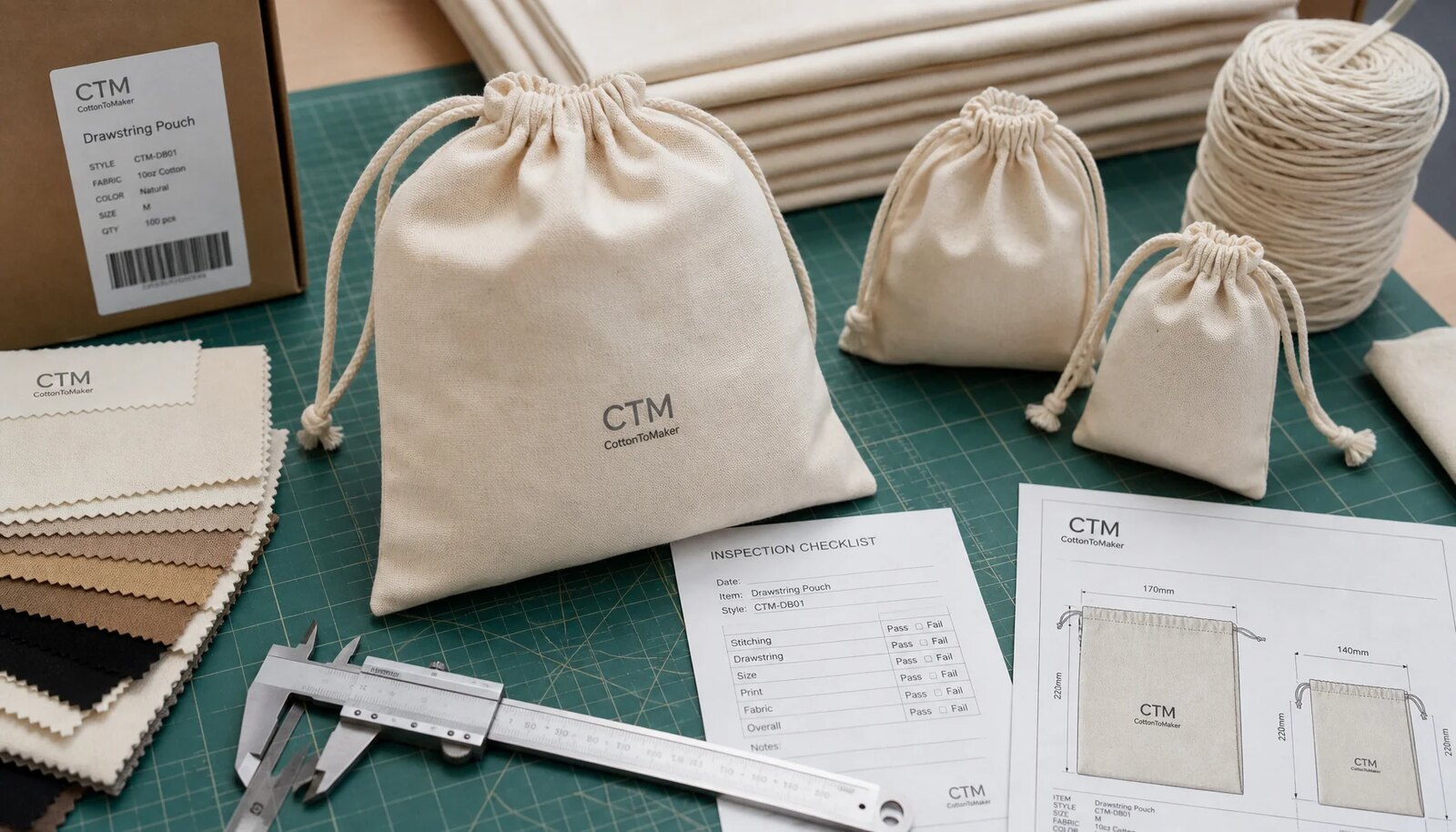
Why a Simple Pouch Still Needs Control
Cotton drawstring pouches for craft fairs look simple. That is exactly why sourcing teams sometimes under-specify them. A bulk order can involve fabric sourcing, cutting, sewing, drawstring assembly, printing, trimming, labeling, packing, carton marking, and export paperwork. If the RFQ only says “natural cotton pouch, logo, 1,000 pieces,” every supplier fills the gaps in a different way.
One quote may assume 5 oz cotton and loose bulk packing. Another may include 8 oz canvas, barcode labels, and stronger cartons. A third may look cheaper because screen setup, sample courier charges, inspection support, or inland freight are missing. The unit price is not comparable until the construction, decoration, packing, and terms are comparable.
The practical risk is not just paying too much. A pouch can fail when a booth team uses it, when a distributor receives it, or when a retail customer checks compliance paperwork. Common problems include transparent fabric, cords that fray, seams that split around handmade ceramics, logos printed too close to the channel, cartons mixed by SKU, and unsupported claims such as organic or recycled cotton.
A supplier compliance checklist keeps the order grounded. It connects the RFQ, quotation, sample, purchase order, production run, inspection, packing, and receiving process before fabric is cut. The purpose is not to make a low-cost accessory difficult. It is to remove vague assumptions before they become rework, air freight, rejected cartons, or missed selling dates.
- Use the checklist before sending the RFQ so suppliers quote the same finished pouch.
- Treat the pouch as branded packaging if it carries a logo, barcode, retail label, or gift-set role.
- Ask for evidence, not broad claims: photos, documents, sample records, and measurable tolerances.
- Compare suppliers by fabric, cord, construction, decoration, packing, QC scope, and Incoterm.
- Control revisions so artwork, swatches, label data, and packing instructions do not drift during production.
Start With the Craft Fair Use Case
The right pouch depends on what it needs to hold. Jewelry, soap, candles, ceramics, stationery, seed packets, cosmetics, small toys, and handmade accessories place different demands on fabric weight, opacity, opening width, seam strength, cord feel, and booth presentation. A light cotton pouch may work well for earrings. The same pouch can look weak or transparent around a ceramic ornament.
Begin the specification with the filled product, not the pouch alone. Share the product dimensions, approximate filled weight, whether corners are sharp, whether the item may stain fabric, whether odor transfer matters, and whether the pouch is used as gift packaging, retail packaging, reusable storage, or a wholesale add-on. Good suppliers can then recommend construction instead of defaulting to the cheapest stock cotton.
Craft fair packaging often has two jobs. It protects the item after purchase, and it carries the maker’s brand in a very visible way. A soap pouch may need opacity and odor neutrality. A jewelry pouch may need a smoother cord, clean fine-line printing, and a smaller finished size. A pottery pouch may need stronger seams, a wider opening, and faster packability during busy booth hours.
Do not approve only an empty sample if the pouch will carry a real product. Fill it. Stack it. Pull the cord. Check how it looks when handed to a customer. Empty pouch approval is useful, but it does not reveal corner pressure, seam stress, fabric show-through, or how quickly staff can pack purchases.
- Jewelry, charms, seed packets, sample cosmetics, and lightweight accessories often suit 5 oz to 6 oz cotton when edges are smooth.
- Soap bars, candles, ornaments, small pottery, and gift sets often benefit from 8 oz cotton or light canvas.
- Premium reusable packaging may use 10 oz canvas, but buyers should account for thicker channels, heavier cartons, and higher freight weight.
- Food-adjacent use should be defined carefully; standard cotton pouches should not be assumed to be direct food-contact packaging.
- Fragile, angular, oily, scented, or dark-colored products should be tested inside the actual pouch before bulk approval.
Build a Production-Ready RFQ
A strong RFQ describes the pouch in production language. Finished size means the sewn pouch measured flat after cord insertion. Cut-panel size is an internal factory measurement and should not be used as the buyer’s final size reference. If the pouch is tight-fitting, opening width and usable internal height may matter as much as overall width and height.
Fabric weight should be stated with one primary unit and a tolerance. Many factories quote cotton in ounces per square yard, while buyers often use GSM. Approximate conversions help discussion: 5 oz cotton is often near 170 GSM, 6 oz near 200 GSM, 8 oz near 270 GSM, and 10 oz near 340 GSM, depending on weave and finishing. The purchase order should still state the actual approved fabric, not rely only on a conversion chart.
Cord details deserve the same attention as fabric. Cotton cord supports a natural look but may vary in twist, shedding, and smoothness. Polyester cord can slide smoothly and resist fraying, but it changes the material story. Self-fabric tape gives a handmade look and may need a wider channel. State cord material, diameter or tape width, color, exposed length, knot or end treatment, and closure performance.
Construction details should be visible in the sample and written into the specification. The supplier should know the drawstring style, channel width, stitch density, seam allowance, thread color, bottom corner reinforcement if any, and whether loose threads are acceptable after trimming. If the pouch will hold heavier handmade goods, ask the supplier to confirm a practical filled-weight target.
- Size field: finished width x height in millimeters, measured flat after sewing and cord insertion, with tolerance.
- Fabric field: fiber content, weave, color, finish, nominal weight, tolerance, approved swatch reference, and certification claim if any.
- Cord field: material, diameter or tape width, color, exposed length, end treatment, and pull-function requirement.
- Construction field: drawstring style, channel width, stitch density, seam allowance, bottom corner strength, and thread color.
- Decoration field: method, artwork file, Pantone color, print size, placement, tolerance, and sample approval status.
Control Fabric Claims and Tolerances
Cotton fabric is not defined by weight alone. Yarn, weave density, finish, natural specks, slubs, shrinkage, opacity, and shade all affect the final pouch. A loose-weave 8 oz fabric can feel less stable than a tighter fabric with a similar nominal weight. A softened or washed finish may feel better in the hand but can influence size stability and shade consistency.
Material language must be precise. Natural cotton does not automatically mean organic, chemical-free, unbleached, undyed, or recycled. Recycled cotton content should not be stated unless the supplier can document the claim. Organic cotton claims should identify whether the certification covers fiber, fabric, or finished goods, and whether transaction documentation is available for the order.
Dyed pouches need additional controls. Request lab dip approval for custom colors, define shade tolerance, and confirm the colorfastness expectations that match the use case. Dark cotton may require different ink, a white underbase, longer curing, or a different decoration method. If several pouch sizes will be displayed together as a coordinated set, shade-lot variation matters.
Natural cotton has its own approval issue: buyers often expect a clean handmade look, not a perfectly white fabric. The approved swatch should show the acceptable range of cream tone, specks, slubs, weave texture, and opacity. Without that reference, one shipment may look warm and rustic while the next looks grey, thin, or inconsistent.
- RFQ example: natural cotton drawstring pouch, finished size 120 x 160 mm, 6 oz cotton, approximately 200 GSM, fabric-weight tolerance ±5 percent, natural shade within approved swatch range.
- For retail programs, request a signed swatch or sealed reference sample from the fabric lot or approved equivalent lot.
- For repeat orders, keep a dated reference swatch labeled with supplier, PO, revision, fabric weight, color, and approval owner.
- For natural cotton, define acceptable specks, slubs, shade variation, and opacity instead of expecting bleached-white consistency.
- For organic or recycled claims, request certificate scope and approved claim language before using the claim commercially.
Set Artwork and Branding Rules Early
One-color screen printing is common for craft fair pouches because it is economical and works well for simple logos on cotton. Still, the print area is small. A logo that looks clear on a website header or tote bag can become crowded on a 100 mm pouch. Before sampling, review the artwork at actual print size.
Digital printing and heat transfer can help with full-color artwork, gradients, seasonal designs, and short runs with many versions. They may change handfeel, edge appearance, rub resistance, and wash behavior. Embroidery can feel premium, but on small or thin pouches it can pull the fabric, distort the shape, or create puckering. A woven side label may be better when the same brand mark must work across several pouch colors.
Artwork approval should be measurable. State the print size in millimeters, distance from the side seams, distance from the bottom edge, and clearance from the drawstring channel. For screen printing, confirm the number of colors, Pantone references, setup charges, screen charges, repeat-order charges, and whether printing happens before or after sewing. For multi-color prints, registration tolerance must allow for fabric movement.
Do not rely on digital mockups alone. A physical sample on the real or approved-equivalent fabric is the best way to judge opacity, ink edge, handfeel, print position, and color. If the supplier uses sample-room fabric or substitute ink, write that limitation into the approval notes and require a bulk-line first piece before full production.
- For simple logos, provide vector artwork, Pantone reference, print size, placement from edges, and placement tolerance such as ±3 mm to ±5 mm depending on pouch size.
- For fine detail, ask the supplier to confirm minimum line width, minimum gap width, and smallest readable text height before sample making.
- For dark dyed pouches, confirm whether a white underbase is required and whether it changes opacity, cost, curing time, and handfeel.
- For full-color artwork, approve a physical print on actual fabric rather than only a digital mockup or paper proof.
- For QC, define rejection rules for bleeding, ghosting, ink transfer, weak opacity, registration error, scorch marks, stains, and off-position prints.
Check Supplier Evidence, Not Just Claims
Supplier compliance should be tied to the actual pouch order. A company profile does not prove the supplier can hold a 5 mm size tolerance, keep cord lengths consistent across 10,000 pieces, or pack six SKUs without mixing. Ask where each production step happens and who owns corrective action if defects appear.
This matters even more when a trading company coordinates cutting, sewing, printing, labeling, and packing across several workshops. Trading companies can be useful, especially for mixed orders and export support, but responsibility must be clear. If the print shop causes a defect, the buyer should not be stuck between the seller, sewing workshop, and printer.
For many craft fair pouch orders, a full factory audit may not be necessary. Basic evidence still helps. Ask for non-confidential photos of similar pouch production, material storage, cutting tables, sewing lines, print setup, inspection tables, and packing. First-piece records and final inspection photos are more useful than generic phrases such as “high quality” or “professional service.”
Compliance documents depend on the destination market and sales channel. Some buyers need only a commercial invoice, packing list, and material composition statement. Retail or regulated programs may need REACH-related declarations, Prop 65 review, CPSIA relevance, restricted-substance forms, packaging material declarations, organic cotton chain documents, or recycled-content proof. Confirm these needs during quotation, because compliant materials and testing can affect cost and lead time.
- Confirm business license, production address, export experience, and whether the supplier has shipped textile accessories to the destination market.
- Request material composition statements for fabric, cord, print ink or transfer film, labels, polybags, paper bands, inserts, and cartons if needed.
- Require disclosure of subcontracted dyeing, printing, embroidery, labeling, or packing before the PO is issued.
- Ask for comparable production photos showing similar fabric weight, pouch size, cord construction, branding method, and packing style.
- Check whether the supplier has incoming-material inspection, in-process inspection, final inspection, and nonconforming-goods handling procedures.
Approve Samples With Measurements
A photo sample can confirm the general look, but it cannot prove handfeel, opacity, odor, cord function, seam strength, print rub resistance, or packing quality. For branded or retail-ready pouches, the pre-production sample should use actual or confirmed-equivalent bulk fabric, production cord, real decoration method, intended label, and intended packing.
Sample review should be physical and specific. Measure the finished width and height flat. Check the opening width. Pull the drawstring repeatedly. Inspect the cord ends. Review seam allowance and stitch density. Compare print placement against the specification. Insert the actual product and judge the filled pouch, not only the empty one.
The approved sample should become a controlled production reference. Label it with supplier name, PO or project number, approval date, fabric specification, cord specification, decoration method, packing method, and revision. Keep one approved sample with the buyer and require the supplier to keep one matching sample at the production site.
If the sample room and bulk factory are different, add a first-piece control step. Require photos or a physical first-piece sample from the actual bulk line before full production continues. This prevents a clean sample-room pouch from becoming a bulk shipment with different fabric shade, cord length, stitching, or print position.
- Common finished-size tolerance is ±5 mm for many small and medium pouches; very small or tight-fit pouches may need tighter tolerance agreed before sampling.
- Common print-placement tolerance is ±3 mm to ±5 mm depending on artwork size, pouch size, fabric movement, and print method.
- Cord testing should include repeated open-close cycles and a normal customer pull to check slipping, knot security, channel friction, and tearing.
- Seam review should cover stitch density, skipped stitches, seam allowance, raw edges, loose threads, puckering, and bottom corner strength.
- Sample approval notes should list deviations allowed for bulk and issues that must be corrected before production.
Normalize MOQ and Price Breaks
MOQ is not one number. It depends on fabric availability, pouch size, color, cord sourcing, decoration method, label requirements, packing method, and SKU count. Natural cotton with standard cord usually supports lower MOQs than custom dyed cotton, certified fabric, special cord colors, embroidery, or individual retail packing.
A supplier may accept a low quantity, but the unit cost can rise because setup, sampling, cutting loss, sorting, and packing labor are spread across fewer pieces. Procurement buyers should ask where cost breaks occur, not only what the minimum order is. Quote breaks at 500, 1,000, 3,000, 5,000, and 10,000 pieces often show where production efficiency improves.
For distributors serving craft fair sellers, standardization can reduce cost. Using the same natural cotton, cord, and packing method across several pouch sizes may be cheaper than treating each size as a separate custom project. Logo versions can still vary, but the base material and trim platform remain stable.
To compare suppliers fairly, normalize the quote. Every supplier should price the same finished size, fabric weight, cord, branding method, packing, inspection scope, Incoterm, and payment terms. A cheaper quote may only mean the supplier excluded setup, used thinner fabric, assumed bulk cartons, omitted inspection support, or quoted EXW while another quoted FOB.
- Ask whether each size, color, artwork, cord color, and packing version counts as a separate MOQ.
- Separate unit price from screen charges, digitizing charges, sample fees, label costs, packing costs, and inland freight.
- Request quote validity because cotton, dyeing, labor, and freight assumptions can change.
- Clarify overage or shortage tolerance for dyed, printed, or custom-packed orders.
- Compare the same Incoterm such as EXW, FOB, CIF, DAP, or DDP before negotiating price.
Specify Packing and Carton Controls
Packing is easy to overlook because the pouch itself is inexpensive. In practice, packing affects receiving accuracy, warehouse labor, display readiness, and landed cost. Poorly packed pouches can arrive wrinkled, dusty, damp, compressed, mixed by SKU, or labeled with incomplete carton marks.
The RFQ should state whether pouches are bulk packed, bundled, individually packed, or packed as part of a kit. Bulk packing is cheapest but needs reliable count control and SKU separation. Inner bundles help warehouse teams count and pick stock. Individual packing supports retail presentation and barcode scanning, but it increases material use, labor, carton volume, and sustainability review.
If plastic-free packing is required, define the alternative instead of leaving the supplier to guess. Options may include paper bands, kraft envelopes, glassine bags, tissue wrap, carton liners, or carton-only packing. Each option affects presentation, dust protection, moisture exposure, and receiving efficiency.
Carton planning should happen during quotation, not after production. Request carton quantity, dimensions, net weight, gross weight, and carton mark format before approving price. Heavy canvas, inserts, retail labels, or individual packs can increase chargeable weight for air freight. Sea shipments place more emphasis on carton strength, moisture protection, pallet stacking, and container transit conditions.
- Bulk packing should include clean cartons, accurate counts, SKU separation, and liner or moisture protection when needed.
- Inner bundle packing should state bundle count, tie or band material, orientation, and whether mixed colors are allowed in one carton.
- Individual packing should state bag material, thickness if polybagged, closure method, warning text if applicable, barcode position, and sustainability requirements.
- Carton marks should include PO, SKU, color, size, quantity, carton number, gross weight, net weight, origin marking if required, and destination instructions.
- Retail-ready programs should approve barcode data, label artwork, carton layout, and pallet rules before packing begins.
Define Inspection and Defects Before Shipment
Inspection should be agreed before production starts. Buyers can use supplier inspection, third-party inspection, or buyer-arranged inspection depending on order value and risk. If AQL is used, the PO should state inspection level, AQL limits, sample size approach, and defect classification. The key is to describe defects in pouch-specific language, not generic textile terms only.
Critical defects are issues that create safety, legal, or customer rejection risk. Examples may include wrong material claim, sharp metal contamination, mold, severe odor, incorrect barcode, wrong country-of-origin label, or mixed goods that cannot be identified. These should trigger shipment hold until the issue is resolved.
Major defects affect function or saleability. Examples include finished size outside tolerance, seam failure, cord failure, wrong fabric weight, wrong logo, poor print opacity, shade outside the approved range, incorrect packing count, or labels that do not match the SKU. Minor defects are small appearance issues that do not affect function or retail presentation beyond agreed limits.
Inspection should include measurement, function, appearance, and packing checks. Inspectors should measure finished size, cord length, print placement, bundle count, carton count, and label data. Functional checks should include opening and closing the pouch, a light pull on seams and corners, comparison to the approved sample, and a rub check on printed areas. If goods are reworked, define whether reinspection is required and who pays for it.
- Define critical defects such as mold, contamination, wrong compliance claim, incorrect barcode, wrong SKU mix, or unsafe trim issue.
- Define major defects such as size out of tolerance, seam failure, cord failure, wrong fabric weight, wrong logo, poor print opacity, or incorrect packing quantity.
- Define minor defects such as limited loose threads, slight natural cotton specks within approval range, or small cosmetic issues that do not affect saleability.
- Record measurement method, sample quantity, accepted tolerance, and whether results are averaged or judged piece by piece.
- Require failed inspection findings to include photos, defect counts, rework plan, reinspection responsibility, and shipment hold status.
Specification comparison for buyers
| Supplier option | What to verify | Commercial advantage | Buyer risk to control |
|---|---|---|---|
| Direct sewing factory | cord material proof, reinforcement close-ups, load-test photos, approved sample tag, and bulk-line first-piece record | Better sample-to-bulk control and faster production feedback | May be weaker on export paperwork or branded packing unless checked early |
| Trading company | Factory name, production photos, trim-source proof, and who owns QC decisions | Can coordinate small mixed orders and extra services | Markup can hide real factory capability and slow defect decisions |
| Specialized bag workshop | cord diameter, eyelet or reinforced channel, bottom corner reinforcement, seam allowance, bar-tack position, and load target | More practical for detailed construction, trims, and repeat programs | Capacity may be limited during peak seasons |
| Low-price general supplier | 6-10 oz cotton canvas, 210D polyester, rPET, or blended cotton with shrinkage and colorfastness expectations set before sampling | Useful for simple promotional runs with loose specs | Material downgrades, weak packing, and vague inspection scope can erase savings |
| Retail-ready supplier | fold direction, cord protection, bundle count, carton compression, moisture bag, and retail label position | Can handle labels, SKU separation, carton marks, and receiving rules | Higher unit cost must be compared against reduced warehouse work |
| Compliance-focused supplier | Fabric records, labeling review, test plan, and production traceability | Safer for retail programs and repeat brand orders | Documentation claims need evidence, not only sales language |
| Local sample room plus bulk factory | Signed sample, bulk factory handoff, first-piece photos, and deviation owner | Good for complex branding before large production | Sample room quality may not match bulk line unless handoff is controlled |
Buyer checklist before sampling
- Define finished pouch size as width x height measured flat after sewing and cord insertion, not cut-panel size; state tolerance by size class, for example ±3 mm for very small pouches and ±5 mm for common small or medium pouches.
- State fabric specification clearly: fiber content, weave, finish, color, nominal weight in oz/yd² or GSM, agreed tolerance, shrinkage expectation if washing is relevant, and whether the fabric lot must match an approved swatch.
- Clarify whether cotton is natural, bleached, dyed, organic-certified, recycled-content, blended, or merely natural-look; list required evidence before sample approval and before shipment.
- Specify drawstring material, construction, color, diameter or tape width, exposed length, knot or end treatment, and whether the cord must be cotton, polyester, recycled polyester, self-fabric tape, or another trim.
- Provide artwork as vector files for screen print or embroidery where possible, with Pantone references, print dimensions in millimeters, placement from edges or channel, and version-controlled file names.
- Set print tolerances and inspection rules: placement tolerance, color approval method, acceptable ink opacity, rub resistance check, registration tolerance for multi-color prints, and rejection criteria for stains, bleeding, ghosting, or transfer.
- Require a pre-production sample using actual or confirmed-equivalent bulk fabric, cord, print method, label, and packing for retail, branded resale, or repeat sourcing programs.
- Define QC before production: inspection level, AQL if used, critical/major/minor defect examples, measurement method, sample size, rework process, and who pays for reinspection after failed QC.
- Confirm packing details: folding, bundle quantity, inner bag or paper band, carton count, carton dimensions, gross weight estimate, moisture protection, SKU labels, barcode labels, shipping marks, and palletization if needed.
- Require quote breakdown for fabric, cutting, sewing, printing or embroidery, setup charges, sample charges, labels, packing, inland freight, export charges, Incoterm, payment terms, lead time, overage/shortage tolerance, and quote validity.
Factory quote questions to send
- Are cutting, sewing, printing, embroidery, labeling, and packing done in your own facility, or will any step be subcontracted? If subcontracted, who is responsible for defects and delays?
- What fabric weights can you offer for this finished size, and will you quote the weight in oz/yd² and GSM with the production tolerance you can control?
- Is the quoted fabric greige, natural, bleached, dyed, organic-certified, recycled-content, or blended, and what documents can you provide if the claim will be used in buyer-facing materials?
- What is the practical MOQ for this exact size, fabric, cord, print method, color count, and packing method, and what price breaks apply at 500, 1,000, 3,000, 5,000, and 10,000 pieces?
- Can you quote both 6 oz and 8 oz cotton versions using the same finished size, cord, logo, packing, inspection scope, Incoterm, and payment terms so the comparison is fair?
- Which branding method do you recommend for our artwork, and what are the setup charges, screen charges, digitizing charges, color limits, underbase needs, curing requirements, repeat-order charges, and durability limits?
- Can the pre-production sample use production fabric, production cord, and production ink, or will it be made from available sample-room materials? If substitutes are used, how will bulk differences be approved?
- What finished-size tolerance, print-placement tolerance, stitch density, seam allowance, cord-length tolerance, and acceptable shade range will you write on the approved specification sheet?
- How many pouches are packed per bundle, inner bag, master carton, and pallet, and what are the estimated carton dimensions, net weight, gross weight, and carton mark fields?
- What compliance documents can you provide for fabric composition, dyeing, printing ink, cord, labels, polybags, paper bands, cartons, country of origin, and any organic or recycled-content claim?
Quality-control points to confirm
- Finished size must match the approved specification, measured flat after sewing, trimming, pressing if applicable, and drawstring insertion; inspectors should record width and height on a defined number of pieces.
- Fabric weight should be checked against the agreed oz/yd² or GSM tolerance before full cutting starts, using the agreed lot reference and excluding packaging or finishing claims that are not documented.
- Fabric appearance must match the approved swatch for shade, weave density, natural specks, slubs, opacity, odor, stains, and visible contamination under normal retail display lighting.
- Drawstring channel must open and close smoothly without skipped stitches, tight corners, twisted cord, loose threads, cord snags, tearing, or excessive friction that slows packing at a craft fair booth.
- Side seams and bottom seams must resist normal handling for the intended filled product weight, with no seam slippage, popped stitches, exposed raw edges, uneven seam allowance, or weak bottom corners.
- Cord length must remain consistent across the lot, close the pouch securely, and avoid excessive loose ends that cause tangling, poor presentation, or inconsistent bundle packing.
- Print or embroidery must match the approved sample for color, placement, opacity, registration, edge sharpness, density, rub resistance, and cleanliness, with no ink bleeding, heavy stains, ghosting, scorch marks, puckering, or print transfer.
- Labels, hangtags, barcode stickers, care labels, inserts, and carton labels must match buyer artwork, SKU data, placement requirements, country-specific labeling instructions, and retailer receiving rules.
- Natural cotton shade variation must stay within the approved range, especially for retail sets, multi-piece displays, or craft fair suppliers selling pouches as part of a coordinated brand kit.
- Packing must protect pouches from moisture, odor, dust, crushing, carton abrasion, ink transfer, SKU mixing, miscounts, and carton-label errors during export transport and warehouse handling.