Start With the Compliance Problem, Not the Pouch Shape
For university bookstores, cotton drawstring pouches are not difficult products, but they sit inside a difficult buying environment. The item may carry a licensed university logo, move through a procurement system, arrive during a fixed academic calendar window, and be handled by retail staff who cannot spend hours sorting cartons. A supplier compliance checklist keeps the order from becoming a chain of small assumptions.
The most useful checklist starts by separating product compliance, supplier compliance, and receiving compliance. Product compliance covers fabric, construction, print, and safety expectations. Supplier compliance covers factory identity, documentation, inspection control, and export capability. Receiving compliance covers carton labels, SKU separation, barcode needs, packing count, and delivery timing. If these are not written into the RFQ, the lowest quote often omits the work that the bookstore later needs most.
- Use one RFQ line per pouch size, fabric color, and artwork group when cost or MOQ may differ.
- Treat licensed logo handling as a production control issue, not just an artwork approval issue.
- Request evidence that the supplier can control sewing, printing, inspection, and packing under one schedule.
- Define the bookstore receiving method before the factory quotes packing labor and carton labels.
Define the Bookstore Use Case Before Selecting Fabric
A pouch used to package a graduation gift does not need the same fabric as a retail pouch sold beside apparel and stationery. For light gift packaging, natural cotton in the 4 oz to 5 oz range may work if the contents are soft and the printed logo is simple. For bookstore resale or welcome kits that carry chargers, pens, badges, notebooks, or small merchandise, 6 oz to 8 oz cotton canvas is safer because it holds shape better and looks less disposable.
Buyers should request both the commercial fabric name and the measurable weight. Factories may quote by ounces per square yard, GSM, or a local fabric reference. Natural cotton canvas around 170-270 GSM is common for drawstring pouches, but the handfeel changes with yarn count, weave density, washing, bleaching, and finishing. A quote that only says cotton pouch leaves too much room for substitution.
- 4 oz to 5 oz cotton: acceptable for lightweight gift bags, cosmetics, or flat inserts, but less premium for retail.
- 6 oz cotton canvas: balanced choice for campus bookstore pouches with one-color or two-color logos.
- 8 oz cotton canvas: better structure and durability, with higher material cost and sometimes stiffer closure.
- Organic cotton: useful when the retail story requires it, but request certification scope and transaction documentation before quoting.
Choose Construction Details That Survive Retail Handling
Most pouch failures are not dramatic; they are small defects that make the item look cheap on the shelf. Uneven top channels, weak side seams, thin cords, and distorted corners show quickly when a bookstore stacks or hangs the product. The RFQ should describe the construction instead of assuming every supplier builds pouches the same way.
For standard cotton drawstring pouches, specify flat size, finished size tolerance, seam allowance, bottom shape, top channel width, cord diameter, and whether the cord exits on one side or both sides. If the pouch must hold heavier merchandise, the buyer should consider reinforced side seams, thicker cord, and stronger stitching around the channel opening. If it is mainly retail packaging, a clean top fold and consistent drawcord length may matter more than load strength.
- Finished size tolerance: commonly plus or minus 5 mm for small pouches and 10 mm for larger pouches, depending on fabric and construction.
- Cord diameter: often 3 mm to 5 mm for cotton cord; thinner cord reduces cost but can feel weak in retail handling.
- Top channel: must be wide enough for smooth cord movement after washing, pressing, and packing.
- Seam finish: inside overlock or clean seam should be specified if the pouch will be opened repeatedly by customers.
Match Print Method to Campus Artwork Risk
University bookstore artwork usually includes a school name, mascot, crest, department mark, or event identity. These graphics can be sensitive to color and registration. Screen printing remains the practical option for many cotton drawstring pouches because it produces solid logo color, predictable cost at volume, and good opacity on natural cotton. It also works well when several pouch sizes share the same one-color mark.
Heat transfer, digital transfer, or DTG-style printing can be useful for complex multicolor art, gradients, or low quantities, but buyers need to test handfeel and durability. A transfer that looks clean on a sample can feel like a sticker on lightweight cotton. For licensed university marks, poor color matching is not only a quality problem; it may trigger approval rejection. Always provide Pantone references, logo size, placement distance from seams, and whether the supplier must follow a brand guideline sheet.
- Screen print: best for solid marks, larger quantities, and cost-controlled bookstore programs.
- Heat transfer: useful for detailed graphics, but test edge lifting, cracking, and handfeel.
- Digital print: flexible for small runs, but confirm color consistency across fabric lots.
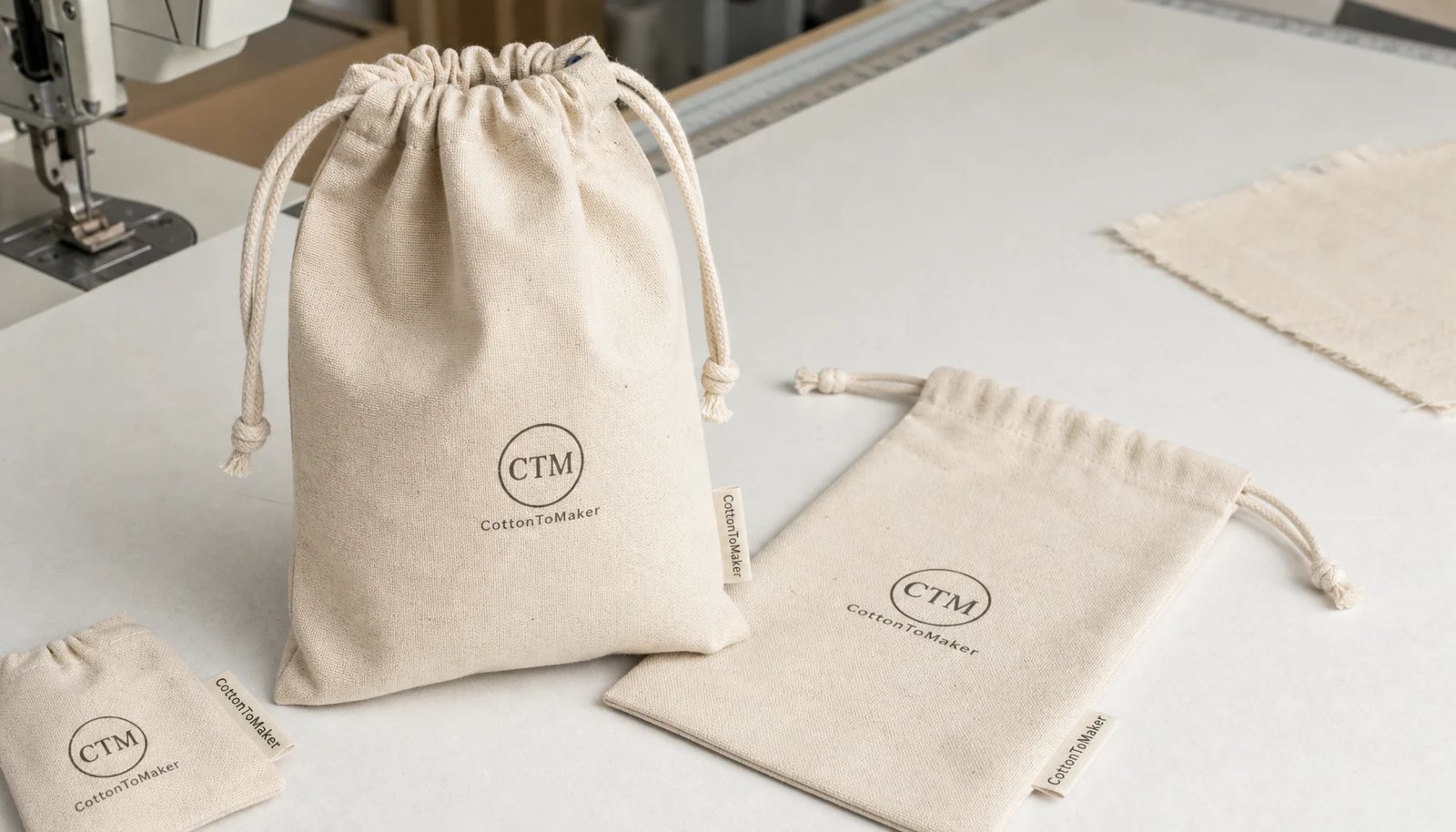
- Woven label or side tag: useful for subtle branding, size information, or CTM-style sample identification.
Understand MOQ Logic Before Comparing Quotes
A cotton drawstring pouch quote can look simple until the buyer separates fabric MOQ, cutting quantity, print setup, color change, and packing labor. A factory may accept 500 pieces for a standard natural cotton pouch, but custom dyed fabric, colored cord, private label sewing, or several artwork versions can push the real economical quantity higher. Procurement teams should not judge only the headline MOQ.
For university bookstores, one common mistake is grouping many small campus departments into one order without telling the supplier the artwork split. A quote for 3,000 pieces with one print is not equal to 3,000 pieces divided across ten department logos. Each screen, ink setup, drying control, inspection batch, and packing separation adds time and cost. The RFQ should show quantity per design and ask the supplier to price the split honestly.
- One pouch size with one natural fabric color and one print design gives the cleanest MOQ and unit cost.
- Multiple artworks increase screen charges, make-ready time, inspection handling, and carton labeling work.
- Custom dyed cotton usually requires higher fabric MOQ and longer lead time than natural cotton.
- Low MOQ can still be valid for samples or test orders, but the unit price should not be used to forecast reorder cost without review.
Verify Supplier Evidence Before Releasing Artwork
Supplier compliance is more than asking for a company profile. A buyer should know whether the supplier is a direct factory, a trading company, a print shop, or a coordinator using several outside workshops. Each route can work, but the risk changes. Direct factories usually give better control over sewing details and production timing. Sourcing agents can consolidate categories but may create communication gaps when artwork and construction details change.
For bookstore procurement files, useful evidence includes business registration, export capability, material composition declaration, inspection process, production photos, and relevant certificate copies when applicable. Do not accept generic certificates without checking whether they cover the actual cotton fabric, the processing facility, and the current validity period. If organic cotton is requested, the buyer should clarify whether the certification covers only the yarn, the fabric, the finished pouch, or the transaction.
- Request the supplier role in writing: manufacturer, exporter, trading company, decorator, or licensee.
- Match any certificate or test report to the actual pouch material and production route.
- Ask who controls logo files and how rejected or overrun branded goods are destroyed or managed.
- Require inspection records for bulk orders, not only photos of a nice sample.
Use Sample Approval as a Production Lock Point
The pre-production sample should not be treated as a showroom piece. It is the control sample that locks fabric, size, stitch, cord, print color, placement, label, and packing. If the sample uses substitute fabric or a hand-applied print, the buyer should mark it clearly as a development sample and require a second sample made with production materials before approving bulk cutting.
Sample comments should be measurable. Instead of saying make the logo higher, write the print centerline, distance from top edge, and acceptable tolerance. Instead of saying the pouch feels too thin, specify the approved fabric weight or require a swatch comparison. This protects both sides. The factory can cost the change correctly, and the buyer can inspect bulk goods against a real standard.
- Approve the sample only after checking dimensions, fabric handfeel, cord movement, print color, and seam finish.
- Keep one signed sample with the buyer and one sealed sample with the factory for inspection reference.
- Record sample date, revision number, artwork version, fabric weight, and print method in the approval email.
- Do not allow bulk cutting until sample comments and final artwork are closed.
Set QC Thresholds That a Factory Can Inspect
Quality control for cotton drawstring pouches should be simple enough for the factory line and strict enough for retail. Buyers should define critical, major, and minor defects before production begins. Critical defects may include wrong logo, wrong fabric color, unsafe contamination, or mixed licensed marks. Major defects include broken seams, blocked drawstring channel, severe print misregistration, visible stains, or wrong packing. Minor defects may include small loose threads or slight wrinkles within agreed tolerance.
Inspection should cover incoming fabric, in-line sewing, print output, final trimming, and carton packing. A final random inspection alone may catch defects too late, especially when the logo is printed before sewing. For screen printed cotton pouches, test ink adhesion and rub resistance after drying. For natural cotton, inspect stains under good light because oil and dust marks show clearly on undyed fabric.
- Measure finished pouch dimensions from a random sample across several cartons, not just top pieces.
- Pull the drawcord repeatedly to check channel friction, seam tearing, and cord shedding.
- Rub the print with a dry white cloth and, where relevant, a slightly damp cloth after curing.
- Reject cartons with mixed artwork unless the packing plan specifically allows assortment.
Plan Packing Around Bookstore Receiving Work
Packing is often quoted too late, but it affects both factory cost and bookstore labor. A pouch sold as merchandise may need individual polybagging, a hangtag, a barcode sticker, or a belly band. A pouch used inside an orientation kit may only need bulk packing by count. Retail buyers should decide whether the item must arrive shelf-ready or assembly-ready.
Carton labels should include PO number, SKU, item description, artwork version, quantity, carton number, gross weight, and destination if the order ships to multiple campus stores or distributor warehouses. Mixed cartons can reduce freight volume but increase receiving mistakes. If the bookstore has chargeback rules, include them before the quote is finalized so the factory can price labeling and separation correctly.
- Bulk packing: lowest cost, suitable for internal kits or repacking by the buyer.
- Individual polybag: protects natural cotton from dirt but may conflict with plastic reduction policies.
- Paper band or belly wrap: better retail presentation, adds labor and print approval steps.
- Carton-level SKU labeling: essential when multiple logos, sizes, or bookstore departments share one shipment.
Protect the Schedule From Academic Calendar Pressure
University bookstore orders are often tied to orientation, homecoming, graduation, alumni events, or back-to-school launch dates. Missing the window can turn a useful pouch into dead inventory. The safest schedule counts backward from the required delivery date and includes artwork approval, sample production, sample shipping, comments, material booking, printing, sewing, final inspection, export packing, and freight transit.
Lead time varies by quantity, fabric availability, print complexity, and packing requirements. As a planning example, a standard natural cotton pouch with one-color screen print may move faster than a custom dyed pouch with several logos and retail barcode packing. Buyers should also account for licensing approval cycles, because the factory cannot correctly print a university mark until the approved file and color standards are final.
- Fastest route: stock natural cotton fabric, standard cord, one artwork, bulk packing, early sample approval.
- Schedule risk: custom dyeing, multiple logos, revised artwork, special hangtags, or late barcode files.
- Inspection timing: reserve at least one production day for rework before cargo pickup.
- Freight planning: request carton dimensions early so the forwarder can estimate air, sea, or courier cost.
Specification comparison for buyers
| Supplier option | What to verify | Commercial advantage | Buyer risk to control |
|---|---|---|---|
| Direct sewing factory | cord material proof, reinforcement close-ups, load-test photos, approved sample tag, and bulk-line first-piece record | Better sample-to-bulk control and faster production feedback | May be weaker on export paperwork or branded packing unless checked early |
| Trading company | Factory name, production photos, trim-source proof, and who owns QC decisions | Can coordinate small mixed orders and extra services | Markup can hide real factory capability and slow defect decisions |
| Specialized bag workshop | cord diameter, eyelet or reinforced channel, bottom corner reinforcement, seam allowance, bar-tack position, and load target | More practical for detailed construction, trims, and repeat programs | Capacity may be limited during peak seasons |
| Low-price general supplier | 6-10 oz cotton canvas, 210D polyester, rPET, or blended cotton with shrinkage and colorfastness expectations set before sampling | Useful for simple promotional runs with loose specs | Material downgrades, weak packing, and vague inspection scope can erase savings |
| Retail-ready supplier | fold direction, cord protection, bundle count, carton compression, moisture bag, and retail label position | Can handle labels, SKU separation, carton marks, and receiving rules | Higher unit cost must be compared against reduced warehouse work |
| Compliance-focused supplier | Fabric records, labeling review, test plan, and production traceability | Safer for retail programs and repeat brand orders | Documentation claims need evidence, not only sales language |
| Local sample room plus bulk factory | Signed sample, bulk factory handoff, first-piece photos, and deviation owner | Good for complex branding before large production | Sample room quality may not match bulk line unless handoff is controlled |
Buyer checklist before sampling
- Define pouch use: retail merchandise, gift packaging, orientation kit, graduation item, or bundled bookstore set.
- State fabric type and weight clearly, such as natural cotton canvas 6 oz, 8 oz, or GSM equivalent.
- Provide pouch dimensions with tolerance, drawstring style, seam construction, and whether shrinkage allowance matters.
- List every logo version, print location, print size, Pantone color, and licensing approval requirement.
- Separate total order quantity from quantity per artwork, per color, and per delivery destination.
- Require pre-production sample approval using actual fabric, cord, print method, and packing style.
- Set acceptance criteria for size tolerance, print registration, color match, seam strength, stains, odor, and drawcord function.
- Request carton dimensions, gross weight, packing quantity, SKU label method, and any retail barcode placement.
- Confirm supplier evidence for material composition, restricted substance controls, export documents, and inspection records.
- Build the timeline around artwork approval, sample revision, material booking, production, inspection, and freight handoff.
Factory quote questions to send
- Are you the sewing factory, the printer, a trading company, or a coordinator using outside production partners?
- What cotton fabric weights are available from stock, and which options require weaving, bleaching, dyeing, or special purchasing?
- What is the MOQ for the pouch body, each fabric color, each cord color, and each separate printed artwork?
- Which print method do you recommend for our artwork, and what are the setup charges, print area limits, and color tolerances?
- Can the pre-production sample use bulk fabric and bulk printing inks, or will it be a hand sample made from substitute materials?
- What size tolerance, shrinkage tolerance, seam strength, and print rub resistance can you commit to in writing?
- How are rejected pieces handled during production, and will replacement quantity be included before final packing?
- What is the carton packing plan, including units per carton, carton size, gross weight, inner packing, and SKU labels?
- Which documents can you provide with shipment: commercial invoice, packing list, material declaration, inspection report, and certificate copies if applicable?
- What production milestones will you report after deposit, artwork approval, sample approval, cutting, printing, sewing, inspection, and shipment booking?
Quality-control points to confirm
- Fabric weight verified against approved sample, with GSM or oz tolerance recorded before cutting.
- Pouch dimensions checked after sewing and after drawstring closure, not only on flat cut panels.
- Drawcord pulls smoothly through the channel without fraying, twisting, or tearing the top seam.
- Print position, color, opacity, registration, and edge sharpness match the signed pre-production sample.
- Seams are straight, bartacks or reinforced areas are secure, and loose threads are trimmed.
- Finished pouches are free from oil stains, dirt marks, mildew odor, heavy chemical smell, and needle damage.
- Packing quantity per carton matches the purchase order and receiving label requirements.
- Random inspection includes both top cartons and lower cartons, because mixed-quality packing often hides inside the pallet.