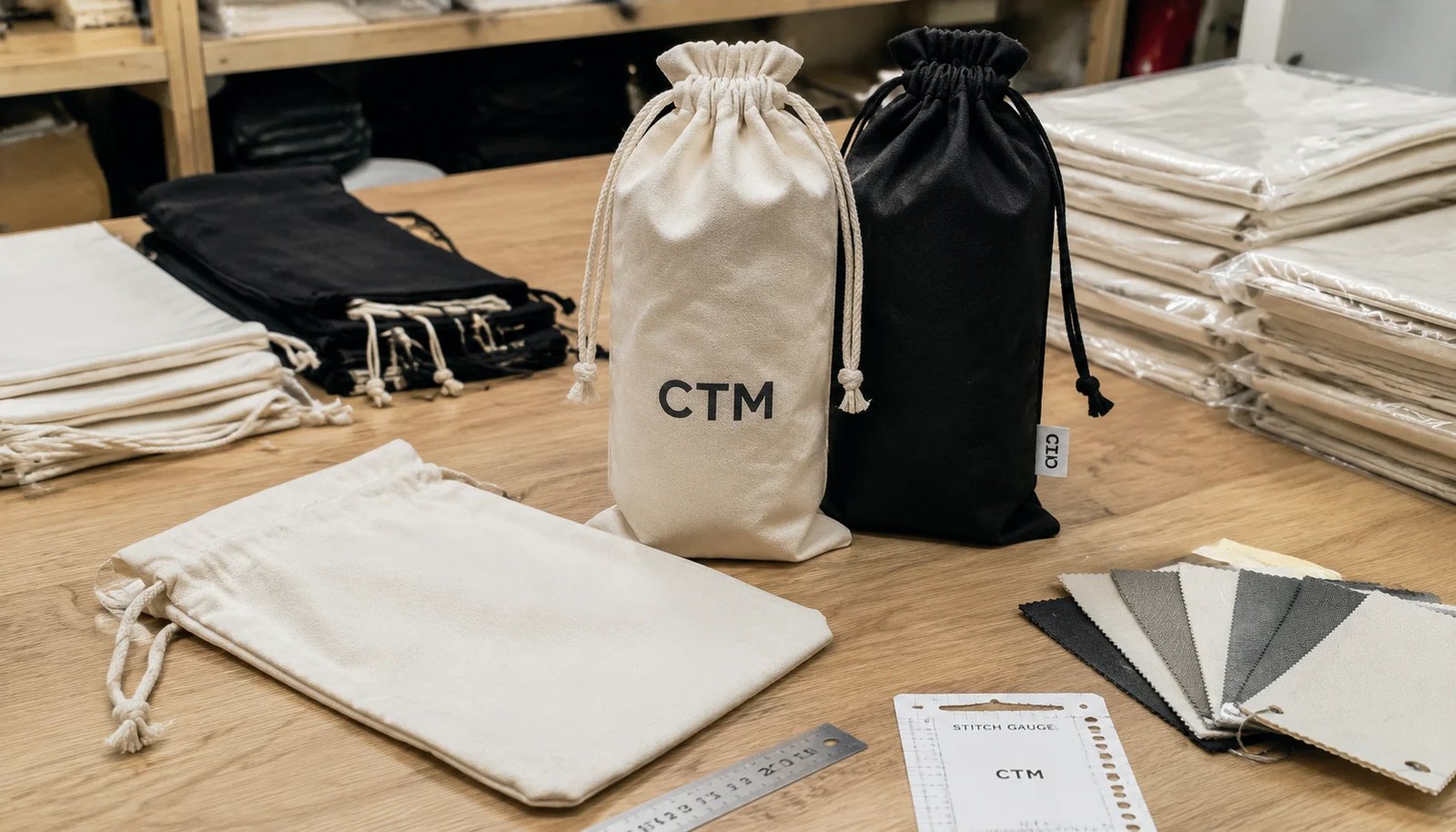
Why liquor retailers need a product-specific supplier checklist
Cotton drawstring pouches look simple, but liquor retail programs expose weak specifications very quickly. The pouch must fit a heavy glass bottle, close at the intended point around the neck or cap area, present well on shelf or in gift displays, and arrive packed in a way the retailer can receive without relabeling or recounting. If any one of those assumptions is unclear, the buyer can end up comparing prices for different products rather than true like-for-like offers.
This is why a generic bag vendor questionnaire is not enough. A useful review process for liquor retailers needs to convert supplier claims into item-specific evidence: what fabric was actually quoted, what finished size is being measured, what drawstring construction is included, what print assumptions are priced, and what packing work is covered. That is the practical meaning of a cotton drawstring pouches supplier compliance checklist for liquor retailers: not a marketing label, but a document trail and decision tool.
The commercial risk is usually hidden in assumptions. One supplier may quote lightweight sheeting, polyester cord, loose bulk packing, and cut-panel dimensions. Another may quote heavier cotton canvas, cotton cord, unit polybags, and finished sewn dimensions. Both may call the item a cotton pouch, but the buyer is not buying the same thing. A tighter checklist prevents those mismatches at RFQ stage rather than after sampling or after a failed receiving process.
For procurement teams, the best checklist also aligns internal functions. Sourcing may care most about MOQ and lead time. Brand teams focus on logo appearance. Store operations care about counts, labels, and carton handling. A shared checklist keeps those requirements in one place so the supplier is not trying to interpret disconnected comments later.
- Use one item-specific checklist from RFQ through final inspection.
- Compare quotes only after normalizing technical assumptions.
- Treat bottle fit, branding, and retail packing as equal sourcing priorities.
- Ask for evidence tied to this pouch program, not broad quality language.
Start with bottle-fit rules, not artwork or unit price
Bottle fit is the first technical control because bottle volume alone does not define shape. A 750 ml bottle may be tall and slim, broad-shouldered, or short with a wider body. The pouch dimensions that work for one format may fail another even when the capacity is the same. Buyers should therefore issue actual dimensions: total height, maximum body diameter, shoulder profile, neck length, and cap or closure height where relevant.
Just as important is the intended closure position. Some programs want the pouch to gather decoratively below the cap. Others want the drawstring to close above the capsule so most of the bottle is concealed. Those are different fit targets and can change both height requirement and logo placement. If one pouch must fit several bottle shapes, define the largest body and tallest total height in the approved range and state that the sample must be tested on those formats.
Measurement basis must also be frozen early. Suppliers may think in cut size, pattern size, or finished sewn size. Procurement should quote and approve finished sewn dimensions measured flat after sewing because that is the most practical basis for QC and receiving. If the buyer wants a tolerance such as ±0.5 cm, it should be framed as a project requirement to be agreed rather than a universal rule for all pouch programs. Some projects can accept more variation; some bottle-fit-sensitive programs may need tighter control.
The fastest way to catch fit errors is to require bottle-inserted photos or a physical fit sample before print approval and before bulk cutting. A flat pouch can look correct while still being too short when the bottle is inserted or too narrow once the shoulder area stretches the body. Fit approval should be a formal gate, not a casual visual check.
- Provide actual bottle dimensions, not only bottle volume.
- State where the pouch should close when cinched.
- Approve finished sewn size, not only pattern or cut size.
- Treat fit approval as a required sample gate before bulk release.
Write fabric specs in clear textile language
Fabric is the largest source of quote confusion in this category. Terms like cotton cloth, premium cotton, or canvas-style fabric are too loose for reliable comparison. Buyers should identify composition and fabric type more precisely, such as 100% cotton sheeting, plain weave, or cotton canvas, then state the target GSM and how tolerance will be handled.
Many liquor retail programs use midweight fabric because it balances cost, opacity, print support, and carton efficiency. Buyers often start discussions around 180 to 220 GSM for that reason, but that range should be treated as a common program assumption rather than a published standard. Lighter fabric may be fine for low-cost promotional use where some bottle silhouette is acceptable. Heavier fabric can create a more substantial handfeel, but it adds bulk at the drawstring channel, increases carton weight, and may reduce packing efficiency.
The GSM line should also specify whether the number is a target, a minimum, or a target with an agreed tolerance. Some buyers work from supplier mill tolerances; others set a specific range in the PO. The key is to avoid leaving the point vague. If one supplier quotes the midpoint of a desired range and another quietly prices the low end, unit costs may differ for reasons hidden from the buyer.
Color status changes sourcing risk. Natural cotton is typically the simplest option because it avoids dye-lot approval and some colorfastness concerns. Bleached and dyed fabrics require added controls for shade approval and lot consistency. If a custom shade is requested, ask whether the supplier is sourcing pre-dyed fabric or arranging a separate dyeing step, because lead time, MOQ, and color-approval sequence can change.
Appearance expectations for natural fabric should also be written down. Natural cotton can include small seed flecks or slubs depending on grade. If the retail program expects a very clean surface, say so in the brief instead of rejecting commercially normal material later.
- Name composition and fabric type precisely.
- State GSM as a target or range with an agreed tolerance basis.
- Use common weight ranges as planning assumptions, not universal benchmarks.
- Clarify whether natural cotton variation is acceptable for the program.
Match drawstring and seam construction to handling stress
On a bottle pouch, drawstring and seam details are functional. The pouch will be pulled open, pushed over a bottle, cinched closed, and often moved by the neck area during merchandising or gifting. If the cord is too thin, too short, or too slippery, users feel it immediately. If the seams are underbuilt, failures usually appear at the side seams, bottom seam, or drawstring exit points.
The quote should state cord material and size clearly. Cotton cord may fit natural-fabric aesthetics, while polyester can improve consistency and sometimes price. Flat tape or ribbon changes both function and appearance again. Buyers should request the diameter or width and whether the quote includes knotting, wrapped ends, or other finishing. Without that detail, two quotes with similar descriptions may not be functionally similar.
Channel construction deserves equal attention. Hem depth and usable channel width influence how smoothly the cord moves. A heavy fabric with a narrow channel can bind during closing, while an oversized channel may change the appearance at the top opening. For this reason, top hem depth and clear channel width should be part of the construction line, not left to factory habit.
Seam style should match the use case. A short-term promotional pouch may only need a straightforward construction if appearance and basic function are acceptable. A reusable branded pouch for gifting or premium sets may justify cleaner seam finishing or extra reinforcement. The goal is not to over-specify for the sake of it, but to make the expected handling level visible before the order is placed.
Stress points such as cord exits, top corners, and side-label insertion points should be reviewed in sampling and in production QC. A pouch can look good on the table and still fail quickly if these small construction choices are ignored.
- Specify cord material, size, and end finishing.
- Include top hem depth and channel width in the RFQ.
- Match seam complexity to expected reuse and bottle weight.
- Review stress points, not just general appearance.
Choose branding methods that survive real retail use
Branding should be reviewed on the filled pouch, not only on a flat panel. A logo that looks centered before use may sit too low once the bottle stretches the body or may distort near the gathered top. For liquor retail, where the pouch often functions as a gift or display accessory, those presentation issues matter even if the sewing is technically correct.
Screen printing remains one of the most practical methods for many pouch programs because it handles simple brand marks well and is usually easier to quote transparently. Buyers should define print size, placement references, number of colors, and whether Pantone matching is required. If dark fabric is involved, ask whether an underbase is included where needed, because that affects cost and final appearance.
Placement tolerance should be measurable. Many buyers start with a practical placement assumption such as ±0.5 cm from a fixed reference point, but the tolerance should be tied to the artwork and pouch size and agreed case by case. Terms like centered or near top are too vague for factory QC or third-party inspection.
Woven labels, side tabs, and hangtags need equally clear instructions. State fold type, visible side, finished size, insertion point, and whether the label is decorative, informational, or traceability-related. If retail barcodes are required, define whether they belong on the pouch, on the polybag, or only on outer cartons. Confusion at this point often creates repacking work later.
The buyer should separate visible branding from operational labeling. Shelf presentation and warehouse receiving are different jobs. A supplier can meet one and fail the other unless both are written into the specification package.
- Review logo appearance on a filled pouch, not only flat fabric.
- Define print references, color count, and dark-fabric assumptions.
- Specify label fold type and insertion point if labels are used.
- Separate branding requirements from receiving labels and barcodes.
Build RFQs that reveal real MOQ and price drivers
Pricing for cotton pouches is rarely driven by sewing alone. MOQ and cost often come from fabric availability, custom dyeing, print setup, labels, polybags, or barcode application. Buyers should therefore ask suppliers to break assumptions out line by line instead of hiding them inside one all-in unit price.
A stronger RFQ asks separate questions for stock natural fabric, custom dyed fabric, woven labels, custom polybags, barcode stickers, and development samples. This makes it easier to understand why one supplier appears cheaper. Sometimes the lower quote simply excludes retail-ready packing or assumes stock materials that do not match the brief.
It is also useful to split fixed and variable costs. Screen charges, sample development, or label setup may be one-time costs. Fabric, sewing, print labor, and packing labor are variable. That distinction matters when buyers compare a first order against likely repeats. A supplier that looks expensive on the first PO may become more competitive once setup costs are absorbed across repeat volume.
For annual retail programs with multiple release dates, buyers may also consider forecast-based sourcing rather than many fragmented micro-orders. If material and branding remain stable, reserving fabric or standard components can reduce MOQ pressure and help control color consistency across batches. This is not always necessary, but it is a useful commercial option when the program is recurring.
The objective is not only to get the cheapest opening quote. It is to create a quote basis that remains usable when the business moves from sampling to replenishment.
- Ask suppliers to separate MOQ by component, not only by finished pouch.
- Identify what is included in the quoted unit price.
- Split one-time setup charges from repeat-order costs.
- Consider repeat-program planning if volume is seasonal but predictable.
Check supplier capability with evidence tied to this product
A supplier should not be judged only by a catalog or by broad claims such as retail-ready or quality-focused. Capability for cotton bottle pouches should be demonstrated through records and examples linked to the actual product. Ask for recent production photos, sample specification sheets, in-line inspection forms, packed-sample images, and examples of how finished measurements are recorded.
Subcontracting must be mapped clearly. A company may sew in-house but outsource printing. Another may control development and export while using an external sewing workshop. Neither model is automatically a problem, but the buyer needs to know who is responsible for each stage and who owns final conformance to the approved sample and specification.
For liquor retailers, packing capability is as important as sewing capability. A technically acceptable pouch still creates operational issues if SKU separation, unit labeling, fold direction, or carton marks are inconsistent. Buyers should therefore ask for evidence of packed-sample control, not only product photos.
A simple but valuable question is whether the production line uses a first-piece approval process. If the factory approves and retains a first bulk piece against the golden sample, there is a better chance of keeping print placement, channel construction, and seam details consistent through the run. Ask to see the form or photo record, not just a verbal yes.
The strongest suppliers usually answer product-specific questions with product-specific records. The weakest answer with general assurances. Procurement teams should reward the former.
- Request measurement records, QC forms, and packed-sample evidence.
- Identify every outsourced step and the final quality owner.
- Review packing capability as closely as sewing capability.
- Ask for first-piece approval records from bulk start.
Use a staged sample process with clear approval gates
Sampling is where many preventable sourcing errors can be removed at low cost. For liquor retail pouches, approvals should be staged because fabric, branding, fit, and packing answer different questions. Combining them too early can hide important issues or delay decisions unnecessarily.
A typical sequence starts with fabric or color swatch approval. This confirms handfeel, surface appearance, and approximate weight before print and labels are added. If fabric is dyed, this stage may involve a swatch or lab-dip route depending on how the supplier sources color.
The next stage is branding review. That may be a strike-off, printed swatch, or near-finished sample. The buyer should confirm color expectation, opacity, and placement reference at this point. For dark shades, underbase behavior should be reviewed deliberately rather than assumed.
Then comes the pre-production sample using final fabric, final cord, final construction, and final branding method. This sample should be measured exactly the way bulk goods will be measured, then tested on the actual bottle or an approved dummy. Record whether insertion is smooth, whether coverage is sufficient, and where the drawstring sits when closed.
A packed sample should be its own gate. The packed sample should show the real polybag or unit-pack method, barcode placement if needed, fold direction, inner-pack count logic, and carton mark format. This is the stage that protects receiving accuracy and reduces warehouse rework.
Each approval should state what it authorizes. Fabric approval is not blanket approval for any shade variation. A pre-production sample does not authorize a later packaging substitution. A signed golden sample and written specification sheet should travel with the order and remain the reference if questions arise during production.
- Separate swatch, branding, fit, pre-production, and packed-sample approvals.
- Test fit on the actual bottle whenever possible.
- Measure samples the same way bulk QC will measure them.
- Use a signed golden sample plus written spec as the final reference.
Set QC rules around measurable pass-fail points
Quality control is most effective when buyer, supplier, and inspector are judging the same product in the same way. For cotton liquor pouches, that means setting pass-fail points around fit, dimensions, print, stitching, cord function, shade consistency, cleanliness, and packing accuracy.
Dimensions should be based on finished sewn measurements taken flat after sewing. If the buyer sets a tolerance, it should be documented in the specification and matched to the fit sensitivity of the project. Measurement points should be illustrated or described clearly enough that the sample room, factory line, and inspector all use the same method.
Print inspection should cover both location and appearance. List unacceptable defects such as severe off-placement, weak opacity, smudging, major pinholes in critical logo areas, misregistration, or cracking from normal handling. If the print sits close to the gathered area, check how it looks after the bottle is inserted.
Seam criteria should identify open seams, skipped stitches, broken backtacks, weak reinforcements, or raw-edge exposure where not specified. Cord function deserves its own test: the pouch should open and close smoothly without the channel locking or twisting excessively. Cord lengths should also remain reasonably consistent within the program tolerance.
Cleanliness and lot consistency are often underestimated. Dyed shipments should be reviewed for visibly mixed shade lots within the same SKU, and all goods should be free from strong odor, mildew, oil marks, dirt, or excessive loose threads. Those issues affect shelf presentation even if the dimensions are correct.
If AQL is used, add item-specific automatic-fail points such as wrong size, failed bottle fit, wrong logo, wrong fabric color family, or incorrect carton marking. AQL does not replace product-specific decision rules.
- Define measurement points, not only tolerance numbers.
- Inspect print for both appearance and exact location.
- Treat bottle-fit failure and nonfunctional cords as major issues.
- Add cleanliness, odor, and shade checks to the QC brief.
Control labeling, packing, and lead time by process stage
Retail execution often breaks down at packing rather than sewing. A pouch may be made correctly but still create receiving delays if the barcode is on the wrong level, fold direction is inconsistent, or carton counts do not match the retailer's expectation. These are procurement issues because they should be set before production starts.
Begin by deciding how the pouch moves through the retail operation. Will it be sold individually, added later to a gift set, sent to stores as a seasonal accessory, or handled by e-commerce fulfillment? That decision shapes whether unit bagging is needed, where labels belong, and how inner-pack quantities should be structured.
It helps to separate labeling into three levels. Product-level information may include origin or fiber content if required for the market and program. Unit-pack labeling may include barcodes or SKU labels on the polybag. Carton-level marking usually covers PO, SKU, color, quantity, origin, and routing details. Suppliers make fewer mistakes when those layers are explicitly separated in the spec.
Carton planning should also be practical. Set unit counts by inner pack and master carton, then ask for estimated carton dimensions and gross weights early. Overfilled cartons may reduce packaging material cost but can distort pouches and create counting or handling issues at destination.
Lead time should be mapped by stage rather than shown as one blended ex-factory number. Ask for separate timing for fabric booking, color approval if any, strike-off, pre-production sample, bulk sewing, final packing, inspection readiness, and ship readiness. This makes both supplier scheduling and buyer approval responsibilities visible. Repeat orders can often move faster, but only if material and packing assumptions remain unchanged.
- Decide the retail handling flow before finalizing packing specs.
- Separate product, unit-pack, and carton labeling requirements.
- Set carton counts and weights early to avoid receiving issues.
- Ask for stage-by-stage lead time instead of one overall promise.
Specification comparison for buyers
| Supplier option | What to verify | Commercial advantage | Buyer risk to control |
|---|---|---|---|
| Direct sewing factory | cord material proof, reinforcement close-ups, load-test photos, approved sample tag, and bulk-line first-piece record | Better sample-to-bulk control and faster production feedback | May be weaker on export paperwork or branded packing unless checked early |
| Trading company | Factory name, production photos, trim-source proof, and who owns QC decisions | Can coordinate small mixed orders and extra services | Markup can hide real factory capability and slow defect decisions |
| Specialized bag workshop | cord diameter, eyelet or reinforced channel, bottom corner reinforcement, seam allowance, bar-tack position, and load target | More practical for detailed construction, trims, and repeat programs | Capacity may be limited during peak seasons |
| Low-price general supplier | 6-10 oz cotton canvas, 210D polyester, rPET, or blended cotton with shrinkage and colorfastness expectations set before sampling | Useful for simple promotional runs with loose specs | Material downgrades, weak packing, and vague inspection scope can erase savings |
| Retail-ready supplier | fold direction, cord protection, bundle count, carton compression, moisture bag, and retail label position | Can handle labels, SKU separation, carton marks, and receiving rules | Higher unit cost must be compared against reduced warehouse work |
| Compliance-focused supplier | Fabric records, labeling review, test plan, and production traceability | Safer for retail programs and repeat brand orders | Documentation claims need evidence, not only sales language |
| Local sample room plus bulk factory | Signed sample, bulk factory handoff, first-piece photos, and deviation owner | Good for complex branding before large production | Sample room quality may not match bulk line unless handoff is controlled |
Buyer checklist before sampling
- Define the use case clearly: gift sleeve, promotional add-on, gift-set component, retail accessory, or reusable branded pouch.
- List every bottle format the pouch must fit, including overall height, maximum body diameter, shoulder profile, neck length, and intended drawstring closure position.
- Specify finished sewn width and height measured flat after sewing, and note that any tolerance stated is a program assumption to be agreed in writing rather than a universal industry rule.
- State the fit requirement: full bottle coverage, decorative gather below the cap, partial neck exposure, or full closure above the capsule.
- Name the fabric correctly: 100% cotton sheeting, plain weave, or canvas, with target GSM and agreed tolerance or mill tolerance basis.
- Confirm color status: natural, bleached, stock dyed, or custom dyed, and define who approves shade before bulk cutting.
- Specify drawstring material, size, finish, and whether a single or double drawstring construction is required.
- Define branding method, artwork size, placement references, and whether strike-off approval is required before bulk.
- List labeling and receiving needs by level: product, unit pack, and carton.
- Request a staged sample plan covering fabric, branding, fit, pre-production, and packed sample approvals.
Factory quote questions to send
- What exact material are you pricing: 100% cotton, cotton blend, sheeting, plain weave, or canvas, and what GSM target or range is assumed?
- Is your quoted size based on cut panels or finished sewn dimensions measured flat after sewing?
- What finished-size tolerance do you expect to hold in bulk, and how will it be measured and recorded?
- What seam construction is included: overlock, lockstitch, topstitch, French seam, or another finish, and what seam allowance is planned?
- What top hem depth and usable drawstring channel width are included in the quote?
- What drawstring material, diameter or width, and end finishing are included?
- If printing is included, how many colors, what print size, what placement reference, and is underbase included for dark fabrics where needed?
- If dyed fabric is quoted, what is the approval route for color: stock swatch, lab dip, or bulk fabric swatch before cutting?
- What MOQ applies separately to stock fabric, custom dyeing, woven labels, hangtags, custom polybags, and barcode stickers?
- Which operations are in-house and which are subcontracted, specifically fabric sourcing, dyeing, printing, label attachment, and final packing?
Quality-control points to confirm
- Measure finished pouch width and height flat after sewing using one approved method shared by supplier, buyer, and inspector.
- Run bottle-fit checks on the actual bottle or an approved dimensional dummy, and confirm insertion, coverage, and closure position against the written fit rule.
- Check bulk fabric against the approved basis for composition, weight, color status, and visible appearance before full sewing starts.
- For natural cotton, review seed flecks, slubs, stains, holes, mildew, and weaving defects against the agreed appearance expectation.
- For dyed fabric, control visible shade variation within the same shipment and avoid mixing clearly different lots within one SKU unless approved.
- Measure print placement from fixed reference points such as top edge and side seam, using the tolerance agreed for the program.
- Review print quality for opacity, edge definition, smudging, misregistration, pinholes in key logo areas, and resistance to normal handling.
- Inspect seams for open stitching, skipped stitches, broken backtacks, weak reinforcement, raw-edge exposure where not specified, and excessive seam grin.
- Check top hem depth and channel consistency so the cord moves smoothly without locking, trapping, or excessive twisting.
- Verify cord length consistency, knotting or end finishing, and that the drawstring functions after repeated open-close handling.