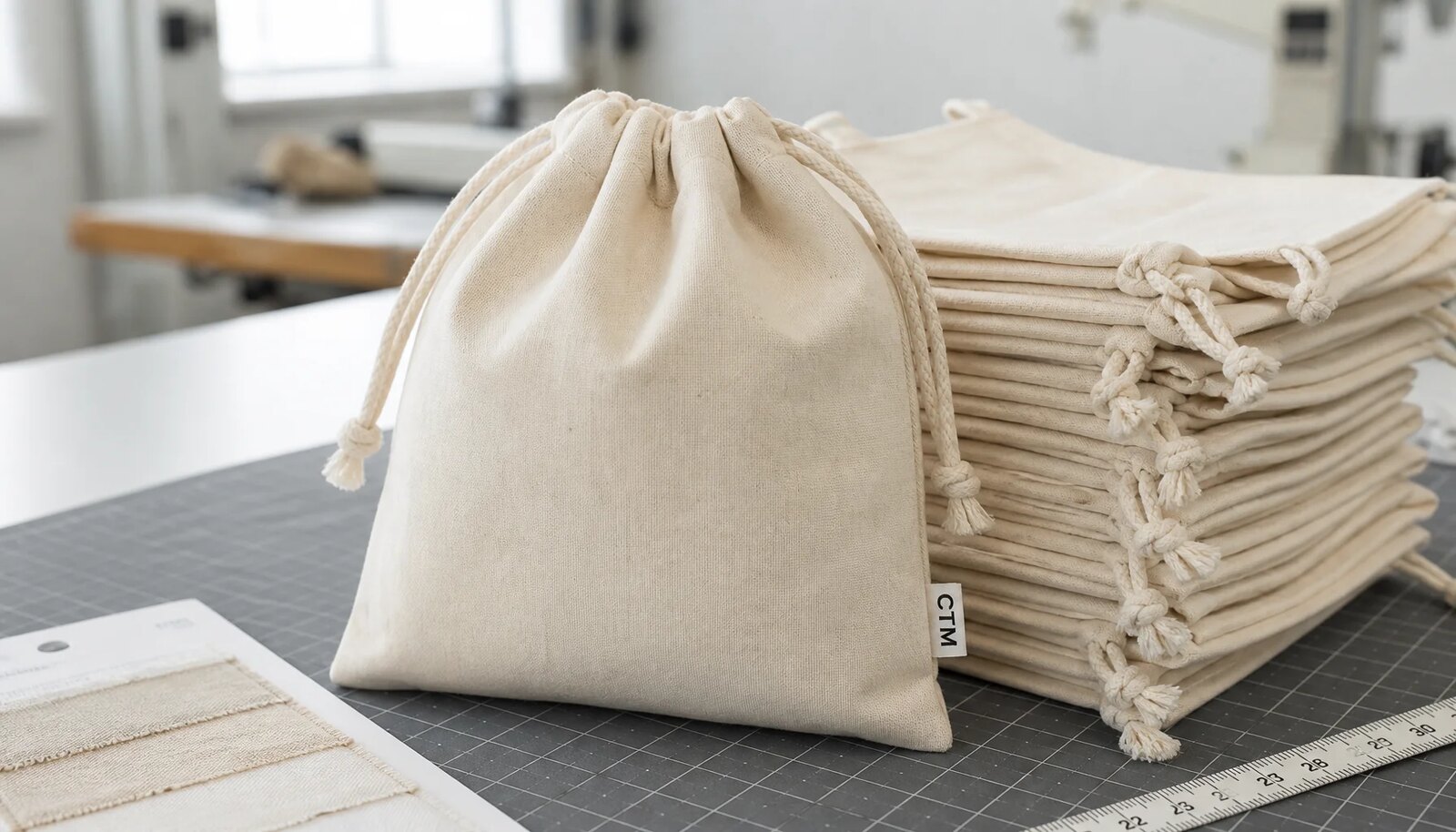
Start compliance before unit-price negotiation
For eco apparel brands, cotton drawstring pouches are not minor packaging afterthoughts. They touch the garment, carry brand language, and can show up in unboxing content, marketplace checks, retail receiving, and internal sustainability reviews. A low quote helps only when the pouch is defined clearly enough to inspect, repeat, and defend.
The most common sourcing mistake is asking several suppliers for a price on a vague phrase such as natural cotton pouch with logo. One supplier may quote 110 GSM unbleached cotton with a thin polyester cord and loose bulk packing. Another may quote 180 GSM cotton canvas, cotton cord, screen print, side label, barcode label, and retail-ready cartons. Both may sound reasonable. They are not quoting the same product.
A cotton drawstring pouches supplier compliance checklist for eco apparel brands should turn the RFQ into a controlled buying document. It should state material, construction, decoration, compliance evidence, packing, inspection, and logistics assumptions before final pricing. That gives procurement leverage without falling back on vague quality complaints after the purchase order is placed.
- Include material, construction, print, packing, testing, and traceability in the RFQ before asking for final price.
- Require suppliers to separate included and excluded costs so quotation gaps are visible.
- Treat eco, organic, recycled, natural, unbleached, and plastic-free claims as compliance statements that need evidence.
- Use one written specification and one approved master sample as the basis for production and inspection.
- Compare total risk cost, including re-sampling, failed inspection, repacking, relabeling, delay, and warehouse sorting.
Define fabric with procurement-grade language
Cotton pouch fabric should be specified by composition, construction, weight, color, and finishing. GSM is the most common fabric-weight reference, although some suppliers use oz/yd2. Do not accept only light, medium, thick, or premium cotton unless the supplier also states a measurable weight. A lightweight apparel pouch may sit around 120 to 140 GSM. A reusable customer-facing pouch, shoe pouch, denim pouch, or premium set may need 160 to 220 GSM or heavier depending on size and garment weight.
Fabric construction matters as much as weight. Plain-weave cotton, cotton canvas, muslin-style cloth, twill, and blended cotton fabrics do not behave the same in printing, shrinkage, opacity, or seam strength. Natural cotton may show seed flecks and cream-tone variation. Bleached cotton gives a cleaner print ground but has a different processing story. Dyed fabric needs shade control and colorfastness review. Washed or softened fabric may feel better in hand, but it can change shrinkage and finished measurements.
Eco apparel buyers should make the fabric wording match the claim they can support. Conventional cotton is not certified organic cotton. A recycled cotton blend is not automatically 100 percent recycled. Unbleached cotton does not mean chemical-free. If the pouch will be described as organic, recycled, undyed, biodegradable, or plastic-free, procurement needs component-level evidence for that exact wording.
- State composition, weave, GSM or oz/yd2, color, finishing, and whether the fabric is greige, unbleached, bleached, dyed, washed, or pre-shrunk.
- Ask for the supplier's normal production tolerance for fabric weight and record the accepted range in the PO.
- Confirm whether fabric shade variation, seed flecks, slubs, or natural marks are acceptable for unbleached cotton.
- Request shrinkage expectations for washed, dyed, or softened fabric and decide whether bulk measurement is before or after any finishing process.
- Do not allow material-claim substitutions without written buyer approval and updated documentation.
Specify construction so every factory quotes the same pouch
A drawstring pouch looks simple until the order reaches bulk production. Small construction choices change cost, function, carton volume, and defect risk. The specification should separate finished flat size from usable internal size. A 20 x 30 cm pouch does not provide 20 x 30 cm of practical packing space once seam allowance, bottom bulk, and drawcord-channel height are included. Test the real garment inside the pouch, not only an empty sample.
The top tunnel deserves close attention. If the channel is too narrow for the cord, the pouch will not close smoothly. If it is too wide, the top can look loose and low value. A thicker cord may improve hand feel and perceived quality, but it needs clearance and may increase packing volume. The drawcord exit may be a simple side opening, a double-sided opening, a reinforced eyelet, a stitched buttonhole, or a folded tunnel gap. Each option changes labor, durability, and brand-claim risk if metal or synthetic parts are involved.
Write seam details in production language. Define seam allowance, stitch type where relevant, thread color, inside or bound seams, side-label insertion, reinforcement points, and cord-end finish. These details prevent the supplier from quietly simplifying the pouch to meet a target price.
- Define width, height, usable internal height, top tunnel height, seam allowance, and measurement points.
- Specify single-cord or double-cord closure, side or center exits, cord diameter or width, and knot or tip finish.
- State whether eyelets, metal parts, plastic tips, waxed cord, or synthetic trims are prohibited under the brand's material policy.
- Include reinforcement requirements at cord exits, side seams, bottom corners, and side-label insertion points.
- Approve the pouch with the real garment inside before releasing bulk dimensions.
Request documents that match the actual order
Compliance evidence should connect to the pouch being purchased, not only to the supplier's general capability. A factory profile, social-audit summary, or old material certificate may help initial qualification, but it does not prove that the bulk pouch uses the claimed fabric, cord, dye, print, and label. Procurement should ask which documents are lot-specific, component-specific, factory-level, and supplier declarations.
Useful records for cotton drawstring pouches may include fabric composition information, material purchase records, lot references, dye or finishing details, print or ink information, and test reports required by the destination market or retailer. Depending on the program, buyers may need to review restricted substances, azo dyes, formaldehyde, heavy metals, phthalates in prints or trims, colorfastness, fiber content, and labeling requirements. The test plan should come from the buyer's compliance team or customer requirements, not from a supplier's generic certificate list.
Not every useful document is a third-party lab report. Supplier declarations, invoices, batch records, and lab tests serve different purposes. The key is to name what each document proves and what it does not. Generic eco-friendly language is not proof. If marketing wants to print an environmental statement on the pouch or use it in product copy, compliance should review the exact wording before bulk production.
- Ask the supplier to identify the fabric lot or material source proposed for the order.
- Separate batch-specific records from annual certificates and general factory documents.
- Check that cord, print, label, thread, and packing components do not undermine the advertised material claim.
- Confirm whether the test report scope covers the same material, color, print, and component type as the bulk order.
- Keep compliance documents in the shipment file with report numbers, lot references, declarations, and approval dates.
Compare supplier routes by accountability, not only price
The best supplier type depends on program risk. A direct sewing factory can give better control over cutting, sewing, trimming, and first-piece approval. That matters when the pouch has tight size tolerance, side labels, several sizes, or repeat production. Still, the buyer must check whether the factory can handle testing, export documents, carton marks, and branded packing.
Trading companies can be practical for mixed orders, small quantities, or programs that combine fabric sourcing, printing, labels, pouches, and freight. The risk is opacity. Procurement should know the factory name, production location, outsourced steps, and who has authority to stop production or approve rework if defects appear.
Specialized bag workshops often understand tunnel construction, cord behavior, reinforcement, and carton packing better than broad promotional suppliers. Their limitation may be capacity, especially during peak seasons. They may also outsource printing, dyeing, or washing. Outsourcing is not automatically a problem. Hidden outsourcing is the problem. Map responsibility from fabric purchase to export handover before issuing the PO.
- Ask whether the quoted company owns the sewing line or uses a named factory.
- Identify who buys fabric, who prints, who sews, who inspects, who packs, and who books testing.
- Require subcontracting disclosure for dyeing, washing, printing, label production, and final packing.
- Clarify who pays for rejected goods, replacement production, third-party reinspection, and shipment delay after a failed inspection.
- Use first-piece photos and inline QC records when the supplier route includes several parties.
Make MOQ and quote comparison transparent
MOQ is rarely one simple number. It may be driven by fabric availability, dye-lot minimums, cutting efficiency, print setup, cord color, label production, barcode versions, packing format, or carton printing. A supplier may advertise a low MOQ for blank stock pouches, then raise the requirement once the buyer asks for custom fabric, dyed color, cotton cord, side label, multi-color logo, or SKU-level packing.
Ask suppliers to break MOQ down by constraint. Fabric-color MOQ tells procurement whether several artwork versions can share one fabric run. Print MOQ shows how many units are needed to spread screen, plate, transfer, or digital setup cost. Label MOQ matters when each apparel line has a different logo, material statement, or barcode. Packing MOQ appears when printed cartons, paper bands, warning labels, or marketplace stickers are required.
Quote comparison should reflect the same product and service level. A pouch quoted loose in a master carton is not commercially equivalent to a pouch quoted folded, banded, barcoded, SKU-separated, and packed in export cartons. Compare ex-works, FOB, or landed cost only after all suppliers have priced the same specification, inspection scope, and packing plan.
- Request MOQ by fabric color, size, cord color, print version, label version, barcode version, and packing format.
- Ask whether setup charges apply per logo color, screen, plate, transfer, embroidery file, or artwork revision.
- Separate sample cost, sample freight, bulk unit cost, tooling, testing, inspection, packing, inland freight, and export charges.
- Check whether lower unit price creates warehouse work through mixed cartons, missing labels, loose packing, or unclear carton marks.
- Record quote validity and material-price assumptions so old quotes are not reused after fabric or freight costs change.
Choose branding methods by durability and claim risk
Screen printing is often efficient for simple logos, bold artwork, and repeat volume. It can look clean on cotton when artwork uses suitable line thickness, limited colors, and enough contrast against the fabric shade. Even so, approve a strike-off on the actual fabric. Cotton texture, seed flecks, slubs, and absorbency can affect print edges, ink coverage, and opacity.
Digital printing, heat transfer, embroidery, woven labels, printed side labels, and patches all have a place. They simply need different controls. Heat transfer can handle complex artwork, but it needs checks for adhesion, cracking, edge lift, blocking, and hand feel. Embroidery may look premium, yet it can pucker lightweight cotton and may be inefficient for small pouches. Woven labels can avoid print issues, but label placement, seam strength, and label fiber become more important.
Branding can also affect compliance. Ink, transfer film, label fiber, thread, adhesive, and backing paper may need restricted-substance review. A pouch marketed as plastic-free may conflict with a plastic transfer or poly label. A pouch described as all cotton may conflict with polyester cord or synthetic sewing thread unless the claim is worded carefully and approved internally.
- Approve artwork using minimum line thickness, smallest readable font size, color reference, and print-position tolerance.
- Use a strike-off on production-equivalent fabric, not only a paper proof or digital mockup.
- Check logo placement from fixed edges, such as distance from bottom seam and centerline, rather than by eye only.
- Test print behavior after folding, stacking, carton pressure, and normal handling against garments.
- Review environmental text, QR codes, care symbols, and legal markings for legibility and claim accuracy before bulk printing.
Use sample approval as a controlled gate
A physical sample is the buyer's first real evidence of supplier capability. Photos help with progress checks, but they cannot verify fabric weight, hand feel, odor, seam strength, cord function, print adhesion, or actual fit with the apparel product. For B2B programs, the sample should be measured, handled, packed, photographed, and recorded before bulk production is released.
The approval record should include supplier name, sample date, fabric spec, pouch size, cord spec, print method, artwork version, label details, packing format, and deviations. If the sample is approved with changes, comments must be exact. Move logo 10 mm upward, increase cord diameter from 3 mm to 5 mm, change tunnel height to 2.5 cm, or shorten thread tails to below 5 mm are usable instructions. Improve quality is not.
For higher-value or compliance-sensitive orders, keep three references: one buyer master sample, one supplier master sample, and one inspection reference. Each should be signed, dated, and linked to the final PO or tech pack. If the supplier changes fabric lot, print method, cord, label, or packing, decide whether a new sample or strike-off is required before production continues.
- Do not release bulk production from photos alone when fabric, print, fit, or compliance risk is material.
- Measure flat size, usable size, tunnel height, cord length, print position, and label position on the approved sample.
- Record all approved deviations from the original RFQ in writing.
- Seal or tag master samples so sales, production, QC, and inspectors follow the same reference.
- Require first-piece approval when bulk production starts, especially after cutting, printing, or sewing setup.
Write a QC plan with tolerances and defect classes
A usable QC plan tells the factory what to check, how to measure it, and what happens if the goods fail. For cotton drawstring pouches, inspection should cover dimensions, fabric shade, fabric defects, seam strength, stitch quality, tunnel construction, drawcord function, reinforcement, print accuracy, odor, stains, labels, packing count, barcode position, and carton marks.
Define defect classes before production. Critical defects may include wrong material claim, wrong logo, prohibited component, mildew, severe contamination, missing required label, or a safety-related issue. Major defects may include size outside tolerance, broken seam, nonfunctional cord, obvious print misplacement, poor print adhesion, wrong carton quantity, wrong barcode, or strong odor. Minor defects may include small wrinkles, light thread tails, or slight cosmetic issues within agreed limits.
Many buyers use AQL-based final inspection, but inspection level and acceptance limits should be agreed before production starts. For small orders, a full check or tighter factory internal inspection may be more practical. For retail-bound orders, final inspection should include packed-unit verification and open-carton checks, not only loose product review. Repeat orders should be compared with the latest approved standard to catch gradual material or workmanship drift.
- Set measurement tolerance by pouch size and construction, not as a vague one-size rule.
- Define critical, major, and minor defects in the PO or inspection checklist.
- Use the written spec and signed master sample as inspection references.
- Request inline QC after first pieces and before the full order is sewn or printed.
- Require inspection photos showing measurement points, seam close-ups, cord function, print detail, packed cartons, and any defects found.
Control packing, lead time, and shipment files
Packing is part of compliance control because it determines whether the warehouse can receive the goods without rework. The supplier should quote the actual required packing format: folded or flat, individual packed or bundle packed, plastic-free or polybagged, quantity per bundle, quantity per master carton, SKU separation, barcode placement, carton dimensions, gross-weight target, and carton marks.
Eco apparel brands often want to reduce plastic. That goal needs a practical protection plan. Unprotected cotton can absorb dust, moisture, odor, and scuffs. If polybags are prohibited, specify the alternative, such as paper bands, tissue, inner cartons, or bundle ties, and confirm how the supplier will protect cleanliness and count accuracy. If individual bags are required for retail, marketplace, or warehouse rules, approve the material, warning text, barcode position, and sealing method.
Lead time should be managed by milestones rather than a broad promise such as 25 to 35 days. Track artwork lock, sample dispatch, sample approval, fabric booking, material arrival, print setup, first-piece approval, sewing start, inline QC, final packing, inspection booking, inspection result, and export handover. The shipment file should contain the final PO, invoice, packing list, carton marks, compliance documents, inspection report if used, and approved deviations.
- Approve individual packing, bundle count, master-carton quantity, carton dimensions, carton marks, and moisture-control method before the final quote.
- Confirm barcode readability, SKU separation, carton-number sequence, gross weight, and packing-list accuracy during final inspection.
- Break lead time into artwork, sampling, fabric, printing, sewing, QC, packing, inspection, and export handover milestones.
- Book laboratory testing and third-party inspection early when shipment timing depends on results.
- Keep a shipment file with compliance evidence, approved sample references, inspection records, packing list, and corrective-action notes.
Specification comparison for buyers
| Supplier option | What to verify | Commercial advantage | Buyer risk to control |
|---|---|---|---|
| Direct sewing factory | cord material proof, reinforcement close-ups, load-test photos, approved sample tag, and bulk-line first-piece record | Better sample-to-bulk control and faster production feedback | May be weaker on export paperwork or branded packing unless checked early |
| Trading company | Factory name, production photos, trim-source proof, and who owns QC decisions | Can coordinate small mixed orders and extra services | Markup can hide real factory capability and slow defect decisions |
| Specialized bag workshop | cord diameter, eyelet or reinforced channel, bottom corner reinforcement, seam allowance, bar-tack position, and load target | More practical for detailed construction, trims, and repeat programs | Capacity may be limited during peak seasons |
| Low-price general supplier | 6-10 oz cotton canvas, 210D polyester, rPET, or blended cotton with shrinkage and colorfastness expectations set before sampling | Useful for simple promotional runs with loose specs | Material downgrades, weak packing, and vague inspection scope can erase savings |
| Retail-ready supplier | fold direction, cord protection, bundle count, carton compression, moisture bag, and retail label position | Can handle labels, SKU separation, carton marks, and receiving rules | Higher unit cost must be compared against reduced warehouse work |
| Compliance-focused supplier | Fabric records, labeling review, test plan, and production traceability | Safer for retail programs and repeat brand orders | Documentation claims need evidence, not only sales language |
| Local sample room plus bulk factory | Signed sample, bulk factory handoff, first-piece photos, and deviation owner | Good for complex branding before large production | Sample room quality may not match bulk line unless handoff is controlled |
Buyer checklist before sampling
- Define the finished flat pouch size, usable internal size, top tunnel height, seam allowance, drawcord exit style, and measurement method before asking suppliers for final pricing.
- Specify the exact fabric composition, weave, GSM or oz/yd2, finishing treatment, color standard, and whether the fabric is greige, unbleached, bleached, dyed, washed, pre-shrunk, or untreated.
- Set realistic finished-size tolerances in writing, such as +/-0.5 cm for small pouches where practical and a separately approved tolerance for larger shoe, denim, or laundry pouches.
- State the acceptable fabric-weight tolerance, commonly expressed as a percentage around the nominated GSM, and require the supplier to explain how weight will be checked in production.
- Choose the drawcord material, construction, diameter or width, color, knot or tip finish, and whether synthetic cord, metal eyelets, aglets, waxed cord, or mixed-fiber trims are allowed under the brand claim.
- Require order-specific evidence for cotton, organic cotton, recycled cotton, undyed cotton, recycled blend, or other eco claims; do not rely on generic sustainability wording without a document trail.
- Define the logo method, artwork placement, Pantone or LAB reference, minimum line thickness, smallest readable text size, print-position tolerance, and durability concerns such as rub, wash, cracking, or ink transfer.
- Ask which steps are outsourced, including fabric weaving, knitting if applicable, dyeing, washing, printing, cord production, label making, sewing, trimming, packing, testing, and export documentation.
- Approve a pre-production sample or strike-off made with production-equivalent fabric, cord, print method, label, and packing; keep a sealed buyer sample, supplier sample, and inspection reference when risk justifies it.
- Write the QC standard into the PO, including defect classification, AQL or inspection method, measurement points, sample reference, required inspection photos, and responsibility for rework or failed inspection.
Factory quote questions to send
- What is the exact fabric specification: composition, weave, GSM or oz/yd2, yarn appearance, color, finishing treatment, shrinkage expectation, and fabric-weight tolerance?
- Is the fabric stock fabric or made to order, and can the lot used for the approved sample be linked to the bulk order or clearly re-approved if the lot changes?
- What is the minimum fabric order by color and finishing route, and does the MOQ change for dyed, washed, organic, recycled, or custom-color fabric?
- Which drawcord will be used: cotton cord, polyester cord, recycled polyester cord, blended cord, flat tape, round braided cord, twisted cord, or another trim, and what is the diameter or width?
- Will the cord, side label, care label, thread, ink, transfer film, adhesive, or packing material conflict with an all-cotton, plastic-free, organic, recycled, or biodegradable claim?
- Which print or branding method do you recommend for this artwork, and what are the setup costs per color, screen, plate, transfer sheet, embroidery program, label version, or artwork revision?
- What is the minimum line thickness, smallest readable text size, QR-code limitation, and print-position tolerance you can hold on the proposed cotton fabric?
- Can you provide a strike-off on the actual production-equivalent fabric before bulk printing, and will the bulk print use the same ink or transfer system?
- What compliance documents can you provide for the exact fabric, cord, dye or finish, label, and print process proposed for this order?
- Which documents are batch-specific, which are component-specific, which are annual factory documents, and which are supplier declarations only?
Quality-control points to confirm
- Finished size should be measured flat after sewing and packing relaxation, using agreed points such as width at body, height from bottom seam to top edge, and usable height below the drawcord channel.
- A practical tolerance for many small apparel pouches is +/-0.5 cm, but larger pouches, washed cotton, and heavy canvas styles may require a wider tolerance agreed by size and construction.
- Fabric weight should match the nominated GSM or oz/yd2 within the agreed tolerance; the PO should avoid vague phrases such as premium cotton or good thickness without a measurable standard.
- Fabric composition must support the brand claim. If the pouch is sold or described as cotton, organic cotton, recycled cotton blend, undyed cotton, or unbleached cotton, the document trail should match that wording.
- Shrinkage should be evaluated when fabric is dyed, washed, softened, or likely to be exposed to humidity; compare sample and bulk using the same measurement and conditioning method.
- Fabric shade should be checked against the approved sample or color standard, especially for natural cotton where seed flecks, cream tone, and lot variation can affect logo contrast.
- Seams should be even, secure, and free from skipped stitches, open seams, broken threads, puckering, needle damage, and excessive loose thread tails at the side seam, bottom seam, tunnel, and label insertion.
- The drawcord should pull smoothly through the tunnel without snagging, tearing fabric, cutting into the channel, or causing the pouch mouth to distort beyond the approved sample standard.
- Knots, stitched ends, tipped ends, or heat-sealed synthetic ends should remain secure during normal opening and closing; the test method should match expected consumer handling rather than an undefined pull.
- Bar-tacks, backstitches, or reinforcement stitches should be consistent at stress points such as cord exits, side seams, label insertions, and any corner areas expected to carry garment weight.