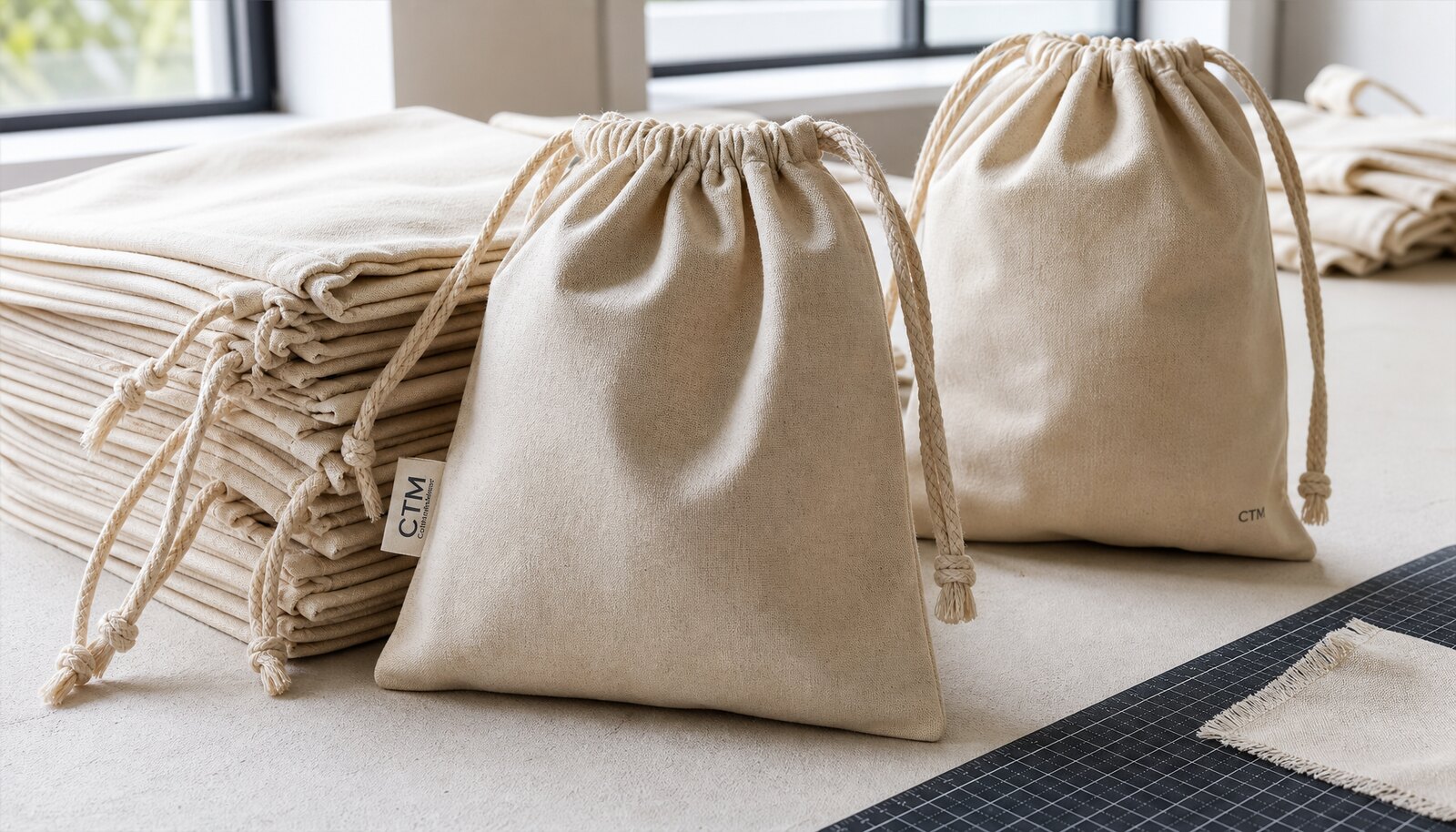
Why this is a supplier compliance issue, not just a pouch spec
Cotton drawstring pouches are often treated as simple packaging, but in corporate gifting they sit in front of the recipient before the main item is even handled. A thin fabric, crooked logo, fraying cord, or crushed carton can make the whole gift program feel careless. Procurement teams therefore need a supplier compliance checklist that covers two things at the same time: the physical pouch specification and the supplier evidence behind it.
A good cotton drawstring pouches supplier compliance checklist for corporate gifting should not stop at fabric weight and logo approval. It should ask whether the supplier can document materials, control production, keep traceability records, meet the buyer's labeling rules, and support any compliance review required by the corporate client. Some gift programs only need basic commercial assurance. Others may involve retail distribution, employee kits, child-facing promotions, sustainability claims, or brand-controlled vendor rules. The supplier route has to fit that risk level.
The most useful checklist is practical. It gives the supplier a clear target and gives the buyer a way to compare quotes without relying on sales language. That means measurable tolerances, named documents, dated photos, signed approvals, packing data, and a decision process for deviations. When these items are agreed before bulk production, fewer arguments happen after cartons arrive.
- Treat the pouch as a branded component with compliance evidence, not only as a low-cost textile bag.
- Match documentation depth to the corporate client's risk level and destination market.
- Record the approved version of the spec, sample, artwork, packing, and compliance documents before bulk starts.
Start with the gift program before choosing fabric or price
The right pouch starts with what goes inside it. A small pen, USB item, keychain, jewelry card, cosmetic sample, or employee welcome item will each put different pressure on fabric, seams, opening size, and presentation. If the pouch is too tight, the gift pack team loses time during insertion. If the fabric is too light, the item may show through or create stress at the corners. If the pouch is overbuilt, the buyer may pay for thickness that does not improve the final presentation.
Finished pouch size should not be decided only from a flat product drawing. Buyers should test the actual filled item, especially if the contents are rigid, boxed, or have sharp edges. Usable opening width matters because drawstring channels reduce the mouth of the pouch when filled. A 15 x 20 cm pouch may look generous on paper but become awkward if the item needs to slide in quickly during a pack-out.
Corporate gifting also changes the acceptable quality threshold. A low-risk giveaway can tolerate more natural cotton character and simpler packing. A premium client gift, retail-style kit, or executive welcome set needs tighter control over fabric hand feel, logo position, folding, and carton condition. The procurement brief should state the presentation level clearly so the supplier does not quote a promotional-grade pouch for a premium gifting use.
- Define contents, weight, insertion method, finished size, and usable opening before requesting quotes.
- Use 110-120 GSM only for light, simple items where presentation expectations are modest.
- Use 120-140 GSM for many standard corporate gifting pouches and 140-180 GSM for heavier or more premium programs.
Material compliance: what buyers should ask for
Fabric approval is where many pouch orders become vague. A quote that says cotton pouch is not enough. The buyer should define cotton content, GSM, weave, color state, and finishing expectation. Natural cotton may include flecks and shade variation. Bleached or dyed cotton needs more attention to shade consistency, colorfastness, and chemical declarations. If the pouch uses a polyester cord, metal eyelet, printed label, polybag, or insert card, those materials should be included in the compliance review instead of being treated as invisible trims.
For many corporate gifting orders, a simple material declaration is enough. It should identify the main fabric, cord, print ink or transfer, label, and packing materials. If the corporate client has restricted-substance rules, the supplier should confirm whether existing test reports are available and whether they actually apply to the ordered pouch. A report for a similar cotton tote or a different dyed fabric is useful context, but it is not the same as product-specific evidence.
Buyers should also be careful with sustainability language. If the order claims organic cotton, recycled content, unbleached cotton, plastic-free packing, or low-impact dyeing, the supplier needs to provide documents that support the claim. Do not let marketing wording enter the gift program unless procurement has evidence that the claim can be defended. For ordinary natural cotton pouches, it is cleaner to describe the material plainly and avoid claims that create extra compliance burden.
- Request a material declaration for fabric, cord, print, labels, and packaging materials.
- Check whether test reports are current, relevant to the product, and tied to the material actually used.
- Avoid sustainability or chemical-safety claims unless the supplier can support them with appropriate documents.
Supplier documentation and traceability expectations
Supplier compliance is partly about the factory's ability to prove what happened. For cotton drawstring pouches, useful evidence includes fabric roll records, trim purchase records, cutting records, print strike-off approval, first-piece inspection notes, inline QC photos, final inspection results, and carton packing lists. These records do not need to be elaborate for every order, but the supplier should be able to produce them when the corporate client or buying office asks.
Traceability is especially important when orders are split across sizes, colors, logo versions, or destinations. The buyer should know how the supplier separates fabric lots, printed panels, cords, inner packs, and master cartons. A small mix-up can create a warehouse problem if one region receives the wrong logo or one department receives the wrong insert. The supplier should show how cartons are labeled and how counts are checked before shipment.
Social compliance may or may not be required. If the corporate client has a vendor code of conduct, audit platform, or social compliance requirement, raise it before quoting. Some suppliers can provide current factory audit documents or social compliance records; others cannot. That does not automatically make them unsuitable for every pouch order, but it matters if the client has a non-negotiable approval process. Procurement should not discover this after the price is approved.
- Ask who manufactures, prints, packs, and inspects the order, including any subcontracted steps.
- Request traceability records for fabric lots, trim lots, print approval, and carton packing when risk is meaningful.
- Confirm social compliance or factory audit requirements before supplier selection, not after PO release.
Build an RFQ that makes quotes comparable
The easiest way to receive unusable quotes is to ask for a cotton pouch with logo and quantity only. Suppliers will fill in the missing details differently. One may quote 110 GSM natural cotton with bulk packing. Another may quote 140 GSM bleached cotton, screen setup, individual bags, and printed carton marks. The unit prices will look different, but the quotes are not competing on the same job.
A strong RFQ defines the commercial and technical scope in one place. Include finished size, GSM, fabric color, drawcord material and color, logo method, logo size, number of print colors, artwork file format, sample requirement, packing method, carton marks, delivery term, destination, compliance documents, inspection requirement, and lead time target. If any item is flexible, mark it as an option so the supplier can quote alternatives clearly.
Procurement teams should ask suppliers to separate unit price from setup cost, sample cost, mold or screen cost, packing cost, label cost, inspection cost, and freight if quoted. This prevents a common problem: the cheapest unit price later becomes expensive after every necessary service is added. It also helps internal stakeholders understand why a slightly higher price may be lower risk for the gifting deadline.
- Use one RFQ template across all suppliers so price, documents, and packing are judged on the same basis.
- Ask suppliers to disclose assumptions instead of burying them inside the unit price.
- Reject or clarify quotes that omit GSM, print method, packing count, sample timing, or compliance scope.
Sample approval should create a production standard
A sample is not useful unless it represents bulk production. Sales samples can be made carefully by hand, using available fabric or extra finishing time that will not exist on the production line. For corporate gifting orders, buyers should request either a production-matched sample or a pre-production sample after materials and print method are confirmed. The sample should be tagged with size, fabric GSM, logo method, date, version, and approval status.
The golden sample should include more than the front view. Photograph the front, back, inside seam, drawcord channel, cord ends, logo close-up, and any label or packing format. Keep one signed sample with the buyer and one with the factory. If the pouch will be inserted into a box, test the filled pouch inside the actual box or tray. If the logo sits near a fold, fill and close the pouch to see whether the artwork distorts.
Approval should also define what happens if bulk production cannot match the sample. For example, if the fabric lot changes slightly, who decides whether the shade difference is acceptable? If the print shifts by 4 mm, is that a major defect or acceptable? If the cord supplier runs out of the approved shade, can production substitute a close color? These decisions should not be made by the production line alone.
- Approve fabric swatch, print strike-off, cord sample, and finished pouch before bulk for important programs.
- Sign and date the golden sample, then connect it to the purchase order and artwork version.
- Define who can approve deviations and require written evidence before shipment.
QC tolerances that make inspection less subjective
Quality control becomes easier when the buyer defines measurable limits. For size, small pouches can often be controlled to +/-3 mm and larger pouches to +/-5 mm, depending on fabric and sewing method. For GSM, a common commercial tolerance is around +/-5% if the supplier agrees in advance. Logo placement should be measured from fixed edges, with a tolerance such as +/-2 mm to +/-3 mm for small logos and up to +/-5 mm for larger designs where fabric movement is expected.
Stitch defects should be separated by severity. Open seams, broken stitches at stress points, loose drawcord channels, wrong logo, severe stains, mold odor, and incorrect material should be major or critical depending on the program. Loose thread tails, minor natural cotton specks, and very small print imperfections may be minor if they do not affect presentation. The important point is that both sides know the defect standard before final inspection.
For inspection approach, buyers can use an AQL-style plan or a simpler agreed sample size for small orders. Many buyers use general inspection level II and define AQL limits for critical, major, and minor defects, but the exact plan should fit order size and risk. A small VIP gift order may justify 100% visual sorting. A large promotional run may use sampled inspection plus first-piece and inline photo checks. Whatever the method, carton counts, SKU separation, and packing condition should be checked alongside pouch quality.
- Set tolerances for size, GSM, logo placement, stitch quality, cord length, and carton count in the PO or quality sheet.
- Classify defects as critical, major, or minor so final inspection decisions are not improvised.
- Use AQL-style sampling, defined sample-size checks, or 100% sorting depending on program value and deadline risk.
Packing, carton marks, and receiving rules
Packing is part of supplier compliance because it determines whether the order can be received, stored, and assembled efficiently. Cotton pouches compress well, but over-compression can create deep creases or a flattened presentation. If the pouches are used in premium gift boxes, the buyer may need flatter stacking, controlled fold direction, or inner packs that protect the logo face. If the pouches are used for a large promotional kit, counted bulk packs may be more efficient.
The quote should include inner pack count, master carton count, carton dimensions, gross weight, net weight if needed, carton strength, and carton mark format. For multi-SKU orders, carton marks should show item name, size, color, logo version, quantity, PO number, destination, and carton number where required. If the receiving warehouse uses barcode labels or routing labels, those layouts should be approved before packing starts.
Carton strength deserves more attention than it usually receives. Pouches are soft, but cartons still face stacking, handling, and moisture exposure during freight. Buyers can ask for reasonable carton compression expectations and clear photos of packed cartons before shipment. For retail-style or event-critical orders, a simple carton drop or handling check may be appropriate. The goal is not to over-engineer the packaging; it is to prevent wrinkled product, split cartons, short counts, and warehouse delays.
- Include carton size, weight, inner count, master count, and carton marks in the supplier quote.
- Ask for packed-carton photos and label proofs before shipment, especially for multi-destination orders.
- Define whether pouches are folded, stacked, individually packed, bundled, or packed directly into gift sets.
Lead time control from artwork to shipment
Cotton pouch production is not usually complicated, but deadlines slip when approvals are casual. The critical path often includes artwork confirmation, fabric availability, print setup, sample approval, cutting, sewing, printing, final inspection, packing, and freight booking. A supplier can produce quickly only when the buyer freezes the size, fabric, cord, logo, and packing scope early enough.
Artwork changes are a common source of delay. A small logo movement may require a new strike-off. A new print color may require a new screen or ink match. A cord color change may affect material sourcing. A move from bulk packing to individual packing changes labor and carton volume. Procurement should treat these as schedule events, not harmless edits.
For corporate gifting tied to an event, onboarding campaign, product launch, or holiday season, build milestone dates into the purchase order or production calendar. Ask for dated photos at first-piece stage so errors can be corrected before the full run is printed or packed. If inspection is required, reserve time for inspection, report review, correction, and release. A clean timeline is often the difference between ocean freight and expensive emergency air freight.
- Set separate dates for artwork approval, sample approval, material readiness, production start, inspection, packing, and shipment.
- Treat changes to size, fabric, logo, cord, or packing as possible lead-time changes.
- Ask for first-piece photos before full production continues.
Landed-cost logic for procurement teams
The lowest ex-factory price is not always the best procurement outcome. The landed cost includes unit price, setup charges, sample fees, inspection cost, packing materials, carton labels, inland transport, freight, duties where applicable, destination handling, and any repacking or rework. A supplier who prevents short counts, weak cartons, or misprinted logos may be cheaper in the final program even if the quoted unit price is a few cents higher.
When comparing suppliers, normalize the assumptions. One quote based on 120 GSM natural cotton should not be compared directly with another based on 160 GSM dyed cotton. A bulk-packed pouch should not be compared with an individually bagged and labeled pouch. A supplier offering current compliance documents and traceability records may be carrying work that another supplier has not priced. Put those differences into the comparison instead of treating them as negotiation noise.
Procurement should also price schedule risk. If a gift program has a fixed event date, the cost of delay can exceed the unit savings. Late artwork approval, missing test reports, unclear packing instructions, or unresolved social compliance documents can all push a shipment into air freight. A good landed-cost view therefore includes both visible cost and risk exposure.
- Compare unit price only after GSM, print method, packing, compliance scope, and delivery term are aligned.
- Add setup, sample, inspection, label, carton, freight, duty, and rework assumptions to the same comparison sheet.
- Flag any quote that is cheaper because documentation, packing, or inspection is undefined.
Specification comparison for buyers
| Supplier option | What to verify | Commercial advantage | Buyer risk to control |
|---|---|---|---|
| Direct sewing factory | cord material proof, reinforcement close-ups, load-test photos, approved sample tag, and bulk-line first-piece record | Better sample-to-bulk control and faster production feedback | May be weaker on export paperwork or branded packing unless checked early |
| Trading company | Factory name, production photos, trim-source proof, and who owns QC decisions | Can coordinate small mixed orders and extra services | Markup can hide real factory capability and slow defect decisions |
| Specialized bag workshop | cord diameter, eyelet or reinforced channel, bottom corner reinforcement, seam allowance, bar-tack position, and load target | More practical for detailed construction, trims, and repeat programs | Capacity may be limited during peak seasons |
| Low-price general supplier | 6-10 oz cotton canvas, 210D polyester, rPET, or blended cotton with shrinkage and colorfastness expectations set before sampling | Useful for simple promotional runs with loose specs | Material downgrades, weak packing, and vague inspection scope can erase savings |
| Retail-ready supplier | fold direction, cord protection, bundle count, carton compression, moisture bag, and retail label position | Can handle labels, SKU separation, carton marks, and receiving rules | Higher unit cost must be compared against reduced warehouse work |
| Compliance-focused supplier | Fabric records, labeling review, test plan, and production traceability | Safer for retail programs and repeat brand orders | Documentation claims need evidence, not only sales language |
| Local sample room plus bulk factory | Signed sample, bulk factory handoff, first-piece photos, and deviation owner | Good for complex branding before large production | Sample room quality may not match bulk line unless handoff is controlled |
Buyer checklist before sampling
- Define the gift contents, finished pouch size, usable opening, fill weight, and presentation standard before asking for prices.
- Specify fabric as GSM plus weave, color state, and finish: for example natural 120 GSM cotton, bleached 140 GSM cotton, or dyed 160 GSM cotton canvas.
- Ask for a material declaration covering cotton content, dye or print chemistry at a basic level, and whether any trims such as cords, metal eyelets, labels, or polybags are included.
- Confirm restricted-substance expectations where relevant to the buyer or destination market, especially for dyed fabric, printed logos, metal trims, child-facing gifts, or retail distribution.
- Request current test reports only when they are needed, and check product scope, date, lab name, test standard, and whether the report covers fabric, print, cord, or only a similar item.
- Set measurable QC tolerances for finished size, GSM variance, logo placement, stitch defects, cord length, carton count, and carton condition.
- Approve a fabric swatch, print strike-off, cord sample, and finished pre-production pouch before bulk production for any meaningful corporate gifting program.
- Keep one signed golden sample with the buyer and one with the factory; record the approval date, version number, and who is allowed to approve deviations.
- Ask for dated production photos at fabric cutting, first-piece sewing, printing, final inspection, and packing stages.
- Require carton dimensions, gross weight, inner pack count, master carton count, carton marks, and any barcode or retail label rules before issuing the purchase order.
Factory quote questions to send
- What exact fabric are you quoting: GSM, weave, color state, cotton content, finish, and expected GSM tolerance in bulk?
- Can you provide a material declaration for fabric, cord, print ink, labels, and packaging materials included in the pouch order?
- Are any restricted-substance statements, REACH-related declarations, CPSIA-related declarations, OEKO-TEX certificates, or other compliance documents available if our corporate client requires them?
- If you provide a test report, what product does it cover, when was it issued, which lab issued it, and does it cover the fabric, print, cord, or final pouch?
- Is production done in your own factory, and which parts are outsourced: fabric dyeing, printing, sewing, packing, labeling, or inspection?
- Do you have social compliance or factory audit documents available if the corporate buyer requires them, and are they current enough for client review?
- What is the exact logo method, number of colors, print area, setup charge, and approval process for strike-off or digital proof?
- What finished-size tolerance, logo placement tolerance, GSM tolerance, and stitch defect limits are included in your normal QC standard?
- Will the first bulk run use the same fabric roll type, cord stock, thread color, print ink, and carton specification as the approved sample?
- Can you provide dated photos of fabric rolls, cutting, print strike-off, first-piece inspection, bulk sewing, carton packing, and final pallet or carton condition?
Quality-control points to confirm
- Finished size should match the purchase order within an agreed tolerance, commonly +/-3 mm for small pouches and +/-5 mm for larger pouches unless the construction requires a wider range.
- Fabric GSM should stay within the agreed band, often +/-5% for controlled corporate orders; wider variance should be disclosed before production rather than discovered at inspection.
- Logo placement should be measured from fixed edges, with a typical tolerance such as +/-2 mm to +/-3 mm for small logos and +/-5 mm for larger prints, depending on print method and fabric movement.
- Print quality should show clean edges, no obvious ink bleed, no pinholes visible at normal viewing distance, no misregistration beyond the approved artwork tolerance, and no cracking after normal folding and handling.
- Stitching should be even, with no open seams, broken stitches, skipped stitches over a defined limit, loose bartacks, exposed raw edges outside the approved construction, or thread tails that make the pouch look unfinished.
- Drawcord should close smoothly across the inspection sample, with consistent cord length, secure knots or end finishing, no severe fraying, and no binding inside the channel.
- Color and natural cotton variation should be judged against the approved swatch; normal cotton flecks can be acceptable, but patchy dyeing, oil marks, mildew, or mixed shade lots should be treated as defects.
- Count accuracy should be checked at inner pack and master carton level; carton shortage, mixed SKUs, or wrong label placement should be treated as major receiving defects for gift programs.
- Packing should protect presentation: pouches should not be crushed so tightly that they arrive permanently distorted, and moisture protection should be used when route, season, or warehouse conditions require it.
- A basic final inspection can use AQL-style sampling, such as General Inspection Level II with agreed AQL values, or a buyer-defined sample size for smaller orders; define critical, major, and minor defects before inspection starts.