Why Craft Fair Buyers Need a Real Compliance Checklist
Cotton drawstring pouches look simple, which is exactly why they get under-specified. In procurement terms, they are customer-facing textile packaging with a deadline, a presentation standard, and a failure cost that shows up at the booth or in the receiving dock. When a pouch is too thin, too small, off-color, or packed badly, the problem is not theoretical. It slows kit assembly, hurts display quality, and can force a last-minute replacement buy.
For craft fair programs, the same pouch may be used as free packaging, booth merchandise, seller-kit packaging, wholesale presentation packaging, or a retail add-on. Each use case changes the acceptable fabric weight, sewing strength, print tolerance, and pack format. A supplier compliance checklist keeps the buyer from relying on soft language like standard cotton, normal stitching, or good print.
The commercial target is not simply the lowest unit price. The better goal is the lowest practical cost per accepted pouch delivered on time. That includes rejects, repacking, inspection time, freight volume, and delay risk. A slightly higher quote can still be the better procurement decision if the supplier gives cleaner samples, clearer paperwork, better packing, and faster corrective action.
For that reason, the checklist in this guide is written for decision-making, not paperwork theater. The buyer should be able to tell, before PO release, which supplier is technically capable, which one is merely inexpensive, and which one will need extra management to deliver the right pouch in the right carton.
Use it as a sourcing filter, a sample-approval tool, and a final receiving checklist. If a supplier cannot answer the questions here clearly, that is usually a signal to slow down rather than to push volume.
- Treat the pouch as a customer-facing item, not a generic textile accessory.
- Compare suppliers on accepted usable pouches, not only quoted unit price.
- Use the checklist before the PO, not after production has started.
- Separate craft fair packaging needs from retail add-on needs.
- Require evidence, not just sales claims.
Start With the Product and Use Case
The right specification starts with the item inside the pouch. A 10 x 12 cm pouch for earrings has different needs from a 20 x 30 cm pouch for a candle tin, soap bundle, stationery set, or DIY kit. Buyers should share product dimensions, approximate filled weight, surface sensitivity, and the required presentation. Empty pouches can look fine and still fail once filled because the corners press against seams, the logo stretches, or the cord will not close above the product.
The pouch’s commercial role also changes the buying standard. Free packaging often prioritizes cost, easy counting, and quick booth handling. A paid retail pouch needs cleaner sewing, better fabric body, stronger print consistency, and neater finishing because the customer judges it as part of the product. Wholesale presentation packaging may also need SKU separation, barcode stickers, country-of-origin review, or retailer receiving marks.
When buyers skip the use case and only request a nominal size, suppliers guess. That is where size drift, unusable channel height, and weak closure performance show up. A better brief says what the pouch must hold, how it will be handled, and what the buyer will reject. Example: “to hold one 7 x 7 x 8 cm candle box, approximately 300 g filled weight, drawcord must close fully above the product.” That one sentence is far more useful than a vague size request.
If possible, send a real product or a dimensional dummy to the supplier. Fit testing with the actual insert is usually the fastest way to avoid a wrong-size order, especially when the pouch is meant for a craft fair launch date with no room for a second round.
- For jewelry, stickers, and cards, prioritize size accuracy, clean print, and compact packing.
- For soap, candles, jars, and ceramics, prioritize seam strength, fabric body, and cord durability.
- For premium handmade goods, prioritize opacity, shade consistency, soft hand feel, and low visible defects.
- For booth giveaways, prioritize quick counting, carton efficiency, and reliable delivery timing.
- For retail-ready pouches, confirm labels, barcodes, hangtags, and presentation details before quoting.
Choose Fabric Weight With the End Use in Mind
Fabric drives strength, opacity, print quality, hand feel, shrinkage, and freight volume. Buyers should specify composition and weight in measurable terms instead of relying on fabric names alone. Cotton drawstring pouches for light inserts can start around 120-150 GSM if some translucency is acceptable. General craft fair packaging often sits around 160-220 GSM. Heavier products or premium presentation usually benefit from 6-8 oz cotton canvas, which gives better body and a more substantial feel.
Natural cotton is not automatically wrong if the look is intended. It may show seed specks, small slubs, neps, and subtle shade variation. Those features can support a handmade or rustic brand identity, but only if the buyer approves them deliberately. If the pouch needs a cleaner white ground, stronger logo contrast, or fewer visible fibers, the supplier may need bleached cotton, dyed cotton, or selected fabric. Those choices can affect MOQ, lead time, and shrinkage behavior.
Documentation matters as much as the material description. If the order depends on a claim such as organic cotton, recycled content, azo-free dyeing, or restricted-substance compliance, ask what the document actually covers. A fabric certificate does not automatically cover the finished pouch, the cord, the thread, the print ink, the label, or the packaging. Buyers should keep the proof chain specific to the actual product they are buying.
The fastest way to stay honest is to tie the material decision to the product use. A light pouch for seed packets can save money on weight and freight. A heavier pouch for candle tins or ceramics can save money later by reducing damage, customer complaints, and repacking labor. The quote should reflect that tradeoff instead of treating every size as the same commodity.
- State fabric as 100% cotton, cotton canvas, dyed cotton, bleached cotton, or certified cotton where applicable.
- Set a fabric weight tolerance, commonly plus or minus 5% if the supplier can verify it.
- Approve a bulk-lot swatch when shade, specks, hand feel, or opacity matters.
- Separate acceptable cotton character from stains, holes, oil marks, mildew, and contamination.
- Check whether documents cover fabric only, trims only, or the finished pouch.
Control Size, Gusset, and Construction Details
Many pouch disputes start with size language. Suppliers may quote cutting size, finished flat size, total height, or an approximate usable size. Buyers usually care about what actually fits inside, which means the usable space below the drawcord channel. A pouch can meet total height and still be too small if the channel is tall or if the product pushes into the closure area. The technical sheet should define measurement points and state whether measurements are taken flat, relaxed, and empty.
Construction should match the intended load. Lightweight jewelry cards may only need straight stitching and neat trimming. Candle tins, soap bundles, small jars, and ceramics may need stronger seams, secure back-tacking, a wider channel, heavier fabric, or a gusset. If customers are expected to reuse the pouch, seam durability and cord retention matter more than they do for one-time giveaway packaging.
Tolerances should be realistic and written before cutting. For many medium cotton pouches, plus or minus 5 mm on finished width and height is a workable starting point. Very small pouches may need tighter control, while large gift bags may need a wider or percentage-based tolerance. Print placement often needs to be tighter than sewing tolerance because off-center logos are highly visible on a craft fair table.
A buyer should also decide how much natural variation is acceptable in a cotton pouch. Small slubs and slight shade differences may be fine for a handmade brand. A crooked seam, uneven channel height, or one side panel clearly larger than the other is not. The approved sample should make that line clear so the inspection team can use it later without second-guessing.
- Define finished width, total height, usable height below channel, channel height, and gusset depth.
- State whether size is measured flat, relaxed, and empty, excluding cord and knots.
- Set tolerances before cutting; do not judge bulk goods against unwritten assumptions.
- Define seam type, stitch density expectation, back-tacking, and raw-edge treatment.
- Test filled samples using the actual product weight, not only the empty pouch.
Define Drawcord Performance, Not Just Cord Material
The drawcord is a small trim with a big effect on usability. Material, diameter, surface texture, color, knot style, and end finish all affect closure, appearance, packing volume, and customer feel. A thin cord can reduce cost, but it may slip through the channel or feel rough in the hand. A thicker braided cord can look more premium, but it may need a wider channel and increase carton volume. Ribbon or flat tape can suit gift presentation, yet it may twist or crease when packed tightly.
Ask for cord details in measurable terms. For round cord, request diameter in millimeters. For flat tape or ribbon, request width and thickness where relevant. Confirm whether the cord is cotton, polyester, recycled polyester, jute, or a blend. If the pouch body is natural cotton but the cord is synthetic, the marketing language should not imply the entire finished pouch is cotton unless that distinction is acceptable and documented.
Closure testing should reflect real use. The pouch should close fully with the actual product inside. The cord should slide without excessive force. Knots should not pull through the channel, and cord ends should not fray during normal handling. At craft fair booths, staff often open and close pouches quickly while serving customers, so repeated open-close checks are more useful than a single photo of a closed sample.
If the pouch will be reused or displayed prominently, the buyer should also watch for cord behavior after packing. A cord that looks fine in a flat sample can bunch the fabric, snag at the exit point, or make the opening lopsided once the pouch is filled. That is a commercial issue, not a cosmetic one, because it slows packing and makes the product look less polished.
- Specify cord material, diameter or width, color, length, knot style, and end finish.
- Confirm that channel height works with the selected cord thickness.
- Check that knots or cord ends cannot slip into or through the channel.
- Test at least 20 open-close cycles when reuse or busy booth handling is expected.
- Review shrinkage or color bleeding if moisture exposure is possible.
Lock Artwork and Print Approval Before Bulk Production
Logo printing can turn a low-cost pouch into a high-cost quality issue. Cotton texture, natural specks, fabric shade, seams, and manual loading all affect the final result. Screen printing is often practical for one to three spot-color logos at volume, as long as ink curing and placement are controlled. Digital printing or heat transfer can be useful for short runs, gradients, artist collections, or many artwork versions, but each method should be tested on the actual fabric.
Artwork files should be managed like production documents. Provide vector files where possible, Pantone or CMYK targets, final print dimensions, print side, placement from finished edges, and an artwork version code. If several makers, booth teams, or seasonal designs are involved, each design should have a file name and approval record. This prevents the supplier from printing an old logo or putting the right logo on the wrong pouch size.
Approve a printed strike-off before bulk printing when color, opacity, or logo sharpness matters. The strike-off should be made on the intended cotton, not only on a smooth test cloth. Review color under likely booth or retail lighting as well as office lighting. For heat transfer or digital print, check edge feel, cracking, adhesion, ink transfer, and stiffness after folding and stacking.
This is one area where buyer experience saves money. A print that looks acceptable on a desk can read too light, too fuzzy, or too small once the pouch is tied and displayed. Ask the supplier to show the logo at real-life distance, not only in a flat close-up photo. If the pouch is part of a craft fair bundle, check whether the print remains legible when the bag is partially filled.
- Provide artwork codes, vector files, print dimensions, Pantone targets, placement, and print side.
- Set print placement tolerance, commonly plus or minus 3-5 mm where practical for smaller pouches.
- Approve a strike-off on the intended cotton fabric before bulk printing.
- Check curing, dry rub, edge quality, opacity, cracking, and transfer risk.
- Maintain an artwork approval log for repeat orders and seasonal versions.
Compare Quotes Using the Real Commercial Drivers
MOQ is rarely just a sewing quantity. It may be driven by fabric roll minimums, dyeing minimums, cord color purchases, print setup, cutting efficiency, label setup, barcode application, packing format, and export carton handling. A natural cotton pouch with one-color print may have a much lower practical MOQ than a dyed pouch with custom cord, multiple artwork versions, and retail barcode labels. Buyers should treat MOQ as a supply-chain outcome, not a supplier whim.
The quote should be broken down enough to compare tradeoffs. Separate pouch sewing, fabric surcharge, print setup, print running cost, label cost, packing cost, sample cost, inland freight, inspection support, and export handling where possible. This makes supplier comparison cleaner and shows where specification changes can reduce cost without weakening the pouch. For example, one base pouch with several print versions is often cheaper than changing fabric or cord color for every design.
Landed cost per accepted pouch is the more useful metric. Include setup charges, sample freight, inspection, freight volume, rejected pieces, sorting labor, repacking, payment terms, and schedule risk. A loose-bulk EXW quote should not be compared directly with a retail-ready FOB quote that includes barcode labels, individual sleeves, stronger cartons, and SKU separation. They are not the same commercial product.
For craft fair buyers, lead-time impact matters almost as much as unit price. A supplier with a low quote but limited fabric availability can miss your event date. A supplier with a slightly higher quote but available fabric, approved trim stock, and a clear sample path may actually be the lower-risk decision. The quote should tell you not only what it costs, but also what it will cost if the supplier misses one small detail.
- Ask whether MOQ is per size, fabric color, cord color, artwork, label type, packing type, or total shipment.
- Request price breaks at 500, 1,000, 2,500, 5,000, and repeat-order quantities if relevant.
- Separate setup fees from running costs so repeat-order pricing is clear.
- Compare EXW, FOB, and delivered pricing using the same packing and inspection assumptions.
- Calculate accepted usable pouch cost, not only quoted unit cost.
Check Supplier Evidence and Compliance Documents by Category
Supplier evidence should match the risk level of the order. Catalogue photos and generic claims are not enough for a custom craft fair program. Ask for current photos of cutting, sewing, printing, packing, fabric storage, and finished carton storage. For larger or repeat programs, short production videos and first-piece inspection photos help confirm that the supplier is using the correct construction and material.
Documents should be separated into the right buckets. Fabric proof answers what the material is. Test reports answer whether the material or finished product meets a specific standard. Traceability records answer where the lot came from and which production run used it. Packaging verification answers how the goods were packed, marked, and protected. Mixing those categories creates false confidence. A fabric certificate does not automatically prove the finished pouch after sewing, printing, cord insertion, labeling, and packing.
Subcontracting should be disclosed early. Printing, dyeing, washing, embroidery, labeling, and packing may be handled outside the sewing workshop. Outsourcing is not automatically a problem. The issue is responsibility. The purchase order should state who owns defects and delays so the buyer is not negotiating after print transfers, labels are crooked, or the subcontractor misses the event deadline.
For compliance-focused programs, ask for what the supplier can actually control. If the seller says they are compliant, ask which document covers the fabric, which covers the finished pouch, and which covers the packaging materials. That is the practical way to separate a well-organized supplier from one that only has a polished sales deck.
- Request current production photos for the actual order, not only old catalogue images.
- Keep approved swatches, strike-offs, sealed samples, and inspection records linked to the PO.
- Verify certificate holder, scope, validity, material coverage, and shipment relevance.
- Ask who can approve sorting, rework, replacement, discounts, or shipment hold.
- Assign written responsibility for subcontracted printing, dyeing, washing, labeling, and packing.
Use Sampling as Production Control, Not Decoration
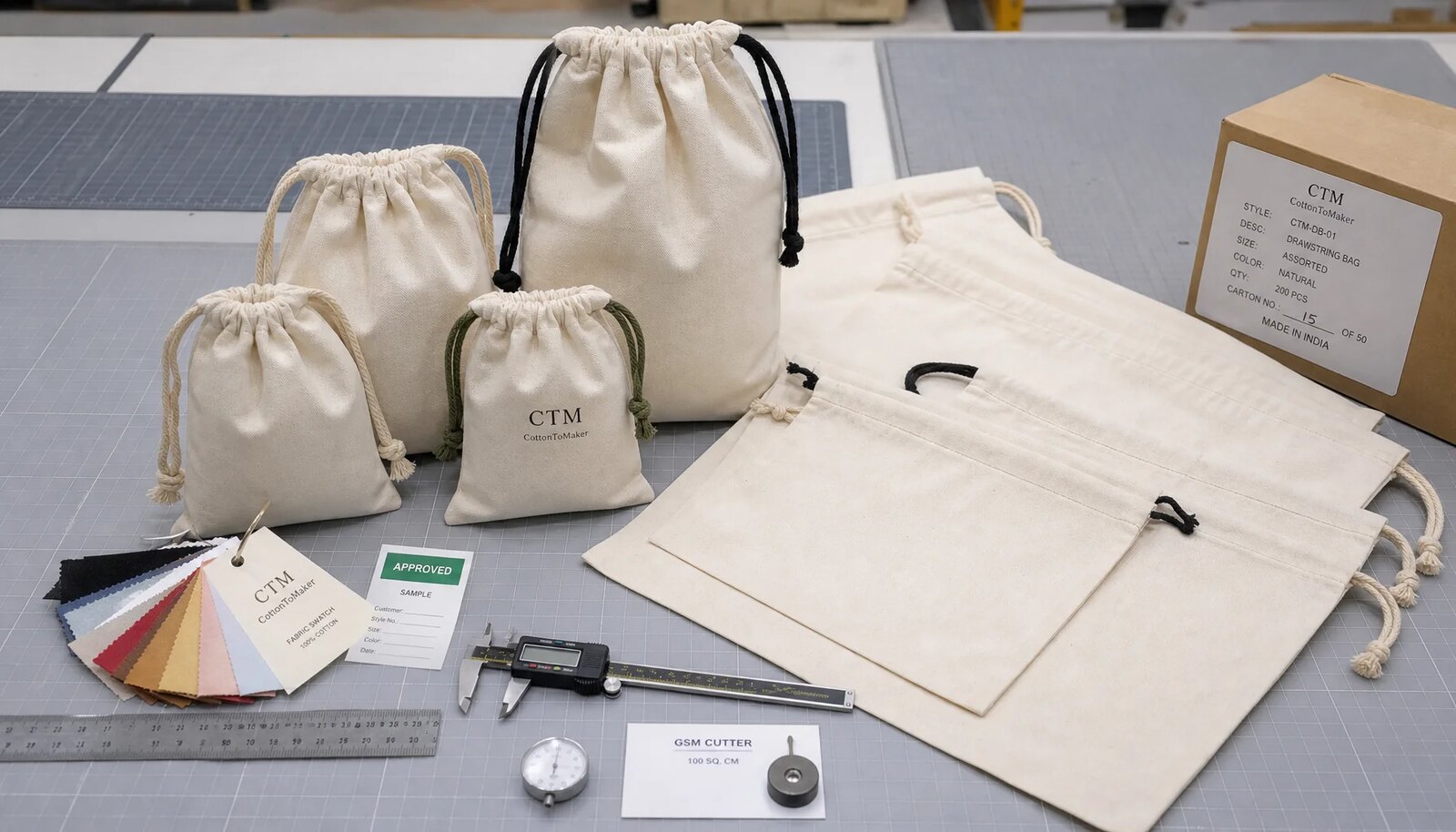
Sampling should move from idea confirmation to production control. A blank fit sample confirms size, shape, fabric body, seam construction, drawcord function, and product capacity. A printed strike-off confirms artwork size, placement, ink behavior, color, and logo appearance. A pre-production sample should use the intended bulk fabric, cord, thread, sewing method, print process, label, and packing format. The sealed approval sample then becomes the inspection reference.
Photo approval alone is weak for cotton pouches. Touch, opacity, odor, drawcord slide, fabric body, and ink hand feel are hard to judge from images. For craft fair buyers, the best sample test is simple: insert the real product, close the pouch, reopen it, stack it, place it in a carton, and handle it as booth staff would. If the pouch is part of a gift set or seller kit, test the full set rather than the empty pouch only.
Approval records should be detailed enough to control bulk production. Measure several sample pieces, not one perfect piece. Record acceptable cotton character, measurements, stitch quality, cord movement, print tolerance, label position, and packing method. If the supplier later proposes substitute fabric, a different cord, an adjusted channel, or alternate ink, require written approval before bulk cutting or printing.
A good sample file also shortens repeat business. When the approved sample is tagged with PO number, date, size, artwork code, version, and pack format, the next order starts with less debate. That is valuable for craft fair buyers who reorder seasonally and do not want to re-litigate every detail with every quote.
- Use a blank fit sample before print approval when size or construction is uncertain.
- Approve a strike-off before bulk printing when color, opacity, or placement matters.
- Require a pre-production sample using intended bulk materials and final packing.
- Measure multiple sample pieces to set realistic sewing and size tolerances.
- Seal and label the approved sample with PO number, date, size, artwork code, and version.
Set Packing, Carton, and Receiving Rules Early
Packing affects cost, damage risk, receiving speed, and booth readiness. Loose bulk packing is inexpensive and reduces packaging material, but it requires counting and sorting after arrival. Individual polybags protect against dust and moisture, yet they add cost, volume, labor, and waste. Paper bands, counted bundles, or inner cartons can be a good middle ground for craft fair teams that need fast kit assembly without full retail packaging.
Carton data should be collected before the purchase order is finalized. Ask for units per inner pack, units per master carton, carton dimensions, gross weight, net weight, CBM, carton marks, SKU labels, and mixed-carton rules. If cartons ship to multiple craft fair teams or retail partners, carton marks should identify size, color, artwork version, quantity, PO number, and destination where needed. A carton labeled only cotton bags is not receiving-ready.
Cotton also needs basic moisture and odor control. Poor storage, damp cartons, humid sea freight, or solvent contamination can make pouches unusable even when sewing is acceptable. Require clean, dry packing conditions, final packing photos, and carton inspection before shipment release. If presentation matters, confirm fold direction, cord position, print protection, label placement, and whether pouches are bundled print-to-print or print-out.
Receiving rules are worth spelling out because they save time at the dock. The buyer should know whether cartons can be mixed by color or size, whether overage or short-shipment allowances exist, and what evidence is needed for a claim. If the packing list does not match the carton marks, the first problem is often not the goods themselves but the lack of a clear packing standard.
- Choose loose bulk, counted bundle, paper band, inner carton, polybag, or retail pack based on workflow.
- Set inner pack quantities to match seller kits, booth boxes, or warehouse pick quantities.
- Request carton dimensions, gross weight, net weight, CBM, carton marks, and SKU labels.
- Avoid mixed cartons unless each SKU and quantity is clear on the carton and packing list.
- Verify final packing photos for fold, bundle count, carton condition, label placement, and moisture protection.
Specification comparison for buyers
| Supplier option | What to verify | Commercial advantage | Buyer risk to control |
|---|---|---|---|
| Direct sewing factory | cord material proof, reinforcement close-ups, load-test photos, approved sample tag, and bulk-line first-piece record | Better sample-to-bulk control and faster production feedback | May be weaker on export paperwork or branded packing unless checked early |
| Trading company | Factory name, production photos, trim-source proof, and who owns QC decisions | Can coordinate small mixed orders and extra services | Markup can hide real factory capability and slow defect decisions |
| Specialized bag workshop | cord diameter, eyelet or reinforced channel, bottom corner reinforcement, seam allowance, bar-tack position, and load target | More practical for detailed construction, trims, and repeat programs | Capacity may be limited during peak seasons |
| Low-price general supplier | 6-10 oz cotton canvas, 210D polyester, rPET, or blended cotton with shrinkage and colorfastness expectations set before sampling | Useful for simple promotional runs with loose specs | Material downgrades, weak packing, and vague inspection scope can erase savings |
| Retail-ready supplier | fold direction, cord protection, bundle count, carton compression, moisture bag, and retail label position | Can handle labels, SKU separation, carton marks, and receiving rules | Higher unit cost must be compared against reduced warehouse work |
| Compliance-focused supplier | Fabric records, labeling review, test plan, and production traceability | Safer for retail programs and repeat brand orders | Documentation claims need evidence, not only sales language |
| Local sample room plus bulk factory | Signed sample, bulk factory handoff, first-piece photos, and deviation owner | Good for complex branding before large production | Sample room quality may not match bulk line unless handoff is controlled |
Buyer checklist before sampling
- Define the pouch job first: free purchase packaging, gift-with-purchase, paid retail item, craft kit component, booth merchandise, wholesale presentation packaging, or seller-kit packaging. The use case drives fabric weight, sewing strength, print tolerance, and pack format.
- State finished usable size, not only a flat cutting size. Include finished width, total height, usable height below the drawcord channel, channel height, seam allowance expectation, and gusset depth if any.
- Specify the product that will go inside the pouch. A pouch for jewelry cards, a candle tin, a soap bundle, or a ceramic ornament needs different space, closure strength, and hand feel.
- Set fabric composition and weight in measurable terms, such as 100% cotton natural 160-220 GSM, 6 oz cotton canvas, 8 oz cotton canvas, bleached cotton, or dyed cotton.
- Write a fabric weight tolerance before sampling. A common starting point is plus or minus 5% when the supplier can verify it, but the tolerance should be aligned to the actual pouch use and print result.
- Separate acceptable cotton character from rejectable defects. Seed specks, small slubs, and natural shade variation may be acceptable; oil marks, mildew, holes, dirt, and foreign fibers should not be.
- Provide artwork as vector files with Pantone or CMYK targets, print dimensions, print side, placement from finished pouch edges, artwork version code, and the required print hand feel.
- List drawcord requirements: material, color, diameter or tape width, cord length, knot style, end finish, shrinkage concern, and whether repeated open-close handling must be tested.
- Ask for a pre-production sample made with intended bulk fabric, bulk cord, final thread, final sewing construction, final print method, final label, and final packing style before mass cutting or printing.
- Set measurable inspection tolerances for finished size, print position, print color, stitch density, seam security, stains, loose threads, odor, cord function, label accuracy, carton count, and packing accuracy.
Factory quote questions to send
- What exact fabric is quoted: composition, weave, finish, GSM or ounces per square yard, weight tolerance, shrinkage expectation, and opacity?
- Can you share a bulk-lot fabric swatch before cutting, especially if the pouch will be judged on shade, specks, or print contrast?
- Is the fabric natural, greige, bleached, dyed, washed, or selected for fewer specks, and how will shade variation be controlled across rolls and lots?
- Which drawcord is included: cotton cord, polyester cord, recycled polyester cord, jute, ribbon, twisted cord, or flat tape; what diameter or width is quoted; and what color tolerance applies?
- What are the finished size tolerances for width, total height, usable height below channel, channel height, gusset, and cord length?
- What is the usable height below the drawcord channel for the approved size, not just the total pouch height?
- Is printing handled in-house or by a subcontractor, and who controls artwork checking, screen making, Pantone matching, ink curing, and rework approval?
- What sample stages are included: blank fit sample, fabric swatch, printed strike-off, pre-production sample, sealed approval sample, and carton packing sample?
- What are the costs and lead times for each sample stage, and which sample stage becomes the production reference?
- What is the MOQ by size, fabric weight, fabric color, cord color, print color count, artwork version, label type, packing type, and shipment?
Quality-control points to confirm
- Fabric weight should match the approved range using a buyer-agreed verification method such as mill record, GSM cutter test, or comparison to an approved swatch. Material drift affects strength, opacity, print result, hand feel, and freight volume.
- Finished pouch size should be measured at agreed points while laid flat and relaxed. Buyers should set tolerances before cutting; small jewelry pouches often need tighter control than large gift bags.
- Usable height below the drawcord channel must be checked with the real product insert. A pouch can meet total height but still fail if the channel takes too much space.
- Fabric appearance should be sorted into acceptable natural cotton character and unacceptable defects such as oil marks, dirt stains, mildew spots, holes, heavy slubs, color streaks, shade panels, and foreign fibers.
- A practical defect rule for craft-fair packaging is simple: one stain, one hole, or one broken seam can be a reject; a few tiny slubs may be acceptable if the approved sample allows them.
- Drawcord must slide smoothly, close the opening fully, hold knots or end finishes consistently, remain inside the channel, and resist slipping or fraying after repeated opening and closing.
- For busy booth use, test at least 20 open-close cycles on samples and verify the cord does not catch, twist badly, or loosen under normal handling.
- Side seams, bottom seams, and channel seams should show consistent stitch density, secure back-tacking at stress points, no skipped stitches, no open seams, no broken threads, and no exposed raw edges unless approved.
- A useful inspection reference is a buyer-specified AQL plan with critical defects at zero tolerance and tighter major-defect limits for retail or premium craft-fair use. AQL 2.5 for major defects is common in general soft goods, but the buyer should confirm the exact level with the supplier and the product risk.
- Print color, size, opacity, sharpness, and placement should match the signed sample within agreed tolerance; ink must be cured and should not transfer during dry rub or normal handling checks.