Start With the Buying Problem, Not the Pouch Name
For tech startups, cotton drawstring pouches are usually not just a giveaway item. They may protect charging cables, hold onboarding accessories, package a small hardware device, organize event kits, or replace disposable plastic packaging. Each use changes the correct GSM, size tolerance, printing method, packing method, and compliance evidence needed from the supplier.
A weak RFQ says only “cotton drawstring pouch with logo.” A usable RFQ states the product loaded inside, finished size, target fabric weight, closure type, logo method, shipment market, packing unit, and required compliance documents. That is the difference between receiving comparable factory quotes and collecting prices that cannot be compared.
- For cable or adapter pouches, prioritize drawcord function, seam strength, and lint control.
- For retail packaging, prioritize shade consistency, print accuracy, barcode packing, and carton protection.
- For event giveaways, prioritize MOQ, lead time, simple logo printing, and carton-ready delivery.
- For device accessory kits, test the actual product fit after closure, not only the flat pouch size.
Fabric Weight and Construction Choices
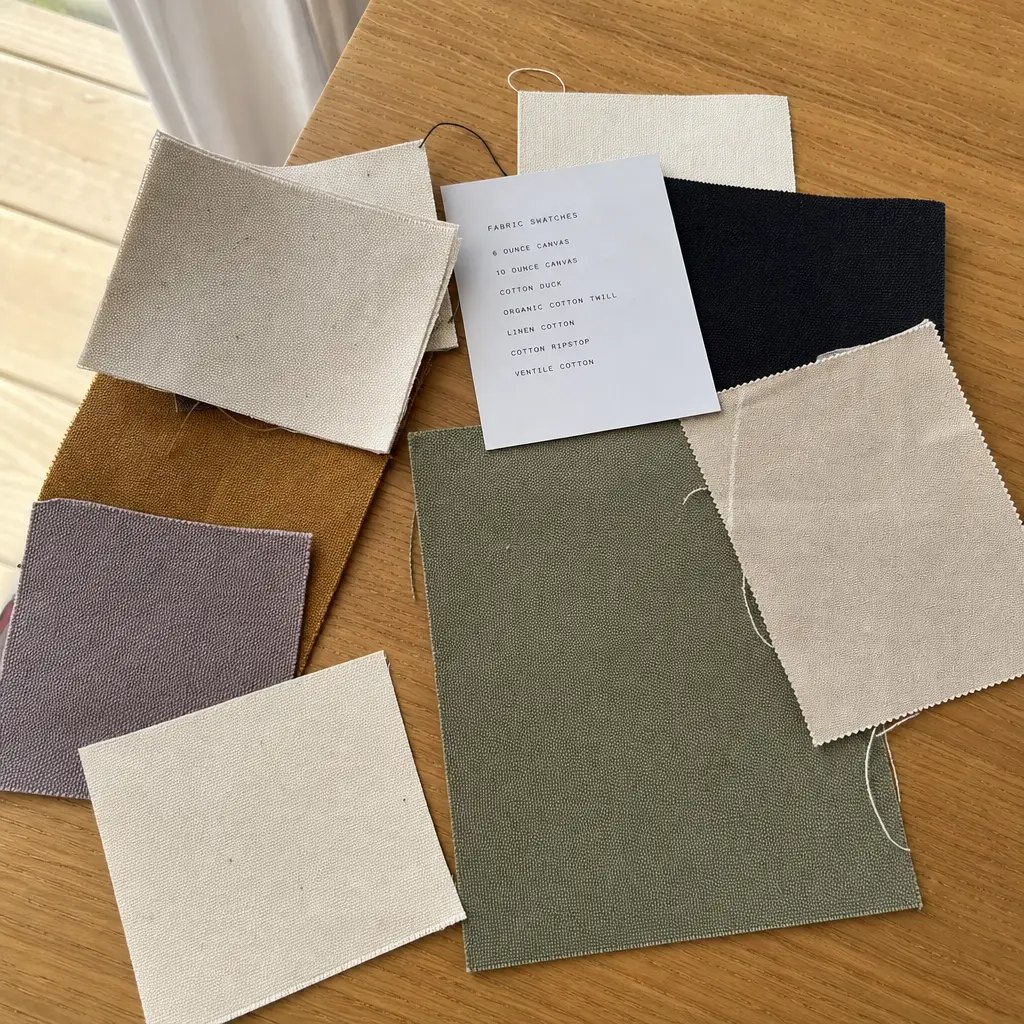
Cotton pouch cost is driven heavily by GSM, size, fabric width, shrinkage control, and sewing time. Lightweight 100-120 GSM cotton works for low-cost giveaways and very light inserts, but it can feel thin and show contents through the fabric. Around 140-160 GSM is a common commercial range for tech accessory pouches because it balances cost, printability, and enough body for daily handling. For a premium retail feel, 180-220 GSM cotton or canvas gives better structure, but raises material cost, freight weight, and sometimes MOQ.
The buyer should decide whether the pouch needs soft folding, rigid presentation, or abrasion resistance. A pouch for USB-C cables does not need the same body as a pouch for a metal power bank. Natural unbleached cotton may include seed specks and a warmer shade. Bleached cotton looks cleaner for some brand colors, while dyed cotton needs more control on shade and rub resistance.
- 100-120 GSM: budget event pouches, light inserts, lower perceived value.
- 140-160 GSM: practical range for startup swag, accessory bags, and onboarding kits.
- 180-220 GSM: stronger handfeel for retail packaging, chargers, or premium gift sets.
- Canvas weave: better structure, usually higher cost and less compact packing.
- Natural cotton: visible cotton character; set acceptable specks and shade range.
Supplier Route and Compliance Evidence
The keyword “supplier compliance checklist” matters because many quote failures happen before production starts. A supplier may have a good sample but no matching factory audit, no chemical compliance file, or no control over the printing workshop. For retail buyers and distributors, the document name is not enough. The report must match the producing factory name, address, product scope, and validity period.
Not every cotton pouch order needs certified organic cotton or a social audit. A startup event order may only need a reliable conventional cotton pouch with safe ink and export packing. A retail order going into chain stores may need BSCI, Sedex, OEKO-TEX material evidence, REACH-related declarations, CPSIA-related considerations for certain markets, or transaction documentation if organic claims are printed on product or packaging.
- Match audit documents to the actual sewing factory, not only the exporter.
- Check whether print ink compliance is covered separately from fabric.
- Do not print “organic” unless the certification route and labeling rules are confirmed.
- For EU distribution, request material and chemical declarations early, not after production.
- For enterprise gifting, align supplier paperwork with the customer’s vendor onboarding form.
Logo Method, Print Area, and Brand Risk
Screen printing is usually the most economical and reliable method for bulk cotton drawstring pouches with one to three solid logo colors. It works well on 140 GSM and heavier cotton when the artwork is not too fine. Heat transfer can hold small details and gradients better, but it changes the handfeel and may not suit every natural cotton texture. Embroidery looks premium on heavier fabric, but it can pucker lightweight cotton and is not ideal for very small text.
Tech startup logos often use fine lines, small app icons, gradients, or precise brand colors. Those details must be converted into production rules. The RFQ should state vector artwork, Pantone color, logo width, print placement from pouch edges, maximum tilt tolerance, and whether the print must pass a rub or wash-style handling test. If the pouch is only packaging, washing may be irrelevant, but rubbing against the product or insert still matters.
- Screen print: best for solid logos, clear brand marks, and wholesale quantities.
- Heat transfer: useful for gradients or fine details, but review edge feel and durability.
- Embroidery: suitable for heavier pouches; avoid tiny QR codes or micro text.
- Woven label: useful when print area is limited or the pouch will be reused often.
- Inside label: consider only when product compliance or SKU identification requires it.
MOQ Logic and Cost Drivers
MOQ is not a single number. It depends on fabric availability, dyeing minimums, cutting efficiency, print setup, sewing line changeover, and packing version. A supplier may accept 500 pieces for natural cotton with one-color screen print, but require 1,000 or 3,000 pieces for dyed fabric, custom cord, multiple SKUs, or certified organic cotton. Buyers get cleaner quotes by separating MOQ by version.
The cheapest unit price is not always the lowest landed cost. A 220 GSM pouch may look better but increase carton weight and ocean or air freight. Individual polybags improve retail presentation but add labor, packing material, and carton volume. Multiple logo versions increase setup time and inspection complexity. For startup procurement, it is often better to lock one practical spec and scale volume than to split the first order across too many colors and sizes.
- Quote breaks should include at least 1,000, 3,000, 5,000, and 10,000 pieces for comparison.
- Custom dyed fabric normally has higher MOQ than natural cotton stock fabric.
- Each logo version can trigger separate screen, setup, sample, and inspection work.
- Heavy GSM increases fabric cost and freight weight at the same time.
- Individual retail packing can cost more than buyers expect on low-value pouches.
Sample Approval That Prevents Bulk Mistakes
A cotton pouch sample should not be approved only by appearance. Procurement teams should load the real product, close the drawcord, measure usable space, rub the printed logo with a dry cloth, inspect the seam ends, and compare fabric handfeel with the intended brand position. For pouches holding electronics or accessories, the inside seam and lint level are also practical checks.
The safest approval path is artwork proof, material reference, physical sample, and pre-production sample from bulk-intended materials. If timing is tight, the buyer can approve a digital layout for placement first, but fabric, print ink, cord, and construction still need physical confirmation. The approved sample should become the reference for bulk inspection, not a loose inspiration image.
- Measure flat finished width and height, then test usable loaded capacity.
- Check drawcord length balance after closing the pouch several times.
- Compare logo position to a printed placement guide, not just by eye.
- Review print sharpness on the actual fabric texture and GSM.
- Photograph approved sample details and include them in the purchase order file.
Packing and Carton Planning
Packing decisions affect both presentation and landed cost. Bulk bundle packing is economical for event kits or when a distributor will repack locally. Individual polybag packing gives cleaner handling for retail or enterprise gift programs, but adds material, labor, volume, and sometimes sustainability concerns. Kraft banding or paper sleeve options may fit some brand programs, but they need testing for carton abrasion and moisture exposure.
Carton data should be part of the quote, not an afterthought. Buyers need pieces per inner bundle, pieces per master carton, carton dimensions, gross weight, net weight, carton mark format, and barcode or SKU label requirements. Cotton is absorbent, so sea freight orders need sensible moisture control and clean carton storage. Overpacked cartons can crush pouches, while underfilled cartons waste freight.
- Bundle packing: lower cost, good for kitting centers and distributor repacking.
- Individual polybag: cleaner unit handling, but more plastic and labor.
- Paper band or sleeve: brand-friendly, but test for tearing and scuffing.
- Carton gross weight: keep within warehouse handling limits, commonly under 15-18 kg when possible.
- Carton marks: include PO, SKU, size, color, quantity, carton number, and destination if required.
Lead Time and Schedule Risk
A realistic pouch schedule has several stages: artwork confirmation, sampling, material booking, cutting, printing, sewing, trimming, inspection, packing, and export handover. Natural stock cotton with one-color print moves faster than dyed cotton, organic documentation, custom cord, or multiple pouch sizes. Buyers should not treat all drawstring pouches as stock items unless the supplier confirms finished inventory.
Schedule risk often comes from late artwork, unclear logo color, delayed sample approval, fabric shade rejection, or packing label changes. For tech startups with launch events, the delivery date is usually fixed. That means the RFQ should include the in-hands deadline, event date, destination, and whether partial shipment is acceptable. Air freight can rescue a delay, but it may erase the savings from a low unit price.
- Sampling often takes longer when dyed fabric, embroidery, or certified material is involved.
- Bulk production should start only after written sample approval and deposit terms are clear.
- Packing labels and barcodes should be finalized before sewing finishes, not at carton closing.
- For event launches, keep a buffer for customs clearance and local kitting.
- If the date is fixed, compare FOB plus freight time against DDP or local decoration routes.
Quote Data Needed for Landed-Cost Comparison
Procurement teams should make suppliers quote the same assumptions. Otherwise, one offer includes screen charges, export cartons, and individual packing while another excludes them. A useful quotation breaks out fabric GSM, finished size, print method, number of colors, packing, MOQ, sample fee, tooling or screen fee, production lead time, carton data, Incoterm, and payment terms.
For importers and distributors, landed cost also includes freight, duty classification, customs brokerage, local delivery, warehousing, inspection cost, and any repacking. A pouch with a low EXW price may become expensive if carton volume is high or the supplier is far from the export port. Ask for FOB port pricing as a baseline, then compare CIF, DDP, or local decorator options based on timeline and control.
- Unit price should state Incoterm, currency, quote validity, and included packing.
- Carton dimensions are needed before freight comparison, not after production.
- Sample fee and screen fee should be separated from bulk unit price.
- If multiple SKUs are involved, request a cost table by SKU, not one blended price.
- For repeat programs, ask how price changes when reusing screens and approved materials.
Acceptance Criteria for the Purchase Order
The purchase order should convert the approved quote into measurable acceptance criteria. It should list product name, finished size, GSM, fabric color, cord type, stitching standard, logo method, logo size, logo placement, packing, carton marks, inspection standard, delivery term, and document requirements. If these details are missing, the buyer has little leverage when bulk goods differ from the sample.
For wholesale cotton drawstring pouches for tech startups, the best control is a clear golden sample plus written tolerances. Do not rely only on photos. Define what is acceptable for natural cotton character, how much size variation is allowed, how print defects are counted, and when a defect becomes major. This protects both sides: the factory understands the target, and the buyer avoids rejecting normal cotton features that were never specified.
- Attach approved artwork, approved sample photos, and measurement sheet to the PO.
- Define minor, major, and critical defects for stitching, stains, print, and packing.
- State whether overrun or underrun quantity is acceptable and at what percentage.
- Include required documents such as packing list, commercial invoice, test report, or certificate copy.
- Require final inspection before balance payment or shipment release when order value justifies it.
Specification comparison for buyers
| Supplier option | What to verify | Commercial advantage | Buyer risk to control |
|---|---|---|---|
| Direct sewing factory | cord material proof, reinforcement close-ups, load-test photos, approved sample tag, and bulk-line first-piece record | Better sample-to-bulk control and faster production feedback | May be weaker on export paperwork or branded packing unless checked early |
| Trading company | Factory name, production photos, trim-source proof, and who owns QC decisions | Can coordinate small mixed orders and extra services | Markup can hide real factory capability and slow defect decisions |
| Specialized bag workshop | cord diameter, eyelet or reinforced channel, bottom corner reinforcement, seam allowance, bar-tack position, and load target | More practical for detailed construction, trims, and repeat programs | Capacity may be limited during peak seasons |
| Low-price general supplier | 6-10 oz cotton canvas, 210D polyester, rPET, or blended cotton with shrinkage and colorfastness expectations set before sampling | Useful for simple promotional runs with loose specs | Material downgrades, weak packing, and vague inspection scope can erase savings |
| Retail-ready supplier | fold direction, cord protection, bundle count, carton compression, moisture bag, and retail label position | Can handle labels, SKU separation, carton marks, and receiving rules | Higher unit cost must be compared against reduced warehouse work |
| Compliance-focused supplier | Fabric records, labeling review, test plan, and production traceability | Safer for retail programs and repeat brand orders | Documentation claims need evidence, not only sales language |
| Local sample room plus bulk factory | Signed sample, bulk factory handoff, first-piece photos, and deviation owner | Good for complex branding before large production | Sample room quality may not match bulk line unless handoff is controlled |
Buyer checklist before sampling
- Define pouch purpose first: retail package, device accessory bag, event giveaway, onboarding kit, or distributor resale item.
- State finished pouch size in width by height, and include whether measurement is before or after drawstring closure.
- Specify fabric composition and weight, such as 100% cotton at 120, 140, 180, or 220 GSM, instead of only writing natural cotton.
- Clarify whether certified organic cotton is required, and name the certificate type and document needed for shipment.
- Set color standard for natural, bleached, dyed, or Pantone-matched fabric, including acceptable shade variation.
- Choose drawcord type: cotton cord, flat tape, polyester cord, jute cord, or matching dyed cord, with diameter or width.
- Confirm seam construction, top channel width, drawcord exit style, and whether double-line stitching is needed.
- Provide logo artwork in vector format and specify print size, placement, color count, and Pantone references.
- Match print method to fabric and quantity: screen print for most bulk logo work, heat transfer for detail, embroidery for premium thicker pouches.
- Define MOQ by one size, one fabric weight, one body color, and one logo version; do not mix versions without asking the impact.
Factory quote questions to send
- Are you quoting as the direct pouch factory, a trading company, or a decorator using blank stock pouches?
- What is the quoted fabric composition, weave, color process, and GSM, and what tolerance do you allow on GSM?
- Is the quoted size measured as finished flat size, usable inside size, or cut panel size before sewing?
- What is the MOQ for one size, one GSM, one fabric color, and one logo design, and how does price change at 1,000, 3,000, 5,000, and 10,000 pieces?
- Which print method are you quoting, and what is the maximum printable area on this pouch size without distortion near seams or drawcord channel?
- Are screen charges, sample charges, artwork setup, Pantone matching, courier cost, and export carton cost included or separate?
- Can you provide a physical pre-production sample using the same bulk fabric, drawcord, print ink, and packing method?
- What compliance documents are available under the same factory name and address that will produce the order?
- What inspection standard do you use for fabric stains, loose threads, skipped stitches, print smudges, and size tolerance?
- How many pieces per polybag, inner carton, and master carton are included in the quote, and what are the carton dimensions and gross weight?
Quality-control points to confirm
- Finished size tolerance should normally be agreed before production, commonly within plus or minus 5 mm for small pouches and plus or minus 10 mm for larger pouches.
- Fabric GSM should be checked against the approved sample; a common working tolerance is plus or minus 5% unless the buyer needs a tighter retail standard.
- Drawcord should open and close smoothly without tearing the top channel, jamming at the side seam, or leaving uneven cord lengths.
- Stitching should have no open seams, skipped stitches, broken threads, severe puckering, or loose thread tails longer than the agreed limit.
- Print placement should stay within the approved position tolerance and should not tilt, bleed, crack, smear, or transfer onto adjacent pouches.
- Natural cotton shade variation, seed specks, and small slubs should be classified before production so normal fabric character is not confused with defects.
- Dyed cotton should be checked for rubbing risk, shade consistency, and odor, especially when pouches will touch white electronics, paper inserts, or apparel.
- Packing inspection should verify quantity per bundle, barcode or SKU labels, carton marks, carton strength, gross weight, and moisture protection for sea freight.
- A pull test on drawcord and a seam stress check should be included when the pouch will hold chargers, metal accessories, or multiple tech components.
- Final inspection photos should show random pieces from bulk cartons, close-ups of print and stitching, carton labels, and a measurement record.