Why carton planning belongs in the pouch specification
Cotton drawstring pouches look simple on a product table, but craft fair programs put them through a surprisingly demanding chain. They arrive near the selling season, move through receiving, get counted, sometimes receive inserts or price tags, and then travel again to booths, pop-up shelves, storage bins, or event vehicles. If the cartons are poorly planned, the buyer pays for it in the busiest part of the calendar.
For B2B procurement, the shipping carton is not just a box chosen at the end. It is part of the product specification. Carton design influences count accuracy, print condition, moisture exposure, carton handling weight, receiving speed, and landed cost. A quote that gives only the unit price of the pouch is incomplete if it does not also show carton dimensions, gross weight, inner pack quantity, carton marks, and packing method.
The difference can be very practical. The same pouch packed 1,000 pieces loose in a light carton may arrive wrinkled, dusty, and slow to count. Packed in inner bags of 100 inside a stronger export carton, it may cost slightly more but be much easier to receive and allocate. Neither plan is automatically right; the point is to choose deliberately instead of letting the factory default decide.
Good procurement turns assumptions into measurable requirements. Define pouch GSM, finished size tolerance, drawcord construction, logo placement, inner pack count, master carton quantity, carton wall grade, gross weight, carton mark, and inspection method in the same order file. Then the factory, logistics team, warehouse, and craft fair staff are working from one standard instead of interpreting a vague packing note.
- Include carton planning in the purchase order, not only in the freight booking.
- Compare suppliers on the same packing basis: inner pack count, carton grade, carton dimensions, and Incoterms.
- Treat receiving speed, sorting time, and repacking labor as part of landed cost.
- Require a carton mark proof before production packing begins.
Define the pouch build before calculating carton count
Carton count should come after the pouch construction is fixed. Finished size, cotton GSM, seam allowance, top hem depth, drawcord thickness, print method, fold method, and pressing all change carton volume. A small change in fabric weight or pouch height can turn a carton from tidy and liftable into overfilled and difficult to close.
For general craft fair resale, many buyers start with midweight cotton around 170-220 GSM, commonly marketed as roughly 5 oz to 6.5 oz. This range usually gives a natural handfeel, reasonable opacity, a usable screen-print surface, and manageable carton weight. Lighter 140-170 GSM cotton can work for small jewelry, seed packets, favors, or lightweight samples. Heavier 270 GSM or about 8 oz cotton is better for contents that need more structure, such as candles, several soaps, small bottles, or reusable gift kits.
Be careful with ounce descriptions. “5 oz cotton” is useful as a familiar buying phrase, but it is not always used consistently across suppliers and markets. GSM gives the factory a clearer production target. If ounce weight is included, ask the supplier to confirm the GSM equivalent and the tolerance they will hold in bulk. For basic cotton pouches, a practical GSM tolerance may be around ±5% to ±10%, depending on the fabric and mill, but the agreed number belongs in the purchase order.
Size language also needs precision. A pouch sold as 10 x 15 cm is often measured flat from outside edge to outside edge. The actual internal width is reduced by the side seams, and usable height is reduced by the drawcord channel plus the bottom seam or fold. If the pouch must hold a soap bar, jewelry card, candle tin, seed bundle, or craft kit, give the supplier the product dimensions and ask for a fit confirmation before the carton plan is approved.
- Record finished flat width, finished flat height, usable internal width, usable internal height, and drawcord channel depth.
- Set a practical size tolerance, commonly ±0.5 cm for small pouches and ±1.0 cm for larger textile pouches unless tighter control is confirmed.
- Use GSM as the primary fabric specification and ounce weight only as supporting terminology.
- Do not approve carton count from a drawing alone; confirm with a folded physical sample or representative production sample.
Choose fabric color and finish with retail handling in mind
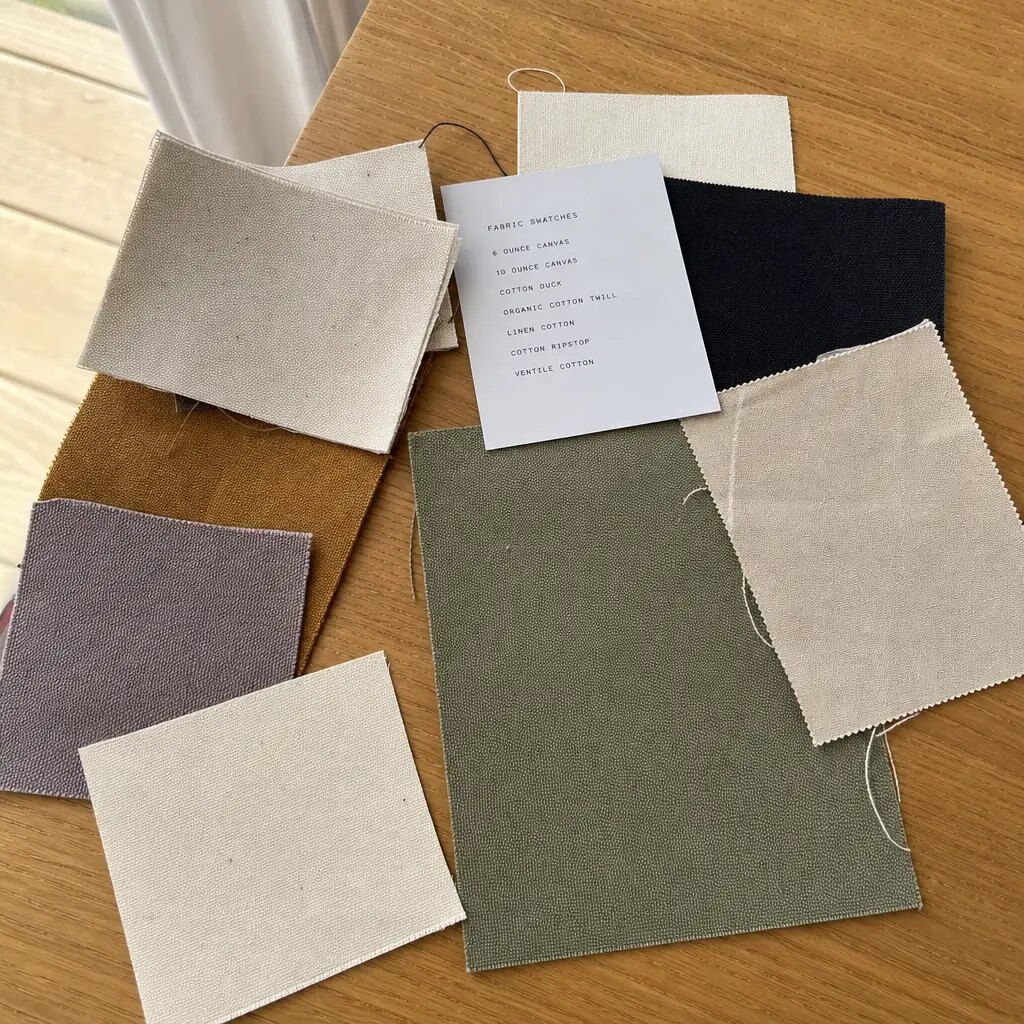
Craft fair pouches may go straight from carton to table, so surface appearance matters. Natural cotton gives a low-gloss, handmade look and is popular for simple craft packaging. Bleached cotton gives a cleaner white background for printing, but it can show dust, lint, and handling marks more easily. Dyed cotton supports stronger brand color, yet it adds dye lot control, shade approval, and often more complex MOQ planning.
The finish should match the selling environment. If pouches will sit in open bins, shoppers will see wrinkles, lint, loose threads, and surface marks quickly. Cotton may arrive with fold creases; that might suit rustic packaging, but it may not be acceptable for a premium logo pouch. If your team has to steam, iron, air out, or sort goods before a fair, that labor is part of the true landed cost.
Dyed pouches need a clear color approval process. A Pantone number is helpful, but cotton fabric, dye chemistry, and lighting can change the result. A lab dip or approved fabric swatch is stronger than a color name. Bulk shade variation should be controlled by lot, and mixed shade lots should not be packed into the same inner pack unless the buyer accepts that in writing.
Certification claims need the same discipline. If the pouch will be marketed as organic cotton, recycled content, or another certified material, ask what documents the supplier can provide and what the certification actually covers. It may apply to the fabric, the factory scope, the transaction, or only a general supply claim. Do not add certification logos or product claims to craft fair packaging unless documentation and labeling rules are clear.
- Specify natural, bleached, dyed, washed, or unwashed cotton in the PO.
- For dyed goods, approve a swatch or lab dip and state whether shade variation is acceptable.
- Check odor, lint, stains, and water marks because pouches may go straight to the sales table.
- Ask for certification documents before placing the order if the product will be sold as organic or otherwise certified.
Build drawcord and seam details into the quote
The drawcord is one of the first quality details a customer notices. At a craft fair, shoppers may open and close the same pouch several times before purchase, and booth staff may use pouches quickly while packing products. A smooth channel and even cord length make the pouch feel reliable. A tight channel, frayed cord, or uneven pull makes it feel cheap, even if the fabric itself is acceptable.
The quote should state drawcord material, color, thickness or diameter if available, cord length, and cord-end finish. Cotton cord gives a cohesive natural look. Polyester or blended cord may be smoother or more durable depending on construction. If the brand wants a fully cotton appearance, say so clearly. If cord ends must be knotted, trimmed, or finished without heat, define that before production.
Seam construction does not need to be overcomplicated, but the buyer should still set workmanship rules. State that open seams, skipped stitches, severe puckering, excessive loose threads, fraying channel openings, and weak stress points are not acceptable. If the pouch will hold heavier items, ask whether the side seams or bottom seam should be reinforced. The factory should know the approximate filled weight, not just the pouch dimensions.
The top hem and drawcord channel also affect usable space and folding. A deeper channel can look neater and allow smoother pulling, but it reduces internal height. A narrow channel may save fabric but slow handling. Ask for close-up photos of the approved top hem, channel opening, stitch line, and cord finish. Those photos are useful later during inspection, especially if several factories or production lines are involved.
- Define drawcord material, thickness, length, color, and cord-end finish.
- Tell the supplier the approximate filled weight when pouches will hold candles, bottles, or dense gift kits.
- Check that both cords pull evenly and do not twist inside the channel.
- Include seam workmanship defects in the QC checklist, not only in general product comments.
Pick a branding method that survives folding and carton pressure
Logo method affects appearance, lead time, and packing risk. For many cotton drawstring pouches used at craft fairs, 1-color screen print is the most practical choice for simple repeat artwork. It is clear, efficient at volume, and familiar to many pouch factories. Two-color screen print can also work, but the buyer should define registration tolerance and avoid artwork so small that minor movement becomes obvious.
Heat transfer is useful for gradients, full-color detail, or shorter runs where screen setup is not economical. It needs tighter process control. Poor heat, pressure, curing, fabric moisture control, or transfer film quality can lead to edge lift, cracking, adhesive marks, scorching, or weak adhesion. Some problems may not show on a fresh sample but appear after cartons are compressed or the pouches are handled repeatedly.
Embroidery and woven labels are possible alternatives. Embroidery can look premium, but it adds thickness, may distort lightweight cotton, and can reduce carton efficiency. Woven side labels add brand identity with less risk to the front panel, but they require label setup, placement tolerance, and sewing control. Treat these choices as specifications, not decorative afterthoughts.
Artwork approval should include exact print dimensions, a measurable location, color reference, and placement tolerance. For example: logo centered on the front panel, 4 cm below the drawcord channel, placement tolerance ±5 mm if the factory confirms it is realistic. Keep artwork away from the top hem, side seam, bottom fold, and drawcord channel. Before approval, ask the factory to fold the pouch exactly as it will be packed so you can see whether the logo will crease.
- Use screen print for simple repeat logos; use heat transfer when detail or short-run economics justify it.
- Specify print size, color reference, setup charges, and placement tolerance before sampling.
- Request a print strike-off or pre-production sample on the actual fabric.
- Review the logo after the pouch is folded the same way it will be packed in cartons.
Set inner packs and master cartons for fast receiving
A practical packing plan starts with inner packs. For small textile items, 50-piece or 100-piece inner polybags are common because they are easy to count and easy to allocate. They also protect cotton pouches from carton dust and help keep sizes, colors, and artwork versions separated. Loose bulk packing can reduce packaging material, but it usually increases counting time and handling exposure.
Master carton quantity should be chosen after reviewing pouch size, GSM, fold method, and target gross weight. A small lightweight pouch may fit 1,000 pieces per carton without creating a lifting problem. A larger or heavier pouch may be better packed at 300 or 500 pieces. Large cartons are not automatically cheaper if they crush hems, crease printed panels, burst corners, or slow down receiving.
Procurement should request proposed carton dimensions and both net and gross weight before issuing the PO. Logistics teams need those numbers for freight estimates, storage space, and event staging. Receiving teams need carton count and carton sequence to reconcile the shipment quickly. If the supplier cannot provide final carton data during quotation, ask for an estimate and require final confirmation before production packing.
Avoid mixed cartons unless there is a clear operational reason. When mixed cartons are necessary, require a carton map and labeled inner packs. Each inner pack should show SKU, size, color, artwork version, and quantity. Without that discipline, mixed cartons create the very errors the buyer was trying to avoid: wrong allocation, slow counts, and last-minute booth shortages.
- Use 50-piece or 100-piece inner packs for clean count control.
- Select 300, 500, or 1,000-piece master cartons based on size, GSM, fold method, and safe gross weight.
- Require one SKU per carton when possible.
- If mixed cartons are unavoidable, approve the carton map and inner labels before packing.
Specify carton strength, moisture protection, and handling route
Cotton pouches are flexible, but the cartons still have a tough job. They may face compression, humidity, sorting, cross-docking, and repeated manual handling. A 5-ply export carton is usually the safer choice for ocean freight, high stacking, long transit, humid warehouses, or loose loading. A 3-ply carton may be acceptable for short domestic routes with limited stacking and fast delivery. The route should drive the decision.
Moisture control deserves attention because cotton absorbs humidity and can carry odor. Wet cartons, damp liners, or long storage in humid conditions can cause musty smell, water marks, or mildew risk. Depending on the lane and storage plan, inner polybags, carton liners, or desiccants may be appropriate. For a quick domestic shipment, simpler packing may be enough. For sea freight or seasonal storage, protection should be planned before there is a problem.
Handling method changes the risk profile. Palletized cartons are easier to move with warehouse equipment and may reduce individual carton abuse, although pallets can increase dimensional volume and cost. Loose-loaded cartons may reduce pallet cost but often involve more manual handling and compression. Buyers receiving goods in small storage rooms, garages, retail back rooms, or event spaces should consider whether cartons are too large or heavy for the team.
A useful carton specification includes carton wall grade, dimensions, gross weight, closure method, inner pack count, carton mark location, and palletization instructions if needed. If there is a maximum manual handling weight, put it in the RFQ. Otherwise, the supplier may pack for maximum carton utilization rather than for practical receiving.
- Ask whether the carton is 3-ply or 5-ply and whether it is designed for export handling.
- Define moisture controls based on route, storage duration, and season.
- Confirm loose loading versus palletization before freight quotes are compared.
- Set a maximum gross weight target if cartons will be moved by event staff.
Use carton marks as an inventory control tool
Carton marks often get treated as a warehouse detail, but for craft fair pouch programs they are inventory controls. A receiving team should be able to identify what is inside a carton without cutting the tape. At minimum, marks should show PO number, SKU, pouch size, pouch color, artwork version, quantity, carton number, and country-of-origin wording where required.
For multi-event programs, carton marks can also support allocation. If inventory is intended for different craft fairs, the buyer can use carton sequences, destination codes, or event labels to stage goods faster. This is especially helpful when pouches are packaging supplies rather than the main product being sold. Booth teams do not want to open every carton just to find the correct size or logo version.
Carton labels must match the packing list. If the PO shows 20 cartons of 500 pieces but the cartons are marked inconsistently, receiving slows down and count disputes become harder to resolve. Request a carton mark proof before packing starts, then check the printed labels during pre-shipment inspection.
If origin marking or regulatory wording is required for the destination market, confirm it with the importer of record or compliance adviser. The supplier can usually print the wording requested by the buyer, but the buyer should not assume that generic carton text is correct for every market.
- Approve carton marks before cartons are sealed.
- Make marks readable from the normal storage orientation.
- Use carton sequence numbers, such as 1 of 20, 2 of 20, and so on.
- Match carton labels, packing list, invoice, and SKU master data.
Compare suppliers on complete quote data, not unit price alone
Cotton drawstring pouch quotes can look similar while hiding very different assumptions. One supplier may include labeled inner packs, 5-ply export cartons, screen setup, a print strike-off, and FOB terms. Another may show a lower unit price but assume loose packing, weaker cartons, excluded setup charges, and ex-works terms. Those offers are not commercially equivalent.
A buyer-ready RFQ should request unit price, MOQ, sample cost, setup charges, fabric GSM, finished size tolerance, print method, drawcord specification, inner pack count, master carton count, carton dimensions, net weight, gross weight, Incoterms, lead time, and inspection responsibility. With that structure, it is much easier to compare factory-direct suppliers, trading companies, distributors, and local print converters.
MOQ should be broken down by the real cost drivers. A supplier may accept a total order of 5,000 pouches, but MOQ may still apply by size, fabric color, drawcord color, artwork version, and print color. A craft fair assortment with three sizes, four fabric colors, and two logos can become twenty-four combinations. Each combination affects cutting, printing, counting, packing, carton marks, inspection, and reorder planning.
For a first seasonal program, simplicity often protects margin. One size, one fabric color, and one print version reduce setup cost and packing error risk. If sales data later proves demand for additional sizes or colors, the buyer can expand with better forecasting. Variety should earn its place in the assortment; it should not be added only because it looks attractive in a catalog.
- Normalize Incoterms before comparing prices.
- Ask for MOQ by size, color, artwork, print method, and packing version.
- Include setup charges and carton packing costs in the landed-cost comparison.
- Avoid excessive SKU variety unless the receiving and sales plan can support it.
Inspect the product and the packed cartons before shipment
A good loose sample does not guarantee a good shipment. Bulk inspection needs to check both pouch workmanship and packed-carton execution. Product checks confirm fabric, size, seams, drawcord, print, and cleanliness. Packing checks confirm inner pack quantity, carton count, carton mark accuracy, carton condition, fold method, and moisture protection.
For simple cotton pouches, buyers may not need extensive laboratory testing unless the order carries regulatory, certification, or performance claims. Still, disciplined visual and functional checks are important. Measure pouches from several cartons, not only the top of one stack. Pull the drawcord repeatedly. Check whether the channel twists. Where appropriate, rub the print lightly with a dry white cloth to identify obvious uncured ink. Look at printed panels after folding to see whether compression has damaged the logo.
If AQL inspection is used, define the inspection level and defect classification before production. Critical defects may include wrong SKU, wrong artwork, wet or moldy goods, sharp contamination, or serious safety concerns. Major defects may include open seams, incorrect size beyond tolerance, severe print defects, wrong count, or missing carton marks. Minor defects may include small loose threads or slight cosmetic variation within approved limits. The classification should match the buyer’s commercial risk.
Packed cartons should be opened selectively for count verification and then resealed properly. Inspection photos should include carton exterior, carton marks, inner pack labels, folded pouches, product close-ups, and any defects. This evidence helps the receiving team know what to expect and gives both buyer and supplier a better chance to resolve issues before goods leave the factory.
- Inspect samples from different cartons and inner packs.
- Verify both product quality and packing accuracy.
- Use defect classifications that match commercial risk.
- Photograph opened cartons and carton marks before shipment release.
Specification comparison for buyers
| Spec decision | Recommended option | When it fits | Buyer risk to check |
|---|---|---|---|
| Fabric weight | 140-170 GSM cotton, often described as about 4 oz to 5 oz, for light favors and jewelry; 170-220 GSM, often about 5 oz to 6.5 oz, for most craft fair resale; 270 GSM+ or about 8 oz for heavier gift kits | Use lighter fabric for small flat items and lower freight weight; use midweight fabric for general retail pouches; choose heavier fabric when contents need more structure or abrasion resistance | Do not rely on ounce wording alone. Suppliers may define ounce weight differently. Specify GSM, tolerance, fabric color, and whether the cotton is greige, natural, bleached, dyed, organic-certified, or conventional |
| Finished size tolerance | A practical tolerance is often about ±0.5 cm for small pouches and ±1.0 cm for larger textile pouches, unless the factory confirms tighter control | Useful when pouches must fit soaps, candles, jewelry cards, seed packets, craft kits, or pre-packed retail bundles | Flat advertised size is not the same as usable internal size. Usable height is reduced by the drawcord channel and bottom seam; usable width is reduced by side seams |
| Print method | 1-color screen print for simple repeat logos; 2-color screen print where registration tolerance is acceptable; heat transfer for gradients, photos, or short-run detailed artwork | Screen print fits natural cotton pouches used repeatedly at booths; transfer fits high-detail branding when process controls are documented | Ask for print size, placement tolerance, setup charges, color reference, wash or rub expectation, and whether printing happens before or after sewing |
| Print placement tolerance | Set a measurable window, commonly ±3 mm to ±5 mm for small pouch logos, depending on print method, sewing variation, and artwork size | Important when the logo must remain centered after folding and when several pouch sizes share the same artwork | If placement is only described as “centered,” bulk cartons may contain visible drift. Artwork too close to seams, the bottom fold, or the drawcord channel can look distorted |
| Drawcord and channel | Cotton cord or braided cord sized to the pouch; smooth channel, even top hem, and cord ends finished by knotting or trimming as specified | Best for pouches customers will open and close often during craft fairs, retail sampling, gift packaging, or resale | Thin cords can fray or slip; tight channels slow handling; uneven cord length looks unprofessional in display bins |
| Inner pack count | 50 or 100 pieces per inner polybag, with one SKU, artwork, and color per inner pack unless mixed packing is approved | Supports quick receiving, clean storage, and partial carton replenishment for booth inventory | Loose bulk packing is harder to count and more exposed to carton dust. Mixed inner packs create receiving errors unless labels are explicit |
| Master carton count | Typical planning range: 300, 500, or 1,000 pieces per carton depending on size, GSM, fold method, and target gross weight | Works when cartons must be moved by warehouse staff, event teams, or small booth crews without special equipment | Do not over-pack just to reduce carton count. Overfilled cartons can crush hems, crease print panels, burst corners, or exceed safe manual handling limits |
| Carton strength | 5-ply export carton for ocean freight, long transit, high stacking, or humid storage; 3-ply may be acceptable for short domestic routes with low compression risk | Use stronger cartons when goods may be loose-loaded, cross-docked, stored before the season, or stacked under other cartons | Low carton cost can hide high receiving cost. Ask for carton grade, dimensions, gross weight, closure method, and whether cartons will be palletized |
| Moisture and cleanliness | Inner polybags, carton liners, and desiccants when route, warehouse dwell time, or humidity justifies them | Useful for cotton goods shipped by sea, stored seasonally, or moved through humid warehouses | Too little protection can cause odor, carton dust, water marks, and mildew risk. Too much packaging may add cost and waste on short routes |
Buyer checklist before sampling
- Confirm finished flat dimensions and usable internal dimensions. Record flat width, flat height, bottom seam allowance, side seam allowance, drawcord channel depth, and measurement tolerance by size.
- Specify fabric in GSM and, if helpful, the common trade weight such as 170-220 GSM or about 5 oz to 6.5 oz. State acceptable GSM tolerance, fabric color, cotton type, and whether certification documents are required.
- Define whether the pouch is natural, bleached, dyed, washed, or unwashed. For dyed cotton, request a color standard such as a Pantone reference, approved swatch, or lab dip and confirm shade tolerance by lot.
- Confirm drawcord material, cord thickness or diameter where available, cord color, cord length, knot or no-knot finish, trimming method, and whether both cords must pull evenly.
- Define print method, artwork file format, print size, print location, ink color reference, number of colors, setup charges, print placement tolerance, and whether the artwork will be printed on fabric panels or finished pouches.
- Set acceptable workmanship standards: no open seams, skipped stitches, loose thread bundles, heavy puckering, oil marks, stains, strong odor, severe slubs, or mixed shade lots without approval.
- Approve a pre-production sample that includes the real fabric weight, real drawcord, final artwork, final logo placement, final folding method, and representative inner packing where possible.
- Set inner pack quantity, normally 50 or 100 pieces, and state whether every inner pack must contain one SKU only. If mixed packing is needed, define exact inner labels and carton map.
- Set master carton quantity by SKU, carton wall grade, carton dimensions, estimated net weight, estimated gross weight, closure method, and maximum gross weight target for manual handling.
- Request the carton mark proof before bulk packing. Include PO number, SKU, pouch size, pouch color, artwork version, quantity, carton sequence, gross weight, net weight, and origin wording where required.
Factory quote questions to send
- What exact fabric GSM are you quoting, what common ounce weight do you consider it equivalent to, and what bulk tolerance will you hold?
- Is the quoted cotton natural, bleached, dyed, organic-certified, or conventional? If certified, which transaction or scope documents can you provide?
- What is the finished flat size and the usable internal size after side seams, bottom seam, and drawcord channel? What size tolerance applies in bulk?
- What seam allowance, top hem depth, drawcord channel width, stitch type, and stitch density will be used for this pouch size?
- What drawcord material, thickness, length, color, and cord-end finish are included in the price? Can you provide a close-up sample photo?
- Which print method is included, what maximum print area is included, what placement tolerance do you hold, and what setup charges apply per screen, color, or artwork?
- Will printing occur before sewing or after sewing? How do you control registration, ink curing, transfer adhesion, and print rubbing during packing?
- How many pieces will be packed per inner polybag and per master carton? Are the inner packs labeled by SKU, size, color, and artwork version?
- What are the proposed master carton dimensions, net weight, gross weight, carton wall grade, and maximum stacking recommendation?
- Will every master carton contain one SKU only? If you propose mixed cartons, can you provide a carton map and labeled inner packs before packing approval?
Quality-control points to confirm
- Fabric GSM is checked against the approved specification using a practical sampling method, and results stay within the agreed tolerance. Fabric has no severe thin areas, heavy slubs, holes, oil marks, stains, mildew odor, or unexpected shade variation.
- Finished flat width, flat height, usable depth below the drawcord channel, channel depth, and seam allowances match the approved sample and purchase order tolerance.
- Pouch panels are cut straight enough that the finished pouch does not twist, lean, or distort the printed artwork when laid flat.
- Top hem is even, drawcord channel is open, and cords slide without snagging, twisting, breaking, or pulling loose under normal open-close handling.
- Side seams and bottom seams are secure, with no open seams, skipped stitches, unraveling thread, severe puckering, fraying edges, or unfinished stress points.
- Drawcord length is consistent within the approved range, cord ends are finished as specified, and both sides pull evenly when the pouch is closed.
- Print color, opacity, edge clarity, and position match the approved strike-off or pre-production sample. Placement stays within the agreed window and does not enter seam allowance, bottom fold, or drawcord channel.
- Print surface shows no major smearing, ghosting, pinholes, ink buildup, transfer edge lift, cracking, scorching, adhesive residue, or obvious color mismatch between cartons.
- A simple dry rub check is performed where appropriate to identify obvious ink transfer or poor curing before shipment. Any stricter test must be specified in the PO.
- Pouches are clean, dry, and free from loose lint bundles, strong chemical odor, damp smell, carton dust, insect contamination, or foreign objects.