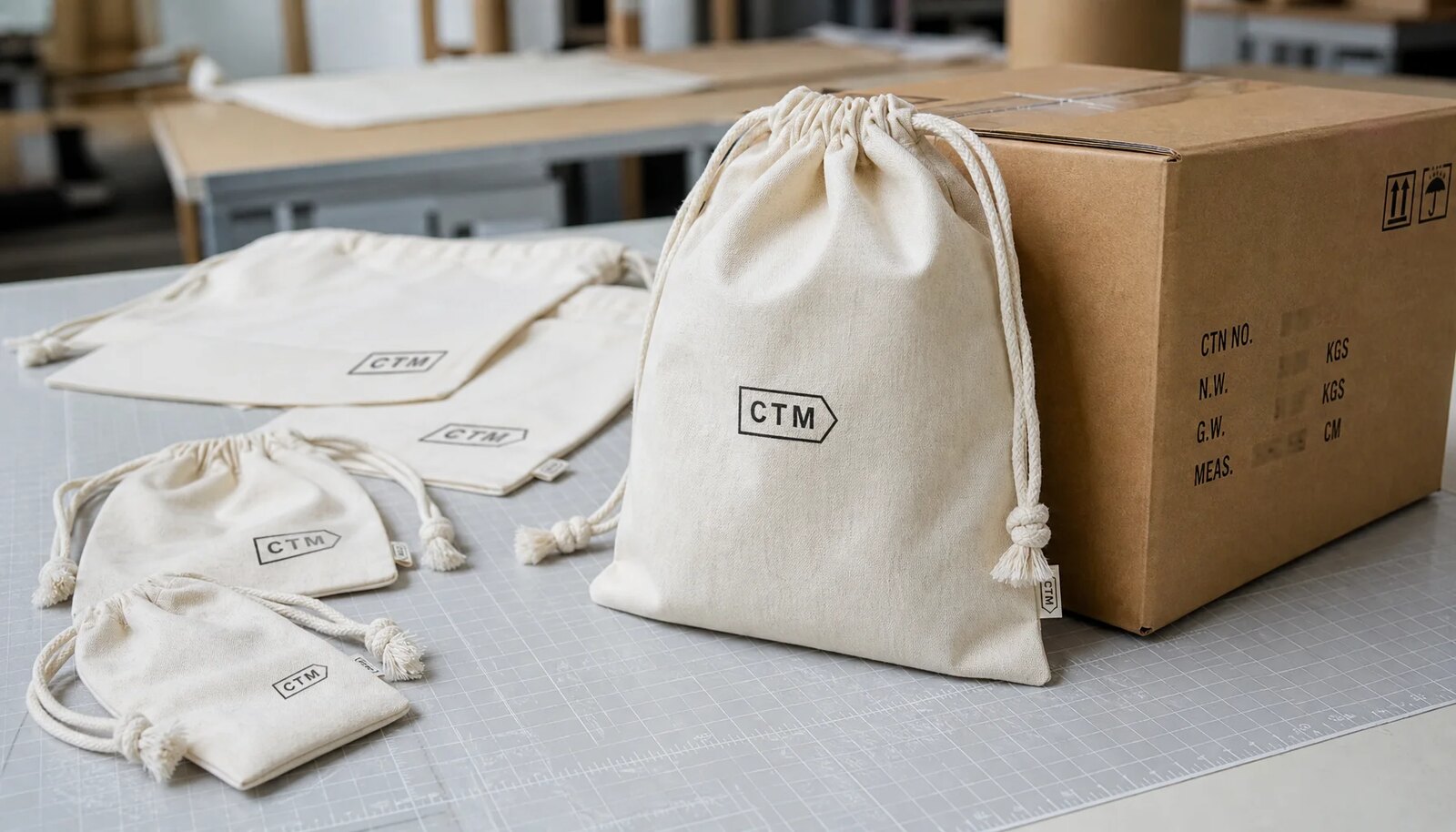
Start With the Carton, Not Just the Pouch
Cotton drawstring pouches for craft fairs are easy to underestimate. The product looks simple: cotton fabric, two seams, a channel, a cord, maybe a one-color logo. Yet small specification gaps can become expensive once thousands of pieces are packed into export cartons. A low unit price may hide lighter cotton, vague sizing, weak bundle control, oversized cartons, or mixed designs that take hours to sort at the warehouse or event site.
For procurement teams, the RFQ should cover the pouch and the logistics plan together. Craft fair programs often include several pouch sizes, different maker logos, seasonal artwork, sponsor marks, or destination codes. If carton planning waits until the goods are finished, the buyer may discover that total CBM is higher than budgeted, cartons are too heavy for manual handling, or booth-specific SKUs are mixed in a way that slows distribution.
Build carton data into the first supplier comparison. Ask every supplier to quote by SKU with finished size, fabric GSM, estimated finished pouch weight, print method, pieces per inner pack, pieces per master carton, carton dimensions, net weight, gross weight, carton count, and total CBM. This turns a pouch quote into a landed-cost quote. It also gives the forwarder, receiving team, and event coordinator numbers they can actually use.
- Create one RFQ line per SKU: size, GSM, print version, quantity, inner pack, master carton quantity, carton dimensions, gross weight, and CBM.
- Set a carton gross weight target before quoting; many manual warehouse programs prefer roughly 12 to 18 kg, but the buyer’s own handling rule should control.
- Avoid heavily under-filled cartons because cotton pouches settle in transit and weak cartons may collapse during stacking.
- Avoid over-compressed cartons when the logo area must arrive smooth enough for retail presentation or craft fair booth display.
- Require carton marks showing item number, size, color, print version, quantity, carton sequence, gross weight, net weight, and destination if allocation is split.
- Treat missing carton data as an incomplete quotation, not a detail to solve after the purchase order is placed.
Specify the Pouch Around the Real Product
Sizing should begin with the item that goes inside the pouch, not with a catalog dimension. A supplier may list a 10 x 15 cm cotton drawstring pouch, but that flat size does not show the usable space below the drawstring channel. Seam allowance, product thickness, fabric stiffness, and the channel depth all reduce the space available for the product.
Measure the packed item in its final selling condition. Include the belly band, hang tag, barcode label, insert card, protective sleeve, box, tissue wrap, or any added component that ships with the product. Then add enough clearance for booth staff or warehouse teams to insert the item quickly. A pouch that technically fits but requires force is not a good production fit.
Presentation matters too. A giveaway pouch can be compact. A pouch used for a paid handmade product should close cleanly, protect the item, and feel intentional in the buyer’s hand. If one program covers many products, group them into practical size families instead of creating unnecessary custom sizes. Every extra size adds cutting, sewing, printing, packing, carton marking, and inventory-control work.
- Measure the packed item, not only the bare product, before selecting a pouch size.
- Specify finished flat width and height after sewing, and state whether height includes the drawstring channel.
- Define usable internal height below the channel when jewelry cards, soap bars, tins, boxes, or kits must fit exactly.
- Allow closure clearance above the item so the cord can pull shut without crushing the product or hiding the print.
- Test thick or rigid items in a physical sample because flat pouch dimensions do not predict depth capacity reliably.
- For multi-item kits, approve the pouch with the full bundle weight and shape, not a single component.
Use Measurable Fabric Language
Words like lightweight, medium, premium, canvas, and muslin are too loose for a purchase order. They may be useful in conversation, but they do not give an inspector a measurable standard. Cotton drawstring pouch fabric is commonly quoted in ounces per square yard and sometimes in GSM. Ask for both where possible, or at least one clear fabric-weight value.
For small craft fair packaging, 4 oz to 5 oz cotton, approximately 135 to 170 GSM, is often enough. It works for jewelry cards, seed packets, small stationery, soap samples, lightweight accessories, and giveaways. It also packs efficiently, which helps control freight cube. The tradeoff is feel and opacity: thinner cotton can show product outlines, wrinkle after compression, and feel less substantial for premium goods.
A 6 oz cotton, roughly around 200 GSM, often gives a better balance for reusable retail pouches. It has more body without becoming difficult to sew or bulky to pack. An 8 oz cotton, often around 270 GSM, can be useful when the pouch is part of the product value, such as gift sets, ceramics, candles, or refill kits. Before approving heavier fabric, check the finished pouch weight and carton plan. Across thousands of pieces, a small GSM change can move the freight and handling numbers noticeably.
- Use 4 oz to 5 oz cotton for light items, giveaways, and compact carton packing when premium structure is not required.
- Use 6 oz cotton for many retail craft fair pouches where hand feel, print quality, and landed cost need balance.
- Use 8 oz cotton when the pouch is part of the product value, but review carton weight, carton quantity, and CBM first.
- Ask for the finished pouch weight by size so carton gross weight estimates can be checked against the fabric claim.
- Specify whether fabric is natural, greige, bleached, dyed, washed, recycled, or certified organic, because each affects shade, MOQ, and lead time.
- Define whether natural slubs, seed flecks, and shade variation are acceptable or must be limited against an approved sample.
Agree on Tolerances Before Cutting
Cotton pouches are sewn textile products, so small variation is normal. The problem is not tolerance itself. The problem is discovering after production that the buyer, supplier, and inspector all had different expectations. A clear tolerance protects both sides: the factory knows the target, and the buyer has a fair basis for acceptance.
For small pouches, a few millimeters can decide whether the product fits. A jewelry card may catch under the channel. A soap bar may push against the side seam. A small rigid box may fit in width but stop the drawstring from closing. A practical starting point is around ±3 mm for small pouches, ±5 mm for medium pouches, and ±8 mm for larger pouches, subject to supplier capability and buyer approval.
Fabric weight and finishing can change what is realistic. Washed cotton may vary more than unwashed cloth. Heavier cotton can be harder to fold and sew precisely on very small pouch sizes. GSM control also needs a written standard when fabric weight is a buying criterion. If a buyer approves a 6 oz sample but bulk production uses lighter cloth, the pouch may feel thinner, print differently, and create carton weights that do not match the quote.
- Measure finished dimensions after sewing and normal finishing, not cutting-panel dimensions.
- Use tighter tolerances for fit-critical small pouches and wider tolerances for larger general-use pouches.
- State whether tolerance applies to total height, usable internal height, or both.
- Agree on GSM control method before production if fabric weight is a key buying criterion.
- Inspect seam allowance and channel depth because they affect usable capacity even when outer dimensions look correct.
- Record approved tolerances in the purchase order, inspection checklist, and sealed sample file.
Make the Drawcord a Controlled Component
The drawcord is small, but customers touch it first. At a busy craft fair booth, the pouch needs to open easily, close without jamming, and survive repeated handling. A natural cotton cord gives a consistent cotton-packaging look and suits many maker programs. Flat cotton tape can look more substantial on larger pouches. Synthetic cord may be acceptable for some designs, but it should not be an accidental substitution if the buyer is promoting a natural or plastic-reduced package.
The RFQ should name the cord material, diameter or tape width, color, length, knot style, and channel reinforcement. For many small and medium pouches, a cotton cord around 3 to 5 mm diameter is practical. Flat cotton tape around 8 to 12 mm can work well on larger styles, but the channel must be wide enough for smooth movement. Too thin, and the cord may fray or slip into the channel. Too thick, and the pouch may feel stiff or difficult to close.
Do not approve drawcord function by appearance alone. During sample review and final inspection, open and close the pouch repeatedly. Pull both cord ends with agreed moderate force. Check knot security, channel stitching, fraying at the opening, cord length consistency, and whether the ends disappear into the channel. If reinforced openings or bar tacks are required, show them clearly on the sealed sample.
- Define cord material, diameter or tape width, color, length, and knot finish in the quote sheet.
- Confirm the channel width matches the cord so the pouch closes smoothly without jamming.
- Specify reinforced cord openings or bar tacks when repeated opening and booth handling are expected.
- Check that knots are large enough to prevent the cord from slipping into the channel.
- Test drawcord opening and closing during final inspection, not only visual appearance.
- Reject broken channel stitches, frayed cords, loose knots, and cords shorter than the approved reference.
Match Print Method to Artwork and Cotton Surface
Print approval should happen with the fabric decision, not after it. Screen printing is usually the first option for simple maker logos, craft fair names, sponsor marks, seasonal icons, and one- or two-color artwork. It can be durable and cost-effective for repeat programs when line weight is suitable and ink curing is controlled.
Cotton surface affects print quality. Natural cotton may include slubs, seed flecks, and uneven yarns. Those features can be acceptable, even desirable, for craft packaging, but they can soften logo edges and change ink coverage. A clean digital mockup does not show how ink behaves on the actual cloth. For a new supplier, new GSM, new fabric color, or tight brand-color requirement, request a strike-off on production fabric before bulk printing.
Detailed artwork may need a different route. DTF, heat transfer, or another transfer process can work for gradients, many colors, fine lines, or low quantities per design. The buyer should still approve the hand feel. On a small pouch, a large transfer panel can feel stiff. It may also crease, lift at the corners, or show heat marks after packing. Test rubbing, folding, edge adhesion, and appearance after the pouch has been bundled.
- Use screen print for solid logos, one- or two-color designs, repeat programs, and artwork with clear line weight.
- Consider transfers for gradients, fine detail, many colors, or low quantities per design, but approve hand feel first.
- Approve print on actual production fabric color and GSM, not only on a substitute swatch or digital proof.
- Define print position by measurable offsets from bottom seam, side seam, or pouch centerline.
- Use practical placement tolerance, such as ±3 mm on small pouches and ±5 mm on medium or larger pouches unless otherwise agreed.
- List screen fees, transfer setup, strike-off charges, and sample charges separately from the unit price.
Break MOQ Down by Real Variables
MOQ is rarely one simple total quantity. For cotton drawstring pouches, the real minimum can depend on blank fabric availability, dyeing, cutting efficiency, sewing setup, print method, cord color, label type, and packing style. A supplier may accept a natural cotton order with one logo, then quote differently when the same volume is split into several dyed colors, custom cords, woven labels, and many maker designs.
Craft fair programs often create this issue. A buyer may say the order is 5,000 pouches, but the production split might be ten designs of 500 pieces across three sizes. Each version needs artwork checking, screen or transfer preparation, drying or curing time, sorting, inspection, carton marking, and packing list control. If the quote is based only on the total quantity, the final price and lead time may change once the SKU structure is clear.
Ask suppliers to show exactly what drives the minimums. Can different designs share the same blank pouch run? Does a custom cord color require its own MOQ? Are labels or hang tags packed by SKU? Are mixed cartons included or charged separately? These details are not administrative noise. They decide whether the quoted program can actually be produced as planned.
- Ask for MOQ per finished pouch size because cutting and sewing efficiency vary by size.
- Ask for MOQ per fabric color or dye lot when ordering dyed, washed, or non-standard cotton.
- Ask for MOQ per print design because each artwork version may require separate setup and inspection.
- Ask for MOQ per cord color, label type, hang tag, and packaging style when these details vary by SKU.
- Ask whether different print designs can share the same blank pouch production to improve efficiency.
- Require the quotation to show which assumptions change if final artwork, quantities, or SKU splits change.
Build a Carton Plan Suppliers Can Execute
A carton plan is not just a packing list created at the end. It is part of the product specification. It affects freight cost, warehouse receiving, event allocation, and how the pouch looks when unpacked. Cotton pouches compress more than rigid products, so factories may pack tightly to reduce carton count. That can help CBM, but excessive compression creates deep fold marks, flattened cords, distorted knots, and poor logo presentation.
Loose packing creates a different problem. It may protect appearance, but it increases total CBM and can weaken carton stacking if there is too much void space. The right balance depends on shipment mode and use case. Ocean freight puts pressure on CBM and carton strength. Air or courier shipments may be driven by volumetric weight. Direct-to-event shipments often need simple SKU separation and readable carton marks more than the lowest possible carton count.
Request a carton proposal for every SKU before issuing the PO, or at minimum before mass packing. The proposal should include pieces per inner pack, pieces per master carton, carton dimensions, net weight, gross weight, carton count, and total CBM. If the numbers are estimated before sample approval, ask the supplier to reconfirm final carton data after pre-production samples and before forwarder booking.
- Request carton data by SKU, not only for the total order.
- Use inner packs of 25, 50, or 100 pieces when receiving teams need fast counting and booth allocation.
- Define fold method, cord placement, bundle compression, and whether the print face must be protected from hard creases.
- Specify export-grade corrugated cartons suitable for the shipment mode and stacking environment.
- Keep different sizes, colors, and designs in separate cartons unless mixed-carton packing is approved in writing.
- Require carton marks with item number, description, size, color, print version, quantity, N.W., G.W., carton number, and destination code.
Control Inner Packing and Plastic Policy
Inner packing looks like a small line item, but it changes receiving speed and cleanliness. Bundles of 25, 50, or 100 pieces are much easier to count than loose pouches. They also help teams allocate stock to maker kits, retail stores, regional event teams, or craft fair booths without opening every master carton for a full recount.
The protection method needs the same level of clarity. Polybags protect cotton from dust and moisture during export handling, but some buyers want plastic-free or reduced-plastic packing. Paper bands, kraft wraps, or other alternatives may reduce plastic use, yet they can offer less moisture protection and may not hold bundles as securely during long transit. The right answer depends on the buyer’s policy, destination humidity, warehouse cleanliness, and whether the pouches must arrive retail-ready.
Avoid vague instructions such as eco packing. Instead, state the allowed materials and ask the supplier to confirm cost, feasibility, carton impact, and moisture risk. If paper bands are used, the bundle should stay stable and countable. If polybags are used, define pieces per bag, bag thickness if relevant, warning text if required by destination rules, and whether individual polybags are prohibited.
- Choose inner pack quantities that match receiving, allocation, or booth replenishment needs.
- Specify whether inner packs use polybag, paper band, kraft wrap, carton divider, or another approved format.
- Define if individual polybags are allowed, prohibited, or only used for samples and master bundles.
- Ask for packing photos before mass packing to confirm fold direction, cord position, and bundle compression.
- Check whether paper-based inner packing protects the pouches adequately for the shipment route and storage conditions.
- Include the approved inner packing method in the inspection checklist and packing list.
Approve Samples With Packing Evidence
A pouch sample sent by courier can look better than bulk goods that have spent weeks compressed in a master carton. That is why approval should cover both the pouch and the packing method. Many problems found during event setup are packing-related: creases through the logo, tangled cords, mixed designs, dirty bundles, missing carton marks, or cartons that crush during handling.
Use a staged approval process. Start with a blank fit sample if the pouch must hold a specific product. This confirms finished size, usable internal height, seam construction, drawstring closure, and ease of insertion before print costs are incurred. Then approve fabric and print on actual production cotton. The pre-production sample should show final fabric, size, cord, stitching, label if any, print, and the agreed packing instruction.
Before mass packing is completed, ask for first-carton packing photos. The photos should show the folded pouch, print direction, cord arrangement, inner bundle count, master carton fill, carton tape, carton marks, and SKU separation. These images give the buyer, supplier, inspector, warehouse, and event team the same reference. They also reduce the chance that a verbal packing instruction is interpreted differently on the production floor.
- Approve a blank fit sample with the actual product inserted when pouch capacity matters.
- Approve a print strike-off on production fabric because natural cotton shade and GSM affect ink appearance.
- Seal a pre-production sample showing fabric, finished size, cord, stitching, label, print, and packing requirements.
- Check whether the logo lands on a fold line or becomes distorted inside the approved bundle.
- Request first-carton packing photos before the supplier packs all cartons.
- Use approved packing photos as inspection references for fold method, inner count, carton fill, and carton marks.
Specification comparison for buyers
| Spec decision | Recommended option | When it fits | Buyer risk to check |
|---|---|---|---|
| Fabric weight for small craft-fair pouches | 4 oz to 5 oz cotton, approximately 135 to 170 GSM | Jewelry cards, seed packets, soap samples, stationery, small accessories, lightweight inserts, or giveaways where unit cost and freight cube matter | May be semi-transparent, wrinkle after carton compression, or feel too light for premium products; approve opacity and hand feel with the actual item inserted |
| Fabric weight for reusable retail pouches | 6 oz to 8 oz cotton, approximately 200 to 270 GSM | Handmade goods, candles, ceramics, gift sets, refill kits, or branded packaging intended for customer reuse | Higher fabric weight increases finished pouch weight, carton gross weight, and sometimes CBM; compare landed cost per usable packed pouch, not only FOB unit price |
| Size specification basis | Finished flat size plus usable internal height below drawstring channel | Orders where the pouch must fit a product, box, jar, soap bar, card, candle tin, or bundled kit | Catalog dimensions may include the channel and seam allowance; test closure clearance and define measurement points in the PO |
| Finished size tolerance | Common working range: ±3 mm for small pouches, ±5 mm for medium pouches, ±8 mm for larger pouches, subject to buyer approval | Procurement programs that need measurable inspection criteria without over-specifying textile sewing beyond practical limits | Overly loose tolerance can cause fit failures; overly tight tolerance can raise cost or rejection rate, especially on washed or heavier cotton |
| Drawcord construction | Cotton cord around 3 to 5 mm diameter or flat cotton tape around 8 to 12 mm width, with secure knots and reinforced openings | Natural-look craft fair packaging where repeated opening, booth handling, and customer reuse are expected | Thin cords can fray or slip into the channel; specify cord material, diameter or tape width, color, knot finish, and pull-test method |
| Print method for simple logos | Screen print, usually one to two spot colors, approved on production fabric | Maker logos, fair names, sponsor marks, seasonal icons, and repeat programs with clean artwork and stable quantities | Coarse cotton can reduce edge sharpness; require a strike-off on actual fabric and define print placement tolerance before bulk printing |
| Print method for detailed artwork | DTF, heat transfer, or another transfer process after adhesion and hand-feel approval | Gradients, many colors, fine lines, small design batches, or programs where multiple screens are not economical | Transfers can feel stiff on small pouches or lift at corners; test rubbing, folding, edge adhesion, heat marks, and appearance after packing |
| Inner packing format | Counted bundles of 25, 50, or 100 pieces, protected by polybag, paper band, paper wrap, or buyer-approved alternative | Distributors, event organizers, and retail buyers needing clean receiving, booth allocation, and fast replenishment | Over-tight bundles create deep creases and cord distortion; define fold method, bundle count, plastic policy, and carton-fill standard |
| Master carton planning | SKU-level export cartons with pieces per carton, dimensions, N.W., G.W., carton count, total CBM, and carton marks | Importers consolidating pouch sizes or shipping to warehouses, stores, craft fair booths, or regional event teams | Under-filled cartons waste freight volume; over-filled cartons can crush or exceed handling limits; require carton data before PO release or before mass packing |
Buyer checklist before sampling
- Confirm the actual product being packed, including width, height, depth, wrapping, hang tag, barcode label, insert card, and clearance needed above the item for the drawstring to close.
- Specify finished flat pouch size after sewing, not cutting-panel size, and state whether total height includes the drawstring channel.
- Define usable internal height below the channel when fit is critical, especially for jewelry cards, soap bars, candle tins, small boxes, and craft kits.
- Select fabric weight in both oz and GSM where possible, and state natural, greige, bleached, dyed, washed, recycled, or certified organic requirements if applicable.
- State acceptable fabric appearance, including whether natural slubs, seed flecks, shade variation, or visible yarn irregularity are acceptable.
- List drawcord material, diameter or tape width, color, cord length, knot style, channel opening reinforcement, and any bar-tack requirement.
- Provide artwork files with print size, print position, number of colors, Pantone or ink reference when needed, one-side or two-side print instructions, and print method preference.
- Set measurable print tolerances, including placement tolerance, color approval basis, registration expectations, rubbing test, and transfer edge adhesion if transfers are used.
- Separate MOQ and pricing by pouch size, fabric color, print design, cord color, label type, packing method, and carton segregation so supplier quotes are comparable.
- Set carton rules before quoting: inner pack count, master carton quantity, carton dimensions, gross weight target, net weight, carton marks, and pallet or no-pallet handling.
Factory quote questions to send
- What finished flat size will you produce for each pouch, and does the quoted height include the drawstring channel?
- What usable internal height remains below the drawstring channel after sewing, and can you test it with our product dimensions or physical sample?
- What cotton fabric weight in GSM and oz will be used for each size, and is the cloth natural, greige, bleached, dyed, washed, recycled, or certified organic?
- What is the estimated finished pouch weight for each size and fabric weight, and how will you control bulk GSM against the approved sample?
- What finished size tolerance do you apply by pouch size, and can the PO specify ±3 mm, ±5 mm, or another agreed tolerance?
- What drawcord material, cord diameter or tape width, cord length, knot style, and channel opening reinforcement are included in the quotation?
- What is the MOQ per pouch size, fabric color, print design, cord color, label type, packing method, and carton segregation requirement?
- Which print method do you recommend for our artwork, and what setup charges, screen charges, transfer charges, sample charges, or minimum print runs apply?
- Can you provide a print strike-off on the actual production fabric, and what print placement tolerance do you apply for this pouch size?
- What rubbing, curing, wash, or adhesion checks do you use for the proposed print method before final inspection?
Quality-control points to confirm
- Measure finished pouch width and height after sewing and normal finishing, not from cutting panels; apply agreed tolerances by pouch size.
- Check usable internal height below the drawstring channel when the pouch is designed for a specific product fit.
- Verify fabric GSM using an agreed inspection method, such as a cut sample from bulk fabric and a calibrated GSM cutter or supplier test record.
- Compare fabric color and surface to the approved sample, allowing natural cotton slubs only if agreed while rejecting oil marks, dirt, mildew, dampness, and strong odor.
- Inspect fabric weight, hand feel, opacity, and shade consistency across production lots, especially when comparing 5 oz and 6 oz quotations.
- Test drawcord function by opening and closing the pouch repeatedly and pulling both cord ends with agreed moderate force to check slipping, fraying, knot security, and channel failure.
- Inspect side seams, bottom seams, channel stitching, and cord openings for skipped stitches, broken stitches, loose threads, uneven seam allowance, puckering, and needle damage.
- Check print placement against approved artwork with a defined tolerance, such as ±3 mm for small pouches or ±5 mm for medium and larger pouches unless otherwise agreed.
- Inspect screen print for ink coverage, pinholes, smudges, registration drift, under-curing, excessive ink thickness, and contamination.
- Inspect transfer print for edge lifting, cracking after folding, heat marks, stiffness, misalignment, and poor adhesion.