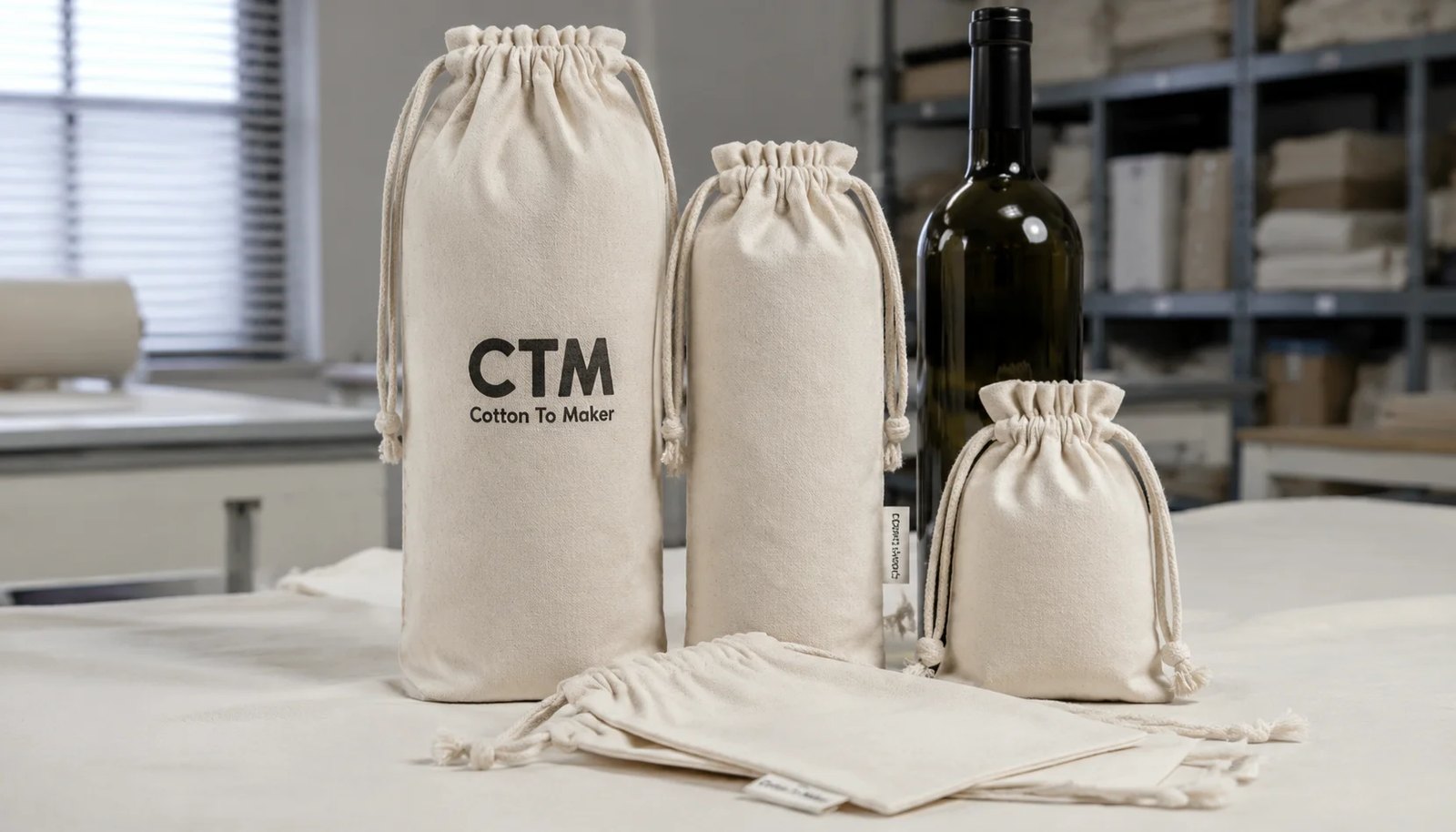
Start With the Retail Use Case
A strong RFQ for cotton drawstring pouches starts with the retail job, not a generic request for a cotton bag with logo. A pouch for a tasting event, a holiday wine sleeve, a whisky club gift, and a reusable premium pack can all share the same product name while requiring different fabric weight, print method, cord construction, packing, and inspection focus.
State where the pouch will be filled and handled. Store-filled pouches need quick opening, smooth drawcord movement, and packing that keeps logos flat. Co-packer-filled programs need consistent orientation, reliable carton counts, and easy line feeding. Premium gifting needs tighter control of fabric shade, print sharpness, stitching, and presentation after transit.
Also name the commercial priority. If the pouch is a short-life promotional sleeve, low cost and fast repeatability may lead the spec. If it supports a premium spirits bottle, opacity, hand feel, closure shape, and decoration quality matter more. This context helps suppliers quote the same product instead of guessing what can be downgraded.
- For store-filled gifts, prioritize easy opening, neat closure, and crease-free logo packing.
- For e-commerce bundles, prioritize fit, seam strength, and protection of bottle labels inside the shipper.
- For tasting events, prioritize unit cost, print speed, and acceptable fabric transparency.
- For premium gifting, prioritize opacity, hand feel, decoration finish, and consistency across stores.
Build Size Around Real Bottles
Bottle data is the main input in a liquor pouch RFQ. A tall Bordeaux-style bottle, broad Burgundy bottle, square gin bottle, squat whisky bottle, and sampler set can all require different pouch proportions. A sample that fits one SKU can fail when the program expands to another bottle family.
Provide a bottle schedule with height, maximum body diameter, shoulder width, neck shape, closure type, and filled weight. Mark the tallest, widest, shortest, and heaviest bottles. If the pouch will hold a bottle plus opener, tag, insert, or mini pack, give the dimensions and weight of the full packout.
Write pouch size as finished width by height by gusset in millimeters. Cut size is not enough because seams, pressing, and drawcord channel construction affect the usable opening. If the pouch is flat, say there is no gusset. If it has a side or bottom gusset, define the finished gusset depth.
As a starting point, many bottle pouches need bottle diameter plus about 20-30 mm of ease. Height often needs 40-70 mm above the bottle shoulder if the fabric must gather cleanly. Treat these as sample targets, not final rules. Heavier fabric, a broad shoulder, or an internal label can require more room.
- List every bottle SKU the pouch must fit, including the hardest-to-fit bottle.
- State finished size, for example 160 x 360 x 60 mm, not only the planned cut size.
- Clarify the desired closure look: covered neck, partly visible neck, or exposed cap.
- Require filled-pouch sample photos from the front, side, top, and flat view.
Choose GSM for Cost and Shelf Appearance
Cotton GSM affects price, opacity, hand feel, packing cube, and closure performance. A pouch that is too light can look transparent, wrinkle on shelf, and twist at the drawcord channel. A pouch that is too heavy can cost more, pack bulkier, and gather stiffly around a narrow bottle neck.
For budget giveaways or short promotional runs, 135-170 GSM cotton may be acceptable. It keeps unit cost and freight weight lower and can work with simple one-color print. The tradeoff is a softer body, more show-through from dark glass, and less support for premium decoration.
For most liquor retail gift pouches, 200-270 GSM cotton or canvas is a more useful middle range. It improves opacity, supports a cleaner print surface, and feels more substantial when customers handle the bottle. This range is often suitable for wine sleeves, spirits gifts, private-label packs, and reusable retail packaging.
Color and finish should be stated plainly. Natural cotton can include flecks, slubs, and lot-to-lot shade movement. If that character is acceptable, record it against the swatch. If a chain-wide promotion requires a cleaner look, specify bleached, dyed, or shade-controlled cotton and expect possible MOQ or lead-time impact. If organic or recycled content is requested, ask for current material certificates and define whether the claim appears on consumer-facing packaging.
- Use 135-170 GSM cotton for low-cost event pouches and simple giveaways.
- Use 200-270 GSM cotton or canvas for bottle gifts where opacity and hand feel matter.
- Define whether natural flecks, slubs, and shade variation are acceptable.
- Ask for a fabric swatch before sample approval, especially for natural or dyed cotton.
Make Artwork Production-Ready
Digital logo approval is not the same as production approval. The RFQ should translate artwork into manufacturing rules: vector file format, Pantone references, print size, placement from edges, orientation, number of colors, and no-print zones near seams, gussets, and the drawcord channel.
Screen printing is usually the practical choice for one to three solid colors. It works for retailer logos, private-label marks, seasonal artwork, and simple promotional copy. If one logo will appear on several pouch sizes, state whether the print remains the same physical size or scales by pouch size.
Premium decoration needs proof on real fabric. Metallic ink can lose definition on textured cotton. Heat transfer can look crisp but needs adhesion and rub checks. Embroidery, patches, and woven labels can improve perceived value but may pucker lighter fabrics or add placement variation. Use them when they support the retail offer, not only because they look strong in a mockup.
Small legal or campaign copy deserves attention. Cotton is not paperboard, and tiny text may fill in on a woven surface. If wording is mandatory, define minimum text height and line thickness, then approve it on the selected fabric. If readability is weak, move that information to a hangtag, insert, or secondary label.
- Provide vector artwork, Pantone colors, print size, and placement in millimeters.
- Set minimum line thickness and text height for required wording.
- Require a dry-rub check for dark ink, metallic ink, heat transfer, or heavy print coverage.
- Confirm whether logo size stays fixed or changes across pouch sizes.
Specify Cord, Channel, and Stitching
The word drawstring leaves too much open. Suppliers may quote single draw or double draw, narrow or wide channels, different cord diameters, simple knots, raw cord ends, or different stitch finishes. Those choices affect store handling and the finished shape around the bottle neck.
For bottle pouches, double draw construction often closes more evenly and feels better for repeated use. Cotton cord gives a natural look but may vary in color and texture. Braided polyester can be smoother and more consistent, especially in dyed colors. Cord diameter around 4-6 mm is common for bottle pouches; thinner cord can feel weak, while thicker cord may bunch inside the channel.
The top channel must allow smooth movement without stressing the seam. The side seam, bottom seam, gusset corners, and channel openings are the main stress points. The RFQ does not need to dictate every machine setting, but it should define the required result: no open seams, skipped stitches, seam grin under bottle load, heavy thread nests, or loose raw edges in visible areas.
If the filled pouch needs to stand better, define the gusset and test it with the actual bottle. A bottom gusset may be worth the cost for shelf display or gift tables. For pouches that will lie flat in a hamper or ship inside another carton, flat construction may be enough.
- State single or double draw, cord material, diameter, color, and knot or end finish.
- Define top channel width by approved sample and require smooth cord movement.
- Specify flat pouch, bottom gusset, or side gusset based on display need.
- Confirm placement for side labels, hangtags, care labels, and barcode stickers.
Qualify Suppliers Before Comparing Unit Price
A low unit price is only useful if the supplier can make the product consistently. Before narrowing quotes, ask whether the factory has produced bottle pouches or similar filled textile packaging. Non-confidential photos, sample references, inspection formats, and defect examples are more useful than broad statements about experience.
Check whether the supplier understands the inspection risks specific to bottle pouches: fit on filled glass, closure above the shoulder, seam load, print distortion after filling, and carton compression marks. A supplier that only shows flat empty bags may still be capable, but the RFQ should require filled-bottle sampling before bulk approval.
When material or sustainability claims are part of the retail message, ask for documentation early. Organic cotton, recycled cotton, dyed fabric standards, and restricted substance requirements should be supported by relevant certificates or test reports where applicable. Do not rely on a claim in a quotation if the claim will appear on pack, in-store, or in marketing copy.
Ask how the approved sample will be retained. The best process is simple: buyer and supplier each keep a sealed sample labeled with PO, item code, date, fabric weight, print version, and approved dimensions. That sample becomes the reference for production, inspection, and dispute resolution.
- Ask for examples of prior bottle pouch or filled textile packaging work.
- Request inspection report samples or a clear final inspection checklist.
- Require certificates or test reports when cotton content, organic, recycled, or compliance claims are used.
- Set a sealed sample retention process before placing the bulk order.
Make MOQ and Cost Breaks Comparable
MOQ is rarely one number. It can be driven by fabric color, GSM, pouch size, cord color, print artwork, screen setup, sewn label, packing method, or carton marking. An order of 10,000 pouches split across five sizes and six logos is not the same as 10,000 identical units.
Ask for MOQ by size, fabric color, cord color, artwork, and label type. Then ask what can be consolidated. A shared natural cotton body and common cord may reduce complexity even when logos differ. A single print size across several SKUs may also reduce setup handling.
Request price breaks at realistic quantities such as 1,000, 3,000, 5,000, and 10,000 pieces per design. Separate recurring unit cost from one-time charges such as screens, development samples, custom labels, print plates, or special carton setup. Procurement teams need this split to compare first order cost against reorder cost.
Every supplier should quote on the same commercial basis. The unit price should state whether it includes fabric, sewing, printing, cord, labels, inner packing, export carton, standard inspection, and delivery to port if FOB is requested. A cheaper quote is not meaningful if print setup, export packing, or inland handling is outside the price.
- Ask MOQ by size, fabric color, cord color, artwork, and label type.
- Request price breaks per design, not only total program quantity.
- Separate setup, sample, and tooling costs from recurring unit price.
- Require ex-factory and FOB options when landed cost comparison matters.
Use Sampling to Catch Fit and Print Issues
Sampling should be a sequence, not a single photo approval. Start with a blank size and construction sample. This confirms bottle fit, gusset behavior, channel width, cord movement, and seam strength before the supplier spends time on print and decoration.
After size and construction are accepted, move to the printed pre-production sample. Review it empty and filled. A logo centered on a flat pouch may shift visually once the bottle fills the body and the top gathers. Check color, placement, ink coverage, edge sharpness, and whether the print changes the hand feel of the fabric.
The final approved sample should be sealed and retained by both buyer and supplier. Record the approved finished size, fabric shade, GSM, print color, logo position, cord specification, label placement, and folding method. Without a sealed sample, disputes become subjective.
Do not release bulk production from empty flat photos alone. A liquor pouch is judged in filled condition. Ask the supplier to show the reference bottle inside the pouch, open and closed, from front, side, and top. If several bottle families are included, approve against the largest or most difficult bottle and add a secondary fit check where appearance changes materially.
- Approve blank fit before printed sample work starts.
- Use the widest and heaviest bottle for first fit approval.
- Keep sealed samples with both buyer and factory.
- Record approved tolerances and packing fold with the sample record.
Define QC and Packing Controls
Cotton pouches are simple sewn products, but retail programs still need written QC. Divide inspection into measurement, fabric appearance, sewing, print, function, and packing. This makes defects easier to classify and reduces arguments about subjective quality.
For measurement, check finished width, height, gusset depth, channel width, drawcord length, and logo position after sewing and pressing. If the pouch fit is tight, height above the bottle shoulder and channel placement need special attention because a small shortage can change the closed look.
Fabric inspection should look for oil marks, dirt, mildew odor, weaving holes, unacceptable slubs, panel-to-panel shade mismatch, and distortion that makes the pouch hang crooked. Natural cotton variation should be judged against the approved swatch or sealed sample so inspectors know what is normal.
Print QC should include alignment, color, ink coverage, smudging, pinholes in large solids, bleed-through, and rub resistance. For formal inspections, buyers may reference ISO 2859-1 sampling with agreed AQL levels, separating critical, major, and minor defects. The exact AQL should match the buyer's risk tolerance and order value.
Packing affects usability on arrival. Define flat packing, pieces per inner pack, pieces per export carton, carton dimensions, net weight, gross weight, carton marks, and pallet requirements if needed. Avoid folding directly through the main print area when presentation matters. For multi-design programs, carton marks should identify item code, size, color, artwork version, PO number, and quantity.
- Use the approved sealed sample as the reference for shade, print, construction, and packing.
- Classify critical, major, and minor defects before final inspection.
- Include filled-bottle checks in random cartons, not only flat visual review.
- State carton count, carton marks, gross weight limits, barcode needs, and pallet rules early.
Use One RFQ Response Template
Lead time depends on approvals as much as production capacity. Missing bottle data, changing artwork, undecided fabric shade, or late carton marks can delay a simple pouch program. Ask suppliers to break timing into sample making, sample revision, material booking, dyeing if needed, printing, sewing, finishing, packing, inspection, and export handover.
Liquor retail timing is often tied to holidays, limited offers, tastings, launches, or club shipments. A late pouch may have little commercial value even if quality is acceptable. Identify critical-path items before awarding the order. Common risks include dyed fabric, special cord colors, woven labels, metallic print, custom cartons, and international sample courier cycles.
Use a fixed RFQ response template so every supplier answers the same fields: finished size, fabric weight, fabric color, print method, print colors, cord specification, MOQ by variant, sample cost, bulk lead time, packing method, carton details, quote term, port, payment terms, and validity period. This makes quote gaps visible and speeds internal comparison.
The goal is not a longer RFQ. The goal is a measurable product brief. Bottle fit, GSM, print, construction, supplier evidence, MOQ, sample approval, QC, and packing should be clear enough that two suppliers quote the same pouch and your team can compare cost, lead time, and risk without guesswork.
- Start the production timeline from sealed sample and artwork approval, not first inquiry.
- Add buffer for sample revision, courier transit, buyer signoff, and pre-shipment inspection.
- Flag critical-path items such as dyed fabric, special cord, labels, metallic print, and carton printing.
- Use one structured RFQ file instead of fragmented emails and screenshots.
Specification comparison for buyers
| Spec decision | Recommended option | When it fits | Cost or lead-time impact | Buyer risk to check |
|---|---|---|---|---|
| Fabric weight for bottle gift pouch | 6 oz to 8 oz cotton canvas, about 200-270 GSM, pre-shrunk if fit is tight | Wine, spirits, club gifts, and retail bottle sleeves where opacity and hand feel matter | Moderate material cost; heavier cloth increases carton volume and may add cutting or sewing time | Very light cotton can show the bottle shape; very heavy canvas may gather poorly at the neck |
| Fabric weight for event giveaway | 4 oz to 5 oz cotton, about 135-170 GSM, with simple one-color print | Tastings, inserts, limited promotions, and price-sensitive seasonal giveaways | Lower unit cost and freight weight; faster when stock fabric is available | Thin fabric wrinkles more, twists at the channel, and may make dark bottles visible |
| Print method for retail logo | Screen print for 1-3 solid colors with Pantone references and print size in millimeters | Retailer logos, private-label marks, holiday artwork, and campaign graphics | Screen setup applies by color and design; repeat orders may avoid some setup work | Fine serif text, metallic ink, and small required copy must be approved on real fabric |
| Premium decoration route | Woven label, side label, patch, embroidery, or tested heat transfer | Premium whisky, wine club, gift sets, and reusable programs | Higher unit cost and more sampling time; labels and patches may have separate MOQs | Embroidery can pucker light cotton; heat transfer needs adhesion and rub checks |
| Drawcord construction | Cotton or braided polyester cord, 4-6 mm diameter, double draw for repeated handling | Store-filled pouches, co-packer lines, and programs where customers reopen the pouch | Slightly higher cost than single draw; adds cording and sewing time | Cord ends, knot size, and channel width must allow smooth closure without tearing |
| Size tolerance for bottle fit | Bottle diameter plus 20-30 mm ease; height plus 40-70 mm above shoulder depending on closure target | Programs covering wine, spirits, mini sets, or bottle-plus-accessory packs | Oversizing raises fabric cost; tight sizing raises sample revision risk | A pouch that fits one bottle can fail on square, broad-shoulder, or short spirits bottles |
| Packing method | Flat pack in counted inner packs, then export cartons with controlled gross weight | Retail DC receiving, promotional kitting, store filling, and co-packer line feeding | Neater packing can reduce carton density but protects logo appearance and handling speed | Compressed cartons can crease printed logos and slow store-level preparation |
| Supplier route | Direct factory for repeat custom programs; trading partner when bundling several packaging items | Importers, distributors, and procurement teams comparing cost, service, and responsibility | Direct sourcing can reduce margin but requires stronger buyer-side specification and QC control | Quote comparisons must separate fabric, decoration, packing, inspection, and inland freight assumptions |
Buyer checklist before sampling
- List every bottle or gift set SKU the pouch must fit, with bottle height, maximum diameter, shoulder width, neck shape, closure type, and filled weight.
- State finished pouch size in width by height by gusset, not only fabric cut size or bottle volume.
- Specify fabric type, GSM or ounce weight, color, shrinkage expectation, weave feel, and acceptable natural cotton variation.
- Provide vector artwork with Pantone references, print size, print location, orientation, and minimum acceptable edge clarity.
- Define cord material, diameter, single or double draw, cord color, knot type, and whether metal or plastic cord ends are allowed.
- Ask suppliers for evidence of similar bottle pouch work, sample photos, inspection records, and material certificates when claims such as organic or recycled content are used.
- Set sampling steps: blank size sample, printed pre-production sample, and sealed approval sample retained by both sides.
- Request MOQ by fabric color, print design, pouch size, cord color, and label type because different variables can drive minimums.
- Include pieces per inner pack, pieces per export carton, carton dimensions, gross weight, carton marks, and pallet preference if needed.
- Define inspection expectations for dimensions, stitching, print rub, stains, odor, cord function, bottle fit, carton count, and labeling.
Factory quote questions to send
- What fabric weight, construction, finish, and shade standard are you quoting, and can you provide a swatch before sample approval?
- Have you produced drawstring pouches for glass bottles or similar filled products, and can you share non-confidential photos or inspection examples?
- Is the quoted size the finished size after sewing and pressing, and what tolerance applies to width, height, gusset, channel width, logo position, and drawcord length?
- What is the MOQ per pouch size, fabric color, cord color, printed artwork, label type, and packing method?
- Which print method are you using for this artwork, and what are the setup charges, color limits, curing requirements, and minimum line thickness?
- Can you test the sample with our largest and heaviest bottle SKU and photograph the pouch open, closed, front, side, and top?
- What sample fee, sample lead time, and revision cost should we budget before bulk production?
- How will the approved sample be retained, labeled, and used as the bulk production reference?
- How many pouches are packed per inner pack and export carton, and what carton dimensions, net weight, and gross weight do you expect?
- What AQL level or inspection plan do you use for final checking, and which defects are treated as critical, major, and minor?
Quality-control points to confirm
- Finished pouch width, height, gusset, channel width, logo position, and drawcord length must match approved tolerance after sewing and pressing.
- Bottle fit must be checked using the buyer's heaviest and widest reference bottle, not only a standard wine bottle.
- Fabric must be free from oil marks, weaving holes, strong odor, visible mildew, and unacceptable shade variation across panels.
- Seams at side, bottom, gusset, and drawcord channel must show no skipped stitches, open seams, seam grin, or thread nests.
- Drawcord must pull smoothly, close the pouch without tearing the channel, and hold after repeated opening and closing.
- Logo print must align with the approved position, meet color tolerance, resist dry rubbing, and avoid ink bleeding through thin fabric.
- Labels, hangtags, and barcode stickers must match the retail packing plan and not cover the printed logo.
- Cartons must meet agreed piece count, carton mark, gross weight, and compression condition for export handling.
- Top hem and channel opening must be even so the pouch hangs neatly and does not look twisted on shelf.
- Random filled-pouch checks should confirm the pouch closes above the bottle shoulder without unintentionally exposing cap or neck.