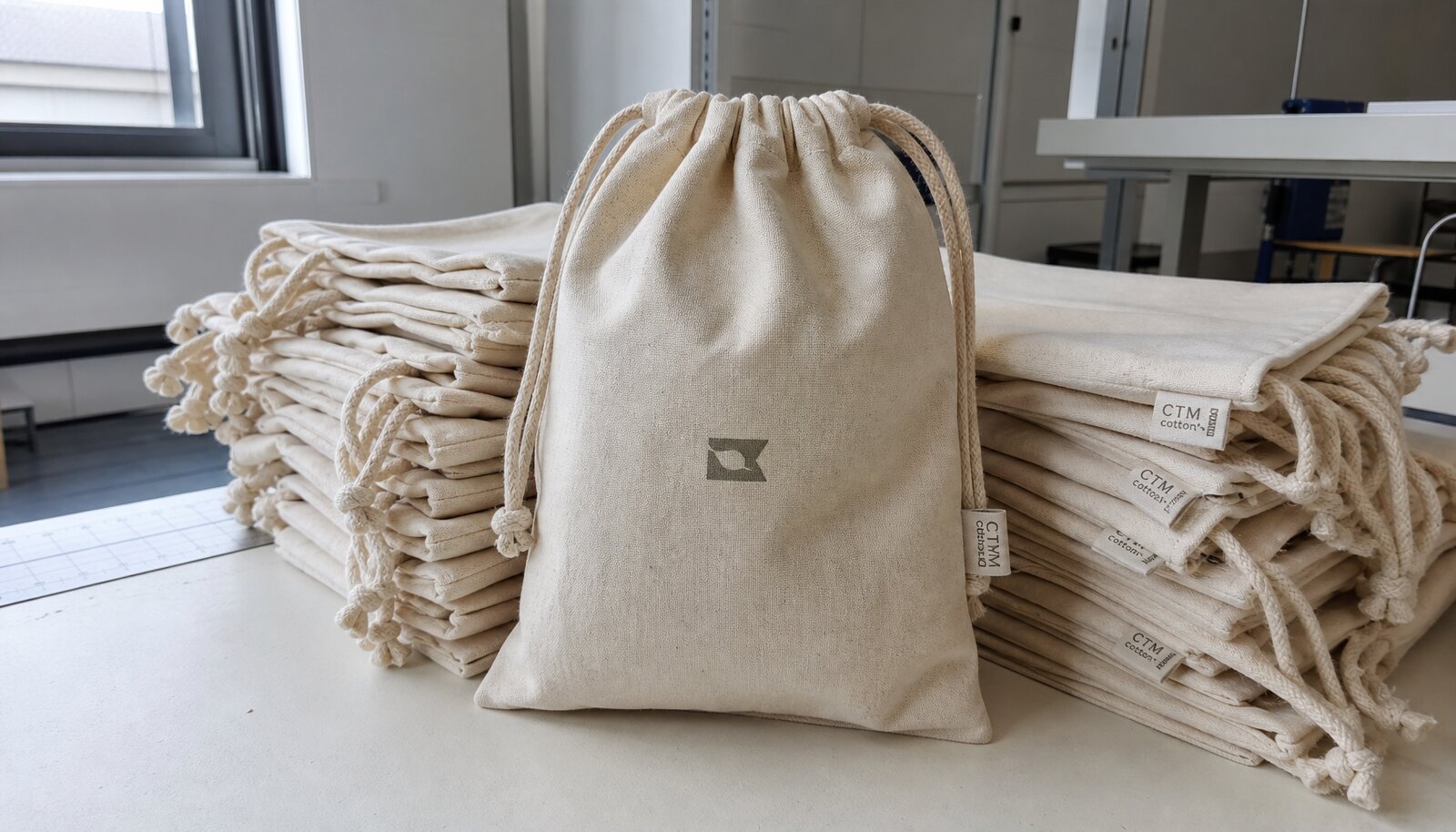
Define the job before asking for a price
Cotton drawstring pouches look simple, but in corporate gifting they often serve several roles at once: branded packaging, protective wrap, event handout, kitting component, or reusable accessory. A pouch for a one-day giveaway can accept different tradeoffs from a pouch used in an executive gift set or a direct-mail campaign. Start the RFQ with the commercial use, not only the product name.
Suppliers quote based on assumptions unless the buyer removes them. One quote may include 100 GSM natural cotton, basic cord, and loose bulk packing. Another may include 140 GSM cotton, one-color screen print, cotton drawcord, trimmed threads, inner packs, and export cartons. Those are not comparable prices. They are different products.
The useful version of a cotton drawstring pouches RFQ template guide is concise but specific. State what the pouch must hold, how the brand should appear, where the shipment goes next, and which quality issues would create failure for the program.
- State the program type: event giveaway, onboarding kit, client gift, launch kit, product insert, direct mail, or premium wrap.
- List the contents with dimensions, weight, shape, packaging material, and sharp corners or stress points.
- Define the presentation level: economy, standard branded, premium branded, or retail-ready.
- Clarify the next handling step: warehouse receiving, kitting partner, event team, distributor, or direct-to-recipient fulfillment.
- Name the key buying driver: durability, print appearance, speed, price, sustainability positioning, carton efficiency, or SKU control.
Convert loose descriptions into measurable RFQ fields
Procurement problems often start with words that sound clear but are not measurable: good cotton, normal cord, standard size, nice logo, export packing. Replace them with numbers, tolerances, physical samples, and acceptance criteria. The supplier should be able to mark each requirement as included, excluded, or quoted as an option.
Finished size should be written as flat width by flat height. Note whether the height includes the cord channel. The top channel, seams, and fabric gathering reduce usable internal space, so a 20 cm high pouch does not always hold a 20 cm product cleanly. If the pouch must close fully over the contents, ask the supplier to confirm usable fit and test it during sampling.
Tolerance should be agreed before bulk production. For small and medium pouches where fit matters, around +/-0.5 cm on width and height is a practical target if the supplier confirms it can be controlled. Larger or very low-cost pouches may need wider tolerance. Print placement, cord length, channel height, and label position also need limits.
- Write finished size as flat width x flat height, and state whether height includes the cord channel.
- Ask for usable internal space when the pouch must fit a fixed product.
- Specify GSM, fabric finish, color, shade standard, and acceptable cotton flecks or weave variation.
- Define size tolerance, print-position tolerance, cord-length tolerance, and label-position tolerance.
- Attach a marked drawing or photo showing seams, channel, logo position, label placement, and opening direction.
- Require suppliers to list exceptions instead of silently changing fabric, cord, print, or packing.
Choose fabric and finish with sourcing reality in mind
Fabric choice controls hand feel, opacity, print result, freight weight, and perceived quality. Most drawstring pouches use plain-weave cotton, but buyers still need to specify GSM, finish, color, and approval standard. For many corporate gifting programs, 120-140 GSM is a balanced starting range. Around 160 GSM can feel more substantial for premium or heavier gifts. Around 100-110 GSM can work for budget or lightweight programs, but sample approval is important.
Natural unbleached cotton gives a warmer look and may support an eco-style brand message. It can also show seed flecks, small slubs, and shade movement. Bleached white cotton usually improves logo contrast but may show handling marks. Dyed cotton supports campaign colors, but it introduces shade approval, possible lab dips, and extra lead time.
Ask whether the quote uses stock fabric, purchased-to-order fabric, or a custom dyed lot. If color matters, do not rely only on a screen reference or digital mockup. Keep an approved swatch as the bulk standard and write the accepted GSM tolerance, such as +/-5% or another agreed range, into the specification.
- Ask for fabric type, GSM, weave, finish, color, and sourcing basis.
- For natural cotton, confirm whether flecks, slubs, and shade variation are acceptable.
- For white cotton, check brightness, yellowing, and handling marks on the sample.
- For dyed cotton, request lab dip or physical shade approval before bulk production.
- Confirm whether fabric is washed, softened, calendared, bleached, dyed, or untreated.
- Include odor, lint, and cleanliness expectations if the pouch will hold cosmetics, candles, food packaging, or premium items.
Build size, structure, and cord around the contents
A pouch should be engineered from the item it will carry. A flat notebook, a candle jar, a cable kit, a bottle, and a multi-item wellness set all behave differently inside cotton fabric. The RFQ should identify whether a flat pouch is enough or whether a bottom or side gusset is needed for a boxy shape.
The top channel is a common source of fit and branding problems. When the cord gathers, it shortens the visual body of the pouch and can pull the logo upward. A logo that appears centered on an empty flat sample may look too high once the pouch is filled. Test the filled pouch in the same position recipients will see it.
Drawcord details affect both cost and user experience. Cotton cord gives a cohesive natural appearance. Polyester cord can offer smoother pulling and more color choices. Flat tape, braided cord, and round cord sit differently in the channel. Define the material, diameter or width, color, exposed length, exit style, and end finish.
- Measure the actual contents and allow clearance for insertion, gathering, and closure.
- State single or double drawcord and one-side or two-side pull.
- Define cord material, diameter or width, color, exposed length, and end finish.
- Confirm knot, stitch, tape, or heat-seal method for cord ends.
- Check seam security at side seams, bottom seam, and channel openings with the intended load.
- For bulky gifts, ask whether a gusseted pouch is needed instead of a flat construction.
Control print, placement, and added brand elements
Decoration turns a plain pouch into a branded gift component, but it also creates visible failure points. Provide final artwork files, preferably vector, and state the approved revision. Include logo size, print side, color reference, and placement from physical points such as top edge, side seam, and centerline.
Screen printing is often efficient for simple one-color or two-color logos. Cotton texture may soften fine lines or small type, so artwork should be tested at actual size. Heat transfer or digital print may be better for gradients, complex art, short runs, or many colors. Transfers may feel firmer; digital print can shift with fabric tone; screen print needs curing control.
Approve the decoration on the actual pouch fabric. Ink on natural cotton will not look identical to ink on coated paper. If the order includes several pouch colors, approve each colorway because contrast and opacity change. Extra items such as woven labels, hangtags, barcode stickers, and insert cards should be treated as technical specifications, not decoration afterthoughts.
- Provide final vector artwork with revision date and approved logo dimensions.
- Specify print side, placement from top and side edges, and centering tolerance.
- Define print color by Pantone, swatch, or brand standard while allowing for fabric influence.
- Approve a physical printed sample on the actual fabric, not only a mockup.
- Set criteria for opacity, edge sharpness, registration, curing, rubbing, cracking, smudging, and hand feel.
- Specify woven labels, side tabs, hangtags, barcodes, stickers, insert cards, and carton marks with size and placement.
Ask for pricing that reveals the real cost drivers
A single unit price is rarely enough for a clean sourcing decision. MOQ and price depend on fabric sourcing, cutting yield, print setup, artwork count, label handling, packing format, and shipment lot. A one-size, one-color, bulk-packed pouch is not comparable to four sizes with different logos and destination-specific cartons.
Ask suppliers to price the base specification and list charges separately. Screen setup, artwork handling, woven labels, hangtags, barcode stickers, individual polybags, sample freight, and carton marks can change the landed cost. If these costs are hidden inside one number, supplier comparison becomes unclear.
Use quantity tiers that reflect realistic demand. If the program may reorder, ask whether the same fabric, cord, and print standard can be maintained for a defined period, subject to material availability. For natural or dyed cotton, perfect long-term continuity should not be assumed without confirmation.
- Request unit pricing at realistic quantity tiers and state the target order quantity.
- Ask whether MOQ applies per size, fabric color, artwork, print setup, label, packing method, or shipment.
- Separate pouch sewing, decoration, setup charges, labels, packing, samples, inspection support, and freight.
- Ask for option pricing only for defined alternatives, such as 120 GSM vs 140 GSM or bulk pack vs inner pack.
- Require suppliers to list assumptions and exceptions in the quotation.
- Compare extra quantity against storage cost, future usability, campaign date relevance, and inventory control.
Use staged samples to prevent bulk mistakes
Sampling is the last low-cost point to catch avoidable problems. A blank sample can confirm approximate size and construction, but it does not prove logo behavior, ink opacity, print placement, label position, cord function after decoration, or packed appearance. For corporate gifting, a practical path is fabric swatch, blank fit sample if needed, printed strike-off, then pre-production sample using intended materials.
Test the sample with the actual gift item or a dummy load matching size and weight. Insert the contents, close the pouch, reopen it, and repeat. Check the opening width, cord movement, gathering, logo visibility, seam stress, and presentation inside the gift box or shipping format.
Approval should be documented with measurements, not only photos. Record finished dimensions, GSM, cord specification, channel height, stitch details, logo size, placement, label location, and packing fold. If a sample is approved with comments, define the correction clearly and confirm whether a revised sample is required before bulk starts.
- Approve a physical sample for event-critical, premium, or item-specific orders.
- Keep one approved sample with the buyer and one with the supplier, both labeled with date and revision.
- Measure logo placement instead of using comments such as looks centered.
- Confirm bulk will match the approved sample for fabric, cord, print, label, stitching, and packing.
- Treat artwork, size, fabric, cord, label, or packing changes as formal revisions.
- Confirm whether changes affect price, MOQ, or production schedule.
Specify packing, carton marks, and receiving rules
Packing affects presentation, freight volume, warehouse labor, and receiving accuracy. The RFQ should state whether pouches are bulk packed, folded in stacks, grouped in inner packs, individually polybagged, or prepared for retail-style handling. Bulk packing is efficient but may increase wrinkling or dust exposure. Individual bags protect cleanliness but add cost, plastic, labor, and carton volume.
For kitting and warehouse receiving, inner packs are often a useful middle ground. Ask for pieces per inner pack, pieces per master carton, carton dimensions, gross weight, net weight, and total carton count. A cheaper unit price can be offset by inefficient carton dimensions or heavy handling units.
Multi-SKU programs need strict separation. Different sizes, colors, artwork versions, or destinations should not arrive mixed without clear labels. Define carton label content: PO number, SKU, item description, size, color, artwork version, quantity, carton number, gross weight, and destination if relevant.
- State the required packing method: bulk, folded stacks, inner packs, individual polybags, retail-ready, or kitting-ready.
- Request inner pack quantity, master carton quantity, carton dimensions, gross weight, net weight, and total carton count.
- Require separate cartons or labeled inner packs for each size, color, artwork, and destination.
- Define carton label fields before shipment.
- Confirm whether individual polybags are required, optional, or prohibited by sustainability goals.
- Consider moisture, odor, dust, and compression risk during storage and transit.
Set QC rules and defect definitions before production
Quality control should match the way the pouch will be used. For corporate gifting, inspection should cover appearance, function, fit, count accuracy, and packing. The approved pre-production sample plus written tolerances should become the inspection standard.
Define defect severity before production. Critical defects may include wrong artwork, unsafe contamination, or construction that makes the pouch unusable. Major defects may include wrong size beyond tolerance, open seams, missing cords, severe print misplacement, wrong SKU in carton, or print that smudges during normal handling. Minor defects may include small loose threads, slight wrinkles, or shade variation within the approved range.
AQL sampling can be helpful when used appropriately, but it does not replace clear specifications. The inspector still needs measurement points, tolerances, sample references, and functional tests. For item-specific pouches, load testing with the real gift may be more important than appearance alone.
- Use the sealed pre-production sample and written tolerances as the inspection standard.
- Check GSM, shade, finished size, channel height, cord length, print placement, and label position.
- Perform function tests: load contents, close pouch, open pouch, pull cord, and check seam stress.
- Inspect seams for skipped stitches, open seams, weak backtacks, puckering, broken threads, and loose tails.
- Inspect print for color, opacity, registration, curing, rubbing, cracking, bleeding, smudging, and tackiness.
- Verify inner pack counts, master carton counts, carton labels, barcodes, and SKU separation before shipment.
Specification comparison for buyers
| Buyer decision | Common options | Best fit | Risk to verify before PO |
|---|---|---|---|
| Supplier route | Direct factory, trading company, managed sourcing partner, or print-and-sew coordinator | Direct factory suits repeat programs with stable specs; managed sourcing helps when fabric, printing, labels, packing, and export coordination need one accountable owner | Confirm who owns cutting, sewing, printing, label application, inspection, packing, and subcontractor defects. |
| Fabric weight | 100-110 GSM, 120-140 GSM, 160 GSM+ | 120-140 GSM is a practical middle ground for many corporate gifts; 160 GSM+ feels sturdier for premium or heavier items | Ask for actual GSM, tolerance, and swatch approval. Vague terms such as thick cotton are not enough. |
| Fabric finish | Natural unbleached, bleached white, dyed cotton | Natural suits warm eco-style presentation; white improves logo contrast; dyed supports campaign colors | Natural cotton may show flecks and shade movement. Dyed goods need lab dip or physical shade approval. |
| Pouch structure | Flat pouch, bottom gusset, side gusset, single drawcord, double drawcord | Flat works for light flat items; gussets help boxy gifts, candles, bottles, or multi-item kits | Finished outside size does not equal usable space. Test closure with the real item or a dummy load. |
| Cord specification | Cotton cord, polyester cord, flat tape, round braided cord | Cotton cord matches natural pouches; polyester can pull smoothly and offer broader colors | Define diameter or width, exposed length, knot or end finish, color, and pull-through prevention. |
| Print method | Screen print, heat transfer, digital print, embroidery, woven label | Screen print suits simple logos; transfer or digital suits complex artwork or shorter runs; woven labels suit subtle premium branding | Approve decoration on the actual fabric. Check color, opacity, hand feel, placement, rubbing, and curing or adhesion. |
| Packing method | Bulk packed, folded stacks, inner packs, individual polybags, retail-ready packing | Bulk reduces cost; inner packs help warehouse receiving; individual bags protect presentation when needed | Overpacking adds cost and freight volume. Underpacking can cause dust, wrinkles, moisture marks, or count disputes. |
| QC approach | Internal factory QC, buyer final inspection, third-party inspection, sample-only approval | Use stronger inspection for event-critical, premium, multi-SKU, or item-specific programs | Define defect classes, measurement points, sampling plan, carton checks, and approval sample standard before production. |
| Cost comparison | Unit price only, itemized quote, landed-cost quote | Itemized and landed-cost views are better for procurement decisions across suppliers | Separate pouch, print, screens, labels, packing, samples, inspection support, freight terms, duties, and carton dimensions. |
Buyer checklist before sampling
- Confirm the gifting use: conference giveaway, employee onboarding kit, client gift, product insert, launch kit, direct-mail gift, or premium presentation wrap.
- List the exact contents going into the pouch, including dimensions, shape, weight, packaging, sharp corners, and whether the pouch must close fully.
- Specify finished flat width and height, cord-channel height, usable fit requirement, and agreed size tolerance.
- Define cotton GSM, weave, finish, fabric color, shade standard, and whether natural cotton flecks or slubs are acceptable.
- State drawcord material, diameter or width, color, exposed length, end finish, knot method, and pull-function requirement.
- Provide final artwork files, logo size, print colors, placement measurements, and acceptance limits for centering, opacity, registration, and print defects.
- Confirm labels and marks: woven side label, care label, brand tag, barcode sticker, hangtag, insert card, carton mark, or no added label.
- Request itemized pricing for sewing, decoration, labels, packing, screen or setup charges, samples, inspection support, and freight assumptions.
- Ask for MOQ and price breaks by finished size, fabric color, artwork version, print method, packing method, and shipment lot.
- Define the sample path: fabric swatch, blank fit sample if needed, printed strike-off, pre-production sample, and sealed approval sample.
Factory quote questions to send
- What cotton GSM, weave, finish, and color are you quoting, and what GSM tolerance will apply in bulk production?
- Can you provide a fabric swatch from the quoted material and confirm whether bulk fabric is stock, purchased to order, or custom dyed?
- For dyed or bleached fabric, what shade standard, lab dip process, and color variation limit are included?
- What finished size, cord-channel height, seam allowance, usable space, and size tolerance are included in the quote?
- Is the drawcord cotton, polyester, blended, flat tape, or round cord, and what are the diameter or width, color, exposed length, and end-finish details?
- Which print method is included, and how does price change for one-color, two-color, transfer, digital, two-side printing, or larger artwork?
- What print-position tolerance, color tolerance, curing or adhesion check, and rubbing check will be used for the logo?
- What is the MOQ per size, fabric color, artwork, print setup, and packing method?
- Will the pre-production sample use actual bulk fabric, actual drawcord, actual print method, actual label, and actual packing fold?
- What setup charges are separate from the unit price, including screens, artwork handling, sample freight, label application, hangtags, barcodes, or carton marks?
Quality-control points to confirm
- Verify fabric GSM against the approved specification using production fabric or documented fabric-weight checks, not catalog wording alone.
- Compare fabric shade with the approved swatch or color standard, including natural cotton flecks, bleached white yellowing, and dyed-lot variation.
- Measure finished pouches flat after sewing, including width, height, cord-channel height, opening width, and usable fit for the intended item.
- Inspect stitching for straight seams, secure backtacks, skipped stitches, broken thread, loose thread tails, open seams, and severe puckering.
- Check cord channels so the cord slides without snagging, excessive twisting, channel tearing, or pull-through during normal use.
- Confirm drawcord ends are consistently knotted, stitched, taped, or heat sealed according to the approved sample.
- Measure print placement from the top edge, side seams, and centerline; repeated logo drift should be corrected before packing continues.
- Inspect print opacity, edge clarity, color reference, curing or adhesion, cracking, smudging, bleeding, tackiness, and transfer risk.
- Check labels, hangtags, barcode stickers, and side tabs for consistent placement and no interference with pouch closure or front-facing presentation.
- Test pouches with the real gift item or a matching dummy load to confirm fit, closure, shape, logo visibility, seam stress, and presentation after handling.