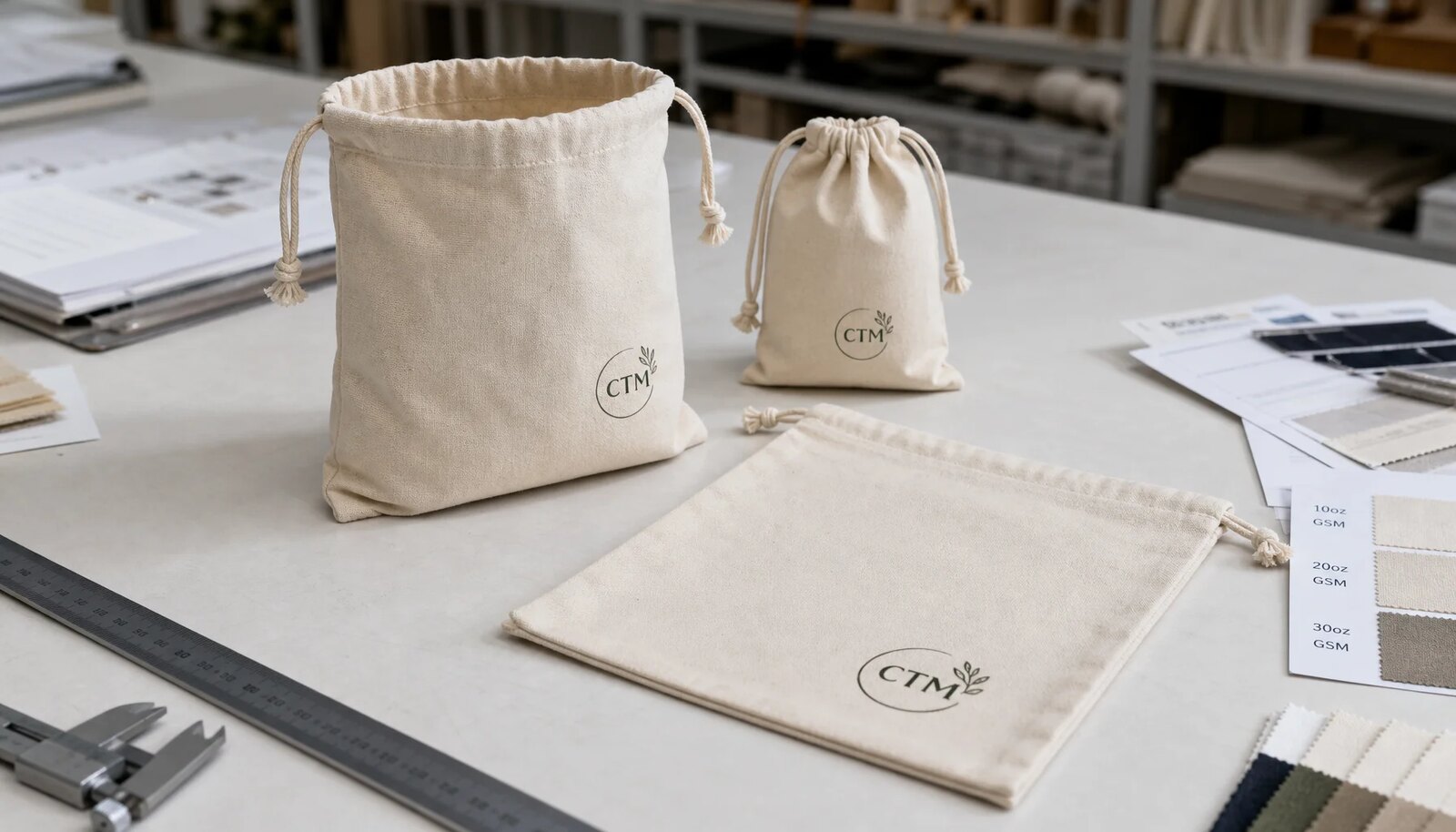
Start with the pouch job
A cotton drawstring pouch for a craft fair can be low-cost packaging, but it can also carry the first impression of a handmade product. Before requesting price, define the pouch role. Is it primary retail packaging on the booth table, a gift pouch replacing a box, a dust cover, a vendor kit pouch, an event giveaway, or a reusable branded item? This one sentence helps the supplier choose the right fabric, closure, print method, and packing plan.
Avoid vague phrases such as premium eco pouch or simple cotton bag. Use production wording: 150 GSM natural cotton pouch for retail display, one-color front logo, must close fully around a 7 x 7 x 3 cm boxed candle weighing 180 g. For a budget event handout, write: 120 GSM natural cotton pouch for lightweight giveaway, bulk packed by SKU, simple one-color print, tolerance suitable for promotional use.
Also tell the supplier how the pouch will be handled. A necklace pouch needs clean stitching, low lint, and sharp print placement. A soap pouch may need opacity and awareness of oils or fragrance. A candle tin, jar, ceramic ornament, or boxed kit puts more load on the bottom seam. Vendor kit packaging needs count accuracy, carton labels, and separation by logo or destination.
- State product dimensions, weight, shape, and whether the item is boxed, wrapped, or loose.
- Name the pouch role: retail packaging, gift pouch, vendor kit, giveaway, dust bag, storage pouch, or sleeve.
- Explain the use environment: booth table, checkout counter, retail shelf, warehouse kitting, or direct-to-vendor distribution.
- Rank the buying priority: low cost, premium look, fast lead time, plastic reduction, tight fit, or packing accuracy.
- Send product photos or display photos so the supplier can judge opacity, print position, closure height, and filled appearance.
Build a simple RFQ SKU table
The best RFQ template for cotton drawstring pouches is a controlled SKU table. Each row should describe one purchasable pouch. Each column should cover one decision: finished size, usable height, fabric, color, cord, print, quantity, packing, tolerance, and shipment requirement. This prevents suppliers from filling in missing details differently.
Keep base specifications separate from optional alternatives. For example, ask for a base quote on 140 GSM natural cotton with 3 mm cotton cord and one-color screen print, then request an optional 170 GSM version. Do not compare one supplier’s 120 GSM price with another supplier’s 170 GSM price as if they are the same product.
Use SKU codes early. If there are three sizes and six vendor logos, each version needs a code on the quote, artwork proof, sample label, production order, inspection sheet, packing list, and carton label. This is a basic control step, but it prevents logo mix-ups and receiving errors.
- Create one row per SKU with size, usable height, GSM, fabric color, cord, closure, print method, print colors, quantity, and packing.
- Request price breaks by SKU and total program volume when demand is still flexible.
- Ask suppliers to mark every deviation, including substitute GSM, cord, size, print method, or packing count.
- Compare landed-cost inputs, not only ex-factory unit price: incoterm, carton dimensions, gross weight, CBM, and special packing.
- Use unique SKU codes for each size, fabric color, cord color, artwork, and packing format.
Choose fabric by use, not GSM alone
Fabric weight affects appearance, opacity, sewing, print result, carton weight, and freight cost. Many craft fair retail pouches start with a buyer-spec example around 120-170 GSM plain-weave cotton, but this is not a universal standard. The right choice depends on product value, weight, desired handfeel, deadline, and factory capability.
Lighter cotton can work for giveaways, inserts, jewelry cards, or dust covers where the pouch is not carrying much perceived value. The tradeoff is that it may look more translucent under booth lighting, crease more easily, or show seam puckering. Heavier cotton gives more body and a stronger handfeel, but it can raise cost, increase freight weight, and make small pouches harder to gather at the top.
GSM alone does not define quality. Confirm weave, handfeel, opacity, shrinkage expectation, and whether the fabric is stock or custom. Natural cotton may show seed flecks or small specks, which may suit handmade branding but should still be approved. Dyed cotton adds shade approval and may require extra colorfastness checks depending on the product and storage conditions.
- 100-110 GSM can suit lightweight giveaways or dust covers, but check translucency and wrinkles.
- 120-140 GSM is often practical for small soaps, jewelry cards, stationery, seed packets, and lightweight accessories.
- 150-170 GSM gives more retail body for branded gift packaging and repeated booth handling.
- 180-220 GSM may fit higher-value or heavier products, but sample closure function, seam bulk, and freight impact.
- Natural cotton usually supports simpler MOQ and lead time; dyed cotton adds shade and approval variables.
- Approve print on the final fabric, not on a substitute swatch.
Specify finished size and usable height
Size wording causes many pouch disputes. A buyer writes 10 x 15 cm and expects usable internal space. A supplier may quote finished outer size laid flat, cut panel size before sewing, or the closest stock size. The difference can stop a box from fitting or prevent the drawstring from closing properly.
For fit, usable inner height below the drawstring channel is often more important than total height. The top hem and channel take space, and the pouch needs enough fabric above the product to gather. Depending on construction, cord size, and pouch scale, the channel area may reduce practical usable height. Treat any 2-4 cm allowance as an example to verify in sampling, not as a guaranteed rule.
Write both product dimensions and pouch dimensions. A good RFQ line is: product is boxed soap 8.0 x 5.5 x 2.5 cm, weight 120 g; required pouch finished outer size 11.0 x 15.0 cm laid flat; usable inner height minimum 12.0 cm below channel; must close fully with product inside; tolerance ±0.5 cm if confirmed by factory.
- State whether total height includes the drawstring channel and top hem.
- List finished outer width x height laid flat, usable inner height, channel height, and acceptable tolerance.
- Allow extra room for rigid boxes, tins, jars, ornaments, square corners, inserts, and tight closures.
- Keep logo placement below the channel and away from side and bottom seams.
- Request a fit sample using the actual product or a weight-and-size substitute before bulk cutting.
Match drawstring construction to handling
The drawstring is a small cost component, but shoppers touch it constantly. A cord that binds, frays, feels rough, pulls through, or looks mismatched can make the pouch feel cheap. The RFQ should define cord material, diameter, color, one-sided or two-sided closure, channel width, and end treatment.
Cotton cord gives a natural look and works well with undyed or eco-positioned pouches. Polyester cord may feel smoother and offer stronger color consistency for dyed pouches or high-touch retail bins. Ribbon, twill tape, and flat tape create a different retail look but usually need a wider channel and more careful sewing.
One-sided and two-sided draw closures are not the same. A two-sided closure often feels more balanced and secure, but it uses more cord and labor. A one-sided draw can be lower cost but may not close as neatly on wider pouches. Knot size matters too: small knots can slip into the channel, while large knots add bulk.
- Define cord material, diameter, color, closure type, channel width, and end finish.
- Sample the cord and channel together because diameter and channel width control smooth closing.
- Specify one-sided or two-sided draw closure because it changes price and performance.
- Test repeated opening and closing to find binding, twisting, fraying, knot slip, or side-opening stress.
- For dyed fabric or cord, confirm shade matching and possible color migration risks if goods will be stored tightly or in humidity.
Select print method from artwork limits
Most craft fair pouch programs use simple logos, event marks, or one-color brand graphics. For this work, screen printing is often the practical choice because it balances cost, solid color, and repeatability on cotton. Provide vector artwork, target print size, print location, color reference, and safe distance from seams and channel.
Screen printing has limits. Fine lines, tiny reversed text, gradients, distressed textures, and large solid ink blocks may not reproduce cleanly on cotton texture. Heavy ink can feel stiff, especially on small pouches where the print covers much of the front panel. Ask the supplier for minimum line thickness and minimum readable text size based on the actual fabric and screen setup.
Other methods can fit specific needs. Heat transfer can handle detail but may show a film edge. Digital print can help multicolor or short-run artwork, but color strength and rub resistance should be sampled. Embroidery can look premium, but it may distort lightweight cotton and add cost. Let suppliers suggest alternatives, then lock the approved method in the PO.
- Use screen print for 1-2 color logos, event marks, simple brand names, and repeat packaging programs.
- Avoid tiny strokes, small reversed text, gradients, and heavy ink blocks unless sampled on final fabric.
- Place artwork below the drawstring channel and away from seams so it remains visible when filled.
- Ask whether screen charges apply per color, artwork, pouch size, or run.
- Define print QC: size, position tolerance, color reference, opacity, registration, smudges, tilt, cure, and adhesion.
Use MOQ logic before adding variation
MOQ is not just a supplier rule. It reflects fabric purchasing, cutting setup, printing setup, sewing efficiency, inspection time, and packing control. Low MOQ is easier when the buyer uses stock natural cotton, a common size, one-color print, and bulk packing. MOQ becomes harder with custom dyed fabric, many small sizes, multiple logos, special cord colors, barcode packing, or mixed cartons.
Craft fair programs often want variety, while production rewards consistency. Five sizes, four fabric colors, three cord colors, and ten vendor logos can quickly become many small lots. Each added combination increases setup cost, shade risk, sampling work, print mix-up risk, and packing errors. Before approving every variation, ask which differences create real merchandising value.
Invite suppliers to quote the requested specification and suggest practical alternatives. They may recommend natural cotton with colored print instead of custom dyed fabric, two sizes instead of three, or one shared fabric and cord batch with separated logos. These ideas are useful only when clearly labeled as alternatives, not hidden substitutions.
- Ask for MOQ per size, fabric color, cord color, print design, packing format, and shipment.
- Consolidate GSM, fabric color, cord, print method, and packing style where merchandising allows.
- Request quantity breaks by SKU and by total program volume.
- Limit custom dyeing, embroidery, special cords, and individual retail packing to SKUs where they add clear value.
- Require labels for alternatives: base quote, alternative GSM, alternative color, alternative print method, or alternative packing.
Approve samples with measurable notes
Sampling should test the RFQ, not just create an attractive photo. A sample should confirm product fit, fabric handfeel, opacity, print clarity, closure function, seam security, and appearance after handling. A development sample is useful for direction, but it should not become the final standard if it uses substitute fabric, cord, stitching, or print method.
For bulk orders, request a pre-production sample made with final fabric GSM, final color, final drawstring, final print method, final artwork size, and final seam construction. If packing matters, include inner bag count, SKU label, barcode position, carton label format, or hangtag arrangement. This sample becomes the inspection reference.
Record the sample review. Measure finished width, finished height, usable inner height, channel height, print size, print position, cord length, and product fit. If changes are needed, revise the written spec. Verbal corrections are easy to miss once bulk production starts.
- Put the actual product inside, close the pouch fully, and check seam, bottom, and channel stress.
- Open and close repeatedly to check cord movement, knot security, binding, twisting, and side-opening strength.
- Rub the cured print lightly to check adhesion, stiffness, smudging, and ink coverage.
- Review handled appearance: wrinkles, puckering, transparency, lint, stains, shade variation, and logo visibility.
- Document approval with photos, measurements, tolerances, revision date, and a sealed reference sample.
Set inspection standards before the PO
Quality control should be practical and tied to the approved sample. Craft fair buyers do not need an overbuilt lab protocol for every pouch order, but the PO should state what will be accepted and rejected. Otherwise, stains, loose threads, off-center print, weak seams, or rough drawstrings become subjective disputes.
Cover four areas: dimensions, workmanship, print, and packing. Dimensions include finished outer size, usable inner height, and channel consistency. Workmanship includes seams, channel stitching, drawstring function, loose threads, puckering, holes, stains, and shade variation. Print includes color, placement, registration, opacity, cure, edge quality, tilt, and smudges. Packing includes inner bag count, carton quantity, carton labels, barcodes, SKU separation, and mixed-carton accuracy.
If an inspection company is used, align the sampling plan, defect classifications, and acceptance level before production. Critical defects may include contamination or unsafe foreign objects. Major defects may include wrong logo, wrong size outside tolerance, open seams, nonfunctional drawstrings, or print adhesion failure. Minor defects may include trimable threads or light wrinkles if saleability is not affected.
- Set finished-size tolerance only after confirming factory capability for the pouch size and fabric.
- Set a usable inner-height minimum when product fit matters.
- Define print-position tolerance and reject obvious tilt or poor presentation.
- Check seam security at side seams, bottom seam, channel openings, and backstitched stress points.
- Reject visible stains, oil marks, holes, unacceptable shade variation, foreign fibers, and excessive loose threads according to agreed criteria.
- Schedule inspection with time for rework before shipment, especially for fixed craft fair dates.
Control packing and carton labels early
Packing affects cost, receiving accuracy, inspection, freight, and event readiness. Bulk packing by SKU is usually efficient for wholesale craft fair programs, especially when the buyer or organizer will repack locally into vendor kits. Individual bags may help cleanliness, barcode scanning, retail handling, or direct-to-vendor distribution, but they add labor, material, volume, and waste.
Cotton pouches are flexible, so carton loading needs balance. Overfilled cartons can crease light fabric, distort channels, crush individual packs, and make counting difficult. Underfilled cartons waste space and raise freight cost. If pouches need to be vendor-ready, the inner bag count should match the distribution plan rather than the factory’s default.
Lock labeling before production. The factory needs to know whether carton labels require SKU, size, fabric color, print design, quantity, PO number, gross weight, net weight, destination, barcode, carton number, or shipping mark. Avoid mixed cartons unless the assortment ratio is documented and the label clearly shows contents.
- Define pieces per inner bag, inner bags per carton, total pieces per carton, and whether cartons may contain mixed SKUs.
- Require carton labels to show SKU, size, print design, quantity, PO number, carton number, and destination if needed.
- Request carton dimensions, gross weight, net weight, and CBM during quotation.
- Approve packing photos or a packing sample for multiple designs, barcodes, vendor kits, or strict receiving rules.
- Avoid mixed cartons unless assortment ratio and label content are written in the PO and packing list.
Specification comparison for buyers
| RFQ decision | Buyer wording to include | Best fit | Risk to confirm |
|---|---|---|---|
| Use case | State whether the pouch is retail packaging, gift packaging, vendor kit packaging, event giveaway, dust bag, reusable storage, or product-protection sleeve. | Craft fair organizers, handmade brands, distributors, and promotional buyers who need comparable supplier quotes. | If the use case is vague, suppliers may quote the cheapest pouch that matches size but misses presentation, closure, or packing needs. |
| Fabric weight | Use a buyer-spec example such as 120-170 GSM plain-weave cotton for many retail craft fair pouches; ask for alternatives only when needed. | Small soaps, jewelry, candles, stationery, ornaments, accessories, and lightweight kits. | GSM does not prove durability by itself. Confirm weave, handfeel, opacity, shrinkage expectation, and sample performance. |
| Finished and usable size | Specify finished outer size laid flat, usable inner height below the channel, channel height, and product dimensions. Example: finished 12 x 18 cm, usable inner height minimum 14.5 cm, tolerance ±0.5 cm if factory confirms. | Boxed goods, tins, jars, ornaments, soap bars, jewelry cards, and kits where fit affects closing and display. | Cut size, finished outer size, and usable space are different. Channel and seam allowance can reduce usable height. |
| Drawstring construction | Define cord material, diameter, color, one-sided or two-sided draw closure, channel width, and end finish. | Pouches handled repeatedly at booths, checkout counters, vendor kits, or retail bins. | Cord can bind, fray, pull through, or mismatch the pouch if channel width, knot size, and side opening strength are not controlled. |
| Print method | Quote 1-2 color screen print for simple logos; request heat transfer, digital print, or embroidery only when artwork requires it. | Most branded cotton pouch programs using simple marks, event logos, or vendor identities. | Fine text, gradients, heavy ink coverage, and print too close to seams or channel may create production defects. |
| MOQ and SKU plan | Request MOQ per size, fabric color, cord color, print design, and packing format. Ask suppliers to show quantity breaks by SKU and total order volume. | Programs with multiple pouch sizes, vendor logos, or craft fair distribution kits. | Too many small variations create setup cost, shade risk, logo mix-ups, sample delays, and packing errors. |
| Quote breakdown | Separate unit price, setup, screen charge, sample, courier, packing, labeling, carton quantity, carton dimensions, gross weight, net weight, CBM, incoterm, and lead time. | Procurement teams comparing landed cost rather than headline unit price. | A low unit price may exclude sample costs, special packing, labels, inspection rework, or freight impact. |
| Sample approval | Request a pre-production sample using final fabric, cord, size, print method, artwork, and proposed packing label format. | Orders where fit, print placement, closure, or craft fair delivery date matters. | Photo approval cannot verify handfeel, opacity, drawstring function, print cure, or fit with the real product. |
| QC standard | Set measurable checks for size, usable height, print position, seam security, drawstring function, stains, loose threads, shade variation, and packing accuracy. | Bulk orders with multiple SKUs, barcodes, fixed event dates, or vendor-ready distribution. | Without written criteria and an approved sample, inspection decisions become subjective and disputes are harder to resolve. |
Buyer checklist before sampling
- Define the pouch function: retail packaging, gift pouch, vendor kit, event giveaway, dust bag, reusable storage, or protective sleeve.
- Provide packed product dimensions, weight, shape, sharp corners, surface sensitivity, and whether the pouch must close fully with the product inside.
- Specify finished outer width x height laid flat, usable inner height below the channel, channel height, fabric GSM, weave, fabric color, cord material, cord diameter, and closure style.
- Send production-ready vector artwork, print size, logo placement drawing, color reference if needed, and safe distance from side seams, bottom seam, and drawstring channel.
- Group SKUs by shared fabric, GSM, cord, print method, packing style, and shipment date unless merchandising requires variation.
- Request quantity breaks such as 500, 1,000, 3,000, 5,000, and 10,000 pieces where relevant, plus MOQ per size, fabric color, cord color, and artwork.
- Ask for a quote breakdown covering unit price, setup, sample, courier, packing, labeling, carton dimensions, gross weight, net weight, CBM, incoterm, and lead time.
- Approve a physical pre-production sample before bulk cutting when fit, logo placement, drawstring function, or presentation affects product value.
- Test the sample with the actual product inside: close it, open it repeatedly, check seam stress, rub the cured print lightly, and view it under booth-style lighting.
- Write acceptance criteria into the PO, including size tolerance, usable-height minimum, print-position tolerance, seam defects, stain limits, loose threads, and packing accuracy.
Factory quote questions to send
- What fabric GSM, weave, fiber description, fabric color, shrinkage expectation, and stock or custom status are included in the quotation?
- Can you provide fabric swatches before sample making, and what shade or texture variation should we expect between swatch and bulk?
- Is the quoted pouch size the cut panel size, finished outer size laid flat, or usable inner size below the drawstring channel?
- What channel height and usable inner height are included, and will the pouch close fully around our stated product dimensions and weight?
- What finished-size tolerance can your factory hold for this pouch size, and should we adjust our tolerance before issuing the PO?
- What cord material, cord diameter, cord color, drawstring style, knot size, channel width, and end finish are included?
- Which print method are you quoting, what print area do you recommend, and what minimum line thickness or reversed-text size should our artwork follow?
- Are screen charges calculated per color, per artwork, per pouch size, or per run, and can screens be reused for repeat orders?
- Are artwork adjustment, sampling, courier, pre-production sample cost, barcode labeling, individual packing, and packing surcharges included or itemized separately?
- What MOQ applies per size, fabric color, cord color, print design, packing format, and shipment date?
Quality-control points to confirm
- Finished pouch size should follow the PO tolerance agreed with the factory, such as ±0.5 cm for some small pouches or ±1.0 cm for larger pouches when confirmed as achievable.
- Usable inner height should be measured below the drawstring channel because a pouch can meet outer size but still fail product fit.
- Channel height and side openings should allow smooth cord movement without binding, skipped stitches, tearing, or uneven gathering.
- Cord length, diameter, color, knot size, and end finish should match the approved sample and should not pull through under normal opening and closing.
- Logo print should match the approved sample for color, placement, opacity, edge sharpness, registration, cure, and handfeel on the final bulk fabric.
- Defined print defects should include smudges, pinholes, ghosting, bleeding, misregistration, off-center placement beyond tolerance, heavy ink patches, cracked transfer film, scorch marks, and poor adhesion.
- Side seams, bottom seam, channel openings, and backstitched stress points should have secure stitching with no open seams, broken stitches, excessive loose threads, or shape-changing puckering.
- Fabric should be checked for visible stains, oil marks, holes, serious slubs, dye streaks, unacceptable shade variation, and foreign fibers within the same SKU.
- Shrinkage expectations should be discussed before approval if the buyer will steam, wash, fill tightly, store in humidity, or require exact fit after handling.
- Random finished goods should be tested with the actual product or a weight substitute to confirm bottom seam, side seam, channel, and drawstring performance.