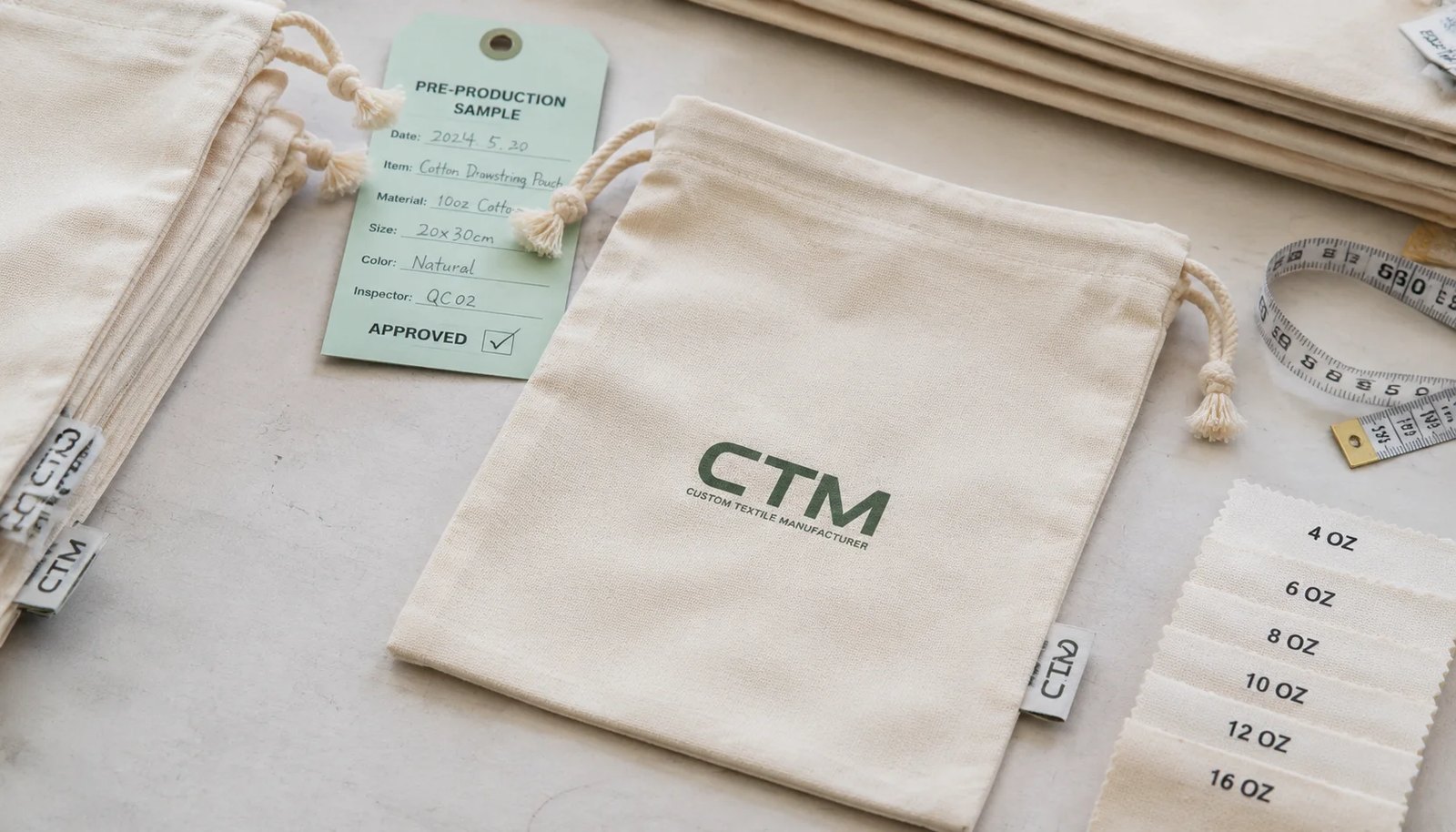
Why natural grocers need a tighter pouch inspection standard
Cotton drawstring pouches for natural grocers usually look simple, which is exactly why buyers underestimate the defect risk. These programs often sit close to food, wellness, or low-packaging brand positioning, so the product gets judged on material honesty, clean sewing, natural appearance, and practical reusability. A pouch with a crooked print, oily mark, weak channel seam, or overly thin fabric can damage a store's sustainability message faster than a standard promo item would.
The main buying problem is not design complexity. It is inconsistency between development sample, quote sheet, and mass production. Many RFQs say 'natural cotton pouch with logo' and leave the factory too much room to substitute a lighter fabric, simplify the drawstring, widen size tolerance, or pack loosely. A good inspection checklist starts much earlier than final QC. It begins by locking the commercial specification in a way that makes quotes comparable and failures measurable.
- Typical failure points on this item: underweight fabric, off-center print, tight drawstring channel, frayed cord ends, count shortages, and mixed shade lots
- Natural grocer programs often need cleaner-than-average presentation because the product may sit near unpackaged or wellness-oriented goods
- If the pouch is intended for resale, the seam finish and print quality matter more than for free giveaway use
Set the core specification before you compare any supplier quote
For this product, quote comparison only works if all factories are pricing the same pouch. The minimum commercial spec should include finished size, fabric construction, GSM range, color, print method, drawstring material, seam type, packing format, and inspection standard. Without that, one supplier may quote a 140 GSM pouch with polyester cord and another may price 220 GSM with cotton cord, and the lower number looks attractive until defects or complaints appear after delivery.
For most natural grocer use cases, 200 to 270 GSM natural cotton is the practical range. At the lower end, the pouch remains flexible and economical for dry goods accessories or gift-with-purchase items. Toward 240 to 270 GSM, the pouch feels more substantial on shelf and prints more cleanly, but freight and carton weight increase. If the pouch is meant for repeated produce or pantry use, this midweight range is usually the safer commercial choice than very light cotton.
- Useful RFQ line example: natural cotton plain weave, 220 GSM plus or minus 5 percent, finished size 180 x 240 mm, one-color water-based screen print
- State whether dimensions include the channel or exclude it; this prevents frequent supplier interpretation errors
- If your brand needs organic or recycled content claims, require documentation in quotation stage, not after sample approval
Choose fabric and drawstring specs that fit the actual load
Fabric choice should follow what the pouch carries, not what looks best in a product photo. A pouch for tea sachets, soap bars, or lightweight store accessories does not need the same body as one used for grains, produce, or refill goods. Overbuilding can raise cost with little retail benefit, but underbuilding leads to seam stress, shape distortion, and customer complaints about thinness after first use. Cotton plain weave is usually the safest option because it keeps print edges cleaner and stitching more stable than loose novelty weaves.
Drawstring details deserve more attention than they usually get. A cotton cord generally supports the natural positioning better than polyester, but the cord diameter must match the channel width. If the channel is narrow or topstitch tolerance is poor, the cord will snag during use and inspection. Cord ends should be heat-cut only if the cord contains synthetic content; for cotton cord, wrapped tape finish, knot finish, or stitched finish may be more appropriate depending on presentation and cost.
- Light retail accessory pouch: around 180 to 200 GSM if price pressure is high and fill load is low
- Reusable store or pantry pouch: around 200 to 240 GSM for better structure and seam durability
- Higher shelf-value gift or premium wellness pouch: around 240 to 270 GSM if the brand wants a fuller hand feel
- Cord length should allow full closure without excessive loose tails that tangle in cartons
Print method decisions that affect quality complaints later
Most natural cotton pouch programs for natural grocers use one-color or two-color artwork, and water-based screen printing is typically the best fit. It keeps the hand feel soft, works well on natural fabric, and is commercially efficient at moderate volume. The problem is not the method itself but poor artwork preparation, weak curing control, or unrealistic expectations on very dark coverage over raw cotton. Small logos and simple marks print reliably. Large flood areas are where pinholes, crocking, and color inconsistency start to show.
Digital printing can work for multicolor graphics or shorter runs, but buyers should review wash fastness, edge sharpness on textured fabric, and cost impact on larger quantities. Heat transfer is less common for this product type when a natural hand feel matters, and it may look off-brand for eco-positioned store merchandise. Whatever method is chosen, the approved sample should use the same fabric and same print process as bulk production. A paper color proof is not enough.
- Screen print is usually the most stable option for 500-plus units with simple artwork
- Request print placement tolerance, for example plus or minus 5 mm from approved centerline
- For dark inks on natural cotton, include a rub test standard or at least a signed sample after cure
- If the print sits near the channel seam, define minimum spacing so sewing variation does not clip the artwork
MOQ logic and quote structure: where buyers misread the low price
MOQ on cotton drawstring pouches is rarely just one number. Factories often have a base MOQ by style, then practical minimums by size, fabric color, and print artwork. A supplier may quote an attractive unit price at 5,000 pieces total, but that can assume one size, one print, one fabric lot, and one packing format. If your natural grocer program needs mixed sizes for different products, separate logo versions for store regions, or assorted pack ratios, the real order economics change quickly.
A workable quote should separate at least these components: pouch material and sewing, print cost by color and location, sample charges, packing add-ons, and any surcharge for low-volume splits. As an example only, a factory may absorb one screen setup over a larger order but charge separately for each extra size because cutting efficiency and packing labor change. Buyers who only compare the total unit price usually miss where future reorder costs will rise.
- Clarify whether MOQ applies per SKU, per size, per logo, or per combined order
- Mixed-size programs often increase cutting waste and carton complexity even if total volume stays the same
- Very small runs can shift a factory from screen print to digital print, changing both look and cost
- Ask for quote validity period if cotton prices are volatile
What to inspect in pre-production samples before bulk approval
The pre-production sample is where many later defects can still be prevented cheaply. It should be made from the intended bulk fabric, with the intended drawstring, print method, seam construction, and packing style if possible. Development samples often use substitute fabric from stock, and that is fine for shape approval, but not for final sign-off. If the natural cotton shade in bulk is warmer, more slubbed, or lighter in GSM than the first sample, your print and overall presentation can change materially.
Sample review should be practical, not just visual. Open and close the pouch repeatedly. Measure channel width, seam allowance consistency, and print placement. Put in the intended product or a similar fill weight. Review whether the pouch opens wide enough for store staff to load it efficiently if packing will happen after import. If a branded pouch is sold in-store, test how it looks folded, pegged, or stacked because the top seam and logo balance are very visible in retail presentation.
- Measure at least width, height, channel depth, and print placement from top seam and side seam
- Compare actual fabric hand feel against approved GSM target, not only visual thickness
- Check if cord knots, end finish, and pull smoothness match the approved sample notes
- Retain one approved sealed sample as shipment inspection reference
Final inspection thresholds that actually work on this product
A useful final inspection standard for cotton drawstring pouches should divide defects by seriousness. Critical defects may include mildew, sharp contamination, wrong fiber claim labeling, or anything making the pouch unsafe or commercially unusable. Major defects usually include wrong size beyond tolerance, obvious print misregistration, open seams, severe stains, missing drawstring, or wrong SKU packing. Minor defects can include small slubs outside the print area, slight thread tails within agreed tolerance, or limited shade variation if natural fabric variation was pre-approved.
For dimension tolerance, many buyers use plus or minus 5 mm on smaller pouches and a little more on larger formats, but the tolerance should reflect the sewing method and intended use. Fabric weight tolerance should be stated as a percentage range and tested on agreed basis. Print placement tolerance should be numerical. Without numbers, inspection becomes argument-driven and shipment release slows down. Natural cotton does not justify poor workmanship; it only justifies reasonable material variation where documented in advance.
- Major defect examples: underweight fabric, crooked print visible at arm's length, seam opening, jammed drawstring, incorrect quantity per inner pack
- Minor defect examples: trim thread over agreed limit, slight natural flecking, small non-prominent weave irregularity outside branding area
- Function test: random units should open and close smoothly without channel tearing or cord pull-through
- Use approved golden sample plus inspection checklist in the final inspection room
Packing standards that reduce warehouse claims and contamination
Packing is often treated as an afterthought, but natural cotton pouches mark easily and count disputes are common when inners are unclear. For natural grocer channels, cleaner presentation matters because the product may be sold as a reusable item rather than hidden as internal packaging. Flat packing by SKU in sealed inner bags reduces dust pickup and helps receiving teams count accurately. If barcodes or retail labels are needed, they should be linked to the exact inner or master carton level in the packing instruction.
Carton planning also affects landed cost. Overpacked cartons may save some board cost but create handling problems and can exceed buyer warehouse limits. Underfilled cartons waste freight cube. If pouches are packed with cords loose and tangled, unpacking labor rises and some units arrive badly creased. A simple packing spec can prevent this: fixed quantity per inner, cord orientation consistent, desiccant only if justified by route and climate, and carton marks showing SKU, PO, quantity, and carton number.
- Example packing logic: 50 pieces per inner by one size and one print, 500 pieces per export carton if carton weight remains acceptable
- Request carton gross weight cap if your warehouse has manual handling limits
- Natural cotton should be packed away from oil, ink transfer, and damp storage risk
- If the pouch is retail ready, specify whether hangtags must be attached before inner packing
Lead time planning and the schedule risks buyers usually miss
Lead time on cotton drawstring pouches looks short until artwork approval, fabric booking, and packing details begin to move. A realistic schedule usually includes artwork confirmation, pre-production sample, material preparation, cutting and sewing, printing, in-line review, final inspection, and booking to vessel or airfreight. Small products are often inserted into a factory's larger sewing schedule, so the biggest risk is not always sewing capacity. It can be waiting for approved print, waiting for natural fabric shade confirmation, or reworking cartons after late barcode changes.
Natural grocer buyers should also watch seasonal congestion. Orders placed before holiday gifting periods or large sustainability campaigns can face print line bottlenecks even when sewing is available. If the item is tied to a store launch, build in time for one sample revision and at least one inspection correction window. A pouch is easy to remake in theory, but a print issue found at final inspection can still push shipment if replacement fabric or print line slots are not immediately available.
- Pre-production sample often takes around one week or more depending on print and material availability
- Bulk production timing depends on quantity, artwork complexity, and whether natural fabric is in stock or woven to order
- Final inspection should be scheduled before freight cutoff, not on the same day
- Late packaging changes are a common avoidable cause of delayed shipment release
How to compare landed value, not just ex-factory price
A lower ex-factory pouch price can still produce a worse landed result if the fabric is underweight, cartons are inefficient, or defect rates force rework. For small textile items, freight sensitivity is often more about cube and carton discipline than raw piece count. A slightly heavier 220 GSM pouch may still be the better value if it reduces complaint risk, improves shelf appearance, and avoids the need for double-bagging or replacement stock.
When comparing offers, build a practical landed-value view: unit price, sample cost, print setup, carton efficiency, expected defect exposure, and warehouse handling impact. A supplier with stronger in-line controls and better packing may save more than a nominal difference in piece price. This matters especially for distributors and retail buyers who split stock across multiple locations, because receiving errors and repacking labor quickly erode any savings from a thin initial quote.
- Compare price per usable approved unit, not only price per shipped unit
- Include inspection cost and likely rework exposure in your sourcing decision
- Carton count accuracy matters more when shipments are cross-docked or allocated by SKU to different stores
- Natural fabric variation tolerance should be written into the buying decision, not disputed after arrival
Specification comparison for buyers
| Spec decision | Recommended option | When it fits | Buyer risk to check |
|---|---|---|---|
| Fabric weight | 6 oz to 8 oz cotton, about 200 to 270 GSM | Best for reusable grocery accessory pouches holding produce, snacks, tea, soaps, or dry goods without feeling too thin | Under 180 GSM often looks cheap, twists after wash, and prints show through seam tension |
| Cotton type | Natural cotton with fiber content declaration matching label claims | Suitable when the pouch is sold as a practical reusable store item and natural color variation is acceptable | Do not let 'organic style' wording replace actual documentation if organic content is part of packaging claims |
| Fabric construction | Plain weave with low slub variation for print areas | Good for clean logo printing and more consistent cutting yield | Heavy slub fabric may look artisanal but can create print pinholes and unstable shrinkage |
| Drawstring format | Single cotton cord with side pull for small pouches; double cord only for wider openings | Single cord saves cost and reduces tangling for produce or gift-size pouches | Double cord on low-cost production may jam in narrow channels or create uneven closing tension |
| Print method | Water-based screen print for 1 to 2 solid colors on natural cotton | Best for natural grocer branding where soft hand feel matters and coverage is moderate | Large dark flood prints can crock if ink cure is rushed; request rub and wash sample evidence |
| Closure channel construction | Folded self-fabric channel with clean topstitch and 8 to 12 mm internal clearance over cord diameter | Works for repeated opening and closing in retail use | Tight channels slow filling at packing and cause drawstring snagging during inspection |
| Seam specification | Single needle lockstitch with 8 to 10 SPI minimum, reinforced backtack at cord exits | Commercially balanced choice for most non-heavy-duty pouch programs | Loose SPI, skipped stitches, or missing backtack often become the top carton-level defect |
| Packing format | Flat packed in inner poly by size or color with carton count discipline | Efficient for mixed-SKU retail distribution and easier receiving at buyer warehouse | Loose mixed packing creates count disputes and more handling contamination on natural fabric |
| Inspection level | AQL-based final random inspection with in-line print and stitching review | Appropriate for importers who need measurable acceptance criteria before shipment release | Final-only inspection misses early print registration drift and size inconsistency from cutting spread |
Buyer checklist before sampling
- Define the actual use case: produce pouch, gift-with-purchase pouch, bulk-bin accessory, or shelf merchandise, because GSM and seam standard change with intended load.
- State finished size with tolerance in millimeters, measured after sewing but before packing, for example 150 x 200 mm plus or minus 5 mm.
- Specify fabric weight as a range, not a vague word like medium weight; example: 200 to 220 GSM natural cotton plain weave.
- List whether natural color variation is acceptable or whether fabric must match an approved lab dip or retained swatch.
- Name the print method required, number of colors, print location, maximum artwork size, and whether water-based ink hand feel is important.
- Require a pre-production sample made in bulk fabric and bulk print method, not only a digital mockup or development sample.
- Set seam performance expectations including stitch density, backtack at stress points, and no raw edge exposure outside the channel construction.
- Define acceptable odor, lint, oil mark, and contamination thresholds because natural cotton easily picks up dust in sewing rooms.
- State packing details: pieces per inner bag, inner label format, carton quantity, carton weight limit, and whether assortments are allowed.
- Include inspection standard such as AQL level, major and minor defect examples, and whether third-party inspection approval is required before balance payment.
Factory quote questions to send
- What fabric GSM range do you quote, and what is the actual finished GSM after washing or finishing tolerance?
- Is the quoted fabric carded cotton, combed cotton, recycled blend, or another composition, and what documents can support any content claim?
- What size tolerance do you normally hold on this pouch style after cutting and sewing?
- Does your quote include one pre-production sample in bulk fabric with bulk print, and how many revisions are chargeable?
- What print method is included in the price, and what extra charge applies for larger coverage, dark ink coverage, or second-side printing?
- How many pieces are packed per inner and per export carton, and what carton dimensions and gross weight should we budget for freight?
- What is the MOQ by size, color, and artwork, and can mixed sizes share one fabric lot or not?
- At what production stage do you inspect print registration, seam quality, and drawstring function, and can you share your internal checklist?
- What lead time applies for lab dips, pre-production sample, bulk production, and rework if inspection finds defects?
- Which defects do you classify as critical, major, and minor for cotton drawstring pouches?
Quality-control points to confirm
- Fabric weight must fall within the approved GSM range using the buyer-approved test method and sample basis.
- Finished dimensions must stay within tolerance for width, height, and channel depth across the inspected sample set.
- Print position must match the approved artwork placement standard with no obvious skew, blur, ghosting, or under-cured ink.
- Seams must be straight, secure, and free from skipped stitches, open seams, seam grin beyond tolerance, or missing backtack.
- Drawstring must move smoothly through the channel without knot blockage, fraying ends, or closure imbalance.
- Fabric surface must be free from oil marks, mildew odor, heavy slubs in the print area, holes, stains, and unacceptable shade variation.
- Top opening and cord exit points must not tear under normal hand-pull use during simple function testing.
- Packing count, size assortment, carton marks, and barcode labels must match the approved packing list exactly.
- Cartons must meet gross weight and drop-handling practicality limits set by the buyer or forwarder.
- Retained sample, approved color swatch, and approved print standard must be present during final inspection for reference.