Start With the Event Use Case, Not the Unit Price
A cotton drawstring pouch for a trade show is not a generic giveaway item. It might be handed out empty at the booth, used to hold a product sample, or prefilled with brochures, inserts, and small parts before it reaches the attendee. Those are different use cases, and they fail in different ways. A light pouch that looks acceptable in a product photo can turn thin at the seams once a kit is inserted. A more expensive pouch can still fail if the cord feels rough, the opening collapses, or the print rubs off after being handled all day on the show floor.
The first inspection question is simple: what will the pouch carry, how often will it be opened, and who touches it first. If the answer is one-time handout, the spec can stay lean. If the bag needs to move through a convention hall, survive repeated opening and closing, or support a heavier sample set, the inspection standard has to rise with the use case. That means the buyer defines the acceptable feel, pack format, and print durability before comparing suppliers. Price without that context is not useful.
- Separate one-use giveaway, reusable sample kit, and retail-ready pouch as three different specs.
- Write down the expected fill weight before you ask for quotes.
- Check whether the pouch needs to look good flat, filled, stacked, or carried by attendees.
Specify the Pouch Like a Production Part
Cotton GSM is the first serious commercial decision, but it is not the only one. Around 120-140 GSM usually works for light promotional use where cost matters and the contents are soft. Around 150-180 GSM gives better body, less show-through, and a cleaner hand feel for premium kits or higher-value inserts. Go too low and the pouch starts to reveal contents, lose shape at the corners, and make the logo look thinner than it did on the proof. Go too high and you add weight, cost, and bulk without always improving the user experience.
The spec needs more than a GSM line. Ask whether the cloth is natural, bleached, dyed, or prewashed, and whether the factory is quoting cut size or finished size. For trade show orders, the finished size is what matters, because the kit has to fit and the pouch has to close cleanly after packing. A good control sheet should also define seam allowance, channel height, cord type, and stitch density. The goal is to remove guesswork before the first sample is sewn.
- Use a GSM target and a tolerance range, not only the phrase natural cotton.
- For small pouches under 20 cm, a finished-size tolerance of +/- 5 mm is a useful starting point.
- For larger pouches, allow +/- 10 mm unless your insert kit needs tighter control.
- Ask for the pouch to be measured at the top, center, and bottom so the shape is documented.
Set Decoration and Appearance Controls Up Front
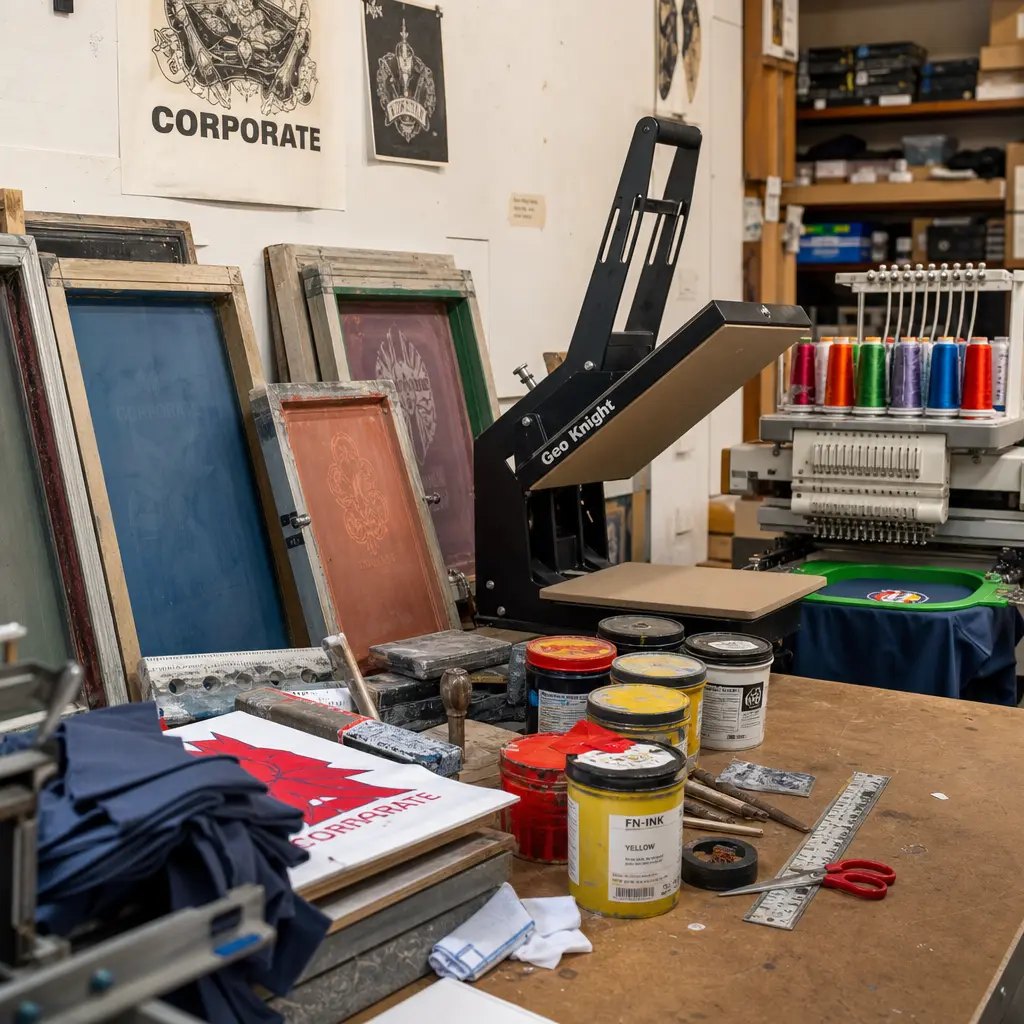
The print method drives both the unit cost and the defect profile. Simple logos with one or two colors are usually best handled by screen print because the setup is predictable and the result is easier to inspect. If the branding needs a more premium look, a sewn woven label or side label can be a better fit because it avoids ink wear and keeps the decoration stable across batches. Digital or transfer print only makes sense when the artwork truly needs it, such as a short run with multiple colors or a design that would not survive screen constraints.
For a trade show buyer, the main issue is not style. It is repeatability. A logo that is a few millimeters off center may not matter in a warehouse, but it can look sloppy when the pouches are stacked on a booth table or handed out one by one. The quote should state the print size, the distance from the top seam, the color count, and whether the artwork sits over a seam or on a flat panel. If the supplier cannot explain how the ink behaves on cotton, the quote is not ready for approval.
- Prefer screen print for repeat logos and woven labels for a more durable premium finish.
- Define logo position from the seam, not only from the edge of the artwork file.
- If the print must survive rubbing, give rub resistance more weight than color novelty.
- Reject any approval that relies on a photo alone when the pouch will be handled heavily.
Normalize Quotes Before You Compare Prices
A useful quote separates fabric, cutting, sewing, printing, labels, packing, cartons, and freight. If all you see is one unit price, you are not comparing suppliers on the same basis. Hidden line items are common in custom pouch sourcing because screens, plates, extra setup, and special packing are easy to leave out until the order is already moving. That is where many buyers lose time and budget. The right comparison is the finished approved pouch, packed the way your team will receive it, with every production step priced or clearly excluded.
A simple worked example shows why this matters. Supplier A quotes $0.42 per pouch plus a one-time $90 screen charge across 20,000 pieces. That makes the print cost $0.0045 per unit, or $0.4245 total before freight. Supplier B quotes $0.39 per pouch but excludes $0.01 inner bags and $0.02 cartons. That becomes $0.42 before freight, and it still may not include the same GSM or the same inspection standard. The lower headline number is not better if it depends on missing line items or weaker controls.
- Compare ex-works price and landed price separately so freight does not get mixed into the decision.
- Ask for the exact quantity break where the price changes.
- Treat screens, labels, inserts, cartons, and packing as cost drivers, not footnotes.
- Normalize every quote to the same finished spec, pack format, and ship-to basis.
Approve a Sample That Predicts Bulk Behavior
The sample is the control document for the order, not a courtesy item. It should tell you whether the cotton feels right, whether the opening stays true, whether the cord slides evenly, and whether the print looks dense enough on the actual cloth. A sample that looks clean in a photo can still fail when you pull the cord, flatten the pouch, or place a folded insert inside it. That is why sample approval should include measurements, touch points, and a practical use test, not only an image review.
Use one signed golden sample as the bulk reference. If the factory revises the pattern, print, or pack format after the first sample, approve a second round before production starts. Record finished size, logo placement, color reference, stitch quality, cord length, and the exact packing count. If one of those items changes later, the buyer should be able to point to a signed reference rather than negotiate from memory. For trade show timing, that paperwork is not administrative overhead. It is the cheapest way to avoid rework.
- Measure the pouch at the top, middle, and bottom so the shape is captured, not guessed.
- Pull the cord several times to verify that the channel does not twist or bind.
- Flatten and refill the pouch to check how it behaves in actual use.
- Sign, date, and retain one golden sample per approved revision.
Use an Inspection Plan With Real Acceptance Criteria
QC guidance is only useful when the acceptance criteria are specific. A reasonable starting point for standard custom orders is ANSI/ASQ Z1.4 Level II with AQL 2.5 for major defects and 4.0 for minor defects, unless the brand risk justifies a tighter plan. That is not a universal law. It is a practical baseline that lets the buyer compare suppliers on the same inspection discipline. If a supplier cannot tell you their sampling logic, then they are asking you to trust a process you have not defined.
The quality checklist should split defects into categories. Critical defects are zero tolerance because they affect function or safety: holes, contamination, broken stitches that compromise the pouch, or a missing drawcord. Major defects affect usability or brand presentation: wrong size beyond tolerance, print shifted beyond the allowed band, cord slippage, or seam failure under pull. Minor defects are cosmetic and only acceptable within the written limit: light fold marks, a loose thread trimmed in finishing, or a slight natural-fiber variation that stays within the approved standard. The point is to make the line between pass and fail visible before the first carton ships.
- Set a finished-size tolerance in writing before the first sample is approved.
- Use a 40 C wash, line dry, and 24-hour conditioning to check shrinkage if the pouch is meant to be washable.
- Require no more than 3 percent dimensional change after the wash test unless the spec says otherwise.
- For non-washable promotional pouches, run a steam or press test and check that the channel does not distort or twist.
- Use a dry rub target of Grade 4 or better and a wet rub target of Grade 3-4 or better for a practical branding standard.
- Set a cord pull benchmark such as no failure at 5 kg static pull for 10 seconds, or at 2x intended filled weight, whichever is higher.
- Inspect for skipped stitches, seam puckering, oil marks, broken needles, holes, and mislabeling at the lot level.
Check Packing, Cartons, and Receiving Workflow
A pouch can pass inspection and still create problems if the packing format is poor. Mixed-size bundles, unlabeled inner bags, or overfilled cartons slow receiving and make floor distribution messy. Trade show teams often work under time pressure, so the carton needs to be understandable as soon as it is opened. If the pouches are stacked too tightly, the cotton takes a hard crease that is visible when the team lays them on a booth table. If the cartons are too loose, the bags shift and the drawstrings tangle.
Build the receiving workflow before the order ships. Confirm whether the cartons go to a warehouse, an advance receiving center, or straight to the venue. Verify receiving hours, appointment rules, carton label requirements, and whether palletization is required. Include carton IDs, net and gross weight, and the count per inner bag on the packing list. If the pouches are prefilled with inserts or samples, that extra volume and weight must be in the carton spec. Packing is part of quality because it controls whether the goods arrive countable and usable.
- Inner packs should be labeled by size, color, quantity, and PO number.
- Keep carton weights manageable for warehouse staff and event setup teams.
- Make sure carton marks match the PO, packing list, and artwork file.
- Ask the supplier to keep a hold-back sample from each carton run in case the receiving team needs a reference.
Plan for Kit Weight, Booth Replenishment, and Event Deadlines
If the pouch will carry a kit, the filled weight matters as much as the empty bag spec. Define a maximum gross weight per pouch so attendees can carry it comfortably and booth staff can replenish it quickly. Many trade show buyers miss this point: the bag looks fine on its own, but once it is filled with brochures, catalogs, or sample parts, the drawcord slips or the pouch sags off the display table. Set the kit weight before you approve the pouch construction, not after. If the fill weight changes late in the process, the structural spec may need to change too.
Booth replenishment should be planned as a controlled inventory problem, not an emergency. Estimate daily burn rate from expected handouts per hour, show hours, and a safety factor, then stage reserve cartons on-site or at the advance warehouse. Keep enough overage to cover damaged units, last-minute VIP kits, and one unplanned spike in traffic. On timing, reverse schedule from the venue move-in date, not the factory ship date. A practical control point is to lock artwork and sampling early enough that production, freight, and receiving all have room for a one-step delay without putting the event at risk.
- Set the maximum filled weight for each pouch before final production release.
- Calculate booth-day demand and keep a reserve carton count for replenishment.
- Freeze artwork and carton marks early enough that one sample revision does not break the schedule.
- Hold a calendar buffer for freight delays, customs review, or venue receiving bottlenecks.
Compare Sourcing Routes by Risk, Not by Headline Price
Factory-direct sourcing is usually the best route when you need control over GSM, stitch quality, print placement, and packing. It gives the buyer a cleaner line of communication and better visibility into where defects can appear. The tradeoff is that the buyer has to be precise. If the spec is vague, the factory will fill in the blanks, and those assumptions may not match the brand's expectation. A trading company can simplify communication or combine multiple items into one shipment, but that convenience usually comes with less transparency on the actual production source and fewer options for correcting a drift in quality.
A domestic converter or local finishing partner can be useful when the event timeline is tight and the buyer values speed over absolute unit cost. The better question is not which route is cheapest. It is which route best matches your internal QA capacity and event deadline. If you have strong in-house procurement controls, factory-direct often wins. If the order is small, urgent, or bundled with other goods, a local converter may reduce execution risk. The lowest quote is rarely the lowest landed cost once you include rework, inspection time, and the cost of a late delivery.
- Use landed cost per approved unit, not raw unit price alone.
- Add the cost of rework, late freight, and extra inspection into the comparison.
- Choose the sourcing route that matches your internal QA capacity and event deadline.
- Do not trade away inspection discipline just to save a small amount on the headline price.
Lock the RFQ Bundle Before You Release the Order
The cleanest orders start with a buyer packet that leaves little room for interpretation. That packet should include the finished size drawing, target GSM, decoration file, logo placement measurement, color reference, cord specification, pack format, carton mark, ship-to address, receiving window, and event date. If the pouch is part of a larger kit, add the kit weight, the insert dimensions, and whether the bag needs to survive prepacking or final assembly on arrival. The factory should be quoting the same object the buyer expects to receive.
A strong RFQ also makes supplier comparison easier later. You can ask each factory to respond against the same checklist and then sort the answers by spec compliance, inspection discipline, packing clarity, and schedule confidence. If one quote is cheap but omits test method, packing format, or carton weight, it is not really a lower quote. It is a less complete one. For procurement, completeness is usually worth more than a small unit-price discount.
- Send a finished-size drawing or dimension sheet with tolerances.
- Attach the logo file and mark the placement measurement from the top seam.
- Include the required inspection plan, packing matrix, and event delivery date.
- Ask each supplier to confirm what is included and what is excluded, line by line.
Specification comparison for buyers
| Decision area | Preferred control | How to normalize the quote | Buyer risk to check | Cost and risk impact |
|---|---|---|---|---|
| Sourcing route | Factory-direct custom production with a written QC sheet | Compare the same spec, same pack, same ship-to basis | A vague quote can hide setup fees, rework, or packing changes | Lower quote transparency usually means higher execution risk |
| Fabric GSM | 120-140 GSM for light giveaways, 150-180 GSM for premium kits | Convert all quotes to the same GSM and finished size | Too-light cloth shows contents and feels flimsy; too-heavy cloth adds cost and bulk | GSM changes affect hand feel, opacity, and freight weight |
| Decoration method | 1-2 color screen print or a sewn woven label | Compare setup fees, color limits, and rub resistance on the same artwork | Digital or transfer print can change MOQ and durability | Decoration drives both unit cost and defect exposure |
| Finished size tolerance | +/- 5 mm for smaller pouches, +/- 10 mm for larger ones | Match quote to a measured finished size, not only a cut size | Loose tolerances create packing waste and visible inconsistency | Tighter tolerances reduce waste but require better sewing control |
| Inspection basis | ANSI/ASQ Z1.4 Level II with AQL 2.5 major / 4.0 minor as a starting point | Compare the same sampling plan across suppliers | If one supplier quotes no inspection plan, the price is incomplete | A disciplined inspection plan lowers late-stage surprises |
| Packing format | Inner bags by count, labeled cartons, clear carton marks | Normalize unit price to the same inner pack and carton spec | Wrong pack count or unlabeled cartons slow receiving | Packing differences can erase a small unit-price advantage |
| Worked quote example | Supplier A: $0.42 + $90 screen fee across 20,000 pcs = $0.4245/unit; Supplier B: $0.39 + $0.01 inner bag + $0.02 carton = $0.42 before freight | Add every excluded line item and divide by the same quantity | A lower headline unit price can still cost more after setup and packing | Normalized cost is more useful than the headline number |
| Event timing | Release order only after sample approval and artwork lock | Compare calendar risk, not just factory lead time | Late sample changes can push freight into rush mode | Schedule slippage is often more expensive than a small unit-price delta |
Buyer checklist before sampling
- Define the pouch use case first: handout, sample kit, or retail-style reusable pouch.
- Lock finished size, seam allowance, and usable opening before asking for final pricing.
- Specify the target fabric GSM and a tolerance band, not just the phrase natural cotton.
- Ask whether the cloth is pre-shrunk, washed, bleached, dyed, or left natural.
- Require a finished size tolerance in writing: +/- 5 mm for small pouches under 20 cm, +/- 10 mm for larger pouches unless your kit needs tighter control.
- Set a stitch density target, typically 8-10 stitches per inch on side seams and the drawcord channel, with no skipped stitches in the control sample.
- Specify the print method, logo size, color count, and exact placement from the top seam or side seam.
- Require a pre-production sample and keep one signed golden sample as the bulk reference.
- Set shrinkage acceptance before production: for washable pouches, use a 40 C wash, line dry, and 24-hour conditioning, then require no more than 3 percent dimensional change unless you approve a different standard.
- If the pouch is not meant to be washed, run a steam or press test and confirm there is no visible warping, channel twist, or size drift that affects packing.
Factory quote questions to send
- What exact cotton GSM are you quoting, and what tolerance are you building into the finished order?
- Is the fabric pre-shrunk or untreated, and what shrinkage allowance is included in the finished size?
- Which print method are you pricing, how many colors are included, and what is the setup fee per design or screen?
- What is the MOQ by size, color, and logo version, and does the MOQ change if I adjust the artwork or carton pack?
- What finished size tolerance do you hold for width, height, seam allowance, and opening width?
- What stitch density do you use on the side seams and drawcord channel, and where do you place reinforcement or bartacks?
- What is your standard cord pull test, and what weight or force do you use to confirm the seam does not fail?
- How do you verify shrinkage, colorfastness, and print rub resistance before bulk release?
- How many sample stages are included before bulk, and how long does each approval round usually take?
- How will the pouches be packed per inner bag and per master carton, and can the pack format be customized for our warehouse or advance receiving instructions?
Quality-control points to confirm
- AQL plan is defined before production release, with ANSI/ASQ Z1.4 Level II and AQL 2.5 major / 4.0 minor used as a practical starting point unless the program requires tighter control.
- Critical defects are zero tolerance: holes, stains, broken stitches that affect function, missing drawcord, or unsafe contamination.
- Fabric GSM matches the approved range and the cloth is not see-through under normal booth lighting.
- Finished dimensions stay within the agreed tolerance after sewing and, if relevant, after pressing or conditioning.
- Shrinkage stays within the agreed limit after the required test method: 40 C wash and dry for washable goods, or steam/press and rest for non-washable promotional goods.
- Dry rub and wet rub results meet the approved standard, and the print does not visibly bleed, crack, or smear under handling.
- Seam lines are straight, reinforced at stress points, and free from skipped stitches, seam puckering, or loose thread tails above the buyer's limit.
- Cord length is even on both sides, the drawstring slides smoothly, and the cord ends are secured so they do not fray in transit.
- Cord pull performance meets the written benchmark, with no channel tear, no stitch rupture, and no slippage under load.
- Logo placement is centered or offset only within the agreed measurement tolerance and does not cross a seam unless the artwork was approved for that placement.