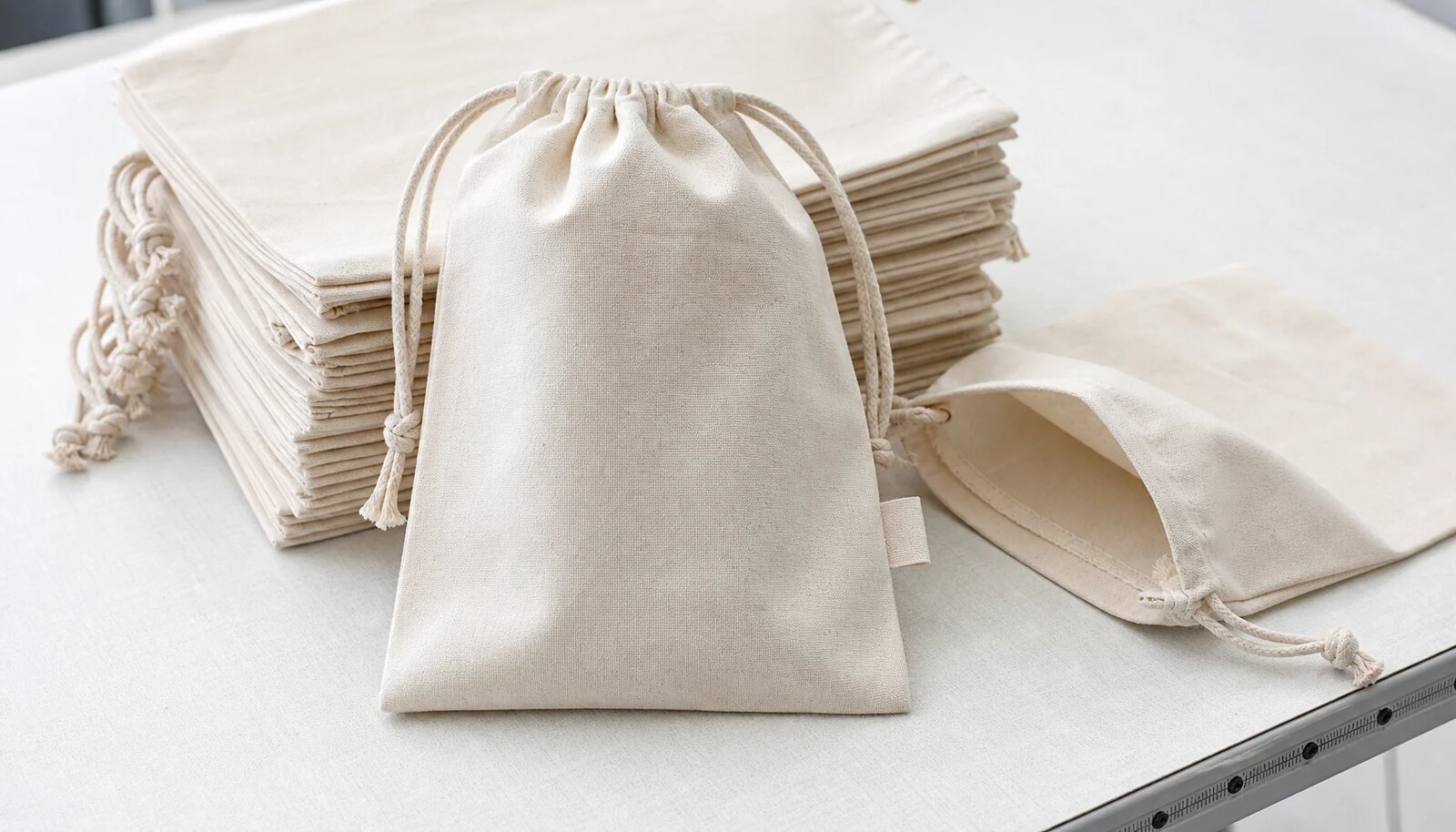
Why simple pouches still need controlled QC
Cotton drawstring pouches look simple on a line sheet. That is part of the trap. A pouch is a small textile product with fabric purchasing, cutting, sewing, trim, decoration, finishing, packing, and carton handling all compressed into one low-cost item. If the RFQ only says natural cotton pouch with logo, the supplier has wide room to choose the lightest fabric, cheapest cord, fastest print process, or easiest packing method. The result may be technically recognizable as a pouch, but it may not fit the garment, match the brand presentation, or pass warehouse receiving without questions.
For eco apparel brands, the pouch often sits close to the product story. It may hold swimwear, underwear, sleepwear, kidswear, accessories, event merchandise, a gift set, or an ecommerce bundle. The customer sees the pouch before handling the garment inside. Procurement, meanwhile, is judged on details that can feel subjective unless they are translated into measurable standards: fabric weight, shade, usable size, stitching, drawcord movement, print clarity, odor, packing count, and carton markings.
A useful cotton drawstring pouches quality inspection checklist for eco apparel brands should start before production, not at the final inspection table. The strongest QC tool is a complete purchase specification with clear tolerances and an approved pre-production sample. Final inspection then becomes a verification step against known requirements, not a debate about whether the pouch feels good enough.
- Treat the pouch as a branded packaging component, not a generic bag.
- Define measurable standards before comparing supplier prices.
- Use the approved pre-production sample as the physical reference for bulk inspection.
- Separate normal natural cotton variation from true defects before fabric is cut.
- Include packing and cartonization in the quality plan, because warehouse failures are still quality failures.
Start with use case, load, and size
The specification should begin with the job the pouch has to do. A low-cost insert bag for warehouse packing can be lighter and simpler than a pouch handed to a retail customer as part of the product experience. A reusable accessory pouch may need stronger cotton, smoother cord movement, cleaner trimming, and a more consistent logo. A pouch for a folded sweatshirt needs different usable space than one for jewelry, lingerie, socks, or swimwear.
Finished size is not the same as usable size. Side seams, the bottom seam, the drawstring channel, and any gusset all reduce the space available for the garment. A pouch can measure correctly when flat and still fail if the mouth opening is too small, the channel takes too much height, or the cord pulls the opening into a tight shape. Procurement teams should test the sample with the actual folded product or a product-size substitute before approving bulk production.
Write tolerances by pouch size and purpose. Many buyers use millimeter-level tolerances for small and medium textile pouches, such as +/-3 mm on smaller sizes and +/-5 mm on medium sizes, but there is no universal rule. Large pouches, washed fabrics, or relaxed natural finishes may need wider agreed limits. What matters is alignment on measuring method, measurement points, and pass/fail limits before cutting starts.
- State the use case: inner packaging, retail presentation, reusable accessory, event kit, gift set, ecommerce bundle, or warehouse component.
- Specify finished width, finished height, gusset depth, mouth opening, channel height, and usable internal size.
- Confirm the maximum product dimensions after folding, not only the flat pouch dimensions.
- Define size tolerance by measurement point instead of using general wording such as approximate or standard.
- Include target loading weight when the pouch will be reused or packed with heavier items.
Choose fabric with real procurement numbers
Fabric weight is one of the first cost and quality decisions. For many apparel packaging programs, 120-140 GSM cotton is a practical middle range because it offers reasonable opacity, hand feel, and print support without excessive bulk. For pouches intended to feel more substantial or to be reused often, 150-180 GSM may be appropriate. For low-cost promotions or very light contents, fabric below 110 GSM can work, but the buyer should accept that opacity, drape, and seam strength may feel less premium.
Avoid relying on words such as eco, natural, thick, soft, or premium. They help describe preference, but they do not control production. State the composition, GSM range, fabric finish, weave appearance, and whether the fabric is stock or newly booked. If organic cotton, recycled cotton, or another sustainability claim is part of the brand story, ask for the exact document type required, such as a transaction certificate, scope certificate, recycled content declaration, or supplier statement. Keep documentation requirements separate from physical quality requirements.
GSM also needs a tolerance. A buyer may approve 130 GSM cotton and later receive fabric that feels closer to 110 GSM if tolerance was never discussed. Ask the factory what GSM tolerance they can hold and whether they test internally or rely on mill certificates. If GSM testing is required during inspection, state the test method or at least the sampling approach so both sides understand what evidence will be accepted.
- Use a numeric GSM range and tolerance instead of vague quality language.
- Confirm composition, finish, weave appearance, and whether fabric is stock or custom booked.
- Ask whether the sample and bulk order will use the same fabric lot or an approved equivalent.
- Separate sustainability documentation from visual inspection requirements.
- Check opacity with the actual product inside when the pouch fabric is light or natural.
Control shade, odor, and shrinkage
Natural unbleached cotton is popular for eco apparel packaging because it looks less processed and pairs well with low-ink branding. It also varies. Seed flecks, small slubs, and shade movement can be normal, depending on the fabric. Oil marks, dirty streaks, mildew odor, dampness, holes, and heavy weaving defects are not normal presentation features. The inspection checklist should make this distinction clear so acceptable character is not confused with poor quality.
Shade approval needs a physical reference. A photo on a screen is not enough for accurate natural cotton comparison. Buyers can approve a sample, a reference swatch, or a small shade band showing the lightest and darkest acceptable tones. If the program includes multiple deliveries, ask the supplier to avoid random mixing of clearly different fabric lots within the same SKU. Carton-to-carton shade shifts become especially noticeable when pouches are displayed together or packed into sets.
Shrinkage matters even when the pouch is not intended for regular laundering. Cotton can change through washing, steaming, heat curing, ironing, or humidity exposure. If the pouch is marketed as reusable or washable, ask the supplier for expected shrinkage after a defined wash condition. If laundering is not part of the claim, still confirm whether printing heat, finishing, or storage could affect final dimensions. A production sample made from pre-softened material and a bulk run made from untreated fabric can create size and hand-feel disputes.
- Approve a natural cotton shade band when exact shade consistency is not realistic.
- Define acceptable seed flecks and slubs separately from stains, holes, and oil marks.
- Reject mildew odor, damp cartons, visible dirt, and chemical odor that could transfer to garments.
- Ask whether dyed cotton requires colorfastness checks, especially when packed with light garments.
- Confirm expected shrinkage if the pouch is described as reusable, washable, or long-life packaging.
Specify construction beyond the sketch
Construction details decide whether the pouch feels easy to use. A clean drawing helps, but the technical spec should define side seams, bottom seam, seam allowance, drawstring channel, cord exit method, stitch type, and stitch density. A double-fold channel is often preferred because it hides raw edges and supports repeated cord movement. A channel that is too narrow may save fabric but create a tight pull. A weak bottom corner may pass a quick visual check and then split during packing.
Stitch quality is functional quality. Inspectors should look for skipped stitches, broken threads, loose tension, seam puckering, uneven seam allowance, open seam ends, and weak back-tacking. Stress points deserve extra attention: bottom corners, drawcord exits, side label insertion points, and the start and end of the channel seam. One loose thread is usually minor. Many untrimmed threads across the lot tell a different story about finishing control.
Drawcord specification is another common weak point. Define cotton cord or tape, diameter or width, finished length, number of cords, knot style, color, and fray control. Cord length should be tested after the pouch is closed around the intended product. Too-short cords make closure difficult. Overly long cords can look untidy, tangle during packing, or raise category-specific concerns for some apparel programs.
- Define seam allowance, channel width, stitch type, stitch density, and cord exit position.
- Check stress points at corners, channel openings, labels, and cord exits.
- Test opening and closing several times on sampled units, not only once.
- Specify cord diameter or tape width so it fits the channel without binding.
- Confirm whether raw edges are overlocked, folded, bound, or otherwise finished.
Make logo QC measurable
Logo decoration is often where brand teams notice defects first. The print may be complete but still unacceptable if it is crooked, off-center, under-cured, too pale, too heavy, or poorly registered. Cotton texture also changes how ink appears. A Pantone reference on coated paper will not look identical on natural cotton, so the approved sample should become the practical production target.
Screen printing is a strong option for simple logos and repeat bulk orders because it can deliver consistent coverage when the screen, ink, pressure, and curing are controlled. Heat transfer can work for fine detail, gradients, or lower quantities, but buyers should inspect edge lifting, peeling, film hand feel, bubbling, and behavior after bending. Embroidery can look premium on heavier cotton but may pucker lightweight fabric. Woven labels provide subtle branding, yet placement still needs a measured tolerance.
Print placement should be specified from fixed points: distance from the top edge, bottom edge, side edge, or centerline. For many pouch programs, a tolerance of a few millimeters may be reasonable, but the exact number should be agreed based on logo size and pouch size. A small logo on a small pouch needs tighter control than a large relaxed print on a large laundry-style bag. Final inspection should compare bulk pieces to the approved sample and artwork with measured checks, not visual judgment alone.
- Send vector artwork and identify the final file name in the PO.
- Specify logo width, height, placement reference points, color target, and placement tolerance.
- Check curing with rub, bend, and light scratch checks appropriate to the ink or transfer method.
- Reject tackiness, cracking, smudging, blocked ink, transfer marks, and obvious pinholes beyond the approved standard.
- Clarify whether setup fees apply per artwork, per print color, per pouch size, or per order.
Compare quotes on the same basis
Supplier quotes can look similar while covering different products. One factory may quote 140 GSM cotton, cotton cord, screen print, trimming, bulk packing, carton marks, and export cartons. Another may quote a lower unit price using lighter fabric, polyester cord, no print setup, no barcode labels, and fewer packing controls. Procurement needs to normalize the specification before price negotiation begins.
MOQ deserves careful reading. The supplier may say the MOQ is 1,000 pieces, but that could mean 1,000 per size, per fabric color, per logo artwork, per print color count, or per packing version. Labels and cords may have their own minimums. If the order has three sizes, two cotton shades, and two logo versions, the real production split may be less efficient than the headline quantity suggests.
Freight belongs in the comparison because cotton pouches are usually light but can be bulky. A small change in folding method or pieces per carton can shift total CBM. Ask for carton dimensions, gross weight, net weight, pieces per carton, and estimated CBM at quotation stage. That gives the buyer a view of landed cost, not only ex-factory unit price.
- Normalize GSM, size, construction, cord, logo, label, packing, and carton details before comparing prices.
- Ask what is included in unit price and what is charged separately.
- Clarify MOQ by size, color, artwork, print color, label version, and packing version.
- Request estimated carton dimensions, gross weight, net weight, pieces per carton, and CBM.
- Treat an unusually low quote as a reason to recheck the specification line by line.
Use sampling as a release gate
Sampling should move from general to specific. A stock sample helps screen supplier workmanship, but it does not approve your custom order. A plain custom sample verifies size, construction, fabric hand feel, and cord movement. A logo sample verifies decoration method, placement, color, and curing. A pre-production sample is the key approval because it should represent the actual bulk setup as closely as possible: fabric, drawcord, labels, print, finishing, folding, and packing.
Sample review should be practical, almost boring in the best way. Measure the pouch with the agreed method. Place the intended product inside. Close and open the cord several times. Check whether the mouth pulls evenly. Inspect corners and label insertion points. Look at the print under normal light and from a realistic customer viewing distance. Pack the pouch as it will be packed in bulk and confirm whether creasing, pressure marks, or ink transfer appear after compression.
Approval must be documented. A short email saying sample approved is weak for B2B procurement control. Record the sample version, date, fabric GSM, finished size, cord details, artwork file, logo placement, packing method, accepted deviations, and required changes. If anything changes after approval, issue a revised specification or written sample comment. This protects both buyer and supplier because final inspection can refer to a clear standard.
- Use stock samples for supplier screening only.
- Approve a pre-production sample before bulk cutting or printing begins.
- Test the sample with the real garment or a realistic substitute.
- Record measurements, material details, artwork version, and packing method during approval.
- Do not accept special hand-finishing on samples unless the same method will be used in bulk.
Run inspection with defect classes
A strong inspection plan defines critical, major, and minor defects before inspection starts. Critical defects may include mildew odor, contamination, sharp foreign objects, unsafe packaging, or severe color transfer risk. Major defects may include wrong size beyond tolerance, wrong fabric, open seams, unusable drawcord, clearly crooked logo, print transfer, wrong count, or mixed SKUs. Minor defects may include isolated loose threads, very small shade variation within the approved band, or slight creasing that does not affect presentation. The exact classification should match the buyer's risk tolerance and product use.
Many buyers use AQL-based final random inspection for shipment release, often with general inspection level II and agreed AQL limits such as 0 for critical defects, 2.5 for major defects, and 4.0 for minor defects. These figures are common in consumer goods inspection, but they are not mandatory. The buyer can set stricter or looser limits depending on brand standards, order value, and risk. The important part is to state the inspection standard in the PO instead of debating it after defects are found.
Final inspection should include measurement, visual review, functional checks, print checks, and packing verification. Inspectors should pull cartons from different parts of the finished lot, not only from the most convenient stack. Reports should include photos, measurement tables, defect counts, carton count checks, and a clear pass/fail recommendation. If inspection fails, the supplier should sort, repair, reprint, replace, or re-pack before shipment release, with reinspection rules already agreed.
- Define critical, major, and minor defects before production starts.
- State the AQL level or buyer-specific acceptance rule in the PO.
- Inspect fabric, size, sewing, drawcord, print, labels, packing, carton condition, and markings.
- Sample cartons across the finished lot instead of relying on staged inspection units.
- Require photos and measurement records for any failed or borderline inspection result.
Lock packing, cartons, and PO controls
Packing is often where a technically good pouch order becomes an operational headache. Bulk packing is efficient when the buyer's warehouse will pair pouches with garments later. Individual polybags may be required for retail cleanliness, barcode control, ecommerce handling, or product protection, but they add cost, labor, and material use. Hangtags, inserts, barcode labels, suffocation warnings, and country-of-origin wording should be decided before production planning, not after sewing is complete.
Cartonization affects cost and receiving accuracy. Ask for pieces per inner pack, pieces per master carton, carton dimensions, gross weight, net weight, and total CBM. If the pouch has a printed logo, woven label, or visible knot, the fold method should avoid deep pressure marks and ink transfer. If compression packing is allowed, define the acceptable level and confirm whether pouches recover shape after unpacking. Moisture control matters for cotton; cartons should be dry, clean, and strong enough for the shipment route.
The purchase order should act as the final control document. Attach or reference the approved sample, specification sheet, artwork file, packing plan, carton marking guide, inspection checklist, delivery schedule, and defect resolution process. State whether inspection is factory internal, remote photo review, third-party inspection, or buyer inspection. If production photos are required, specify the stages: fabric receiving, cutting, sewing, printing, curing, packing, and carton marking. Clear PO controls reduce rework and make supplier accountability practical.
- Approve bulk pack, individual polybag, barcode label, hangtag, insert, or carton-only packing before production.
- Define pieces per inner pack, pieces per carton, carton marks, carton size, gross weight, net weight, and CBM.
- Avoid mixed cartons unless the warehouse approves the exact assortment and label format.
- Check cartons for moisture, crushing, poor tape, missing marks, wrong counts, and SKU mixing.
- Attach the approved sample reference, spec sheet, artwork, packing plan, and QC checklist to the PO.
Specification comparison for buyers
| Procurement decision | Recommended buying standard | What to specify in the RFQ | Inspection risk to control |
|---|---|---|---|
| Fabric weight | 120-140 GSM cotton for standard apparel packaging; 150-180 GSM when the pouch is sold, gifted, or reused as a more premium accessory; below 110 GSM only when lower cost and a lighter hand feel are acceptable | GSM target and tolerance, fabric composition, natural/bleached/dyed finish, weave, approved hand feel, opacity expectation, shrinkage expectation, and certification documents if required | Underweight fabric can look translucent and weak; overweight fabric can increase unit cost, carton CBM, and freight without improving the customer experience |
| Finished size | Use finished outside dimensions plus usable internal size; common tolerance is often +/-3 mm for small pouches and +/-5 mm for medium pouches, but the limit must be agreed by size and measuring point | Finished width and height, gusset depth if any, mouth opening, drawstring channel height, seam allowance, measuring method, product-fit test, and tolerance | A pouch that passes flat measurement may still fail if the garment cannot fit after the channel and seams reduce usable space |
| Fabric finish and shade | Natural unbleached cotton suits eco positioning when shade movement, seed flecks, and small slubs are approved; dyed or bleached cotton is better when visual consistency is critical | Approved physical shade reference or shade band, acceptable seed flecks, unacceptable stains, odor limit, colorfastness concern, and whether mixed lots may be packed together | Natural shade movement can become a claim dispute unless the buyer defines acceptable range before cutting |
| Construction | Double-fold drawstring channel, secure side and bottom seams, reinforced stress points, clean trimming, and smooth drawcord movement for reusable apparel pouches | Stitch type, stitch density target, seam allowance, channel width, cord exit style, corner reinforcement, label insertion depth, loose-thread standard, and seam-end security | Crooked channels, weak corners, skipped stitches, and tight drawcords cause packing-line delays and poor customer handling |
| Drawcord | Cotton cord or flat cotton tape matched to pouch size; diameter or tape width should allow smooth pull without tearing or crowding the channel | Cord material, diameter or tape width, finished cord length, color, knot style, fray control, number of cords, and pull-test expectation | A cord that is too short, rough, frayed, or inconsistent makes the pouch feel cheaper than the fabric specification suggests |
| Logo method | Screen print for simple repeat logos; heat transfer for detailed graphics or low-volume artwork; woven labels for subtle branding; embroidery only after pucker risk is tested on the selected fabric | Artwork file, print size, placement from edges, Pantone or approved color target, ink type, curing method, rub test, registration tolerance, setup fees, and reprint responsibility | Poor curing causes cracking, tackiness, odor, rub-off, ink transfer, or blocked pouches inside compressed cartons |
| MOQ logic | MOQ should be confirmed per size, fabric color, print artwork, print color count, label version, and packing version, not only by total order quantity | Minimum order quantity by variant, stock-fabric availability, setup charges, screen charges, label MOQ, carton MOQ, and split-order surcharge | A low headline MOQ can hide high setup costs, fabric surcharges, slow trims, or inefficient packing splits |
| Sampling route | Use a stock sample for supplier screening, a plain custom sample for fit, a logo sample for decoration, and a pre-production sample for bulk release | Sample type, sample material source, sample tolerance, courier timing, approval criteria, and whether bulk will use the same fabric lot or an approved equivalent | Hand-finished samples may look cleaner than production unless the pre-production sample is made with bulk materials and real production methods |
| Inspection plan | Use in-line checks for fabric, sewing, and print setup; use final random inspection before shipment release; define AQL or buyer-specific defect limits in advance | Inspection standard, sample size, defect classification, measurement points, required photos, inspector access, and who pays for reinspection | Without agreed defect limits, the buyer and factory may disagree on shade variation, loose threads, print drift, size deviation, or odor |
Buyer checklist before sampling
- Confirm finished pouch width, height, gusset if any, usable internal size, mouth opening, target loading weight, folding method for the product inside, and size tolerance before requesting final prices.
- Specify cotton composition, GSM range and tolerance, fabric finish, weave appearance, shade reference, acceptable seed flecks, shrinkage expectation, odor standard, and whether organic or recycled certification documents are required.
- Define drawcord material, diameter or tape width, finished cord length, number of cords, knotting or bar-tack method, exit position, fray-control method, and acceptable pull performance.
- Send vector artwork and state logo size, print placement from pouch edges, print color target, ink type preference, curing expectation, registration tolerance, and acceptable print placement tolerance.
- Approve a physical pre-production sample that uses bulk-intended or approved-equivalent fabric, drawcord, print method, label placement, construction, folding, and packing style.
- Ask the supplier to state what is included in the unit price: fabric, cutting, sewing, drawcord, printing, labels, trimming, ironing, inspection, inner packing, master cartons, carton marks, and export documentation support.
- Agree on defect definitions for fabric stains, oil marks, holes, shade variation, skipped stitches, broken seams, open corners, loose threads, print cracking, smudging, odor, size deviation, and packing count errors.
- Set measurable tolerances for finished size, channel width, cord length, print placement, label placement, stitch defects, shade variation, carton quantity, and SKU separation.
- Record carton dimensions, gross weight, net weight, pieces per carton, pieces per inner pack, carton marks, barcode requirements, SKU separation, and whether compression packing is allowed.
- Confirm whether inspection will be factory internal QC, buyer remote review, third-party final random inspection, in-line inspection, or a combination of these controls.
Factory quote questions to send
- What exact cotton fabric are you quoting: GSM, GSM tolerance, composition, weave, finish, width, stock status, and whether the bulk order will use the same fabric lot as the approved sample?
- Is the quoted size the finished pouch size or cut panel size, and what tolerance do you accept for finished width, height, gusset, mouth opening, and channel width?
- What construction is included: side seams, bottom seam, double-fold channel, seam allowance, stitch type, stitch density, cord exit method, corner reinforcement, trimming, and ironing?
- What drawcord material, diameter or tape width, finished length, knot type, color, and fray-control method are included in the quote?
- Which logo method did you price: screen print, heat transfer, embroidery, woven label, printed label, or another method, and how many colors are included?
- What print controls are included: screen setup, artwork adjustment, Pantone matching, curing, rub testing, placement guide, registration check, and replacement for printing defects?
- Are screen charges, label setup, sampling, courier cost, individual polybags, barcode labels, carton marks, hangtags, inserts, and export cartons included or charged separately?
- Is the MOQ based on total order quantity, each size, each fabric color, each print design, each print color count, each label version, or each packing version?
- What sample will you provide first: stock reference, plain custom-size sample, logo sample, or full pre-production sample using bulk-intended materials?
- What quality checks do you perform during fabric receiving, cutting, sewing, printing, curing, trimming, packing, and final carton inspection?
Quality-control points to confirm
- Fabric GSM is checked against the approved range, with the measurement method and sample count recorded when GSM testing is part of the inspection plan.
- Fabric hand feel, opacity, weave appearance, finish, shade, and natural cotton seed flecks match the signed sample or approved shade band.
- Fabric is checked for stains, oil marks, dirt, holes, weaving defects, broken yarns, unexpected slubs, dampness, mildew odor, chemical odor, and unacceptable creasing.
- Finished pouch width, height, gusset depth, channel width, mouth opening, seam allowance, and usable internal space are measured against the written tolerance.
- Side seams, bottom seams, corners, label insertion points, and drawstring channel stitching are straight, secure, evenly tensioned, and free from skipped stitches or broken thread.
- Drawcord length, color, diameter or tape width, knotting, exit position, fray control, and pull action are consistent across sampled units.
- Drawcord movement is tested by opening and closing sampled pouches several times, with attention to binding, twisting, cord slippage, and tearing at exit points.
- Print size, placement, color density, edge sharpness, registration, ink curing, rub resistance, odor, and surface cleanliness match the approved reference sample.
- Heat transfer, embroidery, woven label, or sewn label applications are checked for lifting edges, bubbling, wrinkling, poor adhesion, puckering, needle damage, and inconsistent placement.
- Loose threads are trimmed, seam ends are secured, pouch mouths open evenly, and finished bags lie flat without twisting, heavy puckering, or obvious distortion.