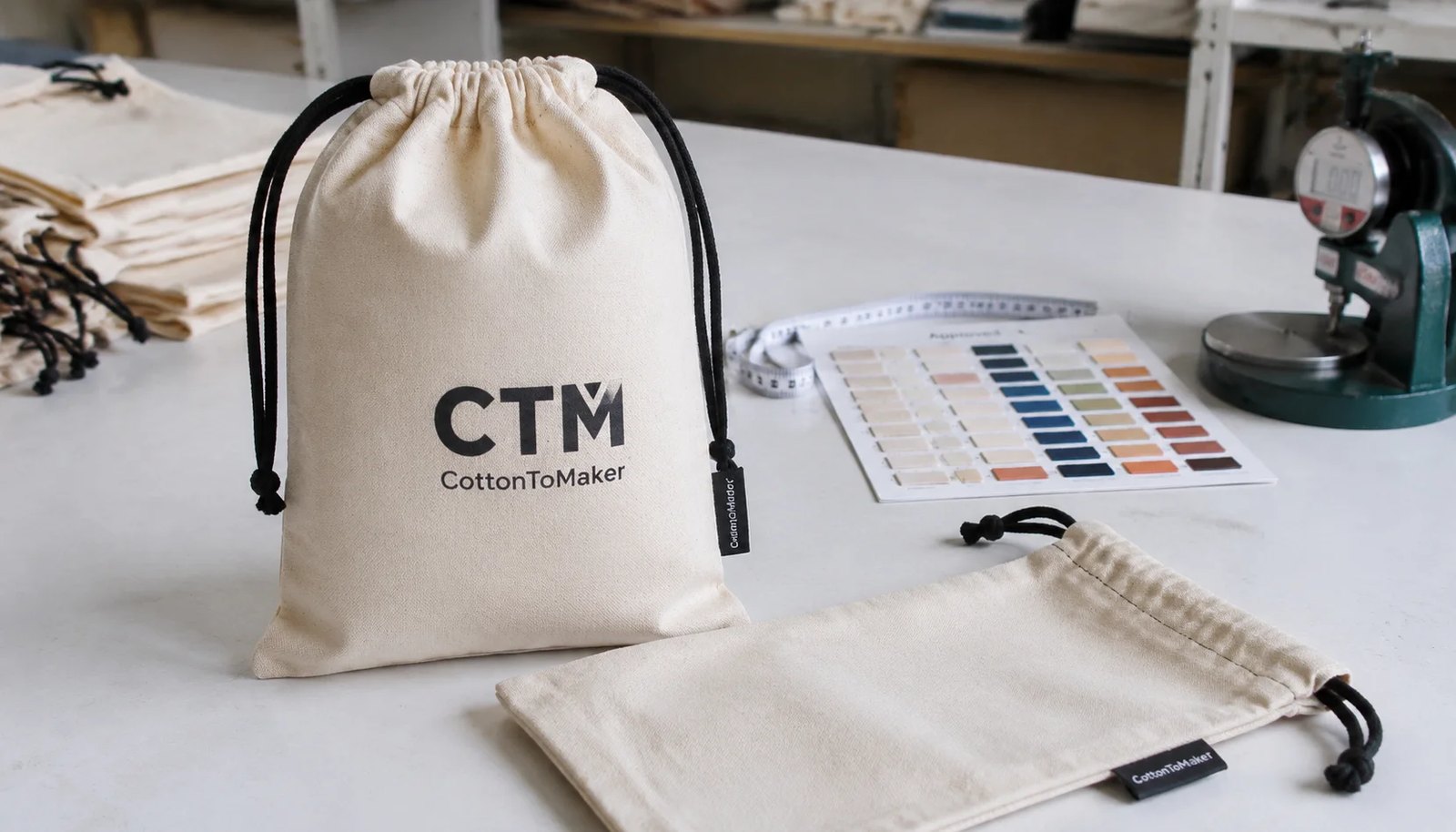
The Real Proofing Problem
Cotton drawstring pouches look simple until the first liquor retail order reaches store level with off-center logos, stiff transfer patches, shade variation, or cartons mixed across SKUs. The main buying problem is not choosing a pouch shape. It is proving that the artwork, fabric, construction, and packing can be repeated in bulk without damaging the retail presentation.
For liquor retailers, these pouches often sit next to bottles, tasting kits, miniatures, bar tools, or gift sets. The pouch becomes part of the product value. A poor print proof makes the bottle look cheaper, slows store kitting, and can create chargebacks when barcodes, carton marks, or SKU splits are wrong. The proofing stage should turn artwork into factory instructions, not just produce a nice sample photo.
- Use the proof to lock fabric, size, print method, print position, cord, label, and packing at the same time.
- Treat every artwork version as its own approval unless only the printed store name or barcode changes under a controlled template.
- Record acceptance criteria in millimeters and color references, not only in comments such as approved or looks good.
Start With Use Case
A pouch for a 50 ml miniature bottle is not specified the same way as a pouch for a corkscrew, glass charm set, tasting card, or premium bottle accessory. Before print proofing, the buyer should define the item going inside, the filling method, and the display environment. This decides the finished size, fabric weight, drawcord strength, and how much empty space can remain around the product.
Liquor retail buyers also need to decide whether the pouch is packaging, a reusable gift item, or a promotional giveaway. Packaging can accept a simpler construction if it only protects a small item. A reusable gift pouch needs better seam strength, smoother cord movement, and a print that will not crack after repeated handling. Without this distinction, suppliers may quote low with a lightweight fabric that meets the size request but fails the retail purpose.
- For small accessories, many buyers use 4 oz to 6 oz cotton, but print opacity and durability need approval.
- For premium retail pouches, 6 oz to 8 oz cotton usually gives a stronger hand-feel and better shelf presentation.
- For bottle-related use, test the actual filled product for closure height, bottom seam stress, and logo visibility when the pouch is standing or hanging.
Fabric GSM Decisions
Fabric weight is one of the first quote differences that procurement teams should normalize. Some factories quote in ounces, some in GSM, and some describe fabric only as cotton canvas or cotton sheeting. For cotton drawstring pouches, a practical range is often 120-150 GSM for very light promotional pouches, 180-220 GSM for general retail gift packaging, and 240-280 GSM for a heavier premium feel. The right choice depends on print coverage, product weight, and freight budget.
Natural cotton is common because it fits craft liquor, wine, and spirits branding, but it has cotton seed flecks and shade variation. Bleached cotton gives cleaner print contrast. Dyed cotton can look more controlled for brand color, but fabric dye MOQ and shade approval become additional issues. If the buyer wants organic cotton or recycled cotton, the RFQ should state documentation requirements separately from the print proof; otherwise suppliers may quote conventional cotton and leave the certification discussion until too late.
- Write both GSM and ounce target in the RFQ when possible, for example 6 oz cotton, approximately 200 GSM.
- Define whether natural cotton specks are acceptable in the print area, especially behind small black text or fine gold artwork.
- For tight size requirements, discuss washing, pre-shrinking, or allowance in cutting because cotton can move during printing and pressing.
Print Method Choice
Screen print is usually the safest route for liquor retail logos with one to three solid colors. It gives stable unit cost at volume, good color control, and a hand-feel that can be acceptable on cotton when the ink is not too thick. The proof should confirm ink penetration, edge sharpness, curing, and opacity on the exact fabric color. A logo that looks sharp on coated paper may gain rough edges on cotton weave.
DTF and heat transfer can solve full-color artwork, gradients, or short runs with many designs, but they change the hand-feel. A large transfer on soft cotton can feel like a patch and may crease during packing. Embroidery can work for small premium marks, but it is slower, more expensive, and can pucker lighter fabric. Woven labels avoid some print abrasion issues but need label MOQ, sewing labor, and exact placement control.
- Use screen print for solid logos, batch consistency, and larger repeat programs.
- Use transfer print only after approving edge adhesion, flexibility, and touch on the chosen cotton weight.
- Avoid embroidery on very small pouches unless the fabric is heavy enough and the stitch density is tested.
- Consider a woven side label when the pouch is reused often and the main artwork can stay minimal.
Artwork Proof Rules
A print proof should not be approved from a low-resolution JPG placed on a generic pouch image. The factory needs vector artwork, print size, print position, Pantone color references, and any retail compliance marks. For a drawstring pouch, print position must be measured from construction points: top folded edge, side seam, and bottom seam. Measuring from a visual center only creates disputes after sewing variation.
Liquor branding often uses fine typography, seals, crests, metallic-looking effects, and legal text. Cotton texture does not hold all of that equally. Small reversed text can close up, thin lines can break, and faux metallic gradients may look dull in a flat screen print. The proofing checklist should identify which details are critical and which can be simplified for fabric printing.
- Set minimum text height and stroke width before sampling; many cotton screen prints need more tolerance than paper labels.
- Provide Pantone Coated or Uncoated references, then approve against the actual cotton sample because fabric base color changes perception.
- Mark the print area with exact width, height, and distance from top edge; do not rely on a supplier choosing a balanced position.
- If there are multiple SKUs, use a version control file name that matches the purchase order and carton mark.
MOQ And Cost Logic
The lowest unit price is often built on assumptions the buyer did not see. MOQ may be driven by fabric purchase, dye lot, screen setup, cutting efficiency, cord color, woven label MOQ, or packing labor. A supplier may accept 1,000 pieces total, but that does not mean 100 pieces each across ten different prints at the same unit price. Procurement should make the SKU breakdown visible before comparing quotes.
Cost also moves with print size and color count. A one-color 70 mm logo on natural cotton is not the same as a 160 mm full-front print with three spot colors. Larger prints require more ink, slower handling, more drying space, and higher rejection risk. Retail unit packing, barcode labels, inner carton sorting, and mixed SKU cartons can add labor even when the pouch itself is unchanged.
- Break the quote into pouch base cost, print cost, setup cost, label cost, packing cost, sample cost, and courier cost.
- Ask for pricing at realistic tiers such as 1,000, 3,000, 5,000, and 10,000 pieces per artwork or per fabric color.
- Separate one-time screen charges from repeat-order unit cost so replenishment pricing is clear.
- For multi-store campaigns, group artwork under one fabric and cord specification to reduce production changeovers.
Sample Approval Sequence
A photo proof is useful for layout discussion, but it is not enough for a first liquor retail order. The buyer should approve a physical pre-production sample made with actual bulk fabric or a confirmed equivalent, actual drawcord, actual print method, and final size. If the supplier uses substitute fabric for sampling, that must be stated because print color, shrinkage, and hand-feel may change in bulk.
The sample should be measured and handled like incoming stock. Pull the drawcord several times, fill the pouch with the real product or a weight equivalent, rub the print with a dry cloth, and compare logo position against the artwork sheet. Keep one approved sample with the buyer and one sealed at the factory. During mass production, the factory should compare against that approved sample, not against memory or a phone photo.
- Approve fabric shade and GSM before approving print color because the base fabric affects the final appearance.
- Measure finished size flat after sewing and pressing, then measure usable internal size with the intended item inside.
- Take close-up photos of print edges, drawcord channel, seam inside, side label, and packing method for the production file.
- Do not release bulk production until artwork version, sample date, and signed approval are connected to the purchase order.
QC Thresholds
Quality control must turn subjective print comments into inspection points. For cotton drawstring pouches, practical thresholds include fabric weight tolerance, finished size tolerance, print position tolerance, color comparison, seam condition, drawcord function, and packing accuracy. The buyer should define which defects are critical for retail use. A tiny cotton fleck may be acceptable, while a missing barcode label or unreadable logo is not.
AQL inspection can be used, but the defect list must match the product. For example, loose threads inside the pouch may be minor if they do not show or affect function, but open seams, major print smears, wrong artwork, wet ink transfer, and mixed SKU cartons are more serious. Because cotton can vary, the approved sample should act as the standard for acceptable natural texture and shade range.
- Common size tolerance: +/-5 mm for small pouches and +/-8 mm for larger pouches, unless the product fit requires tighter control.
- Print position tolerance should be written, for example +/-3 mm from approved placement for small front logos.
- Dry rub test should show no obvious ink transfer after proper curing; define the method if the order is high risk.
- Closure should work without cord breakage, channel tearing, or cord ends disappearing into the seam.
Packing And Warehouse Fit
Packing is part of print proofing because poor packing can damage a good print. Freshly printed cotton pouches need enough curing time before stacking. Heavy pressure inside cartons can leave creases, transfer marks, or shiny patches on certain inks and transfers. If the pouch is used for retail display, the buyer should decide whether fold marks are acceptable or whether flat packing is required.
Liquor retailers and distributors often need carton marks, SKU labels, inner bag counts, and store allocation rules. If a purchase order includes several artworks, the packing plan must prevent mixed versions unless the warehouse specifically allows mixed cartons. Retail unit polybags may help cleanliness and barcode control, but they add plastic, labor, carton volume, and sometimes repacking work if the pouch will later be filled with bottles or accessories.
- Define pieces per inner bag, pieces per export carton, carton dimensions, gross weight, and whether cartons can contain mixed SKUs.
- Keep print faces away from abrasive carton surfaces when the artwork uses large ink coverage or transfers.
- Use clear SKU labels and carton marks that match the buyer's receiving system, not only the supplier's item code.
- Confirm whether pouches ship empty, pre-kitted, flat, folded, or individually bagged because this changes labor and freight.
Lead Time Risks
Lead time should start from the correct approval milestone. For a simple repeat order, production may start after purchase order and artwork confirmation. For a new cotton drawstring pouch with print proofing, the safer trigger is approval of pre-production sample, fabric shade, and packing label. If a supplier quotes lead time without stating the start point, the schedule can slip before production even begins.
Risk increases when the order includes custom dyed fabric, special cord color, woven labels, multiple artworks, retail barcodes, or inspection booking. Liquor campaigns often have fixed promotional dates, so the buyer should build a calendar from artwork release to sample approval, material booking, printing, sewing, final QC, packing, and shipping. Late artwork changes are especially costly after screens, labels, or transfer films are prepared.
- Build in time for artwork correction before sampling, not only sample making and courier transit.
- Confirm whether printing happens before or after sewing; the choice affects print position control and production flow.
- For multi-SKU orders, require a production schedule that shows fabric cutting, print batches, sewing, and packing by artwork.
- Book inspection before the expected completion date so failed packing or print issues can still be corrected.
Specification comparison for buyers
| Spec decision | Recommended option | When it fits | Buyer risk to check |
|---|---|---|---|
| Fabric weight for liquor gift pouch | 6 oz to 8 oz cotton, about 200-270 GSM, pre-shrunk if tight size tolerance is needed | Small bottle accessories, tasting kits, miniatures, bottle neck gifts, or premium retail counter packaging | Too light a fabric can look translucent after printing; too heavy a fabric may make drawstring closure bulky and increase freight weight |
| Print method for simple brand mark | Screen print with water-based or pigment ink, 1-3 spot colors | Logos with solid shapes, limited colors, and repeat orders where color consistency matters | Artwork with fine serif text below 1.5 mm stroke may fill in on cotton texture; require strike-off before approving bulk |
| Print method for full-color art | DTF transfer or heat transfer only after wash, rub, and hand-feel approval | Short campaigns, multiple store artworks, or photographic graphics where screen setup cost is inefficient | Transfers can feel plastic on soft cotton and may crack if poor film or curing is used; define acceptable edge lift and hand-feel |
| Drawstring construction | Cotton cord or braided cotton rope through a folded channel with bartack or reinforced side seam | Retail packaging that customers may open and close repeatedly in store or at home | Thin cord cuts into fabric, weak side seam opens during filling, and cord length variation creates uneven closure on shelf |
| Pouch size tolerance | Finished size tolerance of +/-5 mm for small pouches and +/-8 mm for larger bottle accessory pouches | Orders where printed logo must sit centered under a bottle neck, ribbon, label, or hangtag | Uncontrolled shrinkage after cutting or printing can move artwork too close to the bottom seam or drawcord channel |
| MOQ logic for liquor retailers | One base fabric color with grouped artwork versions when possible; separate MOQ for each print colorway | Retailers ordering for multiple stores, seasonal campaigns, or private-label bottle ranges | A quote may show one MOQ for sewing but a higher practical MOQ for dyeing, cord color, label weaving, or print setup |
| Sampling path | Pre-production sample using actual fabric, drawcord, print ink, size, packing, and label position | Any first order, new artwork, new print method, or pouch used as retail-facing packaging | A photo proof alone cannot verify ink penetration, fabric shade, closure strength, or real logo position after sewing |
| Packing format | Flat bulk pack in export carton with inner polybag by SKU; optional retail unit polybag only if needed | Warehouse replenishment, store distribution, or kitting with bottles and accessories | Over-tight carton packing can crease prints; loose mixed-SKU cartons create receiving errors and slow store allocation |
Buyer checklist before sampling
- Define finished pouch size, usable internal size, drawcord length, cord material, fabric GSM, fabric color, and whether the pouch must fit a specific bottle, glass, opener, mini set, or gift card.
- Send vector artwork with Pantone references, print size in millimeters, print position from top seam and side seam, and minimum readable text height.
- State the expected fabric: natural cotton, bleached cotton, dyed cotton, organic cotton, or recycled cotton blend, and specify whether cotton specks and shade variation are acceptable.
- Choose a print route before quoting: screen print for solid spot colors, heat transfer or DTF for full color, embroidery only for small premium marks, and woven label when print abrasion is a concern.
- Require a pre-production sample made with actual bulk fabric, actual drawcord, actual print ink or transfer film, and the same sewing construction intended for mass production.
- Approve the sample against measurable criteria: logo size tolerance, print position tolerance, color tolerance, seam strength, closure function, fabric weight, packing method, and carton mark format.
- Separate one-time costs from unit price in the quote, including screen charges, artwork handling, sample fee, courier fee, label setup, cutting mold if any, and retail packing labor.
- Confirm MOQ by fabric color, pouch size, print design, print color count, drawcord color, woven label, and packing SKU, not only by total order quantity.
- Lock carton quantity, carton size, gross weight, inner bag quantity, barcode or SKU label rules, and mixed-carton restrictions before production starts.
- Keep one signed or sealed approval sample with the buyer and one at the factory, then use photos plus measured QC records during inline and final inspection.
Factory quote questions to send
- What is the exact fabric weight in GSM and oz, and is the quoted fabric greige, bleached, dyed, washed, or pre-shrunk?
- Is the MOQ calculated by total pouch quantity, fabric color, pouch size, print design, print color count, drawcord color, or packing SKU?
- Which print method is included in the unit price, and what are the limits for fine lines, small text, gradients, and edge registration on cotton fabric?
- Can the pre-production sample use actual bulk fabric, actual cord, actual label, and actual print method rather than substitute material?
- What print color tolerance will you control against Pantone or approved sample, and under which light source will the comparison be made?
- What are the expected tolerances for finished pouch size, print position, drawcord length, and logo dimension after sewing and pressing?
- How will the pouches be packed by SKU, and what carton quantity, carton size, gross weight, and carton marks are assumed in the quote?
- What production lead time starts after which approval: deposit, artwork approval, fabric approval, pre-production sample approval, or packing label approval?
- Which QC records can be provided during production: fabric GSM check, print rub test, seam pull check, size measurement report, carton drop risk review, and final AQL report?
Quality-control points to confirm
- Fabric GSM should match the approved standard within the agreed range, commonly +/-5 percent for cotton pouch fabric unless a tighter tolerance is written into the purchase order.
- Finished size should stay within the approved tolerance and be measured after sewing, pressing, and normal relaxation, not only after cutting.
- Print position should be measured from fixed construction points such as top folded edge, side seam, and bottom seam, with the same method used in sampling and inspection.
- Print color should be compared against the approved sample or Pantone target under consistent lighting, with natural cotton shade variation considered before rejection.
- Ink curing or transfer bonding should pass dry rub and light scratch checks before packing, especially for dark logos on natural cotton and full-color transfer prints.
- Drawcords should pull smoothly without tearing the channel, slipping into the seam, or leaving uneven cord tails outside the closure.
- Side seams and bottom seams should be secure with no loose threads, skipped stitches, open seams, or raw edges visible on retail-facing areas.
- Pouches should be packed only after prints are fully cured and cooled, with print faces protected from heavy pressure, moisture, and carton abrasion.
- Carton marks, SKU labels, inner bag quantity, and mixed-carton rules should match the buyer's warehouse receiving instructions.