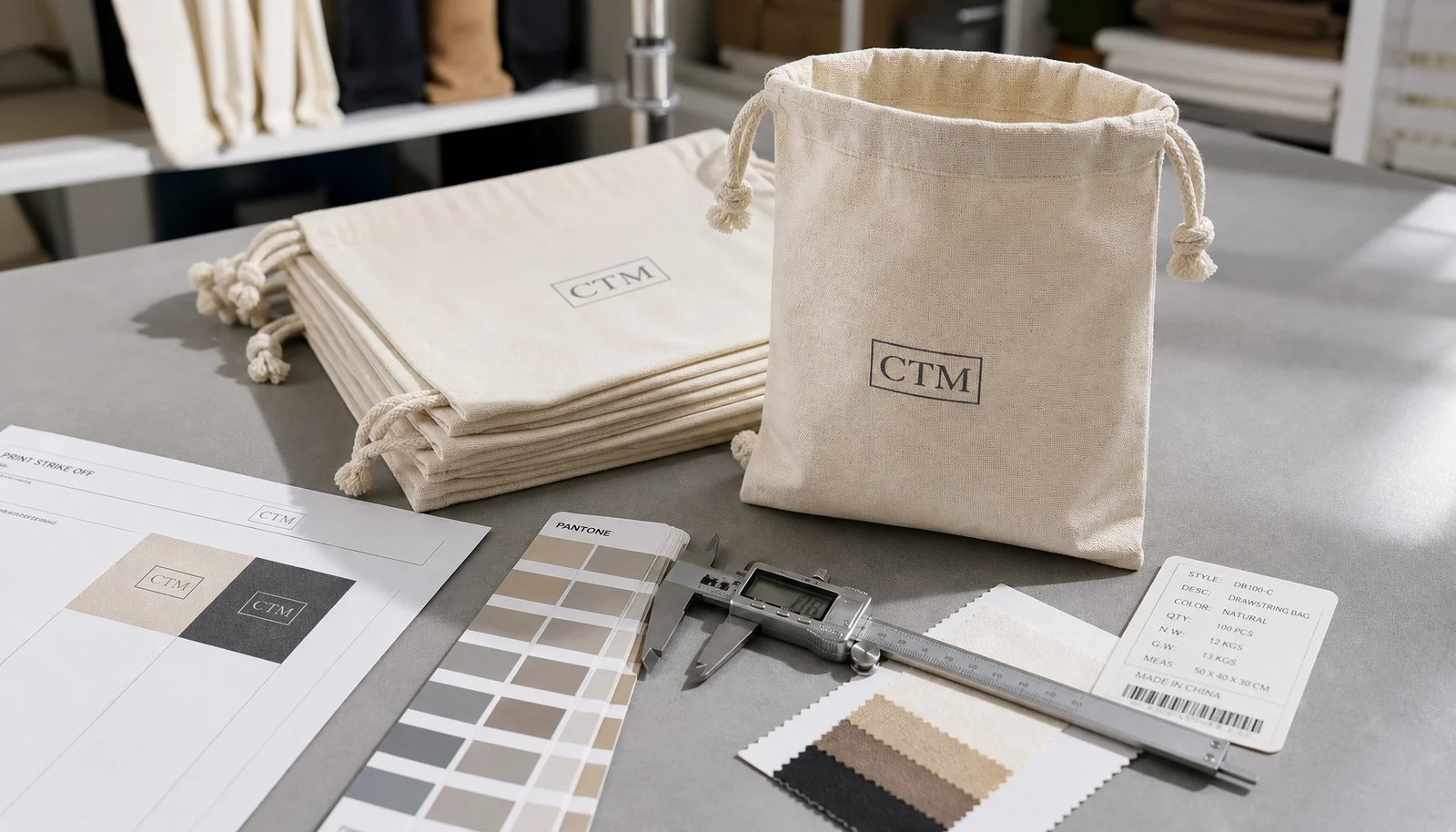
Proof the pouch like an event item, not a simple bag
Cotton drawstring pouches look uncomplicated, which is exactly why they can catch procurement teams off guard. The product may be only fabric, stitching, a channel, a cord, and a printed mark, but trade show use adds pressure. The event date will not move. Booth teams need the right version in the right carton. A visitor may scan a QR code in poor hall lighting. A sponsor logo that is 6 mm too low can look careless when the pouch is filled and stacked on a counter.
The best cotton drawstring pouches print proofing checklist for trade show exhibitors connects sourcing, artwork, sampling, quality control, and packing. When these steps are handled separately, gaps appear. A digital proof can show placement, but it cannot prove how ink sits on natural cotton. A fabric swatch can show hand feel, but it cannot confirm usable fill height. A pre-production sample can be excellent evidence, but only if someone measures it, fills it, closes it, scans it, and checks it against written criteria.
For B2B buyers, the goal is not to slow the order down with paperwork. It is to remove expensive uncertainty early. Procurement should give suppliers enough detail to quote the same product, require proof evidence that reflects bulk production, and define what will pass inspection before cartons are sealed. Trade show pouch orders rarely fail because nobody cared. They fail because important details were left as assumptions until production was already underway.
- Approve fabric, print, construction, packing, and carton marks as one connected specification.
- Use physical proofing for first-time orders, strict brand colors, fine print, QR codes, and fixed event dates.
- Keep the signed sample, artwork file, measurement record, tolerance sheet, and carton plan available for inspection.
- Do not release bulk production from a flat mockup unless the same fabric, size, print method, supplier, and artwork have already been proven.
Start the RFQ with the contents
An RFQ that says "cotton drawstring pouch with logo" leaves too much room for interpretation. One supplier may quote 120 GSM natural cotton with a basic one-color print. Another may quote 180 GSM cotton canvas, thicker cord, and counted inner packing. Both responses may be reasonable, but they are not quoting the same thing. To make prices comparable, start with what the pouch must carry and how it will be used at the show.
List the contents before naming the pouch size. Include item dimensions, item weight, the number of items per pouch, and whether the items are rigid, sharp-edged, oily, fragile, loose, or boxed. A small cable, folded leaflet, glass vial, badge, metal part, and square sample carton all behave differently inside cotton. Sharp corners can push into the fabric and make a centered print appear off-center. Heavy contents may need stronger fabric, reinforced stitching, or more clearance below the drawcord channel.
Then state the finished pouch size as width x height after sewing. Add usable fill height as a separate number. This is not a minor distinction. A pouch that is 200 mm tall on the outside may lose 25-35 mm to the top hem, channel, and closure behavior, depending on the construction. If the contents must sit fully below the channel, outside height alone is not a reliable fit specification. When possible, send the supplier a content sample, a dieline, or a measured drawing before the pouch is cut.
- Define the use: giveaway, sample pouch, VIP kit, sponsor pack, resale pouch, or kitting component.
- Provide content dimensions, content weight, item count per pouch, and edge sharpness.
- Specify finished outside size and usable fill height as separate measurements.
- Tell the supplier whether pouches will ship empty, filled at the factory, or sent to a fulfillment center.
- Ask the supplier to confirm comfortable filling, closure, and stacking before sampling.
Choose cotton fabric with print and freight in mind
GSM affects more than whether the pouch feels cheap or premium. It influences print opacity, wrinkle behavior, sewing stability, carton volume, freight cost, and how the pouch sits when filled. For economy trade show giveaways, 120-140 GSM plain-weave cotton is common. It can work well for light inserts, badges, small cables, pins, and mass handouts where cost and quantity matter most. The tradeoff is a thinner hand, more show-through, and less support under large solid ink areas.
A 160-180 GSM cotton is often a better middle ground for exhibitors who want a reusable visitor pouch without moving into heavy canvas. It usually handles screen print more cleanly and feels more substantial when handed across a booth counter. For VIP kits, retail-style sampling, beauty products, wellness packs, or heavier contents, 180-220 GSM cotton or cotton canvas may be the better choice. Buyers should allow for higher material cost, larger cartons, increased freight weight, and slightly more sewing complexity on small pouch sizes.
Fabric color belongs in the print specification, not in a separate note. Natural cotton has a warm base shade, visible seed flecks, and normal shade variation. That can support a natural-material message, but it can also make blue, gray, green, and bright brand colors appear warmer or duller. Bleached white improves print brightness but changes the look of the product. Dyed cotton creates a stronger background, yet it may introduce dye-lot tolerance, print opacity questions, higher minimums, and longer lead time. If color matters, the proof should use the same fabric color and GSM intended for bulk.
- Use 120-140 GSM for lightweight, cost-sensitive giveaways with low load requirements.
- Use 160-180 GSM for a stronger everyday promotional pouch with better hand feel.
- Use 180-220 GSM cotton or canvas for premium kits, heavier contents, or reusable packaging.
- Define acceptable natural cotton flecks, slubs, shade range, and fabric marks before approval.
- Request the actual bulk fabric base for strike-offs when brand color or print coverage matters.
Match the print method to the artwork risk
Screen printing is often the practical choice for cotton drawstring pouches with one to three solid colors. It suits clean vector logos, medium-to-large quantities, and repeat trade show programs. With the right screen, ink, and curing, it can give strong coverage and a familiar promotional-product finish. The limits are also familiar. Tiny reversed text can fill in. Very thin lines can break. Gradients do not behave like a digital file. Multi-color designs need registration tolerance.
DTF, heat transfer, and digital print can make sense when artwork includes full color, gradients, photographs, many sponsor marks, or small version quantities. They can reduce the need for several screens, but they create a different proofing checklist. Review hand feel, edge visibility, flexibility, heat marks, rub resistance, and whether the print cracks or lifts when the pouch is folded, stacked, or packed. A bright supplier photograph is helpful, but it is not enough evidence for a bulk event order.
Artwork should also be adjusted for the pouch format. Keep critical marks inside a stable print area below the channel and away from side seams, bottom corners, and heavy fold lines. QR codes need quiet space and enough final printed size to scan through cotton texture. Small URLs, sponsor names, and compliance marks should be proofed at actual size on the chosen fabric. Ask the supplier for the minimum line width and minimum text height for the selected method; do not assume the factory can reproduce every detail in the art file exactly.
- Use screen print for clean spot-color logos and medium-to-high quantities.
- Use transfer, DTF, or digital print for complex graphics or small version splits after reviewing hand feel and durability.
- Keep critical artwork away from seams, bottom folds, and the drawcord channel.
- Confirm minimum line width, minimum text height, and recommended QR code size before proofing.
- Scan the physical printed QR code from the sample pouch, not only from the PDF proof.
Make proof approval measurable
"Looks good" is not a production standard. It may be fine in an email, but bulk production needs measurements the buyer, supplier, and inspector can all apply. For printed cotton drawstring pouches, the proof approval should cover fabric, finished size, usable fill height, print size, print position, print color, registration, seam quality, drawcord function, and packing method.
For size, agree how the pouch will be measured. Finished width and height should be measured flat after sewing, before filling. Usable fill height should be measured from the bottom seam to the practical lower edge of the channel or closure area, depending on construction. Many small and medium cotton pouch orders use a finished size tolerance around plus or minus 5 mm, although this is not universal. Small pouches, rigid inserts, and tightly centered artwork may need closer control. Large pouches may allow slightly more variation if the contents and print still work.
For print position, record the artwork size in millimeters and define placement from fixed points such as the side seam, bottom seam, or finished edge. Avoid using the gathered top as the reference point because the drawcord changes its shape. A placement tolerance of plus or minus 3-5 mm may be practical on many pouches, but 5 mm can be obvious on a small pouch with a centered logo. Color approval should reference a physical strike-off or signed sample on production fabric. Pantone numbers help communication; they do not make cotton behave like coated paper.
- Record print width, print height, and placement from fixed seams in millimeters.
- Define finished size tolerance and print placement tolerance before sampling.
- Approve color against a strike-off or signed sample on the same fabric base.
- Define acceptable registration movement for multi-color artwork.
- Keep dated sample photos and measurement notes with the purchase order file.
Control MOQ, setup charges, and version splits early
MOQ is not only a sewing quantity. It may be driven by fabric availability, dyeing, cutting yield, cord stock, screen making, print setup, version changes, packing labor, and carton segregation. A standard natural cotton pouch with one logo may have a relatively low practical minimum. The same pouch in a custom dyed fabric, with several sponsor logos and destination-specific packing, is a more complex job even if the total unit count is identical.
Trade show exhibitors often need version splits by sponsor, language, city, product line, distributor, sales team, or booth location. A 5,000-piece order divided into ten 500-piece versions is not the same production run as one 5,000-piece logo. Screen printing may need separate screens or setup changes. Transfers may need separate files, cutting, and sorting. Packing has to prevent version mixing. Procurement should ask for the base pouch MOQ, MOQ per print version, setup charges per color, and sorting or packing fees as separate quote lines.
Repeat programs deserve the same discipline. A reorder can vary if cotton lots, dye lots, ink batches, operator settings, or curing conditions change. If a prior sample is the standard, identify it by date, PO number, fabric GSM, size, fabric color, and print method. For brand-sensitive reorders, a short strike-off may be cheaper than discovering after production that a logo color has shifted or the print is sitting lower than last season's approved pouch.
- Quote total quantity and quantity per artwork version in the same RFQ.
- Separate base pouch MOQ from print MOQ and setup minimums.
- Ask whether charges apply per screen, per color, per logo, or per version.
- Confirm whether custom fabric, custom cord, individual packing, or carton separation changes MOQ.
- For reorders, identify the approved reference sample and list which elements may vary.
Use strike-offs and samples for different decisions
A strong proofing path often uses two physical steps: a print strike-off and a pre-production sample. They are related, but they do not answer the same question. The strike-off proves the interaction of artwork, ink, print method, and fabric. It is especially useful for natural cotton, strict Pantone targets, large ink coverage, fine text, QR codes, and unfamiliar print methods. The pre-production sample proves the finished pouch: fabric, size, sewing, drawcord, print placement, balance, and the first packing approach.
Skipping the strike-off can save a few days on a proven reorder. On first-time event orders, it can create more risk than it removes. If the first full sample reveals poor coverage, a QR code that fails on fabric, or an unacceptable color shift, the correction may cost more time than a strike-off would have taken. For tight schedules, ask whether artwork review, fabric confirmation, and strike-off preparation can move in parallel, with clear approval gates before bulk cutting, printing, and sewing.
Review the sample as it will be used. Put the intended contents inside. Pull the cord. Stack several pouches. View the print from normal booth distance and then inspect it close up. Turn the pouch inside out and check seams, bottom corners, channel stitching, cord length, knot security, and print flexibility. If a third-party kitting center will fill the pouches, involve that team before bulk production. A pouch that looks good on a desk may still be slow to fill if the opening is tight or the cord channel grabs during closure.
- Use the strike-off to approve color, coverage, line detail, QR code readability, and fabric interaction.
- Use the pre-production sample to approve finished construction, drawcord function, print position, and packing logic.
- Measure and record finished size, usable fill height, print size, and print location from the approved sample.
- Photograph the sample flat, filled, closed, inside-out, stacked, and packed.
- Write every correction into the approval record before releasing bulk production.
Define inspection defects before production
Final QC works better when defects are defined before the order is made. Otherwise, inspection becomes a debate about taste at the worst possible moment. For B2B purchasing, defects should be grouped into critical, major, and minor issues. A critical defect makes the pouch unsafe, unusable, or clearly wrong for the order, such as the wrong logo version, severe contamination, missing drawcord, or unreadable required information. A major defect affects function or commercial acceptability, such as incorrect size beyond tolerance, visibly off-center print, broken seams, poor ink adhesion, mixed versions, or QR codes that do not scan. A minor defect is a small imperfection that does not materially affect use, such as slight thread tails within the agreed standard.
Inspection can follow an agreed AQL plan or a simpler buyer-approved sampling method, depending on order size and internal requirements. The key is to state the basis in the PO. Common promotional orders may use random carton sampling to check size, print, stitching, cord function, quantity, and packing. Larger distributor programs may require formal AQL sampling. Either way, the inspector needs the approved sample, artwork, tolerance sheet, packing list, and carton mark requirements.
QC should include functional handling, not just appearance. Pull the cords several times and confirm the knots do not slip into the channel. Rub the print with a clean dry cloth. Fold a printed pouch as it will be packed. Scan QR codes with a normal phone camera. Count inner packs. For multi-version orders, version separation is a quality point. A perfect print in the wrong carton can still create a failed event handout.
- Classify wrong logo, missing cord, severe stains, and unusable construction as critical defects.
- Classify size out of tolerance, poor ink adhesion, broken seams, unreadable QR codes, and visible print misplacement as major defects.
- Define minor defects such as small thread tails or slight natural cotton variation within the approved limit.
- Provide inspectors with the signed sample, artwork, tolerance sheet, packing list, and carton mark plan.
- Require inspection photos that show measurements, print position, drawcord function, version labels, and packed cartons.
Treat packing as part of event readiness
Packing is not an afterthought for trade show orders. Cotton drawstring pouches can wrinkle if over-compressed, pick up dust if inner packing is weak, or slow booth setup if counts are unclear. A carton that works for warehouse storage may be frustrating for an event team that needs to restock a table in minutes between visitor waves.
Specify inner packing before production starts. Options include bulk flat packing, counted inner polybags, paper bands, individual bags, or kitting-ready bundles. Counted inner packs of 50 or 100 pieces can help distributors and fulfillment centers receive, count, and pick the order with fewer errors. Premium programs may prefer looser packing and cleaner folding even if carton volume increases. If sustainability requirements limit polybags, discuss paper bands, carton liners, or other protective options early because they affect labor and protection.
Carton marks should identify pouch style, size, fabric color, logo version, quantity, PO number, destination, and any booth, SKU, or event reference required by the receiving team. Multi-location roadshows need version separation that is visible without opening every carton. Agree on maximum carton weight because oversized or heavy cartons can cause handling damage and venue move-in problems. Estimated carton dimensions and gross weight should be available before freight comparison, not discovered after packing.
- Define pieces per inner pack, pieces per carton, and maximum gross weight per carton.
- Confirm whether pouches must arrive flat, folded, individually packed, or kitting-ready.
- Use version-specific carton marks for sponsor logos, languages, cities, booth kits, and destinations.
- Request estimated carton dimensions and gross weight before confirming freight mode.
- Inspect carton count, version separation, and carton condition before shipment.
Build the schedule around approval gates
The lead time that matters is not only production days after approval. A realistic schedule includes artwork preparation, technical file review, fabric confirmation, strike-off, sample making, courier transit, buyer review, correction cycles, material ordering, cutting, printing, curing, sewing, trimming, inspection, packing, export documents, and freight. A quote of 20 production days after approval may be reasonable. It still will not protect the event date if artwork approval takes two weeks.
Assign approval gates with named owners and dates. Artwork should be final before screens, transfers, or digital print files are made. Fabric and cord should be confirmed before cutting. The strike-off should be approved before bulk printing. The pre-production sample should be approved before full sewing or final assembly, depending on the production flow. Carton marks should be locked before packing labels are printed or applied. If legal, brand, sales, or sponsor teams must review the proof, name the responsible approver so the supplier is not waiting for unclear feedback.
Create the contingency plan before the order is late. Decide whether a second strike-off is allowed, whether artwork can be simplified if fine detail fails, whether substitute fabric is acceptable, and whether air freight is approved if the schedule slips. For fixed trade show dates, set a final change deadline. After that point, artwork edits, version count changes, and packing changes should trigger written cost and lead-time review.
- Create separate deadlines for artwork approval, fabric approval, strike-off approval, sample approval, and packing mark approval.
- Build at least one correction cycle into first-time or brand-sensitive orders.
- Confirm factory holidays, peak-season capacity, material lead time, and sample courier time.
- Lock version counts and carton marks before production packing begins.
- Make freight contingency decisions visible before late approval forces a rushed decision.
Specification comparison for buyers
| Sourcing decision | Practical specification to request | Best fit for exhibitors | Proofing or QC risk to control |
|---|---|---|---|
| Finished pouch size | Quote finished width x finished height after sewing, plus usable fill height below the drawcord channel | Sample inserts, cables, badges, mini bottles, appointment gifts, sponsor packs, and booth replenishment kits | A pouch can meet total outside height while still being too shallow once the channel, hem, cord gathering, and contents are considered |
| Fabric weight | 120-140 GSM for economy use, 160-180 GSM for mid-weight programs, 180-220 GSM cotton or canvas for premium kits | Mass giveaways, reusable visitor kits, cosmetic samples, technology accessories, and higher-value meeting packs | Thin fabric may show contents and weaken print opacity; heavier fabric increases unit cost, carton volume, freight weight, and sewing difficulty on small sizes |
| Fabric color | Natural, bleached white, dyed cotton, or custom color with approved bulk fabric swatch | Brand-sensitive campaigns, natural-material positioning, sponsor programs, and cosmetic, wellness, or technology booths | Natural cotton warms ink colors and shows flecks; dyed cotton may add MOQ, shade tolerance, dye-lot approval, and longer material lead time |
| Print method | Screen print for spot colors; DTF, heat transfer, or digital print for full color, gradients, photos, or small version splits | One-color logos, multi-sponsor layouts, regional graphics, QR codes, campaign artwork, and short version runs | Screen print can lose fine reversed detail; transfers may show edges, heavier hand feel, heat marks, cracking, or edge lift if not tested |
| Proof type | Digital layout plus physical strike-off or pre-production sample on the approved fabric | First-time orders, strict brand colors, QR codes, fine text, hard event deadlines, and distributor programs | A PDF cannot confirm fabric absorption, color shift, ink coverage, seam relationship, drawcord gathering, or finished pouch balance |
| Artwork tolerances | Specify print size, placement from fixed seams, color target, registration, minimum text height, and minimum line width | Centered logos, sponsor marks, URLs, compliance icons, QR codes, and multi-color artwork | Small shifts are obvious on small pouches; placement should be measured from stable edges, not from the gathered top |
| Drawcord and channel | Cotton cord or cotton tape matched to channel width, with agreed cord length, knot style, and reinforced channel ends where needed | Reusable event pouches, quick booth replenishment, sample kits, and natural-brand packaging | Cord too short, channel too tight, weak channel stitching, loose knots, and uneven pull can slow filling and disappoint visitors |
| MOQ and version split | Quote pouch MOQ, print MOQ per artwork, setup charge per color or version, and sorting labor separately | Sponsor editions, city versions, language splits, distributor kits, and multi-booth programs | A low total MOQ may hide screen charges, version change fees, smaller-run premiums, sorting time, and carton separation cost |
| Packing plan | Flat packed or counted inner packs with carton labels by version, destination, booth, SKU, or PO | Kitting centers, roadshows, distributor fulfillment, multi-location shows, and event teams needing fast setup | Mixed versions, over-compression wrinkles, under-counts, missing carton marks, overweight cartons, and slow venue receiving |
Buyer checklist before sampling
- Define the commercial use before quoting: mass giveaway, product sample pouch, VIP meeting kit, sponsor pack, retail resale pouch, or inner packaging for a larger event kit.
- State finished pouch size as width x height after sewing, and list usable fill height below the drawcord channel as a separate measurement.
- Provide content dimensions, content weight, number of items per pouch, edge sharpness, and whether pouches will ship empty, pre-filled, or kitted by a third party.
- Specify cotton composition, fabric color, target GSM range, weave preference, acceptable GSM tolerance, and whether natural seed flecks, slubs, or shade variation are acceptable.
- Confirm drawcord type, cord diameter or tape width if known, cord color, knot style, channel height, and whether the pouch needs one-sided or two-sided draw closure.
- Send editable vector artwork when possible, with Pantone references, final print size in millimeters, placement from fixed seams, minimum line width, and minimum text height.
- List every artwork version, language version, sponsor logo, regional mark, packing group, and carton mark before the supplier calculates MOQ, setup charges, and lead time.
- Require a digital layout for position approval and a physical strike-off or pre-production sample on actual fabric when color, QR code readability, or deadline risk is meaningful.
- Set written tolerances for finished size, usable fill height, print size, print position, color variance, registration, ink coverage, rub resistance, seam defects, and drawcord function.
- Scan QR codes, small URLs, compliance marks, and sponsor text from the physical printed sample at final size under normal phone-camera conditions.
Factory quote questions to send
- Which fabric options do you recommend for our contents and target hand feel, and what GSM range, shrinkage expectation, shade tolerance, and available stock colors apply?
- Is the quoted size the finished size after sewing, and what tolerance will you apply to width, total height, and usable fill height below the channel?
- How much height does the drawcord channel consume, where will the print-safe area start, and what margin do you recommend from the channel, seams, and bottom corners?
- Which print method are you quoting, and why is it suitable for our artwork detail, color count, fabric color, quantity per version, and required delivery date?
- What minimum line width, minimum text height, and recommended QR code size do you require for this fabric and print method?
- Are screen charges, transfer setup, digital setup, Pantone matching, sample fees, courier fees, artwork version fees, sorting, inner packing, and carton labeling included or itemized separately?
- Can you provide a print strike-off on the actual production cotton before making the full pre-production sample, and how many working days should each approval step take?
- What tolerances will you use for print placement, print size, color variance, registration, ink coverage, and acceptable cotton slubs or flecks under the print?
- How do you check curing, dry rub resistance, transfer edge adhesion, ink cracking, heat marks, and print durability during packing and normal booth handling?
- Can the order be split by logo version, destination, carton mark, booth kit, or delivery date without changing MOQ, unit price, lead time, or inspection scope?
Quality-control points to confirm
- Finished pouch size should be measured flat after sewing, before filling, using a written tolerance agreed before production. Many small and medium cotton pouch orders use plus or minus 5 mm, while small pouches, insert-fit projects, or centered artwork may need tighter control.
- Usable fill height should be measured separately from total outside height because the drawcord channel, top hem, seam allowance, and gathered closure reduce the space available for contents.
- Fabric GSM should be checked against the approved swatch or sample using a practical mill tolerance. Buyers should define whether plus or minus 5 percent or another agreed range is acceptable for the project.
- Fabric appearance should be inspected for stains, holes, oil marks, heavy slubs, thin spots, broken yarns, shade jumps, and unacceptable seed flecks in the print area based on the signed sample.
- Print placement should be measured from fixed pouch edges, side seams, bottom seam, or an approved template, not estimated from the gathered top after the pouch is closed.
- Print size should be checked in millimeters against the approved proof so scaling errors are caught before packing, especially when artwork is shared across several pouch sizes.
- Print color should be compared under consistent lighting against the approved strike-off, Pantone target, or signed physical sample on the same fabric base. Cotton should not be judged against coated-paper color alone.
- Fine lines, reversed text, sponsor marks, URLs, and QR codes should be inspected at actual size. A sharp digital file does not guarantee readable print on woven cotton texture.
- Ink adhesion should pass a practical dry rub and handling test suitable for packing, kitting, booth replenishment, and visitor use. Transfers should also be checked for edge lift, cracking, and heat marks.
- Multi-color prints should be checked for registration movement, color trapping issues, and visible misalignment around outlines, small icons, or sponsor text.