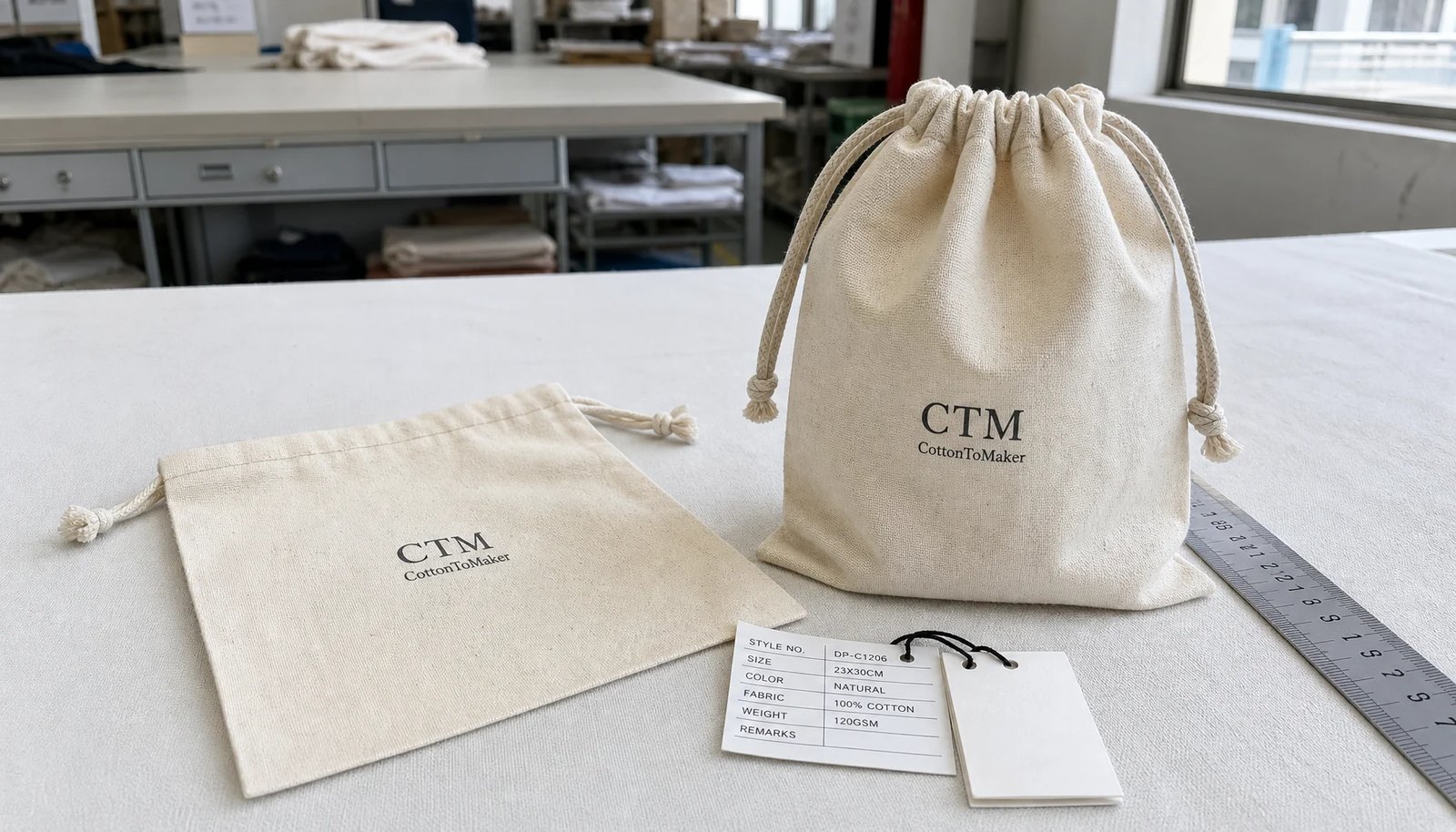
Start with the pouch job, not the artwork
A cotton drawstring pouch for a subscription box is packaging with a specific job. It may protect a product, stage a sample set, make the unboxing feel deliberate, or become a reusable keep item after the box is opened. Those jobs are different enough that they change the fabric target, decoration method, packing rule, and approval criteria. If the brief starts with the logo file, the supplier will fill in the blanks for you, and those assumptions often become the first production dispute.
Write the pouch brief around use, not aesthetics. State what will be inside it, how the pouch will be handled, whether it needs to sit flat in the box, and whether the end customer will keep or discard it. A low-cost insert pouch can tolerate lighter cloth and simpler finishing. A pouch that becomes part of the brand experience needs more structure, cleaner seams, and a print method that still looks good after handling.
Also define what the pouch must not do. If it sits next to cosmetics, note that it cannot shed lint. If it carries a hard object, say that it cannot snag or collapse in transit. If the co-packer needs the logo facing a certain direction, specify the orientation. The more operational detail you add here, the less time you spend correcting a sample that looked fine in a photo but failed in real use.
- State the role in one line: insert, protector, keepsake, or retail accessory.
- List the intended contents and how much they compress the pouch.
- Define whether the pouch must lie flat, stand upright, or fold a specific way.
- Add any must-not-fail condition such as no lint transfer, no odor, or no exposed metal parts.
- Tell the supplier whether the pouch will be hand-packed, machine-inserted, or staged for a co-packer.
Specify fabric and construction with enough precision to prevent drift
GSM is useful, but it is not enough on its own. For most subscription-box programs, a middle-weight cotton is the practical baseline because it balances cost, print hold, and perceived quality. Lighter cloth can be acceptable for short-life inserts, but it usually needs a tighter acceptance check for transparency and seam pull. Heavier cloth makes sense when the pouch is reusable or part of a premium retail presentation, but it raises cost and can change fold behavior inside the box.
The weave and finish matter as much as the weight. A loose weave can look soft and natural while still showing contents, softening print edges, or creating more seam distortion than the spec suggests. Pre-shrunk, washed, and bleached options also change the final result. If the pouch must stay dimensionally stable across replenishment runs, ask the factory how the fabric is finished and what shrinkage or skew they expect after sewing and curing.
Natural cotton is attractive because it is easy to source and usually cost-effective, but it is not perfectly uniform. Shade can move from roll to roll and lot to lot. That is acceptable only if the file includes a real lot reference. A fabric description that stops at natural cotton leaves too much room for variation; a fabric description that includes GSM, weave, finish, and allowable shade band gives the supplier something production can actually execute against.
- Use under 100 gsm only when the pouch is low-fill and opacity is not a priority.
- Use roughly 120-140 gsm as a practical baseline for many subscription-box pouches.
- Use roughly 150-180 gsm when the pouch must feel substantial or reusable.
- Ask for the fabric finish: natural, bleached, washed, pre-shrunk, or dyed.
- Request the supplier’s GSM tolerance and lot consistency plan, not just the target number.
Match the print method to the artwork and the approval burden
Screen print is usually the most controllable choice when the artwork is simple and the order will repeat. It handles one- or two-color logos well, is easier to compare against an approved sample, and tends to be straightforward for factory QC. Digital or transfer printing can be the better fit when the artwork is complex, the run is small, or the buyer wants to avoid screen setup. Embroidery can add a premium feel, but it changes the cost structure and can be a poor fit for fine text or dense graphics.
The method choice should be driven by artwork tolerance, not by what the sales team prefers to sell. If the logo has thin strokes, tiny legal text, or a QR code, set an acceptance rule before the sample is made. As a practical buying rule, anything below about 0.5 mm stroke width or very small type should be proofed on the actual cloth before bulk approval. Cotton texture, ink spread, and curing can soften those details more than a vector file suggests.
Placement matters as much as print quality. If the artwork sits too close to the seam or drawstring tunnel, the pouch can pass a paper proof and still fail in production. Ask the supplier how far the print can stay away from the top channel, and require a physical strike-off when the design depends on exact alignment. A good print proof is not just visually correct. It is manufacturable on the same fabric, with the same process, within the same tolerances you can accept in bulk.
- Use screen print for simple logos, stable repeat runs, and solid fill areas.
- Use digital or transfer only when complexity or short-run economics justify it.
- Require a physical proof if the design uses small text, QR codes, or narrow strokes.
- Keep artwork clear of the seam and drawstring channel unless the factory has proven that placement already.
- Ask the supplier to state the smallest line width and smallest text size they will run on that fabric.
Write the RFQ so the real cost drivers are visible
A useful quote separates the pouch body from the branding and packing steps. If the supplier gives only one all-in number, you cannot tell whether the difference sits in fabric, labor, setup, packing, or freight assumptions. For cotton drawstring pouches, the main price drivers are finished size, GSM, weave and finish, drawstring type, print color count, print position, label attachment, individual packing, and carton spec. Put those items on the page so the supplier cannot quietly normalize them in a way that makes the bid look better than it is.
MOQ should be tied to setup burden, not treated as a random number. Stock cotton with a one-color print will usually have more flexible minimums than custom-dyed cloth, embroidery, woven labels, or special bundle packing. A low MOQ can still be expensive if the factory simplified the job in ways you would not approve for production. Ask what makes the minimum move: fabric source, print setup, decoration method, packing pattern, or inspection complexity.
Sample fees need the same treatment. Ask whether artwork setup, strike-off, pre-production sample, and pack mock-up are charged separately or included in unit pricing. If multiple proof rounds are expected, that should be visible before the PO is issued. Trade term matters too. EXW, FOB, and delivered pricing do not mean the same thing. Normalize the quote to the same point in the supply chain, including inland freight, export handling, and repacking if that is where the real cost lives.
- Ask for separate line items for blank pouch, setup, label, packing, and carton work.
- Compare quotes only after the same fabric, same print method, and same pack count are in scope.
- Write the trade term on every quote so EXW, FOB, and delivered pricing are not mixed together.
- Request pricing at multiple quantities so setup cost and unit cost are both visible.
- If a quote looks unusually low, check what was removed from scope before you treat it as a better price.
Select the supplier model that actually fits the program
Direct factory is not automatically the best answer, and a local decorator is not automatically a compromise. What matters is who owns each step and how much variance your team can tolerate. An integrated factory that sews, prints, and packs in one facility is usually the cleanest route for repeat programs because one site owns the sample, the bulk run, and the final carton. That reduces the number of handoffs and makes accountability easier if the pouch misses spec.
A local decorator or regional pack-out partner can be the better fit when the launch is late, the replenishment is urgent, or the subscription box is fulfilled domestically and repacking time matters more than factory-scale unit cost. This model only works if the decorator can name the blank pouch source, the print process, the quality check, and the repack method. If they are only acting as a pass-through, the extra handoff can create new failure points without adding control.
Brokers and trading companies are only worth using when they solve an actual problem, such as language, consolidation, or multi-factory coordination. The risk is not the middleman itself. The risk is hidden ownership. If the sewing factory, print vendor, and packer are different companies, ask for a simple process map with named owners for each step. You do not need marketing language; you need a clear chain of custody from fabric to carton seal.
- Prefer an integrated factory when you need one owner for sewing, print, and pack.
- Use a local decorator when speed, domestic fulfillment, or last-mile flexibility matters more than factory scale.
- Treat brokers as useful only if they add real QC, coordination, or consolidation value.
- Ask who owns blank inventory, print QC, packing, and claims before you award the order.
- Request a process map if more than one company touches the pouch before shipment.
Approve samples in the same order production will follow
A PDF proof only confirms layout on a screen. It does not prove that the logo lands correctly on sewn cotton, that the color behaves after curing, or that the seam does not distort the visible area. For pouch orders, approval should move in the same sequence as production: artwork proof, strike-off or first sample, pre-production sample, and then one sealed golden sample that becomes the reference for bulk. If the supplier wants to skip directly to bulk after a PDF approval, that is a process shortcut, not an approval process.
Inspect the sample the way the warehouse will handle it. Measure the finished dimensions after turning. Check the print with the pouch empty and again with the intended insert inside. Confirm how the logo sits when the pouch hangs naturally, not only when it lies flat on a table. If the pouch is intended to be reused, add a simple rub check on the print. If the pouch is meant to sit front-facing in the box, confirm that orientation before approval, not after the first shipment lands.
The approval record should be useful to a future receiver who was not in the sample review. Note the approved sample version, the acceptable shade range, the accepted print position, and any variance the supplier may have. Keep one sealed golden sample with the PO file. If the next run shifts, that sample is what both sides will use to decide whether the difference is normal lot variation or a real nonconformance.
- Do not approve a pouch from a PDF alone.
- Use a physical strike-off or sewn sample before bulk production.
- Check the logo both empty and filled with the intended insert.
- Record the approved fabric appearance, print position, and sample version in the file.
- Keep one sealed golden sample as the production reference.
Set packing rules for subscription-box fulfillment before the quote is accepted
Packing is where a good pouch becomes a warehouse problem. Decide early whether the pouches should be folded, nested, banded, loose-packed, or boxed in a specific bundle count. If the logo must face a certain direction when the box is opened, say so. If the co-packer wants a bundle count that matches line staging, match it at the factory instead of forcing the warehouse to repack later. That saves labor and removes one more place where counts can drift.
Cotton pouches also need a protection decision. Polybags can protect the cloth during transit, but they slow unpacking and add waste. Loose packing is faster, but only if the carton discipline is tight and the receiving team can handle it. There is no universal answer. The right call depends on shipping lane, dwell time, humidity risk, and how visible the pouch is in the final unboxing. If the pouch can pick up dust or smell easily, spell out the protection method before price is fixed.
Carton markings deserve the same attention as the pouch itself. State the inner bundle count, master carton count, carton dimensions, lot label format, and any barcode or SKU requirement. If the supplier ships in a bundle count your co-packer cannot use, the savings from a lower unit price may disappear at receiving. Matching the pack pattern to the actual workflow is usually more valuable than shaving a few cents off the factory line item.
- State whether the pouch must face a specific direction in the box or carton.
- Lock the bundle count to the receiving process whenever possible.
- Confirm whether polybags are required, optional, or not allowed.
- Write carton dimensions, lot labels, and barcode rules into the RFQ.
- If the pouch is sensitive to dust or humidity, specify the protection method before bulk pricing starts.
Set acceptance criteria before the first carton ships
Most pouch complaints start with one of three failures: the artwork was not matched to the sewing geometry, the sample was approved without enough physical checking, or the packing spec was too vague for the warehouse to follow. The inspection plan should target all three. Measure finished dimensions on the sewn pouch, check print placement against the seam and drawstring channel, and compare the print to the approved reference under daylight-style light. If you use AQL, define the defect classes before the inspection starts so the inspector is not improvising.
Then test the pouch the way it will be used. Put the intended insert inside and see whether the logo still reads cleanly. Pull the drawstring several times to make sure it moves smoothly and does not catch or collapse the channel. If the pouch will be reused, run a dry-rub check on the printed area. These checks are simple, but they catch the problems that cost time after cartons are sealed.
The acceptance criteria should also cover the small failures that add up. Decide how many loose threads are acceptable, what level of seam puckering is still usable, whether shade variation across the run is within tolerance, and how much print misregistration is too much. If these limits are not in the file, the team will default to opinion at the worst possible time. Production approval should rest on measurable limits, not on memory or visual disagreement.
- Measure the finished pouch after sewing and turning, not the raw cut piece.
- Inspect placement relative to the seam and drawstring channel.
- Check the print with the intended insert inside the pouch, not only when empty.
- Run a dry-rub check if the pouch will be reused or handled often.
- Verify carton count, bundle count, and lot labels against the packing instruction.
- Open cartons from different pallet positions to catch mixed lots, moisture, or compression damage.
- Set critical, major, and minor defect categories before inspection starts.
- Keep the approved golden sample with the purchase file and inspection report.
Compare suppliers on landed cost and failure risk, not unit price alone
A lower factory price is not a better buy if it creates more handling, more exceptions, or a higher chance of rework. Compare landed cost using the same scope on every quote: blank pouch, decoration, packing, carton spec, trade term, inland freight, export handling, and any repacking that the receiving team would otherwise absorb. If one supplier is quoting EXW and another is quoting FOB or delivered pricing, normalize those numbers before anyone debates which bid is cheaper.
For subscription-box programs, the hidden cost is usually labor. A pouch that arrives with the wrong bundle count, mixed lot labels, or a pack format the co-packer cannot receive cleanly can cost more than the savings from the cheapest quote. The same is true of a print that is technically close but not consistent enough to avoid sorting questions. Those problems may never show up as a formal factory claim, but they show up quickly in receiving time and exception handling.
The better supplier is usually the one that reduces friction across the whole program. Stable color, readable carton labels, clean sample control, and packing that matches the receiving process are worth money because they lower the chance of late-stage fixes. If two quotes are close, prefer the vendor that makes reorder execution easier. That matters more than a one-time price edge that disappears in freight, repacking, or dispute resolution.
- Normalize all quotes to the same trade term before comparing price.
- Include inspection, repacking, and handling risk in the landed-cost view.
- Do not award on price alone if the supplier cannot prove stable print and packing control.
- Keep change requests separate from the base quote so the core price remains comparable.
- Choose the supplier that makes repeat orders easier, not the one that only looks cheapest on paper.
Lock reorder and change control before the program scales
The first bulk order is only half the procurement job. Subscription-box programs tend to reorder, sometimes under pressure and sometimes with small artwork edits that look harmless until they hit production. Build a file that makes repeat buying possible without re-litigating every decision. That file should include the approved artwork version, the fabric reference, the print method, the packing spec, the accepted defect limits, and the sealed golden sample. If any of those pieces are missing, the next order becomes a fresh sourcing exercise instead of a controlled repeat.
Change control matters because small edits can force big operational changes. Moving the logo a few millimeters can require a new screen or a new sample. Adding a woven label can change MOQ and pack time. Switching from loose pack to polybagged pack can alter carton count and warehouse labor. Treat those changes as production changes, not as casual revisions. A buyer who freezes the spec before the factory starts setup will usually get a faster approval and fewer surprises at the next run.
For recurring programs, ask the supplier what they archive and how they identify the exact repeat spec. If they can only describe the order in generic terms, there is a good chance the reorder will drift. Good suppliers can point to the same fabric source, the same print setup, and the same packing logic. That is the difference between a repeat order and a new sample cycle.
- Keep the approved artwork version and sample reference in one reorder file.
- Treat logo moves, label additions, and pack changes as formal production changes.
- Freeze the spec before setup if you want the next run to match the first one.
- Ask the supplier how they identify the exact repeat spec in their system.
- Do not rely on memory when the program will reorder under deadline pressure.
Specification comparison for buyers
| Spec decision | Recommended option | When it fits | Buyer risk to check |
|---|---|---|---|
| Fabric baseline | Stock natural cotton in a middle-weight weave | Most subscription-box inserts, repeat orders, and pouches that need a simple premium look without custom dye | Confirm the exact stock shade, weave count, and lot consistency; natural cotton can vary more than expected |
| Light fabric | Lighter cotton under 100 gsm | Very low-fill inserts, temporary packaging, or programs where structure is not important | Check transparency, seam pull, and whether the print looks washed out on a looser weave |
| Heavier fabric | Tighter-weave cotton around 150-180 gsm | Reusable keepsake pouches, retail-facing accessories, or premium box programs | Heavier cloth can improve hand feel but may change print behavior, fold quality, and unit price |
| Finish choice | Pre-shrunk or washed cotton when reorders must stay stable | Programs with repeat replenishment or strict dimensional fit | Ask whether shrinkage, skew, or softening changes the finished size after the first wash cycle |
| Print method | Screen print for simple one- or two-color logos | Stable repeat runs, solid fills, and artwork with limited detail | Check minimum line width, opacity on natural cotton, and placement tolerance near seams |
| Print method | Digital or transfer print for detailed art or short runs | Lower-volume launches, multicolor graphics, or small-batch tests | Watch for hand feel, edge sharpness, and durability after curing or heat transfer |
| Branding add-on | Woven side label or printed care label | Pouches that are kept, reused, or displayed after the box is opened | Verify label width, fold direction, and whether the label crowds the seam or logo |
| Supplier model | Integrated factory that controls sewing, print, and packing | Repeat programs that need one owner for sample approval and bulk consistency | Confirm the factory truly controls all steps and is not routing print or packing elsewhere without disclosure |
| Supplier model | Local decorator or regional pack-out partner | Urgent replenishment, domestic fulfillment, or late-stage branding changes | Check who owns blank inventory, print QC, repacking, and claims if the final output misses spec |
Buyer checklist before sampling
- Define the pouch role before asking for price: insert, reusable keepsake, protective sleeve, or retail accessory.
- Lock finished size, seam allowance, drawstring type, and print-safe zone on the first RFQ.
- State the fabric baseline in measurable terms: GSM target, weave type, finish, and acceptable lot variation.
- Send vector artwork plus a Pantone target or visual reference, and specify minimum text size and minimum line width.
- Define the placement tolerance for the logo, the top seam, and the drawstring channel before proofing starts.
- Request a physical strike-off or sewn pre-production sample, not only a PDF proof.
- Approve the sample with the intended insert inside the pouch, not only empty on a flat table.
- Write the packing rule in the RFQ: folded or loose, bundle count, carton count, and whether polybags are required.
- Ask for separate pricing for blank pouch, decoration setup, label, individual packing, and outer carton packing.
- Ask for the trade term on every quote so EXW, FOB, and delivered pricing are not mixed together.
Factory quote questions to send
- Which exact cotton are you quoting: stock natural, bleached, washed, pre-shrunk, or custom dyed, and what GSM and weave count are you using?
- What is your finished size tolerance, and how do you measure it after sewing and turning?
- Is sewing, print, label attachment, and final packing done in-house? If not, who owns final quality signoff?
- What print process are you using, what ink or transfer system is involved, and what is the minimum line width you will accept on this fabric?
- Can you provide a sample made from the same or equivalent fabric lot planned for bulk, and what changed if it is only equivalent?
- What is included in the unit price: blank pouch, setup, extra color, woven label, individual packing, carton work, and inspection?
- What MOQ changes if I add a second print position, a woven label, a custom dye, or special carton packing?
- What are your measured tolerances for print placement, shade variation, and seam distortion?
- What bundle count and carton count do you recommend for subscription-box receiving and co-packer handling?
- What is the sample path from artwork proof to strike-off to pre-production sample to sealed golden sample, and how many revisions are included?
Quality-control points to confirm
- Measure the finished pouch after sewing and turning, not from the raw cut fabric.
- Inspect the pouch under daylight-style light so the logo color is judged against the approved reference, not warehouse lighting alone.
- Check that the artwork sits clear of the side seam, top fold, and drawstring channel, with a written placement tolerance.
- Compare the print on an empty pouch and again with the intended insert inside, because filling changes the visual center.
- Use a simple dry-rub test if the pouch will be reused or handled often: 10 firm strokes with a white cloth on the print area.
- Pull the drawstring several times to confirm smooth movement, no snagging, and no channel collapse.
- Inspect the corner seams, top channel seam, and thread trimming for skipped stitches, puckering, or loose ends longer than your cut-off.
- Verify the pouch opens and closes cleanly without twisting, bunching, or catching at the mouth.
- Check that the pouch lies flat or stands up as intended when packed with the actual insert.
- Confirm carton count, bundle count, lot label, barcode or SKU marks, and any carton orientation marks against the packing instruction.