Start With the Event Risk
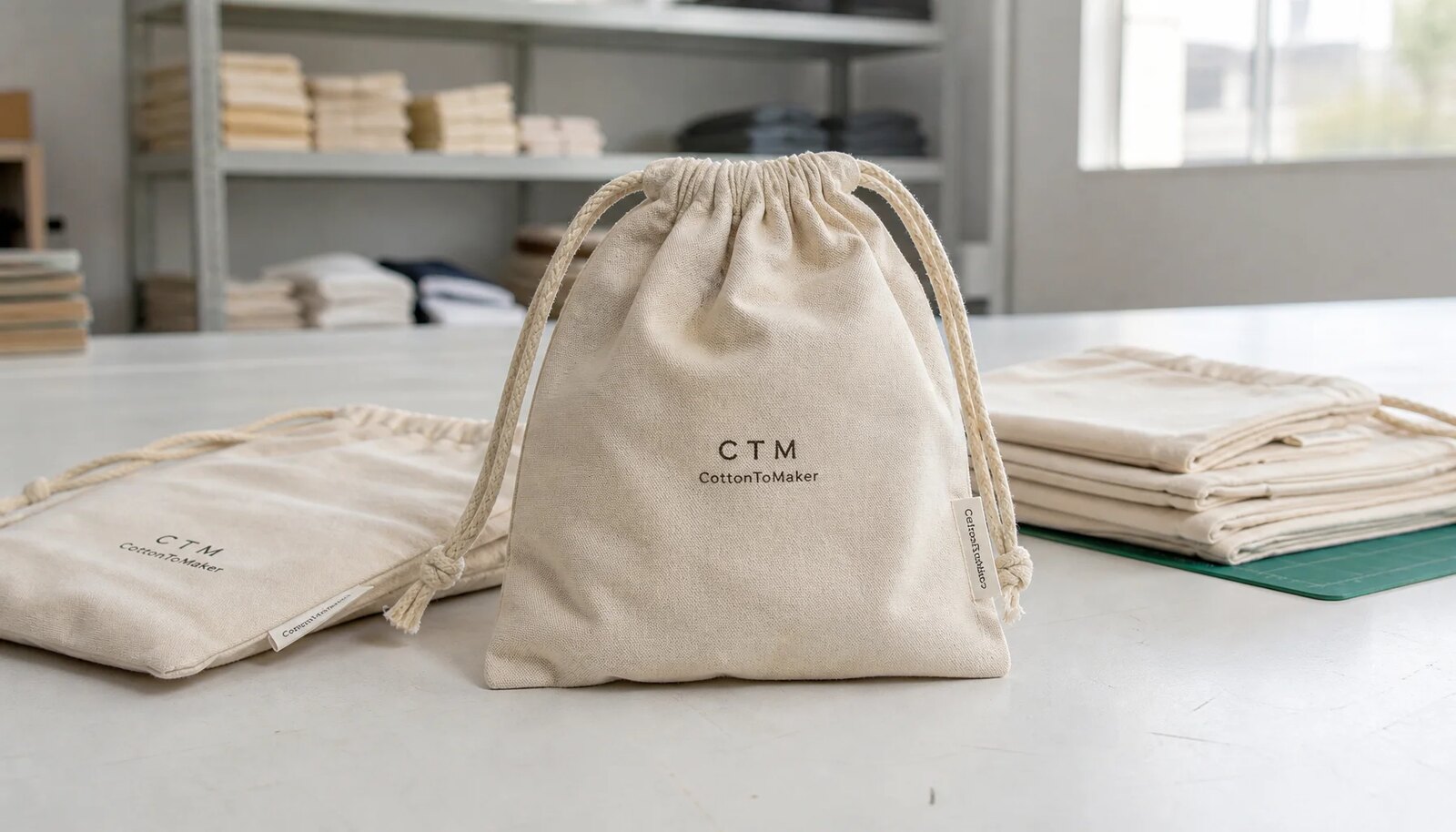
Cotton drawstring pouches look simple, which is why proofing mistakes often appear late. A clean digital logo can print softer on woven cotton, shift after sewing, sit too close to the drawstring tunnel, or lose small sponsor text once the pouch is filled. For event planners, the risk is operational as well as visual. A wrong version, weak ink, mixed carton, or late approval can affect registration kits, VIP gifting, press packs, merchandise tables, and multi-city deliveries.
A useful cotton drawstring pouches print proofing checklist for event planners connects creative approval with production control. The pouch specification, proof, sample, quote, packing plan, lead time, and inspection standard should all describe the same item. If the quote says natural cotton, the proof shows bleached cotton, and the sample is printed on a stock pouch of unknown weight, the order is not ready for bulk production.
Start by ranking consequence. A low-cost internal giveaway may tolerate more fabric shade variation than a sponsor-funded VIP kit. A retail merchandise pouch needs stronger construction and cleaner presentation than a one-day badge pouch. This risk level determines whether a PDF proof is enough or whether the order needs a physical strike-off, sample courier, and final inspection before shipment.
- Define the event use before discussing price: giveaway, VIP gift, sponsor pack, merchandise pouch, or kit component.
- Name the people who can approve brand color, pouch construction, commercial terms, and delivery schedule.
- Tie each approval to a PO number, artwork file name, revision number, sample date, and version name.
- Do not release bulk production until the spec, proof, packing instruction, and lead time match.
Specify the Pouch Before the Logo
The pouch body should be specified before the artwork is judged. Finished size matters more than a general description such as small cotton bag. A 15 x 20 cm flat pouch behaves differently from a 15 x 20 cm pouch with a gusset once it is filled. The RFQ should state finished width, finished height, gusset depth if any, seam allowance, tunnel depth, drawcord material, cord diameter, cord length, and whether the closure uses one cord or a double pull.
Fabric weight needs careful wording because suppliers may quote cotton pouches by GSM, ounces, weave, finish, stocked fabric reference, or local mill standard. Light event giveaways often sit around 100 to 120 GSM cotton, while heavier kits or premium presentation may require heavier cotton, canvas, or an ounce-based fabric specification. Those ranges are not universal, and they do not cover every canvas event pouch. Ask for the quoted weight range, actual fabric reference, and whether shrinkage, washing, dyeing, or finishing changes the finished feel.
Fabric finish affects print proofing. Natural cotton has a warm base shade and visible fiber variation, so pale colors and fine tonal differences may shift. Bleached cotton gives a cleaner base for bright artwork. Dyed cotton adds a colorfastness and shade-control question. A good quote should make these details inspectable, not hide them behind broad words like eco, premium, or standard.
- Specify finished dimensions and allowed tolerance, not only approximate size.
- State fabric weight, weave, color, finish, and whether natural slubs are acceptable.
- Confirm top hem and tunnel construction because they limit the safe print area.
- Ask for reinforcement when pouches carry bottles, candles, dense samples, hardware, or retail goods.
- Request a blank pouch sample when the contents are heavy or the presentation standard is high.
Match Print Method to Artwork
Print method should follow the artwork, order quantity per version, fabric, and deadline. Screen printing is often efficient for one-color or two-color logos at practical volume. It can give strong coverage and repeatable results, but tiny reverse text, thin lines, gradients, and photographic effects may need adjustment. The supplier should flag these issues before screens are made.
Digital direct print and heat transfer can be useful when an order has many versions or complex color. For example, 2,000 total pouches split across eight city names is not the same sourcing problem as one 2,000-piece logo run. Setup charges, proofing time, version control, and carton separation all follow the version count. A method with a higher unit cost may still be cleaner if it reduces setup and sorting risk.
Embroidery, woven labels, and sewn patches suit premium programs where tactile branding is part of the value. They also change the production plan. Embroidery can pucker lighter cotton if stitch density is high. Woven labels and patches may have separate MOQs, artwork lead times, and sewing tolerances. The best method is the one that can be sampled honestly on the final pouch and repeated within the event schedule.
- Use screen printing for simple, solid artwork repeated across enough quantity to absorb setup.
- Use digital print or heat transfer for many colors, gradients, personalization, or low quantities per version.
- Use embroidery, woven labels, or patches when texture and durability matter more than large print coverage.
- Ask how the method affects color, opacity, hand feel, setup cost, version cost, and lead time.
- Require the physical proof to use the actual production method.
Set Proofing Gates by Risk
The right approval path depends on order value, event visibility, supplier history, and time available. For a small internal event using stock pouches and a one-color logo, a measured PDF proof plus supplier production photos may be commercially acceptable if the buyer accepts the risk. For a first-time supplier, sponsor-facing order, custom size, custom fabric, or color-sensitive logo, a physical strike-off or pre-production sample is the safer gate.
Quantity bands can keep decisions practical. Under 500 pieces, setup and sample courier timing may drive the method choice. From 500 to 2,000 pieces, compare total cost by artwork version rather than only unit price. From 2,000 to 10,000 pieces, sample approval, carton separation, and final inspection become more important. Above that, ask how the supplier controls fabric lots, print consistency, overrun, shortage, and inspection sampling.
Avoid repeating approval steps without purpose. Use four clear gates: RFQ spec, measured proof, physical sample when required, and bulk release. Any change after a gate should be logged with cost and schedule impact. That keeps marketing, procurement, sponsors, and operations aligned without reviewing the same issue in five different documents.
- For low-risk small runs, confirm whether PDF proof approval is acceptable.
- For first orders, sponsor logos, custom construction, or tight color targets, require a physical sample.
- For multi-version orders, approve each version quantity separately.
- For larger runs, define inspection method, defect categories, carton sampling, and shipment release evidence.
- Record whether post-approval changes affect setup charges, sample timing, or delivery date.
Make the PDF Proof Measurable
A proof file is not just a mockup. It should be a production control document. It needs to show finished pouch size, front and back orientation, top hem, drawstring tunnel, side seams, centerline, safe zone, logo width, logo height, distance from top edge, distance from side seam or centerline, print method, print color reference, artwork file name, revision date, and version name.
Placement should be measured against construction. A logo centered on the flat body may look too high when the pouch is cinched. A sponsor mark near the bottom may fold into the base during packing. If printing happens before sewing, the factory needs alignment controls so the logo lands correctly after stitching. If printing happens after sewing, the supplier needs to confirm how the pouch is held flat and whether seams or cords interfere with the print area.
Approval authority should be clear. Event teams often have marketing, procurement, sponsors, and operations commenting at the same time. That is useful during review, but only named approvers should release artwork and production. The proof should move forward because the responsible person approved a dated version, not because several people said it looked fine in a message thread.
- Show top hem, tunnel, seams, centerline, safe zone, and final pouch dimensions.
- Include logo size, placement measurements, color references, artwork name, version name, and revision date.
- Confirm whether printing happens before or after sewing and how placement will be controlled.
- Name the brand approver, procurement approver, and production release contact.
- Treat logo, fabric, size, method, quantity, and packing changes as formal revisions after proof approval.
Inspect the Physical Sample
A physical strike-off bridges artwork and production. For first orders, high-visibility events, Pantone-sensitive logos, custom fabric, or custom construction, the sample should use the same cotton, weight range, finish, and decoration method planned for bulk. A screen print on paper, a digital rendering, or a sample printed on a different fabric cannot show how ink behaves on the chosen pouch.
Review the sample as it will be used. Check it in daylight and indoor lighting. Put the intended contents inside if the pouch will be filled before distribution. Cinch and uncinch the cord several times. Fold the pouch as it will be packed. Look for print cracking, transfer edge visibility, ink bleeding, puckering, poor opacity, thread distortion, and small details that disappear into fabric texture.
Approval should be specific. Instead of writing only approved, state what is approved: fabric, finished size, logo size, print color, print placement, drawcord, construction, and any packing direction that affects presentation. Keep photos with a ruler and retain the physical sample as the master reference for production and inspection.
- Confirm the sample uses the same fabric, weight, finish, method, and construction as bulk production.
- Measure pouch width, pouch height, logo width, logo height, and logo distance from top and side references.
- Check coverage, edge sharpness, small text, color shift, pinholes, hand feel, and decoration durability.
- Fill, fold, cinch, and handle the pouch before judging final presentation.
- File sample photos, measurements, approval date, approver name, and approved exceptions.
Compare Quotes Cleanly
A cotton drawstring pouch quote should separate the cost drivers. Ask for pouch cost, print setup, artwork or screen charge, sample charge, packing charge, carton cost, inspection cost if any, inland freight, export freight, and courier cost for samples. A supplier who omits setup may look cheaper than one who quotes the full path. Line-item quotes make differences visible.
MOQ must be checked by version, not only by total order size. A 3,000-piece order split across six sponsor logos creates six production and packing flows of 500 pieces. Screen charges, changeover time, proofing, labels, carton marks, and inspection effort follow the version count. Ask suppliers to price by artwork version, pouch color, and packing format.
Use decision thresholds. If each version quantity is low, compare screen printing against digital print or transfer on total landed cost. If the event is close, prioritize stock fabric, standard size, one print location, and a proven method. If the pouch is part of a premium kit, do not choose the lowest fabric weight without testing filled presentation. The strongest quote is the one that shows cost, calendar, and controllable risk clearly.
- Request price breaks at realistic quantities such as 500, 1,000, 3,000, 5,000, and 10,000 pieces.
- Quote by artwork version, pouch color, destination, and packing method.
- Compare EXW, FOB, and delivered options only after carton size and weight are estimated.
- Confirm payment terms, sample cost credit, overrun billing, shortage handling, and cancellation rules.
- Ask what specification or artwork change would require a revised quote.
Control Packing and Cartons
Packing is part of the product for event orders. A well-printed pouch can still fail operationally if cartons arrive with mixed versions, unclear labels, or counts that do not match the packing list. Before bulk production, define whether pouches are bulk packed, bundled in inner packs, individually bagged, paired with inserts, packed by kit, or separated by destination.
Carton labels should be written for the people receiving the goods. At minimum, outer marks should include PO number, SKU or style, pouch color, artwork version, quantity per carton, carton number, gross weight, net weight, and destination when there are multiple sites. For sponsor-heavy events, version names should match the order sheet exactly. Warehouse teams should not need to interpret internal nicknames.
Separate versions unless mixed cartons are deliberately approved. If New York, Chicago, and Dallas versions are printed on the same natural pouch, combining partial cartons may save space but create sorting work at the event warehouse. When mixed cartons are allowed, the packing list must identify the exact contents. When they are not allowed, the PO should say separate cartons only.
- Define bulk pack, inner pack, individual bag, insert pairing, or kit packing before quote approval.
- Set carton quantity to support counting, manual handling, and destination sorting.
- Require separate cartons for each artwork version unless mixed cartons are approved in writing.
- Use carton labels that match PO language, SKU codes, version names, and destination names.
- Ask for carton photos and a packing list before shipment release when timing allows.
Plan Time Backward
The sourcing calendar should start with the date goods must be usable at the event site, not the supplier's best-case production days. Work backward through receiving count, inland delivery, customs if applicable, freight, export handover, final QC, packing, bulk production, sample approval, sample courier, physical sample production, PDF proof, supplier questions, and artwork finalization.
A supplier lead time that says 20 days after approval excludes the buyer's review time, sponsor revisions, sample transit, and warehouse receiving. If the event date cannot move, simplify the order before trying to compress production. Fewer artwork versions, a standard pouch size, stock fabric, one print location, and familiar packing can remove days of uncertainty.
Revisions are usually the calendar threat. Changing logo size after screens are made, adding a sponsor version after carton labels are prepared, or switching from natural to dyed cotton after sampling can reset part of the process. The production calendar should state artwork freeze date, sample approval deadline, bulk start date, inspection date, ship date, and required delivery date.
- Separate artwork time, sample time, approval time, bulk production, freight, customs, and receiving count.
- Ask which step is on the critical path and which changes add days.
- For rush orders, reduce versions and use standard materials before compressing production time.
- Confirm whether quoted lead time starts after deposit, artwork approval, sample approval, or PO release.
- Build a receiving buffer for count checks, sorting, kit assembly, and event-site transfer.
Write QC Into the PO
Quality control works best when the PO tells inspectors what to check. A PO that says cotton pouch with logo leaves too much judgment to the factory. A stronger PO lists finished size tolerance, fabric weight range or reference, fabric finish, logo placement tolerance, print color standard, print defect limits, stitch expectations, drawcord function, packing method, carton labeling, version separation, and overrun or shortage rules.
Final inspection should pull random pieces from different cartons and different artwork versions, not only factory table samples. For larger or higher-risk orders, reference an agreed sampling approach such as ANSI/ASQ Z1.4 or the supplier's documented inspection plan, and define critical, major, and minor defects in plain language. Wrong artwork, mixed versions, unreadable sponsor names, open seams, and severely misplaced logos should not be treated like small cosmetic variation.
After the event, archive the approved sample, final invoice, packing list, inspection photos, proof file, quote, and notes about what worked. Repeat sourcing becomes easier when the next RFQ can reference a real standard: same fabric reference, same finished size, same print method, same carton quantity, same label format. Good records reduce proofing time and make future quotes more comparable.
- Attach the approved spec sheet, proof, sample photos, packing instruction, and carton mark to the PO.
- Set measurable tolerances for size, placement, fabric weight, color, quantity, overrun, shortage, and carton count.
- Inspect across all artwork versions, pouch colors, and destinations included in the order.
- Check print quality after folding, filling, cinching, and handling, not only while the pouch lies flat.
- Archive the approved sample and production documents for repeat orders and future quote comparison.
Specification comparison for buyers
| Print method | Best fit for event pouches | Proofing requirement | Procurement watchout |
|---|---|---|---|
| Screen printing | One-color or two-color logos, sponsor marks, simple icons, and medium to high volume orders with stable artwork | Measured PDF proof plus a physical strike-off on the same cotton fabric, confirming logo size, placement, ink color, opacity, and edge quality | Setup is usually charged by screen or color. Very small type, gradients, fine reverse areas, and tight registration may need artwork adjustment. |
| Digital direct print | Short runs, multi-color artwork, city-specific versions, variable sponsor names, or designs with gradients | Printed sample on the actual pouch or production fabric, checked for color shift, sharpness, fabric show-through, and wash or rub sensitivity if relevant | Color may appear softer on natural cotton. Ask whether white ink underbase is available, useful, or likely to change hand feel. |
| Heat transfer | Complex artwork, small batches, versioned orders, and designs that are difficult to print directly on textured cotton | Finished pouch sample folded, rubbed, filled, cinched, and checked at the transfer edge as well as across the printed area | Transfer film can create a different hand feel, visible edge, or cracking risk if the pouch is folded tightly or handled heavily. |
| Embroidery | Premium gift pouches, simple marks, initials, badges, and retail-style presentation where texture matters | Stitch-out on the same cotton weight and construction, with thread color checked under daylight and indoor light | High stitch density can pucker lighter cotton. Tiny lettering and detailed sponsor marks often lose clarity. |
| Woven label or sewn patch | Subtle branding, repeat programs, durable identification, and pouches where large print coverage is not needed | Sewn sample showing label size, position, stitch line, edge finish, and how the label balances with pouch size | Labels and patches can have separate MOQs, extra sewing time, and placement tolerances that affect both cost and schedule. |
| Material | 6-10 oz cotton canvas, 210D polyester, rPET, or blended cotton with shrinkage and colorfastness expectations set before sampling | Before price comparison | Different cloth weights, backing, or certification claims make quotes hard to compare |
| Construction | cord diameter, eyelet or reinforced channel, bottom corner reinforcement, seam allowance, bar-tack position, and load target | Before sampling | Weak stress points create returns and failed inspections |
| Decoration | screen print, transfer, embroidery, woven label, or drawstring tag tested against folding and abrasion | Before artwork approval | The wrong method can crack, bleed, pucker, or fail on the chosen fabric |
Buyer checklist before sampling
- Define the event use: giveaway, registration kit, sponsor pack, VIP gift, merchandise pouch, or retail-style insert.
- Lock finished pouch size, gusset depth, cotton weight or range, weave, finish, drawcord type, cord length, seam construction, and usable print area in the RFQ.
- Frame cotton weight carefully: ask whether the supplier quotes by GSM, ounces, fabric width, weave, finish, or a stocked material reference.
- Choose the print method based on artwork complexity, order quantity per version, color sensitivity, desired hand feel, packing method, and deadline.
- Send vector artwork with Pantone or brand color references, logo dimensions, minimum text size, clear space rules, and final file name.
- Request a measured PDF proof showing top hem, tunnel, seams, centerline, safe zone, logo size, logo placement, print method, color reference, version name, and revision date.
- Require a physical strike-off or pre-production sample for first orders, sponsor-facing programs, custom fabric, custom size, heavy contents, or color-sensitive branding.
- Approve placement by measurement, including distance from top edge, tunnel, side seam, and centerline, instead of relying on visual centering.
- Quote quantities by artwork version, pouch color, destination, and packing format, not only by total event volume.
- Set written tolerances for dimensions, fabric weight, print placement, print color, overrun, shortage, carton count, and SKU separation.
Factory quote questions to send
- What finished pouch dimensions, gusset, seam construction, tunnel width, drawcord material, cord diameter, and cord length are included in this quote?
- What cotton weight, weave, and finish are you quoting, and is the fabric natural, bleached, dyed, washed, pre-shrunk, untreated, or referenced by an existing stock fabric?
- Is the fabric weight stated in GSM, ounces, or another internal mill specification, and what tolerance should we inspect against?
- Which print method do you recommend for this artwork, quantity, fabric, and version count, and what are the setup charges by color, screen, transfer, label, or version?
- Can you provide a measured PDF proof before sampling and a physical strike-off or pre-production sample on the same production fabric before bulk approval?
- What tolerances do you apply for finished size, fabric weight, print placement, print color, drawcord length, overrun, and shortage?
- Will printing happen before or after sewing, and how will you control placement during bulk production?
- What is the MOQ by pouch color, artwork version, print method, and packing format, not only by total order quantity?
- How many pieces will be packed per inner pack and carton, and can each artwork version stay in separate labeled cartons?
- Can carton marks include PO number, SKU, event name, artwork version, quantity, carton number, gross weight, net weight, and destination?
Quality-control points to confirm
- Fabric weight, weave, color, and finish match the approved sample or agreed range, with natural cotton variation judged against a physical reference rather than a screen image.
- Finished pouch width, height, gusset depth, tunnel width, seam allowance, and drawcord length match the signed specification within written tolerance.
- Side seams, bottom seams, top hem, and drawstring tunnel are secure, straight enough for the approved appearance, and free from skipped stitches, open seams, loose threads, and visible repair work.
- Drawcords pull smoothly from both sides, knots or tips are secure, and the tunnel does not tear or bunch during normal opening and closing.
- Logo placement matches the approved measurement from top edge, drawstring tunnel, side seam, and centerline, not merely a visual estimate.
- Print color, opacity, edge sharpness, and coverage match the approved strike-off, with no obvious pinholes, ghosting, smearing, banding, bleed, or clogged detail.
- Small text, QR codes, sponsor names, and reverse areas remain readable after the pouch is sewn, folded, filled, cinched, and handled.
- Embroidery, transfer, label, or patch decoration is secure, positioned correctly, and does not distort the pouch body beyond the approved standard.
- Random pieces from different cartons match the approved sample in hand feel, fabric body, print density, construction, and presentation.
- Artwork versions, pouch colors, destinations, and SKUs are not mixed inside cartons unless the packing instruction explicitly allows mixed sets.