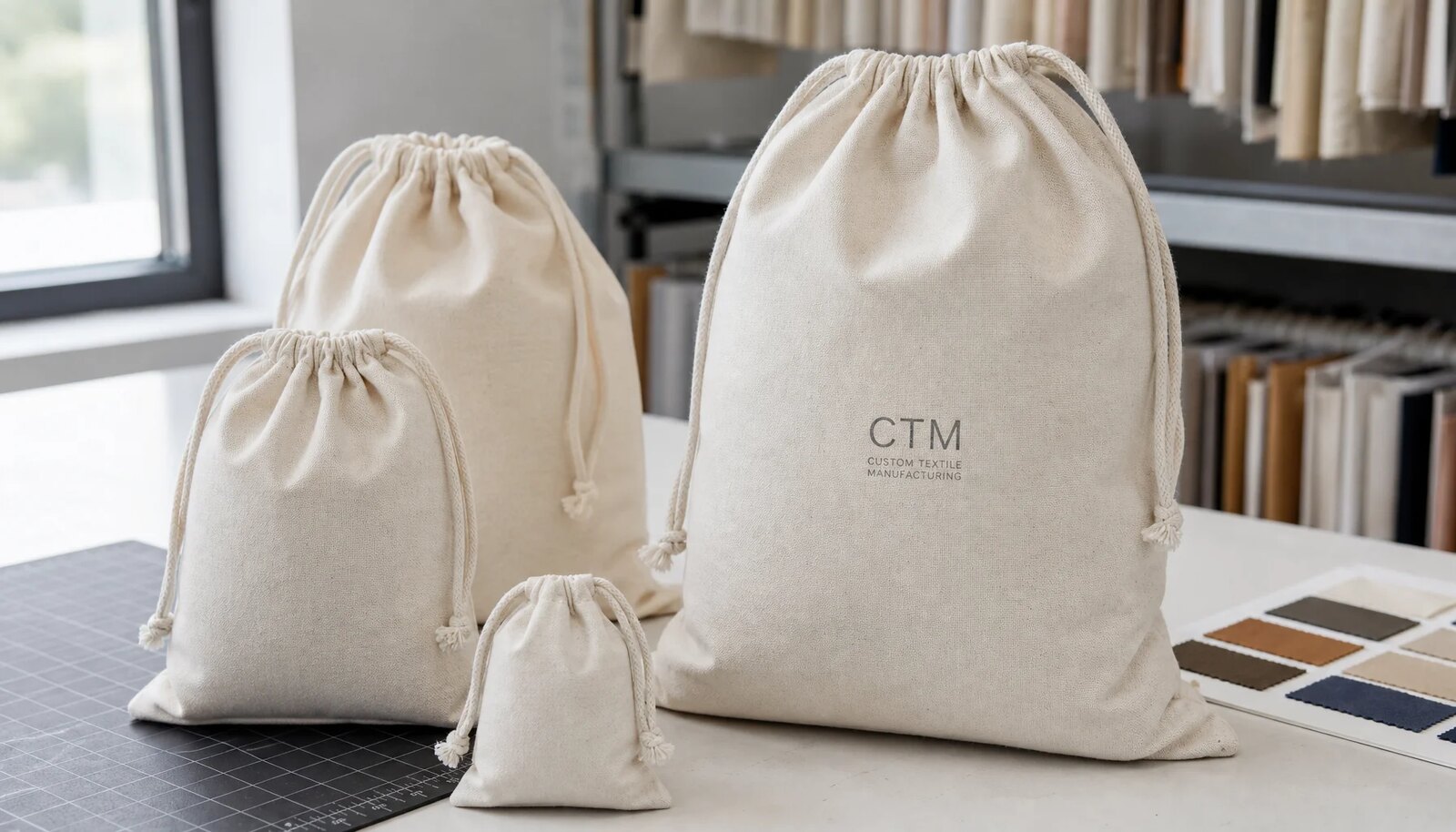
Start With the Gift, Then Place the Logo
A useful cotton drawstring pouches print proofing checklist for corporate gifting begins with the item going inside the bag. The pouch is not only a logo surface. It has to accept the product quickly, close cleanly, travel without looking crushed, and create a tidy first impression when the recipient opens a kit or event bag. That means procurement should define the contents, weight, shape, handoff method, and packing route before approving pouch size or artwork placement.
Flat proofs are helpful, but they can hide practical problems. A mark that looks centered on an empty pouch may sit too close to the drawstring channel when the cords are pulled. A logo can fall into a curved or wrinkled area once a bottle, candle, power bank, charger set, notebook, or sample pack is inside. If the pouch will be folded into a mailer or stacked in a gift box, the printed face may rub or crease unless the fold direction is part of the specification.
The simplest control is a contents test. Measure the product, add clearance for insertion, and confirm that the opening is wide enough for fast assembly. A pouch that fits only when handled carefully may slow a kitting line and create frustration at receiving. For first orders and event-dated programs, ask for a filled sample or test the pre-production sample with the real product before final approval.
- List each gift item, its approximate dimensions, and its loaded weight before selecting the pouch.
- Confirm whether the pouch will be viewed flat, filled, hanging, stacked, mailed, or inserted into another kit.
- Use small sizes such as 100 x 150 mm or 120 x 180 mm only when the contents are narrow and easy to insert.
- Use 150 x 200 mm or 180 x 240 mm as common starting points for small corporate gift bundles, stationery, chargers, or cosmetics.
- Leave clearance around rigid or sharp-cornered items so seams and print are not strained after filling.
Write the Pouch Specification in Buyer Language
Cotton pouch quotes often use broad descriptions: natural cotton bag, eco pouch, reusable drawstring bag. Those phrases are not enough for fair supplier comparison. A B2B specification should state finished size, fabric weight in GSM, finish, color, construction, cord type, seam expectations, usable print area, and acceptable tolerance. If these details are missing, one supplier may quote a light stock blank while another prices a heavier cut-and-sew pouch with controlled sampling.
For many corporate gifting programs, 120 to 140 GSM is a practical middle range. It gives more body than very light cotton while keeping folding, packing, and freight manageable. Lower GSM can work for mass giveaways and light contents. Higher GSM, often 140 to 160 GSM, may be better for reusable packaging or a more premium feel. GSM alone does not decide quality, though. Weave, finish, shade consistency, cord quality, and sewing all affect the final product.
Natural unbleached cotton is popular, but it has personality. Seed flecks, slubs, and small shade shifts may be normal depending on the fabric lot. Buyers should decide in advance whether those marks support the look of the program or count as defects. Bleached cotton can improve contrast for some artwork but may show dirt and handling marks more easily. Dyed cotton can support brand color goals, yet it adds checks for dye shade, colorfastness, MOQ, and print opacity.
- State GSM and the supplier-confirmed tolerance instead of using a vague fabric weight description.
- Identify the fabric as natural, bleached, dyed, washed, organic-certified if applicable, or standard conventional cotton.
- Define whether visible slubs, seed flecks, shade variation, and wrinkles are acceptable for the brand presentation.
- Specify cord material, cord diameter or style, channel depth, seam type, and finished size tolerance.
- Ask for the usable print area in millimeters before the logo is scaled.
Protect the Usable Print Area
The total pouch size is not the same as the safe branding area. A 180 x 240 mm pouch does not give the buyer a clean 180 x 240 mm canvas. The drawstring channel, side seams, bottom seam, folds, and fabric movement all reduce the reliable print zone. If the logo is placed too high, the drawcord can interrupt it. If it is too low, the pouch may bulge through the artwork once filled. If it is too close to the side seam, placement variation becomes obvious.
Ask the supplier to show the pouch outline with channel depth, seam allowance, visible front panel, and proposed print area. For a centered front logo, the proof should define what centered means. It may mean centered to the finished pouch width, centered to the visible front panel, or centered between side seams. Those are not always the same point on a soft sewn item.
The print area should also account for handling. Corporate gifts often pass through several hands before the recipient sees them: supplier packing, freight handling, warehouse receiving, kitting, event staging, and final distribution. If the printed face will be folded, pressed against another pouch, or touched repeatedly, the print method and placement should be tested under those conditions.
- Request a layout showing finished pouch outline, drawstring channel, seams, fold lines, and usable front print area.
- Keep artwork away from side seams, bottom seams, top channel, and cord exit points.
- Confirm whether printing happens on flat fabric panels before sewing or on finished pouches.
- Check logo placement on a filled and closed pouch, not only on a flat empty sample.
- Use a fixed reference point for placement, such as top edge below the channel, side seam, bottom seam, or centerline.
Choose Decoration by Artwork Risk, Not Habit
Screen printing is often the strongest route for cotton drawstring pouches with one- or two-color logos. It suits solid marks, bold typography, simple icons, and spot-color artwork. The buyer should still ask practical production questions: ink type, number of screens, mesh suitability, whether the print is applied before or after sewing, and the minimum line width that can hold on the selected cotton. Woven texture can soften edges, fill small counters, and break thin strokes.
DTF, heat transfer, and digital transfer methods can be better for gradients, full-color graphics, short runs, or many artwork versions. They solve some color-separation problems, but they introduce others. Transfers may have a visible edge, a different hand feel, or a tendency to react differently when folded or rubbed. A digital proof cannot answer those questions. The buyer needs a physical sample on the actual cotton base.
Embroidery and woven labels can add a more retail-like cue, but they are not automatic upgrades. Embroidery can pucker thin cotton. A woven label can add bulk, interfere with folding, or sit crooked after the pouch is filled. These methods should be controlled with placement drawings, stitch or label samples, and the same approval discipline used for direct printing.
- Use screen print for simple spot-color logos, repeat programs, and medium to high quantities.
- Use DTF or digital transfer for full-color designs, gradients, many artwork versions, or smaller runs.
- Avoid very small legal copy, hairline strokes, and dense QR codes unless the supplier proves readability at actual size.
- Ask the supplier to state minimum line width and minimum text height for the exact fabric and method.
- Approve hand feel, edge appearance, opacity, and fold behavior before bulk release.
Build an RFQ That Prices the Same Product
A weak RFQ can make suppliers look cheaper or more expensive for the wrong reasons. One quote may be based on a 100 GSM stock pouch with local decoration. Another may include a 140 GSM custom pouch, export cartons, proofing, and a pre-production sample. Procurement cannot compare those unit prices cleanly until the assumptions are aligned.
The RFQ should include finished size, cotton GSM, fabric finish, color, construction, cord style, print method, logo size, number of colors, print side, packing method, quantity breaks, delivery terms, and proofing requirements. It should also state whether substitutions are allowed. If a supplier plans to change the blank, cord, print process, or carton plan, the buyer needs that information before price approval.
Corporate gifting programs often include operational requirements that affect cost. Different departments may need different logos. Regional events may require split shipments. Fulfillment partners may need fixed carton counts, barcode labels, country-of-origin labels, pallet rules, or no mixed artwork in a carton. Put those details in the RFQ early. Late packing changes often cost more than buyers expect because they touch labor, labels, cartons, inspection, and schedule.
- Quote all suppliers on the same finished size, GSM, fabric finish, print method, logo size, and packing basis.
- Request price breaks at pilot quantity, main order quantity, and expected reorder quantity.
- Ask whether proofing, sample production, sample freight, screen setup, cartons, and carton marks are included.
- State whether fabric, cord, print method, or packing substitutions are allowed.
- Require lead time from written approval or approved sample, not from inquiry date.
Make the Proof a Control Document
The print proof should do more than show a logo on a pouch outline. It should become the production control document. At minimum, it should show finished dimensions, drawstring channel, seam or fold references, usable print area, logo size, print side, print position, artwork version, color reference, revision date, and approval status. If the proof leaves room for interpretation, production will fill in the gaps.
Placement needs numbers. A practical proof might state that the logo is 70 mm wide, printed on the front panel, centered to the visible front, and positioned 45 mm below the top opening with a plus or minus 5 mm tolerance. The exact tolerance should fit the pouch size, construction, and print method. A 5 mm shift may be acceptable on a larger pouch but look careless on a small bag with a narrow centered logo.
Color needs the same discipline. Pantone references help for spot-color screen printing, but cotton changes the appearance of ink. Natural cotton can make bright colors look warmer or less saturated. If the brand requires close color control, ask whether approval will be based on Pantone visual match, a signed physical sample, spectrophotometer reading, or another agreed standard. For full-color transfers, the proof should name the accepted visual standard instead of pretending that a monitor preview is enough.
- Show pouch outline, channel, seams, fold lines, usable print area, and final logo scale.
- Measure logo placement from a fixed edge, seam, channel, bottom edge, or centerline.
- Record Pantone target, ink or transfer method, print side, artwork file name, and proof revision.
- Mark the proof approved only after procurement, brand, and gifting stakeholders have consolidated comments.
- Attach the final proof to the purchase order or production file.
Challenge Fine Detail Before Screens or Transfers
Many corporate logos were built for websites, decks, signage, or paper printing. Cotton is less forgiving. Thin rules, small registered trademark symbols, condensed type, legal lines, and QR codes can lose clarity once they meet a woven surface. The supplier should review the artwork at actual print size and flag details that may not hold before screens, films, or transfers are made.
Procurement teams should be wary of approving screenshots or zoomed-in PDFs. Review the proof at the final physical dimensions. If a legal line is unreadable on a sample, the fix may be to enlarge it, remove it, simplify it, move it to an insert, or change decoration method. If a QR code is required, test the printed sample with common phone cameras under normal lighting. Do not assume a code that scans on a digital proof will scan on cotton.
Multi-color work adds another layer of risk. With screen printing, close registration can be harder on soft finished pouches than on flat paper. With transfers, small negative spaces, film edges, and edge halos deserve attention. These are not glamorous details, but they are the details that separate controlled branded merchandise from a pouch that simply has a logo on it.
- Review artwork at final size, not zoomed in on a PDF.
- Ask for supplier-confirmed minimum line width and minimum text height.
- Test QR codes, small icons, and legal marks on the physical sample if they are required.
- Simplify artwork when cotton texture makes fine detail unreliable.
- Record approved changes in a new proof revision rather than relying on email notes alone.
Approve Samples Like the Bulk Order Depends on Them
A sample is only useful if it represents production. Confirm whether it uses the same cotton fabric, GSM, cord, construction, ink or transfer, print position, and packing method planned for the order. A polished sample made on a different blank or decorated in a different workshop can create false confidence. For first orders, new suppliers, custom-dyed cotton, strict brand programs, and fixed event dates, a strike-off or full pre-production sample is usually worth the time.
Inspect the sample twice: once like a recipient and once like an operations team. View it flat. Fill it with the intended item. Close the drawstring. Check whether the logo still reads well. Pull the cords several times. Look at the channel, seams, bottom corners, and cord exit points. Fold the pouch the way it will be packed and look for cracking, transfer lift, pressure marks, or color rub. A simple dry rub with a clean white cloth can reveal obvious ink transfer issues before bulk production starts.
Keep the approved sample as a physical standard. Mark it with the approval date, artwork version, supplier, and order reference. Photographs are useful for records, but they do not replace the feel of the fabric, the judgment of color under consistent lighting, or the way the cords work in hand. Final inspection should compare bulk units against both the signed proof and the approved sample.
- Request a strike-off for print color and detail, or a full pre-production sample for construction plus print.
- Approve the sample only after checking it with the intended gift contents.
- Inspect cord movement, seam security, print position, color, opacity, and fold behavior.
- Use consistent lighting when judging cotton shade and print color.
- Retain a signed sample for final inspection and reorders.
Define Tolerances and Defect Classes Early
Cotton drawstring pouches are soft sewn goods, not rigid molded parts. Some variation is normal after cutting, sewing, pressing, and packing. That does not mean standards should be vague. The purchase order or quality file should define finished size tolerance, print placement tolerance, print color standard, stitching expectations, cord function, and packing accuracy. Measurable language prevents arguments later.
Separate major and minor defects before production. Major defects are problems that make the pouch wrong for the program: wrong logo, wrong artwork version, print color outside the approved standard, unreadable print, severe placement error, broken seam, missing cord, visible stain, wrong size, wrong count, or mixed SKU packing. Minor defects may include a small loose thread, a slight fold variation, or a natural cotton slub if those characteristics were accepted in the specification.
AQL inspection can be useful when the order size and risk justify it, but the AQL level and defect classification should be written into the agreement. Even without formal AQL, inspection should sample from multiple cartons and, where possible, multiple production bundles. For brand-sensitive work, production-line first pieces can be checked before the run continues. Catching a placement or color issue after 50 pieces is different from catching it after 50,000.
- Define finished size tolerance, print placement tolerance, and color acceptance before production.
- Classify wrong logo, severe misplacement, broken seams, stains, missing cords, and wrong counts as major defects.
- Measure placement from the agreed edge, seam, channel, or centerline.
- Inspect samples from multiple cartons and, where possible, multiple production bundles.
- Compare bulk units against both the signed proof and approved physical sample.
Control Packing Before Receiving Finds the Problem
Packing affects appearance, receiving speed, and kitting accuracy. Over-compressed cartons can create deep wrinkles, distorted folds, and pressure marks on printed areas. Loose cartons can allow printed faces to rub together or create count uncertainty. The packing specification should define fold method, inner count, master carton quantity, carton markings, SKU separation, and whether pouches are bulk packed, bundled, individually bagged, or prepared for kit assembly.
For corporate gifting, warehouse requirements can be as important as the pouch itself. A fulfillment partner may require fixed quantities per carton, barcode labels, carton numbering, artwork codes, destination labels, or no mixed colors within a carton. If those requirements are missing from the RFQ, the supplier may quote a cheaper packing method that later needs manual rework. That rework can absorb the schedule buffer the buyer thought they had.
Cotton also needs practical protection during storage and transit. Consider moisture, odor, carton strength, and the route from factory to final receiving point. Inner protection may help on long freight routes or humid handling paths, but it should fit the buyer's sustainability and kitting requirements. Clear carton marks help receiving teams identify SKU, artwork, color, quantity, purchase order, and carton sequence without opening every box.
- Specify fold direction, inner count, master carton count, and carton strength.
- Keep different artwork versions, colors, or SKUs separated unless the kitting plan requires mixed cartons.
- Add carton marks with SKU, artwork code, color, quantity, purchase order, carton number, and destination where needed.
- Confirm barcode, country-of-origin, pallet, and warehouse receiving rules before price approval.
- Avoid carton compression that damages pouch shape or printed surfaces.
Specification comparison for buyers
| Procurement decision | Practical specification | Best fit | Quote or QC risk to verify |
|---|---|---|---|
| Finished pouch size | State finished width x height in millimeters, opening width after sewing, channel depth, and intended fill item | Corporate kits where the pouch must fit a known product, insert, sample set, or fulfillment process | Do not approve artwork only on a flat outline; fill the pouch and close the cords because the logo can shift visually once the bag is loaded |
| Fabric weight and finish | 100-120 GSM for light giveaways, 120-140 GSM for most corporate gifts, 140-160 GSM for more reusable or premium-feel pouches | Programs balancing hand feel, cost, print clarity, carton weight, and repeatability | Confirm GSM tolerance, cotton shade, shrinkage if washed, and whether natural slubs are accepted characteristics or defects |
| Cotton shade and fabric type | Natural, bleached, dyed, washed, organic-certified if applicable, or conventional cotton, with shade reference | Brand-sensitive gifting where fabric appearance affects perceived quality | Natural cotton can vary by lot; dyed cotton adds colorfastness, MOQ, and print-opacity checks |
| Sourcing route | Cut-and-sew production with controlled decoration, or approved stock blanks with late-stage print | Repeat programs usually benefit from a controlled pouch body; urgent pilots may use stock blanks | Ask whether pouch sewing, fabric sourcing, and printing are in-house or subcontracted; split responsibility can blur defect ownership |
| Screen print | Spot-color screen print with specified ink, mesh suitability, and actual logo size | One- or two-color brand marks, solid artwork, strong edges, and medium to high quantities | Ask for minimum line width, minimum text height, opacity on natural cotton, and whether print is applied before sewing or on finished bags |
| DTF or digital transfer | Approved transfer system on the selected cotton base, with hand-feel, edge, fold, and rub checks | Short runs, gradients, multi-color logos, photo-style graphics, or designs that are costly to screen separate | Approve film edge, surface feel, wash or rub expectations, cracking risk on folds, and color accuracy on the actual fabric |
| Woven label or embroidery | Label placement drawing or embroidery test on the same pouch fabric | Premium gifts, reusable packaging, retail-style kits, and executive welcome packs | Check puckering, label bulk, carton compression, channel interference, and whether the label remains straight after filling |
| Proof approval | PDF proof plus physical strike-off or pre-production sample for first orders, new suppliers, or brand-sensitive work | Any order with a fixed event date, strict brand review, new fabric, or new print method | The proof must include revision number, logo size, placement measurements, print side, Pantone target, and final approver |
| Tolerance control | Measurable tolerances for size, print placement, color, stitching, drawcord function, and packing count | B2B orders where consistent receiving and brand presentation matter | Avoid vague terms such as centered or close match; define millimeter ranges, visual standards, and defect classes before production |
Buyer checklist before sampling
- Define the gift contents, approximate weight, pouch orientation, opening width, and whether the pouch will be handed out loose, packed in a mailer, or used by a kitting partner.
- Specify finished pouch size in millimeters, including body width, body height, top channel depth, seam allowance, and usable print area.
- Name the cotton fabric weight in GSM, acceptable GSM tolerance, weave appearance, finish, color, and whether the fabric is natural, bleached, dyed, washed, or certified.
- Confirm whether natural cotton slubs, seed flecks, shade variation, and wrinkles are acceptable, minor defects, or rejection issues.
- Attach vector artwork, Pantone or brand color references, logo scale in millimeters, print side, print position, and any required clear space.
- Ask the supplier to confirm the print method, ink or transfer type, minimum line width, minimum text height, and expected opacity on the selected fabric.
- Require a PDF proof that shows pouch outline, drawstring channel, side seam or fold reference, logo size, placement measurements, artwork version, and approval status.
- Request a physical strike-off or pre-production sample for first orders, strict brand programs, custom colors, new suppliers, or event-dated shipments.
- Approve the sample only after filling the pouch with the intended product or a close weight and shape substitute.
- Define print placement tolerance in millimeters from a fixed point, such as the top edge below the channel, side seam, bottom seam, or centerline.
Factory quote questions to send
- What exact finished pouch size, top channel depth, seam allowance, and usable front print area are included in your quote?
- What cotton GSM, GSM tolerance, weave, fabric finish, fabric color, and shrinkage or shade tolerance are you quoting?
- Is the pouch cut and sewn in-house, subcontracted, or purchased as a stock blank before decoration?
- Is the printing done in-house, outsourced, printed on flat panels before sewing, or applied to finished pouches?
- What MOQ applies by pouch size, fabric color, GSM, print method, number of print colors, and artwork version?
- What setup charges apply for screens, films, separations, transfers, labels, embroidery digitizing, Pantone matching, sample revisions, or packing changes?
- What proofing steps are included before production: PDF proof, printed strike-off, sewn sample, full pre-production sample, or production-line first piece?
- What minimum line width and minimum text height do you recommend for this fabric and print method at the quoted quantity?
- What logo placement tolerance can you hold, in millimeters, and from which edge, seam, channel, or centerline is it measured?
- What color standard do you use for print approval: Pantone visual match, signed sample, spectrophotometer reading, or another method?
Quality-control points to confirm
- Finished pouch width, height, opening width, top channel depth, and usable print area match the approved specification within the agreed tolerance.
- Fabric GSM is checked against the approved spec and does not fall outside the supplier's stated tolerance or feel materially different from the signed sample.
- Cotton color, weave, slubs, seed flecks, and fabric finish remain consistent with the approved sample and the defect classification agreed before production.
- Logo size, print side, print orientation, and print position match the signed proof, with placement measured from the agreed edge, seam, channel, or centerline.
- Print color is compared against the approved Pantone target, signed physical sample, or agreed visual standard under consistent lighting.
- Print edges remain clean, with no heavy bleed, pinholes, broken strokes, double impressions, filled-in text, registration shift, transfer lift, or obvious patchiness.
- Fine text, legal marks, QR codes, and small icons are readable or scannable at the approved final size, if those elements are part of the artwork.
- Printed areas pass the agreed rub, fold, scratch, or handling check without visible smearing, cracking, lifting, or color transfer beyond the approved standard.
- Stitching is straight and secure at side seams, bottom seam, top channel, and cord exit points, with no open seams or weak corners.
- Draw cords pull smoothly through the channel, are balanced by pair, and do not snag, fray, shed, or pull out under normal handling.