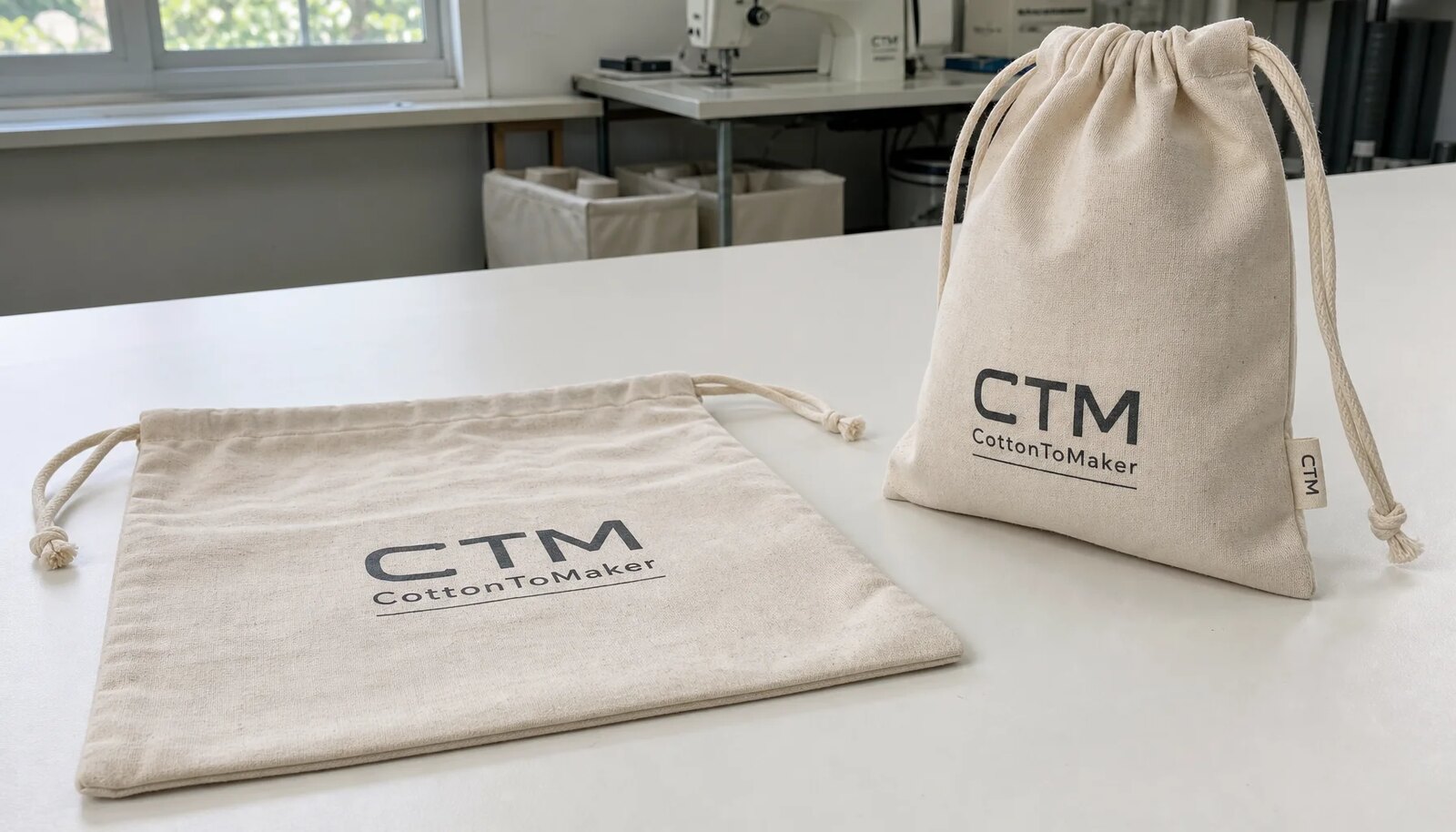
Start With the Real Risk: A Pouch Is Not Flat Artwork
Cotton drawstring pouches look uncomplicated until a buyer has to approve 5,000 of them. The artwork may be clean. The mockup may be balanced. Then the real pouch arrives and the logo sits too close to the cord channel, the cotton shade is warmer than expected, or the print loses sharpness where the weave is uneven. None of those issues is unusual. They are the normal result of treating a sewn textile product like a flat label.
A useful cotton drawstring pouches print proofing checklist for eco apparel brands has to cover the whole object: fabric, print, sewing, cord, packing, and reorder controls. The proof is not only a design approval. It is the buyer's evidence that the factory can reproduce the agreed pouch at bulk scale.
For procurement teams, the commercial risk is rarely the pouch cost alone. A poor print run can delay a garment launch, force warehouse sorting, create urgent air freight, or leave the brand using packaging that feels weaker than the product inside. Eco apparel brands also have less room to hide behind heavy finishes. Natural cotton, lower-ink artwork, and reduced packing can look excellent, but only when the spec is controlled before production.
- Approve the print on the finished pouch, not only on a flat cut panel or digital mockup.
- Check the pouch flat, filled, and fully closed because the logo reads differently in each state.
- Treat the drawcord channel, side seams, bottom seam, and gathered areas as no-print or limited-print zones.
- Record the approved proof with measurements, close-up photos, and a sealed golden sample.
- Make the proofing checklist part of the purchase order, not a separate design conversation.
Define the Physical Spec Before You Invite Quotes
A supplier can quote almost anything if the request is vague. That does not mean each quote represents the same pouch. Before asking for pricing, lock the physical specification: finished size, tolerance, seam allowance, drawcord channel depth, fabric weight, print area, cord detail, and packing format. These details decide cost and quality. Leaving them open encourages assumptions.
Finished size is the first control point. It is the width and height of the pouch after sewing, trimming, and any final pressing or washing. Cut size is the fabric panel before construction. Buyers should avoid approving cut size as the commercial size because the finished pouch will be smaller. For many small cotton pouches, +/-3 mm on finished dimensions is a practical starting tolerance. For larger pouches, +/-5 mm is more realistic unless the supplier has already proven tighter control.
The channel depth also deserves attention. A deeper channel can make the top look neater, but it uses more fabric and moves the safe print area lower. If the pouch will hold folded apparel, trims, accessories, or a sample kit, run a fit test with the real item. A pouch that fits empty dimensions may still feel tight once the garment is folded consistently for packing.
- State finished width and height in millimeters, then state the measurement tolerance.
- Separate finished size, cut size, seam allowance, channel depth, and bottom fold in the spec sheet.
- Ask the supplier to confirm where the usable print area begins below the finished top edge.
- Fit-test the actual garment or accessory before approving the final pouch size.
- Confirm whether measurement is taken before or after steaming, pressing, or washing.
Choose Cotton Fabric Around Print Performance
Fabric selection is not only a sustainability or handfeel decision. It determines print opacity, edge sharpness, wrinkle behavior, and how the pouch looks in a carton. For light inserts and low-weight packaging, 100-120 GSM cotton may be enough. For standard apparel packaging, 120-150 GSM is often the practical middle range. For retail presentation, gift kits, repeated use, or heavier accessories, 180-220 GSM gives more structure and usually supports a cleaner finished appearance.
Weave changes the result even at the same GSM. A plain weave gives a smoother surface for small logos, thin lines, and text. Canvas or duck weave adds body and durability, but the texture can interrupt fine artwork. If the brand mark includes small typography, a certification line, a QR code, or a fine icon, insist on a strike-off on the actual fabric grade. A nice product photo of a similar pouch does not prove print readability.
Natural cotton brings an attractive low-intervention look, but it also brings flecks and shade movement. That may be completely acceptable. It just has to be named. Bleached white supports stronger contrast and tighter print color. Dyed cotton can match a campaign or brand palette, but it adds shade tolerance and sometimes colorfastness checks. Eco claims should be handled separately from appearance. A pouch can look natural without being organic or recycled, so marketing language needs supporting evidence.
- Use 100-120 GSM for light inserts, 120-150 GSM for standard apparel packaging, and 180-220 GSM for retail or reusable programs.
- Ask whether the quoted fabric is plain weave, canvas, duck, or another construction.
- Define whether natural flecks, slubs, and small shade variation are acceptable or rejectable.
- Print on the intended bulk fabric, not a convenient substitute, before approving color or detail.
- Request documentation if organic, recycled, or other fiber claims will be used externally.
Make Artwork Files Production-Ready, Not Just Presentation-Ready
Many print problems begin with files that were fine for a deck but poor for production. Screenshots, low-resolution PNGs, and compressed mockups invite interpretation. Procurement buyers should request or provide vector artwork in AI, EPS, SVG, or print-ready PDF format. Fonts should be outlined. The file should state the exact print width and height in millimeters.
Small decisions matter. A thin line that looks elegant on screen can break across cotton texture. Pale ink that looks subtle in a digital mockup may disappear on natural fabric. A QR code that scans in the artwork file may fail after printing if it is too small or softened by the weave. Put minimum line weight, minimum text size, and any scannable-code requirement into the proofing notes.
Placement should be measured from finished edges. Not the cut panel. Not the mockup frame. Finished edges. As a starting point, keep artwork at least 10 mm from side seams and place front artwork roughly 25-35 mm below the finished top edge, depending on pouch size and channel depth. If the logo must remain visible when the pouch is pulled closed, approve the placement in that closed state too.
- Provide vector artwork with fonts outlined and colors named clearly.
- State exact print dimensions in millimeters and avoid terms such as small, medium, or standard.
- Mark no-print zones around seams, cord openings, bottom folds, and gathered fabric.
- Ask for a strike-off photo with a ruler beside the print before moving to sewn sample approval.
- Scan QR codes or barcodes from the actual printed sample, not only from the design file.
Select the Print Method for Repeatability, Not Habit
Screen printing is often the strongest option for cotton drawstring pouches with stable one-color or two-color artwork. It gives solid opacity, repeatable placement, and a familiar inspection standard. Once screens, ink, fabric, and curing are approved, screen printing is usually efficient for repeat B2B packaging orders.
Digital printing has its place. It can work well for short runs, frequently changing artwork, multi-color graphics, or designs that would be inefficient to screen print. The buyer still needs a real proof. Cotton texture, pretreatment, and curing can make the printed result different from a digital mockup. If a supplier proposes digital printing, ask what fabric preparation is required and whether the final handfeel changes.
Heat transfer should be reviewed carefully on eco apparel packaging. It may solve complex artwork problems, but the finish can feel more like a film on the fabric surface. Edges may look thicker than expected, and repeated folding or carton compression can expose lifting or cracking if the transfer is not suitable. A transfer is not automatically wrong. It simply needs a stricter sample review because the finish is part of the brand signal.
- Use screen printing for stable one- or two-color artwork at repeat quantities.
- Use digital printing for short runs, variable designs, or multi-color artwork after reviewing a fabric strike-off.
- Use heat transfer only after checking handfeel, edge thickness, folding behavior, and durability.
- Ask which ink system is included in the quote and how the print will be cured or dried.
- Compare print methods by opacity, touch, defect risk, setup cost, and reorder consistency.
Use a Sample Path That Catches Problems in Order
A good sample process moves from simple to specific. Start with a digital proof to confirm layout. Review the fabric swatch to confirm base material. Approve a print strike-off to check ink on the intended cotton. Then approve the sewn pre-production sample. If cartons, labels, or retail presentation matter, add a packing sample before bulk release.
The strike-off is where buyers should slow down. It proves color, opacity, edge definition, registration, and handfeel. It also exposes whether the fabric texture breaks small artwork. Review the strike-off at actual size. For pale inks, view it under the lighting normally used by the brand team or receiving team. For small text, check readability without zooming. For QR codes or barcodes, scan the printed proof.
The sewn sample answers different questions. Does the finished size match the PO? Does the cord slide smoothly? Does the logo sit straight after sewing? Does the channel gather through the print area? Fill the pouch with the intended item and close it. Some placement issues only show up when the pouch is doing its real job.
- Approve digital proof, fabric swatch, strike-off, sewn pre-production sample, and packing sample where relevant.
- Do not treat a printed fabric swatch as approval of finished pouch construction.
- Measure print position from finished edges and record the allowed placement tolerance.
- Review the sample flat, filled, closed, and packed in the intended carton format.
- Keep a sealed golden sample with the buyer and, when possible, one duplicate with the supplier.
Compare Supplier Quotes on the Same Scope
Two pouch quotes can look far apart because they are not quoting the same product. One price may include fabric, sewing, print setup, strike-off, pre-production sample, bundle packing, carton marks, and sample freight. Another may include only a stock pouch with decoration. The lower unit price is not always the lower landed cost.
Ask for line-item pricing. Separate fabric and sewing from printing. Separate one-time setup from repeat unit cost. Separate samples, courier, packing, labels, inspection support, and cartons. This makes it easier to see whether a supplier is efficient or simply omitting work that will be charged later.
MOQ is another place to read carefully. Stock pouch decoration may be the right choice for a pilot run of 500 or 1,000 pieces. Custom sewing and reserved fabric may make more sense for a program that repeats at 3,000, 5,000, or 10,000 pieces. A procurement team should compare the order size it expects to buy, not only the minimum the supplier prefers to quote.
- Request pricing at 500, 1,000, 3,000, 5,000, and 10,000 pieces if those quantities are realistic for the program.
- Ask what is included in the quoted unit price and what is charged separately.
- Confirm whether screens, artwork files, and production notes are retained for future reorders.
- Ask whether the same fabric lot can be used for both approved samples and bulk production.
- Compare landed cost, not only ex-factory unit price, when packing volume differs.
Write QC Rules Before Bulk Production Starts
Quality control works best when the defect rules are written before the goods exist. Cotton can have natural character, but that does not mean every mark is acceptable. Buyers should define the difference between acceptable flecks and rejectable stains, holes, oil marks, mildew odor, severe slubs, yarn defects, or print-blocking contamination.
Print inspection should compare bulk goods against the approved strike-off or golden sample. Inspectors should check print size, placement, opacity, color, edge definition, pinholes, smudging, ghosting, screen drag, and registration. For water-based or digital inks, a dry rub or scratch check can catch curing problems before the pouches are packed tightly together. If wash resistance is required, the test method and pass standard need to be agreed before production.
Sewing can make or break the final look. Crooked seams shift the front panel. Uneven channel depth tilts the print area. Loose threads, skipped stitches, weak bartacks, and rough cord ends make the pouch feel unfinished. If the buyer uses AQL inspection, defect classes should be specific enough that the factory, inspector, and buyer judge the same issue the same way.
- Define major and minor defects for fabric, print, sewing, cord, and packing.
- Use the golden sample as the visual reference for bulk inspection.
- Check early production for large orders, difficult artwork, or new suppliers.
- Pull inspection samples from multiple cartons, not only the top layer of one carton.
- Require corrective-action photos, affected quantities, and replacement plans before shipment release if defects are found.
Control Packing, Labels, and Cartons Early
Packing is part of the product cost and part of the quality result. Bulk bundle packing is often best for wholesale, internal apparel packaging, and B2B distribution because it reduces material and labor. The risk is compression. If too many pouches are forced into one carton, cotton can hold hard creases and fresh print can scuff or transfer.
Individual packing is useful only when the workflow requires it. Retail sales, marketplace fulfillment, hygiene expectations, or 3PL receiving rules may justify individual polybags, paper bands, insert cards, or barcode labels. For brands avoiding plastic, a paper band or other lower-plastic option may fit better, but it should still be sampled. Paper can tear, slide, or obscure the logo if it is not designed around the pouch size.
Carton planning belongs in the quote stage. Confirm pieces per bundle, bundles per carton, carton dimensions, gross weight, net weight, carton marks, and mixed-SKU rules. Freight can change quickly when carton volume is inefficient. Barcode labels should be proofed and scanned before bulk packing, especially if the pouches are going directly into a warehouse, retailer, or fulfillment center.
- Confirm bundle count, carton quantity, carton size, and estimated carton weight before PO release.
- Specify whether individual polybags, paper bands, insert cards, or barcode labels are required.
- Ask for a packing sample if the pouch will go to retail, 3PL, marketplace, or strict warehouse receiving.
- Avoid overcompression if fabric creases heavily or the print surface can transfer.
- Make carton marks include SKU, color, quantity, PO reference, carton number, and destination details where required.
Protect Reorders and Sustainability Claims
If the pouch will be reordered, the first run should become the control standard. Keep the final spec sheet, artwork file, fabric record, strike-off, sewn sample, packing sample, and carton details together. Reorder drift is common when these references are missing. The logo file may stay the same while fabric shade, cord color, print density, or packing count slowly changes.
Ask the supplier what it can retain. Screens may be reusable for a period. Production notes may record ink mix, mesh, curing settings, print position, and sewing details. Fabric lots may or may not be reserved. These answers matter more for a packaging program than for a one-time event pouch because consistency is part of the buyer's cost control.
Sustainability language needs discipline. Natural cotton does not automatically mean organic cotton. Recycled cotton, organic cotton, and other responsible sourcing claims require evidence if the brand will publish them. Ask for the documents that support the exact claim and confirm whether they apply to the pouch being ordered. Also check packing material if the brand makes broader packaging claims. The clean release rule is simple: bulk production starts only when the quote, sample, QC plan, and claim evidence all match.
- Keep a golden sample and written production file for every repeatable pouch program.
- Ask the supplier to retain screens, print settings, and production notes for reorders.
- Confirm whether fabric, cord, and thread colors can be matched in the next production run.
- Request evidence before using organic, recycled, or other material claims in external copy.
- Do not approve bulk until sample approval, quote scope, QC rules, and sustainability evidence are aligned.
Specification comparison for buyers
| Spec decision | Recommended option | When it fits | Buyer risk to check |
|---|---|---|---|
| Finished pouch size | Quote finished dimensions such as 150 x 200 mm, 200 x 250 mm, or 250 x 300 mm, and state tolerance as +/-3 mm on small pouches and +/-5 mm on larger pouches. | Use finished size for artwork placement, carton planning, receiving checks, and fit tests with folded garments or accessories. | Approving cut size instead of finished size can leave the pouch too small after sewing, trimming, and channel folding. |
| Fabric weight | 100-120 GSM for light inserts, 120-150 GSM for standard apparel packaging, and 180-220 GSM for retail, gifting, or reusable kits. | Choose lighter fabric for low-cost inserts and heavier fabric when the pouch needs body, opacity, or strength for heavier contents. | Too-light fabric can show print strike-through, wrinkle heavily, lose shape in cartons, or feel weak next to the apparel item. |
| Weave type | Plain weave for sharper print edges; canvas or duck weave for more structure and abrasion resistance. | Plain weave suits small logos and text; heavier weave suits premium handfeel, a firmer body, and reusable pouch programs. | Coarse weave can break thin lines, soften small type, distort QR codes, and make halftones unstable. |
| Fabric color | Natural, bleached white, or dyed cotton, selected around print contrast and the brand's material story. | Natural cotton fits a lower-impact look; bleached or dyed cotton fits tighter color control or specific campaign palettes. | Lot-to-lot shade change can make the same ink look different across reorders, especially on pale or tonal artwork. |
| Print method | One-color screen print for lower risk at volume; digital for short runs or changing art; heat transfer only when the sample proves durability and handfeel. | Screen printing is usually the safest route once artwork, size, and placement are stable. | Low-cost prints can crack, bleed, feel plasticky, transfer in packing, or fail rub checks if ink and curing are not controlled. |
| Artwork placement | Front-center placement, typically 25-35 mm below the finished top edge and at least 10 mm away from seams, folds, or cord openings. | Place the logo where it remains visible when the pouch is filled and pulled closed. | Artwork too close to the channel or side seam can skew, gather, disappear, or look off-center after sewing. |
| MOQ route | Stock pouch plus decoration for pilot runs; custom sewing and reserved fabric lot for repeat programs. | Lower MOQ often fits trials and seasonal campaigns; custom production fits repeat packaging with tighter control. | Comparing only unit price can hide setup fees, sample charges, fabric substitutions, packing scope, and freight differences. |
| Sample stage | Digital proof, fabric swatch, print strike-off, sewn pre-production sample, then sealed golden sample. | Needed when color, placement, packaging, or fit affects launch readiness or receiving approval. | Approving only the mockup does not confirm fabric shade, print opacity, seam distortion, cord function, or carton creasing. |
| Packing method | Bulk bundle packing for wholesale; individual polybag, paper band, barcode label, or insert only when required. | Counted bundles often reduce material waste and labor. Individual packing fits retail, marketplace, or 3PL workflows. | Overpacked cartons can create creases, print scuffing, higher freight cost, and extra warehouse handling. |
Buyer checklist before sampling
- Confirm finished width, height, drawcord channel depth, seam allowance, bottom fold, and print safe zone in millimeters; do not approve based on cut size alone.
- Specify fabric composition, GSM, weave, color, finish, and expected shrinkage, then ask whether the intended fabric lot can be reserved for the sample and bulk order.
- Decide whether the pouch must be natural, bleached, dyed, organic, recycled, or conventional cotton, and request evidence if that claim will appear in marketing, compliance copy, or retailer documentation.
- Provide vector artwork with outlined fonts, exact print size, color reference, minimum line weight, and minimum readable text size; avoid screenshot-based artwork.
- Mark no-print zones around side seams, bottom seam, drawcord channel, cord openings, and any area that gathers when the pouch is closed.
- Define the print method, number of colors, print side or sides, ink system, curing or drying process, and expected handfeel before requesting final pricing.
- State the drawcord material, diameter, color, knot or tip finish, cord length, and pull expectation, because cord choice changes both appearance and handling.
- Approve the sample path in writing: digital proof, fabric swatch, strike-off, sewn pre-production sample, packing sample if needed, and golden sample.
- Set packing and labeling rules before pricing: bundle count, polybag yes or no, paper band yes or no, barcode format, carton marks, carton quantity, and mixed-SKU policy.
- Request line-item pricing at realistic quantity breaks such as 500, 1,000, 3,000, 5,000, and 10,000 pieces, with one-time setup fees separated from repeat unit price.
Factory quote questions to send
- What exact finished size, tolerance, GSM, weave, fabric color, finish, and shrinkage allowance are included in this quotation?
- Is the fabric already in stock, or will you source and reserve a specific lot for this order after sample approval?
- Is the quoted print price based on one color, one side, and one position, and what changes if we add colors, locations, or a larger print area?
- Which print method are you quoting, what ink system will you use, and what curing or drying process is required before packing?
- What is the MOQ at the quoted price, and how does the unit price change at 500, 1,000, 3,000, 5,000, and 10,000 pieces?
- Does the quote include screens, artwork preparation, strike-off, pre-production sample, packing sample, inspection support, and sample courier charges?
- What artwork file formats do you accept, and what are your tolerances for print size, print position, color variation, and registration?
- How are drawcord material, cord diameter, cord color, knots or tips, seam allowance, stitch density, bartacks, and thread color specified in the quotation?
- Will the pouch be sewn before printing or printed before sewing, and how will you prevent logo distortion near seams or the drawcord channel?
- What packing format is included in the base price, and what extra charges apply for individual polybag, paper band, barcode label, insert card, or master carton customization?
Quality-control points to confirm
- Fabric GSM matches the approved range, and the fabric lot shows no holes, stains, oil marks, mildew odor, or slubs that affect print or strength.
- Finished pouch width, height, channel depth, and overall shape stay within the agreed tolerance after sewing and any required steaming, pressing, or washing.
- Logo placement is centered within the approved window and measured from the finished edges, not from a cut panel or a stretched sample.
- Print size, opacity, edge definition, and color match the approved strike-off or golden sample under the agreed light source.
- Small text, QR codes, barcodes, and fine line artwork remain readable at actual size and are not broken by the cotton weave.
- Ink coverage is even, with no pinholes, bleeding, ghosting, dust marks, off-register colors, or visible screen drag lines beyond the agreed limit.
- Curing or drying passes the required rub or scratch check, and the print surface is not tacky or transferring to adjacent pouches in packing.
- Drawcord slides smoothly through the channel, knots are secure, cord ends are finished as specified, and cord lengths are consistent.
- Side seams, bottom seam, drawcord channel, bartacks, and stitch density are consistent, with no skipped stitches, open seams, loose threads, or puckering that distorts the logo.
- Carton counts, carton marks, label data, and packing format match the approved packing sample and the purchase order.