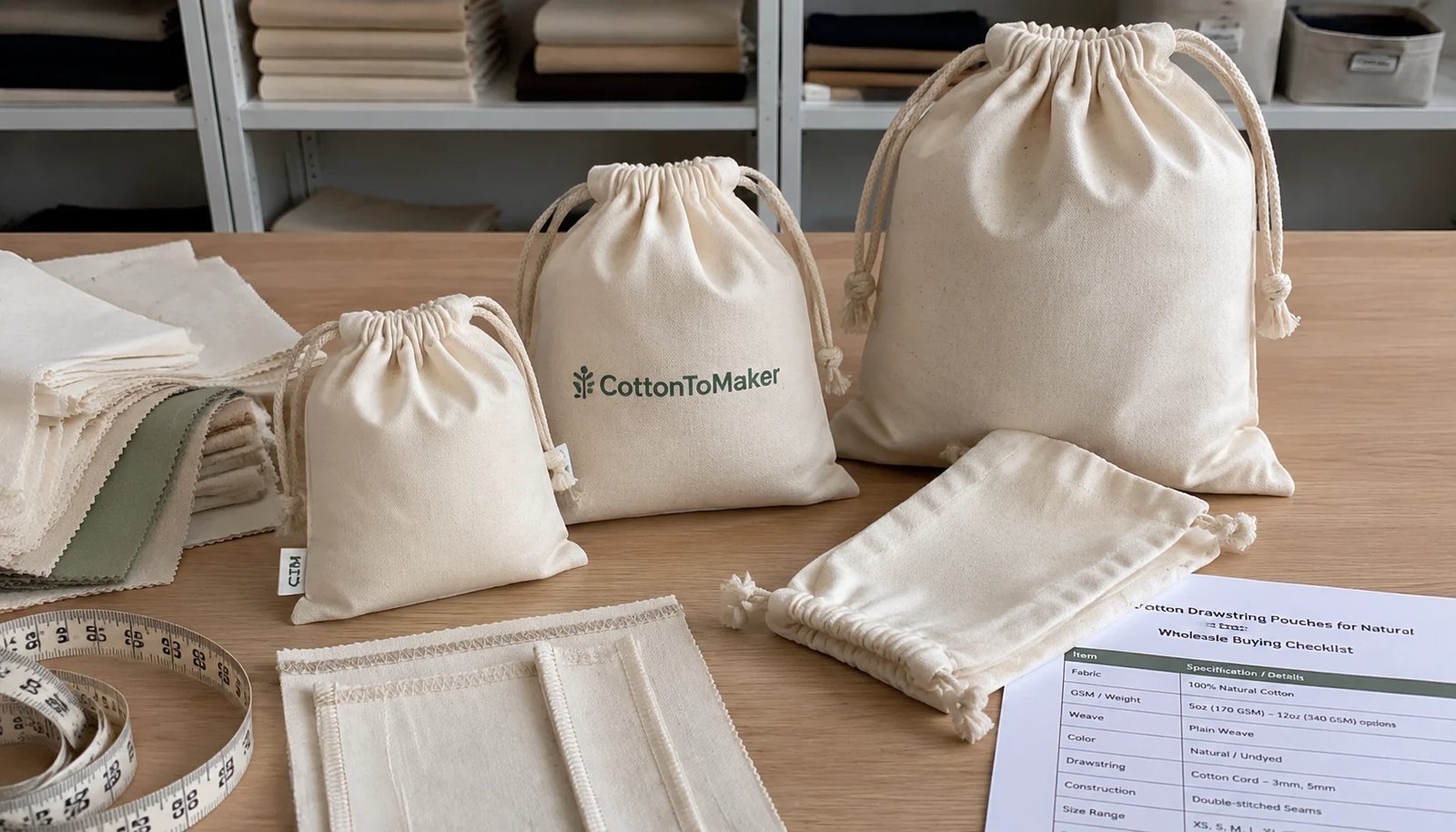
Why natural grocers need a stricter buying checklist for cotton drawstring pouches
Cotton drawstring pouches look simple, but from a procurement perspective they are specification-sensitive products. Two suppliers may both quote a “cotton pouch with drawstring,” yet one has assumed 140 GSM fabric, another 220 GSM, and a third has excluded printing, inner packing, or carton labeling. The ex-works prices may appear close until the technical assumptions are opened up. That is why a strong cotton drawstring pouches for natural grocers wholesale buying checklist has to translate a visual idea into measurable purchasing language.
Natural grocers also use these pouches in different commercial roles. Some are soft retail sleeves for soap, tea tools, herbal accessories, or private-label gift sets. Others are reusable add-ons that need better body, cleaner closure function, and stronger seams. In both cases, the pouch is part of store presentation and brand signaling, not just a commodity trim. If the fabric feels too thin, the print sits crooked, or carton packing is inconsistent, the issue shows up immediately in merchandising, receiving, or customer perception.
For B2B buyers, the practical goal is quote normalization. Procurement teams need to compare suppliers on the same assumptions for finished size, usable opening, GSM, closure construction, branding method, packing, and lead time start point. Without that discipline, low quotes often hide weaker fabric, smaller true size, lighter cords, or excluded handling costs. The result is either a surprise during sampling or a problem after goods reach the warehouse.
A good checklist also reduces internal friction. Merchandising may care about the look of natural cotton and logo placement. Quality may care about seam integrity and print rub resistance. Operations may care about size-separated bundles and carton marks. A complete specification aligns those functions early so the purchase order is easier to execute and easier to repeat.
- Quote gaps usually come from unstated assumptions on fabric weight, true finished size, print method, or packing.
- A sample that looks premium can still be misleading if it uses substitute fabric or sample-room finishing not representative of bulk production.
- Warehouse issues on pouch programs are often caused by mixed-size cartons, count errors, or weak carton marking rather than sewing defects alone.
- The more measurable the RFQ, the more meaningful the quote comparison becomes.
Start with the actual end use: product fit, fill weight, and retail role
The most common sourcing mistake is requesting quotes from a photo reference and a rough pouch size. Natural grocers use cotton drawstring pouches for very different products, and those products do not require the same cloth weight or construction. A pouch carrying a bar soap, tea strainer, sachet set, or gift insert can often be lighter and more presentation-oriented. A pouch intended to hold denser accessories, bundled refill tools, candles, or repeated-use items usually needs more fabric body, stronger seams, and a closure that can be opened and closed many times without fraying quickly.
Buyers should therefore define the end use in plain operational terms. What item goes inside? What are its dimensions and unit weight? Is it soft, rigid, boxed, or irregular in shape? Will store staff insert the product manually, or will filling happen at origin? Does the pouch need to close fully over the contents, or is it mainly a partial-cover sleeve with gathered top styling? These answers help a supplier quote the correct size, channel depth, and cloth range instead of defaulting to the cheapest workable assumption.
End use also affects tolerance priorities. If the pouch holds loose promotional items, a small size variance may not matter much. If it needs to fit a boxed soap set or a private-label accessory kit, even a 0.5 cm change in width or usable height can create packing friction. The RFQ should therefore describe both the pouch dimensions and the inserted product profile.
When a natural grocer program includes several SKUs, segment by function rather than forcing one fabric and one pattern onto every item. It is often smarter to standardize where possible but allow different GSM or dimensions for different categories. That approach tends to improve both fit and cost control.
- Describe the inserted product by dimensions, weight, and shape.
- Clarify whether the pouch is decorative, protective, reusable, or all three.
- State whether full closure is required when the pouch is filled.
- Use real product samples for fit testing where contents are bulky or rigid.
- Do not assume one standard pouch spec is optimal across soap, tea, candles, and gift-set accessories.
Fabric specification: cotton type, GSM, finish, and acceptable variation
Fabric weight is usually the largest hidden variable in cotton pouch pricing. Lightweight cotton in the 135 to 170 GSM range is common for low-cost, light-duty programs where the pouch mainly serves a presentation role. It can be appropriate for tea accessories, soap presentation, herb kits, event gifting, or point-of-sale add-ons. The benefit is lower material cost and easier cinching. The tradeoff is a softer handfeel, more show-through, and a higher chance of seam strain if buyers later use the pouch for heavier contents than originally specified.
Midweight cotton in the 200 to 270 GSM range is often safer for natural grocers that want stronger perceived value and better opacity. This range usually gives the pouch more body on shelf, a more substantial feel in hand, and a more stable surface for one-color screen printing. It also tends to perform better when the pouch is intended for repeated opening and closing. The cost difference becomes more noticeable on larger sizes, so buyers should confirm that the upgraded weight is tied to a real use requirement, not just a vague preference for “better quality.”
GSM alone is not enough. Buyers should ask for composition and base cloth description, and if a claim such as organic cotton, recycled content, or certified material is commercially important, that claim must be written into the sourcing process early. The PO and quote should make clear what the supplier is claiming and what evidence can be provided. Vague sustainability wording creates avoidable compliance risk.
For natural grocers, unbleached natural cotton often aligns well with brand positioning because it communicates a low-process, earthy appearance. But buyers should be precise about what that means commercially. Natural cotton can show tone variation and occasional seed specks. Those features are often normal, not defects. The key question is whether the retail program can accept that variation within a commercially reasonable range. If visual consistency across multiple SKUs matters, define that expectation before sample approval and bulk booking.
- Lightweight cotton: about 135-170 GSM for economical, presentation-focused programs.
- Midweight cotton: about 200-270 GSM for better opacity, stronger handfeel, and more durable reuse.
- Ask for fabric composition, base cloth description, finish, and nominal GSM with tolerance.
- If sustainability claims matter, require documentation expectations before PO placement.
- For natural cotton, define what level of shade variation is commercially acceptable.
Size engineering: finished dimensions, usable opening, and production tolerances
A drawstring pouch should never be specified only by flat width and height. The top channel consumes height, seam allowances consume width, and the opening can become narrower than buyers expect once the drawstring is inserted. This is why some pouches that look correct on paper are awkward in real use: the product fits the body but is difficult to insert, or the pouch closes poorly around the contents.
For better sourcing accuracy, a wholesale RFQ should define at least the finished width, finished height, top channel depth, and any critical usable internal dimension. On small sizes, channel depth can materially reduce usable height. If the pouch must hold a rigid or boxed product, buyers should ask the factory to test the fit using a real sample or a dimensional dummy. A paper estimate is not enough when clearance is tight.
Tolerance should also be stated in measurable terms. For many cotton pouch programs, plus or minus 0.5 cm on smaller sizes and plus or minus 1.0 cm on larger sizes is commercially workable, measured after sewing on a laid-flat pouch. The exact tolerance should match the end use. A decorative gift pouch can often accept more variation than a pouch intended to fit a specific product kit.
Another common issue is logo position relative to graded sizes. If one artwork is used across multiple pouch sizes, its visual balance can change significantly. Buyers should review the size set together to see whether the same logo size, or proportionally adjusted logo sizes, produce the best presentation.
- Specify finished width and height in centimeters.
- Clarify whether the top channel is included in finished height.
- State channel depth where fit or branding position is sensitive.
- Define tolerance by size category and agree how it will be measured.
- Test fit with actual product dimensions, not only with flat artwork or rough mockups.
Construction details that affect durability: seams, seam allowance, channel, and cord
Buyers often focus on fabric and print first, but construction details are what determine whether the pouch works smoothly in everyday handling. A cotton drawstring pouch is simple, yet repeated complaints usually come from a short list of technical issues: weak side seams, uneven seam allowance that distorts pouch shape, blocked channels, rough cord ends, or knots that pull loose in use.
The quote and sample review should therefore ask how the pouch is constructed. At minimum, buyers should clarify the seam locations, approximate seam allowance, and whether stress points near the drawstring exits receive backstitching or reinforcement. The right level of reinforcement depends on use. A lightweight gift pouch may not need much more than clean standard sewing. A reusable pouch for denser accessories benefits from more secure stitching at high-stress areas.
Channel construction matters as much as seam integrity. If the channel width is too narrow for the selected cord, the closure feels rough and bunches during use. If the exits are not cleanly formed, the cord can catch or fray early. Buyers should define the preferred drawstring style as well: cotton cord, rope-like cord, or tape-style tie if offered. They should also ask for approximate cord diameter and cord length appropriate to each pouch size.
One more practical detail is pull symmetry. On two-side pull pouches, the ends should feel balanced rather than one side grabbing more than the other. This is easy to overlook during a quick sample check, but on retail programs it affects perceived quality immediately.
- Confirm seam type and seam allowance expectations.
- Require clean sewing with no open seams, skipped stitches, or severe puckering.
- Ask whether stress points near cord exits are backstitched or reinforced.
- Match channel width to cord diameter so the drawstring slides smoothly.
- Check cord length, knot finish, and two-side pull balance on samples.
Branding and decoration: print method, artwork placement, and label options
For most wholesale natural grocer programs, one-color screen printing on flat panels before sewing remains the best balance of cost and consistency. Printing before sewing gives a flatter surface, helps control artwork position, and reduces the risk of distortion from seams or the top channel. It is especially suitable for simple logos, refill messaging, product-family marks, or understated private-label branding.
The key is to specify placement in measurable terms. Buyers should not rely on visual instructions such as “centered on pouch.” A better approach is to define print size and location from the bottom seam and side seam, then agree on a placement tolerance. This avoids confusion once the top channel is folded and stitched, because a logo that looked centered on an unsewn panel may end up too high on the finished pouch.
Very small pouch sizes or minimal-branding concepts may work better with a woven side label or cotton content/care label rather than a direct print. Labels can support a cleaner natural look, but they need their own specification: insertion point, label fold type, visible dimensions, and edge finish. Poorly chosen labels can appear bulky, twist during use, or interrupt the soft presentation of the pouch body.
Because natural grocer merchandising formats vary, branding position should also reflect display reality. A pouch shown hanging from hooks may need a different graphic location than one displayed folded in baskets or inserted into gift sets. Buyers should review the decoration method in the actual retail context whenever possible.
- Best-value branding route: one-color screen print on flat panels before sewing.
- Define print location from seam references rather than visual centering.
- Keep artwork clear of the top fold area and side seams.
- For labels, specify insertion point, fold type, visible size, and edge finish.
- Review logo visibility in the real merchandising format, not only on a tabletop sample.
MOQ logic, setup charges, and assortment planning for multi-size programs
MOQ on cotton drawstring pouches is often misunderstood because buyer logic and factory logic are different. Buyers typically think in units per SKU. Factories think in terms of base cloth booking, cutting efficiency, print screen setup, sewing handling time, and packing complexity. That difference matters most when a natural grocer wants several sizes under one branded program.
A well-structured quote request should therefore ask for both per-size MOQ and total program MOQ. If several sizes share the same natural cotton base cloth and one print color, the supplier may be able to run them more efficiently as a combined program. This can lower setup waste and make assortments more viable without pretending each size is a completely independent production run.
Buyers should also ask suppliers to separate one-time costs from recurring costs. Screens, custom labels, special packing instructions, or barcode setup may be charged once, while printing, sewing, and carton packing repeat each order. If these elements are blended into a single unit price, buyers lose visibility on reorder economics and may overestimate or underestimate the true cost of long-term supply.
The lowest published MOQ is not always the best commercial option. Some suppliers accept a low volume but compensate with high setup fees, tighter size-mix restrictions, or less favorable repeat-order terms. Comparing total landed-use cost across the actual assortment is more useful than comparing one unit price attached to an unrealistic volume point.
- Ask for MOQ per size, per print color, and per total program.
- Check whether multiple sizes can share one base cloth and one print setup.
- Separate one-time setup charges from recurring order costs.
- Review realistic price breaks based on your actual assortment mix.
- Discuss repeat-order assumptions during initial quoting, not after the first PO.
Sampling and approval flow: what to verify before bulk begins
For cotton pouches, a disciplined sample flow prevents most avoidable production disputes. In practice, three stages are usually sufficient. First, a blank construction sample confirms body proportion, channel depth, seam shape, cord style, and handfeel. Second, a print strike-off or decorated sample checks logo scale, color, and rough placement. Third, the pre-production sample combines final-intended fabric, final print method, final cord, and the intended sewing construction.
The PP sample is the most important approval point because it reveals how all specifications interact. A logo that looked well placed on a strike-off may sit too close to the channel once sewn. A cord that appears acceptable visually may feel rough after repeated pulls. A fabric that looked fine in the hand may prove too light once the actual product is inserted. Procurement buyers should therefore evaluate the PP sample as a functional production item, not just a visual prototype.
To make approvals useful for later QC, document measurable points on the sample approval form. Record finished dimensions, channel depth, logo position, print size, cord length, cord diameter if relevant, label location, and any agreed comments about the appearance of natural cotton. A generic email saying “approved” is weak evidence if there is later disagreement during inspection.
Where possible, retain a sealed reference sample or a structured photo set with measurement notes. This is especially helpful on repeat orders, supplier transitions, or internal handovers where original context may otherwise be lost.
- Recommended sample path: blank sample, decorated sample or strike-off, then PP sample.
- Approve the PP sample only when it uses bulk-intended materials and construction.
- Document dimensions, placement, and closure details on the approval record.
- Keep a physical reference sample or controlled photo reference for inspection alignment.
- Test the PP sample with the actual inserted product if fit or closure performance is important.
Quality control standards for cotton pouch production and pre-shipment inspection
A practical QC plan for cotton drawstring pouches should focus on function, measurable consistency, and shipment accuracy. Most problems on this product category are not exotic. They are size variance beyond tolerance, blocked channels, weak seams, inconsistent print placement, visible smudging, and mixed carton packing. These are manageable if the buyer defines what will be checked and how acceptance will be judged.
Dimensional control starts with finished width and height measured after sewing, laid flat, against the approved tolerance. If fit is critical, buyers should also inspect channel depth and usable opening. On natural cotton programs, appearance control should be based on commercially acceptable consistency rather than unrealistic uniformity. Unbleached cloth can vary, so the inspection standard should reflect the approved reference and the retail sensitivity of the program.
Function testing should include repeated drawstring pulls to confirm smooth sliding, balanced closure, and acceptable cord-end condition. Seam checks should look for open seams, skipped stitches, broken threads, excessive puckering, and poor reinforcement near stress areas. Print checks should confirm placement by measurement from seam references, not visual guesswork. A simple dry rub check is a useful practical screen for transfer risk on one-color prints.
If third-party inspection is used, buyers should align with the supplier on the inspection stage and acceptance basis in advance. Many importers use an AQL method for soft goods, but regardless of the exact plan, the important point is that the inspection criteria match the approved sample and PO specification. An inspector cannot enforce requirements that were never written.
- Measure finished size against stated tolerances, not against visual expectation alone.
- Inspect channel depth and usable opening when product fit matters.
- Check seam integrity, stitch consistency, and reinforcement at stress points.
- Verify print placement by measurement from seams or hem references.
- Run repeated drawstring pulls and a simple dry rub check on printed areas.
- Confirm that packing accuracy is included in the inspection scope, not treated separately.
Packing, carton marking, and lead-time comparison for landed-use value
Packing details can significantly affect landed cost and warehouse labor on pouch orders. Because the product is soft, buyers sometimes under-specify pack-out and assume the factory will choose a workable method. That approach often leads to mixed-size cartons, unclear bundle counts, or compressed printed goods that need re-sorting before use. For distributors and DC-based retailers, those issues can cost more than a small unit-price difference saved at sourcing stage.
A stronger pack specification defines inner bundle quantity, SKU separation, carton quantity, and carton marks. In many wholesale programs, size-sorted inner bundles of 50 or 100 pieces are easy to count and receive. Cartons should be labeled with SKU, size, base cloth or color description where relevant, quantity, PO number, carton sequence, and gross and net weight. If retailer barcodes or shipping labels are required, they should be agreed before production starts, not added after the goods are packed.
Carton dimensions and expected weights should be requested during quotation so freight and warehouse planning are based on real assumptions. Cotton pouches compress efficiently, but over-compression may affect print appearance and slow count verification. The right pack density depends on fabric weight, print coverage, and whether the pouches are sold flat, inserted with products, or repacked domestically.
Lead-time comparison should be done with the same discipline. Buyers should ask for a stage-by-stage timeline covering samples, material preparation, printing, sewing, packing, inspection, and booking readiness. Bulk lead time should clearly start after PP approval if any material, artwork, or closure detail is still open. A shorter quote is only useful if the assumptions behind it are realistic.
In the end, procurement should compare landed-use value, not just the cheapest pouch body. A lower ex-works unit price is not a better buy if it brings thinner fabric than expected, weaker closure performance, poor print consistency, or extra receiving labor. Normalizing quote inputs and outputs is what makes supplier comparison commercially reliable.
- Define inner bundle counts, SKU separation, carton quantity, and carton marks before PO placement.
- Request estimated carton dimensions and weights during quotation.
- Avoid loose mixed-size cartons unless mixed packing is intentionally designed and clearly labeled.
- Clarify whether unit polybagging is required or should be minimized for sustainability reasons.
- Ask for lead time by process stage and confirm that bulk timing starts after PP approval.
- Compare suppliers on normalized landed-use value, not only ex-works piece price.
Specification comparison for buyers
| Spec decision | Recommended option | When it fits | Buyer risk to check |
|---|---|---|---|
| Fabric weight | 4 oz to 5 oz cotton, about 135-170 GSM | Best for lightweight dry-goods accessories, soap sleeves, tea packs, herb kits, event gifting, or reusable checkout add-ons where lower unit cost matters | May feel too soft for heavier contents; verify actual fill weight, seam strain, and show-through with the real product inside |
| Midweight pouch body | 6 oz to 8 oz cotton, about 200-270 GSM | Better for denser items, premium store-brand gift sets, candle accessories, refill-adjacent reuse, and stronger shelf presentation | Higher GSM increases unit cost and carton weight; confirm true finished weight, usable opening, and whether cinching still works smoothly |
| Material finish | Unbleached natural cotton with minimal finishing | Fits natural grocer positioning when an earthy, low-process appearance is acceptable | Shade variation and seed specks are normal; define acceptable visual range if multiple SKUs must look aligned on shelf |
| Closure style | Self-fabric top channel with cotton cord drawstring | Standard, scalable, and cost-effective for most wholesale orders | Check channel width consistency, balanced cord length, knot security, and fraying at cut ends; require repeated pull testing |
| Print method | 1-color screen print on flat cut panels before sewing | Best value for simple logos, refill messaging, ingredient themes, and store-brand programs | Artwork placed too near the top fold or seams can distort; define print location from seam lines and agree on placement tolerance |
| Decoration alternative | Small woven side label or cotton content/care label | Useful when branding should stay understated or pouch sizes are too small for economical printing | Label insertion can vary; confirm insertion point, fold type, edge finish, and whether label bulk affects appearance |
| MOQ structure | Combine same base fabric and same print color across several sizes | Works well for natural grocers needing a size assortment without treating each size as a fully separate program | Some suppliers offset low MOQ with repeated setup charges; compare total program cost, not only per-SKU minimums |
| Packing format | Size-sorted inner bundles, then export cartons by SKU and PO line | Suitable for importers, distributors, and DC-based buyers needing fast receiving and count verification | Loose mixed-size packing creates receiving errors; require carton marks with SKU, size, quantity, PO, carton number, gross weight, and net weight |
| Lead time route | Blank sample and print strike-off, then PP sample approval before bulk | Best for custom branded pouches where print placement, handfeel, and closure function matter more than the shortest schedule | Skipping PP approval may save days but increases risk of size, print, seam, and packing mismatch across the bulk lot |
Buyer checklist before sampling
- Define the pouch end use in commercial terms: inserted product, unit weight, dimensions, shape, and whether the pouch is a retail package, reusable accessory, gift-with-purchase, or private-label sellable item.
- State finished pouch width and height in centimeters and clarify whether the top drawstring channel is included in finished height.
- Specify the usable internal height below the channel if fit is critical, especially for boxed soap, tea tools, candles, jars, or bundled accessories.
- List the required fabric specification in measurable terms: composition, weave if known, color/finish, and GSM target with acceptable tolerance.
- If requesting unbleached natural cotton, state whether shade variation and occasional seed specks are acceptable and at what level shelf uniformity becomes a concern.
- Specify drawstring construction: cord material, approximate diameter, total cord length, one-side or two-side pull configuration, knot finish, and whether both ends must pull evenly.
- Define seam construction expectations, including seam allowance range, stitch quality, and reinforcement at drawstring exit points if needed.
- State branding method and artwork placement from the bottom seam and side seam, plus print size and allowable position tolerance.
- Approve a pre-production sample made with final bulk-intended fabric, final print method, final cord, and final packing method rather than a substitute sample-room version.
- Set packing standards by SKU, inner bundle count, carton quantity, carton marks, barcode requirements, and whether unit polybagging is required or should be minimized.
Factory quote questions to send
- What is the exact fabric composition, construction, and nominal GSM, and what bulk tolerance can you hold on GSM and finished pouch size?
- Is the fabric stock-dyed, bleached, or natural greige-based cloth, and how do you control shade consistency for repeat orders of natural cotton?
- Are the panels printed before sewing or are finished pouches printed after assembly, and what print location tolerance can you maintain in bulk?
- What is the finished seam allowance and seam type on side seams, bottom seam, and top channel, and do you backstitch at drawstring exit areas?
- What drawstring material do you use as standard, what is the approximate cord diameter, and what cord length do you recommend for each pouch size?
- What MOQ applies per size, per artwork, per print color, and per total program if we combine several sizes in one order?
- Can multiple pouch sizes share one fabric lot and one print setup, and if so, how are setup fees and piece rates allocated across the size mix?
- What sample stages are available: blank construction sample, print strike-off, PP sample, and shipment sample, and which charges are refundable against a bulk order?
- How are goods packed by size and PO line, what are the standard inner bundle counts, and what carton dimensions and weights should we expect for freight planning?
- Which charges are one-time versus recurring on repeat orders, including screens, labels, sampling, special packing, barcode labels, and third-party inspection support?
Quality-control points to confirm
- Measure finished pouch width and height after sewing against the approved spec, using the stated tolerance by size category.
- Measure channel depth and check usable opening width, especially on small pouches where the top construction can materially reduce insertion space.
- Verify fabric GSM from bulk fabric records or by cut-panel testing where available; watch for lighter-cloth substitution on repeat orders.
- Inspect natural cotton shade consistency within the same SKU and compare against the approved reference for commercially acceptable variation.
- Check seam appearance and function: no open seams, skipped stitches, severe puckering, broken threads, or uneven seam allowance that changes pouch shape.
- Review reinforcement at stress areas near drawstring exits and bottom corners if the pouch is intended for denser or repeated-use contents.
- Inspect channel width consistency so the cord slides smoothly without trapped seam allowance, blocked exits, or excessive friction.
- Pull both cord ends repeatedly to confirm smooth closure, balanced pull, secure knots, and minimal fraying at cut ends.
- Check print placement and size against approved measurements from seam references, not by visual centering alone.
- Check print shade and print quality for pinholes, smudging, ghosting, poor edge definition, and obvious cracking or transfer risk.