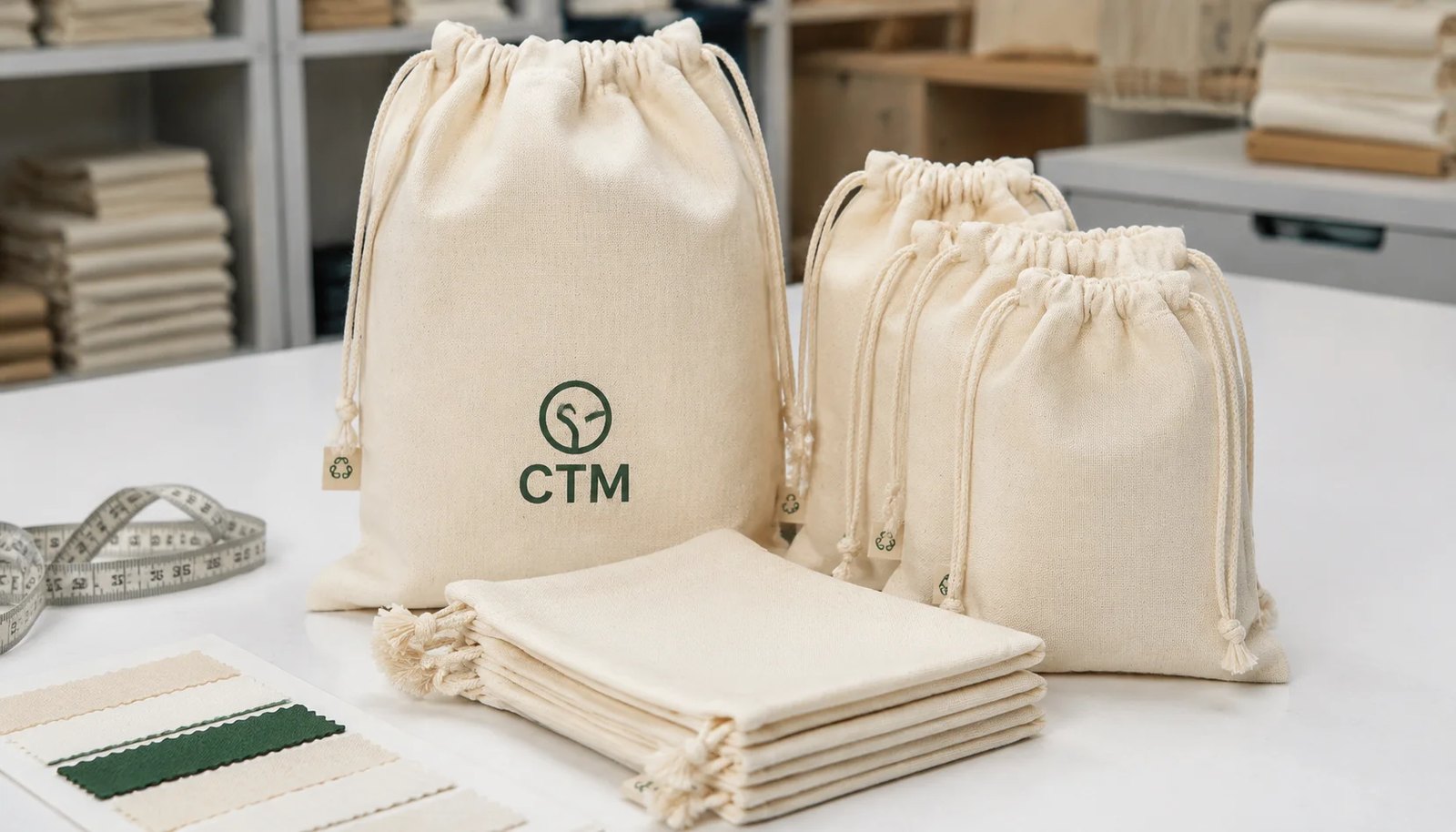
RFQ Scope for Natural Grocery Pouches
Cotton drawstring pouches for natural grocers look simple, but the RFQ needs more discipline than a generic promotional bag inquiry. The product often sits close to food, wellness items, refill products, or private label merchandise, so buyers usually care about material feel, clean sewing, print tone, and how the pouch supports the store brand. A quote that only says cotton pouch with logo is not enough to compare factories.
Start the RFQ by defining the commercial use. A small pouch for bulk spices, a medium pouch for soap bars, and a larger pouch for reusable produce all have different fabric weights, drawcord strength, print positions, packing quantities, and carton dimensions. The clearer the use case, the less the supplier has to guess, and the easier it is to separate a low quote from a practical quote.
- For refill or bulk bin programs, prioritize washable construction, smooth drawcord operation, and low lint.
- For gift sets or private label kits, prioritize print sharpness, shelf appearance, and consistent folding.
- For produce bags, prioritize breathable fabric, lighter GSM, fast drying, and low carton weight.
- For premium wellness products, prioritize heavier cotton, better seam finish, and a cleaner retail pack.
Size and Construction Decisions
The finished size must be written as width by height after sewing, not estimated from fabric cut size. Many quote disputes begin when one supplier prices a 20 cm by 30 cm finished pouch and another prices a cut panel that becomes smaller after seams and the drawstring channel. For natural grocers, common useful sizes include small pouches for tea, spices, and soap; medium pouches for wellness kits or dry goods; and larger pouches for produce or refill programs.
Construction also needs to match the product weight inside the pouch. A basic single drawstring pouch may be enough for light samples, while two-sided drawcord closure gives a better retail feel and easier opening. The top channel should be wide enough for the cord to move freely after shrinkage and stitching. If the pouch will hold heavier goods, bottom seam strength matters more than a slightly cheaper fabric.
- State finished size and tolerance, such as plus or minus 5 mm for small pouches or plus or minus 10 mm for larger pouches.
- Define single drawcord or double drawcord closure because labor and cord consumption differ.
- Show print placement on a flat pouch and on a filled pouch if artwork visibility matters.
- Specify whether side seams must be overlocked, French seamed, bound, or simply lockstitched and trimmed.
Fabric GSM and Cotton Type
Fabric choice drives hand feel, price, freight, and perceived brand quality. For natural grocery use, 120-170 GSM cotton is often the practical range for reusable produce, bulk goods, and lightweight retail pouches. It folds well, keeps carton volume under control, and still gives a natural cotton texture. Below this range, the pouch may look too thin, especially if printed in dark ink. Above this range, the pouch feels more premium but becomes bulkier and more expensive to ship.
The RFQ should separate conventional cotton, recycled cotton blend, and certified organic cotton. These are not interchangeable commercial claims. If the grocer plans to call the pouch organic cotton, the buyer needs documentation that matches the final product and transaction chain. If the pouch only needs a natural cotton appearance without a certified claim, conventional unbleached cotton may be the most cost-effective and stable option.
- 120-140 GSM: better for produce, bulk bin, low-cost giveaways, and large quantity programs.
- 150-170 GSM: better for general retail pouches, branded kits, and repeat store use.
- 180-220 GSM: better for premium sets, heavier contents, and pouches expected to feel like packaging rather than a thin bag.
- Natural cotton shade varies by lot; approve an acceptable shade range instead of expecting paper-white consistency from unbleached fabric.
Print Method and Artwork Control
For most cotton drawstring pouches, water-based screen printing is the most practical method. It gives a soft hand feel, suits one to three color grocery branding, and keeps unit cost reasonable at volume. Pigment selection matters because natural cotton is not a neutral white base. A dark green, brown, black, or muted red usually prints more predictably than pale colors on unbleached cotton.
Digital print and heat transfer can solve specific problems, but they should not be selected automatically. Digital print may help with small runs or multi-color artwork, while heat transfer can hold fine detail or QR codes. The tradeoff is hand feel, edge appearance, and sometimes durability. A buyer should approve a print strike-off on the actual fabric before the factory buys all fabric or starts mass sewing.
- Provide vector artwork, Pantone references, print dimensions, and exact placement from pouch edges.
- Decide whether the logo can distort slightly when the pouch is filled, or whether the print must sit in a flatter panel area.
- For QR codes, test scanning on a sewn sample after the pouch has been opened, closed, folded, and handled.
- For organic or natural positioning, avoid heavy plastic-feel transfers unless the design requirement justifies it.
MOQ Logic and Cost Drivers
MOQ is not one number. A serious quote should explain which part of the order creates the minimum: fabric purchasing, fabric dyeing, printing setup, sewing line efficiency, cord color, or packing requirements. A factory may accept 1,000 pieces for stock natural cotton but require a higher quantity for custom dyed fabric, custom cord color, or multiple artwork versions. Without this breakdown, the lowest unit price can hide later charges.
Cost changes are usually most visible in fabric weight, print complexity, pouch size, and packing labor. A small increase in pouch dimensions can increase fabric consumption more than expected because of panel layout and seam allowance. Multi-color screen printing adds setup and registration control. Individual polybagging may look cheap in the quote but adds labor, material, and receiving waste that a natural grocer may not want.
- Request price breaks at realistic quantities, such as 1,000, 3,000, 5,000, 10,000, and 25,000 pieces if the program may repeat.
- Separate one-time setup charges from repeat order unit cost.
- Ask whether fabric is stock greige, stock natural, custom dyed, or custom woven.
- Compare carton volume and gross weight, not only FOB unit price, because bulky pouches can raise landed cost.
Supplier Evidence and Compliance
Natural grocery buyers often need supplier evidence before a PO is released. The level depends on where the pouch will be sold and what claims appear on the product or store signage. For a plain cotton pouch with a logo, buyers may need country of origin, material composition, and restricted substance declarations. For organic cotton, recycled cotton, or food-adjacent claims, documentation becomes more important and must be consistent from material purchase through shipment.
Do not treat a factory profile as evidence. A supplier should be able to provide recent photos or videos of similar cotton pouch production, sample room capability, sewing line capacity, print method used, and document scope. If a certification is required, confirm that the certification covers the facility, product category, and transaction process involved in your order. A certificate held by a fabric mill does not automatically certify the finished pouch order.
- Request material composition declaration and country of origin details for import documentation.
- For organic cotton claims, define the required certification scope before sampling.
- For restricted substances, state the target market and any retailer standards that apply.
- For social compliance, confirm whether the sewing facility itself is covered, not only a trading office.
Sample Approval Workflow
A cotton pouch sample should prove the production method, not just the shape. A stock sample is useful for hand feel and sewing reference, but it cannot approve your order unless it uses the same GSM, print method, cord, and final dimensions. The buyer should normally move from reference sample to print strike-off to pre-production sample. Skipping the pre-production sample is risky when the order has multiple SKUs, artwork versions, or retail packing requirements.
Approval comments should be measurable. Instead of saying make the logo higher, write the print center should sit 70 mm below the top edge on the flat pouch. Instead of saying fabric feels thin, state the approved fabric is 150 GSM plain weave cotton with acceptable tolerance. This makes the production file clearer for the sewing line, print room, and final inspection team.
- Keep one signed approval sample with the buyer and one with the factory.
- Photograph the approved sample with ruler measurements for size, cord length, and print position.
- Record acceptable shade variation for natural cotton if the project may repeat.
- Do not approve mass production from a digital artwork proof alone when print color or placement is important.
QC Thresholds Before Shipment
Final inspection for cotton drawstring pouches should focus on visible retail defects and functional failures. Natural grocers usually do not want a pouch that looks over-engineered, but they also cannot accept loose threads, crooked logos, missing cords, weak seams, or dirty fabric. The inspection plan should define major and minor defects before production, so the supplier understands what will block shipment.
Common thresholds include finished size tolerance, print position tolerance, print color tolerance, seam strength, cord operation, stain limits, and carton quantity accuracy. If the pouch is washable or promoted for repeated use, add shrinkage and colorfastness expectations. If the pouch touches unpackaged produce or food-adjacent goods, lint, odor, and cleanliness deserve attention.
- Major defects include missing drawcords, open seams, wrong artwork, wrong size, heavy stains, and unreadable barcodes.
- Minor defects may include small thread tails, slight natural cotton specks, or small print variation within the approved limit.
- A practical print position tolerance is often plus or minus 3-5 mm for small pouches and plus or minus 5-8 mm for larger pouches.
- Cord function should be tested by repeated opening and closing, not only by visual inspection.
Packing for Distribution Centers
Packing is where many pouch projects lose time even after the product is correct. Natural grocers and distributors may require carton labels, PO numbers, SKU separation, barcode labels, inner packs, or store allocation by carton. The RFQ should include this information early because it affects labor, carton size, line speed, and inspection. A supplier who quotes bulk loose packing may not be quoting the same work as a supplier who quotes DC-ready cartons.
Flat packing is usually best for cotton drawstring pouches because it keeps the carton efficient and reduces creasing. However, over-compression can mark the print, especially if ink curing is rushed. Inner polybags may protect against moisture and dust, but some natural grocers prefer reduced plastic. If plastic reduction matters, request paper bands, carton liners, or bulk inner packs and test whether the presentation still works at receiving.
- Specify pieces per inner pack and pieces per master carton.
- Request carton dimensions, gross weight, net weight, and estimated CBM before PO release.
- Define whether pouches are packed flat, folded, bundled, or individually packed.
- Include carton mark examples if the shipment goes directly to a distributor or retailer DC.
Lead Time and Schedule Risk
Lead time should be quoted by stage, not as one optimistic number. A realistic schedule includes artwork review, sample making, sample shipping, sample approval, fabric booking, printing, sewing, trimming, packing, final inspection, and export handover. If organic cotton, custom dyeing, or special cord is involved, material lead time can become the main constraint. If the project has a seasonal launch or reset date, the RFQ should state the required delivery window and the latest acceptable ship date.
The biggest schedule risks are late artwork, unclear certification requirements, shade reapproval, print strike-off rejection, and packing changes after production starts. Buyers can reduce these risks by locking the pouch size, fabric, artwork, and packing method before sample approval. A factory can move faster when the approval file is complete; it slows down when each department receives a different version of the specification.
- For a standard natural cotton pouch, sampling may take several working days after artwork and fabric are confirmed.
- Production timing depends on quantity, print colors, fabric availability, and sewing capacity at the time of order.
- Inspection and shipment booking should be included in the schedule, not treated as afterthoughts.
- Repeat orders can move faster if fabric, artwork, and packing remain unchanged and approval samples are retained.
Specification comparison for buyers
| Spec decision | Recommended option | When it fits | Buyer risk to check |
|---|---|---|---|
| Fabric weight for grocery retail display | 120-170 GSM natural cotton for small produce, bulk bin, or gift pouches | Good balance when the pouch must feel natural but still fold flat and ship economically | Very light cotton can twist at the drawstring channel and look weak after washing or handling |
| Fabric weight for premium kits | 180-220 GSM cotton canvas or heavy plain weave cotton | Useful for reusable wellness kits, refill program packaging, or higher value private label sets | Heavier fabric raises freight volume and may require a larger cord channel to close smoothly |
| Material declaration | Conventional cotton, recycled cotton blend, or certified organic cotton clearly separated in the RFQ | Needed when the grocer has sustainability claims on shelf tags, packaging copy, or supplier scorecards | Do not accept vague wording such as eco cotton unless the mill document, certificate scope, and transaction evidence match the order |
| Logo printing | Water-based screen print for most one to three color natural grocery logos | Best for earthy brand colors, moderate detail, and repeat bulk orders with stable artwork | Ink color shifts on unbleached cotton; approve a printed fabric strike-off, not only a digital proof |
| Small graphic or QR detail | Heat transfer only when fine lines, QR codes, or gradients cannot hold in screen print | Works for promotional sets where scan accuracy or detailed artwork matters more than a natural hand feel | Transfer edges can look plastic on natural cotton and may fail buyer preference for low-impact packaging |
| Drawcord construction | Self-fabric cotton cord or braided cotton cord with reinforced channel stitching | Best when the bag will be opened repeatedly in bulk food, gifting, or sample programs | Thin cord can cut into the channel; cord length must be measured after knotting and shrinkage testing |
| Closure and seam finish | Double-fold top channel with lockstitch side seams and clean inside trimming | Suitable for retail-ready pouches where loose threads would be visible during shelf handling | Raw internal edges may fray, especially on small pouches that are handled frequently |
| Packing method | Flat packed in export cartons with inner polybag by SKU, size, and print version | Keeps warehouse receiving simple for grocers and distributors managing multiple store allocations | Over-compressed cartons crease printed areas and can transfer lint or ink if curing is incomplete |
Buyer checklist before sampling
- Define the pouch use before requesting price: produce bag, bulk bin bag, gift pouch, wellness kit, sample pack, or checkout add-on.
- List finished size in width by height, not fabric cut size, and state tolerance expectations for both dimensions.
- Specify cotton type, GSM, weave, color, shrinkage expectation, and whether natural cotton specks are acceptable.
- Attach final artwork with Pantone references, print size, print position, and whether artwork must remain visible when the pouch is filled.
- State drawcord material, cord color, cord diameter or width, knot style, and whether the cord must pass a pull test.
- Request pre-production samples using actual fabric, actual cord, actual print method, and final sewing construction.
- Set packing requirements by inner quantity, master carton quantity, carton marks, barcode labels, and store or DC allocation logic.
- Ask suppliers to separate fabric cost, printing setup, sample charges, mold or screen charges, packing cost, inland freight, and export handling where possible.
- Require lead time broken into material sourcing, sampling, production, inspection, and vessel or air booking stages.
- Define inspection level, acceptable defects, carton drop expectations, and who approves shipment release.
Factory quote questions to send
- What cotton fabric options can you quote for this pouch size, and what are the GSM, weave, width, shrinkage rate, and available stock color for each option?
- Is the quoted size a finished size after sewing, or a fabric cut size before seam allowance and drawstring channel folding?
- Can you provide a printed strike-off on the same fabric before pre-production approval, and how many days does it add?
- Which print method is included in the quote, how many colors are priced, and what setup charges apply for screen, plate, transfer, or digital print?
- What MOQ applies to the fabric, dyeing, printing, sewing line, and packing separately, and what price breaks are realistic at higher quantities?
- What is the expected tolerance for size, GSM, print position, print color, seam strength, and cord length after knotting?
- How many pieces fit per export carton for the proposed pouch size, and what are the carton dimensions, gross weight, and net weight?
- Can carton labels include SKU, PO number, destination DC, barcode, country of origin, and quantity per carton according to our routing guide?
- What documents can you provide for cotton origin, organic or recycled claims if requested, social audit status, and restricted substance compliance?
- What is the latest artwork approval date and material approval date needed to keep the quoted shipment week?
Quality-control points to confirm
- Finished pouch dimensions should be measured flat at top width, body width, and height from bottom seam to top edge, with tolerance agreed before production.
- Fabric GSM should be verified by cutting and weighing from bulk fabric, not judged only by hand feel from the finished pouch.
- Print position should be checked against an approved placement guide, including distance from bottom seam and side seam.
- Ink adhesion should pass a dry rub test and a light wet rub test suitable for the product use; stronger wash testing is needed if the pouch is promoted as washable.
- Drawcord opening and closing should be tested repeatedly to confirm the channel does not pucker, tear, or trap the cord.
- Cord pull strength should be checked at both ends after knotting; weak knots or short cords create high defect visibility in retail use.
- Side seams and bottom seams should be inspected for skipped stitches, broken stitches, raw thread tails, and uneven seam allowance.
- Natural cotton color variation should be assessed against approved shade bands because unbleached fabric can vary by mill lot.
- Cartons should be checked for correct SKU separation, barcode readability, quantity accuracy, and carton compression damage.
- A retained approval sample should be sealed and referenced during inline and final inspection so production does not drift from the approved hand feel, print shade, or sewing finish.