Start With The Event And The Item
Cotton drawstring pouches look simple until a trade show deadline enters the picture. Then they become a sourcing item with a real fit requirement, a print setup, a packing plan, and a delivery window. The right MOQ starts with the actual use case: booth giveaway, sample kit, distributor pack, retail insert, or internal sales sample.
For trade show buyers, the first useful question is not only how low the MOQ can go. It is what the pouch must hold, where it will ship, and how many versions are needed. A flat card, small cable, and QR insert can often run in a lighter cotton body with simple construction. A glass vial, jar, charger, or boxed sample needs more clearance, stronger corners, and a tighter fit check.
- State the packed item dimensions, weight, corner shape, and surface finish.
- Say whether the pouch ships empty, pre-packed, or split across multiple destinations.
- Separate total quantity from per-design quantity.
- Give the arrival date, not only the show opening date.
- Classify the order as a giveaway, premium kit, or retail-style pack because QC and packing expectations differ.
Choose Fabric Weight And Finish Before You Negotiate
Fabric weight is one of the clearest MOQ and cost levers in cotton drawstring pouch sourcing. As a practical reference, 4 oz/yd² is about 135 GSM, 5 oz/yd² about 170 GSM, and 6 oz/yd² about 200 GSM. Those numbers are useful, but weave, yarn, finishing, and shrinkage also affect how the pouch feels and how well it hides the contents.
For many trade show programs, 4 oz cotton is enough for cards, sachets, badges, and light cables. Moving to 5 oz or 6 oz usually improves opacity and gives the pouch a more substantial hand feel. Heavier canvas can look premium, but it also increases sewing resistance, freight weight, and fabric commitment. If the schedule is tight, stock natural cotton or stock black and white are often easier to source than custom dyed or specialty-finished cloth.
- Use 4 oz cotton for light inserts and low-cost event packs.
- Use 5 oz cotton for a balanced mix of cost and perceived quality.
- Use 6 oz cotton for heavier samples, rigid corners, or better opacity.
- Expect custom dyed, brushed, washed, or certified fabric to raise sourcing complexity.
- Ask for shade tolerance, shrinkage expectation, and an approved fabric swatch before bulk cutting.
Specify Finished Size And Construction Like A Production Item
A pouch size should come from the object inside it, not from a catalog name. Finished size means the width and height after sewing, measured flat, usually excluding the drawcord. Cut-panel size is larger because it includes seam allowance and channel allowance. If those terms are mixed in the RFQ, the quote may look fine while the actual fit fails.
Construction changes MOQ because it changes the number of sewing operations. A flat, single-layer pouch with straightforward side seams is the easiest to run. Gussets, linings, French seams, boxed bottoms, reinforced corners, contrast stitching, and woven labels all add operations. Those features can be worth it, but they should be tied to a real need such as load strength, presentation, or brand standard.
- Define finished width x height in millimeters or centimeters, measured flat after sewing.
- State whether the drawcord channel is included in the measurement.
- Allow enough clearance for the packed item to fit once the cord is closed.
- Add more room for bottles, boxes, hardware, or bundled cables than for flat inserts.
- Lock seam allowance and stitch density if the pouch will hold heavier contents.
- Avoid changing size after sample approval because cutting yield, cord length, print placement, and carton count all change.
Read The Full MOQ Stack
A supplier's MOQ is rarely a single number. It is usually a stack of minimums created by fabric purchasing, cutting, printing, sewing, packing, and export administration. Cotton drawstring pouches are simple compared with many promotional items, but every change still creates handling. Switching sizes, body colors, cord colors, print versions, or carton marks takes time and raises the risk of mix-ups.
For that reason, 2,000 pieces in one design may be straightforward while 2,000 pieces split into eight designs is much harder. The total quantity is the same, but the production path is not. Each artwork may need a proof, a screen or digital setup, drying control, a sorting step, and separate carton labels. Capacity matters too. A factory may have fabric available but still reject a small job if the sewing line is fully loaded.
- Order MOQ: the minimum total quantity needed to schedule the job.
- Fabric MOQ: the minimum roll, dye lot, or stock commitment required before cutting.
- Size MOQ: each finished size needs separate cutting bundles and measurement control.
- Artwork MOQ: each logo version can need its own proof, setup, and packing stream.
- Accessory MOQ: custom cord, metal tips, or woven labels may set another minimum.
- Capacity MOQ: a fully loaded line can force a higher practical minimum even when materials exist.
Control Print, Labels, And Artwork Splits
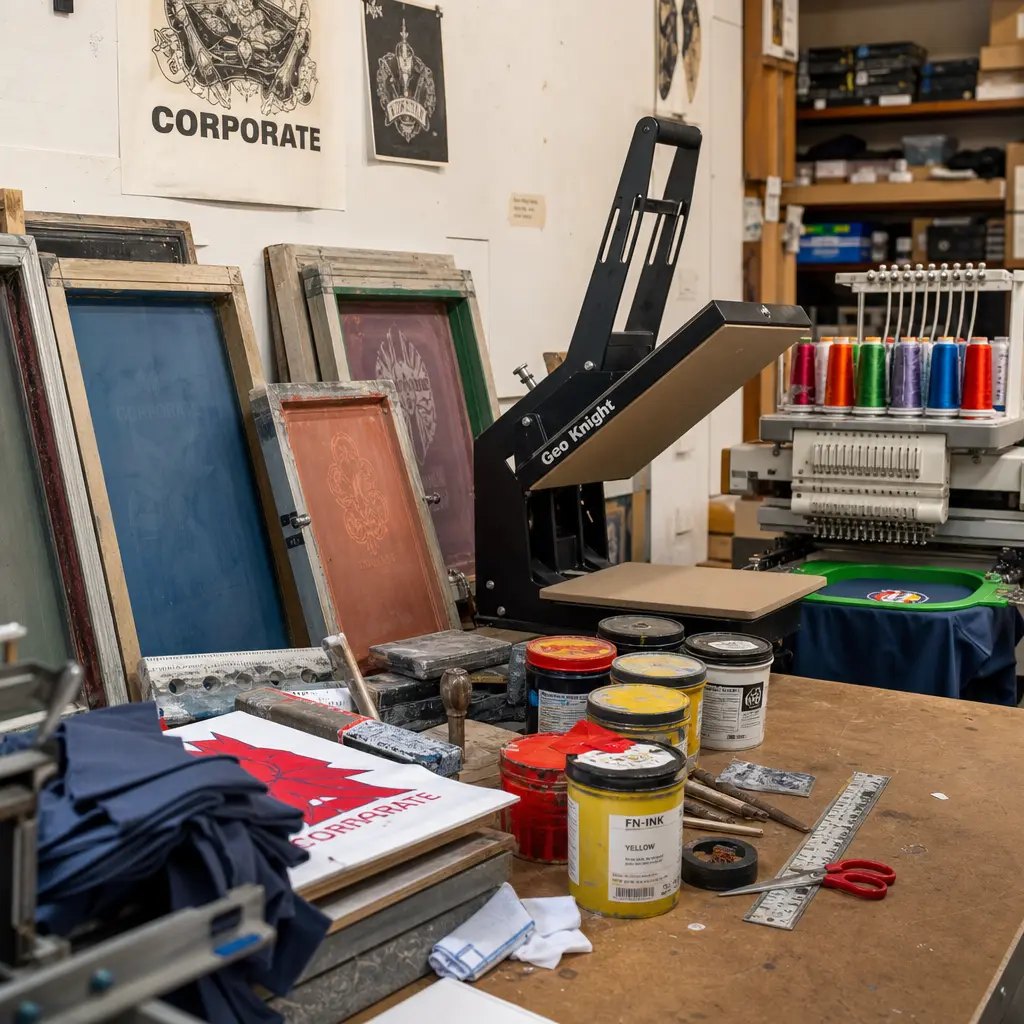
Printing is often the quiet MOQ driver. One-color screen print is usually the most efficient choice for simple trade show logos, URLs, booth numbers, and QR codes with strong contrast. Two-color screen print can still work well, but every added color creates registration work and another chance for rejection. Heat transfer and digital print support more complex art, but both should be tested on the actual cotton surface. Embroidery looks premium, but it is slower and can make small pouches stiff.
Translate artwork into measurable terms before the supplier quotes. Fine lines that are too thin can fill in on textured cotton. Small text can disappear if the weave is coarse. QR codes need enough size, contrast, and quiet space to scan after sewing and handling. Keep critical artwork away from the drawstring channel, where gathering can distort it. If you need several logo versions, keep the pouch spec identical and change only the print file whenever possible.
- Use screen print for simple one-color or two-color branding.
- Use heat transfer or digital print only after testing the fabric and the finished pouch.
- Avoid tiny text and hairline rules that will not survive the cotton weave.
- Test QR codes on finished pouches, not only on the artwork PDF.
- Keep print placement away from the gather line and channel edge.
- Ask whether each artwork version creates a separate screen charge, proof, or sorting fee.
Approve A Sample That Matches Production
The sample is the control standard. It should tell the factory, and you, what bulk production is expected to match. If the bulk order will use 5 oz natural cotton, a 4 mm cord, one-color screen print, and overlocked side seams, the approved sample should follow that spec as closely as the schedule allows. A substitute sample may be acceptable for early review, but it should not become the final standard without documentation.
Sample review should go beyond appearance. Measure finished width and height, channel height, print size, print placement, cord length, and cord diameter. Put the actual item inside the pouch or use a weighted dummy. Open and close the pouch several times. If booth staff will fill hundreds of pouches quickly, the opening should be smooth and predictable. Write comments as production instructions, not vague notes.
- Approve a pre-production sample using the intended cotton, cord, print method, and seam construction when possible.
- Measure the finished pouch in the same way the factory will inspect bulk goods.
- Test the exact item or a full kit inside the pouch before sign-off.
- Record change notes as specific dimensions and positions instead of general comments.
- Keep dated photos, artwork files, and the approved swatch with the sample record.
- Confirm whether the approved sample will serve as the bulk reference for QC.
Write QC Terms Before Bulk Starts
Quality control for promotional textile goods should be practical, measurable, and agreed before the first bulk lot is packed. Without a written defect standard, the buyer may reject stains, crooked prints, or weak seams that the factory considers normal promotional tolerance. A simple written standard reduces that friction. It also gives the factory a way to brief operators and inspectors before errors multiply.
Many buyers use AQL or a simplified random inspection for small promotional orders, but the real value is in defining critical, major, and minor defects. Critical defects include contamination, mold, unsafe foreign objects, or completely wrong goods. Major defects include wrong size beyond tolerance, wrong artwork, unreadable QR code, open seam, severe stain, broken cord, or print failure. Minor defects can include loose threads or light wrinkles if those are within the approved standard. Function matters too. The pouch must open, close, and carry the intended item without obvious failure.
- Measure finished size from the approved method and record the result.
- Check bulk fabric for shade variation, odor, stains, holes, and slubs before cutting.
- Inspect seams for skipped stitches, broken stitches, exposed raw edges, and puckering.
- Check cord movement, cord-end finish, and repeated open-close performance.
- Verify print placement, adhesion, curing, and QR scan readability.
- Count cartons, inner bags, and version labels so the receiving team can allocate goods correctly.
Quote Packing, Freight, And Payment Terms
Packing affects both cost and receiving speed. Bulk packing is usually the cheapest option when the buyer will repack later. Inner bags of 50 or 100 pieces make warehouse allocation easier. Individual polybags cost more and use more labor, but they may be worth it when the pouch needs to look retail-clean, support barcode scanning, or arrive as a pre-packed attendee kit. Mixed-version cartons should be avoided unless inner bags are labeled and the carton mark lists exact counts by version.
Freight and payment terms also influence MOQ. EXW, FOB, CFR or CIF, DAP, and DDP place different responsibilities on buyer and supplier. Some factories will hold a lower MOQ only if the payment is straightforward and the delivery term reduces their exposure. Ask for carton length, width, height, gross weight, net weight, and total CBM so the shipping choice is based on data, not guesswork.
- Use bulk pack when the buyer will insert or sort goods later.
- Use inner bags of 50 or 100 for easier warehouse counts and booth allocation.
- Use individual polybags only when cleanliness, retail handling, or barcode control requires it.
- Avoid mixed cartons unless every version is labeled at the inner-bag level.
- Confirm the quotation basis, including EXW, FOB, DDP, or another term.
- Ask whether payment terms or destination delivery requirements increase the practical MOQ.
Build A Clean RFQ And Compare Quotes
A good RFQ makes quotes comparable. Send one spec, one artwork package, one packing plan, and one delivery date. If the supplier receives a vague message with several possible sizes, several possible print methods, and an uncertain ship date, the quote will usually include a wider risk buffer. Clear input does more for MOQ than pressure does.
The best comparison is not just unit price. Compare the setup fees, sample fees, per-artwork minimums, packing charges, payment terms, incoterm, and the real production capacity for your date. Ask the supplier to state what happens if you reorder the same spec later. If the pouch will be used again next quarter, reorder terms matter as much as the first price.
- Send one finished size, one fabric weight, one cord spec, and one packing method per quote request.
- Ask for quote tiers that match realistic buying levels, not only the lowest possible number.
- Request separate line items for screens, samples, labels, carton marks, and version sorting.
- Compare quotes on the same incoterm and payment basis.
- Ask how long the approved sample and print setup can be reused for reorders.
- Use the factory's stated capacity and timeline to judge whether the lower MOQ is actually safe for the event date.
Specification comparison for buyers
| Procurement variable | Practical B2B specification | MOQ impact | QC or quote detail to lock |
|---|---|---|---|
| Cotton fabric weight | 4 oz/yd² is about 135 GSM, 5 oz/yd² about 170 GSM, and 6 oz/yd² about 200 GSM. Confirm the supplier's actual mill spec because weave and finishing change hand feel and opacity. | Stock 4-6 oz cotton is usually easier to source than custom dyed, brushed, washed, or certified fabric. | Ask for GSM tolerance, shade tolerance, shrinkage expectation, and an approved swatch for bulk matching. |
| Finished pouch size | State width x height after sewing, measured flat, excluding the drawcord. Allow enough room for the packed item plus closure clearance, especially for rigid or cornered contents. | Non-standard sizes increase cutting waste and can force a higher cutting minimum. | Define measurement points and tolerance, commonly plus or minus 5 mm for small pouches and plus or minus 8 mm for larger ones unless the kit requires tighter control. |
| Seam construction | Flat single-layer pouches with overlocked or lockstitch side seams are the simplest. Gussets, linings, French seams, boxed bottoms, and reinforced corners add operations. | More sewing steps usually reduce low-MOQ flexibility because each batch needs more setup and in-line control. | Confirm seam allowance, stitch density, thread color, edge finishing, and whether the pouch needs reinforcement for heavier kits. |
| Drawcord | Cotton cord gives a natural look; polyester cord pulls more smoothly and resists abrasion better. Common diameters are roughly 3-5 mm depending on pouch size. | Custom cord color, special tips, waxed cord, or metal aglets can create accessory minimums. | Lock cord material, diameter, exposed finished length, knot or tip method, color tolerance, and pull performance when loaded. |
| Print method | One-color screen print is usually the most efficient choice for simple trade show logos. Heat transfer and digital print suit more complex art, while embroidery is more premium but slower. | Every color, screen, transfer file, or embroidery setup can create its own minimum and setup charge. | Specify print size, placement, Pantone or closest-match color, line-width limit, QR code size, rub test, and approval standard. |
| Artwork splits | Keep one size, one fabric, one cord, one print position, and one packing method while changing only the logo version when possible. | Splitting one order across several designs increases proofing, printing, drying, sorting, and carton-label workload. | Request separate pricing for total MOQ, per-artwork MOQ, screen charges, version sorting, and mixed-carton labeling. |
| Packing | Inner bags of 50 or 100 pieces usually work well for event allocation. Individual polybags are slower and costlier but may be needed for retail kits or barcode control. | Special packing, insert cards, barcode labels, destination sorting, or mixed-version cartons can trigger packing minimums or labor surcharges. | Specify pieces per inner bag, pieces per export carton, carton dimensions, gross weight, net weight, and mixed-version rules. |
| Lead time | Plan for artwork proof, sample, courier, buyer approval, material purchase, printing, sewing, inspection, packing, export handover, freight, customs, and receiving. | Lower MOQ does not always shorten lead time if the same setup steps still apply. | Ask for calendar days for each stage and the latest sample-approval date needed to meet the trade show delivery date. |
| Inspection | Use AQL or a written defect standard rather than visual opinion. For small promotional textile orders, many buyers use a simplified random inspection with defined critical, major, and minor defects. | Low-MOQ orders still need inspection time, but the method can be scaled to the order size. | Define sample size, measurement method, loaded-fit test, print adhesion check, QR scan check, seam-strength check, and carton-count verification. |
Buyer checklist before sampling
- Measure the actual item or kit going inside the pouch, including width, height, thickness, weight, corner sharpness, and whether it must be fully covered when the drawcord is closed.
- Specify finished pouch size after sewing, not cut-panel size or a catalog name, and state whether the drawcord channel is included in the measurement.
- Choose cotton weight before negotiation, then request the supplier's normal GSM tolerance and a matching bulk swatch.
- Confirm construction details: flat or gusseted, single-layer or lined, seam allowance, stitch density, thread color, and bottom reinforcement.
- State drawcord material, approximate diameter, color, exposed length, knot or tip method, and whether the cord must slide smoothly after loading.
- Provide vector artwork with print width and height, color reference, placement from finished edges, and any minimum line, small text, or QR-code requirements.
- Separate total order quantity from per-design quantity because printing, sorting, and carton labeling are planned differently.
- Request quote tiers such as 500, 1,000, 2,000, 3,000, 5,000, and 10,000 pieces only if those tiers match the event or replenishment plan.
- Ask for setup charges to be itemized, including screens, artwork cleanup, sample making, courier, labels, barcode labels, carton marks, and version sorting.
- Approve a production-relevant sample made with the intended cotton, cord, print process, seam construction, and packing method before bulk cutting whenever the schedule allows.
Factory quote questions to send
- What is your MOQ for this exact finished size, cotton GSM, fabric color, drawcord material, seam construction, print method, artwork count, and packing method?
- Is the MOQ calculated per order, per fabric lot, per finished size, per body color, per cord color, per artwork, per ink color, per packing version, or per shipment?
- If we reduce MOQ, which cost increases first: fabric purchasing, cutting waste, screen setup, print labor, drying space, sewing setup, inspection, packing, export handling, or administration?
- Which cotton weights, widths, colors, and roll quantities do you have available now, and what GSM tolerance and shade tolerance do you normally control?
- Can multiple logo versions share the same cutting batch and sewing batch, and what is the minimum quantity per artwork version after shared cutting?
- For this artwork, what print method do you recommend and what are your minimum line width, minimum readable text height, minimum QR code size, ink coverage limit, and placement tolerance?
- Will the pre-production sample use booked production fabric, final drawcord, final ink, final print position, final seam construction, and intended packing, or only substitute materials?
- What charges are separate from the unit price: screens, artwork cleanup, sample making, courier, labels, individual bags, inner bags, barcode labels, carton marks, inspection support, or mixed-version sorting?
- What is the timeline in calendar days for artwork proof, sample production, sample courier, material purchase, bulk printing, sewing, trimming, inspection, packing, and export handover?
- How many pieces fit per inner bag and export carton, and what are the estimated carton length, width, height, net weight, gross weight, and total CBM for each quantity tier?
Quality-control points to confirm
- Finished pouch size should be measured flat after sewing and pressing, excluding the drawcord; use plus or minus 5 mm for small pouches and plus or minus 8 mm for larger pouches unless the purchase order states a different limit.
- Cotton GSM should be checked against the approved swatch or fabric report, with a practical tolerance such as plus or minus 5% unless the order calls for another limit.
- Bulk fabric should be inspected before cutting for shade variation, stains, oil marks, weaving defects, holes, heavy slubs, odor, moisture marks, skew, and excessive creasing.
- Cut panels should be bundled and labeled by size, fabric color, and artwork version so the factory does not mix versions during printing, sewing, or packing.
- Seams should be checked for skipped stitches, broken stitches, loose threads, uneven seam allowance, exposed raw edges, puckering, needle holes, and weak bottom corners.
- Drawstring channels should have even width and smooth cord movement; the pouch should open and close repeatedly without snagging or twisting.
- Cord ends should match the approved sample, whether knotted, tipped, wrapped, or left natural, and should not fray during normal booth handling.
- Print placement should be measured from the finished top and side edges, with tolerance such as plus or minus 3 mm for small logo areas and plus or minus 5 mm for larger pouches.
- Ink adhesion should be checked after curing with a dry rub test and light flexing; heavy cracking, tacky ink, smudging, ink transfer, or obvious pinholes should be rejected or reworked before shipment.
- QR codes, URLs, booth numbers, and small text should be scanned or read on finished pouches after sewing and packing, not approved only from digital artwork.