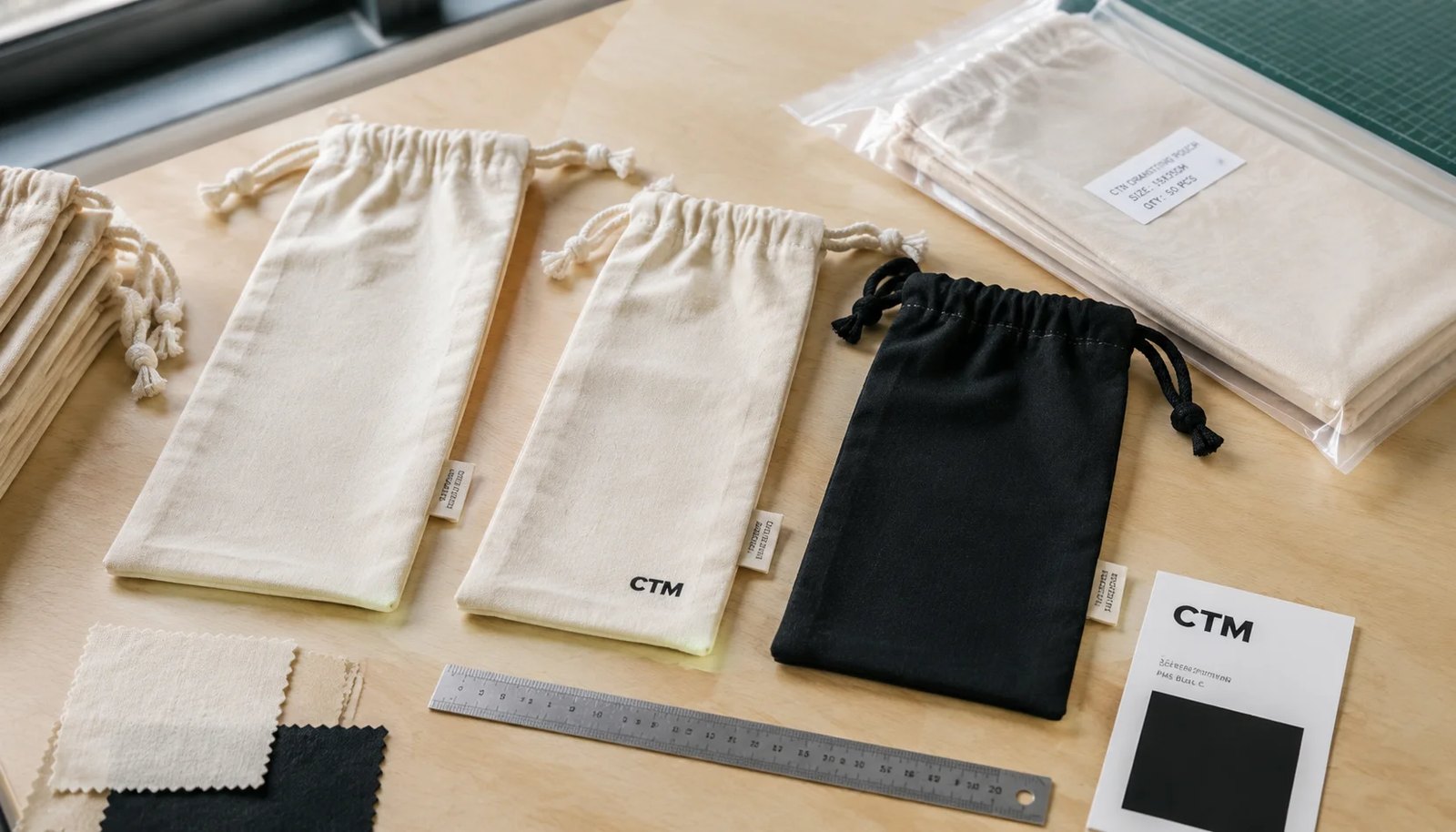
Why liquor retailers negotiate MOQ differently
Cotton drawstring pouches are usually bought as campaign packaging, not as a continuous core product. A liquor retailer may need pouches for a holiday gift table, a private-label bottle, a loyalty offer, a tasting event, or a regional display. The quantities can be meaningful, but they are often split across bottle formats, store groups, logo versions, and seasonal timing. That split is what makes MOQ negotiation difficult.
A factory does not only think about sewing time. MOQ is shaped by fabric availability, dyeing minimums, cutting efficiency, print setup, cord sourcing, packing labor, and inspection complexity. A simple natural cotton pouch in one size is a very different order from a black dyed pouch with gold print, two cord colors, and store-by-store carton allocation. The best negotiation starts by reducing avoidable variation before asking for a lower minimum.
For liquor retail, the practical question is not "What is your lowest MOQ?" It is "Which specification gives us the best retail presentation at the lowest manageable MOQ?" That framing keeps quality visible. If the buyer pushes only on the minimum, the supplier may protect margin by quoting lighter fabric, a smaller print area, shorter cords, looser packing, or broader tolerances.
- MOQ pressure usually comes from fabric sourcing, dyeing, print setup, and packing splits more than from sewing alone
- One size, one fabric, one logo method, and one packing method give the buyer the strongest starting leverage
- Multiple store allocations can raise operational complexity even when the pouch itself is simple
- A lower MOQ is only useful if bottle fit, print quality, and carton accuracy remain controlled
Start with bottle format and retail use
Before discussing GSM or price, define what the pouch has to fit and how it will be used. A 750 ml Bordeaux-style bottle, a wider spirits bottle, a tapered bottle, a 375 ml half bottle, and a gift set with accessories do not behave the same inside a drawstring pouch. A pouch that looks tidy on a slim wine bottle may be tight around a round bourbon bottle or too tall for a shorter liqueur bottle.
Use actual bottle dimensions where possible. Record total height, body diameter, shoulder width, and the height where the drawstring should close. Then decide whether the pouch should hide the entire bottle, leave the neck partly visible, or act as a simple carry and dust cover. This matters for liquor retailers because shelf presentation, gift-counter speed, and display neatness are part of the value.
For mixed SKU programs, avoid adding too many sizes too early. A single well-tested size may cover the majority of 750 ml bottles, while a second size can be reserved for short or wide-shoulder bottles. More sizes can improve fit, but each size creates another SKU to cut, pack, label, count, allocate, and reorder.
- Standard 750 ml bottle pouch: plan around height, maximum diameter, shoulder width, and closure allowance
- Wide spirits bottle: test the shoulder area and drawstring closure, not only the body diameter
- 375 ml or mini gift format: avoid using a tall 750 ml pouch unless loose presentation is acceptable
- Gift set: confirm whether the pouch holds the bottle only or bottle plus opener, card, mini, or insert
- Store allocation: decide whether pouches ship as one bulk SKU or separated by bottle program, region, or store group
Fabric GSM, cotton type, and what to specify
Fabric weight affects presentation, cost, print appearance, and freight. Very light cotton can work for short-use promotional bags, but it may collapse around a glass bottle and show the bottle shape too clearly. Heavier cotton canvas looks more structured, but it increases material cost, sewing resistance, carton weight, and sometimes closure stiffness. For many liquor retail pouches, a mid-weight canvas is the practical starting point, with the exact range confirmed by sample rather than assumed from a number alone.
Do not quote only "cotton pouch" or "canvas bag." Ask for cotton type, weave, color route, and target GSM range. A smooth plain weave or light canvas supports cleaner printing than a highly textured fabric. Natural cotton can include small specks and shade variation, which may be acceptable for an organic or craft-style presentation but less suitable for a polished luxury display.
GSM numbers should be treated as controlled ranges, not magic guarantees. A buyer can request, for example, a 230 to 250 GSM target and ask the supplier what tolerance is realistic in bulk. This is more useful than demanding an exact number the supplier cannot consistently maintain. If the pouch must stand up on a display table or feel premium in hand, approve a fabric swatch and one assembled sample before locking the purchase order.
- Light plain weave can suit low-cost event giveaways but may look flat on bottle displays
- Mid-weight cotton canvas is often the strongest balance for gift presentation and cost control
- Heavy canvas can support a premium feel but should be tested for drawstring closure and carton weight
- Natural cotton usually supports lower MOQ than custom dyed fabric, depending on supplier stock
- Custom dyed cotton requires lab dip approval and shade tolerance before bulk production
MOQ levers that are worth negotiating
MOQ negotiation is most effective when the buyer changes variables that actually affect factory setup. The strongest levers are fabric route, pouch size, artwork complexity, cord customization, and packing method. A supplier has more room to help when the buyer uses stock natural cotton, a standard size, a one-color print, standard cord, and bulk carton packing.
The weaker approach is to ask for a low MOQ while keeping every custom detail. A small order with custom dyeing, metallic ink, two sizes, special cord, hangtag, barcode, and store-ready sorting may be inefficient for both sides. The factory may quote high, refuse the order, or accept it with hidden compromises. Procurement should decide which details are essential for the retail program and which can be standardized.
Ask for option pricing instead of one all-or-nothing quote. For example, compare stock natural fabric versus custom dyed fabric, one size versus two sizes, single-side cord versus double-side cord, and bulk packing versus store-allocation packing. This shows the cost and MOQ effect of each decision. It also creates a clean internal discussion with merchandising and operations teams.
- Keep fixed: bottle fit, minimum fabric quality, approved print appearance, safe carton labeling, and inspection criteria
- Negotiate first: stock fabric, standard cord, simplified print colors, standard size, and bulk packing
- Ask for quote tiers at the same specification so price breaks are visible
- Ask for separate option lines so MOQ increases are tied to specific custom choices
- Do not trade away sampling or QC controls to reach a lower MOQ
Print method and branding choices
Most cotton drawstring pouches for liquor retail use simple branding: a bottle brand mark, retailer logo, holiday message, reserve label, or one-color campaign graphic. Screen print is commonly used for solid artwork because it is direct, economical at volume, and can produce a clean result on suitable cotton. That said, durability and sharpness depend on fabric texture, ink, curing, print size, and handling, so the method should be approved on the actual fabric rather than assumed from a catalog description.
Heat transfer or other methods may be useful when artwork has gradients, tiny details, or multiple colors that are expensive to screen. The tradeoff is that transfers can feel different from ink on fabric, and the edge or adhesion should be checked on textured cotton. For a premium liquor presentation, the logo should look intentional, not like an afterthought applied to an unsuitable base fabric.
The quote must define print size and placement. A 70 mm mark near the lower center and a 150 mm front graphic are not the same cost or production risk. Placement should reference the finished pouch, not the cut panel, because the drawstring channel and seam allowance change visual balance. Ask for a print strike-off on the chosen cotton before pre-production sample approval.
- Use screen print for simple solid logos when volume and fabric surface make it appropriate
- Use transfer methods only when artwork complexity justifies the finish and cost
- Confirm whether the price includes one side or two sides, and the maximum print area
- Set logo dimensions in millimeters and placement tolerance from finished edges or centerline
- Simplify fine crest lines or small serif text if the fabric texture breaks up the image
Packing and allocation can change the real cost
Packing is a procurement cost center, not a small afterthought. A pouch packed flat in bulk cartons is much easier to quote than a pouch packed by store, by bottle SKU, by campaign bundle, or with individual polybags and barcode labels. All of those services can be valid, but they should appear as separate quote lines so the buyer can decide where the work belongs: at the factory, importer warehouse, distributor, or store.
Liquor retailers should connect packing decisions to the campaign flow. If pouches are going to a central warehouse and then allocated with bottles, bulk carton packing with clear SKU labels may be enough. If pouches ship directly to stores for a holiday display, store-ready cartons may reduce domestic handling but raise factory sorting risk. If the pouch is handed to customers at a gift counter, individual polybags may be unnecessary and may conflict with sustainability policies.
Carton count matters because pouches can be compact but still create handling issues when cartons are overfilled or poorly labeled. Ask for pieces per carton, carton dimensions, net weight, gross weight, and carton marking format. If cartons contain mixed colors or sizes, require an assortment label and packing-list structure that warehouse staff can verify without opening every carton.
- Bulk flat packing usually gives the cleanest low-MOQ quote
- Individual polybags add material, labor, and plastic-use considerations
- Store-ready packing can save destination labor but increases factory sorting and carton-label risk
- Carton marks should show PO number, pouch size, color, quantity, carton number, and destination group if applicable
- Gross weight and carton dimensions help compare freight and warehouse handling, not just unit price
Sampling path that prevents expensive disputes
A cotton pouch is simple enough that teams sometimes rush sample approval. That is where avoidable problems enter bulk production. The correct approval path is usually fabric swatch, print strike-off, and pre-production sample. Each stage answers a different question. The swatch confirms material and color. The strike-off confirms logo appearance on the actual fabric. The pre-production sample confirms final size, seams, cord function, and packing presentation.
Use measured comments, not vague approvals. Instead of writing "make logo slightly higher," specify the approved distance from the bottom edge or the centerline position. Instead of saying "fabric feels too thin," state the GSM range or approve a heavier reference swatch. Clear comments protect both sides because they give the factory something specific to reproduce and give procurement a basis for inspection.
For liquor retail, sample testing should include real bottles from the program. Check whether the pouch closes cleanly around the neck, whether the logo remains visible after closure, whether the bottle corners stress the seams, and whether staff can insert bottles quickly during a busy selling period. A sample that looks fine empty can fail as a retail packaging item once glass weight and bottle shape are involved.
- Approve fabric swatch before confirming final GSM and color route
- Approve print strike-off before allowing bulk print setup
- Approve pre-production sample with final cord, channel construction, logo position, and packing method
- Test on actual bottle formats, including wide-shoulder or short bottles in the SKU mix
- Keep the signed sample or approved photo record as the inspection reference
How to compare supplier quotes fairly
A true comparison is not just price per pouch. Normalize the specification first: finished size, GSM range, cotton color route, cord type, print method, print area, packing method, sample charges, setup charges, and lead-time assumptions. If one quote is lower, check whether it uses lighter fabric, a smaller logo, a thinner cord, fewer packing services, or a looser tolerance.
Then compare commercial risk. A supplier with a slightly higher unit price may offer clearer carton planning, better sample discipline, or more realistic timing. That can be worth more than a small price saving when the pouches support a fixed holiday launch or a gift-with-purchase promotion. Late delivery, wrong allocation, or rejected print can erase the apparent savings quickly.
Ask suppliers to quote the same base option plus the same alternatives. For example: Option A stock natural cotton, one-color print, bulk packing; Option B custom dyed cotton; Option C two sizes; Option D store-ready carton allocation. This structure makes the MOQ negotiation visible and keeps merchandising, procurement, and logistics aligned.
- Compare base quote only after the spec is identical
- Separate tooling, sample, lab dip, and screen charges from recurring unit price
- Review carton efficiency and gross weight when comparing landed cost
- Check whether MOQ is total order quantity or per size, color, artwork, or packing group
- Treat vague quotes as higher risk even when the unit price is attractive
QC criteria for purchase order control
Quality control should be written before production, not debated after goods are packed. Cotton drawstring pouches have a short list of important acceptance points: fabric weight and shade, finished dimensions, print position and coverage, seam strength, drawstring function, stains or odor, and carton accuracy. The goal is to define what affects retail presentation and warehouse flow.
Some natural variation should be expected with cotton, especially unbleached fabric. Small seed specks or slight slub may be acceptable if they match the approved sample and brand direction. Major issues are different: visible stains, mildew odor, open seams, severe logo skew, wrong dimensions, drawstrings that jam, or carton labels that do not match the packing list. These defects create customer-facing problems or operational cost.
For negotiated low-MOQ orders, QC discipline becomes more important because replacement stock may be limited. Put measurement tolerances, logo placement tolerance, defect definitions, and packing-label rules in the purchase order or quality appendix. If the supplier uses AQL or another inspection system, confirm how it applies to stitching defects, print defects, and carton count before production begins.
- Measure finished width and height after sewing, not cut panels
- Check logo size, placement, skew, coverage, and smudging against the approved strike-off
- Pull each sampled cord through the channel to confirm smooth closure
- Inspect seams for skipped stitches, open sections, puckering, and loose thread ends
- Screen for odor, mildew, oil stains, dirt, and heavy creasing before carton sealing
- Verify carton count, carton mark, SKU mix, color, size, and store allocation against the packing list
A practical negotiation script for buyers
Start the supplier conversation with a controlled base specification. For example: natural cotton canvas, one standard 750 ml pouch size, one-color screen print, standard cotton cord, flat bulk packing, and approval by swatch, strike-off, and pre-production sample. Ask for MOQ and tiered prices on that base. This gives you the cleanest view of the supplier's true entry point.
Then add options one by one. Ask what happens if the fabric is dyed black, if a second pouch size is added for wider spirits bottles, if the logo becomes two colors, or if cartons must be packed by store allocation. The answer should show the cost, MOQ, and lead-time effect of each choice. If the supplier cannot separate these variables, the quote may be hard to manage later.
Finally, negotiate with tradeoffs that preserve retail quality. Accepting stock fabric or standard cord may be harmless. Removing the print strike-off, ignoring bottle fit, or accepting vague carton labels is not. The best outcome is not the absolute lowest MOQ; it is the lowest practical MOQ for a pouch that looks right on the bottle, arrives in time, and can be allocated without warehouse confusion.
- Ask for the lowest MOQ on a simple base spec before introducing custom options
- Request price tiers so the cost curve is visible
- Use option lines to show which custom features are driving MOQ upward
- Protect sample approvals, bottle-fit testing, and QC standards even during price negotiation
- Confirm all final choices in the purchase order, not only in email discussion
Specification comparison for buyers
| Sourcing route | Typical cost position | MOQ and lead-time effect | Best fit for liquor retail | Main risk to control |
|---|---|---|---|---|
| Stock natural cotton, standard 750 ml size, one-color screen print | Lowest custom-entry cost because fabric, cord, and sewing pattern are already familiar | Usually the easiest route to negotiate a lower MOQ and shorter approval timeline | Regional launch, holiday bottle wrap, tasting-room gift pouch, distributor trial | Confirm finished size against actual bottle shapes; do not let the supplier quote a generic wine-bag template |
| Stock fabric with two pouch sizes for mixed bottle formats | Moderate cost because fabric and print setup stay simple but cutting and packing split | MOQ may be split by size, so ask whether the factory can combine fabric purchasing across both sizes | Retailers carrying 375 ml, 750 ml, or selected wide-shoulder spirits in one campaign | SKU split can create carton-label errors and uneven inventory if store allocation is not defined |
| Custom dyed cotton with standard size and simple logo | Higher cost due to dyeing, shade control, and possible fabric minimums | MOQ and lead time normally increase compared with stock natural fabric | Brand-controlled premium program where black, navy, burgundy, or seasonal color is part of the display plan | Approve lab dip and bulk shade tolerance; dyed cotton can vary by lot and cord shade may not match exactly |
| Premium canvas, double drawcord, larger print area | Higher unit cost from heavier fabric, trim, print handling, and carton weight | MOQ may not rise as much as dyed fabric, but freight and sample approval become more important | Gift sets, limited releases, loyalty packs, reserve-room presentation | Heavy fabric can reduce carton efficiency; check closure function on real bottles before bulk approval |
| Store-ready bundled packing by location or SKU mix | Unit price may look close, but labor and packing materials add hidden cost | MOQ can rise because sorting slows production and increases packing-control work | National or multi-store campaign where cartons must ship directly to store groups | Wrong allocation is costly; require carton marks, inner bundle counts, and packing-list logic before production |
| Heat transfer for complex artwork or short visual test | Can be economical for small or detailed artwork tests, but may cost more per piece at volume | MOQ may be more flexible for artwork complexity, depending on supplier capability | Trial run with gradient artwork, small crest detail, or short event order | Check adhesion, edge feel, and appearance on textured cotton; approve the method on actual production fabric |
Buyer checklist before sampling
- Map the liquor program before quoting: bottle formats, target stores, launch date, display use, and whether pouches ship to warehouse or direct to store groups.
- Measure actual bottles, including height, maximum body diameter, shoulder width, cap or cork height, and drawstring closure allowance.
- Choose one main pouch size when possible; add a second size only when 375 ml, 1 L, squat spirits, or gift-set components cannot share the same fit.
- State fabric construction in practical buying terms: cotton type, weave, target GSM range, color route, and whether natural fiber specks are acceptable.
- Use a realistic GSM range instead of a single perfect number, for example 230 to 250 GSM, and require bulk fabric to be checked within the agreed tolerance.
- Specify cord material, cord diameter, color, single-side or double-side pull, knot position, and whether cord ends must be heat sealed, knotted, or otherwise finished.
- Define print method, logo size in millimeters, print colors, print area, and placement tolerance from the finished pouch edge or centerline.
- Request fabric swatch, print strike-off on actual fabric, and pre-production sample before bulk production starts.
- Separate basic bulk packing from store-ready packing, then quote each option with carton count, carton dimensions, gross weight, and labeling requirements.
- List negotiable items and locked items before supplier discussion: size, GSM, fabric color, cord style, logo method, packing format, delivery window, and inspection standard.
Factory quote questions to send
- What is your MOQ for stock natural cotton fabric, standard pouch size, standard cotton cord, and one-color screen print?
- If we use two bottle-pouch sizes under the same fabric and print artwork, can the MOQ be combined or is it separate by size?
- How does MOQ change for custom dyed fabric, custom cord color, heavier canvas, larger print area, or store-ready bundled packing?
- What fabric weight range is included in this quote, and what GSM tolerance do you apply in bulk production?
- Is the price based on screen print, heat transfer, digital print, or another process, and what maximum print area is included?
- How many print colors are included, what is the extra charge per added color, and are screen charges listed separately?
- Can you quote sample fee, screen fee, lab dip or dye charge, packing-label charge, and any other non-recurring cost as separate lines?
- What are the milestone lead times for fabric swatch or lab dip, print strike-off, pre-production sample, bulk production after approval, and final packing?
- What is your standard packing: pieces per inner bundle or polybag, pieces per carton, carton dimensions, net weight, gross weight, and carton markings?
- What inspection standard do you use for measurement, stitching, print defects, stains, cord function, carton count, and carton labeling?
Quality-control points to confirm
- Bulk fabric GSM should be checked against the agreed range using production fabric, not only the approved swatch.
- Finished pouch width and height should be measured after sewing, with tolerance stated for each dimension and oversized or undersized pieces recorded separately.
- Bottle fit should be checked with approved reference bottles or confirmed dimensions, including wide-shoulder spirits and taller 750 ml formats if included in the program.
- Print placement should match the approved strike-off or pre-production sample within the stated tolerance; skewed, smudged, weak, or visibly off-center logos should be treated as major defects for retail presentation orders.
- Ink coverage and adhesion should be checked on the actual cotton surface, especially on natural, slub, recycled, or heavier canvas fabrics where texture affects the print edge.
- Drawcords should pull smoothly through the channel without trapped seams, fraying, missing knots, inconsistent lengths, or closure tension that makes the pouch hard to use.
- Top-channel stitching and side seams should have no open seams, skipped stitches, broken threads, severe puckering, or loose thread ends that affect presentation.
- Fabric color and cord shade should be reviewed under consistent lighting, especially for custom dyed fabric where batch variation is more visible.
- Odor, mildew marks, oil stains, dirt, and heavy crease marks should be screened before packing because many pouches go directly to gift counters or store displays.
- Carton counts, SKU labels, color labels, store-allocation marks, and packing lists must match the purchase order to avoid recounting and misallocation at the warehouse.