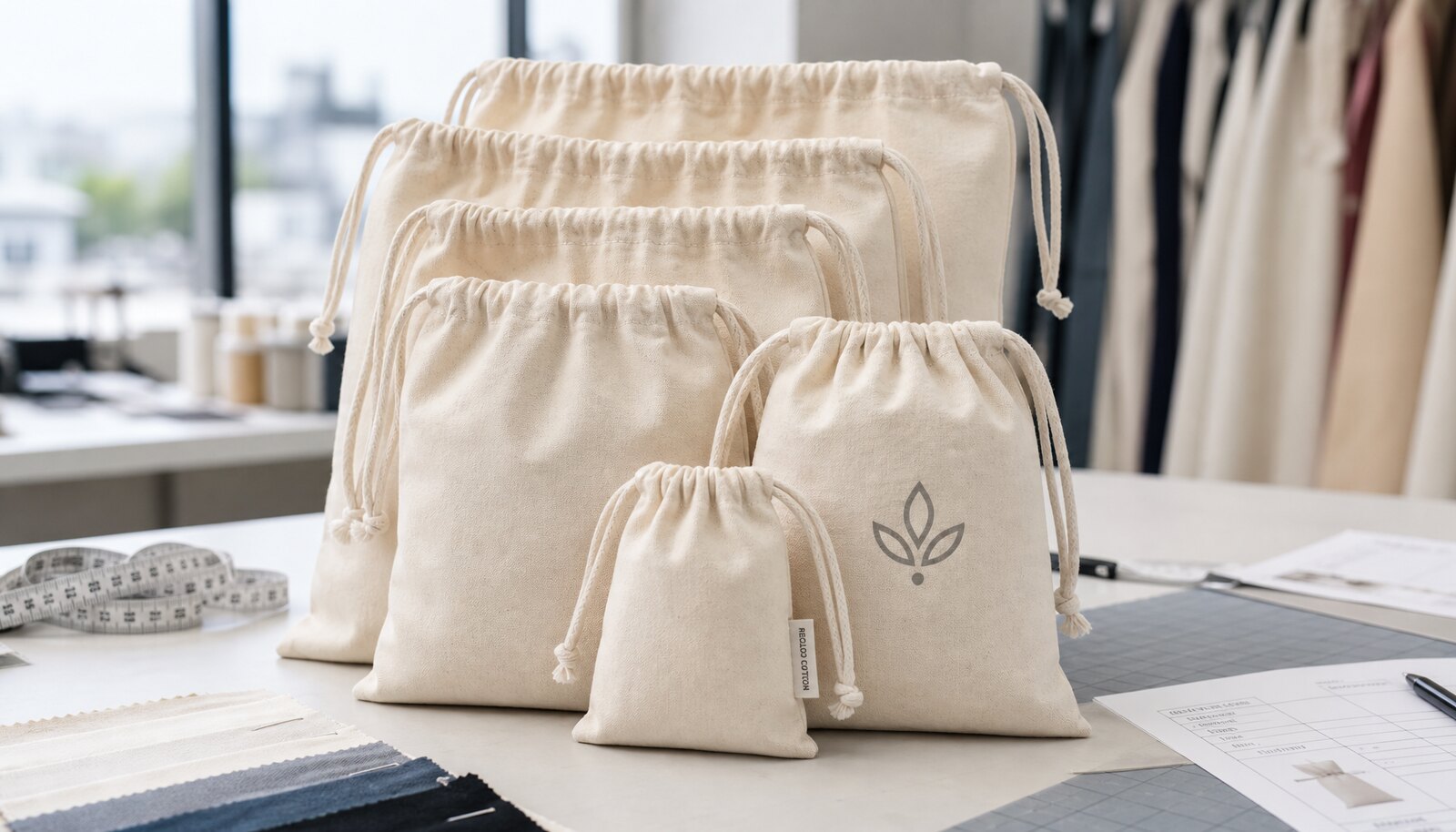
Why MOQ is harder on cotton drawstring pouches than it first appears
Gift shop buyers often hear a single MOQ number, but cotton drawstring pouch sourcing is usually governed by several separate limits. A factory may be comfortable producing a natural pouch in one size at a modest quantity, yet the order becomes harder once you add a second size, a dyed color, a second print color, or retail-ready packing. The factory is not only protecting sewing capacity; it is also managing fabric width, cutting efficiency, print setup, packing labor, and carton planning.
That is why the most useful negotiation question is not simply, “What is your MOQ?” It is, “Which part of this spec creates the minimum?” In practice, the bottleneck may be stock fabric, dye lot, screen setup, or packing time. If you know the real constraint, you can simplify the right variable instead of trimming quantity blindly. That creates a more accurate quote and a better path to a repeatable program rather than a one-off sample job.
For gift shops, MOQ also ties to assortment strategy. A seasonal collection with five pouch variants is almost always more expensive to launch than a focused program built around one core size and one secondary size. Buyers who plan around sell-through and replenishment cycles are usually in a stronger position to negotiate because the factory sees a repeat order path, not only a small test order with multiple exceptions.
The cleanest starting point is a single base spec: one size, one fabric color, one print color, and one packing format. Once the supplier quotes that basis clearly, you can test the cost effect of each change. That gives you better leverage and a clearer approval trail.
- Treat MOQ as a mix of fabric, print, sewing, and packing constraints, not one headline number.
- A simpler first order often creates better pricing than a complicated low-volume assortment.
- Repeatable specs matter for gift shops because replenishment is as important as launch cost.
Choose the pouch spec that protects margin and shelf appeal
Cotton drawstring pouches sit between packaging and product. If they feel too thin, they can look cheap on a retail shelf; if they are too heavy, they may raise landed cost without adding visible value. The right balance depends on what the pouch carries and how the item will be displayed. For light inserts, souvenirs, and lower-priced add-ons, a lighter cloth can be enough. For jewelry, cosmetics, or premium gift sets, a denser fabric often improves opacity and makes the pouch feel more intentional.
A practical way to brief suppliers is to use a GSM range instead of a vague quality description. In many buyer programs, around 120-140 GSM works for lighter-duty pouch use and lower introductory cost, while 150-180 GSM is better when opacity, structure, and a more premium retail feel matter. Those are not universal rules, but they are useful commercial brackets when comparing offers. The key is to link fabric weight to the actual retail use case, not to a generic “good quality” request.
Size choice has the same effect. Buyers often over-specify the assortment on the first inquiry by requesting too many sizes before they know which one will sell. That splits volume and weakens bargaining power. If the product line is new, it is usually smarter to anchor around one core size and one optional larger size. If the pouches are part of a broader gift shop program, a smaller assortment also makes replenishment simpler and reduces the risk of dead stock in niche sizes.
Color changes the commercial picture as well. Natural cotton is usually the easiest basis for MOQ negotiation because it avoids dye lot issues and is often easier to share with other stock programs. Bleached or dyed versions may fit branding better, but they add supply risk and can create a separate minimum by shade. For a gift shop program, ask whether color is a genuine selling point or just an aesthetic preference that raises minimums without improving sell-through.
- 120-140 GSM generally supports lighter-duty pouch use and lower introductory cost.
- 150-180 GSM usually gives better opacity and a more premium retail feel.
- Natural cotton is often easier to source and reorder than custom dyed fabric.
- One core size plus one secondary size is usually more manageable than a wide launch assortment.
What actually moves MOQ in a factory quote
Factories do not set MOQ based only on total piece count. They build the number around production steps with different economics. A simple natural pouch may be easy because the factory can cut and sew it on a line that already handles similar work. But if you change the base color, add multiple print colors, or ask for individual retail packing, the supplier may need separate material preparation, extra setup, and more labor per unit. The quoted MOQ may therefore be a combination of thresholds rather than one stand-alone number.
The most useful move is to ask for MOQ by layer. Split the question into size, fabric color, print color, and packing format. That forces the supplier to show where the order becomes difficult. If the minimum is driven by a dyed fabric lot, you can decide whether a natural version is acceptable. If it is driven by print setup, you can simplify artwork. If packing is the issue, you can compare bulk packing against shelf-ready packing and decide whether the downstream convenience is worth the surcharge.
This layered approach also helps you avoid misleading quotes. A supplier may quote a comfortable total MOQ while quietly assuming stock fabric or a single production lot. Once you add the real spec, the commercial picture changes. Ask for the base assumptions in writing so you are not comparing a stock-based quote from one supplier with a custom-run quote from another.
- Ask for MOQ by size, fabric color, print color, and packing format.
- A dyed base often creates a separate fabric minimum that matters more than total unit count.
- Retail-ready packing can be the hidden MOQ driver even when the pouch itself is simple.
Tiered MOQ examples and quote scenarios buyers can use in RFQs
The fastest way to get a useful quote is to give suppliers a tiered request instead of one vague target. For example, ask for pricing at 500, 1,000, and 3,000 pieces for the same pouch spec. That shows where the price curve flattens and whether the factory is offering a real step-down or just a token reduction. If you only ask for one quantity, you do not learn how the supplier behaves when volume improves.
A realistic quote scenario for gift shop buyers might look like this: one natural cotton pouch, one size, one-color screen print, bulk packing. Then compare it against a second option with the same pouch but retail polybagging and barcode labels. The unit cost will usually rise, but the comparison tells you whether the increase is mainly labor or whether the supplier is padding the pack-out step. It also helps you decide whether shelf-ready convenience is worth the added landed cost.
Another useful scenario is to quote the same pouch in 120-140 GSM and 150-180 GSM. If the higher-GSM version only adds a modest amount, it may be the better commercial choice because it reduces show-through and can support a stronger shelf impression. If the price jump is large, that tells you the factory has a real material cost or a limited fabric source. In that case, you can decide whether the premium feel justifies the expense.
Use the scenarios to test negotiation. If the factory quotes 1,000 pieces as the practical minimum, ask what changes would make 600 pieces feasible: natural instead of dyed, one size instead of two, or bulk instead of retail packing. The answer shows you which lever is real and which is cosmetic.
- Ask for tiered pricing at 500, 1,000, and 3,000 pieces when possible.
- Compare the same pouch in bulk pack versus retail pack to expose real labor cost.
- Use a second GSM option to see whether the supplier is pricing fabric or simply quoting one preferred spec.
Sourcing routes compared: direct factory, trading company, and hybrid buying
The best source for cotton drawstring pouches depends on how much control you need and how much internal coordination your team can handle. A direct factory relationship is usually the cleanest route for a buyer who wants to optimize spec, cost, and repeatability. You can ask detailed questions about fabric weight, sewing method, and print setup, and you can often see more clearly where the MOQ is coming from. The tradeoff is that you may need to manage sampling, communication, and follow-up more actively.
A trading company or consolidator can be useful for buyers who source packaging alongside other merchandise. If your gift shop program needs pouches, boxes, tags, and other packaging items in one order, a single intermediary may simplify communication and document handling. The downside is less transparency. MOQ may be embedded in margin or split across upstream suppliers, which makes price comparisons harder unless the quote is structured well.
A hybrid route can work for larger buyers: one supplier handles sampling or artwork development, while another handles production once the spec is fully locked. This can be effective when you need speed at the sampling stage but want stronger production pricing later. The key is to keep the same approved spec, sample reference, and QC standard across both suppliers so version drift does not creep in.
For gift shop procurement, the right route often depends on reorder expectations. If you expect seasonal replenishment, direct factory sourcing may give better repeat pricing and faster reorders once the factory knows your spec. If the order is one-off and mixed across several accessory items, the convenience of consolidation may outweigh the premium.
- Direct factory sourcing usually gives the clearest visibility into true MOQ drivers.
- Trading companies can simplify multi-item programs, but buyers should verify what is stocked versus sourced.
- Hybrid sourcing can work if the approved spec is carried forward without version drift.
How to compare supplier quotes without getting trapped by a low unit price
A quote is only useful if the comparison basis is consistent. When a supplier offers a low unit price, the first question should be what that price includes. Does it assume natural cotton or dyed fabric? One color or multiple print colors? Bulk pack or individual polybag? One sample round or several? Without those answers, the low number may be useful only as a headline, not as a procurement decision.
For a proper comparison, request at least one alternate quote from each supplier. For example, ask for 120 GSM and 160 GSM, or bulk packing and retail packing. That exposes how much cost is tied to material, print setup, and labor. It also helps you understand whether the supplier is competitively priced on the fabric itself or only on a simplified spec. In practical terms, the supplier that can quote multiple spec levels clearly is often the supplier that understands the commercial tradeoffs best.
It is also useful to ask the factory to break the quote into line items. A clear quote should show fabric, cutting, sewing, print setup, print run, packing labor, outer carton, and any special handling. You do not need every supplier to bill exactly the same way, but you do need enough structure to compare apples to apples. If the supplier resists that level of detail, assume there is hidden complexity somewhere in the order.
For seasonal gift shop programs, the best quote is not always the cheapest first-order price. A quote that supports reorders, simple packing changes, and stable color matching may be more valuable over a full sales cycle. That matters when the pouch is part of a broader assortment that must stay visually consistent across multiple stores or holiday drops.
- Insist on the same quote basis from every supplier: size, GSM, artwork, and packing.
- Request at least one alternate spec so you can see how each variable affects the unit price.
- A structured quote is often more valuable than the lowest unstructured quote.
Spec comparison table for procurement decisions
The table below compares the choices buyers most often make when sourcing cotton drawstring pouches for gift shops. It is focused on commercial consequences, not only technical differences, because MOQ negotiation works best when the buyer understands how each choice affects cost, lead time, and reorder flexibility.
Use it as a working decision sheet during RFQ review. If you are comparing three suppliers, ask each one to quote the same basket of spec options so you can see who is truly flexible and who is only quoting one preferred version.
- Write decisions in measurable language, not only descriptive wording.
- Ask for sample photos plus one physical approval sample for important orders.
- Keep quotation, sample approval, and inspection notes tied to the same spec version.
What sample approval should prove before you place a bulk order
A sample should answer commercial questions, not just design questions. On cotton drawstring pouches, the sample must show how the fabric feels in hand, how the cord moves through the channel, whether the logo remains readable when the pouch is cinched, and whether the finished measurements still match the approved drawing. If the pouch is meant to sit on a retail hook or be displayed on a gift table, the sample should also prove that the front face still looks balanced when the top is gathered.
A common procurement mistake is approving a blank stock sample and assuming the bulk order will match once print is added. That can create problems with opacity, print contrast, and overall hand feel. The correct approach is to request a pre-production sample made from production fabric and the intended print method. If the item uses a special cord, label, or fold, those should be on the sample too.
For gift shop buyers, sample approval is also the place to test packing reality. If the pouch will be sold as a stand-alone accessory, ask whether the fold and bagging method allow it to sit neatly in a shelf tray. If the pouch will be used in gift sets, check whether the size fits the intended insert or product bundle. A sample that passes visually but fails in the packing plan is still a bad sample.
Before approval, measure the pouch both open and closed, test the drawcord repeatedly, and inspect the print under normal store lighting. That catches many of the issues that cause trouble in production. The goal is not a perfect sample; it is a sample that proves the factory can repeat the spec at scale.
- Approve a sample made from production fabric and production print method.
- Measure the pouch open and cinched closed, not just flat on the table.
- Test cord movement, logo readability, and shelf presentation before releasing the PO.
Packing choices that change unit cost and warehouse handling
Packing is one of the easiest places for MOQ and cost to drift. Bulk packing in master cartons is usually the simplest and most cost-efficient approach because it reduces labor and improves carton density. That is often the best option when the buyer will repack locally or send the goods into a warehouse. But gift shop programs frequently need shelf-ready presentation, and that can mean individual polybags, barcode labels, folded insert cards, or bundled sets. Each additional packing step adds labor and can trigger a higher MOQ or higher unit price.
Buyers should decide the final packing format before requesting the quote. If the pouches are going directly to store shelves, retail-ready packing may be worth the cost because it removes work downstream. If the order goes to a 3PL or central warehouse, however, the extra packing is often wasted. In that case, keeping the goods bulk-packed and clearly carton-marked may deliver a better landed cost and faster receiving.
Packing also affects damage and receiving accuracy. A carton that is overpacked, undercounted, or not clearly labeled can create avoidable claims even when the product itself is correct. For that reason, the packing spec should include bundle count, carton count, carton size, carton marks, moisture protection, and any barcode location requirement. These details reduce rework and make the order easier to receive without manual checking on every box.
- Bulk pack usually gives the lowest labor cost and simplest carton loading.
- Retail-ready packing is justified when the gift shop needs shelf-ready units.
- Carton marks, count accuracy, and moisture protection should be part of the product spec.
MOQ negotiation tactics that are actually useful in gift shop buying
Good MOQ negotiation is not about pushing for the lowest number in the abstract. It is about trading the right variables. If a supplier is reluctant to lower quantity, ask which specification change would make the order viable: a simpler print, one fewer size, natural instead of dyed fabric, or bulk instead of retail packing. That creates a path to a commercial compromise instead of a dead-end price conversation.
For gift shop buyers, timing can also be a lever. A supplier is more likely to support a reasonable MOQ if the order fits its production schedule cleanly. If you can align the order with existing fabric or a similar sewing line, you may get a better result than by asking for a fully custom spec during a busy season. Likewise, if you can promise a reorder after sell-through, it may help the factory justify a more flexible first run.
A second lever is assortment discipline. When you lead with three sizes and two colors, you multiply the supplier’s setup burden. When you start with one or two core SKUs and keep artwork simple, the factory can often quote more aggressively. This is especially true for small and mid-sized gift shop programs where one seasonal collection does not justify many production changes.
Finally, be precise about what you want the supplier to optimize. If your goal is a lower opening MOQ, say so. If your real goal is a lower landed cost for a program you expect to reorder, say that instead. The negotiation changes depending on whether the supplier is trying to support launch risk or long-term volume.
- Trade complexity for quantity: reduce sizes, colors, or packing steps when asking for a lower MOQ.
- Use production timing and reorder potential as leverage, not only price pressure.
- Simpler launch SKUs usually get stronger factory support than highly fragmented assortments.
Specification comparison for buyers
| Spec decision | Recommended option | When it fits | Buyer risk to check |
|---|---|---|---|
| Direct factory, stock natural cotton | Best for lower MOQ and clearer cost control | Standard gift shop programs with one or two sizes and simple artwork | Confirm the stock cloth is the right GSM, width, and shrink behavior |
| Trading company or consolidator | Useful for mixed-item orders or buyers needing one point of contact | Gift shop assortments that include pouches plus other packaging items | Check whether MOQ is truly lower or just redistributed across margin |
| One-color screen print on natural fabric | Usually the simplest path for a first order | Launches, seasonal trials, and logos that do not need full-color art | Ask whether the quote includes one screen, one setup, and one print position only |
| Custom dyed fabric | Best for brand-led programs or color-critical packaging | When pouch color is part of the shelf story or gift set identity | Ask about dye lot tolerance, fabric shrinkage, and the minimum color lot size |
| Bulk carton packing | Best for importers and warehouse fulfillment | When the buyer repacks locally or sends to a 3PL | Confirm carton counts, carton marks, and transport damage protection |
| Individual retail polybag with barcode | Best for shelf-ready presentation or scan-based receiving | When the pouch must arrive retail-ready | Check extra labor cost, bag thickness, barcode placement, and pack accuracy |
| Pre-production sample from production fabric | Best for final approval before PO release | When print placement, hand feel, or opacity matter | Do not approve from a blank stock sample or digital proof alone |
| Fewer sizes, deeper repeats | Best for negotiation leverage and replenishment planning | When the buyer wants better pricing and a clearer reorder path | Avoid tiny split quantities across too many variants |
Buyer checklist before sampling
- Define the end use first: jewelry insert, cosmetic set, souvenir pack, holiday gift wrap, or premium merchandise bag. Target GSM, opacity, and size all change with use case.
- Request quotes on one base fabric spec and one artwork setup before asking for alternates, so every supplier prices the same basis.
- Choose whether the pouch will be natural cotton, bleached white, or dyed, because color treatment affects fabric availability, shrinkage, and MOQ by shade.
- Lock the drawcord spec: cotton cord, polyester cord, flat tape, or braided cord, plus finished length, knotting, and cord-end finish.
- State the packing requirement in the RFQ: loose bulk, inner polybag, barcode sticker, folded insert card, hangtag, or retail-ready pack.
- Ask for a pre-production sample made from production fabric and the intended print method, not just a blank pouch or digital mock-up.
- Request a quote split showing fabric, cutting, sewing, print, packing, and carton loading so you can see where the supplier is protecting margin.
- Confirm whether the order will be produced in one lot or split across multiple lots for different sizes, colors, or packing versions.
- Set carton marks and outer carton requirements early if the goods will go to a warehouse, 3PL, or cross-dock.
- For seasonal gift shop orders, check whether the supplier can commit to repeat production on the same spec for replenishment after the first sell-through cycle.
Factory quote questions to send
- What is the MOQ by size, fabric color, and print color separately, and which item is the real production constraint?
- What is the GSM, and what tolerance do you allow on actual fabric weight?
- Is the fabric pre-shrunk, and what shrinkage should we expect after handling or washing?
- Is the quoted price based on natural cotton, bleached cotton, or dyed cotton, and what color tolerance applies?
- Which print method is included, how many colors are included in the setup, and what is the per-color setup charge if we add another logo color?
- Is the sample made from the same fabric lot and same print method as bulk production?
- How are drawcord ends finished, and is there any risk of fraying, unraveling, or unequal cord length after production?
- What packing format is included in the quote, and what is the surcharge for polybagging, folding, barcode labeling, or insert cards?
- What inspection standard do you use for stitch quality, measurement tolerance, and print placement?
- What is the production lead time after sample approval, and what depends on artwork approval, material arrival, or packaging confirmation?
Quality-control points to confirm
- Fabric weight should stay within an agreed tolerance, typically plus or minus 5-7% of target GSM unless the buyer approves a wider band.
- Finished width and height should match the approved spec after sewing and pressing, with a practical tolerance agreed in advance by size.
- Drawcord should pull smoothly without snagging, jamming, excessive twisting, or uneven exit length.
- Stitch density should be consistent at side seams and cord channels, with no skipped stitches, seam opening, or loose thread tails in visible areas.
- Print registration should stay within the approved artwork position, with no obvious blur, cracking, ink bleed, or patchy coverage on cotton texture.
- Color consistency should match the approved pre-production sample, especially when the order uses dyed fabric or split lots for replenishment.
- Trim cleanliness should meet retail standards: no oil spots, broken needles, broken thread, stray fibers, or visible puckering in the top channel.
- Packing accuracy should be checked for correct size split, correct color version, correct carton marks, and no mixing of SKUs within cartons.
- A sample size plan should be agreed before inspection: use AQL-style lot checks or a clear buyer-approved sampling method for production review.
- Escalation should be defined in advance: minor defects can be reworked, but major defects such as wrong size, wrong color, broken drawcord, or unreadable logo should trigger rejection or replacement.