Start With the Buyer Problem, Not the Bag
For farmers market vendors, cotton drawstring pouches are rarely a stand-alone commodity. They are packaging for soaps, samples, loose produce, small gift sets, or retail add-ons, which means the real buying problem is not just finding a low MOQ. The problem is negotiating a first order that is small enough to protect cash flow, but structured enough to repeat without changing the spec every season. If the pouch is only a container, the spec can stay simple. If it carries brand value, the quote needs to cover print, hand-feel, and packing discipline as well.
That is why the first negotiation should focus on the use case and the sales plan. A vendor who hands out 500 units at a weekend market needs a very different pouch from a distributor building a retail line across multiple farmers market chains. The factory will price those orders differently because the risk profile is different. If you want a useful quote, define the expected sell-through speed, the target shelf life, and whether the pouch needs to be reused by the customer or only hold product once.
- Use case drives MOQ more than the word 'custom' does.
- A pouch for light sampling can be simpler than a pouch that has to survive repeated customer handling.
- Repeatability matters: the cheapest first order is usually the one that can be re-ordered without a spec reset.
Choose a Build the Factory Can Quote Cleanly
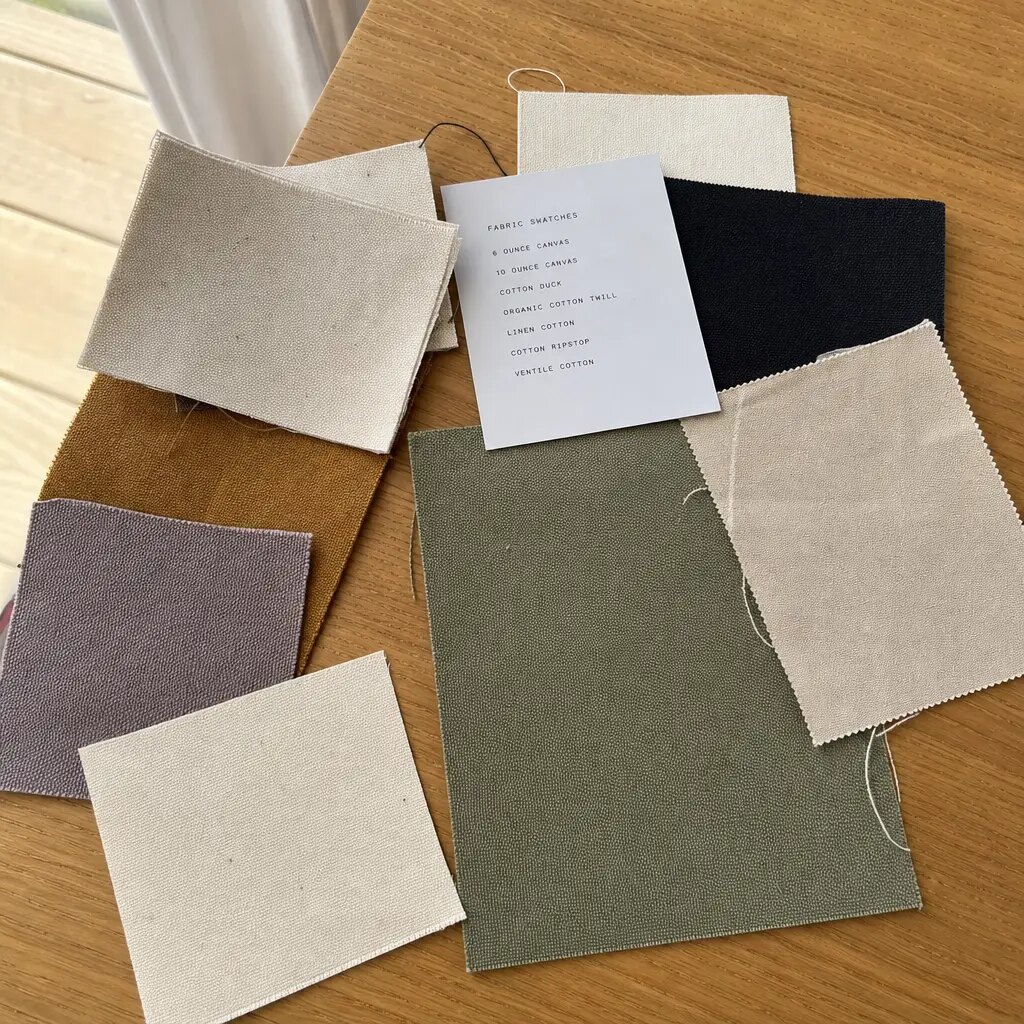
Cotton GSM is one of the fastest ways to change both cost and supplier confidence. For light promotional use, 100 GSM is often enough, especially if the pouch only carries small items and does not need to look structured on a retail shelf. For a more finished retail pouch, 120 GSM is usually the practical middle ground because it gives better body, better print stability, and less complaint risk from see-through fabric. If the pouch must carry heavier contents or feel premium in hand, 140 GSM or more is worth pricing, but it usually pushes MOQ and labor cost upward. Unbleached natural cotton is easier to source and quote; dyed fabric adds lead time, shade risk, and usually a higher lot requirement.
Construction detail also affects MOQ logic. A single drawstring channel with one cord is easy to run and quote. Double drawstrings, bound seams, or custom gussets increase sewing time and inspection time, which can turn a modest order into a borderline order for some factories. If you are comparing quotes, keep the same size, same GSM, same cord type, and same seam style across suppliers. Otherwise you are not comparing MOQs, you are comparing different products. The cleanest RFQ is usually the simplest one that still matches the selling channel.
- Common starting point: 100-120 GSM natural cotton for general market use.
- Move to 140 GSM when the pouch needs more body, better shelf presence, or heavier contents.
- Keep size and construction fixed if you want a meaningful MOQ comparison.
Pick the Print Method Before You Negotiate Volume
Print method is one of the biggest hidden drivers of MOQ. Single-color screen print is usually the easiest path for a first order because it keeps setup simple, the print cost is predictable, and the factory can run it on standard equipment. It also tends to hold up better on cotton than buyers expect, provided the ink is matched to the fabric and cured properly. If your artwork is still flexible, try to reduce it to one or two solid colors before requesting quotes. Every extra color can trigger another screen, another setup, and a higher threshold for the factory to accept the job.
Digital transfer and heat-applied decoration are useful when you need gradients, small text, or photographic art, but they can create wear issues if the pouch will be folded, rubbed, or repeatedly washed. Embroidery and woven labels are better for premium positioning, but they change the hand-feel and can distort a light pouch if the placement is not controlled. For cotton drawstring pouches for farmers market vendors, the best commercial balance is often a one-color screen print on natural cotton, plus a sewn label if the brand needs a stronger retail cue. That combination keeps MOQ manageable and protects margin.
- Screen print is usually the best first-order method for MOQ and repeatability.
- Transfer print helps with detail but needs more scrutiny for crack resistance and fold marks.
- Embroidery and woven labels look premium but can distort lightweight fabric if overused.
Use the Sourcing Route to Lower MOQ, Not Just the Supplier Name
A lot of MOQ friction comes from choosing the wrong sourcing route. A direct factory with stock cotton will usually give you the lowest recurring cost, but it may demand a larger commitment per color or per artwork. A trading company can sometimes split that risk across factories and give you more flexibility on the first order, but you need to understand where the real manufacturing happens and who owns the quality issue if something goes wrong. Domestic decorators are fast, especially for short lead times or event-driven orders, but they rarely beat an offshore factory on unit cost once the order grows beyond a pilot run.
The right route depends on what you need to learn from the first order. If you are testing market reaction, a hybrid setup can make sense: import blank cotton pouches, print locally, and use the first season to confirm size, artwork, and pack format. If you already know the pouch sells, direct factory sourcing usually becomes the better path because it lowers unit cost and gives you more control over fabric consistency. The mistake to avoid is comparing a blank-pouch quote from one supplier to a fully finished quote from another and calling that an MOQ comparison. Those are different supply chains.
- Direct factory: best for scale and repeatability.
- Trading company: best when you need flexibility and support across multiple SKUs.
- Domestic finishing: best when timing matters more than unit cost.
- Hybrid blank-plus-local-print: best for test launches and short-market cycles.
How to Negotiate MOQ Without Breaking the Spec
The best MOQ negotiation starts by protecting the base spec and relaxing the wrong parts of the order. Keep one fabric, one size, one cord, and one sewing construction. Then negotiate around the variables that do not affect fit: artwork placement, label format, packaging level, and shipment timing. If the supplier says the MOQ is 3,000 pieces per color, ask whether the total can stay at 3,000 while colors are split across two or three variants. Some factories will allow this if the fabric is stock and the print setup is straightforward. Others will not, especially if dyed fabric or custom weaving is involved. The point is to know which constraint is real and which is just the factory's default position.
You can also lower risk for the factory by giving them a cleaner production plan. A first order with one logo, one print position, and one carton spec is much easier to accept than an order that asks for mixed sizes, mixed labeling, and multiple retail packs. If the supplier is firm on MOQ, ask for a price tier at the current minimum, another tier at a realistic reorder volume, and a third tier if you move to a one-color or one-size-only program. That shows you are serious without committing to an oversized first buy.
- Negotiate total MOQ before you negotiate price tiers.
- Relax packaging and label complexity before you relax fabric quality.
- Use one base spec across multiple artwork variants when possible.
- Ask for quote tiers at minimum order, reorder volume, and scale-up volume.
Read the Factory Quote Like a Cost Sheet
A quote is only useful if it shows what is included and what is not. For cotton drawstring pouches, a clean quote should separate fabric cost, cutting and sewing, printing or decoration, labels, packing, cartons, and any one-time setup fee such as screens or embroidery digitizing. It should also show the MOQ by artwork or by color, not just the total quantity. If the supplier sends a single unit price with no pack count, no carton data, and no lead time from approval, the number is not complete enough for procurement. You cannot compare a vague quote against a structured one and expect the lower figure to be the better deal.
Useful quote data looks more like a mini production plan than a sales pitch. Example: 3,000 pcs, natural cotton, 120 GSM, one-side one-color screen print, bulk packed, 100 pcs per carton, lead time 28 to 35 days after artwork approval. A second quote might be 5,000 pcs, same fabric, woven side label, retail folded with inner polybag, 50 pcs per carton, lead time 35 to 45 days. Those two lines already tell you where the cost pressure sits. One has lower setup and simpler packing; the other has more retail value but more labor. That is how buyers should compare quotes.
- Demand separate lines for fabric, sewing, print, label, packing, and cartons.
- Compare quotes on the same pack format and same shipping term.
- Treat lead time from artwork approval as part of the quote, not an afterthought.
Approve the Sample on the Actual Fabric, Not on Intent
The pre-production sample is where most preventable mistakes can be removed. A good sample check starts with dimensions, fabric hand-feel, drawstring movement, and the print position relative to seams. Do not approve a pouch based on a paper proof alone; the same artwork can look very different once it is pulled across a woven cotton body. If the order uses unbleached natural cotton, confirm the shade is consistent enough for the whole lot and that no oil, dust, or weaving marks are likely to show through the print. If the fabric is pre-shrunk, make sure the factory states that clearly in the sample record.
A realistic acceptance standard is more important than a perfect sample. The pouch should close smoothly without binding, the print should remain readable after fold and rub checks, and the stitching should hold under repeated opening and closing. If the pouch will be used for produce or food-adjacent items, odor control matters too; the sample should not carry a strong chemical smell from ink, glue, or packing. Once the sample is approved, freeze the spec in writing. Every later change, even a small one, should be treated as a new revision so the factory does not quietly substitute materials.
- Approve the sample on the same GSM and fabric finish intended for bulk production.
- Check print position, seam alignment, and drawstring function together.
- Freeze the approved spec in writing before the factory cuts bulk fabric.
Plan Packing Before Freight Starts Changing the Economics
Packing is not a minor detail when you are buying for retail or distribution. Bulk-packed pouches are cheaper and easier to ship, but they may not fit a retailer's shelf workflow or a distributor's barcode process. Inner polybags add labor and material cost, but they protect cleanliness and make counting easier. If the pouch is going straight to a store or a marketplace kit, folded retail pack-out may be worth the extra cost because it reduces handling at destination. The best answer depends on whether the pouch is being sold as a standalone item or as part of a larger kit.
Carton planning should be part of the first quote. Ask for inner quantity, master carton quantity, carton dimensions, gross weight, and whether the factory can optimize for ocean freight, air freight, or mixed shipment. Too many small cartons can raise freight cost and handling damage risk. Too few pieces per carton can increase compression marks or slow warehouse receiving. For cotton drawstring pouches, a practical approach is to standardize the inner count by SKU and keep one master carton pattern across the order unless retail presentation requires a different pack. That keeps carton labeling simpler and reduces warehouse mistakes.
- Bulk pack lowers cost but may not be retail-ready.
- Inner polybags protect product quality and simplify counting.
- Carton dimensions and gross weight can change freight more than buyers expect.
Work Back From Lead Time and Reorder Risk
Lead time is where many first orders lose margin. A stock-fabric pouch with simple screen print can often be ready faster than a dyed or heavily finished pouch, but the clock should start only after artwork, sample, and packing details are approved. A realistic planning window for a simple order is often in the range of 20 to 35 days after approval, while custom fabric or complex packing can extend that to 35 to 50 days. Add transit time on top of that and you can see why a buyer should not wait until inventory is nearly gone. If the pouch is seasonal, build the buy calendar backward from the market dates, not forward from the inquiry date.
Reorder planning should be part of the negotiation, especially for buyers who expect a repeat sell-through. Ask whether the supplier can hold fabric, screens, or label components for a second run. If the first order sells well, a reorder with the same spec is usually much easier to place than a new design. The supplier also becomes more flexible once they know the pouch is a repeat item, because their risk of dead stock drops. That is one of the strongest reasons to keep the first run simple: simplicity creates reorder leverage.
- Start the clock from artwork and sample approval, not from inquiry.
- Build the market calendar backward from the sale date.
- Ask the factory what components can be reserved for the reorder.
Specification comparison for buyers
| Spec decision | Recommended option | When it fits | Buyer risk to check |
|---|---|---|---|
| Direct factory in Asia with stock cotton | Natural cotton pouch, 100-120 GSM, one-color screen print | Best for repeatable orders where you want lower unit cost and can wait for normal export lead times | Confirm whether MOQ is per artwork, per color, or per size, and whether carton/polys are included in the quote |
| Direct factory with custom-dyed fabric | 120-140 GSM dyed cotton with one or two print colors | Fits brand programs that need a specific colorway and can support a higher fabric MOQ | Ask who pays for dye setup, shade tolerance, and whether first-run fabric is reserved for your order only |
| Trading company consolidating multiple factories | Standard cotton pouch with basic print and flexible packaging | Useful when you need mixed SKUs, help with communication, or a smaller first order spread across variants | Make sure the final sewing factory is named and that the trading margin does not hide carton, label, or inspection charges |
| Domestic decorator or local converter | Blank imported pouches printed locally | Works for urgent events, pilot runs, or buyers who want fast art changes and low in-transit risk | Check the combined cost of blanks plus local print, and verify that local print quality matches the fabric finish |
| Hybrid sourcing: import blanks, finish locally | Blank 100-120 GSM cotton with local labeling, stamping, or final pack-out | Good for test markets, seasonal drops, and buyers who want to separate production from compliance or retail packing | Two vendors means two points of failure, so lock responsibility for defects after the blanks arrive |
| Retail-premium route with woven label or embroidery | Heavy cotton pouch, 120-180 GSM, sewn label or embroidery rather than full print coverage | Fits gift sets, boutique packaging, or a premium brand position where the pouch itself is part of the product | Expect higher setup effort and confirm that the decoration does not distort the pouch opening or drawstring channel |
| Low-MOQ stock program from the supplier | Supplier-held stock pouch in one or two standard colors with simple logo print | Best when you need speed and can live with standard dimensions and limited color choice | Stock can move fast; ask for the current on-hand count, replenishment cycle, and whether shade changes happen between lots |
| Multi-SKU bundle on one base pouch | One fabric spec with several print variants or size labels | Useful when you want to test multiple farmer market assortments without splitting every spec line | Keep the base construction identical or the supplier may treat each SKU as a separate MOQ bucket |
Buyer checklist before sampling
- Define the pouch use case: sample bag, produce bag, gift pouch, retail insert, or packed set component.
- Lock the base spec: finished size, fabric GSM, drawstring length, seam style, and print area.
- Separate one-time setup costs from recurring unit costs in every quote.
- State the required MOQ by total order, per color, and per artwork before you ask for price tiers.
- Choose the packing method early: bulk pack, inner polybag, barcode label, or retail-ready fold.
- Request a production sample on the actual fabric, not only a digital proof.
- Set acceptance criteria for print opacity, stitching quality, shrinkage, and carton count accuracy.
- Confirm lead time from artwork approval, not from inquiry date.
- Tell the supplier whether you need ocean freight, air freight, or mixed shipment planning.
- Ask for a reorder plan so the factory can hold fabric or screens for the next lot.
Factory quote questions to send
- Is your MOQ based on total pieces, per color, per size, or per artwork?
- Which fabric weights are in regular stock, and which weights need new weaving or dyeing?
- What setup charges are one-time and what charges repeat on every order?
- Can you quote the same pouch as bulk packed, inner polybagged, and retail packed so I can compare landed cost?
- What print methods do you recommend for this fabric weight and why?
- What is the sample process, sample fee, and lead time for a pre-production sample?
- Which carton size, carton quantity, and master carton weight do you plan to use?
- What defect rate or inspection standard do you use before shipment?
Quality-control points to confirm
- Finished size should stay within the agreed tolerance, typically within 3% or the buyer's drawing requirement.
- Fabric weight should match the approved GSM range and feel consistent across the lot.
- Seams must be straight, reinforced at stress points, and free of skipped stitches or loose thread tails.
- Drawstrings should slide smoothly, cinch evenly, and survive repeated pull tests without channel damage.
- Print or decoration should stay aligned, with acceptable opacity and no cracking, bleeding, or peeling after fold and rub checks.
- Carton count, inner pack count, and label information should match the packing list before dispatch.