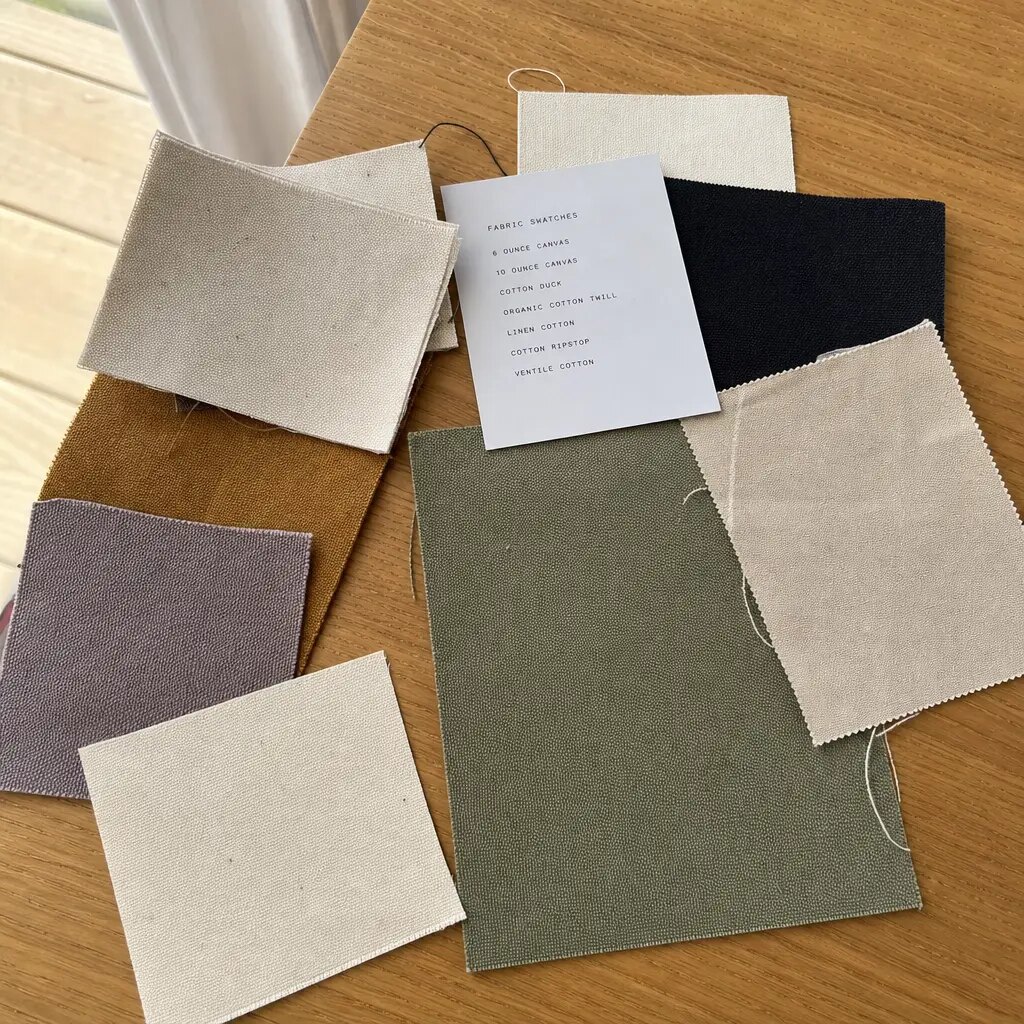
1. MOQ Is a Cost Model, Not Just a Factory Rule
For cotton drawstring pouches, MOQ is the lowest quantity at which the supplier can buy fabric, cut efficiently, set up decoration, sew, inspect, pack, and ship without carrying too much leftover material or labor downtime. That is why two factories can quote different minimums for the same pouch. One may have natural cotton in stock and an in-house screen print line. Another may need to buy fabric from a mill, subcontract printing, and order cartons separately.
Eco apparel brands often want a lower first order because the pouch is attached to a new product launch, capsule collection, or packaging transition. That is reasonable, but the negotiation works best when the buyer understands which part of the specification creates the minimum. A factory may be flexible on sewing quantity but rigid on dyed fabric. It may accept a low pouch run but require a higher woven label order. It may reduce unit MOQ if setup charges are paid separately.
As a planning range, simple natural cotton drawstring pouches with one size, one-color print, and bulk packing are often discussed in the 500-2,000 pc band for first orders, depending on supplier capability and stock fabric. More complex programs, such as custom dyed fabric, certified organic material, multiple sizes, retail packing, or several artwork versions, more often sit around 2,000-5,000+ pcs per variant. These are not universal rules; they are useful procurement bands to test during RFQ.
The buyer’s goal is not only to force the lowest number. The stronger goal is to make MOQ conditional: if we use stock natural cotton, what is the MOQ; if we use organic cotton, what changes; if we pay screen setup separately, can the first run be smaller; if we commit to a blanket PO, can the first delivery be reduced? This turns a vague minimum into a negotiable commercial structure.
- Ask for MOQ by variant, not only total order quantity.
- Separate fabric MOQ, decoration MOQ, label MOQ, and packing MOQ.
- Use planning bands, then verify against the supplier’s actual stock and workflow.
- Treat low MOQ and low unit price as two separate negotiations.
2. Start With the Base Pouch Specification
Before negotiating, lock the base construction. A pouch described only as “cotton drawstring bag, 15 x 20 cm, logo print” is too incomplete for a reliable quote. The factory needs finished width and height, seam type, top channel style, drawcord material, cord diameter, fabric weight, shrinkage expectations, packing method, and whether the pouch must carry a specific product weight.
For eco apparel brands, natural or unbleached cotton is usually the lowest-risk starting point because it avoids dye approval, reduces shade matching disputes, and often fits a lower-MOQ launch run. Common planning weights include 120-140 gsm for light accessories, samples, jewelry, cosmetics, or insert packaging; 140-160 gsm for general apparel packaging; and 160-180 gsm for a more structured premium feel or heavier contents. If the pouch carries shoes, denim, knitwear, or bundled products, do not choose a very light fabric only to hit a lower MOQ.
The phrase “eco” also needs a buying definition. Unbleached cotton, organic cotton, recycled cotton blend, plastic-free packing, water-based ink, and certified supply chains are different requirements. Each has a different cost and MOQ effect. If the brand plans to make a public claim, the RFQ should ask for documentation at the quote stage, not after production begins.
A good first specification sheet should show one approved drawing with finished size, print position, cord exit position, label position, and tolerance notes. This prevents the factory from quoting one construction and sampling another. If the design team is still deciding between two sizes, quote both sizes separately and ask what happens if they share the same fabric, cord, and carton plan.
- Use finished dimensions, not only flat artwork mockups.
- State whether the pouch must fit folded garments, accessories, footwear, or gift sets.
- Choose the lightest fabric that still meets product protection and brand feel requirements.
- Define the sustainability claim before asking the supplier to quote.
3. Use Realistic MOQ and Price Break Scenarios
Procurement teams should ask for breakpoints because pouch economics improve in steps, not in a smooth line. The first step is usually setup recovery: sample handling, artwork checking, print screens, cutting markers, and line allocation. The second step is production efficiency: fabric roll utilization, sewing rhythm, print drying space, and carton packing. The third step is freight efficiency, where carton volume and shipment mode can make a cheap unit price less attractive.
The numbers below are illustrative planning examples for RFQ comparison, not guaranteed market prices. Actual pricing changes by country, cotton market, wage level, certification, exchange rate, and freight lane. The value is in the structure: the buyer can see where to ask the factory for an alternative.
Example A: 15 x 20 cm natural cotton pouch, 140 gsm, one-color one-side screen print, cotton cord, bulk packed. A factory may quote around 1,000 pcs as MOQ, with a higher unit price at 500 pcs if accepted. The supplier may charge a separate screen or setup fee in the approximate range of USD 25-80 per artwork/color, and a custom printed sample or pre-production sample may be quoted around USD 30-120 plus courier, depending on complexity.
Example B: 30 x 40 cm pouch for folded apparel, 160 gsm canvas, two-color print, individual paper band or barcode label. MOQ may move toward 2,000-3,000 pcs because fabric consumption, print setup, and packing labor rise together. If the fabric is custom dyed or certified organic, the practical minimum may be driven by fabric sourcing rather than sewing capacity.
A useful RFQ table might ask suppliers to fill in ex-factory price, setup charges, sample cost, lead time, carton count, and cubic volume at 500, 1,000, 2,500, 5,000, and 10,000 pcs. If the 1,000 pc price is only slightly higher than 2,500 pcs, a smaller launch run may be justified. If the 500 pc price is far higher because setup dominates, a blanket PO or paid setup charge may be better.
- Typical sample lead time for a simple blank or printed pouch is often 5-12 working days after artwork and material confirmation.
- Typical bulk lead time for stock natural fabric is often about 2-4 weeks after approval and deposit.
- Custom dyed, certified, or non-stock fabric can add about 1-3 weeks or more depending on lab dips and material availability.
- Ask the supplier to show which price break is limited by fabric, print, sewing, or packing.
4. Decoration Choices Can Raise or Lower the Real Minimum
Decoration is frequently the hidden MOQ driver. A one-color screen print is usually the most negotiation-friendly option because the setup is clear and repeatable. If artwork uses gradients, very fine lines, large solid coverage, multiple colors, or two-sided printing, the supplier must manage more registration risk, more ink control, more drying space, and more possible rejects.
For a first eco apparel pouch order, ask whether the same screen can be used across multiple SKUs. If the artwork size and position remain identical, the factory may be able to print several pouch sizes with one shared screen or setup. This is a practical tradeoff: the brand gives up size-specific logo scaling, and the supplier reduces setup complexity.
Woven labels, side seam tabs, and patches can create a premium presentation and may support a more understated brand look than a large front print. But labels often come with their own MOQ. If the label supplier requires 5,000 labels and the pouch order is 1,000 pcs, the buyer must decide whether to hold excess labels for reorders, pay a higher label price, or switch to print for the first run.
Embroidery is possible on some pouch constructions but is rarely the simplest MOQ-reduction method. It can slow production, distort lighter fabrics, and require stabilizer or extra handling. If the buyer wants texture, consider whether a small woven label gives a similar brand effect with easier sewing control.
- For lowest first-run MOQ, use one artwork, one print color, one print position, and one side only.
- Ask for setup charges separately so the supplier does not hide them inside an inflated MOQ.
- Confirm whether screens are stored for reorders and for how long.
- Approve a printed strike-off before bulk production if logo color or placement is brand-critical.
5. Negotiation Tradeoffs That Actually Work
Strong MOQ negotiation is an exchange of risk. The buyer reduces uncertainty, and the supplier reduces the minimum. Simply saying “our target is 500 pcs” rarely works unless the order is very simple. A better approach is to ask, “What can we change in the spec to make 500 or 1,000 pcs workable without weakening quality?”
The most effective tradeoff is SKU consolidation. Use one fabric weight, one natural base color, one cord color, one artwork position, and one packing method across the program. If the apparel line has three color stories, resist the urge to make three pouch colors for the first test. Keep the pouch neutral and let the garment or hangtag carry the seasonal story.
Another useful tradeoff is accepting stock fabric. If the supplier has 140 gsm natural cotton available, using it may lower MOQ and shorten lead time compared with specifying a custom 155 gsm organic dyed fabric. The buyer can still meet an eco direction through unbleached material, water-based print, plastic-free packing, or a documented certified option when the order scales.
Paying setup charges separately can also reduce first-run quantity. A factory may resist a 500 pc order if it must recover screen setup, sample labor, and artwork handling inside the unit price. If the buyer pays a clear screen fee or development charge, the supplier may accept a smaller run at a more transparent unit cost.
Blanket POs are powerful when the forecast is real. For example, the buyer commits to 5,000 pcs over six months, releases 1,500 pcs first, then 1,500 and 2,000 pcs later. This gives the factory confidence to purchase fabric or hold screens while the brand avoids receiving all inventory at once. The agreement should state release dates, storage responsibility, whether unused fabric is billable, and what happens if the brand cancels later releases.
- Consolidate sizes or start with one hero size.
- Accept stock natural fabric instead of custom dyeing for the launch run.
- Use shared print screens across SKUs when artwork can remain the same size.
- Choose standard cotton cord or approved stock cord color.
- Use bulk packing first, then upgrade to retail packing after demand is proven.
- Pay setup, screen, or sample charges separately if that lowers the production MOQ.
- Offer a blanket PO with staggered delivery instead of demanding a small one-off run.
- Hold excess woven labels for reorders if the label MOQ is higher than the pouch MOQ.
6. Build an RFQ That Exposes the True Cost
A useful RFQ should make every supplier quote the same product. Otherwise, the lowest price may simply be the least complete offer. For cotton drawstring pouches, ask for itemized pricing by body, decoration, label, packing, setup, sample, and freight term. At minimum, compare EXW or ex-factory pricing separately from FOB and estimated landed cost.
Ask the factory for carton data before choosing the supplier. Cotton pouches are light, so freight can be driven by cubic volume rather than weight, especially when individual packing increases air space. A simple small pouch may pack 200-500 pcs per export carton depending on size and fold method. Larger apparel pouches may pack 50-150 pcs per carton. These are planning ranges only; the supplier should provide actual carton dimensions, gross weight, and pack count for your exact spec.
A landed-cost scenario helps buyers avoid false savings. Suppose Supplier A quotes a lower unit price but requires individual polybags that increase carton volume by 25%. Supplier B quotes slightly higher ex-factory but bulk packs tightly with clear carton marks. If the shipment moves by air or courier, Supplier B may land cheaper. Even by ocean, higher carton cube can affect consolidation cost, warehouse receiving, and storage.
The RFQ should also show payment timing. Lower MOQ orders may require full setup payment, sample payment, or a higher deposit. That is not automatically bad, but it should be visible. A quote that says “USD 0.42 per pc” without screen charge, carton spec, sample fee, packing detail, and lead time is not a procurement-ready quote.
- Request price breaks at the same quantities from every supplier.
- Ask for carton count, carton dimensions, gross weight, net weight, and cubic meters.
- Compare bulk packing versus individual packing as separate quote lines.
- Include destination port or warehouse if you want a realistic landed-cost discussion.
7. Sampling: What to Approve Before Bulk Production
Sampling should answer commercial and technical questions before the factory buys bulk material. A stock blank sample can confirm approximate hand feel and size category, but it does not approve your construction. A custom blank sample confirms dimensions, seam type, top channel, cord length, and fabric choice. A printed strike-off confirms ink color, logo size, and placement. A pre-production sample confirms the full approved pouch before mass production.
For a new supplier, do not skip the custom blank sample if the pouch must fit a specific apparel item. Small dimension errors matter when the pouch is used for folded garments or sets. Measure the sample after it is filled with the intended product, not only flat on a table. Confirm whether the finished size includes the top channel and seams or usable internal space.
Sample fees vary widely by supplier and complexity, but buyers should expect simple custom pouch samples or printed approval samples to be quoted separately, often in a broad planning range such as USD 30-120 plus courier. More complex certified material, custom dyeing, multiple print colors, or labels can cost more. The key question is whether the fee is refundable after a bulk PO and whether the sample uses production-equivalent fabric and ink.
Keep one signed or sealed approval sample with the supplier and one with the buyer or inspection agent. The approval sample becomes the reference for inspection, but it must be supported by written tolerances. A beautiful sample without tolerances still leaves too much room for dispute in bulk production.
- Approve construction before approving decoration when the pouch is new.
- Use actual product-fit testing for apparel, shoes, or bundled sets.
- Ask whether the sample is production-equivalent or only a look-and-feel sample.
- Photograph approved sample details and attach them to the PO.
8. Factory-Ready QC Standards for Cotton Drawstring Pouches
Quality control must be specific enough for a factory inspector to use. Terms such as “good stitching” or “logo centered” are not enough. The PO should include measurement tolerance, print placement tolerance, defect classification, inspection level, and acceptance criteria. This prevents the common dispute where the factory considers a defect normal production variation while the brand sees it as a retail failure.
For many pouch programs, buyers use ANSI/ASQ Z1.4 or ISO 2859-1 sampling with General Inspection Level II. A practical AQL setting is 0.0 for critical defects, 2.5 for major defects, and 4.0 for minor defects. If the pouch is premium packaging or carries a high-value garment, the buyer may tighten major defects. If it is a low-cost giveaway, the buyer may accept a more flexible minor threshold, but critical defects should remain unacceptable.
Measurement standards should be simple. Small pouches may use ±5 mm finished size tolerance; medium pouches ±8 mm; larger apparel pouches ±10 mm. Print placement can often be controlled within ±3 mm for small logos and ±5 mm for larger artwork, provided the factory agrees before production. If exact placement is required near seams or draw channels, the tolerance should be tighter and the MOQ or cost may rise.
Inspection should include function, not just appearance. Pull the drawcord repeatedly, check the channel for jams, inspect corners and seam ends, verify stitch density against the approved sample, and test whether the print transfers or cracks during normal handling. For eco claims, QC should also verify documentation and packing: wrong fiber claim, wrong certification reference, or unauthorized plastic packing can be a major commercial defect even if the pouch looks fine.
- Critical defects: mold, sharp objects, hazardous stains, wrong brand, wrong fiber claim, severe odor, or unsafe cord issue.
- Major defects: open seams, missing cord, wrong size, wrong artwork, wrong barcode, severe misprint, or carton shortage.
- Minor defects: slight loose thread, minor removable lint, small cosmetic variation within approved limits.
- Inspection must cover product, packing, carton marks, and documentation.
9. Eco Requirements: Make the Claim Purchasable
Eco apparel brands should be precise about sustainability requirements because each claim has procurement consequences. “Eco cotton pouch” is not a specification. A natural unbleached cotton pouch may reduce processing compared with dyed fabric, but it is not the same as certified organic cotton. Recycled cotton content may reduce virgin fiber use, but it can affect strength, color consistency, and availability. Plastic-free packing may support brand values, but it can change moisture protection during shipping.
If the brand plans to say “organic cotton,” ask for current supplier certification, transaction certificate process, and whether the factory is certified to handle the material. If the brand plans to say “recycled cotton,” ask for recycled content documentation and whether the blend contains virgin cotton, polyester, or other fibers. If the claim is only “reusable cotton pouch,” avoid overstating certifications that are not documented.
Dyeing choices matter. Natural and unbleached cotton can show seed flecks and shade variation; that is part of the look but should be approved. Bleached cotton gives a cleaner base for print but adds processing. Custom dyed cotton gives brand control but raises MOQ, lab dip time, shade risk, and colorfastness testing needs. Low-impact dye language should be backed by supplier process details, not just a sales claim.
Packing is part of the eco decision. Bulk packing in a lined export carton may eliminate unit polybags, but it requires moisture control and clean handling. Individual paper sleeves or glassine-style bags may look better than plastic but can add cost and volume. If the destination warehouse requires barcodes, ask whether barcode labels can be applied to paper bands, carton inners, or master cartons instead of individual plastic bags.
- Define whether the claim is material-based, process-based, packaging-based, or reuse-based.
- Ask for documentation before approving artwork that includes sustainability claims.
- Quote natural, organic, recycled, and dyed options separately instead of blending them into one request.
- Confirm plastic-free packing feasibility against moisture, freight, and warehouse requirements.
10. Lead Time, Reorders, and Final Supplier Selection
Lead time starts before sewing. The sequence is specification confirmation, sample development, artwork approval, material booking, print setup, cutting, sewing, trimming, inspection, packing, and shipment. For simple stock-fabric pouches, buyers often plan around 5-12 working days for sampling and 2-4 weeks for bulk production after approval and deposit. Custom dyed, certified, or non-stock fabrics can add one to three weeks or more, especially if lab dips or material documents are required.
Reorder planning should be negotiated during the first PO. Ask how long the supplier keeps print screens, whether unused labels can be stored, whether fabric can be reserved, and what reorder MOQ applies if the specification stays unchanged. A supplier may accept a lower reorder MOQ if screens, labels, and cutting patterns are already approved. Conversely, a first order that uses leftover stock fabric may not be repeatable if the supplier cannot buy the same fabric again.
When choosing between suppliers, do not rank only by unit price. Compare MOQ flexibility, documentation discipline, sample quality, carton planning, QC openness, and ability to explain tradeoffs. The best supplier for a launch program is usually the one that gives clear conditions: lower MOQ if stock fabric is used, price break at 2,500 pcs, setup fee separated, carton cube stated, and QC tolerance accepted in writing.
A strong purchase order should attach the final spec sheet, artwork file reference, approved sample photos, price breakdown, setup charges, packing plan, carton marks, AQL standard, inspection timing, shipment term, and sustainability documents required before shipment. That document is what turns a cotton drawstring pouch quote into a controlled procurement program.
- Plan sampling and approval time, not only sewing time.
- Negotiate reorder MOQ, screen storage, and label inventory before the first shipment.
- Select suppliers based on transparency and control, not only the lowest headline MOQ.
- Attach QC, packing, and documentation requirements to the PO before deposit.
Specification comparison for buyers
| Quote variable | Typical buyer choice | MOQ impact | Cost impact | Lead-time impact |
|---|---|---|---|---|
| Base fabric | Stock natural or unbleached cotton, 120-160 gsm | Lowest; often supports first runs around 500-2,000 pcs when the factory has fabric available | Lowest to moderate; avoids dye lot setup | Shorter; commonly 2-4 weeks after sample approval for simple orders |
| Base fabric | Custom dyed cotton or special shade-matched fabric | Higher; commonly pushes practical MOQ toward 2,000-5,000+ pcs per color | Adds dyeing, lab dip, and surplus fabric risk | Longer; add about 1-3 weeks for lab dips and bulk dyeing |
| Fabric weight | 120-140 gsm plain weave | Lower because cutting and sewing are faster and fabric cost is lower | Lower unit cost but lighter hand feel | Usually shorter if stocked |
| Fabric weight | 160-180 gsm canvas or twill | Medium to higher; fabric availability matters more | Higher fabric cost and slightly slower sewing | May add sourcing time if not stocked |
| Size program | One finished size, one cutting marker | Lowest; best for negotiating a first order | Lowest setup cost | Fastest approval and production |
| Size program | Three or more sizes in one PO | Higher; supplier may set MOQ per size rather than total PO | Higher due to marker changes and sorting labor | Longer cutting, packing, and warehouse handling |
| Decoration | One-color screen print, one side | MOQ-friendly; often negotiable at 500-1,500 pcs if artwork is simple | Low setup spread across run; screen charge may be separate | Short; screens usually prepared after artwork approval |
| Decoration | Two to four screen colors or two-sided print | Higher; registration and scrap risk increase | Higher setup and inspection time | Add approval time for strike-off or printed sample |
| Branding | Sewn woven side label | May create a separate label MOQ, often 1,000-5,000 labels depending on supplier | Label cost plus sewing operation; setup may be separate | Add label sampling and delivery time |
Buyer checklist before sampling
- Define finished size in centimeters or inches, including whether measurements are inside usable space or outside seam-to-seam dimensions.
- State fabric type, weight in gsm, color route, and eco preference: conventional cotton, organic cotton, recycled cotton blend, undyed, low-impact dyed, or certified material.
- Ask whether the fabric is in stock, greige-to-dye, or made to order; this is often the real MOQ driver.
- Limit the first run to one size and one artwork if the goal is a lower MOQ.
- Specify decoration method, print size, print position, color count, Pantone references if needed, and whether artwork is one-sided or two-sided.
- Confirm whether screen charges, digital setup, label setup, sample charges, cartons, barcode labels, and export packing are included or separate.
- Request price breaks at realistic levels such as 500, 1,000, 2,500, 5,000, and 10,000 pcs instead of asking for one price only.
- Ask for MOQ by variant: size, fabric color, print design, label version, and packing format.
- Request sampling path and fees: blank sample, printed strike-off, pre-production sample, and whether any fee is refundable after bulk order.
- Set written QC tolerances before production: size tolerance, print placement tolerance, stitch quality, drawcord function, fabric defects, and carton count.
Factory quote questions to send
- What is your MOQ for this pouch by total order, by size, by fabric color, by artwork, and by packing method?
- Can you quote 500, 1,000, 2,500, 5,000, and 10,000 pcs so we can see the real price breaks?
- Which fabric weights do you currently have in stock, and what MOQ applies if we need organic cotton, recycled cotton content, custom dyeing, or a specific shade?
- Is the quoted fabric greige, natural, bleached, dyed, washed, or preshrunk? What shrinkage should we expect?
- What is included in the unit price: fabric, cutting, sewing, cord, print, label, packing, cartons, carton marks, and export documents?
- Are screen charges, artwork setup, label setup, dye lab dips, barcode labels, or sample courier fees separate? If so, list each charge.
- What sample options do you recommend: stock blank sample, custom blank sample, printed strike-off, or full pre-production sample? What are the fees and lead times for each?
- Can you reduce first-run MOQ if we use stock fabric, one print color, a standard cord, bulk packing, or pay setup charges separately?
- Can we place a blanket PO for 5,000 pcs with first release of 1,500 pcs and staggered deliveries? What price and storage terms would apply?
- Can several pouch sizes share the same fabric roll, print ink, cord, label, or carton format to reduce MOQ?
Quality-control points to confirm
- Use written measurement tolerances. A practical starting point is ±5 mm for small pouches up to about 15 x 20 cm, ±8 mm for medium pouches, and ±10 mm for larger apparel or shoe pouches unless the product requires tighter control.
- Set print placement tolerance before production. For many pouch orders, ±3 mm from approved center position is workable for small logos and ±5 mm for larger prints; tighter artwork should be flagged before quoting.
- Specify fabric weight tolerance, commonly within ±5% of approved gsm, and reject obvious thin spots, holes, broken yarns, oil marks, heavy contamination, or inconsistent dye lots.
- Use an AQL plan for final inspection. A common buyer starting point is ANSI/ASQ Z1.4 or ISO 2859-1, General Inspection Level II, AQL 0.0 for critical defects, 2.5 for major defects, and 4.0 for minor defects.
- For a 1,200 pc lot under General Level II, the normal inspection sample is commonly 80 pcs; for 3,200 pcs it is commonly 125 pcs. Confirm the exact code letter and sample size with your inspection provider.
- Define critical defects clearly: mold, live insects, sharp metal fragments, blood or hazardous stains, wrong brand/logo, severe odor, banned packaging material, incorrect fiber claim, or safety issue with cord construction for the intended market.
- Define major defects: wrong size outside tolerance, open seam, missing drawcord, broken draw channel, wrong print color, print off-position beyond tolerance, severe smearing, wrong label, wrong barcode, or carton shortage.
- Define minor defects: loose thread under an agreed length, slight but acceptable slub, minor wrinkle, small removable lint, or very slight print edge roughness that does not affect brand presentation.
- Check drawcord function on the inspection sample: cord should pull smoothly from both sides if specified, not jam in the channel, and maintain even exposed length within the approved range.
- Inspect seam strength and stress points. Corners, side seams, and channel ends should show no skipped stitches, unraveling, open seams, or stitch density below the approved sample.