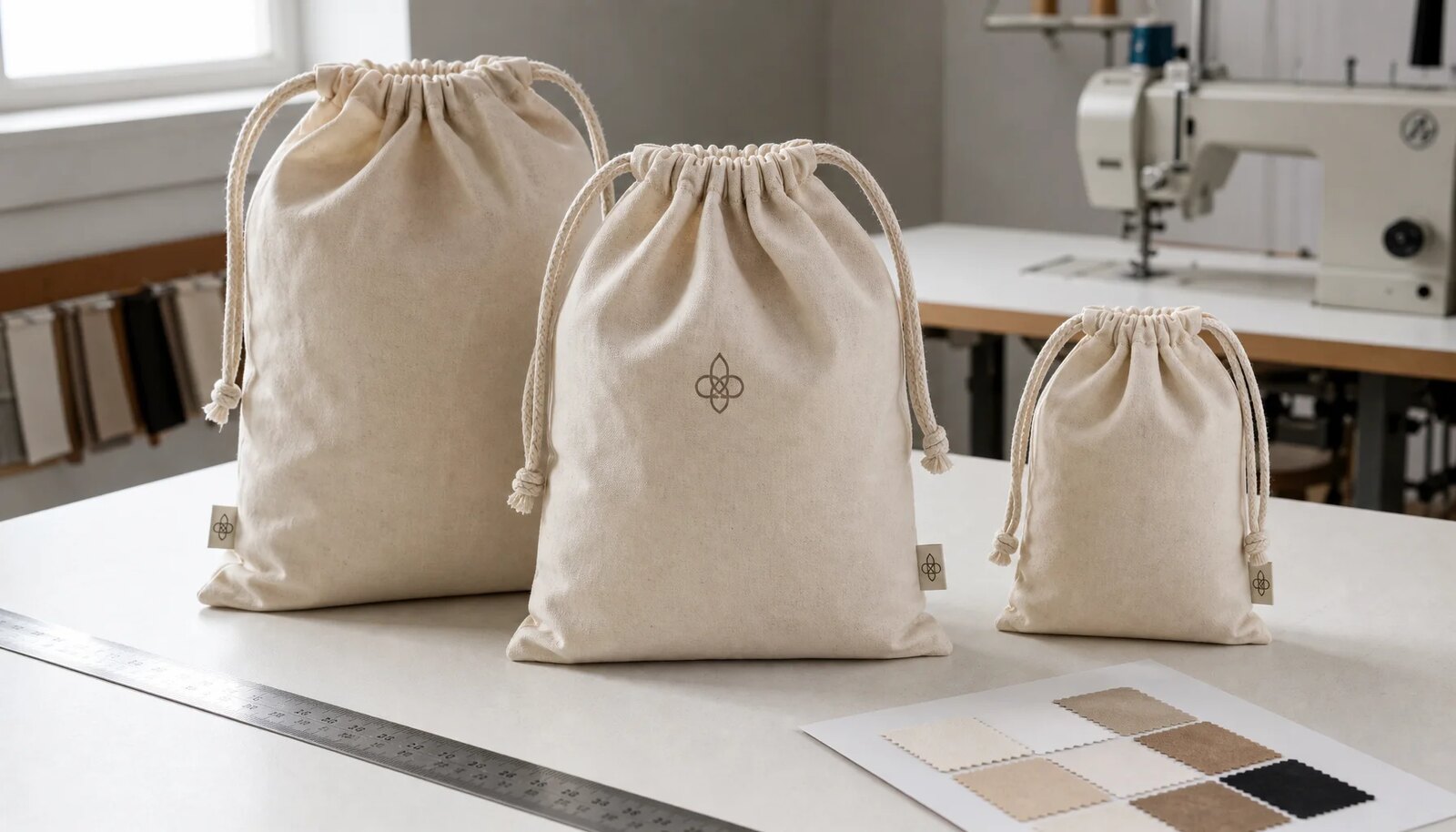
Start With the Event Use Case
A cotton drawstring pouch may look simple, but for an event buyer it affects presentation, packing speed, freight, storage, and on-site distribution. The right pouch for badges and postcards is not the same as the right pouch for cosmetics, candles, tech items, drinkware accessories, or retail samples. Start by defining what the pouch must do between factory packing and guest handoff.
A useful brief should name the event type, contents, filled weight, distribution method, presentation level, and reuse expectation. A pouch handed out empty at registration can be lighter than one pre-packed overseas, reopened by a kitting partner, staged by venue staff, and handled by guests throughout the day.
Also decide whether the pouch is a low-cost carrier, a branded keepsake, or part of the perceived value of the gift. Natural cotton can suit wellness, education, outdoor, and craft-led programs. Bleached cotton gives a cleaner base for corporate branding. Dyed cotton supports a stronger event color system but needs tighter shade control.
- List contents by item, dimensions, total filled weight, and sharp or abrasive contact points.
- Define whether packing happens at the factory, a kitting center, the venue, or by the attendee.
- State whether the pouch should feel economical, reusable, premium, or retail-style.
- Confirm whether it must fit inside a gift box, mailer, tote, display tray, or registration counter setup.
Turn Size Into a Measurable Specification
Specify size as finished dimensions, not as small, medium, large, or a screenshot reference. State width and height in centimeters or inches, measured flat and empty after sewing and final pressing. If the pouch is gusseted, include gusset depth and clarify whether the design uses a bottom gusset, side gusset, or box-style construction.
Sewn cotton products need realistic tolerances because cutting, folding, stitching, pressing, and fabric relaxation all create variation. For many event pouches, plus or minus 5 mm is practical for small sizes and plus or minus 10 mm for larger sizes. Tighter tolerances can be discussed, but they should be quoted and inspected intentionally.
Fit should be tested with actual contents. A pouch that technically fits on paper may slow the packing line if staff must angle the product, force the opening, or tug hard on the cord. At thousands of units, a few extra seconds per pouch become real labor cost.
Opening width is easy to overlook. A tall pouch with a narrow mouth can look fine in a mockup but fail during kitting. Review the sample filled, closed, and reopened. Check whether the top hem curls, whether the logo distorts, and whether corners or hard edges stress the seams.
- Specify finished width, height, gusset depth, opening width, and measurement method.
- Set written tolerances for size, gusset depth, print placement, and cord length.
- Test packing speed with a non-specialist packer using final contents.
- Avoid designing to the tightest possible fit when venue teams need fast assembly.
Choose GSM by Performance, Not Habit
GSM, or grams per square meter, measures fabric weight. It is important, but it is not a complete quality grade. Two cotton fabrics with the same GSM can behave differently if one has a loose weave and the other is more compact. Event planners should compare opacity, hand feel, print clarity, seam strength, and how the pouch behaves when filled.
For light, flat handouts, 120 to 140 gsm plain-weave cotton is usually the economical range. It can work for postcards, badges, seed packets, sachets, small stationery, and low-weight sponsor inserts. The tradeoff is reduced body and opacity. Under bright exhibition lighting, contents may show through, and heavy ink coverage may feel unbalanced on the fabric.
For most event procurement, 140 to 160 gsm is the standard starting point. It balances cost, foldability, opacity, and print performance for welcome kits, conference gifts, beauty samples, education materials, and reusable pouches. When the buyer is unsure, sample this range first and adjust only after testing.
For heavier gifts or premium presentation, 180 to 220 gsm cotton or light canvas gives more structure and a stronger hand feel. It is useful for VIP packs, photo-facing activations, and items expected to be reused. It can also add unnecessary cost and carton weight if the contents are light, so approve it because it solves a performance or presentation need.
- Use 120 to 140 gsm for light, flat, cost-sensitive handouts.
- Use 140 to 160 gsm as the baseline for most event pouches.
- Use 180 to 220 gsm for heavier gifts, premium presentation, or repeated reuse.
- Compare weave tightness and finished sample performance before approving GSM.
Set Fabric Finish and Color Standards
Natural unbleached cotton is popular because it feels warm and material-led. It also has visible characteristics that need buyer approval. Seed flecks, small slubs, and slight shade variation are normal. These may support a wellness, craft, education, or sustainability-led event, but they can surprise a corporate team expecting a clean white surface.
Bleached cotton gives a brighter base and stronger contrast for logos. It is useful when artwork includes fine geometry, pale colors, or sponsor marks that need a cleaner background. The risk is that white or very light cotton shows dust, scuffs, oil marks, and warehouse handling more easily. Clean packing should be part of the specification.
Dyed cotton needs the most structured approval. If the pouch body must match a brand or event palette, request a lab dip or physical shade standard. A Pantone reference helps communication, but cotton fabric will not match coated-paper color exactly. Approve the pouch body, cord, print, label, and hangtag together because a close match in isolation can look mismatched in the final kit.
Dark fabric and dark print should be checked for rubbing. Event pouches may not be washed, but they can rub against white cartons, paper inserts, tissue, apparel, or other pouches in transit. A simple dry rub with a clean white cloth can catch obvious crocking or ink-transfer risk before bulk packing.
- Use natural cotton when visible texture supports the event concept.
- Use bleached cotton when clean contrast and crisp logo presentation matter more.
- Use dyed cotton with a physical shade standard, not only a screen reference.
- Check dark fabric and dark print for transfer before carton packing.
Match Decoration to Artwork and Quantity
Decoration is where many cotton pouch orders become risky. For simple logos, sponsor marks, and one to three solid colors, screen printing is often the most predictable choice. It works well for medium and larger quantities because setup cost is spread across the order. The buyer should provide vector artwork, print size, color references, and placement from finished edges.
Screen printing on cotton is not the same as printing on paper. Fabric texture softens edges, absorbs ink differently, and can make tiny type hard to read. Avoid very fine lines, small disclaimers, and tight reversed-out text unless the supplier has tested them on the exact fabric. Ask for a strike-off or decorated pre-production sample before bulk approval.
Digital or heat transfer is useful for gradients, full-color artwork, short versioned runs, and designs that cannot be separated cleanly for screen print. It is not automatically better. Transfers can leave a visible edge, create a stiff panel, crack, peel, or pick up marks when stacked if the process is poorly matched to the fabric.
Embroidery and woven labels can create a retail-like finish, but they should be used deliberately. Embroidery can distort lightweight cotton and may fail on fine text. A woven side label can look clean, but its fold, placement, orientation, and stitch security must be inspected. For any method, keep the main logo away from the drawcord channel unless distortion is acceptable.
- Use screen print for solid-color artwork and bulk programs.
- Use transfer when artwork complexity justifies extra testing.
- Specify print dimensions, position, color standard, line thickness, and readable text limits.
- Review decoration flat, filled, closed, folded, and packed.
Specify Construction, Cords, Gussets, and Lining
The common event pouch is a single-layer cotton bag with side seams and a folded top hem that forms the drawcord channel. This construction is efficient for light and medium uses, but quality depends on seam allowance, stitch density, thread, channel width, and cord exit. Acceptable fabric can still fail if the top hem tears or the cord binds.
Ask for construction details that can be inspected. The supplier should state seam allowance, stitch density, thread type, top-hem depth, and cord-channel construction. Exact values depend on pouch size and factory method, but the details should appear in the quote or production sheet so bulk goods can be checked against the approved sample.
A gusset adds depth and helps bulky contents sit better. It is useful for candles, jars, bottles, boxed samples, and tech kits. A lining can improve opacity and interior finish, but it adds fabric, labor, and inspection points. These features are worthwhile when they solve a real product or presentation issue, not when added only to make a spec sound premium.
Cord choice affects both appearance and usability. Cotton cord gives a cohesive natural look. Polyester cord can glide smoothly and resist fraying, but may feel less aligned with a cotton message. Cotton-blend cord can be a practical middle option. For many small and medium event pouches, 3 to 5 mm cord is a useful range, but the correct diameter depends on channel width and pouch size.
Cord length should be tested with the pouch full. Too short, and staff struggle to close it. Too long, and knots look messy or catch on neighboring pouches. Specify material, diameter, length, color, knot style, end finish, and tolerance.
- Define top-hem construction, seam allowance, stitch density, thread color, and channel width.
- Use gussets when contents need depth, stability, or easier packing.
- Use lining only when opacity, interior finish, or protection justifies the cost.
- Specify cord material, diameter, color, length, knot style, and end finish.
- Pull-test the cord channel using final contents.
Build an RFQ Suppliers Can Price Fairly
Supplier quotes vary widely when buyers send a concept instead of a specification. One factory may quote 120 gsm natural cotton, another 160 gsm bleached cotton, and another a decorated pouch with individual packing. The prices look like market variation, but they are often different products.
A strong RFQ should include finished dimensions, fabric GSM, weave, finish, body color, cord specification, construction, decoration method, print size, print colors, artwork versions, quantity, packing method, carton marks, sample requirement, inspection requirement, incoterm, and delivery deadline. If there are multiple sizes, colors, sponsors, languages, or venue allocations, list each variant separately.
Ask suppliers to quote useful quantity tiers, such as 1,000, 3,000, 5,000, and 10,000 units when relevant. Request line items for sample fees, screen charges, label setup, custom dyeing, hangtags, barcode labels, individual bags, carton upgrades, inspection support, and freight if the supplier is quoting delivery.
Also ask what is excluded. Duties, taxes, import brokerage, destination handling, relabeling, storage, inspection, and kitting labor may sit outside the factory price. For events, landed cost and deadline reliability matter more than the lowest ex-factory unit price.
- Send the same RFQ template to every supplier.
- Separate variants by size, fabric color, cord color, artwork, label, and packing method.
- Request quantity tiers and line-item setup charges.
- Compare landed cost, schedule risk, carton data, and inspection clarity.
Control MOQ, Lead Time, and Change Risk
MOQ is tied to fabric availability, dye lots, cutting efficiency, print setup, cord sourcing, label production, and packing labor. A stock natural cotton pouch with one size, one cord, one print, and bulk packing is simpler than a program with three dyed colors, six sponsor logos, individual barcodes, and destination-specific cartons.
Cost drivers usually include fabric weight, pouch size, decoration complexity, construction features, and packing format. Higher GSM raises material cost and shipping weight. Larger dimensions increase fabric consumption. More print colors add screens, setup, and registration work. Gussets, linings, labels, hangtags, and individual bags add labor and additional QC points.
Lead time should be counted from final sample and artwork approval, not from purchase order issue. A purchase order does not start real production if artwork is still changing, fabric color is unapproved, or the pre-production sample has not been signed off.
Event deadlines rarely move, so change control matters. If a sponsor sends a late logo, the marketing team changes pouch color, or the kitting partner requests a new bundle count, the supplier should confirm cost and schedule impact in writing. Informal chat approvals are easy to lose and hard to inspect against.
For recurring events, standardization is the best cost-control tool. Use one base pouch size and fabric across programs when possible, then vary printed artwork or hangtags only when needed.
- Treat every extra size, color, logo, label, and pack format as a separate setup risk.
- Ask whether MOQ changes for stock fabric versus custom dyed or newly woven fabric.
- Build the schedule from approval date to event date, including inspection and kitting.
- Require written approval for material, artwork, size, packing, or label changes after sampling.
Approve Samples With Clear Pass and Fail Rules
Sampling turns a pouch idea into a production standard. Early prototypes can confirm shape and fit, but the pre-production sample should use final bulk fabric, final cord, final construction, final decoration, and intended packing if packing affects appearance. A sample made with substitute fabric or another print method should be labeled as a prototype only.
Review samples with tools. Measure finished width, height, gusset depth, opening width, cord length, print size, and print placement. Weigh the pouch if material substitution is a concern. Compare fabric color to the approved swatch under consistent lighting. Pull the cord open and closed repeatedly and inspect the top hem for tearing, puckering, or binding.
Print checks should be practical. Rub the decorated area with a clean white cloth to catch obvious transfer. Bend and fold the printed area to look for cracking or lifting. For screen print, check coverage, edge clarity, registration, and curing. For transfers, check the edge, adhesion, stiffness, and whether stacked pouches mark each other.
Define pass and fail standards before production. Critical defects may include wrong artwork, wrong size, unsafe contamination, or severe stains. Major defects may include failed seams, incorrect cord, obvious print damage, mixed versions, or broken drawcord channels. Minor defects may include small loose threads or slight cosmetic variation within agreed limits.
For larger orders, use an inspection plan with AQL levels agreed in advance. A common approach is to classify defects as critical, major, and minor, then inspect a sample size based on order quantity and risk. Keep one sealed golden sample for dispute resolution and one working sample for the event team, kitting partner, or inspector.
- Approve a pre-production sample made with final materials and final decoration.
- Measure the sample instead of relying on visual approval only.
- Test filled, closed, reopened, folded, stacked, and packed conditions.
- Define critical, major, and minor defects before inspection.
- Keep a sealed golden sample and a working sample for each approved version.
Plan Packing for Warehouses and Venues
Packing affects wrinkles, count accuracy, version control, freight cost, and event labor. Cotton pouches can arrive creased, dusty, miscounted, or mixed by artwork version if packing is vague. The right format depends on what happens after delivery.
A kitting center may prefer inner bundles of 25, 50, or 100. A registration team may need cartons that open cleanly and allow fast counting. A multi-city program may need venue-specific carton marks. Individual polybags are not automatically necessary because they add material, cost, and unpacking labor, but they can be justified for white pouches, barcode control, retail-ready gifts, or long handling routes.
Alternatives include counted bundles, paper bands, inner cartons, carton liners, tissue interleaving for special finishes, or master cartons sorted by version. Request carton dimensions, units per carton, gross weight, net weight, and estimated CBM before freight booking. These details affect shipping cost, warehouse planning, and venue handling.
Version control is critical for sponsor, language, tier, department, or venue-specific programs. Carton marks should identify item name, size, color, artwork version, quantity, purchase order, and destination when applicable. Mixed-version cartons may save space but can create expensive mistakes on event day.
Final inspection should include carton count, inner pack count, folding direction, version accuracy, carton marks, moisture protection, dirt protection, and whether print surfaces are protected from rubbing in transit.
- Match inner pack quantities to kitting, registration, or venue workflows.
- Use individual bags only when protection, sorting, barcode, or presentation requires them.
- Request carton dimensions, units per carton, gross weight, net weight, and CBM.
- Separate carton marks by size, artwork version, destination, and quantity.
- Inspect packing accuracy, folding, protection, and mixed-version control before shipment.
Specification comparison for buyers
| Spec decision | Recommended option | When it fits | Buyer risk to check |
|---|---|---|---|
| Fabric weight | 120 to 140 gsm plain-weave cotton | Flat inserts, badges, postcards, seed packets, sachets, light stationery, and cost-sensitive handouts | May show contents under bright venue lighting; test seam strength, opacity, and print coverage on the final fabric |
| Fabric weight | 140 to 160 gsm plain-weave cotton | Most welcome kits, sponsor gifts, product samples, reusable event pouches, and conference giveaways | Do not approve by GSM alone; compare weave tightness, finished hand feel, opacity, and decorated sample quality |
| Fabric weight | 180 to 220 gsm cotton or light canvas | Premium gifts, heavier samples, retail-style presentation, VIP packs, and photo-facing activations | Higher unit cost, carton weight, and storage volume; may be excessive for one-day lightweight giveaways |
| Fabric finish | Natural unbleached cotton | Wellness, education, craft, outdoor, sustainability-led, and natural-positioned events | Seed flecks, slubs, and warmer shade are normal; define acceptable variation and test logo contrast |
| Fabric finish | Bleached cotton | Clean corporate presentation, high-contrast logos, sponsor marks, and pale artwork | Shows dust, oil marks, and scuffs more easily; require clean packing and shade approval |
| Fabric finish | Dyed cotton | Brand-color programs, team allocation, themed events, VIP tiers, and versioned kits | Approve lab dips or physical swatches; check dye lot variation, crocking, cord match, and print contrast |
| Decoration | 1 to 3 color screen print | Solid logos, sponsor marks, repeat programs, and medium to large quantities | Confirm minimum line thickness, text height, registration tolerance, ink curing, rub resistance, and placement away from the cord channel |
| Decoration | Digital or heat transfer | Gradients, full-color art, small versioned runs, and artwork unsuitable for screen print | Check transfer edge, stiffness, cracking, peeling, stacking marks, color shift, and adhesion on cotton |
| Construction | Single-layer pouch with folded top hem | Most light and medium event uses, including welcome kits and flat product inserts | Confirm seam allowance, stitch density, thread trimming, and cord-channel pull strength |
Buyer checklist before sampling
- List every item going into the pouch, including dimensions, filled weight, fragile surfaces, sharp corners, and any product that may rub or stain.
- Decide whether the pouch is a low-cost carrier, reusable event item, premium gift wrap, or retail-style accessory.
- Specify finished width, height, gusset depth if used, opening width, and whether measurements are taken flat and empty after final pressing.
- Set practical tolerances, commonly plus or minus 5 mm for smaller pouches and plus or minus 10 mm for larger sewn pouches unless the project needs tighter control.
- Define cotton as GSM plus weave type, finish, color standard, and acceptable natural characteristics such as flecks, slubs, and shade variation.
- Confirm the maximum filled weight and require a pull test on the cord channel using final contents.
- Choose decoration before RFQ: screen print, transfer, woven label, embroidery, hangtag, or combined branding.
- Provide vector artwork, print size, placement from finished edges, Pantone or brand references, minimum line thickness, and minimum readable text height.
- Check that the logo still looks correct when the pouch is filled and when the drawcord is closed.
- Specify cord material, diameter, color, length, knot style, end finish, and acceptable fraying limit.
Factory quote questions to send
- What exact cotton GSM, weave, finish, color, and shrinkage expectation are you quoting, and is the fabric stock, newly woven, or custom dyed?
- What GSM tolerance will you hold, such as plus or minus 5 percent, and how will it be verified before cutting?
- Is the quoted price for blank pouches, decorated pouches, individually packed pouches, or retail-ready units with labels, hangtags, barcodes, and carton marks?
- What finished size tolerance do you hold for width, height, gusset depth, opening width, print placement, and cord length?
- What seam allowance, stitch density, thread type, top-hem depth, and cord-channel construction are included?
- Which cord material, diameter, length, color, knot style, and end finish are included, and can bulk production match the approved sample?
- What print method is included, what is the maximum print area, how many colors are covered, and what artwork limits apply for line thickness and text height?
- What approval standard will be used for fabric and print color: Pantone, lab dip, physical swatch, strike-off, or approved brand sample?
- What setup fees, screen charges, sample fees, label setup charges, artwork revision charges, and pre-production sample charges apply?
- What is the MOQ by size, fabric color, cord color, print version, label version, and packing format?
Quality-control points to confirm
- Verify incoming cotton fabric weight with a GSM cutter and fabric scale or approved mill documentation; compare measured values against the quoted tolerance and approved sample.
- Check fabric rolls for shade, natural flecks, slubs, stains, holes, odor, oil marks, weaving defects, and roll-to-roll variation before cutting starts.
- Confirm fabric finish against the approved standard: natural, bleached, dyed, washed, or unwashed; do not mix unapproved lots in one order.
- Measure finished width, height, gusset depth, opening width, print placement, and cord length against the written tolerance on a statistically useful sample set.
- Inspect seam allowance, stitch density, skipped stitches, broken threads, loose thread trimming, corner strength, top-hem depth, and channel consistency.
- Pull-test the drawcord and top hem with final contents; confirm the channel does not tear, bind, twist, or distort after repeated opening and closing.
- Check cord material, diameter, color, length symmetry, knot security, end fray, and glide through the drawcord channel.
- Inspect print clarity, ink coverage, registration, edge sharpness, color match, curing, rub resistance, and placement from finished seams and cord channel.
- Check that transfers do not crack, peel, lift at edges, transfer ink to adjacent pouches, or create an unacceptable stiff panel on the final fabric.
- Inspect labels, hangtags, barcode stickers, and side tabs for spelling, orientation, placement, stitch security, version accuracy, and color consistency.