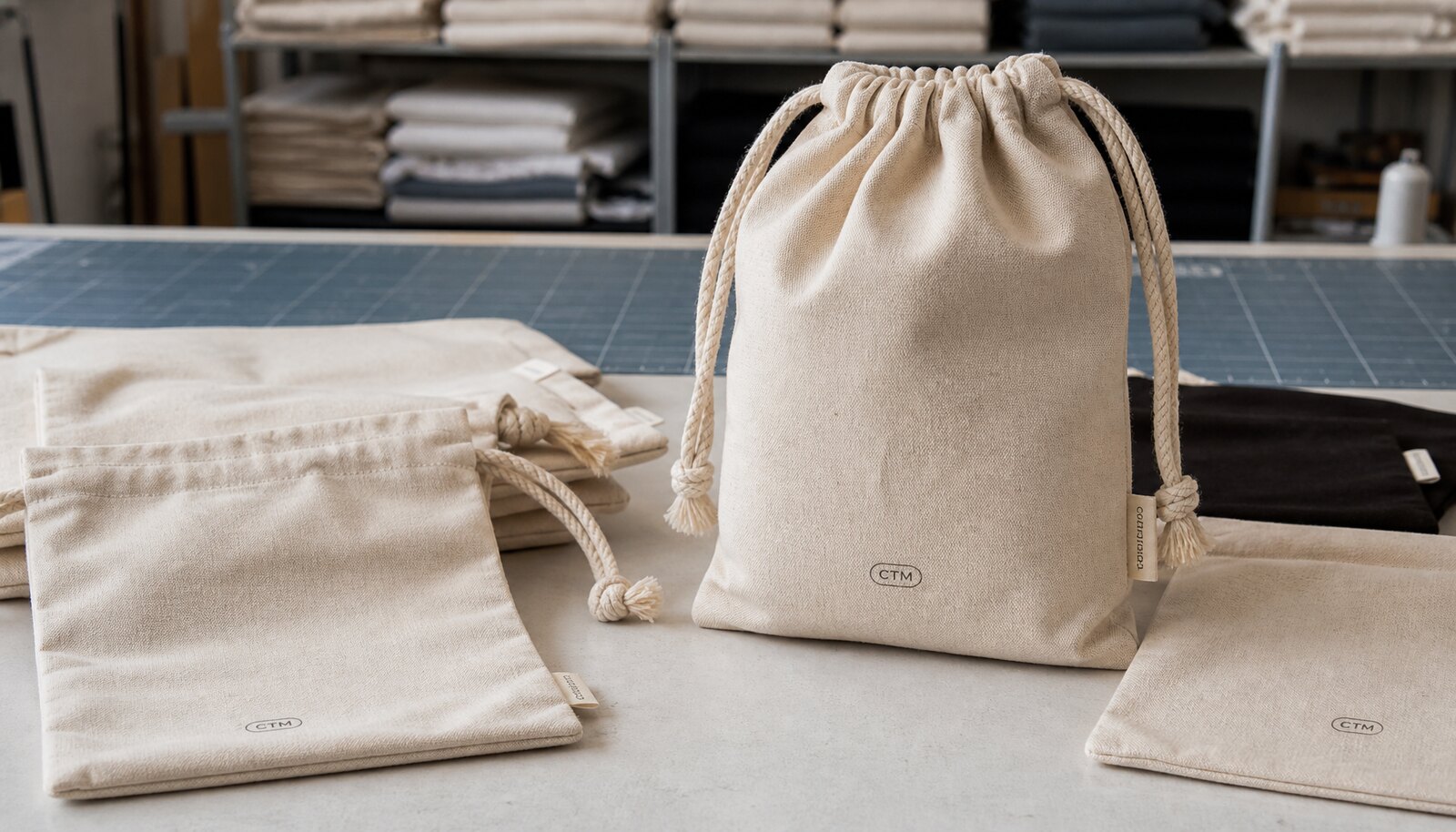
Why material choice matters more than the logo
For corporate gifting, the pouch often does a quieter job than the gift inside, but it still shapes how the whole set is judged. Cotton drawstring pouches are usually bought as packaging, secondary storage, or a reusable item that carries a brand mark. That means material selection is not just about appearance. It affects print result, closing action, perceived value, shipping damage, and how easily the item can be packed at scale.
The most common buying mistake is to choose fabric by image instead of by use case. A soft, lightweight pouch can look clean on a sample table, but it may collapse around a bottle, show through dark artwork, or feel too thin for premium sets. A heavier cotton may print better and feel more substantial, but it can push the unit price up and reduce the number of pieces per carton. The right choice depends on what the pouch must hold, how it will be decorated, and how strict the buyer is on cost and presentation.
- Choose fabric based on product protection, not only brand aesthetics.
- Match the pouch weight to the contents and the print method.
- Treat the pouch as part of the gifting budget, not a free add-on.
The GSM range that actually works in gifting programs
For most corporate gifting projects, cotton drawstring pouches usually land in the 100–160 GSM range. Below 110 GSM, the material can feel too light for a premium set unless the contents are very small and the print is minimal. Between 120 and 140 GSM, you get a practical middle ground: the pouch holds shape better, screen print stays cleaner, and the fabric still folds compactly for bulk packing. Above 150 GSM, the pouch starts to feel substantial and can support heavier contents, but it also adds cost and may require a slightly larger seam allowance or stronger channel construction.
GSM is only useful when you know whether the factory is quoting finished fabric weight or a rough textile estimate. Some suppliers quote fabric before shrinkage or finishing, which can make the actual pouch feel lighter than expected. For buyer comparisons, ask for the tested or measured fabric weight and the finished pouch dimensions. If the gift set includes cosmetics, tea, stationery, or a small accessory, 120–140 GSM is often the safest specification. If the pouch is meant to be reused as an everyday storage bag, move closer to 140–160 GSM and confirm the hand feel is still soft enough for your brand.
- 100–110 GSM: suitable for light inserts and tight budgets, but appearance can be thin.
- 120–140 GSM: balanced option for most gifting programs.
- 150–160 GSM: better for premium feel, heavier contents, and repeat use.
Cotton type, weave, and finish: what changes the buyer experience
The phrase cotton drawstring pouch sounds simple, but the actual fabric behavior changes with weave, yarn quality, and finishing. Plain weave cotton is the standard route because it is stable, easy to cut, and easier to print consistently. A tighter weave improves opacity and helps the pouch look cleaner under dark ink. Looser weaves can be softer and lower cost, but they may show the inner structure of the fabric and allow print to sink in unevenly.
Natural unbleached cotton is often the right choice for corporate gifting because it reads as practical and reusable. However, buyers should not assume all natural cotton is the same. Some lots have more visible flecks, more lint, or subtle shade variation between rolls. If the pouch will be used in a premium welcome kit, the acceptable range for speckling and shade should be shown on the sample and signed off before bulk. If a cleaner appearance matters, bleached or optically whiter cotton can improve perceived quality, but it may raise cost and reduce the natural look some brands want.
- Plain weave gives the most predictable print and sewing performance.
- Tighter weave improves opacity and premium appearance.
- Natural cotton needs an agreed tolerance for flecks, lint, and shade variation.
Print method decisions: match artwork to fabric, not the other way around
On cotton drawstring pouches, print method usually decides whether the bag looks controlled or amateur. Screen printing is still the most dependable option for solid logos, one- or two-color artwork, and medium-to-large runs. It gives strong color, lower unit cost at scale, and better consistency on woven cotton. Heat transfer can help when the artwork has more colors or fine detail, but it adds sensitivity to press temperature, fabric texture, and adhesion. Embroidery can be attractive for premium gifting, but it changes the look, adds cost, and may distort very thin pouches if the stitch area is too large.
The critical issue is not what the artwork looks like on screen, but how it behaves on the real fabric. Fine lines can break, gradients can blot, and small text can fill in on textured cotton. If the brand logo has tiny type or thin strokes, ask the factory for a strike-off or test print before approving the bulk run. For a corporate gifting order, a clean one-color logo placed in a stable print area often performs better than a complex design that looks sharper in concept art but unstable in production.
- Screen print: best for solid logos and repeat orders.
- Heat transfer: useful for multi-color art or smaller runs, but verify adhesion.
- Embroidery: premium feel, but test for puckering and added weight.
Comparison table: which sourcing route fits your buying case
The right supplier route depends on how much control you need over fabric, print, packing, and lead time. A direct factory is usually the strongest route when you need custom size, consistent stitching, and a quote that breaks out material and decoration costs. A trading company can be useful when your order is small, the timeline is tight, or you are bundling the pouch with other gift items from one shipment. Neither route is automatically better; the real question is whether the supplier can prove how the pouch will be made and packed.
For procurement teams, the safest comparison is not simply price per piece. It is how much of the production risk sits with you after the PO is placed. If the supplier cannot explain fabric source, stitch construction, print setup, and carton packing in simple terms, the quote is not fully comparable. Use the table below to align supplier choice with buying situation.
Supplier route comparison for cotton drawstring pouches
Define the measurable checks around cord pull test, seam strength check, logo rub test, size tolerance, color shade check, and loaded hang review. Add tolerance ranges only where the buyer truly cares, and ask for photos that show the measurement point, not just a finished product overview.
For procurement decisions, the inspection note should say who checks, when they check, and what evidence is required. Photos without measurements are often not enough for remote approval.
- Write decisions in measurable language, not only descriptive wording.
- Ask for sample photos plus one physical approval sample for important orders.
- Keep quotation, sample approval, and inspection notes tied to the same spec version.
What to include in the quote so supplier numbers are comparable
A useful quote for cotton drawstring pouches should separate the parts that actually move cost. Fabric weight, pouch size, number of print colors, cord type, packing format, and carton count all affect the final number. If the supplier gives only a single unit price, you cannot tell whether the lower quote came from lighter fabric, cheaper cord, simpler packing, or a lower-quality print process. That is how buyers end up with apples-to-oranges comparisons and surprise adjustments later.
The quote should also make clear what is not included. Freight, customs duties, special inserts, hang tags, master carton labels, and testing costs may sit outside the factory price. If you are comparing several suppliers, force each one to quote the same structure. That makes hidden differences visible early, before tooling and sample rounds consume time.
- Pouch size in centimeters or millimeters.
- Finished fabric GSM and fabric color.
- Print method, print area, and number of colors.
- Cord material, cord length, and channel style.
- Packing method, inner pack quantity, and master carton count.
How MOQ changes when you change one small detail
MOQ logic on cotton drawstring pouches is usually driven by fabric setup, print setup, and cutting efficiency. A plain natural cotton pouch in one size and one logo color can often be produced with a lower MOQ than a pouch that uses a special dyed fabric, multiple print colors, or custom cord colors. Small changes such as changing the logo placement or adding a second side print may look minor to the buyer, but they can require a new setup and a separate inspection path on the factory floor.
When you are building an order for corporate gifting, keep the core product simple and move complexity into packaging only if needed. For example, one pouch size with one logo color and one carton marking scheme is much easier to repeat than three pouch sizes with different print placements. If your distributor or retail team needs variants, ask the factory to price each variant separately rather than averaging them into one number. That reveals which feature is actually pushing MOQ and cost.
- Custom size usually affects MOQ more than logo placement.
- Multiple print colors raise setup complexity and waste risk.
- Special dyeing or cord color matching can increase lead time.
Sample approval should measure construction, not just appearance
A sample that only looks right is not enough for a bag that will be packed at scale. The pre-production sample should be measured for cut size, finished size, seam allowance, cord length, and opening function. It should also be handled the way the end user will handle it: load it with the intended gift item, pull the cord repeatedly, and inspect whether the channel tightens cleanly without twisting. This is especially important for corporate gifting, where the pouch often arrives as part of a kit and there is no second chance after the pack-out line starts.
Use the sample stage to lock a few practical tolerances. For example, if the pouch will hold a bottle or box, confirm the internal clearance and the amount of slack the opening must have for fast packing. Check whether the print remains centered after stitching and whether the cord ends are secure and neat. Once the sample is approved, ask for a reference sample to be sealed and kept on both sides if possible so the bulk lot can be compared against it later.
- Measure final dimensions, not only cut dimensions.
- Load-test the intended contents.
- Approve print placement against the sewn sample, not a flat artwork file.
Packing, carton loading, and shipping damage prevention
Packing decisions affect both receiving quality and landed cost. Cotton pouches are usually shipped bulk packed in polybags and master cartons, but the exact pack count should match your distribution plan. If the order goes directly into gift kits, a clean bulk pack can work well. If the order will be split across retailers or warehouses, stronger carton marking, SKU labels, and a fixed inner pack count reduce counting errors and speed inbound handling. Loose packing may save a small amount of labor, but it creates rework later if quantities do not match the packing list.
For cotton items, moisture and odor control matter more than buyers sometimes expect. Fabric that is packed too soon after printing or steaming can hold smell or slight dampness inside the carton. That becomes a receiving issue even when the product is technically correct. Ask the factory how long the goods rest before packing, whether silica gel or desiccant is used, and whether the cartons are lined or only bulk inserted. If the gifting program is premium, a clean fold standard and consistent cord tuck will matter as much as the logo.
- Use fixed inner pack counts for easier warehouse receiving.
- Keep cartons dry and odor-free before sealing.
- Add carton marks and SKU labels if the goods will be split across locations.
Specification comparison for buyers
| Spec decision | Recommended option | When it fits | Buyer risk to check |
|---|---|---|---|
| Fabric weight | 120–140 GSM plain weave cotton | Most corporate gifting programs that need a better hand feel than promotional pouches but still want a controlled cost | Too light can look thin under dark print; too heavy raises cost and slows drying after washing or pre-shipment steaming |
| Fabric finish | Natural unbleached cotton with controlled whitening tolerance | Brands that want an eco look or a neutral backdrop for one-color logos | Uneven flecking or visible seed specks may be acceptable for some brands but rejected by others if not approved in pre-production |
| Print method | 1–2 color screen print or heat transfer for short runs | Logo-centric campaigns with solid shapes and stable artwork | Fine gradients, small type, or close registration can fail on woven texture; require strike-off approval |
| Closure style | Single cord with center pull or double drawcord with reinforced channel | Standard gifting sets, event kits, and retail inserts | Weak channel stitching can cause cord tear-out during packing and end use |
| Supplier route | Direct factory with pouch specialization | Programs needing lower unit cost, custom sizing, and tighter control over stitching and print details | Weak QC documentation or no measurable acceptance criteria can lead to inconsistent lots |
| Supplier route | Trading company or sourcing agent | Low-MOQ testing, multi-category bundles, or buyers needing consolidated shipments | Markup, slower technical feedback, and less visibility on fabric source and in-line checks |
| MOQ strategy | Keep size/fabric/print to one core spec and vary only logo or pack insert | When you need price stability and easier reorders | Too many variants split production and raise setup cost per SKU |
| Packing method | Bulk packed in polybags with master carton and clear carton marks | Warehouse distribution, gifting kits, and private label replenishment | Loose folding or mixed sizes create counting errors and increase receiving disputes |
| Lead-time planning | Sample in 7–10 days, bulk 25–35 days after approval | Typical seasonal gifting programs with normal factory capacity | Artwork revisions, fabric shade approval, or delayed PO release can add a full production week or more |
Buyer checklist before sampling
- Lock pouch size, target GSM, color, and cord style before requesting quotations so each supplier is pricing the same product.
- Specify logo method, number of colors, print size, and whether a strike-off or digital proof is required before bulk approval.
- State intended use: jewelry, samples, cosmetics, event kits, or retail gift packaging, because it changes GSM, seam strength, and carton packing.
- Request a measured sample with actual fabric weight, stitch count, and cord length rather than a photo-only approval.
- Define acceptable fabric variation, print alignment, and odor limits in writing if the pouch will go into premium gift sets.
- Confirm carton pack count, inner polybag count, and whether cartons need barcodes, SKU labels, or export marks.
- Ask each supplier to separate material cost, printing cost, and packing cost so you can compare routes fairly.
- Check whether the supplier owns cord-making, cutting, and printing in-house or outsources those steps.
- Build in time for one correction round on sample artwork and one round on pre-production confirmation.
Factory quote questions to send
- What cotton fabric GSM is quoted, and is it finished weight or greige weight?
- Is the pouch sewn from pre-shrunk fabric, and what size tolerance can you hold after washing or steaming?
- What is the exact print method, how many colors are included, and what is the repeat setup charge if artwork changes?
- What is the MOQ by size, by print color, and by fabric color?
- Can you share a measured sample photo with seam allowance, cord length, and hem/channel details?
- What packing format is included in the quote: bulk, individual polybag, or retail-ready set packing?
- What lead time applies after sample approval, and what causes delay most often on your line?
- What QC data can you provide with the shipment: in-line inspection, final AQL, carton counts, or material traceability?
- Are the cords cotton, polyester, or blended, and are cord ends heat-cut, knotted, or tucked?
- What is excluded from the quote, such as freight, duties, samples, artwork setup, or testing?
Quality-control points to confirm
- Fabric weight should match the quoted GSM within a practical tolerance agreed with the factory before production.
- Measure pouch opening width, body height, and usable fill area on the pre-production sample, not just the flat cut size.
- Check stitch density at side seams, channel seam, and stress points where the cord enters the top hem.
- Pull-test the cord channel and one random sample from each carton lot to spot weak stitching before shipment.
- Inspect print opacity, edge sharpness, and registration under normal indoor light, not only in photo lighting.
- Confirm no oil stains, thread snags, broken needles, or excess lint on natural cotton fabric.
- Verify carton pack count against the packing list and make sure size/color segregation is clear.
- Check odor and moisture if the bags are packed immediately after steaming or printing.