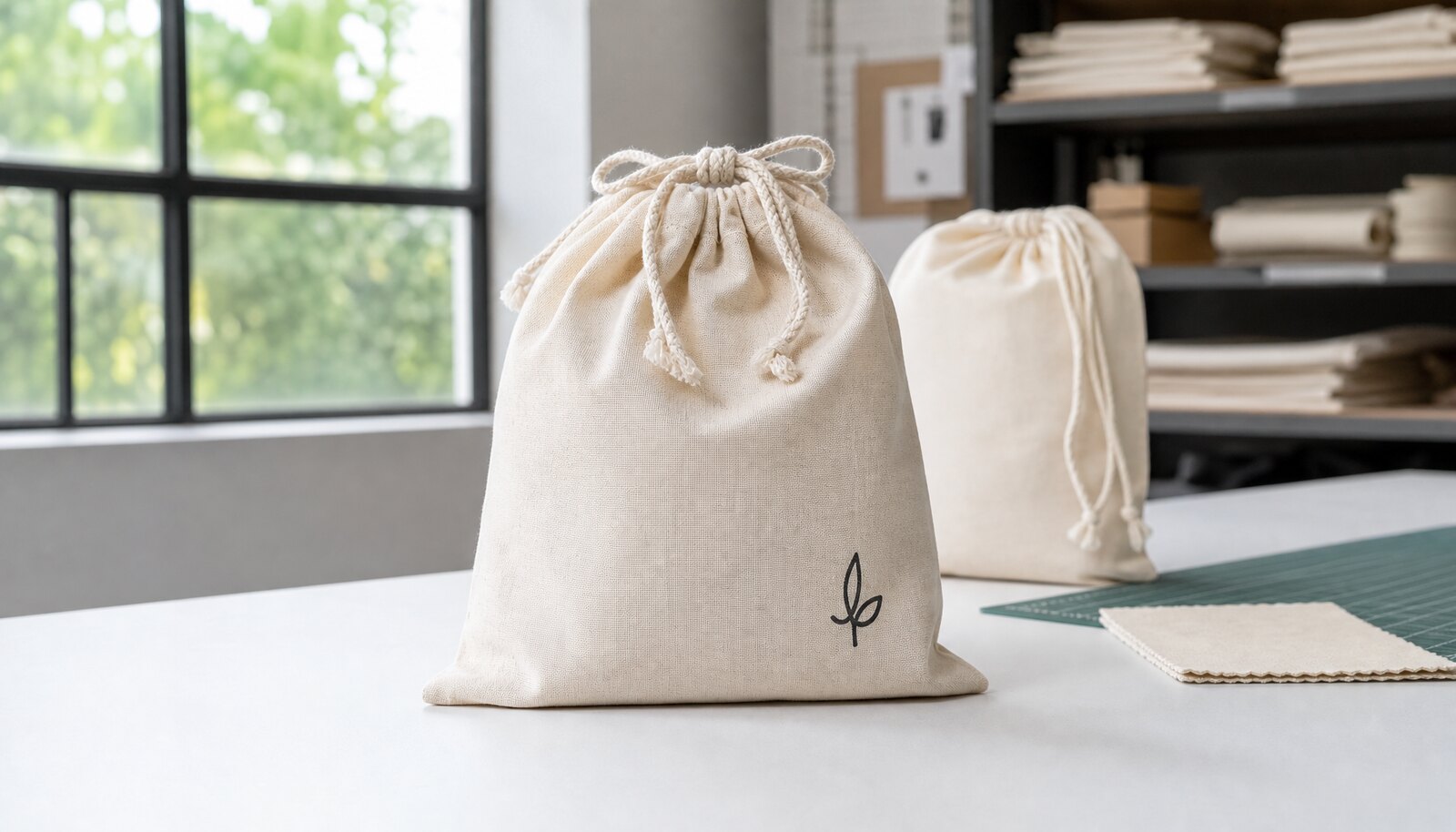
What the pouch has to do in a gift shop
A cotton drawstring pouch in a gift shop is doing more than holding an item. It is part packaging, part merchandising surface, and part brand signal. The logo needs to be visible fast, stay readable after the pouch is tied, and still look intentional when the item is handled by staff and customers. If the mark sits too near the top channel, crosses a seam, or competes with a fold line, the pouch looks cheap even if the cloth itself is fine.
The right logo position depends on how the pouch is sold. If it is a standalone retail item, the front face needs stronger branding and a cleaner composition. If it is packaging for jewelry, candles, tea, cosmetics, or souvenirs, the pouch may need quieter branding so the store can still add a sticker, swing tag, or price label. Procurement teams should decide the merchandising role first, because that choice drives the logo size, placement, and decoration method.
- Decide whether the pouch is retail packaging, a standalone gift item, or an inner pack before placing the logo.
- Keep the mark visible after the pouch is tied, folded, and displayed in a tray or on a hook.
- Reserve blank space for price stickers, barcodes, or hangtags if the store will need them.
Start with the use case, not the artwork
Most logo problems begin when buyers approve artwork before they define the use case. A pouch used for premium gift presentation has different priorities from a pouch used as transit packaging for a set of small products. The premium version needs a cleaner face, more stable cloth, and more attention to fold behavior. The transit version needs efficiency, consistent size, and a print that survives handling without adding unnecessary cost.
Gift-shop buyers should also think about how the pouch will sit in the store. Some formats are sold flat on a shelf, some are filled and tied, and some are used as part of a basket or hamper display. Each display method changes how much of the front panel is visible and which edge lines compete with the logo. That means the buyer should not ask, 'Where do we put the logo?' until the merchandising layout is clear. The better question is, 'Which panel stays visible after packing and shelf setup?'
- Define shelf behavior before confirming the logo location.
- Identify whether the pouch needs to be readable flat, tied, or both.
- Write down the store's display method so the factory can quote against a real use case.
Fabric weight and construction drive the result
Fabric choice and logo placement should be approved together. A lighter cotton pouch in the 170-200 gsm range, roughly 5-6 oz, is often good enough for simple packaging and keeps freight down. But lighter cloth can wrinkle, show pressure marks, and let the weave interfere with print sharpness. If the logo sits too close to a seam on thin fabric, the shape can look distorted once the pouch is filled and tied.
Heavier cotton around 250-270 gsm, or about 8 oz, gives more body and usually supports cleaner decoration. It tends to look better in retail presentation because the face panel stays flatter and the pouch holds shape more consistently. The tradeoff is cost, packing density, and sometimes a stiffer closure feel. Tight weave matters as much as GSM. A tighter weave supports better ink edges and less show-through, while a loose weave can blur small text or create a worn look that may be fine for rustic branding but not for a sharper retail program.
- Use lighter fabric when the pouch is mostly packaging and cost control matters.
- Use heavier fabric when the pouch is part of the sellable presentation and needs better structure.
- Ask the factory to quote actual GSM, weave type, and shrinkage rather than only saying 'cotton.'
Placement choices that work in production
Front-center placement is the standard for a reason. It is easiest to see on shelf, it photographs well, and it gives the factory a generous area to keep the artwork aligned. This is the safest route for most gift-shop programs, especially when the logo needs to feel like part of the product rather than like shipping packaging. The main risk is crowding the top channel or printing too high, where the drawstring action can distort the mark.
Lower-corner placement is better when the brand wants restraint. It leaves blank space for product labels and can make the pouch feel more premium or less promotional. Side-panel or gusset placement can work when the front is reserved for store information, but only if the merchandising plan keeps that panel visible. Back-panel placement is usually a weak choice for retail unless the store has fixed display rules. Buyers should treat placement as a visibility decision, not a design preference.
- Use front-center for maximum visibility and simple retail communication.
- Use a lower corner when the brand wants a quieter, more premium look.
- Use side or back placement only if the display method guarantees that panel stays visible.
Match the print method to the logo, not to habit
For cotton drawstring pouches, one-color screen print is still the most practical default. It handles simple logos well, gives strong coverage on cotton, and keeps the unit structure predictable. The factory can usually control ink deposit, cure, and repeatability better than with more complex methods. That said, screen print is only as good as the strike-off and curing control. If the ink sits too heavy, the print can crack; if it is too light, the logo can disappear into the weave.
Woven labels, sewn patches, and embroidery solve different problems. A woven label is useful when the logo has fine lines, small type, or a premium textile look. A patch can add perceived value and work well on a corner placement. Embroidery can look high-end, but only when the cloth has enough body to resist puckering and the design is large enough to hold detail. Heat transfer can be useful for short runs or multicolor art, but procurement teams should be cautious if the pouch will be folded, rubbed, or stored under pressure, because the finish can age differently than print.
- Use screen print for simple logos and stable repeat orders.
- Use a woven label or patch for small detail or a textile finish.
- Use embroidery only when the fabric weight and artwork size can support it without puckering.
Compare sourcing routes before you compare unit price
A good procurement decision is not only about the printed price per pouch. It starts with the supplier's actual capability. If sewing, printing, and packing are all done in the same factory, you usually have better control over placement, color, and correction speed. If the factory outsources decoration, you need a stricter approval trail because the sewing team and decoration team may have different standards and no single owner for defects.
When comparing suppliers, ask for the process map, not just a quote. Who cuts the cloth? Who prints? Who inspects the placement? Who signs the pre-production sample? What happens if the first strike-off is rejected? A supplier that can answer these questions clearly is usually easier to manage than a vendor who only sends a line-item price. For gift-shop programs, consistency matters more than a low first-order quote because the product often needs repeatability across seasons and multiple store locations.
- Verify whether decoration is in-house or subcontracted.
- Ask who signs off on sample color and logo placement.
- Treat unclear process ownership as a sourcing risk, not as a minor admin issue.
What belongs in the RFQ and sample path
The best RFQ is specific enough that two factories can quote the same product without guessing. It should state the finished pouch size, the cut or flat size, the cotton weight, the color, the decoration method, the exact logo position, the intended display method, and the packing format. If the supplier has to infer whether the pouch is retail packaging or a standalone gift item, the quotes will not be comparable. If the logo can move after a sample is approved, the final goods will not match the buyer's expectations.
Sampling should also be staged properly. An artwork proof confirms the file. A strike-off proves the print on the real cloth. A pre-production sample confirms the final size and assembly. A carton sample checks packing pressure and orientation. If the order is large or the logo sits near a seam, the buyer should not skip the pre-production step. That is where many production issues show up: a mark that looked centered on screen becomes visibly off-center once the cloth is sewn and tied.
- Request artwork proof, strike-off, pre-production sample, and carton sample where risk justifies it.
- Approve the actual cloth and actual pouch size before mass production.
- Make sure the sample also reflects the final packing method if the pouch will be sold retail-ready.
QC needs measurable thresholds, not general impressions
Quality control should be written as inspection criteria, not preference language. For logo placement, define the acceptable tolerance in millimeters and measure against the finished pouch, not the flat cloth. For print quality, require solid coverage with no obvious pinholes, bleed, or feathering that changes the shape of the logo at normal viewing distance. For labels and patches, check edge curl, stitch density, and whether the attachment changes the drape of the pouch face.
Gift-shop buyers should also care about physical handling performance. The pouch should open and close smoothly after decoration, and the printed or sewn area should not interfere with the cord channel. A good quick test is to fill the pouch with a representative item, tie it as it would be sold, and place it in the intended display position. If the logo disappears under the fold, shifts visually, or rubs against the cord, the placement is wrong even if the print itself is neat. The carton inspection should include pieces from the top, middle, and bottom of the stack because pressure marks often appear only after packing.
- Set a measured placement tolerance before production starts.
- Require full visual coverage with no obvious print break-up at normal viewing distance.
- Inspect tied, filled, and carton-packed samples, not only flat loose pieces.
Packing, labeling, and freight can ruin a good logo
Packing changes both the appearance and the survival of the logo. If pouches are folded too tightly, the fold line can sit across the decoration and leave a permanent crease. If they are bulk packed without protection, the logo area may rub against other pouches or carton surfaces. Individual polybags can help with cleanliness and scuff control, but they also add cost, labor, and sometimes glare that makes a handmade-style pouch look less natural on shelf.
For gift shops, the packing spec should support retail presentation. That may mean a consistent fold, a count per carton that matches replenishment practice, and a label position that never covers the logo. If the product is sold as an insert inside a larger gift set, the packaging should protect the face panel while keeping the branding visible after the outer wrap is removed. Freight planning matters too. A denser fold pattern can reduce cubic volume, but only if it does not create a permanent crease in the print area.
- Keep fold lines away from the logo whenever possible.
- Specify whether the pouch ships bulk packed, individually bagged, or with a retail insert.
- Make sure size stickers, barcodes, and hangtags do not cover the print zone.
Common failure cases and how to avoid reorders with the same problems
The most common failure is not a bad logo file. It is a logo that was approved in the wrong position for the actual pouch size. A mark that works on a flat drawing can become awkward once the channel is sewn, the edges are hemmed, and the pouch is tied. Another common issue is using a placement that looks good in a mockup but is hidden by the retailer's folding or hanging method. Buyers should test the design in the same state the customer will see, not just in an idealized proof.
The other repeat problem is assuming a reorder will match the first order without preserving the factory file. If the supplier does not keep the same strike-off, same cloth reference, same approved photo, and same packing method, the second shipment can drift in placement or color even when the quote looks identical. Procurement teams should lock a gold sample, keep a carton reference, and require the factory to record the exact production conditions. That is how you keep a pouch program stable across seasons instead of treating every order as a new experiment.
- Test the logo on the actual tied pouch, not only on a flat artwork proof.
- Check whether the store's fold or hanger hides the decoration.
- Keep a gold sample and a packed carton reference for repeat orders.
Specification comparison for buyers
| Decision area | Recommended option | Why buyers choose it | When it fails | Validation check |
|---|---|---|---|---|
| Sourcing route | Direct factory with in-house sewing and decoration | Best control over placement, color, and repeatability; fewer handoffs | Fails when printing is subcontracted without clear accountability | Ask who actually prints, who inspects, and where the final approval sample is produced |
| Sourcing route | Blank pouch imported, decoration done locally | Useful for short runs, regional artwork changes, or late-stage branding updates | Two vendors can blame each other for color drift, seam distortion, or damage in transit | Require a written split of responsibilities for cloth, printing, packing, and claims |
| Logo placement | Front-center with safe margins from seams and channel | Highest visibility on shelf, in photos, and in customer hands | Can look crowded on small pouch sizes or distort when tied closed | Confirm the logo remains readable after the pouch is filled and cinched |
| Logo placement | Lower corner on the front panel | Cleaner, more premium look; leaves space for a tag or label | Can disappear on smaller formats or when folded for packing | Check visibility at the actual fold and display angle used by the store |
| Logo placement | Side panel or gusset | Works when the front is reserved for product info or a sticker | Can be hidden by the fold line or twisted by seam tension | Test it in the packed state, not only on a flat sample |
| Print method | 1-color screen print | Strongest default choice for cotton pouches, simple art, and repeat orders | Fails if the mesh, ink, or cure profile is not matched to the fabric texture | Request a print strike-off on the exact cloth and inspect coverage in daylight |
| Print method | Woven label or sewn patch | Good for fine detail, small type, or a textile look that feels more finished | Adds stitch lines, thickness, and a new failure point at the edges | Check edge fray, stitch density, and whether the label changes pouch drape |
| Fabric weight | About 170-200 gsm, or 5-6 oz cotton | Lower cost and lighter freight; fine for simple retail packaging | Thin cloth can wrinkle, shadow through, or show the logo less clearly | Inspect opacity, hand feel, and seam pull after the first tie test |
| Fabric weight | About 250-270 gsm, or 8 oz cotton | Better body, cleaner print face, and stronger premium feel | Raises material cost and can affect packing density and closure action | Verify the pouch still closes easily and packs to the expected carton count |
Buyer checklist before sampling
- Write the pouch size in millimeters and include the cut size, finished size, and any shrinkage allowance.
- Attach a dimensioned placement drawing that shows distance from top seam, side seam, bottom seam, and drawstring channel.
- State whether the pouch is retail packaging, a standalone gift item, or an inner pack for a larger set, because that changes the branding strategy.
- Specify the fabric weight, weave type, cotton color, and whether the cloth is bleached, natural, or dyed.
- Define the decoration method, number of colors, ink type, and whether the logo must stay visible when the pouch is tied closed.
- Ask for a physical sample made on the final cloth, final size, and final production method, not a generic proof.
- Separate MOQ for blank pouches, printed pouches, labels, patches, and any custom packaging component.
- Confirm whether screens, digital files, woven label programs, or embroidery data will be reused on reorder or charged again.
- Request the factory's standard defect limits for print shift, bleed, skipped stitches, loose threads, and staining.
- Set packing format, carton count, and whether the product ships bulk packed, folded, or individually polybagged.
Factory quote questions to send
- Is the decoration done in-house or subcontracted, and who owns final approval if placement or color is off?
- What is the MOQ for the blank pouch, and how does it change for 1-color print, 2-color print, woven label, or embroidery?
- Where exactly will the logo sit, measured from the top seam and side seam, and what placement tolerance do you guarantee?
- Will the logo be applied before sewing or after sewing, and how do you control registration if the artwork crosses a seam zone?
- What fabric weight, weave density, and shrinkage allowance are included in the quote, and what is the actual measured GSM?
- Does the price include screen setup, label setup, digitizing, curing, and reprint if the first strike-off is not acceptable?
- Which sample stages do you offer: artwork proof, strike-off, pre-production sample, and carton sample?
- Can you provide a photo set of the sample taken under production lighting, not only a rendered mockup?
- How are pouches packed in the master carton, and how do you prevent fold marks, pressure marks, or print rub?
- What is the standard color tolerance against the approved sample, and what lab or visual method do you use to judge it?
Quality-control points to confirm
- Logo placement should stay within the agreed tolerance, typically 3 mm for small formats and 5 mm for larger panels, measured from the sewn edge on a finished pouch.
- The logo should have full visual coverage with no unprinted pinholes, ink pooling, or visible weave breakage in the key graphic area.
- For screen print, set a minimum rub resistance requirement before shipment, such as no visible transfer after dry rub testing and only minimal change after wet rub testing on the approved cloth.
- If the logo uses multiple colors, the registration should remain clean with no obvious overlap gaps or color offset that changes the mark's shape at arm's length.
- Stitch density around seams, channels, labels, and patches should be even, with no skipped stitches, broken threads, or needle damage around the decoration area.
- The pouch should open and close smoothly after decoration, with no binding at the cord channel and no snagging where the print or label sits near the fold.
- Color should match the approved sample within the buyer's accepted tolerance, and the factory should note whether it is comparing by visual standard, light box, or instrumental target.
- Fabric weight should stay within the agreed range, and the buyer should reject obvious underweight cloth that feels limp or allows show-through against the natural cotton base.
- Carton sampling should include pieces from the top, middle, and bottom of the carton stack, since pressure marks and handling damage often appear only after packing.
- Pack-out should be checked for correct counts, correct size mix, correct logo orientation, and any folding method that creates a permanent crease across the artwork.