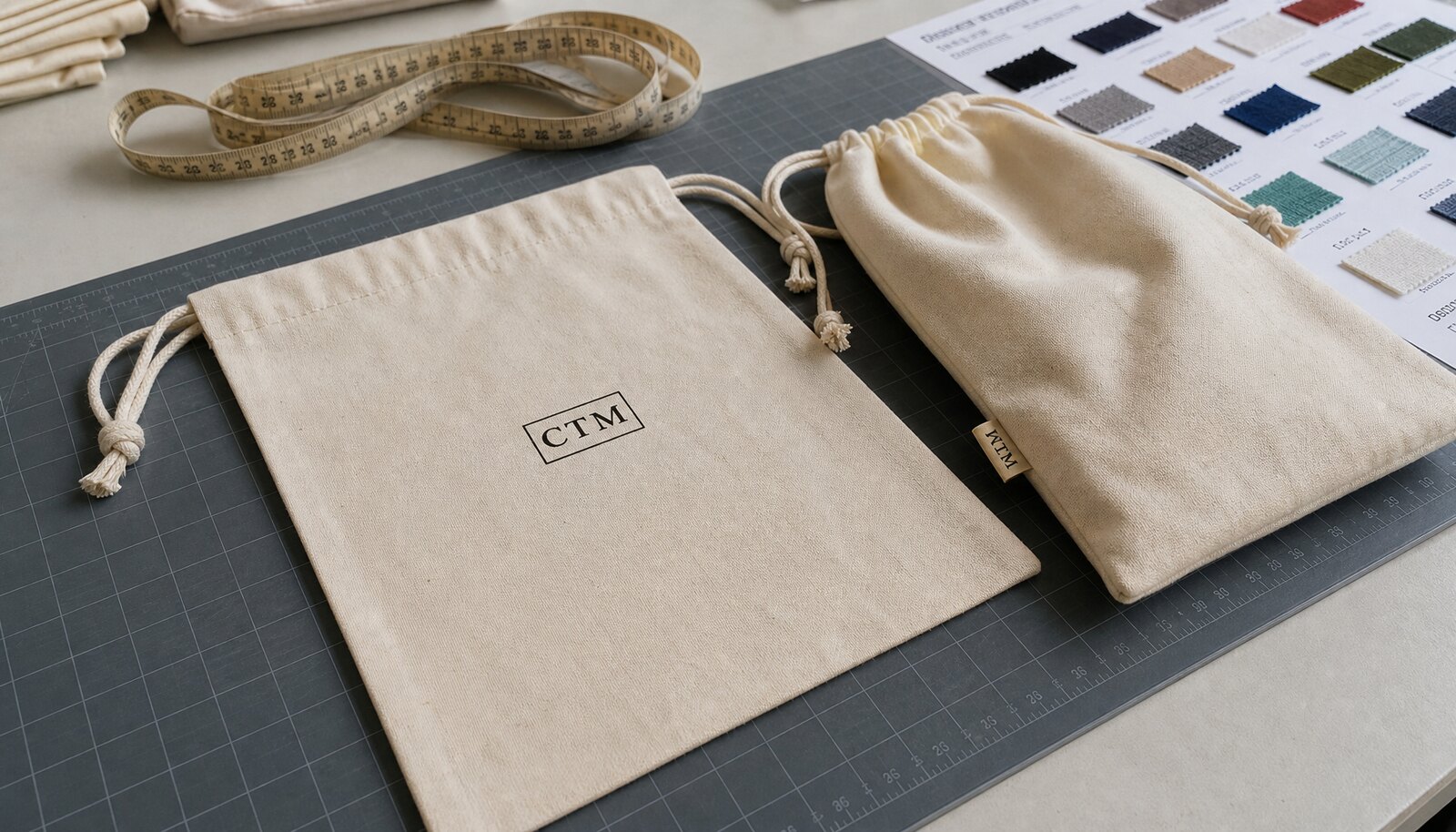
Logo placement is a sourcing specification, not a decoration afterthought
Cotton drawstring pouches look simple on a line sheet. That simplicity is exactly why logo placement is often left too vague. A buyer asks for a natural cotton pouch with a front logo, the supplier sends a clean digital mock-up, and everyone assumes the placement is controlled. In real production, the pouch is not a flat rectangle. It has seam allowance, a drawcord channel, fabric grain, stitching pull, bottom construction, and the shape of the gift inside. Each detail changes how the logo is seen.
For corporate gifting, that small position decision affects more than appearance. It can influence sample approval time, defect rate, print durability, carton packing, and the final presentation. If the mark sits too high, it may disappear into the gathered top when the drawcord is pulled. If it sits too low, a bottom fold, candle, bottle, tech accessory, notebook, or cosmetics set can hide or bend it. If the logo is too large, a normal 3-5 mm production drift suddenly looks obvious.
Treat logo placement as part of the product specification. The RFQ should define finished pouch size, usable print area, logo dimensions, measurement points, placement tolerance, decoration method, sample requirement, and packing method. Those details make quotes easier to compare and give inspectors something measurable to check later. Without them, suppliers can quote very different construction assumptions while appearing to offer the same pouch.
Start with the gifting moment. A pouch handed out at a conference registration desk needs fast readability. A pouch inside an executive gift box may call for a quieter mark. A sample pouch stacked in cartons must still look right after filling and packing. Good placement is not simply the spot that looks best on a mock-up. It is the position that survives use, handling, and inspection.
- Approve logo placement on the physical pouch size and construction planned for bulk production.
- Measure the logo against fixed reference points instead of relying on visual centering.
- Review the pouch empty, filled, closed, folded, and packed before releasing mass production.
- Tie the approved artwork file, placement sheet, master sample, and purchase order together for QC control.
Start with the pouch, not the artwork
Logo placement decisions should begin with pouch engineering. Finished size matters more than cut size because the buyer receives the sewn product, not the fabric panel. A 15 x 20 cm pouch and a 20 x 30 cm pouch may both be called drawstring bags, but their usable front panels are very different once the side seams, top channel, and bottom construction are removed from the branding area. On small pouches, even a few millimeters of seam take-up can make a logo look off-center.
Cotton GSM also changes the result. For many corporate gifting programs, 140-180 GSM cotton is a practical range for lightweight items, sample packs, stationery, accessories, small onboarding materials, and event giveaways. It usually balances cost, printability, and carton efficiency. For heavier or more premium contents, 200-240 GSM can provide better body and opacity, but it also adds material cost, sewing load, drawcord stress, packed volume, and freight weight.
The content inside the pouch should be known before the logo is finalized. A flat card or folded brochure keeps the front panel fairly smooth. A jar, candle, bottle, rolled textile, charger, or round cosmetic item pushes the fabric outward and can curve the printed image. If the pouch is filled close to capacity, the upper section may wrinkle when the drawcord closes. In that case, the logo may need to move lower than it would on a flat sample, while still avoiding the bottom fold.
Send suppliers the gift dimensions and approximate weight where possible. If the item is confidential or still being sourced, use a substitute with similar volume during sampling. The point is not to make a simple pouch complicated. The point is to avoid approving artwork on an empty sample and discovering later that the filled gift hides the brand.
- Specify finished pouch width and height, not only cut-panel dimensions.
- Record drawcord tunnel depth, seam construction, bottom construction, and expected tolerance.
- Use 140-180 GSM for many standard gift pouches and 200-240 GSM when higher body or heavier contents justify it.
- Confirm cotton color and finishing route because natural, bleached, dyed, and washed cotton affect contrast and shrinkage differently.
- Share content dimensions and fill level so the factory can judge whether the logo will distort or be hidden.
Define the print-safe area in millimeters
The print-safe area is the measured zone where decoration can sit without fighting the pouch construction. It is the most useful part of a cotton drawstring pouches logo placement guide for corporate gifting because it turns a subjective instruction into a factory control. Instead of saying the logo should be centered, state where the logo centerline sits in relation to the top edge, bottom of the drawcord tunnel, side seams, and bottom edge.
A practical placement sheet should show finished pouch dimensions, top edge, drawcord channel, side seams, bottom seam or fold, logo width, logo height, and logo centerline. For many small and medium pouches, an early clearance range may be 15-25 mm below the drawcord tunnel and 10-15 mm from side seams. Larger pouches, heavier contents, thicker fabrics, or oversized logos may need more room. These numbers are useful starting points, not universal standards.
Be clear about measurement references. If the supplier measures from the raw cut panel before sewing and the buyer measures from the finished seam, the same pouch can appear to pass and fail depending on who checks it. For front-center printing, the logo should usually align to the finished visible panel, not the theoretical fabric width before sewing. This matters most on small pouches, heavier cotton, and styles where seam pull changes the apparent center.
Make the placement sheet part of the purchase order package. It should travel with artwork approval, sample approval, production instructions, and final inspection documents. When a dispute happens, a ruler-based drawing is far more useful than a polished mock-up. It tells the factory and inspector exactly what to measure.
- Use millimeters for logo size, logo position, and tolerance.
- Show the drawcord tunnel and seam zones as no-print areas on the approval sheet.
- State whether measurements are taken after sewing, pressing, and final finishing.
- Confirm whether the pouch is printed before sewing or after sewing because the control method may differ.
- Keep the signed placement sheet with the signed master sample.
Choose the logo position for the gifting moment
Front-center placement is the most common choice because it gives the clearest brand read. It works well for onboarding kits, trade show giveaways, holiday gifting, employee welcome packs, launch kits, and product insert pouches. It is also easier for many factories to control than angled, edge, or wraparound placements, especially when the artwork is a simple one-color mark.
Upper-center placement can work when the pouch is displayed upright and the lower portion may be blocked by contents. The risk is the drawcord channel. When the pouch closes, fabric near the top gathers and wrinkles. Important text or fine detail placed too close to that area can warp or disappear. Lower-center placement can suit taller pouches, but only after the fold direction is confirmed. A factory fold through the lower panel can crease the logo before the recipient sees it.
Lower-corner marks, woven side labels, and sewn tabs create a more retail-like feel. They suit executive gifts, beauty sets, jewelry pouches, boutique product packaging, and reusable bags where the brand should be present but not loud. The trade-off is visibility. A small tab label may look refined in the hand but may not read clearly in event photos or on a busy registration table.
Co-branded programs need restraint. A pouch carrying a corporate logo, sponsor logo, event name, QR code, slogan, and date can quickly become crowded. If secondary information is required, it may belong on a hangtag, insert card, belly band, or gift box label instead of the cotton pouch. Let the pouch carry the mark that matters most to the gifting experience.
- Use front center when the main goal is immediate brand visibility.
- Use upper center only after testing the pouch closed and filled.
- Use lower center only after confirming the fold direction and bottom bulge do not hide the mark.
- Use a side label or lower-corner logo when premium restraint matters more than long-distance readability.
- Move secondary campaign information to tags or inserts when the pouch panel becomes crowded.
Match the decoration method to the artwork and fabric
Decoration method changes both price and placement risk. Screen print is often the practical choice for simple one-color or two-color corporate logos. It can provide good opacity on cotton, works well at volume, and is straightforward to inspect. It performs best with bold shapes, clean type, and artwork without very fine detail. Before sampling, ask the supplier to confirm minimum line width and text height because cotton texture can soften edges and fill small gaps.
DTF and heat transfer are useful when the artwork includes multiple colors, gradients, small icons, or brand elements that are difficult to separate into spot colors. They may also be practical at lower quantities where screen setup is not economical. The trade-off is hand feel and folding behavior. Transfer graphics sit on the cotton surface differently from printed ink. Test for edge lift, crease whitening, cracking, tackiness, and pressure marks after the pouch is folded and packed.
Embroidery can feel premium, but it is not automatically suitable for every drawstring pouch. It works best on heavier fabric and larger panels. On light cotton, embroidery can pucker the fabric, stiffen the panel, distort the logo, or show backing inside the pouch. It can also make the pouch harder to fold neatly. If embroidery is being considered, sample the actual logo size and check that the pouch still closes and presents correctly.
Woven labels and side tabs are durable and understated, but they bring separate controls. Label production may have its own MOQ, color limits, lead time, and setup charge. Sewing must control seam distance, label angle, fold direction, and stitch neatness. Whether the branding is printed, transferred, embroidered, or sewn on, approve it on the actual bulk fabric whenever possible.
- Use screen print for simple spot-color logos, clean shapes, and volume efficiency.
- Use DTF or heat transfer for complex full-color artwork, then test fold and rub durability.
- Use embroidery only when fabric weight, backing, stiffness, and cost are acceptable.
- Use woven labels when subtle premium branding is more important than a large front read.
- Request a strike-off at actual logo size on actual fabric before mass production.
Build an RFQ that makes supplier quotes comparable
A vague RFQ creates misleading price comparisons. If the request says only cotton drawstring pouch with logo, one supplier may quote 120 GSM cotton, another 180 GSM, and another 220 GSM. One may include screen printing while another assumes heat transfer. One may include individual bags while another assumes bulk packing. The lowest unit price may simply reflect weaker assumptions.
A strong RFQ should specify finished pouch size, GSM, fabric color, cotton finish, drawcord material and color, construction details, logo file, logo dimensions, decoration method, placement measurements, quantity, sample requirement, packing format, delivery term, inspection requirement, and target delivery date. If alternatives are welcome, ask suppliers to quote them as separate lines. For example, request 160 GSM and 220 GSM options, or one-color screen print and full-color DTF options, so the trade-off is visible.
Separate setup charges from unit price. Screen charges, transfer setup, embroidery digitizing, woven label setup, sample charges, artwork correction, courier fees, and repeat-order charges can change the real cost. For repeat gifting programs, ask whether the factory keeps screens, jigs, embroidery files, print templates, and approved samples, and for how long. A low first order price is less useful if every reorder restarts setup or introduces visible variation.
Packing deserves the same attention. Bulk flat packing is usually economical, but inner packs, individual bags, tissue wrapping, barcode labels, carton labels, insert assembly, and gift-box kitting add labor and material. Carton dimensions and gross weight affect landed cost and warehouse receiving. Compare the total program cost, not only the pouch unit price.
- Ask every supplier to quote the same finished size, GSM, logo size, method, placement, and packing.
- Separate setup fees, sample fees, and repeat-order charges from unit cost.
- Require carton dimensions, gross weight, pieces per carton, and packing method for freight comparison.
- State whether substitutions require written approval.
- Ask how artwork files, screens, templates, and master samples are controlled for repeat orders.
Use quote questions to test production control
Good supplier questions are specific enough to reveal how the factory will actually make the pouch. Asking whether a supplier can produce cotton pouches usually produces a quick yes. Asking how they control a logo 20 mm below the drawcord tunnel on a 16 x 22 cm pouch produces a more useful answer. Technical responses reduce ambiguity before sampling starts.
Ask whether printing happens before or after sewing. Printing before sewing can make flat printing easier, but sewing may shift the final visible center. Printing after sewing can align decoration to the finished pouch, but seams and the top tunnel can make fixture control harder. Neither route is automatically better. What matters is whether the supplier can explain the process and support it with a jig, template, operator guide, or inspection method.
Break MOQ down by variable. A supplier may have one MOQ for pouch sewing, another for dyed fabric, another for woven labels, and another for printing setup. Mixed sizes, mixed colors, and multiple logo versions can also change the real MOQ. Corporate gifting programs often include regional versions, sponsor versions, or department versions, so confirm whether each version needs its own setup or can be grouped efficiently.
Map lead time by stage. Artwork review, strike-off, pre-production sample, material preparation, cutting, sewing, printing, curing, inspection, packing, and export handover may each take time. Clarify which approval starts the production clock and which change restarts it. This is especially important for event-based gifting, where a late delivery can make the goods far less useful.
- Ask how the supplier physically controls logo position during bulk production.
- Confirm whether print happens before sewing or after sewing and how the measurement reference changes.
- Break MOQ down by size, fabric color, logo version, decoration method, label style, and packing format.
- Ask which approval starts the lead time and which revisions restart the schedule.
- Require written responsibility for QC and rework if decoration or sewing is subcontracted.
Approve samples through measurement and real-use testing
Sample approval should start with a ruler, not a feeling. Lay the pouch flat on a clean surface, smooth it lightly without stretching, and check the finished width and height. Then measure the logo from the top edge, bottom of the drawcord tunnel, left seam, right seam, and bottom edge or fold. Confirm logo width, logo height, centerline, and clearance from the safe-area boundaries. If the placement is wrong, fix that before debating the overall look.
Next, test the pouch with the intended contents or a close substitute. Fill it to the expected level, pull the drawcord closed, and view the logo from the angle a recipient or event photographer would see. Place the pouch in its planned presentation format: flat inside a gift box, upright on a table, grouped in a welcome kit, or stacked for distribution. This is where many placement issues become obvious.
Check durability before approval. Rub the logo with a clean dry cloth, fold the pouch along the planned packing fold, stack several samples under light pressure, and inspect for cracking, flaking, ink transfer, tackiness, or crease marks. Open and close the drawcord several times to see whether the cord drags across the logo or distorts the upper panel. For woven labels, inspect orientation, edge fray, stitch neatness, and consistency across more than one sample.
Turn the approved sample into a controlled master sample. Sign and date it. Record artwork version, fabric GSM, cotton color, drawcord type, decoration method, placement measurements, and packing method. Keep one sample with the buyer and one with the factory. For larger or brand-sensitive orders, a pre-production sample made from bulk fabric is safer than approving a sample made from available stock fabric.
- Measure the sample before judging whether it looks good.
- Test the pouch filled, closed, folded, packed, and handled.
- Check print adhesion and label stitching before authorizing mass production.
- Approve under consistent lighting, especially for natural, bleached, or dyed cotton.
- Sign a master sample and link it to the PO, artwork file, and placement sheet.
Set bulk inspection criteria before production starts
Bulk QC for logoed cotton drawstring pouches should combine dimensional inspection, placement measurement, workmanship review, print testing, drawcord function, and packing checks. A quick visual scan is not enough. Placement drift, weak seams, tacky print, fabric stains, or poor drawcord movement may only appear when the pouch is measured and handled.
Write placement tolerance in millimeters. For many small and medium pouches, ±5 mm for front-center logo position is a practical reference, but it is not a universal requirement. Larger pouches, border-style artwork, oversized logos, or strict brand guidelines may need a different tolerance. The tolerance should match the approved sample, artwork size, and factory capability. Inspectors must measure from the same reference points shown on the placement sheet.
Workmanship inspection should include top channel stitching, side seams, open corners, loose threads, skipped stitches, fabric stains, shade variation, cord length, cord movement, and closure symmetry. Light-colored cotton can show oil marks, dust, and dye variation easily. Natural cotton can include fiber specks, but buyers should define what is acceptable and what looks dirty or inconsistent for a corporate gift.
Print QC should cover color consistency, registration, sharpness, adhesion, curing, and surface feel. For screen print, check edge quality and small text readability. For transfer methods, check film edges, cracking, crease marks, and pressure transfer. For embroidery, check puckering, thread tension, and backing. Packing QC should confirm fold direction, pieces per inner pack, pieces per carton, carton marks, carton dimensions, gross weight, and whether packing pressure leaves marks through the logo.
- Use the approved placement sheet as the inspection measurement reference.
- Check finished size after sewing and finishing, not only the fabric panel.
- Open and close sampled pouches to verify drawcord function.
- Reject major defects such as unreadable logos, placement outside tolerance, open seams, severe stains, print flaking, incorrect artwork, or nonfunctional drawcords.
- Confirm cartons match the agreed count, size, gross weight, labels, and export packing instructions.
Control landed cost and schedule risk
Cotton drawstring pouches are relatively light, but landed cost can still shift once fabric weight, decoration method, packing format, carton volume, inspection, and schedule risk are included. A low unit price may become expensive if the fabric is too thin for the gift, the logo needs rework, or cartons are packed inefficiently. A higher unit price may be the better buy if it includes stable GSM, cleaner printing, tighter placement control, and reliable packing data.
GSM affects both perceived value and logistics. Moving from 140 GSM to 220 GSM can improve body and opacity, but it increases material use and may increase carton volume. Individual bagging, tissue wrapping, or gift-kit insertion can add bulk as well. Request carton dimensions and gross weight for each quoted option instead of estimating freight from pouch size alone.
Decoration method changes the cost structure. Screen printing may carry setup charges but efficient running costs for simple artwork. DTF or heat transfer may be better for complex artwork but can raise unit cost. Woven labels may add label MOQ and sewing labor. Embroidery may require digitizing and slower production. The best choice is the method that meets the brand requirement with acceptable durability and inspection risk.
Schedule is part of procurement cost. Corporate gifting is often tied to a conference, product launch, seasonal campaign, or employee start date. Build in time for artwork correction, strike-off production, sample shipping, pre-production approval, curing, inspection, and export packing. A quote with an attractive lead time is only useful if it states which approvals and materials are included in that timeline.
- Compare total cost including unit price, setup, samples, packing, freight volume, inspection, and delay risk.
- Request carton data for each GSM and packing option.
- Do not treat unspecified low quotes as comparable to fully specified quotes.
- Add schedule buffer for artwork revision, sample shipping, and sample approval.
- For repeat programs, confirm whether setup, screens, templates, and fabric standards carry over.
Specification comparison for buyers
| Procurement decision | Typical B2B specification | Best use case | Quote and QC risk to control |
|---|---|---|---|
| Primary logo placement | Front center, below the drawcord tunnel, aligned to the finished visible panel | Corporate gifting, onboarding kits, event giveaways, product inserts, and client thank-you packs where the logo needs to read immediately | Define a measured print-safe area. Keep artwork clear of the top channel, side seams, bottom seam or fold, and the bulge created by expected contents. |
| Subtle premium branding | Small lower-corner logo, woven side label, or sewn tab | Executive gifting, retail-style gift sets, reusable pouches, beauty accessories, jewelry, and high-touch packaging | Side labels can twist or sit unevenly. Specify label size, fold type, seam position, stitch line, orientation, and acceptable distance tolerance. |
| Logo size | Usually 40-60% of usable front-panel width for balanced front branding | Most one-logo corporate programs where readability and production consistency both matter | Oversized artwork makes a 3-5 mm placement drift more visible. Ask the supplier for maximum recommended print size for the exact pouch pattern. |
| Logo clearance | Common starting point: at least 15-25 mm below the drawcord tunnel and 10-15 mm from side seams on small to medium pouches | Useful early RFQ guidance before the factory confirms the final pattern | These are working ranges, not universal standards. Final clearance must be confirmed on the approved sample and adjusted for pouch size, GSM, and contents. |
| Cotton fabric weight | 140-180 GSM for standard gift inserts; 200-240 GSM for heavier or more premium pouches | 140-180 GSM suits lightweight items, samples, stationery, accessories, and event packs; 200-240 GSM suits candles, bottles, cosmetics sets, tech items, or reusable presentation | Higher GSM increases material cost, sewing load, drawcord stress, carton volume, and freight weight. Lower GSM may show contents through the fabric or print less cleanly. |
| Screen print | 1-2 spot colors, bold shapes, minimum line width and text height confirmed before sampling | Efficient for simple corporate marks, larger quantities, strong opacity, and repeat orders | Fine strokes, small legal text, halftones, and tight letter spacing can fill in on textured cotton. Approve a strike-off on the actual bulk fabric. |
| DTF or heat transfer | Multi-color marks, gradients, small icons, or artwork that cannot be separated cleanly into spot colors | Brand systems that require full-color reproduction or lower quantities with complex artwork | Film feel, edge lift, crease marks, tackiness, and cracking risk must be tested after folding, rubbing, and packed-pressure simulation. |
| Embroidery | Heavier cotton, larger pouch, simplified artwork, adequate backing control | Premium tactile branding when stiffness and higher cost are acceptable | Embroidery can distort light cotton, stiffen the panel, show backing inside, and reduce foldability. Test the filled pouch before committing. |
| Packing format | Bulk flat pack, grouped inner packs, individual bags, tissue, barcode labels, or insertion into gift kits | Depends on receiving warehouse, event handling, retail presentation, and kitting workflow | Packing can add creases across the logo or change carton volume. Require fold direction, pieces per inner pack, pieces per carton, carton size, gross weight, and carton marks. |
Buyer checklist before sampling
- Confirm finished pouch size, not only cut size. Record width, height, drawcord tunnel depth, side seam allowance, bottom construction, and finished-size tolerance.
- Define the intended gift contents with dimensions, approximate weight, and fill level. Test logo placement empty, filled, closed, folded, and packed.
- Select cotton GSM, fabric color, weave, finishing route, and drawcord type before finalizing logo size. A logo approved on 120 GSM stock fabric may not behave the same on 220 GSM bulk fabric.
- Create a placement sheet with measurements from the top edge, bottom of drawcord tunnel, left seam, right seam, bottom edge or fold, logo centerline, logo width, and logo height.
- Set a practical print-safe area instead of using the full flat pouch dimensions. Keep artwork away from seams, drawcord gathering, bottom fold lines, and likely bulge zones.
- Send vector artwork in AI, EPS, PDF, or SVG format where available, plus Pantone references, CMYK values if relevant, minimum text-size requirements, and one-color artwork for backup quoting.
- Ask the supplier to confirm minimum line width, minimum text height, print method, color limit, setup charges, screen or transfer requirements, and whether each pouch size needs a separate setup.
- Require a strike-off or pre-production sample made with the actual fabric color, GSM, print method, curing process, drawcord, sewing construction, and planned fold direction.
- Measure the approved sample against the placement sheet and record the acceptable tolerance for bulk inspection. Do not approve only by a digital mock-up or photo.
- Check print durability using dry rub, light scratch, repeated opening and closing, fold testing, and short packed-pressure simulation before authorizing mass production.
Factory quote questions to send
- What is the finished pouch size, and what tolerance are you quoting for width and height after sewing and finishing?
- What is the drawcord tunnel depth, side seam allowance, bottom construction, and usable front-panel area for this exact pouch pattern?
- What print-safe area do you recommend, measured from the top edge, bottom of drawcord tunnel, side seams, and bottom edge or fold line?
- What placement tolerance can you guarantee for front-center print, lower-corner print, woven side label, and embroidery on this pouch size?
- Is the quoted cotton natural, bleached, dyed, washed, or undyed greige-finished fabric, and what GSM tolerance or weight range is included?
- What shrinkage or dimensional change should we expect after fabric finishing, printing, curing, pressing, or packing?
- Which decoration method is included: screen print, heat transfer, DTF, embroidery, woven label, or another method? What changes if the logo moves from 1 color to 2 colors or full color?
- What are your minimum line width and minimum legible text height for this fabric texture and print method?
- Can you produce a strike-off on actual bulk fabric, in the final GSM and color, using the same ink, film, thread, curing, and pressing process planned for mass production?
- Does each pouch size, logo size, artwork version, or print color require a separate screen, jig, transfer file, embroidery program, or label setup?
Quality-control points to confirm
- Front-center logo placement should commonly be controlled within ±5 mm on many small and medium pouches, unless artwork size, pouch size, or brand guidelines require a tighter written tolerance.
- Finished pouch dimensions should be measured after sewing, trimming, finishing, and pressing. Typical tolerance may be ±5 mm for small pouches and ±10 mm for larger pouches, but the PO should state the agreed number.
- Logo centerline must be checked against the finished visible panel, not only against the cut fabric edge, because seam take-up and sewing pull can shift the apparent center.
- Print-safe area should exclude the drawcord tunnel, top stitch line, side seam allowance, bottom seam or fold, and any zone expected to wrinkle when the drawcord is pulled closed.
- Minimum legible text height should generally not be less than 3 mm for simple screen print on smooth cotton and 4-5 mm for textured cotton, woven labels, or small reversed-out text.
- Fine logo strokes should be reviewed at actual print size. Very thin strokes can break, fill in, or lose contrast on open-weave cotton.
- Screen print adhesion should be checked after curing, dry rubbing, light scratching, repeated folding through the logo, and packed-pressure simulation.
- DTF or heat transfer should be checked for edge lift, crease whitening, film cracking, tackiness, transfer marks, and change in hand feel after folding.
- Embroidery should be checked for thread tension, puckering, backing visibility, loose threads, needle holes, stitch density, and whether the pouch still folds and closes correctly.
- Woven labels should be inspected for straight stitching, correct orientation, frayed edges, consistent seam distance, readable artwork, and no interference with the drawcord path.