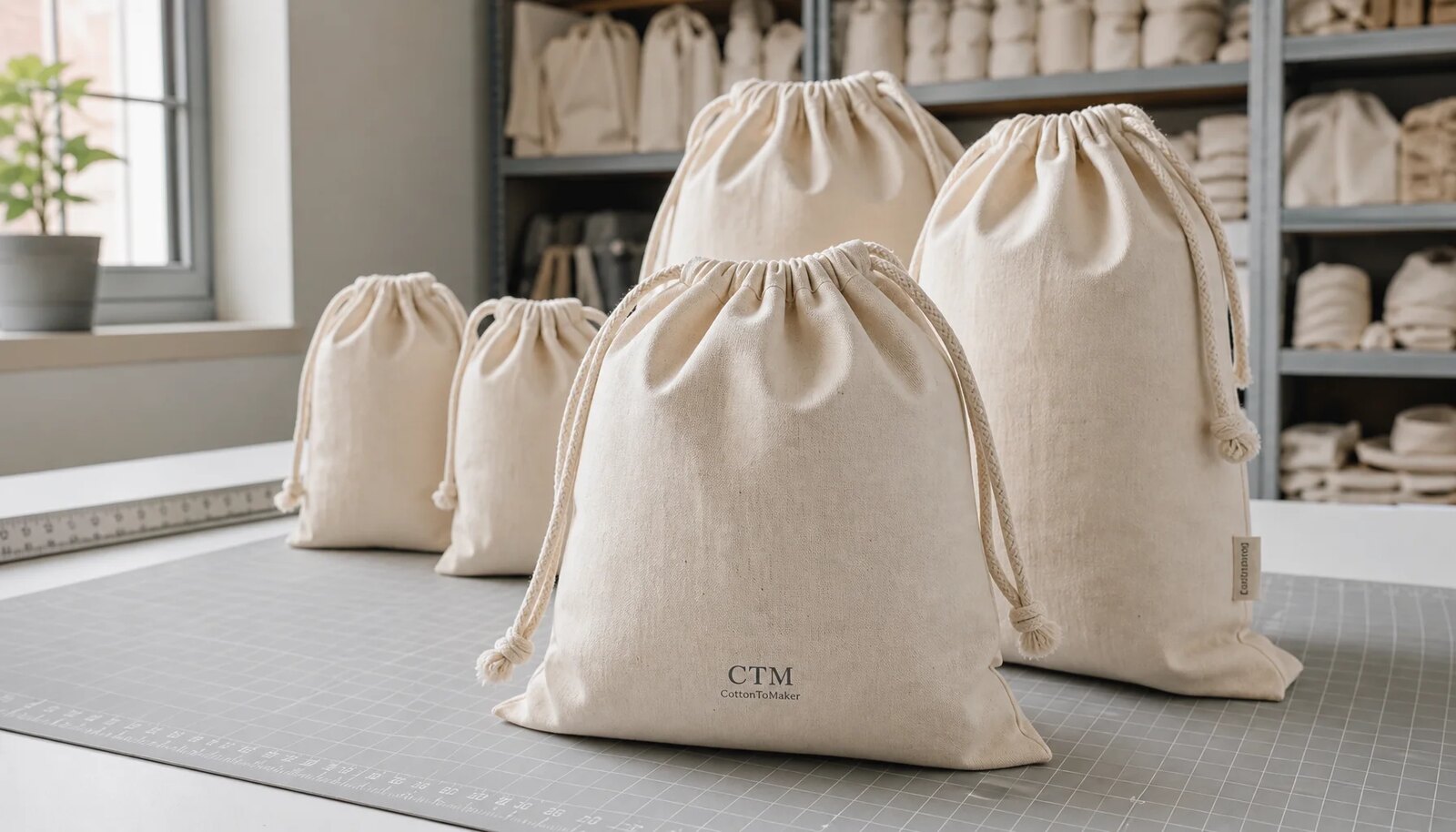
Why Logo Placement Belongs in the Specification
At a craft fair, cotton drawstring pouches work harder than ordinary packaging. They protect small goods, help staff organize table inventory, make products easier to hand to customers, and leave the buyer with a reusable branded item. If the logo hides under the gathered mouth, bends around a candle tin, or disappears into the bottom fold, the decoration has failed at the most visible moment.
A flat mockup can be useful for discussion, but it should not be the approval standard. Cotton shifts. Sewing creates tolerances. The front panel changes as soon as the pouch is filled and tied. What looks centered on an empty pouch may sit too high after gathering, too low after packing, or slightly crooked once the product pushes against the fabric.
Treat logo placement as a measurable production requirement. Use physical reference points: top edge, drawcord channel seam, side seams, bottom seam, logo top edge, and logo centerline. For example: 15 x 20 cm pouch, 75 mm logo width, centered horizontally, logo top edge 60 mm below the pouch top edge, tolerance +/-3 mm. That wording can be sampled, measured, inspected, and discussed without guesswork.
Also think about the booth setup. Pouches may lie flat in trays, stand in baskets, hang on hooks, or sit upright on risers. A logo position that looks right on a flat-lay photo may not read well from table height. Before bulk approval, ask for photos flat, filled, tied, and displayed in the intended orientation.
- Write placement in millimeters, not only as centered, low, or front middle.
- Approve a filled and tied sample before releasing bulk production.
- Measure from construction points the factory and inspector can both identify.
- Keep artwork away from the gathered mouth, side seams, bottom fold, and main product bulge.
- Confirm whether the pouch will be shown flat, upright, stacked, or handled from bins.
Start With Product Fit, Not the Logo
The logo should be placed after the product fit is understood. A 10 x 15 cm pouch, 15 x 20 cm pouch, and 20 x 30 cm pouch do not offer the same stable print area. The drawcord channel, seam allowance, gathering, product depth, and bottom fold all reduce the space where branding remains clean and readable.
Finished height is not usable packing height. The drawcord channel often uses about 15-25 mm, depending on construction, and the top needs room to gather. A product that is 120 mm tall may fit inside a 150 mm pouch on paper, yet close poorly in real use. For many small craft fair items, allow 20-40 mm of extra height above the product. Bulky, round, or rigid items often need more.
Product shape changes the print surface. Flat items such as stickers, cards, soap bars, and small notebooks keep the panel fairly smooth. Round items such as tins, jars, crystals, ornaments, and ceramics create pressure points that can stretch or curve the logo. Soft goods, yarn kits, scarves, and fabric bundles shift during handling, so the safest logo position is usually the area that remains visible even when the pouch is not perfectly filled.
A useful RFQ gives the supplier product dimensions, weight, pack-out method, and display plan. If one pouch size will serve several products, include the largest product and the best-selling or most common product. The factory can then advise whether the best branding option is front-center print, lower-front print, side label, sewn patch, or hangtag.
- Measure product width, height, depth, and weight before choosing pouch size.
- Confirm usable opening and closure allowance, not only finished pouch dimensions.
- Test the largest and most common product pack-outs during sampling.
- Use simpler, smaller logos on 10 x 15 cm pouches with limited stable panel space.
- Check visibility after filling, tying, stacking, and craft fair style display.
Choose GSM, Cotton Finish, and Cord
Fabric choice affects cost, print quality, durability, freight weight, and perceived value. Lightweight 90-100 GSM cotton may work for low-cost packaging, but it can look thin, show product edges, and wrinkle quickly. For most branded cotton drawstring pouches used at craft fairs, 120-160 GSM is a practical range. It gives better opacity, better print stability, and a more reusable feel without moving straight into premium canvas pricing.
Heavier cotton, often 180-220 GSM, suits premium reusable pouches, heavier contents, embroidery, sewn patches, and stronger table presentation. It can hide product edges and make a pouch feel more retail-ready. The tradeoffs are real: higher material cost, more shipping weight, larger carton volume, and a stiffer top when the drawcord is tied.
Natural unbleached cotton is popular for handmade, wellness, rustic, and low-waste branding, but buyers should expect seed flecks and some shade variation. Bleached cotton gives cleaner contrast for colored logos. Dyed cotton needs tighter shade control because fabric color changes how the logo is perceived. Canvas texture can reduce the sharpness of fine artwork compared with a smoother plain-weave cotton.
Cord specification also belongs in the quote. Cotton cord, polyester cord, braided cord, flat tape, or twisted cord each changes the look and function. Specify diameter or width, color, length, knotting, fray control, and pull performance. A good pouch with a poor cord feels cheap; an oversized cord can leave pressure marks when packed tightly across the logo.
- Use 120-160 GSM for a common balance of cost, opacity, print stability, and hand feel.
- Use 180-220 GSM or canvas for premium packaging, heavier goods, embroidery, or patches.
- Approve seed flecks only when natural unbleached cotton is intentionally specified.
- Request GSM tolerance and shade tolerance so supplier quotes are comparable.
- Specify cord material, color, diameter or width, length, knotting, and draw performance.
Match the Branding Method to the Artwork
One-color screen printing is often the safest choice for cotton drawstring pouches with simple artwork. It is economical for repeat production, familiar to most pouch factories, and suitable for bold logos, short brand names, icons, and basic event marks. Cotton absorption can soften edges, so fine detail needs testing. As a working guide, positive lines should usually be at least 0.25-0.35 mm, reversed lines should be wider, and very small text should be reviewed on fabric before approval.
Two-color screen printing can work well, but it brings registration risk. A 1-2 mm shift may be barely noticeable on a large graphic and very obvious on a 10 x 15 cm pouch with tight outlines or small lettering. If colors touch or outline each other, ask for a strike-off and state the registration tolerance. If colors are separated by open space, risk is lower.
Heat transfer is useful for short runs, multicolor artwork, gradients, illustrations, or seasonal campaigns. The decision should not be based on color only. Buyers need to approve hand feel, edge adhesion, flex performance, and blocking risk. Test the transfer on the final fabric, then fold, flex, stack, and inspect it before bulk approval.
Embroidery, woven side labels, sewn patches, and hangtags are better choices when front printing is not the right commercial answer. Embroidery belongs mainly on heavier cotton or canvas and should be checked for puckering. Woven labels give subtle branding, but orientation and seam capture must be controlled. Sewn patches add a premium surface and extra sewing steps. Hangtags are practical when product information changes often, though they can detach during booth handling.
- Use one-color screen print for simple logos and repeat craft fair pouch programs.
- Use two-color screen print only after checking registration risk on the actual pouch size.
- Use heat transfer for colorful or detailed artwork after testing feel, flex, and edge adhesion.
- Use embroidery or patches on heavier fabrics where pucker and stitch density can be controlled.
- Use side labels or hangtags for subtle branding or variable product information.
Define Safe Print Zones and Tolerances
A safe print zone is the part of the pouch where the logo stays readable after sewing, filling, tying, packing, shipping, and display. The unsafe areas are easy to predict. The drawcord area gathers. Side seams distort. The bottom seam folds. The center panel may bulge depending on the product. The goal is not to print the biggest possible logo; it is to keep the branding visible and consistent across the order.
For 10 x 15 cm pouches, a 45-60 mm wide logo is usually more practical than a large front graphic, especially when the logo contains text. For 15 x 20 cm pouches, 65-85 mm often gives a balanced retail look. For 20 x 30 cm pouches, 90-130 mm can work, but larger panels need more attention to slant, folding, and product bulge. These are starting ranges, not universal limits.
Write placement from measurable reference points. A clear instruction might read: front print only, logo width 75 mm, logo top edge 60 mm below pouch top edge, centered horizontally between side seams, minimum 20 mm from each side seam, minimum 30 mm above bottom seam, placement tolerance +/-3 mm. If the factory measures from the drawcord channel seam instead of the top edge, state that clearly.
Tolerances must fit the production method. Printing on cut panels before sewing can be efficient for larger orders, but final placement depends on cutting and sewing consistency. Printing on finished pouches allows direct alignment on the finished product, yet it may require slower handling and jigs. Small finished pouches may hold +/-3 mm if the factory proves control in sampling. Larger or softer pouches may need +/-5 mm or more.
- Keep logos at least 20-25 mm below the drawcord channel on many small and medium pouches.
- Keep artwork at least 15 mm from side seams unless a seam-crossing design is approved.
- Keep logo bottoms at least 20-30 mm above the bottom seam when pouches will be folded or compressed.
- Define whether tolerance applies to the logo top edge, logo centerline, or total artwork position.
- Do not demand tight tolerances unless the supplier confirms the method, jig, and inspection process.
Build a Technical Sheet the Factory Can Use
A technical sheet turns visual preference into production instruction. It should include finished pouch size, size tolerance, fabric GSM, fabric color, finish, cord specification, stitch requirements, logo artwork, logo dimensions, placement, branding method, ink or thread color, label details, packing method, carton quantity, and inspection requirements. Without this document, quote comparison becomes unreliable and bulk inspection becomes subjective.
The logo placement page should include a front-view diagram or annotated photo. Mark the top edge, drawcord channel, side seams, bottom seam, logo width, logo height, and distances from logo to reference points. If the order includes several pouch sizes, create a separate placement line for each size. Do not assume the same logo scales automatically across 10 x 15 cm, 15 x 20 cm, and 20 x 30 cm pouches.
Color instructions should reflect textile reality. Pantone references help, but cotton shade, absorbency, texture, and ink thickness affect the final result. For brand-critical color, approve a physical print strike-off on final fabric. For natural cotton, note whether seed flecks are acceptable inside or near the logo area. For dyed cotton, request a lab dip or approved swatch when shade consistency matters commercially.
Include negative instructions too. Useful examples are: no print inside the drawcord channel, no print over side seams, no fold through logo unless approved, no cord placed over uncured print, no mixed logo versions in one inner bundle, and no substitute fabric without written approval. Many logo defects happen during bundling and packing, not only at the printing table.
- Use one controlled document for material, construction, logo, packing, and QC requirements.
- Include millimeter diagrams for every pouch size and SKU.
- Record the approved fabric swatch, print strike-off, and pre-production sample version.
- State handling methods that could hide, crease, or damage the logo.
- Share the same technical sheet with sales, sampling, production, packing, and inspection teams.
Compare MOQ, Quote Structure, and Cost Drivers
MOQ for cotton drawstring pouches is rarely driven by sewing alone. Fabric availability, dye lot, cutting efficiency, screen setup, transfer sheet preparation, cord purchase, label MOQ, patch MOQ, and packing labor can all affect the minimum. A stock natural cotton pouch with a one-color logo may support a much lower MOQ than a custom dyed pouch with a woven side label, two-color screen print, and individual retail packing.
Logo placement can influence price. Finished-pouch printing may require an operator to align each piece, especially on small pouches or tight tolerances. Panel printing can be faster, but it depends on accurate cutting and sewing control. If the buyer requires strict placement, the supplier may need alignment jigs, slower line speed, more in-line QC, or a higher reject allowance.
Print area and color count also matter. A small one-color logo normally costs less to set up and run than a large multi-color graphic. Two-color screen print adds separate screens and registration checks. Heat transfer can make multicolor artwork feasible at lower quantities but adds transfer material and application time. Woven labels, patches, hangtags, and barcode stickers may come from different vendors with separate lead times.
To compare suppliers fairly, normalize the quote. Confirm finished size, GSM, fabric finish, cord type, logo size, print method, number of print colors, packing count, carton marks, sample cost, setup cost, inspection requirement, incoterm, and freight assumptions. A quote using 100 GSM cotton is not the same product as one using 160 GSM cotton canvas.
- Ask suppliers to separate unit cost, setup cost, sample cost, packing cost, and shipping assumptions.
- Identify whether MOQ comes from fabric, printing, label, cord, patch, packing, or cutting efficiency.
- Compare quotes only after matching GSM, fabric finish, logo method, packing, and incoterm.
- Expect custom dyed fabric, woven labels, patches, and individual packing to increase MOQ or lead time.
- Include inspection and rework expectations before final price approval.
Approve Samples With Procurement Discipline
Sample approval should prove fit, construction, branding, and repeatability. Check fabric hand feel, GSM, dimensions, usable opening, drawcord function, stitch quality, logo size, placement, print color, print clarity, and packing effect. Whenever possible, test the actual product inside the pouch. If the product is not available, use a substitute with the same width, height, depth, and weight.
Do not approve from a single beauty photo. Ask for photos flat, filled before tying, filled and tied, side view showing bulge, close-up of the logo, and a group shot of several samples. If the pouch will sit in a basket, tray, or riser, request a photo in that setup. Craft fair packaging is judged quickly from table distance, so the display angle matters.
Separate sample stages in your records. A fit sample may use substitute fabric and should not approve final print color. A print strike-off confirms artwork and ink on fabric, but it may not prove finished placement. A pre-production sample should use final fabric, final GSM, final cord, final logo size, final method, final placement, and final packing.
Keep an identified approved sample on both buyer and factory sides. Record approval date, sample version, logo dimensions, placement measurements, fabric reference, and any accepted deviations. If a third-party inspection is planned, make sure the inspector receives the approved sample, technical sheet, purchase order, and packing instructions.
- Approve logo size in millimeters, not only by visual scale on a mockup.
- Use final fabric for print color, print clarity, transfer feel, or embroidery pucker approval.
- Check the pouch flat, filled, tied, grouped, and packed before bulk authorization.
- Keep approved samples on both buyer and factory sides for dispute control.
- Allow a correction round when product fit, logo position, or brand color is critical.
Set Bulk QC Standards Before Production
Bulk inspection must be measurable. For logo placement, inspectors should use the technical sheet, approved sample, and ruler. They should measure from the agreed reference point to the logo edge or centerline and compare the result with the written tolerance. If the specification says +/-3 mm, out-of-tolerance pieces can be classified consistently. If the instruction only says centered, the inspection becomes an argument.
Agree defect classification before production starts. Major defects may include wrong logo, wrong print color, unreadable text, logo printed into the drawcord channel, logo touching a seam, heavy slant, poor adhesion, ink transfer, severe stains, blocked drawcord channel, broken seam, wrong fabric, or wrong pouch size. Minor defects may include small loose threads, slight natural flecks within the approved range, or placement variation inside tolerance.
Cotton pouches are soft goods, so machine-perfect uniformity is not realistic. Commercial consistency is the target. A group displayed together should look uniform, cords should pull smoothly, fabric should match the approved swatch, and the logo should sit in the same visual zone. Inspection samples should come from multiple cartons, not only the first production bundle or top carton.
Branding durability belongs in QC. For screen print, check dry rub and light wet rub after curing. For heat transfer, check cracking, edge lift, blocking, and pressure marks after folding or stacking. For embroidery, inspect puckering, backing, skipped stitches, thread trims, and needle damage. For side labels, confirm visible length, orientation, seam capture, and correct label content.
- Measure placement from the exact reference points stated in the technical sheet.
- Classify wrong logo, unreadable print, severe slant, poor adhesion, and blocked channels as major defects.
- Check pouch dimensions, fabric, stitching, drawcord function, branding, labels, and packing count.
- Pull samples from different cartons and production stages for better lot representation.
- Document defects by type so sorting, rework, or replacement decisions are faster.
Plan Packing Around Event Deadlines
Packing can protect a good logo or ruin it before the pouches reach the craft fair. If printed pouches are stacked before curing, ink can transfer or block. If cords press tightly across the artwork, they can leave pressure lines. If cartons are over-compressed, folds may run through the print. Natural cotton also needs moisture control because odor, staining, and mildew risk increase during humid storage or transit.
Craft fair teams need fast setup and easy replenishment. Inner bundles of 25, 50, or 100 pieces make counting simpler. Logo-facing orientation helps staff pull and display pouches quickly. If several pouch sizes, colors, or logo versions ship together, bundle labels and carton marks reduce costly mix-ups during event preparation.
Packing format affects both cost and presentation. Flat packing protects the logo and shape but increases carton volume. Folding reduces freight volume but can crease the artwork if the fold crosses the logo. Individual polybags protect against dirt and moisture but add cost and plastic use. Paper bands look cleaner but offer less moisture protection. Choose based on storage time, handling plan, sustainability preference, and labor needs.
Confirm carton details before production finishes. Define pieces per bundle, bundles per carton, carton dimensions, gross weight, net weight, carton marks, SKU separation, and whether an inner liner or desiccant is required. For dated fairs, work backward from the event date and include sample approval, production, inspection, packing, freight, customs, and local delivery time.
- Require cured and rested print before tight stacking, bundling, or carton packing.
- Avoid folds or cord pressure directly across the logo unless tested and approved.
- Use bundle counts and logo-facing orientation for faster craft fair setup.
- Separate SKUs, pouch sizes, and logo versions clearly inside cartons.
- Confirm carton data, moisture protection, inspection date, and latest ship date in the RFQ.
Specification comparison for buyers
| Procurement decision | Recommended specification | When it fits | QC risk to control |
|---|---|---|---|
| 10 x 15 cm pouch front logo | Logo width 45-60 mm; keep logo top at least 20-25 mm below drawcord channel seam and at least 15 mm from side seams | Jewelry, soap samples, wax melts, tea samples, charms, stickers, small accessories, token gifts | Tiny text under 2.0-2.5 mm cap height may fill in; inspect filled and tied pouches, not only flat samples |
| 15 x 20 cm pouch front logo | Logo width 65-85 mm; position logo in lower-middle visual area, typically 55-75 mm below top edge depending on channel depth | Soap sets, candle tins, skincare minis, small ceramics, gift bundles, craft fair retail packaging | Logo can be pushed into bottom crease if placed too low; measure distance from logo bottom to bottom seam |
| 20 x 30 cm pouch front logo | Logo width 90-130 mm; keep clear of gathered mouth and main product bulge; verify with final contents | Craft kits, scarf packaging, yarn kits, apparel accessories, larger handmade goods | Large panels shift during sewing and packing; check slant, panel distortion, and fold marks across print |
| Side-seam woven label | 20-35 mm visible label length; label captured securely in side seam; confirm orientation before sewing | Premium handmade goods, reusable gift packaging, natural skincare, subtle branding programs | Label MOQ and lead time may be separate from pouch MOQ; inspect upside-down labels and short seam capture |
| One-color screen print | Water-based or pigment ink; minimum positive line 0.25-0.35 mm; reversed line preferably 0.5 mm or wider | Most B2B craft fair pouch orders needing economical, durable branding in one color | Cotton absorption can soften edges; approve a fabric strike-off with final GSM and fabric shade |
| Two-color screen print | Separate screens; define registration tolerance, commonly within 1-2 mm depending on artwork and pouch size | Simple icon-plus-text logos, seasonal marks, brand color plus neutral outline | Small pouches show misregistration quickly; avoid tight outlines and small reversed text |
| Heat transfer | Low-temperature cotton-compatible transfer; approve hand feel, edge adhesion, and flex after folding | Short runs, gradients, illustrations, multicolor logos, campaign artwork | Transfer may feel heavier than cotton; inspect cracking, edge lift, blocking, and pressure marks |
| Embroidery or sewn patch | Use mainly on 180-220 GSM cotton or canvas; include backing and pucker tolerance in approval | Premium pouches, limited-edition gift sets, tactile branding | Embroidery can distort light cotton; confirm stitch density, backing, trim, needle marks, and minimum logo size |
| Fabric weight | 120-160 GSM cotton for most small/medium craft fair pouches; 180-220 GSM for premium or heavier contents | Buyers balancing cost, opacity, print stability, reusable feel, and table presentation | 90-100 GSM can show product edges and wrinkles; verify opacity and seam strength with actual contents |
Buyer checklist before sampling
- Define pouch size from product dimensions: product width, height, depth, weight, required closure space, usable opening, and whether contents are boxed, loose, wrapped, or bundled.
- State fabric specification clearly: GSM, weave, color, finish, natural unbleached or bleached cotton, dyed cotton, canvas, organic cotton if required, and acceptable shade or seed-fleck variation.
- Provide vector artwork with final logo width and height in millimeters, Pantone or brand color reference, minimum line thickness, minimum readable text height, and any artwork simplification rules.
- Mark logo placement with measurable references: top edge, drawcord channel seam, side seams, bottom seam, logo top edge, logo centerline, and minimum clearances from seams and folds.
- Set placement tolerance in writing: commonly +/-3 mm for small finished pouches and +/-5 mm for medium or large soft cotton pouches, unless the factory proves tighter control in sampling.
- Confirm whether printing is on cut panels before sewing or on finished pouches after sewing; require the supplier to explain the impact on alignment, cost, tolerance, and inspection method.
- Request fabric swatch, print strike-off, and pre-production sample using final GSM, final fabric shade, final cord, final logo size, final method, and final packing plan.
- Approve samples flat, filled, tied, side-view, close-up, and in a group of multiple pieces so placement consistency, bulge distortion, and table visibility can be assessed.
- Specify print performance checks: dry rub, light wet rub, curing/rest time, blocking risk, ink transfer risk, heat-transfer edge lift, embroidery pucker, or label seam capture as applicable.
- Define packing: pieces per inner bundle, logo-facing orientation, folding method, polybag or paper band, carton quantity, carton marks, SKU separation, maximum carton weight, moisture protection, and event deadline.
Factory quote questions to send
- What exact cotton fabric are you quoting: GSM, weave, yarn feel, finish, shade, stock or custom, natural unbleached, bleached, dyed, canvas, organic-certified if applicable, and expected GSM tolerance?
- What are the finished pouch size tolerances for width, height, drawcord channel depth, cord length, and usable opening after sewing?
- For each pouch size, what safe logo area do you recommend after allowing for gathering, side seams, bottom seam, product bulge, and packing folds?
- Which branding method do you recommend for this artwork on this fabric: one-color screen print, two-color screen print, heat transfer, digital print, embroidery, woven side label, sewn patch, or hangtag?
- What minimum line thickness, minimum text height, maximum print area, and color limitations apply to the chosen method on cotton fabric?
- Will printing be done on panels before sewing or on finished pouches after sewing, and what placement tolerance can you hold in bulk for each option?
- How will logo placement be measured during production and inspection: from top edge, drawcord seam, logo top edge, logo centerline, side seam, or bottom seam?
- What drives the MOQ: fabric purchase, dye lot, cutting efficiency, sewing setup, screen setup, transfer sheets, cord purchase, label MOQ, patch MOQ, or packing labor?
- Can you provide a fabric swatch, print strike-off, and full pre-production sample made with final GSM, final cord, final logo size, final placement, and final packing?
- What curing, resting, stacking, and bundling controls prevent ink transfer, blocking, cord pressure marks, and print creasing before shipment?
Quality-control points to confirm
- Logo position measured against the approved technical sheet from agreed reference points: top edge, drawcord channel seam, side seams, bottom seam, logo top edge, or logo centerline.
- Placement tolerance verified by pouch size and method, commonly +/-3 mm for small finished pouches and +/-5 mm for larger or softer cotton pouches when agreed before production.
- Print color compared with approved strike-off, Pantone reference, or signed sample under consistent lighting, allowing realistic cotton absorption and natural fabric flecks only if pre-approved.
- Print clarity checked for broken lines, filled counters, blurred small text, pinholes, ink bleeding, uneven coverage, registration shift, screen marks, transfer edge defects, or embroidery puckering.
- Print durability checked after curing by dry rub and light wet rub; heat transfers checked for cracking, edge lift, blocking, and pressure marks after flexing or folding.
- Finished pouch dimensions measured flat for width, height, drawcord channel depth, and opening; representative filled checks confirm closure function and logo visibility.
- Fabric checked against approved swatch for GSM, weave, opacity, shade, odor, hand feel, stains, slubs, holes, and unacceptable lot variation.
- Drawcord and sewing inspected for smooth pulling, blocked openings, loose threads, skipped stitches, seam strength, channel width consistency, and cord length variation.
- Labels, hangtags, barcodes, SKU stickers, and carton marks checked against purchase order, especially when multiple sizes or logo versions ship together.
- Packing inspection confirms cured and protected print, no folds through critical logo area unless approved, no over-compression, correct bundle count, moisture protection, and clean cartons.