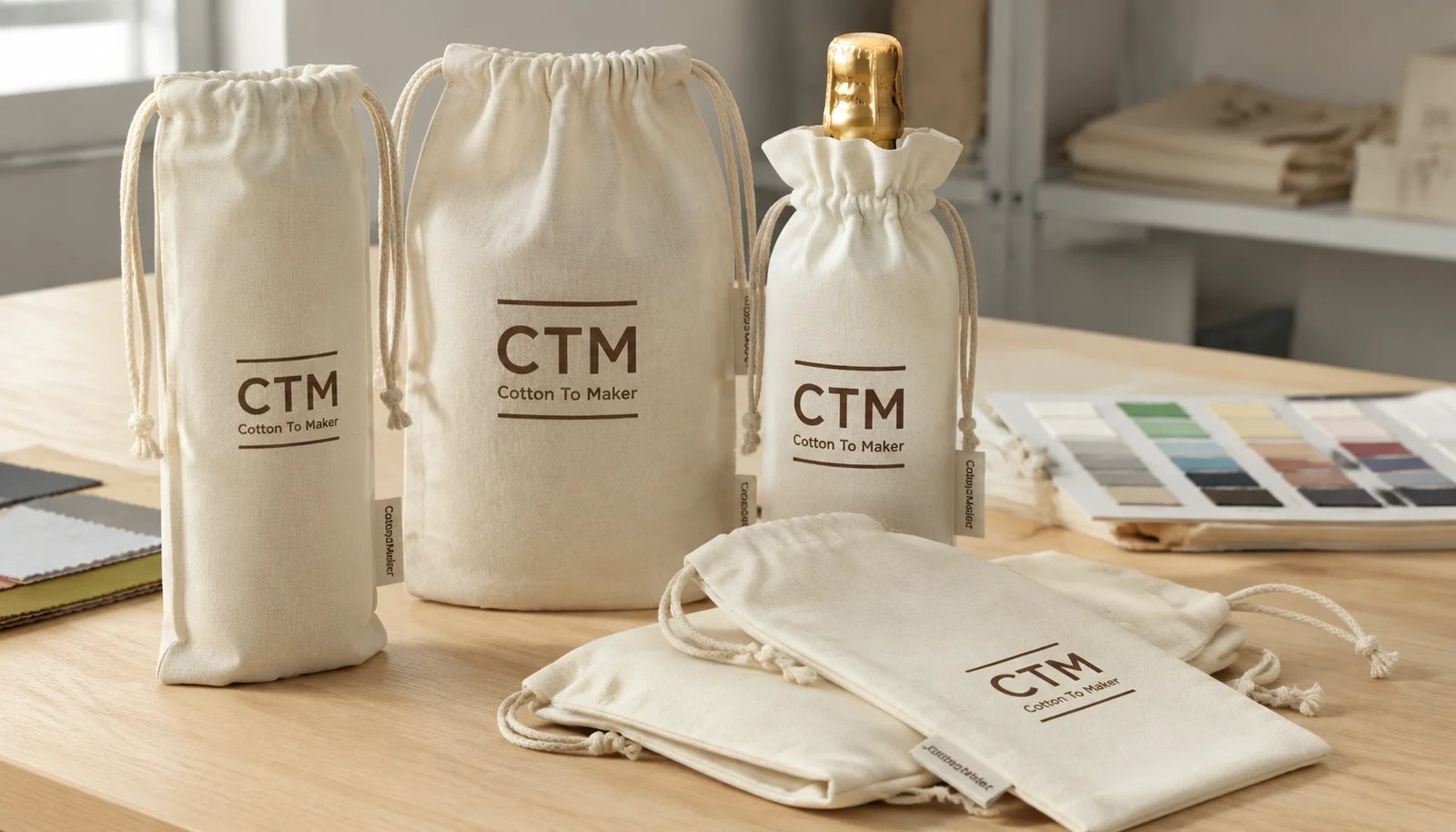
RFQ Scope for Liquor Retail Use
Cotton drawstring pouches for liquor retail are usually bought for a very specific job: to improve gift presentation, protect small add-ons, support seasonal promotions, or group items into a retail-ready bundle. The RFQ should describe that job before it describes the pouch. A pouch for a 50 ml mini bottle set has different fit, fabric, and seam requirements from a pouch used for a corkscrew, tasting glass, bitters kit, or premium full-size bottle sleeve.
A useful RFQ gives the factory enough context to quote the correct construction instead of guessing from a photo. Include whether the pouch will hang on shelf, sit in a gift display, be packed at the factory, packed by your co-packer, or packed by store staff. The handling route affects drawcord quality, print durability, and packing method as much as the pouch size itself.
- Define the packed item: bottle, boxed bottle, glassware, accessory kit, loyalty gift, or checkout promotion.
- State whether the pouch is disposable presentation packaging or expected to be reused by the consumer.
- List the selling environment: liquor store counter, warehouse club, duty-free shop, ecommerce shipment, or distributor gift pack.
- Clarify whether the pouch must fit over primary packaging, secondary packaging, or bare product.
Size and Fit Specification
The most common RFQ error is giving only a flat pouch size without product dimensions. A cotton pouch loses usable space at the side seams, bottom seam, and drawstring closure. If the buyer wants the top to close cleanly above a bottle shoulder or boxed kit, the pouch needs extra height beyond the product height. For a cylindrical bottle, the pouch also needs width that allows for diameter and fabric flex, not just the bottle's front-facing width.
For liquor retail programs, the safer specification method is to provide product length, width, depth, weight, and the desired closure position. A factory can then recommend a finished flat size and warn if the result will look too tight. If your pouch must stand in a gift display, mention that as well, because a basic flat cotton pouch does not create a structured base unless gusseting or heavier fabric is added.
- For mini bottles, allow enough top clearance so the drawcord closes above the cap or neck instead of across the label.
- For boxed spirits, measure the box diagonal and corner sharpness because cotton fabric catches on square corners.
- For accessory kits, provide the maximum packed thickness after all items are inserted, not the dimension of each loose item.
- For full bottle gift sleeves, consider a bottom gusset or heavier GSM if the pouch must look stable when loaded.
Fabric GSM and Cotton Type
Fabric weight drives handfeel, print result, durability, and freight cost. A 120 GSM cotton pouch can work for low-cost giveaways or light accessories, but it may look transparent over dark bottle labels and may not feel strong enough for premium liquor packaging. A 140-180 GSM fabric is often a practical middle range for retail pouches. For full-size bottle sleeves or higher-value gift sets, 200-240 GSM gives more structure and better perceived value, although it increases material cost and carton gross weight.
Cotton type should be specified only as tightly as the program requires. Conventional natural cotton is cost-efficient and common for promotional pouch orders. Dyed cotton gives brand control but adds shade approval and colorfastness risk. Organic or recycled cotton may support brand positioning, but the buyer should define the documentation requirement in the RFQ instead of assuming every supplier's claim will meet internal compliance rules.
- Use 120-140 GSM for light inserts, small accessories, and short-term promotional programs where cost is the main driver.
- Use 140-180 GSM for standard liquor retail pouches that need better opacity and regular handling strength.
- Use 200-240 GSM for premium bottle sleeves, heavier gift kits, or programs where the pouch is part of the perceived product value.
- Request a fabric swatch before sample approval when natural shade, dyed shade, or texture matters to the retail display.
Printing and Branding Choices
Screen printing is usually the most stable choice for cotton drawstring pouches when the artwork is a solid logo, one-color retail mark, or limited-color seasonal design. It gives good opacity and predictable cost at volume. Heat transfer can handle more detailed graphics and gradients, but the surface feel may be less natural, and adhesion needs testing if the pouch will be rubbed during packing or used repeatedly by consumers.
The RFQ should separate artwork count from order quantity. A 20,000 piece order split across eight store logos or seasonal messages is not the same as one 20,000 piece artwork. Each artwork may require its own screen, print setup, approval sample, and packing separation. For liquor retailers working with brand partners, the quote should show setup costs clearly so the buyer can compare whether to consolidate artwork or keep separate branded SKUs.
- Provide vector artwork in AI, EPS, or PDF format with Pantone references or approved color targets.
- Define print size in millimeters and placement from the pouch bottom or centerline, not by visual estimate.
- Keep large ink coverage away from drawstring channels and seam folds where cracking or distortion is more likely.
- Request a rub test and tape test for heat transfer or dense screen print artwork before mass production.
MOQ and SKU Logic
MOQ is not only about total pieces. For cotton drawstring pouches, the real MOQ depends on fabric color, GSM, pouch size, cord color, print artwork, and packing split. A supplier may accept 10,000 pieces total, but if the order is divided into five sizes, four logos, and three cord colors, the production becomes many small runs with separate cutting, printing, sewing, and packing controls.
Retail buyers can get better quotes by building an SKU matrix before sending the RFQ. Group similar sizes, use common fabric across multiple designs, and limit cord color changes where possible. If marketing needs many artwork variations, keep the base pouch identical so the factory only changes the print screen and carton labels. That approach reduces setup waste and makes production planning cleaner.
- Show quantity by SKU, not only total program quantity.
- Identify which SKUs can share fabric, cord, and packing materials.
- Separate firm order quantities from forecast quantities so the factory does not quote unrealistic purchasing levels.
- Ask for price breaks at practical levels such as 3,000, 5,000, 10,000, and 20,000 pieces per SKU when volume is uncertain.
Cost Drivers in the Quote
A clean quote should let the buyer see why two suppliers are different. Fabric GSM, fabric color, print color count, drawcord quality, stitching standard, inner packing, carton strength, and inspection requirements all change cost. A low unit price may simply exclude screen charges, custom packing, sample revisions, or carton labeling. For distributor and retail buyers, those exclusions often reappear later as change fees.
The RFQ should require a line-item quote format. This does not mean every supplier will reveal full factory costing, but it does force them to state what is included. At minimum, request unit price, sample fee, screen or setup charge, packing method, carton data, estimated CBM, payment terms, Incoterm, quote validity, and production lead time. That information is necessary for landed-cost comparison, not just factory price comparison.
- Fabric upgrade from 140 GSM to 200 GSM can increase both unit cost and freight weight.
- Dyed fabric can add dye lot MOQ, shade approval time, and colorfastness testing cost.
- Multiple print colors add screens, registration control, and higher reject risk.
- Individual polybags or retail belly bands increase labor and packing material cost.
- Palletization, special carton labels, barcode labels, or store allocation cartons should be quoted before PO release.
Sampling and Approval Control
A showroom sample is useful for handfeel, but it is not approval for production. The important sample for a liquor retail order is the pre-production sample made with the selected bulk fabric, final pouch size, final drawcord, actual print method, and intended packing. This sample should be tested with the real bottle, box, or kit components. If the buyer approves only photos, fit problems often appear after cutting has already started.
The approval record should be simple and physical where possible. Keep one sealed approved sample at the buyer side and one at the factory side. Mark the approved sample with date, PO number, fabric GSM, size, print method, and revision. During final inspection, the QC team should compare production against this sample instead of relying only on email descriptions.
- Measure the sample flat and loaded; both results matter for liquor packaging fit.
- Pull the drawstrings several times to see whether the cord slides smoothly and closes evenly.
- Insert the intended product and check whether corners, bottle shoulders, or caps distort the print area.
- Review print curing after at least 24 hours if dense ink coverage is used.
- Do not approve bulk cutting until size, artwork placement, cord length, and fabric shade are signed off.
Packing for DC and Store Handling
Packing requirements should match the receiving process. If a distributor warehouse receives mixed cartons without clear SKU labels, count checks become slow and shortage claims become difficult. For liquor retailers with store allocation, the better method is to pack by SKU, artwork, or store group and label cartons with PO number, item number, quantity, color, size, gross weight, net weight, and carton dimensions.
Pouches can be flat packed in counted inner polybags, paper bands, or master cartons depending on the brand's packaging policy. For natural cotton pouches, moisture control matters because cotton can absorb odor or humidity during storage. Export cartons should be dry, clean, and strong enough for the selected loading plan. If the pouches are packed with bottle components later, avoid over-compressing them in cartons because deep creases can make the retail display look poor.
- Use consistent inner pack quantities such as 50 or 100 pieces to speed receiving checks.
- Avoid random mixed artwork cartons unless the DC has approved the receiving method.
- Request carton photos and carton label proofs before shipment.
- Include moisture and odor checks in final inspection, especially for natural cotton and long ocean transit.
- Ask for carton CBM and gross weight so logistics can estimate freight and warehouse handling cost.
Lead Time and Schedule Risk
Lead time should be broken into stages: artwork confirmation, material booking, sample production, sample approval, bulk cutting, printing, sewing, trimming, packing, inspection, and shipment booking. A supplier saying "30 days" may mean 30 days after deposit, final artwork, fabric approval, and sample approval. For seasonal liquor promotions, that difference can decide whether goods arrive before the selling window.
Schedule risk increases when the order uses dyed fabric, organic or recycled material documentation, many artwork versions, or retail-specific packing. Peak season also affects cotton fabric availability and sewing capacity. Procurement teams should build a decision calendar with the last approval date for sample, artwork, packing, and inspection. Without those milestones, late buyer approvals can be mistaken for factory delay.
- Allow extra time for custom dyed fabric and lab dip approval.
- Reserve time for one sample revision if the pouch must fit a specific bottle or box exactly.
- Book inspection after packing is at least 80 percent complete, unless your QC policy requires otherwise.
- Confirm whether lead time changes before major retail seasons or local factory holidays.
- Do not release mass production based on incomplete artwork if logo placement is a retail approval item.
QC Thresholds and Acceptance Criteria
Cotton drawstring pouches are simple products, but they still need clear acceptance criteria. Typical inspection points include finished size, fabric defects, stains, odor, seam quality, drawcord function, print placement, print adhesion, loose threads, needle damage, carton count, and SKU mix. The buyer should define which defects are critical, major, and minor before inspection, not after a shipment problem appears.
For liquor retail use, fit and presentation are the two practical QC priorities. A pouch that is technically sewn well but too tight for the boxed bottle is a commercial failure. A pouch with acceptable size but crooked logo placement may be rejected by the brand team. Set tolerances that match the product value: for example, tighter print placement on premium gift bags, and stricter seam strength for full bottle sleeves than for empty promotional pouches.
- Suggested size tolerance can be around plus or minus 5 mm for small pouches and wider for large cotton pouches, depending on construction.
- Print placement tolerance should be stated in millimeters from a fixed reference point such as bottom seam or centerline.
- Critical defects include contamination, mold, wrong artwork, unsafe sharp objects, severe odor, and mixed unapproved materials.
- Major defects include blocked drawstring channels, broken seams, heavy stains, wrong size, poor print adhesion, and obvious logo misplacement.
- Minor defects include small loose threads, slight shade variation within approved range, and light wrinkles that do not affect retail use.
Specification comparison for buyers
| Spec decision | Recommended option | When it fits | Buyer risk to check |
|---|---|---|---|
| Fabric weight | 140-180 GSM cotton for standard retail pouches; 200-240 GSM for premium bottle sleeves | Retail gift packaging, tasting kits, accessory pouches, mini bottle bundles, and reusable checkout add-ons | Light fabric can show bottle corners and dark contents; heavy fabric increases unit cost and carton weight |
| Pouch construction | Double drawstring with folded top channel and overlocked inner seams | Buyers need fast opening at retail counters and a pouch that closes evenly around boxed or cylindrical products | Single drawstring may look cheaper; narrow channels can jam if cord diameter is too thick |
| Print method | Screen print for solid logos; heat transfer only for fine gradients or small multicolor artwork | Liquor logos, retailer marks, holiday programs, and private label gift campaigns | Heavy ink on thin cotton can stiffen the pouch; heat transfers need rub and wash testing before approval |
| Sizing basis | Internal usable size based on product height, width, depth, and closure allowance | Bottle necks, boxed miniatures, cocktail kits, glassware add-ons, or gift card inserts need reliable fit | Flat pouch size is not the same as usable packed size; missing depth allowance causes tight loading |
| Drawcord material | Cotton cord for natural look; polyester cord when color consistency or abrasion resistance matters | Premium natural packaging or repeated handling in retail displays | Cotton cord can shrink or vary in shade; polyester cord may look less aligned with natural cotton fabric |
| MOQ logic | One MOQ per size, fabric color, print artwork, and cord color combination | Retailers splitting assortments across store groups, seasonal designs, or different bottle formats | Combining too many SKUs below efficient cutting and printing quantities raises setup charges |
| Packing method | Flat packed in inner polybags or paper bands, then export cartons with SKU labels | Distribution centers need count control, barcode receiving, and store allocation by design | Random mixed cartons slow inbound checks and make short shipment claims harder to prove |
| Sample approval | Pre-production sample using bulk fabric, actual cord, actual print method, and final size | Logo color, closure function, bottle fit, and seam strength must be approved before mass cutting | Photo-only approval misses handfeel, drawstring friction, and true packed appearance |
| QC threshold | AQL inspection with separate checks for dimensions, print position, seam defects, stains, and cord function | Importers need defensible acceptance criteria before paying balance or releasing shipment | If tolerances are not stated, supplier and buyer may disagree over minor size and print variation |
Buyer checklist before sampling
- State the pouch use clearly: mini bottle sleeve, full bottle gift bag, tasting kit, accessory pouch, reusable retail packaging, or promotional giveaway.
- Provide product dimensions and target internal pouch fit, not only a flat pouch size copied from a catalog.
- Specify fabric composition, color, and GSM range, including whether recycled, organic, conventional, dyed, or natural cotton is acceptable.
- List each SKU by size, fabric color, cord color, artwork, print location, quantity, and packing requirement.
- Attach vector artwork and define print size, ink colors, placement tolerance, and whether print testing is required.
- Define sample stages: existing reference sample, custom development sample, pre-production sample, and approved sealed sample for QC.
- Request carton dimensions, carton gross weight, units per carton, inner packing method, and carton marking format with the quotation.
- Set practical QC tolerances for size, seam strength, drawcord function, print registration, stains, needle damage, and loose threads.
- Separate production lead time from sampling time, artwork approval time, inspection time, and vessel or air booking time.
- Require quote validity, payment terms, Incoterm, tooling or screen charges, packing charges, and estimated CBM in the supplier offer.
Factory quote questions to send
- What GSM options are available in stock for natural, bleached, dyed, recycled, or organic cotton, and what is the MOQ difference for each option?
- Is the quoted size the flat finished size or the recommended usable internal size after seam allowance and drawstring closure?
- What print method is included in the quote, how many colors are included, and what is the charge for additional screens or artwork versions?
- Can the pre-production sample be made with bulk fabric, final cord, final print, and final packing materials before mass production starts?
- What are the dimension tolerances for pouch width, height, drawcord length, print placement, and logo color matching?
- How many pieces are packed per inner bag and export carton, and can cartons be labeled by SKU, store group, PO number, or barcode?
- What is the production lead time after deposit and final artwork approval, and how does it change during peak season?
- Are fabric shrinkage, colorfastness, print adhesion, and seam strength tests available, and are they in-house checks or third-party lab tests?
- What defects are considered critical, major, and minor during final inspection, and what AQL level is used for export orders?
- Which quote items are not included, such as sample freight, screen setup, lab testing, inspection, palletization, fumigation documents, or destination charges?
Quality-control points to confirm
- Finished pouch width and height should be measured flat at top, middle, and bottom where shape distortion can affect bottle fit.
- Drawstring channel must open smoothly without skipped stitches, twisted cord, blocked ends, or cord lengths that are uneven beyond the approved tolerance.
- Seams should withstand practical loading for the intended product weight, especially for full bottle sleeves and glassware kits.
- Print position should be checked against the approved artwork proof, including distance from bottom seam, side seam, and drawstring channel.
- Ink should not crack, peel, smear, or transfer under normal handling after the agreed curing time.
- Natural cotton shade variation should be evaluated under consistent lighting and compared against the approved bulk fabric swatch.
- Pouches must be clean, dry, odor-free, and free from oil marks, rust stains, needle holes, loose threads, and visible contamination.
- Carton count, SKU mix, inner packing, carton label data, gross weight, and carton dimensions should match the approved packing list.