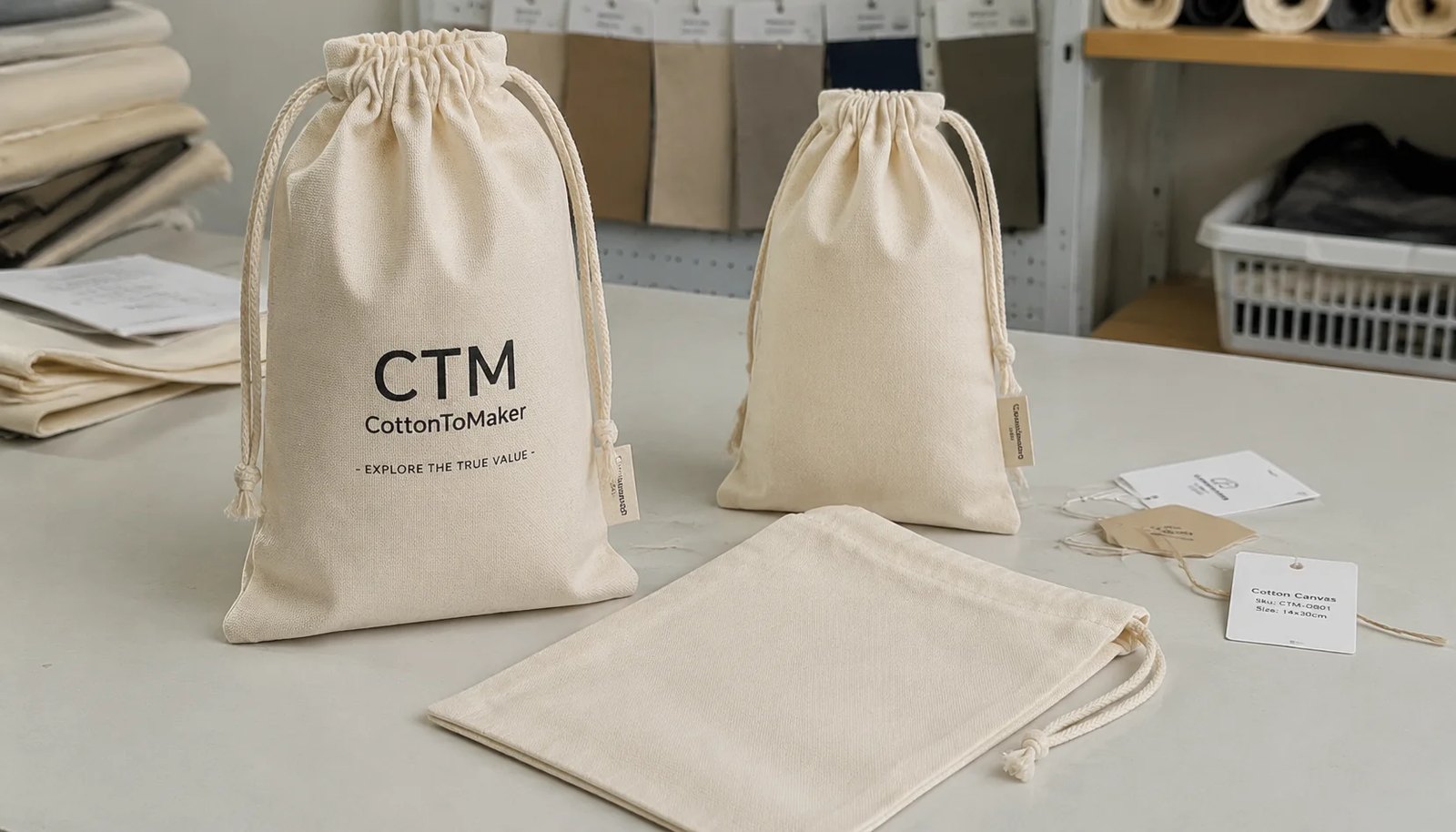
Why MOQ Negotiation Is Different for Liquor Retail Pouches
MOQ negotiation for cotton drawstring pouches is rarely about the sewing count alone. For liquor retailers, the pouch is a packaging component that must fit a glass bottle correctly, support the brand look, survive handling during store packing, and arrive clean enough for gifting. The supplier therefore prices not only cutting and stitching, but also fabric sourcing, print setup, drawcord selection, sample time, inspection effort, and the risk of leftover materials that cannot be reused easily on another order.
That is why two factories may both claim to make the same cotton pouch yet offer very different minimums. One may be quoting from stock natural fabric with a standard drawcord and one-color print. Another may be assuming a dyed fabric batch, custom cord, and stricter packing labor. If procurement pushes only for 'the lowest MOQ' without controlling the assumptions, the comparison becomes unreliable and the final product can drift away from the intended specification.
For liquor retail programs, low-volume demand is common. Buyers may need 300 to 1,000 pieces for a holiday trial, tasting event, distributor gift pack, wine club shipment, or a premium bottle add-on in selected stores. Those quantities are workable in some factories, but usually only if the product is simplified. The practical negotiation question is not 'Can you do 500 pieces?' It is 'Which specification choices let you do 500 pieces without quality loss or hidden cost?'
A useful RFQ therefore separates must-have requirements from preferred upgrades. If bottle fit, print legibility, and a clean natural-cotton look are non-negotiable, say so. If dyed fabric, custom labels, or individual barcoding are optional, mark them separately. That gives the factory room to offer a MOQ-friendly route instead of rejecting the project or quoting an artificially high unit price.
For buyers searching specifically for a cotton drawstring pouches for liquor retailers MOQ negotiation guide, this is the core principle: MOQ becomes easier to control when the pouch is treated as a defined packaging specification rather than a generic textile item.
- Lock the bottle type, pouch purpose, and target market before requesting the first quote.
- Separate required features from optional customizations in the RFQ.
- Ask suppliers to explain the MOQ driver instead of giving one single unexplained number.
- Expect lower MOQ only when some parts of the specification stay standard.
- Use quantity breaks to compare the cost of buying slightly more inventory versus paying a small-order premium.
Start With Bottle Fit and Real Usage Conditions
Bottle fit should be finalized before negotiating price. A pouch for a slim 750 ml wine bottle is different from a pouch for a square-shouldered whisky bottle, a short gin bottle, or a 375 ml holiday gift item. When fit is not defined properly, buyers often receive a pouch that looks acceptable laid flat but performs poorly once the bottle is inserted. The seams strain, the drawstring closes too low, or the bottle sits loosely and looks under-packaged.
A complete fit brief should include bottle height, maximum diameter, shoulder shape, neck length, cap or cork height, and whether the neck should remain visible after closure. In liquor retail, many buyers do not want the pouch to fully hide the bottle. They may want the upper neck or closure exposed to preserve premium shelf recognition. That choice changes pouch height, usable inside depth, and where the drawstring channel must sit.
Also think about who inserts the bottle. A boutique gift desk may pack slowly and carefully, while a high-volume store team may need quick insertion during peak season. A pouch that is too narrow, too stiff, or too tight at the drawcord channel can slow packing labor. Procurement should therefore ask not only whether the bottle fits, but whether store staff can use the pouch efficiently.
If one pouch size must fit multiple SKUs, identify the worst-case bottle. Often that is not the tallest bottle, but the widest shoulder or most abrupt diameter change. Approving the sample only on the easiest bottle creates trouble later when stores use the pouch across the full assortment.
Where possible, include a simple fit table in the RFQ so the supplier understands the real product range. Even a basic note such as 'must fit 750 ml bottle up to X mm height and Y mm diameter' is much stronger than asking for a 'standard wine pouch.'
- Measure the widest point of the bottle body, not only the label panel.
- State whether the drawstring should close above the shoulder or around the neck area.
- Clarify whether the bottle should slide in easily or fit closely for a tailored look.
- If multiple bottles will use one pouch, approve fit on the largest or least forgiving bottle.
- Request a physical fit sample whenever the bottle is glass, premium, or non-standard in shape.
Choose Fabric Weight, Weave, and Finish With Procurement Logic
Fabric weight is one of the biggest reasons supplier quotes appear inconsistent. One supplier may quote light plain cotton, another may quote midweight cotton canvas, and both may describe the product as a cotton drawstring pouch. For liquor retail use, those are not equal options. The fabric affects opacity, structure, print coverage, seam durability, carton volume, and the pouch's perceived value in a gifting context.
For many bottle programs, 6 oz to 8 oz cotton canvas is the most practical range. It is heavy enough to reduce show-through from the bottle silhouette while still folding efficiently for export packing. A 5 oz fabric may work for mini bottles, promotional use, or very cost-sensitive programs, but can look thin around glass. A 10 oz fabric can feel more premium and reusable, yet it increases carton size, freight cost, and sometimes MOQ if the exact fabric is not already stocked.
The weave matters as much as the nominal weight. A looser weave may absorb ink differently and reveal more of the bottle underneath. A tighter canvas can give a cleaner print face but may feel stiffer at the drawstring channel. Procurement should therefore request both the stated weight and a sample swatch or pre-production sample on the actual proposed fabric.
Color and finish choices also affect MOQ. Natural unbleached cotton is usually the most MOQ-friendly option because it can be cut from stocked fabric and avoids dye-batch minimums. It is especially suitable for craft spirits, wineries, rustic retail branding, and eco-positioned gifting. However, natural cotton can show seed specks and lot-to-lot shade variation. If the brand requires a clean white base or an exact dyed color, that should be specified early because it may trigger lab dips, fabric MOQs, and longer lead times.
Shrinkage is another often-missed point. Untreated cotton can react to humidity, steaming, or finishing processes. Even small shrinkage can matter on a bottle pouch because usable height above the bottle shoulder is limited. Ask suppliers whether the quoted material is pre-shrunk, washed, or untreated greige cotton, and make sure the sample and bulk assumptions match.
- Use GSM or oz in every quote comparison; avoid vague terms like 'thick cotton.'
- Natural cotton is usually the easiest route for low MOQ and fast sampling.
- Heavier fabric improves opacity but increases carton volume and freight cost.
- Request confirmation of shrinkage expectation before approving dimensions.
- Review actual swatches when comparing 6 oz versus 8 oz options.
Select Print and Branding Methods That Do Not Break MOQ
For most cotton drawstring pouches used by liquor retailers, screen printing remains the most practical decoration method. It works well on natural cotton, supports logo-based branding, and keeps setup relatively controlled when the design is one or two colors. It is also easier to repeat across future orders compared with more experimental decoration methods. For MOQ negotiation, this matters because the simpler the print setup, the more likely a factory can accept a smaller run without inflating the price excessively.
However, not every artwork suits screen print equally. Fine serif text, gradients, distressed textures, and metallic effects can become problematic on textured cotton surfaces. A logo that looks sharp in a digital file may break visually once printed on woven fabric. Buyers should send vector art and ask the supplier to review minimum line thickness, smallest text size, and any placement too close to seams or the drawcord channel.
If the liquor retailer wants a more premium look, embroidery or a woven label may be considered, but each adds its own MOQ and labor implications. Embroidery can look upscale, yet it is slower and can distort lighter fabric if the stitch density is too high. Woven labels are useful when the same pouch body will be used across several campaigns because the printed face can remain simple, but the label itself may carry a separate production minimum. Heat transfer can reproduce more complex graphics, though buyers should test adhesion, edge cleanliness, and hand feel on the chosen cotton.
Artwork versioning is another hidden MOQ issue. If the base pouch is the same but different stores, regions, or distributors want different names or event messages, the print setup complexity can rise quickly. In many cases it is better to keep one common print and change only the hang tag, insert card, or external carton marking. That preserves the MOQ-friendly pouch body while still allowing channel-specific retail communication.
- Use one-color or two-color screen print when MOQ flexibility matters most.
- Send vector files and ask the factory to flag artwork details that are too fine for the fabric texture.
- Avoid placing logos too close to side seams, bottom folds, or the drawcord channel.
- Use one common pouch print for multiple stores when possible; vary external tags instead.
- Request a strike-off or sample when using metallic, specialty, or transfer decoration.
Understand What Actually Drives MOQ at Factory Level
MOQ is usually the combined result of several small factory economics rather than one rigid policy. Buyers get better outcomes when they ask the supplier to separate these components. In cotton drawstring pouch production, MOQ pressure commonly comes from fabric procurement, dyeing batches, cutting efficiency, print setup, cord purchasing, sewing line planning, and packing labor. If all of those are custom at once, the factory has little room to absorb a short run.
Fabric can be the first constraint. If the buyer accepts stock natural fabric in a width the factory already uses, the MOQ may drop sharply. If the buyer requests a special dyed shade, a heavy canvas not normally stocked, or a certification tied to a specific mill, the practical minimum often rises because the fabric supplier imposes its own purchase threshold.
Printing can be the next major driver. A single logo repeated across the run is easy to plan. Several artwork versions for different store groups, a large print area, or specialty inks increase setup effort and reject risk. Sewing itself is often not the biggest issue on a simple pouch, but very small runs are inefficient if the pattern is unusual or if there are many size variations. Packing can also become a bottleneck when every pouch needs individual barcodes, labels, stickers, or assortment rules.
This is why procurement should ask for MOQ by scenario. For example: 'What is the MOQ with stock natural cotton and one-color print?' then 'What changes if we move to dyed fabric?' That approach reveals which element is expensive and gives the buyer options. It is much more useful than receiving a single factory statement such as 'MOQ is 3,000 pieces' without explanation.
In practice, many low-volume liquor retail programs become possible only because the buyer simplifies one or two variables. The goal is not to force the factory below a sustainable level, but to remove the specification details that are creating unnecessary minimums.
- Fabric stock status often changes MOQ more than sewing complexity.
- Dyed fabric and custom trim can trigger upstream supplier minimums.
- Multiple artworks or store-specific versions can raise print setup cost fast.
- Retail-ready individual packing can increase labor enough to affect MOQ.
- Asking for scenario-based quotes gives procurement real negotiation leverage.
Practical Negotiation Levers for Lower MOQ Without Hidden Risk
The most effective MOQ negotiation strategy is to trade specification flexibility for production simplicity. Instead of asking the supplier to 'please reduce MOQ,' present a structured fallback version of the pouch. For example: standard natural cotton, one agreed size, one-color screen print, standard cotton cord, and bulk flat packing. This gives the factory clear ways to reduce setup cost while keeping the pouch commercially usable for a liquor retail launch.
Another strong lever is to separate first-order economics from repeat-order economics. A small pilot run often carries disproportionate setup cost. If the buyer understands that and negotiates openly, the supplier may agree to a lower initial quantity with a small setup charge or a higher unit price, followed by better pricing on a confirmed reorder. This is cleaner than forcing an unrealistic all-in unit cost and later discovering lighter fabric, weaker stitching, or downgraded packing.
Buyers can also improve MOQ by consolidating identical demand. If several stores, regions, or channels use the same pouch body, combine them into one production batch and differentiate only later through inserts, gift tags, or outer carton labels. The production floor sees one job instead of many fragmented jobs. That is usually more helpful than asking for separate tiny runs of near-identical products.
There are also cases where accepting a slightly higher order quantity is cheaper overall than holding out for the smallest possible MOQ. If the price break between 500 and 1,000 pieces is large and the pouch is likely to be reused across future bottle campaigns, carrying some inventory may be the better procurement decision. This should be evaluated alongside freight, carton volume, warehouse capacity, and the risk of branding changes.
The key is to negotiate transparently. A good factory can often support a pilot quantity if the buyer shows discipline on specification and is realistic about setup cost. Problems usually start when the buyer wants every premium detail while still insisting on the minimum possible run.
- Offer a standard-spec version first, then price the upgraded options separately.
- Treat pilot orders and repeat orders as different commercial stages.
- Consolidate identical pouch bodies across stores or channels where possible.
- Use tags or inserts to localize campaigns instead of changing the pouch print each time.
- Compare setup charges, unit price, and inventory risk together before rejecting a higher quantity tier.
Compare Supplier Quotes Line by Line, Not by Unit Price Alone
A low quote is meaningful only if the underlying specification matches the other offers. In cotton drawstring pouch sourcing, suppliers can unintentionally or deliberately quote different fabrics, pouch sizes, print sizes, cord qualities, and packing methods while describing them in similar language. Procurement should normalize every line item before discussing price competitiveness.
Start with fabric. Confirm the quoted GSM or ounce weight, weave type, and color basis. Then verify finished size after sewing, not only cut panel dimensions. On narrow bottle pouches, a small difference in seam allowance or height can change usability. Next, compare print details: number of colors, print dimensions, placement, and whether setup charges are included. Also compare the cord material and thickness, because a weaker or thinner drawcord changes both function and perceived quality.
Packing terms deserve equal attention. Pieces per carton, inner packing, carton size, gross weight, and destination markings all affect landed cost and warehouse handling. A supplier quoting a slightly higher pouch price but more efficient carton dimensions may actually be cheaper after freight. Likewise, a quote that excludes standard QC steps, replacement responsibility, or final packing details should not be treated as complete.
Lead time basis must also be normalized. Some factories count from deposit date, others from artwork approval, and others from sample approval or raw-material arrival. Buyers should create a quote comparison sheet that lists the exact trigger point for production timing. That helps avoid false assumptions, especially when the pouches are tied to fixed retail campaigns such as holiday launches or distributor gift sets.
A disciplined quote review protects the buyer from negotiating the wrong point. If the product definitions are inconsistent, the cheapest number on paper may simply be a different pouch.
- Compare finished pouch size after sewing, not approximate size descriptions.
- Verify whether the quoted fabric is stock, dyed, pre-shrunk, or untreated.
- Match print size and color count before comparing unit rates.
- Confirm whether screens, labels, barcodes, or setup fees are included or separate.
- Request carton dimensions and gross weight before selecting a supplier.
Approve Samples Against Measurable Standards, Not Visual Impression Only
Sampling should validate the production assumptions that matter in real use. For liquor bottle pouches, a good sample review goes beyond asking whether the pouch looks nice on a table. The buyer should insert the actual bottle, test closure height, pull the drawcord repeatedly, inspect seam stress, and review print appearance under normal retail lighting. If the sample passes those checks, it becomes a genuine production reference rather than just a marketing mock-up.
The strongest approval method is to record measurable standards. Note flat width, flat height, channel height, usable inside depth, print size, print position, cord length, and stitching observations. If the sample was made from substitute sample-room fabric or a temporary cord, that exception must be written clearly into the approval record. Otherwise, the bulk order may not match expectations and the supplier may claim the sample was only illustrative.
For lower MOQ orders, sample discipline becomes even more important because the factory may be using available materials to make the job commercially viable. That is not automatically a problem, but the buyer must know exactly what is changing. For example, if the sample uses one natural fabric lot but production will use another similar lot, procurement should expect some shade variation and decide whether it is acceptable.
It is also wise to keep visual references. Photograph the approved pouch flat and with the bottle inserted, ideally with a ruler or measurement indicator in frame. Save the artwork file, approval comments, and any tolerance agreements in one place. This protects both buyer and supplier when production questions arise later.
A sample is successful when it answers operational questions: Does the bottle fit cleanly? Does the print remain legible on the chosen fabric? Does the drawstring move smoothly? Do the seams look strong enough for normal retail handling? Those checks matter more than a polished presentation photo.
- Approve samples with the real bottle whenever possible.
- Record dimensions and tolerances in writing, not only by email phrases like 'looks good.'
- Test drawcord movement repeatedly with the bottle inserted.
- Review print opacity and edge definition on the actual fabric color.
- Retain a mutually approved sample as the production reference.
Control Quality During Production, Inspection, and Packing
Quality control for cotton drawstring pouches should focus on the issues that affect retail usability, not just generic appearance checks. Because these pouches hold glass bottles, seam integrity, dimensional accuracy, and drawcord function are more important than they may be on a simple promotional pouch. A visually acceptable pouch can still fail in use if it is too short, too narrow, or too tight at the channel.
Start with incoming or pre-cut material verification. Fabric weight should be checked against the agreed GSM or ounce range, and the fabric face should be reviewed for cleanliness, weave consistency, and obvious shade variation. If natural cotton is used, the buyer should expect some natural irregularity, but major lot inconsistency should be flagged before printing begins. Print quality should then be checked on actual production pieces for opacity, placement, curing, and edge definition.
During sewing inspection, focus on side seams, bottom corners, channel formation, and bar tacks where applicable. Narrow bottle pouches show sewing irregularities quickly because the shape is long and vertical. Uneven channels can make the cord drag, and weak seams become visible as soon as a bottle is inserted. Drawcord testing should include opening and closing cycles on finished pouches, not just visual confirmation that cord was inserted.
Final inspection should also include cleanliness and odor. Premium beverage packaging can be rejected by retail teams if the pouches smell strongly of ink, damp storage, or carton dust. For light-colored cotton, packing protection matters. Clean inner polybags or paper separation may be justified even when the pouches are not individually retailed, simply to prevent transfer marks and dirt during export handling.
Procurement should agree in advance how many pieces will be measured, what tolerance applies, and which defects are considered major versus minor. That turns QC from a subjective debate into a manageable acceptance process.
- Verify fabric weight and general fabric face before bulk cutting or before final acceptance.
- Measure finished pouch width and height flat after sewing.
- Check print location using fixed measuring points, not visual centering alone.
- Test drawcord operation on finished pouches with bottle weight inside.
- Inspect for odor, dust, and packing contamination before cartons are sealed.
Plan Packing, Cartons, and Lead Time as Part of MOQ Strategy
Packing format can affect both MOQ and total landed cost more than many buyers expect. For most liquor retailers, bulk flat packing is the most economical choice because the pouches are inserted onto bottles later in-store, in a warehouse, or by a co-packer. Individual polybags, retail labels, barcode stickers, or assortment sorting add labor and can push a supplier toward a higher minimum or a higher unit price.
Even in bulk packing, export-carton planning matters. Cotton pouches compress, but not infinitely. Thick drawcords, embroidery, or heavy canvas can increase carton volume quickly. Over-compression can also crease print areas or deform the drawcord channel. Buyers should therefore ask for pieces per carton, carton dimensions, gross weight, and inner packing assumptions during quotation, not after the PO is placed. Otherwise freight budgeting stays incomplete.
Lead time should be viewed the same way. A quote saying '25 days' is not enough unless the supplier states what starts the clock and what stages are included. For cotton drawstring pouches, the schedule may involve artwork review, sample making, sample shipment, approval wait time, fabric sourcing, cutting, printing, curing, sewing, trimming, inspection, and final packing. If dyed fabric or custom trims are involved, those upstream steps can become the real critical path.
Liquor retail launches often align with fixed seasonal dates: holidays, tasting calendars, club shipments, or store events. Procurement should work backward from required warehouse arrival, adding buffer for sample approval, production delays, and freight booking. This is especially important when negotiating a low MOQ, because smaller orders sometimes wait for an opening in the factory schedule unless timing is agreed clearly.
In short, the best MOQ negotiation is linked to realistic logistics. A supplier who can make 500 pieces is not necessarily the best option if the packing is inefficient or the timing assumptions are vague.
- Use bulk flat packing unless the pouch itself will be sold as a retail SKU.
- Request carton size and gross weight early for landed-cost planning.
- Avoid over-compression that can flatten cord channels or crease printed surfaces.
- Confirm whether lead time starts from deposit, artwork approval, or sample approval.
- Build the schedule backward from the required delivery date, not forward from the PO date.
Specification comparison for buyers
| Spec decision | Recommended option | When it fits | Buyer risk to check |
|---|---|---|---|
| Fabric weight for standard liquor bottle pouch | 6 oz or 8 oz cotton canvas, usually around 200-270 GSM | Best for 375 ml, 500 ml, and 750 ml bottles where the pouch must feel reusable but still fold efficiently for packing | Very light fabric can show bottle edges and print show-through; very heavy canvas increases carton volume and may force a higher MOQ |
| Fabric finish and color | Natural unbleached cotton for economy; dyed cotton only when brand color is essential | Natural cotton works for rustic, craft spirits, wine clubs, and gift-with-purchase programs with tight budget control | Dyed fabric may require fabric MOQ, lab dip approval, and longer lead time; natural cotton has shade variation between lots |
| Print method | Single or two-color screen print for most liquor retail programs | Suitable for logos, event marks, store branding, and limited seasonal copy on cotton pouches | Small text, gradients, metallic inks, and artwork near seams can raise reject risk or require a different print process |
| MOQ negotiation route | Use stock natural fabric plus fixed pouch size to reduce MOQ pressure | Useful when testing a new retail set, gift bundle, tasting event, or regional distributor launch | Low MOQ becomes expensive if every detail is customized: dyed fabric, special cord, custom label, and individual packing |
| Drawcord choice | Cotton cord or flat cotton tape matched to pouch size | Cotton cord fits most liquor retail positioning and avoids a cheap plastic feel | Cord ends, cord thickness, and shrinkage after steaming should be reviewed because poor cord flow slows store packing |
| Sample approval | Pre-production sample using correct fabric weight, print color, cord, and bottle-size fit | Needed before bulk order when the pouch will hold glass bottles or premium gift sets | A photo sample is not enough for fit, hand feel, draw closure strength, or print opacity on natural cotton |
| Packing format | Bulk packed flat in inner polybags, then export carton; retail-ready packing only when needed | Lowest landed cost for liquor retailers that pack bottles in-store, at warehouse, or through a gift set co-packer | Individual polybags, barcodes, hang tags, and carton assortment rules add labor and can change MOQ by packing line |
| Supplier type | Direct cut-and-sew cotton bag factory for repeat or spec-controlled programs | Best when the buyer needs stable fabric, print control, carton marks, and reorder consistency | Trading-only suppliers may quote low but need clear evidence of fabric sourcing, print control, sample retention, and QC process |
Buyer checklist before sampling
- Define the bottle size and actual bottle dimensions before requesting MOQ. A 750 ml spirits bottle, tall wine bottle, and short craft bottle may need different pouch heights and drawstring positions.
- State fabric weight in oz or GSM, not only 'cotton bag'. For liquor retail pouches, 5 oz, 6 oz, 8 oz, and 10 oz produce very different hand feel, opacity, and carton volume.
- Decide whether natural cotton is acceptable. If the brand requires dyed fabric, include Pantone reference, expected shade tolerance, and whether lab dip approval is required before sampling.
- Limit first-order customization if MOQ is the main issue. Keep the size, fabric color, and cord standard, then spend the customization budget on print quality and correct packing.
- Provide vector artwork and maximum print size. Include placement from bottom edge and side seam so the factory can judge if the print is too close to the drawcord channel or stitching.
- Request one full physical sample for fit and closure testing, not only a printed fabric swatch. Insert the bottle, pull the cord, shake lightly, and inspect seam stress.
- Separate product MOQ from print MOQ, fabric MOQ, dyeing MOQ, and packing MOQ in the quotation. These are different constraints and should not be negotiated as one vague number.
- Require carton size, gross weight, net weight, pieces per carton, and packing method in the quote. Carton volume can change the landed cost more than a small unit price difference.
- Set acceptance criteria for print color, print position, stitching, cord length, and pouch dimensions before deposit. Vague approval language creates arguments during final inspection.
- Confirm whether the quoted lead time starts from deposit, artwork approval, sample approval, fabric arrival, or final packing instruction. These dates are often mixed in supplier quotes.
Factory quote questions to send
- What is the MOQ for this exact pouch if we use your available natural cotton fabric, standard cord, and one-color screen print?
- What part of the MOQ is caused by fabric purchasing, printing setup, cutting efficiency, sewing line setup, or packing labor?
- Can you quote 500, 1000, 3000, and 5000 pieces with the same specification so we can see the real price break points?
- Which fabric weight are you quoting in GSM or oz, and can you provide the measured tolerance range for bulk production?
- Is the quoted fabric pre-shrunk, washed, or untreated greige/natural cotton, and what shrinkage should we expect if the pouch is steamed or exposed to moisture?
- What print method is included in the price, how many colors are included, and what artwork details would require a different process?
- Can the sample be made from the same fabric lot planned for bulk production, or will it be made from substitute sample-room fabric?
- What are the pouch dimension tolerance, print placement tolerance, and stitch density standard you will use for QC?
- How many pieces per carton, what carton dimensions, and what gross weight are expected for our pouch size?
- Does the lead time include sample making, sample approval, fabric procurement, printing, sewing, inspection, and export carton packing?
Quality-control points to confirm
- Fabric weight should be verified by cutting and weighing a measured sample, with tolerance agreed before production. A buyer can accept small variation, but not a silent change from 8 oz canvas to a lighter plain cotton.
- Finished pouch dimensions should be measured flat after sewing. For liquor bottles, height tolerance matters because the drawcord must close above the shoulder without exposing too much neck unless that look is intended.
- Print position should be checked from fixed reference points: bottom edge, side seam, and center line. Do not rely on visual centering only because slight skew is obvious on narrow bottle pouches.
- Print adhesion and opacity should be reviewed on the actual fabric color. Natural cotton absorbs ink differently from bleached or dyed cotton, and heavy weave texture can break fine artwork.
- Seams should be inspected for skipped stitches, loose thread, broken bar tacks, and uneven drawcord channels. Liquor bottles add concentrated weight, so weak side seams become visible quickly.
- Drawcord function should be tested by opening and closing the pouch several times with the bottle inside. Tight channels, thick cord, or shrinkage can make store staff avoid using the pouch.
- Odor and cleanliness should be checked before packing. Cotton fabric, ink, and cartons can carry odor if curing or storage is rushed, which is a serious issue for premium beverage packaging.
- Carton packing should prevent crushed drawcord channels and dirty fabric edges. Use clean inner polybags or paper separation when natural cotton is light colored.