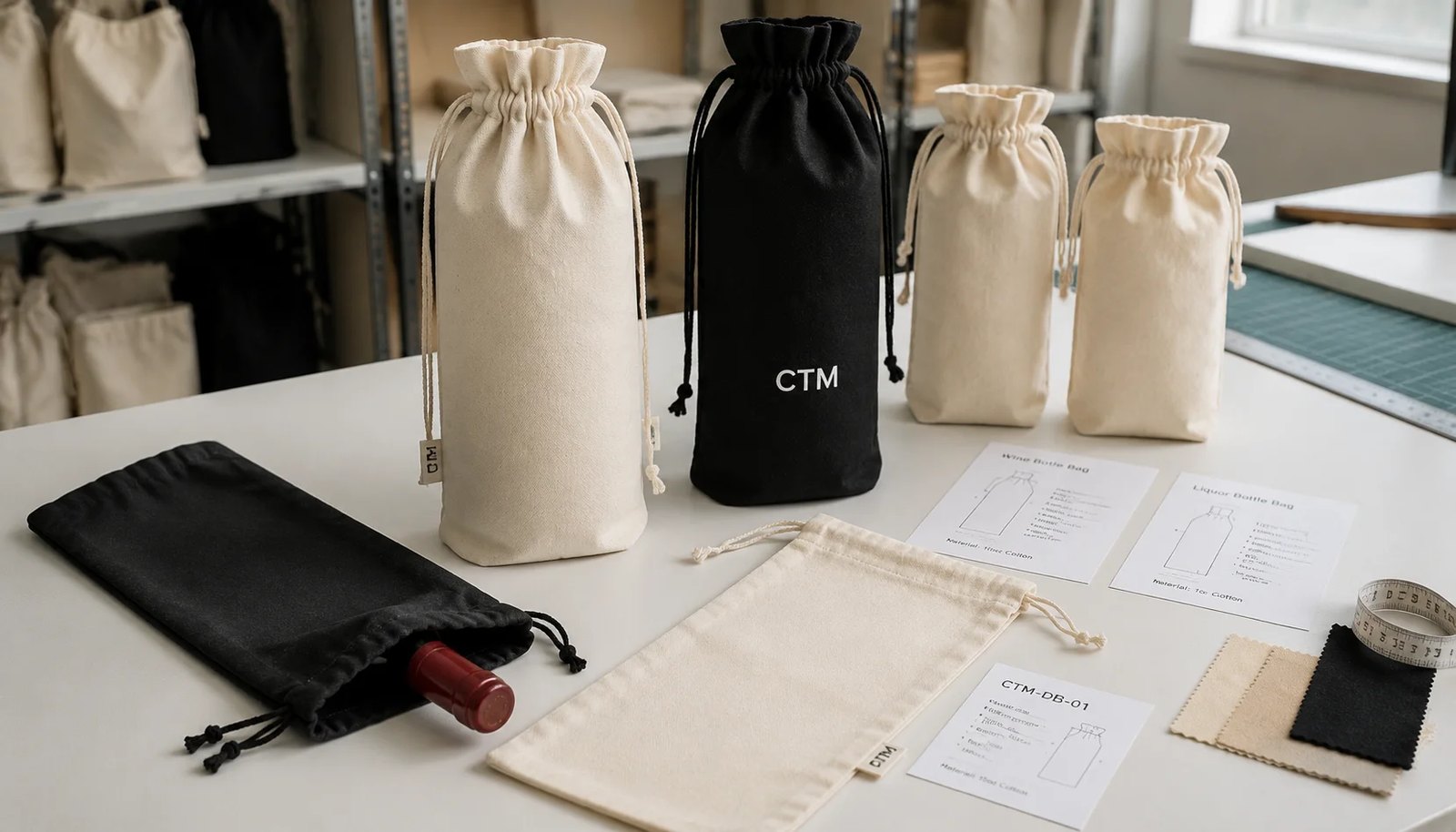
Why compliance is the real buying problem for liquor retail pouches
For cotton drawstring pouches used in liquor retail, the main failure point is usually not the pouch itself. It is the gap between what the buyer assumes the supplier can document and what the supplier can actually support when the retailer, distributor, or importer requests compliance records. A pouch that looks fine in a sample room can still become a receiving problem if the fabric declaration is vague, the print chemistry is undocumented, or the packing materials were substituted without notice.
Liquor retail programs add pressure because packaging often sits close to premium glass products and gift presentation standards. The pouch must fit correctly, print cleanly, survive handling, and arrive with traceable paperwork. Procurement teams therefore need a sourcing method that balances presentation, cost, and document readiness. The supplier compliance checklist is less about bureaucracy and more about avoiding blocked shipments, delayed product launches, and disputes over what the quote actually included.
- Common failure pattern: buyer approves appearance sample but never locks fabric GSM, cord material, or print method
- Common document gap: factory sends a generic declaration that is not tied to the style or PO
- Common retail issue: pouch size fits one bottle format but not a wider shoulder or gift-box configuration
Start with the exact pouch specification, not the keyword
Many RFQs for liquor bottle pouches say only 'cotton drawstring pouch with logo.' That is not enough for a stable quote. Cotton pouches vary heavily by GSM, weave, cord type, stitch count, and print route. If the buyer does not define those variables, suppliers will quote different constructions and the comparison becomes misleading. One quote may use 110 GSM fabric with polyester cord, while another uses 160 GSM cotton with tighter sewing. The cheaper quote may simply describe a lighter, less retail-ready product.
For a standard 750 ml bottle, many buyers end up in the 140-170 GSM plain weave cotton range because it balances cost, drape, and opacity. If the pouch is intended for gifting of heavier spirits bottles or premium boxed sets, 180-220 GSM may make sense, but the buyer should understand the tradeoff: heavier fabric raises unit cost, can make the pouch stiffer, and often requires larger carton volume. Size should be set by actual bottle dimensions, not category assumptions.
- Useful starting size for many 750 ml bottle pouches: based on actual bottle height, body diameter, and closure allowance; always send your target dimensions
- Fabric range often used: 140-170 GSM plain weave cotton for mainstream retail gift pouches
- Premium look option: 180-220 GSM if you want a sturdier hand-feel and reduced transparency
- Cord options: round cotton rope, braided cotton cord, or flat herringbone tape; each affects cost and closing function
How to compare supplier quotes without rewarding under-spec offers
When three suppliers reply to the same RFQ, the lowest price often comes from the least complete interpretation. A buyer should normalize every quote into the same structure: fabric GSM, pouch size, cord type, print method, print colors, sample charge, MOQ, packing details, production lead time, and document support. If one supplier does not list those details, the quote is incomplete, not competitive. Price comparison only becomes meaningful after the construction and service assumptions are aligned.
MOQ logic matters here. Some factories quote a low MOQ on natural fabric with one-color print because they can run that from existing greige or stock cloth. The same factory may require a much higher MOQ once you move to dyed black fabric, custom PMS matching, or multiple logo variants. Procurement teams should separate size MOQ, fabric color MOQ, and print color MOQ. Otherwise they approve a trial order assuming future repeat flexibility, then discover that every artwork variation triggers a different setup cost.
- Break each quote into: material, print, sewing, packing, compliance docs, and ex-factory lead time
- Identify hidden adders: dyed fabric surcharge, extra screen charge, individual polybag, barcode sticker, carton split by SKU
- Separate MOQ by variable: size, fabric color, print artwork, and packing assortment
- Request carton dimensions early if ocean freight cubic cost matters on low-value packaging
Print method and logo durability: where retail appearance gets lost
For most liquor retail cotton pouches, screen printing is still the practical choice when the logo is one or two colors and the order is in bulk. It gives reasonable durability and usually the best unit economics once setup is spread across volume. Heat transfer can work when the logo has gradients or small visual detail, but it changes hand-feel and can look less natural on soft cotton. Digital routes may suit very short custom runs, though consistency and unit cost need closer review.
The main buyer mistake is approving a digital artwork proof and assuming bulk print appearance will match exactly. On cotton, line sharpness, ink spread, and color depth are influenced by fabric texture and curing control. A light natural cotton base can slightly shift dark color appearance, while dyed black fabric may need underbase treatment if a bright logo is required. The pre-production sample should use the actual fabric, actual ink system, and intended print size. Anything else is only a visual concept sample.
- Screen print is usually best for 1-2 color logos at scale
- Heat transfer is more suitable for detailed artwork or smaller custom runs
- Natural cotton can vary slightly in base tone; approve print color on that exact base fabric
- Set logo placement tolerance clearly, especially for front-center bottle presentation
What supplier compliance evidence is worth collecting before production
Not every liquor retailer requires the same document set, but most procurement teams benefit from collecting a basic evidence package before deposit rather than after shipment. At minimum, the buyer should know the declared fiber content, whether any restricted-substance statement is available for fabric and print process, what packaging materials are used, and whether the factory follows a needle control procedure if sewn goods are entering formal retail channels. If your importer file requires factory audit references or social compliance records, identify that at RFQ stage because many smaller workshops cannot supply it on short notice.
The key is to request order-linked or style-linked evidence where possible. Generic declarations with no product reference are weak support in a retail compliance file. If the pouch is marketed with any specific environmental or fiber claim, the bar gets higher. Buyers should not rely on verbal assurances such as 'same as export quality' or 'eco material.' If a claim affects the packaging copy, online listing, or retailer onboarding file, it must be supported by proper documentation from the sourcing route used for that order.
- Typical document set: fiber declaration, packaging material declaration, restricted substance statement if required, factory details, and QC process summary
- If you need specific sustainability or chain-of-custody claims, state that before quotation
- Keep declarations tied to style code, PO, or material lot where possible
- Do not assume cord and pouch body use the same fiber unless separately stated
Sample approval should test fit, feel, and retail presentation together
A strong sample process does more than verify dimensions. For liquor pouches, fit testing should be done with the actual bottle or a dummy with matching body diameter, shoulder shape, and closure height. Some pouches measure correctly on paper but bind at the bottle shoulder or do not close cleanly around a wax seal, cap sleeve, or neck tag. The approved sample should therefore be reviewed in use, not only flat on a table.
Appearance review also needs acceptance criteria. Procurement teams often approve comments like 'looks good' and then fight over bulk variation later. Better approval language is specific: acceptable fabric hand-feel, acceptable show-through level, acceptable print density, acceptable stitch visibility, acceptable cord thickness, and approved packing fold method. If the purchase is important, keep either a sealed physical sample or a photo pack with dimensions, weight reference, logo placement measurements, and close-up construction images.
- Use real bottle fit test during sample review
- Approve pouch size in filled condition, not flat-only measurement
- Record print size and placement from fixed reference points
- Save close-up photos of seam finish, channel construction, and cord ends
- Avoid approving prototypes made from substitute lighter cloth if bulk will be heavier
QC thresholds that prevent avoidable disputes in bulk orders
Cotton pouch defects are usually simple, but they become expensive when they affect packed volume. The buyer should define which defects are critical to retail presentation and which are tolerable fabric characteristics. For example, severe print smudging, open seams, incorrect size, wrong color, and missing cords are clear rejects. Minor natural slubs in plain weave cotton may be acceptable if that fabric character was already known. Without this distinction, inspections become inconsistent and both sides spend time arguing over normal fabric variation instead of real nonconformity.
Use testing should be part of inspection. An inspector should insert the intended bottle type into sampled pouches to verify functional width and closure, not just read a ruler. This is important because seam allowance variation and channel height can change usable internal dimensions. Carton-level sampling should also verify assortment counts, inner pack counts, and label accuracy. Many shortage claims come from poor carton control rather than missing production pieces.
- Major visual defects: off-center print beyond agreed tolerance, open seam, severe puckering, stain, obvious shade mix, cord pull-out
- Functional defects: bottle cannot enter smoothly, drawstring jams, channel closes unevenly, pouch height too short to cinch properly
- Packing defects: wrong count per inner, mixed SKUs in one carton, missing carton labels, overweight cartons causing warehouse handling issues
- Set inspection timing: inline review for print and sewing, final random inspection after packing
Packing details affect freight cost, receiving speed, and store readiness
Packing is often treated as an afterthought, but for low-cost textile packaging it can materially change landed cost and downstream handling. If each pouch is individually polybagged, unit presentation at receiving improves, but material cost and carton cube also rise. Bulk packing in counted bundles can reduce cost, though it may require more labor at the distributor warehouse. Paper bands or inner poly by set count are sometimes a good middle ground when the buyer needs count control without fully individual retail packing.
Carton design also matters. Over-compressed cartons can flatten drawstring channels and leave crease marks in printed areas, especially on heavier stacks of darker dyed fabric. Export cartons should be labeled clearly by style, size, color, PO, and carton sequence so the importer can allocate inventory without opening every box. If mixed SKUs share one container, shipping marks become even more important than the unit price difference between pouch options.
- Common inner pack choices: bulk bundle, individual polybag, paper band by count, or inner poly by set quantity
- Define carton max weight to match warehouse handling limits
- Request carton dimensions to estimate freight cube before approving production
- State whether moisture protection or desiccant is required for sea shipment
- For retailer allocation, ask for outer carton labels that match your SKU logic
Lead-time planning: where pouch programs slip most often
Cotton drawstring pouches look simple, but their schedule risk usually sits in material readiness and approval sequencing. Natural fabric in common weights may be available quickly, while dyed custom colors can extend procurement time. If printing is outsourced, the pouch may also queue between sewing and packing, creating a hidden schedule gap. Buyers should map the full path: fabric sourcing, dyeing if any, cutting, sewing, printing, drying or curing, finishing, packing, inspection, and booking.
The biggest planning mistake is counting only factory production days and ignoring sample approval and booking windows. A realistic schedule should include time for artwork correction, pre-production sample transit, approval turnaround, and final inspection booking. Peak-season congestion around holidays or major promotional launches can add pressure even when the item itself is simple. The safest suppliers are usually those who explain their critical path clearly rather than just promising an aggressive ship date.
- Natural cotton usually moves faster than custom-dyed fabric
- In-house printing usually reduces handoff delay compared with outsourced print vendors
- Mixed SKU orders often slow packing and carton marking
- Build time for sample courier, internal approval, and possible artwork revision
- Reserve inspection and vessel booking early during seasonal peaks
Landed-cost thinking: the cheapest pouch quote can cost more overall
Procurement teams often focus on ex-factory price, but landed cost for liquor retail pouches is influenced by packaging density, freight cube, defect exposure, and warehouse labor. A lighter 110 GSM pouch may save on invoice value, but if it looks too thin for a premium bottle or creates more rejects due to weak seams and poor print holdout, the total program cost rises. A slightly heavier, better-controlled pouch may reduce complaint handling and improve store presentation enough to justify a higher factory price.
Quote data should therefore be analyzed in layers. First compare like-for-like manufacturing cost. Then add sample charges, print setup, inner packing, carton cube, estimated freight impact, and expected QC risk. Even within the same factory, a change from individual polybag to counted inner bundle can alter total landed economics. Buyers that present this full comparison internally make better decisions than teams that select only the lowest unit quote and discover the real costs after arrival.
- Cost drivers beyond unit price: fabric GSM, dyed fabric, print colors, cord material, special packing, inspection, and rework exposure
- Freight cube matters on bulky but low-value textile packaging
- Reject risk has a real cost in relabeling, sorting, replacement, and missed launch timing
- A stable repeat specification often beats chasing the lowest first-order quote
Specification comparison for buyers
| Supplier option | What to verify | Commercial advantage | Buyer risk to control |
|---|---|---|---|
| Direct sewing factory | cord material proof, reinforcement close-ups, load-test photos, approved sample tag, and bulk-line first-piece record | Better sample-to-bulk control and faster production feedback | May be weaker on export paperwork or branded packing unless checked early |
| Trading company | Factory name, production photos, trim-source proof, and who owns QC decisions | Can coordinate small mixed orders and extra services | Markup can hide real factory capability and slow defect decisions |
| Specialized bag workshop | cord diameter, eyelet or reinforced channel, bottom corner reinforcement, seam allowance, bar-tack position, and load target | More practical for detailed construction, trims, and repeat programs | Capacity may be limited during peak seasons |
| Low-price general supplier | 6-10 oz cotton canvas, 210D polyester, rPET, or blended cotton with shrinkage and colorfastness expectations set before sampling | Useful for simple promotional runs with loose specs | Material downgrades, weak packing, and vague inspection scope can erase savings |
| Retail-ready supplier | fold direction, cord protection, bundle count, carton compression, moisture bag, and retail label position | Can handle labels, SKU separation, carton marks, and receiving rules | Higher unit cost must be compared against reduced warehouse work |
| Compliance-focused supplier | Fabric records, labeling review, test plan, and production traceability | Safer for retail programs and repeat brand orders | Documentation claims need evidence, not only sales language |
| Local sample room plus bulk factory | Signed sample, bulk factory handoff, first-piece photos, and deviation owner | Good for complex branding before large production | Sample room quality may not match bulk line unless handoff is controlled |
Buyer checklist before sampling
- Define bottle type and finished pouch size in millimeters, including whether the pouch must fit a 750 ml wine bottle, gift tube, or wider spirits bottle with neck flare.
- Set fabric weight range, not just 'cotton': for most liquor gift pouches, specify 140-170 GSM plain weave cotton unless you need a heavier premium feel.
- State whether the pouch must be opaque enough to reduce bottle show-through under normal retail lighting.
- Specify print method and artwork count: 1-color screen print, 2-color screen print, or heat transfer for detailed graphics.
- Include logo size, print placement from bottom and side seam, and acceptable print deviation tolerance.
- Decide whether cords should be cotton rope, flat tape, or polyester substitute; many buyers assume cotton and receive mixed-material cords.
- Set seam construction expectations, such as clean overlock inside, reinforced cord channel, and no raw fraying visible from outside.
- Require a pre-production sample made from bulk-intent fabric and actual print method before mass production starts.
- Define packing by piece count per inner pack and carton, plus whether each pouch needs individual polybag, paper band, or bulk pack.
- Request compliance file items before deposit: material declaration, restricted substance statement if needed, and packaging material information.
Factory quote questions to send
- What is the exact cotton fabric construction and GSM offered in the quote, and what is the acceptable bulk tolerance on GSM?
- Is the quoted fabric stock-dyed, piece-dyed, or greige/natural, and does the price change by color option?
- Is printing done in-house or outsourced, and how many working days does that add to lead time?
- What is the MOQ by size, fabric color, and print color count? Can mixed artwork share one MOQ if the pouch size stays the same?
- What print method is quoted, and what is the expected durability on cured print under normal retail handling?
- Will the pre-production sample use the same fabric, same cord, and same print process as mass production?
- What size tolerance and logo placement tolerance does the factory control in bulk production?
- How are drawstrings secured to prevent pull-out, and is cord length measured before or after knotting?
- What inner packing is included in the quote, and what export carton dimensions and gross weight are planned?
- Does the quote include needle control, inline QC, final inspection, and replacement policy for packed shortages or major defects?
Quality-control points to confirm
- Fabric GSM should stay within the agreed tolerance range; random roll checks should match approved bulk standard closely enough to avoid mixed hand-feel in one shipment.
- Finished pouch size must meet approved dimensions with a practical tolerance, especially width at bottle body and usable height below drawstring channel.
- Print position should align to the approved artwork placement and remain centered or intentionally offset as specified; obvious drift across packed units is a valid defect.
- Print coverage should be solid with no pinholes, ghosting, severe ink spread, or under-cured rubbing on dark or natural cotton.
- Seams should be straight, secure, and free from skipped stitches, open seams, needle cuts, and heavy puckering around the channel.
- Drawstrings should slide smoothly, with even length on both sides where design requires symmetry, and knots or end finishing should prevent pull-out.
- Fabric should be clean and commercially presentable, without oil stains, mildew odor, mixed shade lots, or major slubs beyond the approved fabric character.
- Packing count per inner and per export carton must match the purchase order exactly; shortage claims often come from unverified carton assortment.
- Carton markings should include style, size, color, PO reference, and carton count to support warehouse receiving and store allocation.
- Pre-shipment inspection should review both appearance and use test by inserting the target bottle shape, not just flat measurement on empty pouches.