Start With the Receiving Date, Not the Show Date
A trade show pouch order has a harder deadline than a normal replenishment order. The pouches do not simply need to exist before the event opens. They may need to arrive at an advance warehouse, clear a decorator receiving window, move through a booth contractor, or reach your internal team in time to be packed into sample kits. That date can sit one to three weeks before the first show day. If procurement plans from the opening morning, the schedule already starts late.
Build the calendar backward from the last acceptable receiving date. Separate the work into approval time, sample time, bulk production time, packing time, and freight time. A standard custom cotton drawstring pouch using in-stock natural cotton and a simple one-color print may still need about one week for RFQ and artwork alignment, one to two weeks for sampling, two to four weeks for production, and one to four weeks for freight depending on origin, lane, and shipping mode. Dyed fabric, multiple print versions, special labels, extra documentation, or unusual packing can push the timeline out.
The most important sentence in the quote is not the unit price. It is the sentence that defines when lead time starts. Some suppliers count from deposit receipt. Others count from final artwork approval, blank sample approval, print strike-off approval, or signed pre-production sample. For a show order, vague wording such as 'lead time 25 days' is not enough. You need to know which buyer action releases production.
- Use the advance warehouse or booth contractor receiving deadline as the planning finish line.
- Ask the supplier to state the production trigger in writing before the PO is issued.
- Keep a visible buffer for sample shipping, payment processing, customs, local delivery, and internal packing.
Turn the Booth Use Case Into a Real Product Spec
Cotton drawstring pouches look simple, which is why they are often under-specified. A pouch for a lightweight brochure and sticker pack does not need the same fabric, seam strength, or cord as a pouch holding product samples, swatches, glass jars, cables, or a boxed demo kit. The clearer the use case, the faster the supplier can quote accurately and the less room there is for late changes.
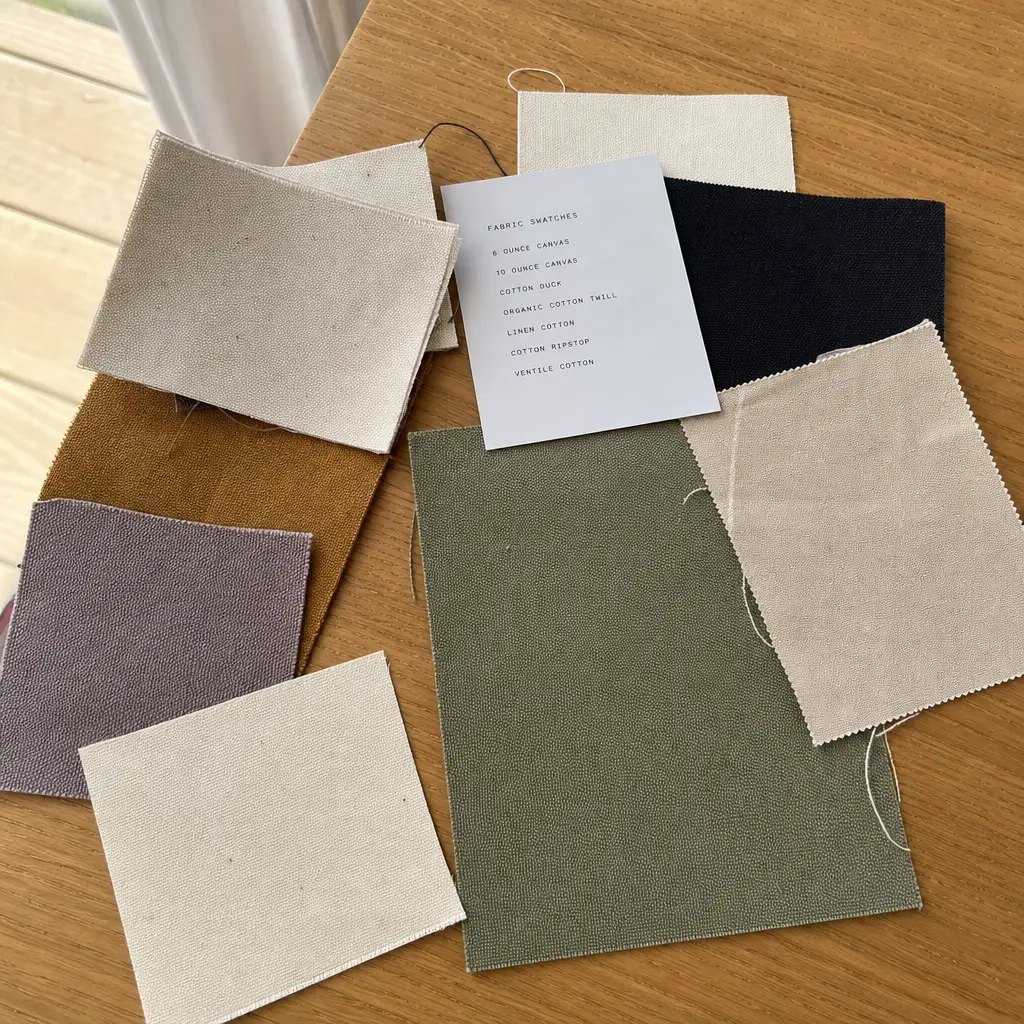
Fabric weight is usually the first decision. A 100 to 120 GSM cotton pouch can work well for flat handouts, simple giveaways, and programs where freight weight matters. It folds easily and keeps cost controlled. A 140 to 180 GSM pouch has more body, usually improves print opacity, and looks more polished on a booth table. It can also raise carton weight and production handling time. Choose the fabric because it matches the fill and presentation goal, not because a previous order used the same GSM.
Construction is the next schedule lever. Flat side-seam pouches are usually easier to cut, sew, and inspect. Gusseted pouches create more usable volume for thicker kits, but they add sewing steps and measurement points. The cord also matters. Standard cotton cord may be fine for one-time giveaway use. If the pouch will be opened and closed repeatedly by sales reps or customers, specify cord thickness, knot finish, and channel strength.
- Define the actual contents the pouch must hold before choosing GSM or gusset style.
- Use 100 to 120 GSM for lighter handouts and 140 to 180 GSM when structure and opacity matter more.
- Specify cord material, color, length, knot type, and channel construction instead of treating the cord as a default accessory.
Choose a Sourcing Route That Can Hold the Date
The best supplier route depends on the amount of customization and the time left on the calendar. A direct factory with an export team usually gives procurement the clearest control over fabric, cutting, sewing, printing, inspection, carton labeling, and documents. That route works well when the spec is defined and the buyer can approve samples promptly. It also makes production responsibility easier to trace.
A trading company can be useful when the program includes several pouch types or the buyer needs quick comparison across factories. The trade-off is visibility. Ask whether the quoted factory is already selected, whether samples and bulk goods will come from the same site, and who signs off on inspection. If the trading partner cannot identify where production will happen, the lead time is harder to trust.
A stockist or warehouse supplier is a different tool. It can save a tight event when standard sizes, available cotton colors, or local imprinting are acceptable. But stock still needs checking. Available inventory may be split across dye lots or carton counts, and printing may be subcontracted. For a trade show, inventory on a website is not the same as allocated stock for your order.
- Use direct factory sourcing when the spec is firm and you need control over production details.
- Use a trading partner only when the factory, production site, and approval responsibility are clearly named.
- Use stock only when the deadline requires it and the standard size, color, and print limits are acceptable.
Make MOQ Work for the Schedule
MOQ is not just a sales number. It is tied to production setup. Cotton drawstring pouch MOQ can change by size, fabric color, GSM, cord color, print method, artwork version, label option, and packing format. A natural cotton pouch with one logo color may run at a lower MOQ than a dyed pouch with three print versions and separate carton labels. Every variation asks the factory to manage another setup, another inspection group, or another packing instruction.
This is where trade show orders become unnecessarily complicated. Marketing teams may want different bag colors for different product lines or regional teams. That can make sense, but it should be a deliberate cost and schedule decision. If the deadline is close, one pouch size, one cotton color, one cord color, and one artwork version are far easier to produce and inspect. Versioning should earn its place.
Ask suppliers to state MOQ by variable, not only total order quantity. A quote for 5,000 pieces may look fine until you learn that each of five artwork versions has a 2,000-piece MOQ. The reverse can also be true: a supplier may allow mixed artwork if all versions use the same pouch blank and print setup schedule. You only know by asking before award.
- Ask for MOQ by size, fabric color, cord color, print version, and packing format.
- Reduce variants first when the show date is fixed and the schedule is tight.
- Treat each extra artwork version as a production and inspection item, not just a design preference.
Use Samples as Decision Gates
Sampling should answer specific questions in the right order. A blank sample confirms the dimensions, fabric weight, handfeel, seam construction, drawcord channel, and fill capacity. It does not prove the logo. A print strike-off or proof confirms artwork size, ink behavior, color reference, line detail, and placement. A pre-production sample should bring the final pouch, final cord, final print, and final packing assumption together before bulk cutting begins.
Skipping sample stages can save calendar days, but it also moves risk into bulk production. That trade-off may be acceptable for a plain stock pouch with local one-color imprinting. It is less acceptable when the order has dyed cotton, a large solid logo, a tight Pantone expectation, a gusset, or multiple SKU packs. Procurement should decide which stage can be compressed and which one cannot.
Be precise about approval. If you approve a photo, say whether the photo approves dimensions, logo placement, color, or only general appearance. If a physical sample is required, include shipping time in the calendar. Once bulk fabric is cut or printed, small changes become expensive and may put the delivery date at risk.
- Use a blank sample to approve construction and fill, not print quality.
- Use a strike-off or proof to approve artwork before the pre-production sample is released.
- Use the pre-production sample as the reference for bulk inspection and attach its ID or image to the PO.
Build Quotes Buyers Can Compare
A quote is only useful when it exposes the assumptions behind the price. Ask each supplier to quote the same size, GSM, color, construction, drawcord, print method, number of colors, quantity breaks, packing method, and freight term. If one quote includes setup charges and another hides them, the cheaper number may not be cheaper. If one quote assumes 100 GSM and another assumes 140 GSM, they are not quoting the same bag.
Separate the main cost lines: unit price, sample charge, screen or setup charge, artwork revision charge, special packing, labels, carton upgrades, palletization, document fees, and freight. For trade show exhibitors, carton data is part of the quote. Carton dimensions and gross weight affect freight booking, warehouse receiving, and whether an air upgrade is practical if the schedule slips.
Ask for at least three quantity breaks. The price curve helps procurement decide whether to order only event quantity or include a small replenishment buffer. It also exposes whether the supplier is pricing a short setup run or a more efficient production batch. Do not award on a single bundled price when the deadline, artwork, and packing still have unresolved details.
- Send the same RFQ sheet to every supplier so quote differences are visible.
- Compare landed cost, not only unit cost, by requesting EXW, FOB, and delivered options where relevant.
- Require carton dimensions, gross weight, and pack count before freight decisions are made.
Lock Artwork Before It Starts Moving the Calendar
Artwork changes are one of the easiest ways to lose a week. A logo that looks clean on screen may sit too close to a seam, distort when the pouch is pulled closed, or lose detail on textured cotton. Print position should be measured from a seam edge, bottom edge, or centerline so the factory and buyer judge the same location. 'Centered on front' sounds clear until the pouch is filled and the drawcord channel changes the visual balance.
For most logo printing, vector artwork is preferred because it scales cleanly. Still, the supplier needs final dimensions, color references, print method, and printable area. If the artwork uses thin strokes, reversed text, small characters, gradients, or large solid ink coverage, ask the factory to confirm the minimum printable detail and any curing or handling limitations. This is especially important for heat transfer and digital print, where fold behavior and rub resistance should be checked.
Version control also matters. Name artwork files with revision numbers and SKU codes. If five regional teams each have a logo version, do not rely on email threads to identify the correct file. The approved proof should show the pouch size, logo size, placement measurement, color reference, and version code.
- Freeze final artwork before pre-production sample approval.
- Measure logo placement from a physical reference point, not by visual description alone.
- Give every artwork version a code that also appears on the carton label and packing list.
Write QC Criteria the Factory Can Measure
Quality control for cotton drawstring pouches is practical, not mysterious. Most failures are visible in ordinary handling: crooked prints, uneven pouch size, weak side seams, loose cord channels, mismatched shade, dirty fabric, frayed cord ends, or cartons with the wrong count. The problem is that many purchase orders describe these issues with soft language. 'Good quality' does not help an inspector decide whether to accept or reject a carton.
Use measurable criteria. Finished width and height should have millimeter tolerances. Print placement should have a measured position and tolerance. Stitch density, seam allowance, cord length, knot security, and fabric shade should be tied to the approved sample or written spec. If your team expects AQL inspection, state the sampling level and define critical, major, and minor defects. Otherwise the factory may inspect to a looser internal habit.
Test the pouch as it will be used. If it will hold brochures and a sample bottle, inspect a filled pouch. If sales reps will open and close it repeatedly, pull the cord several times. If the logo must look clean on a booth table, check the pouch both flat and filled. Empty samples can hide problems that appear during kit assembly.
- Define size, print placement, seam, cord, shade, and packing tolerances before production starts.
- Inspect a filled pouch using the actual or closest expected contents.
- Ask for inspection photos that show measurements, stitching, print detail, cartons, and labels.
Plan Packing Like Part of the Product
Packing is often treated as an afterthought, but it can make or break receiving. Trade show teams need clean counts, clear SKU separation, and cartons that can move through warehouses without confusion. A common format is flat-folded pouches in inner bags, packed into labeled master cartons. The exact count depends on pouch size, fabric weight, and whether the bags must avoid heavy creasing.
Carton rules should be settled before the PO. Ask for inner pack quantity, master carton quantity, carton dimensions, gross weight, carton material, carton marks, and pallet requirements if any. If the order may be split between air and sea, make sure the carton size and weight work for both lanes. Repacking cartons after production wastes time and can introduce count errors.
The packing list must match the physical cartons. That sounds basic, but mixed artwork versions and rush shipments create mistakes quickly. Carton labels should include SKU, artwork version if relevant, quantity, carton number, total carton count, country of origin, and any destination-specific mark. If a decorator warehouse has labeling rules, give those rules to the supplier before carton printing or labeling begins.
- Confirm inner pack, master carton count, carton size, and gross weight before freight is booked.
- Use carton marks that match the packing list exactly, especially for multiple artwork versions.
- Avoid last-minute repacking by choosing carton dimensions that fit the likely freight mode.
Protect the Schedule Against Common Delays
Most trade show delays are not caused by sewing time alone. The usual problems are late artwork, unapproved samples, payment release delays, fabric substitutions, holiday closures, print rework, missing carton information, document errors, and freight rollovers. A buyer can save several days simply by making these risks visible on the project calendar.
Ask the supplier for milestone dates: RFQ confirmation, sample dispatch, sample approval deadline, material ready date, bulk cutting start, print start, in-process inspection, packing date, final inspection, goods-ready date, and estimated departure. These dates help both sides see when a small slip becomes a real threat. They also make it easier to decide whether to simplify the spec, split shipment, or move part of the order by air.
If time becomes tight, simplify before spending money on speed. Reducing artwork versions, choosing in-stock natural cotton, using a standard cord, or accepting standard carton packing may recover more time than an expensive freight upgrade. Rush freight cannot fix a pouch that is still waiting for final artwork or missing a cord color.
- Track milestone dates instead of relying on one broad lead-time estimate.
- Watch payment, artwork, and sample approvals as closely as factory production time.
- When the calendar tightens, remove variables before defaulting to air freight.
Specification comparison for buyers
| Planning decision | Recommended option | Best fit for exhibitors | Risk to confirm before PO |
|---|---|---|---|
| Deadline basis | Plan from warehouse or decorator receiving date | Shows with advance warehouse delivery, booth contractor routing, or strict marshaling-yard rules | Do not use the first show day as the due date unless goods can go directly to the booth that morning |
| Sourcing route | Direct factory with export team | You need control over fabric weight, print approval, carton marks, and ship documentation | Confirm the production trigger, inspection standard, goods-ready date, and who owns export paperwork |
| Sourcing route | Trading company with named factory | You are comparing several pouch formats or need one contact to coordinate multiple production sites | Ask for the factory name, production location, and whether samples and bulk will come from the same plant |
| Sourcing route | Stockist or warehouse supplier | The event is close and standard stock sizes or local imprinting are acceptable | Check real available quantity, dye-lot consistency, carton count, and whether printing is in-house or subcontracted |
| Fabric weight | 100 to 120 GSM cotton | Light handouts, flat inserts, lower freight weight, and budget-conscious giveaway programs | Thin fabric may show contents under booth lighting and can feel less substantial in a premium kit |
| Fabric weight | 140 to 180 GSM cotton | Higher perceived value, better print opacity, and a neater table presentation | Heavier cloth can increase sewing time, carton weight, and air freight cost |
| Construction | Flat pouch with side seams | Standard event handouts, simple fill items, and tight schedules | Check seam allowance, stitch density, and whether the cord channel holds shape when pulled |
| Construction | Gusseted pouch | Sample bundles, boxed inserts, or thicker collateral packs | Gussets add cutting, sewing, measurement, and inspection steps |
| Logo method | 1 to 2 color screen print | Simple logos, larger runs, repeat orders, and stable brand colors | Confirm screen charges, print area, minimum line width, curing time, and color approval method |
Buyer checklist before sampling
- Confirm the show date, booth move-in date, advance warehouse receiving window, freight cutoff, and any decorator delivery rules before requesting quotes.
- Work backward from the real receiving deadline and add internal time for approval, payment release, inbound receiving, and booth-kit packing.
- Define finished pouch size, usable fill size, fabric GSM, fabric color, construction type, drawcord material, cord color, and whether a gusset is required.
- State logo method, artwork file type, Pantone or brand color references, print area, logo placement, minimum line width, and whether artwork versions are allowed.
- Ask each supplier to separate unit price, sampling cost, setup charges, print charges, packing cost, testing or compliance fees, freight term, and freight estimate.
- Request the right sample sequence: blank sample for size and construction, print strike-off or proof for artwork, and pre-production sample for final approval.
- Write acceptable tolerances for finished size, print placement, stitch density, seam allowance, cord length, cord function, shade, and carton count into the PO.
- Confirm MOQ by size, fabric color, print version, cord color, and packing format so hidden production runs do not appear after award.
- Define inner pack count, master carton quantity, carton dimensions, gross weight, carton marks, pallet requirements, and any destination labeling rules.
- Build time for artwork corrections, sample shipping, payment processing, factory holidays, local holidays, customs, and peak-season freight congestion.
Factory quote questions to send
- What is the lead time from final pre-production sample approval to goods-ready date, and what events can reset that lead time?
- What must be complete before production starts: deposit receipt, final artwork, blank sample approval, print proof approval, or signed PO?
- Which cotton fabric weights and colors are in stock now, and which require fresh greige procurement, dyeing, washing, or finishing?
- Is the quoted drawcord material and color in stock, and can the same cord lot cover the full order quantity?
- How many print colors are included in the base quote, and what are the setup fees, screen charges, or proof charges for additional colors?
- What is the MOQ by pouch size, fabric color, print version, cord color, label option, and packing format?
- Can mixed SKUs share one production run, or will each size, color, or artwork version be scheduled separately?
- What sample stages are included: blank sample, print strike-off, digital proof, pre-production sample, shipping sample, and retained factory sample?
- What are the standard finished-size tolerances, stitch density target, seam allowance, cord length tolerance, and shade tolerance for this order?
- What is the safe printable area for this pouch size, and what minimum line width or text height can the chosen print method hold?
Quality-control points to confirm
- Measure finished width and height against the approved spec and record the allowed tolerance in the purchase order. A common commercial target is +/- 5 mm for small pouches and +/- 10 mm for larger formats.
- Check usable fill area, not only flat outside dimensions, especially when the pouch has a drawcord channel, gusset, thick seam allowance, or bulky insert kit.
- Inspect side seams, bottom seams, and cord-channel stitching because weak construction often appears during packing, repeated opening, or booth handling.
- Verify stitch density and seam allowance against the approved sample. Typical production control is around 6 to 8 stitches per cm, with seam allowance agreed in millimeters.
- Pull the drawcord several times on sampled units to confirm smooth opening, even tension, knot security, and no fraying at cord ends.
- Compare print placement, logo scale, edge clarity, and color on both the flat pouch and a filled pouch so the artwork reads correctly in real use.
- Check print adhesion or surface durability using the supplier's agreed method, especially for heat transfer, digital print, dark ink on natural cotton, or large solid logos.
- Confirm fabric shade consistency across cartons and production lots, particularly when orders use dyed cotton, multiple machines, or replenished fabric rolls.
- Test the pouch with the actual expected fill, such as brochures, sample jars, cable kits, swatches, or product inserts, rather than approving an empty pouch only.
- Inspect inner pack count, master carton count, carton labels, carton condition, and carton compression before shipment so receiving teams get the exact SKU mix ordered.