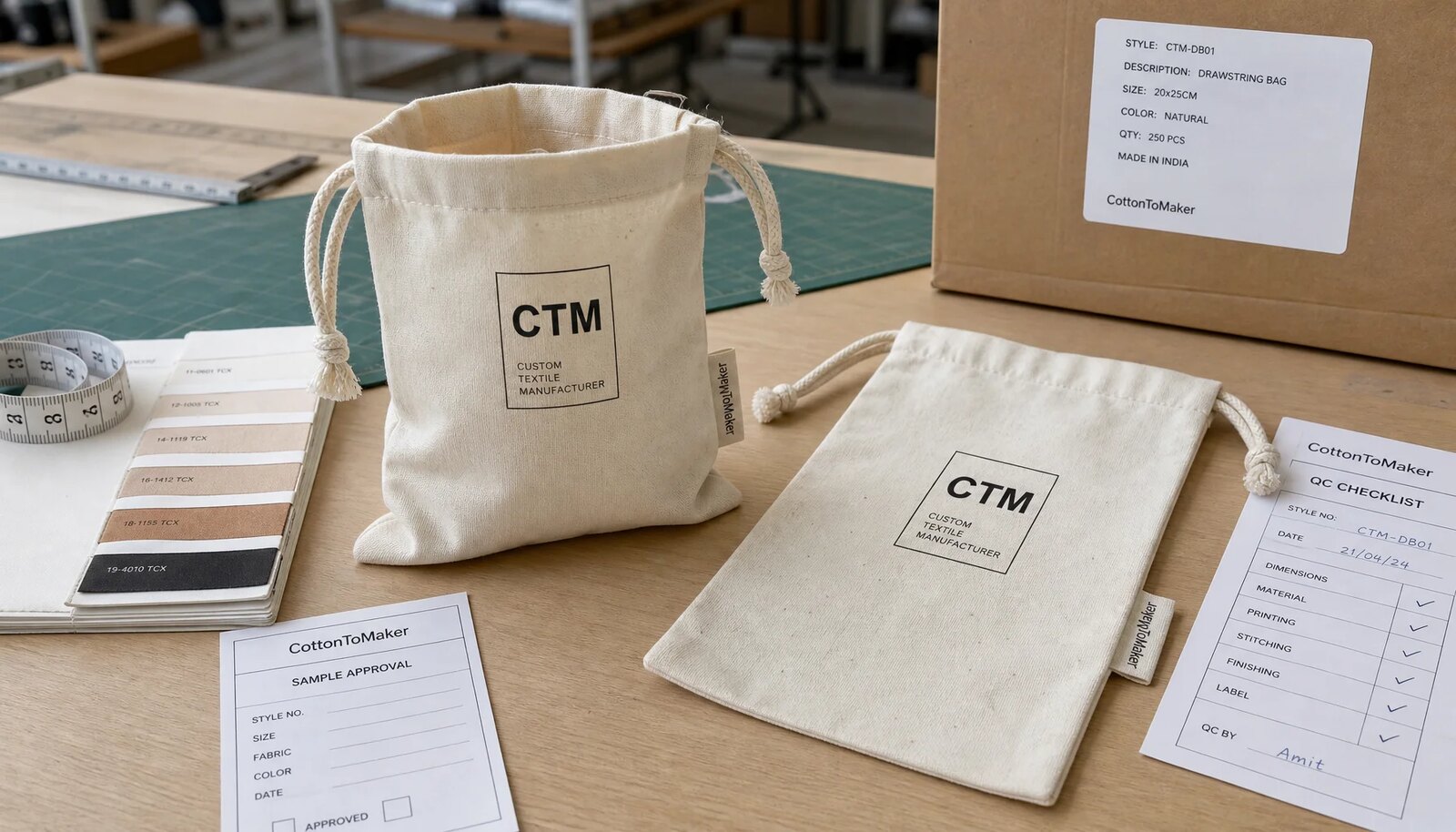
Start With the Date Stock Must Be Ready, Not the Fair Date
Cotton drawstring pouches look like a simple packaging item, which is why they are often ordered too late. For craft fair programs, the real deadline is not the morning the booth opens. It is the date your team needs accepted, counted, and allocated stock in the warehouse, back room, studio, or event staging location. A distributor may need pouches two or three weeks before the first market because inventory still has to be sorted by vendor, packed with products, labeled for booth teams, or routed to regional fairs. A brand attending several weekends of events may need the first receipt even earlier so stock can be divided without rushed manual sorting.
A useful lead time plan breaks the order into visible steps: RFQ clarification, quote comparison, specification lock, deposit, sample making, courier transit, sample review, artwork comments, bulk fabric preparation, printing, sewing, trimming, final inspection, packing, export booking, international transit, customs clearance, inland delivery, receiving, and allocation. When a supplier says production takes 20-30 days, that usually means after material is ready and approvals are complete. It rarely includes incomplete artwork, internal PO delays, sample courier time, payment release, freight booking, customs review, or buyer-side decision pauses.
Late pouch stock is different from late replenishment inventory. If the goods arrive after a holiday market or craft fair weekend, the pouches may still be usable later, but the revenue window has passed. Before issuing the PO, put three dates in writing: the warehouse-needed date, the latest acceptable shipment date, and the latest acceptable approval date. If one date slips, the team should already know the next move: simplify SKUs, ship a partial lot by air, switch to a stock fabric, remove individual packing, or accept a later event allocation.
- Use 8-12 weeks from RFQ to warehouse for a new imported custom cotton drawstring pouch order.
- Use 4-7 weeks only for repeat orders with unchanged fabric, artwork, construction, packing, and approved samples.
- Add 1-3 weeks for dyed fabric, lab dips, woven labels, barcode packing, or multi-destination allocation.
- Write the latest ex-factory date and latest ship date into the PO or order confirmation.
- Reserve buyer approval days for artwork, sample review, payment, inspection booking, and freight selection.
- Plan from the warehouse-needed date, not the craft fair opening date.
Define the Use Case Before You Write the Specification
A strong RFQ starts with what the pouch must do commercially. Craft fair buyers use cotton drawstring pouches as product packaging, retail resale items, kit bags, gift-ready sleeves, booth giveaways, vendor merchandise, and post-purchase wrap. Each use points to a different specification. A soap pouch may need accurate sizing, clean natural cotton, low lint, and economical bulk packing. A pouch sold as a retail accessory may need heavier fabric, individual barcode packing, tighter trimming, and a more controlled visual standard. A giveaway pouch may prioritize fewer variations, speed, and cost.
Avoid the common pattern of asking for a generic cotton pouch, receiving a low quote, and then adding requirements one by one. That creates re-quotes, sample revisions, and confusion about what has actually been approved. Instead, tell the supplier what goes inside the pouch, how often customers will handle it, whether it must be reusable, and how it will sit on the booth table. A pouch stored in a vendor supply bin can be lighter and simpler. A pouch displayed next to premium jewelry, candles, ceramics, or gift bundles needs better structure, cleaner logo alignment, and a cord finish that does not look careless.
The use case also changes the defect standard. For a protective sleeve that is discarded after purchase, small natural cotton flecks may be acceptable. For a retail presentation pouch, the same pouch with an off-center logo, dirty mark, uneven cords, or weak draw channel can lower perceived product value. Good procurement language connects the pouch to the product, the booth workflow, and the end customer’s first impression.
- Packaging pouch: prioritize product fit, clean fabric, efficient bulk packing, and reliable closure.
- Retail resale pouch: add barcode packing, appearance standards, stronger seams, and cleaner thread trimming.
- Giveaway pouch: reduce color and size variations to protect cost and lead time.
- Craft kit pouch: test all components together because combined corners and weight stress seams differently.
- Premium gift pouch: consider 180-220 GSM fabric, double drawcord, woven label, or tighter logo placement tolerance.
- Multi-vendor program: require SKU codes, allocation lists, and carton labels that match vendor destinations.
Choose Fabric GSM and Cotton Base With the Product in Mind
Fabric weight is one of the biggest drivers of both cost and customer perception. A 100 GSM pouch and a 220 GSM pouch can both be called cotton, but they will not feel, print, pack, or perform the same way. Thin cotton folds compactly and ships efficiently. It can be a reasonable choice for light giveaways or simple gift packaging, yet it may look weak around rigid contents or allow dark products to show through. Heavier cotton gives better hand feel and structure, but it increases fabric cost, sewing load, carton weight, and sometimes freight cost.
For many craft fair programs, 120-160 GSM is the practical middle range. It works for soap, jewelry, stationery, ornaments, cards, small accessories, and general branded packaging. For reusable pouches, craft kits with several components, candle tins, heavier handmade goods, or premium gift sets, 180-220 GSM is usually safer. Above that range, the pouch may need a stronger cord and more sewing attention, especially around the top channel.
The cotton base deserves the same care as GSM. Natural unbleached cotton is popular for craft fairs because it fits handmade, rustic, low-waste, and organic-positioned branding. It also often avoids the added approval steps of dyed fabric. The tradeoff is a warmer shade, seed flecks, and batch-to-batch variation. Bleached cotton gives a cleaner background for bright logos, but dirt and handling marks can show more easily. Dyed cotton can match a brand palette, yet it introduces lab dips, dye-lot control, color tolerance, and possible crocking or colorfastness checks. If the event date is fixed, dyed cotton can become the schedule risk that drives the whole order.
Do not compare quotes that only say cotton pouch. Ask for GSM, weave, shrinkage allowance, fabric source, and whether the supplier is using stock greige fabric, bleached fabric, dyed-to-order fabric, or fabric purchased after deposit. If two prices differ sharply, the lower quote may be based on lighter GSM, looser weave, thinner cord, or a less controlled sewing standard. Review the sample by hand, by weight, and with the actual product inserted.
- 100-120 GSM: suitable for light gift packaging, giveaways, and cost-sensitive programs.
- 140-160 GSM: common balance for craft fair packaging, small merchandise, printability, and packing efficiency.
- 180-220 GSM: better for reusable pouches, rigid contents, premium hand feel, and heavier kits.
- Above 220 GSM: stronger structure, but may need heavier cord, slower sewing, and higher freight allowance.
- Natural cotton: approve shade range and seed flecks instead of expecting a pure-white appearance.
- Dyed cotton: use when brand color matters enough to justify lab dips, dye-lot control, and schedule risk.
Control Finished Size, Usable Fit, and Closure Clearance
Size mistakes are easy to prevent during sampling and hard to fix after production. A pouch can match the quoted width and height and still fail in use because the product does not slide in easily, the top channel sits too close to the product, or the drawstring cannot close fully. Buyers need finished dimensions after sewing. Factories also work with cutting dimensions before seam allowance, bottom construction, side seams, top-channel folding, and shrinkage. Those numbers are not interchangeable.
For rigid items, send product dimensions and product shape, not just the pouch size you think you need. Soap boxes, jewelry cards, candle tins, tarot decks, spice jars, ornaments, ceramics, and craft kits stress the pouch in different ways. A rectangular box needs extra width at the corners. A kit with several components may shift during handling and needs more internal room than its separate parts suggest. If the pouch must close fully, the finished height must include the product height plus gathering space above it. If the product should remain partly visible at a booth display, the closure requirement changes.
A good specification states finished flat size, tolerance, product dimensions, desired fit, and closure expectation. It should also say whether measurement is before or after ironing and whether the top channel is included in the total height. For high-risk products, ask the factory to test insertion with a product sample or a dimensionally accurate dummy. A short fit test before bulk production can prevent thousands of unusable pouches.
- State finished flat size clearly, such as 10 cm width x 15 cm height after sewing.
- Add usable fit notes, such as fits a 7 cm x 10 cm x 2.5 cm box and closes fully.
- Use ±0.5 cm tolerance for many small pouches and ±1.0 cm for larger pouches unless fit requires tighter control.
- Allow extra width for rigid corners so side seams are not stressed during insertion.
- Reserve enough height above the product for the drawcord channel to gather cleanly.
- Test the pouch with all kit contents together, not each component separately.
Lock Cord, Channel, and Sewing Details Early
The closure is more than a small construction choice. It affects cost, customer feel, booth handling, and defect risk. A single cotton drawcord is economical and works well for small gift pouches, low-cost packaging, and simple giveaways. A double drawcord improves the opening experience because the pouch can be pulled from both sides, which often feels better in a retail setting. Heavier pouches may need a thicker cord to match the fabric. Thin cord on heavy cotton looks and feels mismatched. Heavy cord on a small thin pouch can distort the top channel.
The top channel must survive repeated pulling. Craft fair customers may open and close pouches at the booth. Vendors may repack samples during setup, tear-down, and restocking. Weak channel stitching, skipped stitches near the cord exit, or poor knotting can cause failure even when the fabric itself is acceptable. The RFQ should define cord material, diameter or thickness reference, single or double draw, knot finish, cord length tolerance, and fray control. Depending on cord material, that may mean knotting, sewing, heat sealing, or another agreed finish.
Sewing details should be settled before quote comparison because they change labor time. Side seam construction, bottom corners, stitch density, seam allowance, thread color, and trimming standard all influence durability and appearance. Natural cotton buyers may accept simple construction, but simple does not mean open seams, thread clusters, uneven channels, or weak corners. If the pouch supports premium packaging, add closer stitch control and cleaner trimming to the inspection checklist.
- Single drawcord: lower cost, simple construction, and suitable for small pouches or giveaways.
- Double drawcord: better opening feel, stronger retail presentation, and easier booth handling.
- Cord length: define target length and tolerance so cords do not hang unevenly across a SKU.
- Channel strength: check repeated opening and closing, not only visual appearance.
- Knot finish: specify knots, sewn ends, or other finishing needed to reduce fraying.
- Stitch quality: inspect side seams, bottom seams, channel seams, skipped stitches, and loose threads.
Choose the Print Method Around Real Artwork, Not a Mockup
Screen printing is often the most efficient decoration method for cotton drawstring pouches with craft fair branding. It works well for one to three spot colors, clear logos, simple icons, seasonal marks, and repeat orders. Setup cost is spread across quantity, and the result can look clean on natural cotton when the artwork is prepared correctly. Send vector files, Pantone references, maximum print size, and print placement measured from fixed pouch edges. A web image, screenshot, or low-resolution mockup is not enough for production.
Heat transfer can be useful when artwork includes gradients, photographs, fine details, or many colors. It also changes the feel of the pouch, so test it on the final fabric GSM before approval. Transfers may feel heavy on small pouches and should be checked for edge adhesion, flexibility, cracking, and rub performance. Embroidery can create premium texture on heavier cotton, but it is less efficient for small or thin pouches because stitching can distort the fabric. Woven side labels are useful when the front artwork changes by product line, but label production, label MOQ, and label approval must be added to the calendar.
Print approval should happen on final or equivalent fabric. Ink behaves differently on 120 GSM natural cotton than on a heavier bleached or dyed base. Natural cotton also changes color appearance because warm fabric affects light inks. If brand color matters, approve a printed sample rather than relying only on a digital proof. The inspection standard should define print placement tolerance, color tolerance, registration tolerance, rub performance, and unacceptable defects such as smudges, ink bleed, ghosting, print-through, or transfer edge lift.
- Screen print: best for simple logos, spot colors, repeat orders, and predictable bulk production.
- Heat transfer: useful for complex artwork, but test hand feel, flexing, edge adhesion, and durability.
- Embroidery: suitable for heavier fabric and premium positioning, but less practical for tiny pouches.
- Woven label: useful for repeat brand identity, but adds label approval and sewing control.
- Artwork files: send vector artwork, Pantone references, print size, and placement from fixed edges.
- Print tolerance: define acceptable placement offset, registration, rubbing, cracking, bleeding, and smudging.
Compare MOQ, Variations, and Landed Cost Honestly
MOQ is not only a supplier sales rule. It reflects fabric purchasing, cutting efficiency, print setup, sewing line changeover, trimming, counting, packing, and inspection. A factory may produce 3,000 pouches efficiently when they are one size, one fabric, one print, and one packing method. The same 3,000 pieces split across six sizes, five logos, three fabric colors, and two packing formats becomes a more complex order with many small production runs inside it.
When comparing quotes, separate total order quantity from variation count. If several pouch sizes use the same natural cotton, same black screen print, same cord, and same bulk packing, the supplier may be able to combine fabric purchasing while charging separate setup or handling for each variation. If every SKU uses a different dyed base, different print colors, individual barcode labels, and destination-specific cartons, the order will cost more and take longer to control.
Ask for a quote that lists the unit price and related charges clearly. Screen charges, sample charges, courier fees, label costs, individual polybag charges, carton mark charges, inland freight, and inspection support can change the real cost. Incoterms matter too. EXW, FOB, CIF, DDP, and other terms shift responsibility for freight, export handling, customs, duty, tax, and final delivery. A low unit price without clear terms is not enough when the craft fair calendar cannot move.
- Ask for MOQ per size, fabric color, logo design, print color group, cord style, and packing method.
- Send one SKU matrix instead of separate informal messages so the quote covers every variation.
- Compare total landed cost, not only unit price, because setup, packing, freight, duty, and inland delivery may change the decision.
- Clarify whether screen charges are one-time, repeat-order reusable, or charged again after artwork changes.
- Request quote validity dates because fabric, labor allocation, and freight assumptions can change before deposit.
- Reduce SKU complexity if the calendar is tight; fewer variations are easier to cut, print, inspect, and ship.
Use Sampling as Proof, Then Control Changes
Sampling should prove the details that matter in bulk: fabric GSM, cotton base, finished size, product fit, cord feel, seam strength, logo position, print color, print method, and packing reference. A digital proof can confirm layout, but it cannot prove fit, hand feel, closure performance, or true color on cotton. For craft fair orders, the expensive mistake is approving from a screen image and discovering during booth packing that the pouch is too tight, the print is too low, or the cord feels weak.
The pre-production sample should be as close to bulk production as possible. If the supplier uses substitute fabric for speed, label it as a construction sample only. It can help confirm size and sewing, but it should not approve color, GSM, opacity, or print behavior. If the order uses dyed cotton, approve lab dips before sample production. If it uses woven labels, approve the label separately and confirm label placement on the pouch sample.
Change control protects the buffer you built into the calendar. Decide how many sample rounds are planned, who approves artwork, who checks product fit, and who releases bulk production. After approval, freeze the specification. A late switch from single cord to double cord, from bulk packing to individual barcode bags, or from one-color print to multi-color art can reset pricing and lead time. Keep the approved sample, PO, artwork, and inspection checklist aligned so the factory and inspector work from the same reference.
- Approve one physical pre-production sample with final fabric, cord, print method, size, and construction whenever possible.
- Measure the sample flat and with the intended product inserted before signing approval.
- Photograph logo placement with a ruler so inspection can verify position objectively.
- Keep one approved sample at the factory and one with the buyer or inspection team.
- Freeze the specification after approval unless the team accepts revised cost and schedule impact.
- Record sample comments in writing; avoid relying on scattered chat messages without final confirmation.
Plan Packing, Carton Labels, and Allocation Before Production Ends
Packing has a direct effect on warehouse speed and craft fair setup. Bulk packing in inner bags of 50 or 100 pieces is efficient when pouches will be used as packaging, giveaways, or vendor supplies. It reduces labor, packing material, carton volume, and inspection points. Individual polybags make sense when the pouch is sold as a retail item, needs barcode scanning, must stay clean through several handling points, or must be allocated as a finished SKU. They also add cost, plastic-use considerations, label checks, and more room for packing mistakes.
For distributors and brands serving multiple craft fairs, carton labeling can matter as much as the pouch specification. A carton label should show PO number, SKU, finished size, fabric color, print design, quantity, carton number, and destination if applicable. Mixed cartons may save space, but they slow receiving if inner bags are not clearly separated. If booth teams need to unpack quickly, avoid cartons that require sorting across too many SKUs. If multi-location delivery is required, send allocation instructions before final packing rather than asking the warehouse to fix it after arrival.
Packing data also supports freight planning. Estimated carton dimensions, gross weight, net weight, and carton count allow the buyer to compare air, sea, express, and truck options early. If the fair date is immovable, the team may decide to send a starter quantity by air and the balance by sea. That decision is easier when carton details are available before production finishes. Packing lists should match carton marks exactly so customs, receiving, and event allocation do not turn into last-minute problems.
- Use bulk inner bags for vendor supply, giveaway pouches, and products that will be packed later.
- Use individual polybags only when retail resale, barcode scanning, cleanliness, or shelf-ready handling requires it.
- Label cartons with PO number, SKU, size, color, design code, quantity, carton number, and destination.
- Avoid unclear mixed cartons unless inner bags are labeled and counted separately.
- Request carton dimensions and weights early so freight options can be compared before the deadline gets tight.
- Provide destination allocation before packing if inventory must go to several warehouses, stores, or fair locations.
Inspect With Measurable QC Criteria, Not Vague Instructions
Quality control for cotton drawstring pouches should not rely on comments like make it clean or good stitching. Small pouches make small errors obvious because customers handle them closely and the print area is limited. A logo that is 0.7 cm off-center may look unacceptable on a small jewelry pouch. A weak drawcord channel may pass a quick visual check and still fail after a few open-close cycles. Procurement teams should define critical, major, and minor defects before production begins.
The approved sample and PO specification should be the main inspection references. Inspectors should verify finished size, fabric GSM or sample-weight reference, cotton shade, print position, print color, seam quality, cord function, cord length, trimming, odor, cleanliness, packing count, and carton labels. For natural cotton, define acceptable shade variation and seed flecks so the factory is not held to a pure-white standard. For dyed cotton, shade tolerance and colorfastness expectations should be clearer because color is part of the purchased specification.
Mixed-SKU orders need SKU-by-SKU inspection. Averaging results across the full shipment can hide a failed size, wrong logo, or incorrect packing method. If one design is packed into the wrong cartons, receiving teams may lose hours sorting under event pressure even when the total carton count is technically correct. Inspection should include opening selected cartons, counting inner bags, comparing labels to the packing list, checking destination allocations, and confirming that carton marks match the buyer’s warehouse requirements.
- Critical defects: contamination, unsafe sharp objects, severe mold, or issues that make the pouch unsafe to handle.
- Major defects: wrong size, wrong logo, missing cord, open seam, dirty stain, strong odor, wrong packing, or wrong carton label.
- Minor defects: small loose threads, slight natural flecks within approved range, or small cosmetic issues that do not affect function.
- Measurement checks: finished size, print placement, cord length, carton quantity, and SKU separation.
- Function checks: repeated open-close drawcord test, seam pull observation, and product insertion test.
- Packing checks: inner bag counts, SKU labels, carton marks, packing list accuracy, and destination allocation.
Specification comparison for buyers
| Procurement decision | Recommended specification | Best fit for craft fair use | Lead time or quality risk to control |
|---|---|---|---|
| Planning window | Allow 8-12 weeks from RFQ to warehouse for a new imported custom pouch order. A 4-7 week window may work only for repeat orders with unchanged fabric, artwork, construction, packing, and approved samples. | Seasonal craft fairs, holiday markets, booth packaging, vendor kits, distributor replenishment, and multi-SKU event allocation. | Factory production days are only one part of the calendar. Add time for RFQ revisions, deposit, sampling, courier transit, approval, inspection, export booking, customs, and inland delivery. |
| Fabric weight | Use 120-160 GSM for most retail gift pouches. Move to 180-220 GSM for heavier kits, reusable packaging, or a more premium hand feel. Confirm GSM tolerance, often ±5% to ±10% if tightly controlled. | Jewelry, soap, stationery, candles, ornaments, small kits, cards, spice jars, and handmade retail products. | A vague cotton description can hide thin fabric or a loose weave. Require GSM, weave, cotton base, shrinkage allowance, and a sample-weight reference. |
| Cotton base | Choose natural unbleached cotton for most craft fair brands, bleached cotton for a cleaner print background, and dyed cotton only when brand color justifies lab dips and colorfastness checks. | Handmade, rustic, organic-positioned, boutique, low-waste, and maker-branded packaging. | Natural cotton includes seed flecks and shade variation. Dyed cotton adds lab dip approval, dye-lot control, higher MOQ risk, and possible crocking or colorfastness checks. |
| Finished size | Specify finished flat size after sewing, usable internal fit, closure clearance, and tolerance. Common tolerances are ±0.5 cm for small pouches and ±1.0 cm for larger pouches unless product fit requires tighter control. | Rigid soap boxes, tarot decks, jewelry cards, spice jars, candle tins, ornaments, ceramics, and kit components. | Cut size is not finished size. Seam allowance, bottom seam, top-channel fold, and fabric shrinkage reduce usable space. |
| Closure construction | Use a single drawcord for cost-sensitive small pouches and a double drawcord for better retail handling. Define cord material, diameter reference, cord length tolerance, knot finish, and fray control. | Giveaways, vendor packaging, gift wrap, reusable branded pouches, and booth displays handled repeatedly by shoppers. | Weak channel stitching can tear after repeated opening. Require a draw test, smooth gathering, consistent cord length, and clean cord-end finish. |
| Print method | Use screen print for 1-3 spot colors, heat transfer for detailed or multi-color graphics, woven labels for repeat brand identity, and embroidery only on suitable heavier fabric. | Simple craft fair logos, vendor icons, product sets, seasonal artwork, and brand packaging. | Print results depend on fabric GSM and cotton base. Require a printed sample on final material and define placement, rub, cracking, bleeding, and registration tolerances. |
| MOQ structure | Price by finished size, fabric color, logo design, print color group, cord type, label, and packing method instead of total order quantity only. | Distributors buying for several vendors or brands managing mixed product lines. | Too many variations slow cutting, printing setup, sewing allocation, sorting, inspection, and packing. One total order can behave like many small production runs. |
| Packing format | Use bulk pack, often 50-100 pcs per inner bag, for packaging use. Choose individual polybag or barcode pack only when retail resale, cleanliness, or scanning requires it. | Fast booth setup, warehouse kitting, vendor allocation, and lower handling cost. | Individual packing adds labor, carton volume, label control, barcode checks, plastic-use decisions, and more inspection points. |
| Inspection plan | Use an approved pre-production sample, written tolerances, AQL or agreed sampling level, defect classifications, and SKU-by-SKU carton checks. | Orders with multiple sizes, designs, destinations, or high booth-readiness requirements. | General visual checks miss off-center logos, size drift, mixed SKUs, weak cords, dirty marks, odor, and carton count errors. |
Buyer checklist before sampling
- Define the commercial use first: product packaging, retail resale pouch, booth giveaway, kit component, vendor merchandise, or post-purchase gift wrap.
- Build a SKU matrix showing finished size, usable fit requirement, GSM, cotton base, cord style, print design, print color, order quantity, packing method, and destination for every variation.
- State finished flat dimensions after sewing, top-channel clearance, product dimensions, and tolerance instead of sending only a general width and height.
- Send vector artwork, Pantone or brand color references, maximum print area, placement measured from fixed edges, and any logo-size restrictions.
- Confirm whether the supplier is quoting final bulk fabric, stock greige fabric, substitute sample fabric, bleached fabric, dyed-to-order fabric, or fabric purchased after deposit.
- Ask exactly when lead time starts: after deposit, artwork approval, lab dip approval, sample approval, bulk fabric arrival, print screen readiness, or production slot confirmation.
- Reserve buyer-side approval days for quote comparison, internal PO release, payment, artwork comments, sample review, inspection booking, and freight decision-making.
- Approve one pre-production sample made with final GSM, cotton base, drawcord, construction, logo size, print method, and intended packing reference whenever possible.
- Record measurable tolerances for finished size, fabric GSM, print placement, print color, cord length, stitch quality, shade range, carton quantity, and SKU separation.
- Decide before production whether late orders can be split between air and sea, shipped partially, or sent directly to multiple warehouse or fair locations.
Factory quote questions to send
- What exact fabric GSM, weave, cotton base, shrinkage allowance, and fabric source are included in this price?
- Is the quoted dimension the finished flat pouch size after sewing or the cutting size before seam allowance and top-channel construction?
- What is the MOQ per finished size, fabric color, logo design, print color group, cord style, woven label, and packing method?
- Which print method is quoted, how many colors are included, what setup charges apply, and what is the maximum printable area for each pouch size?
- Can the pre-production sample be made with final bulk fabric, final cord, final stitching, and final print method, or will any substitute material be used?
- When does production lead time officially start: deposit received, artwork confirmed, lab dip approved, sample approved, fabric ready, or production line scheduled?
- What tolerances do you apply for finished dimensions, print placement, GSM, fabric shade, cord length, seam quality, and carton quantity?
- How many pieces are packed per inner bag and export carton, and what are the estimated carton dimensions, net weight, gross weight, and carton count?
- Can SKU, size, color, design code, quantity, carton number, PO number, and destination be printed clearly on carton labels before shipment?
- Can you provide in-process photos or short videos of fabric receiving, cutting, printing, stitching, trimming, counting, carton packing, and final carton marks?
Quality-control points to confirm
- Finished size tolerance should normally be controlled within about ±0.5 cm for small pouches and ±1.0 cm for larger pouches unless the product fit requires tighter control.
- Fabric GSM should be verified from a swatch, finished sample, or sample-weight reference; require a written GSM tolerance if competing quotes differ materially.
- The approved sample should be weighed and photographed with ruler references so bulk production can be compared against a physical standard.
- Drawcords should pull smoothly, gather evenly, resist fraying, and avoid tearing the top channel after repeated open-close checks.
- Cord length and knot finish should be consistent across each SKU because uneven cords make retail presentation look careless on a craft fair table.
- Print placement should be measured from fixed pouch edges, not judged only by eye, because a 0.5 cm shift can be obvious on small pouches.
- Screen print should pass basic dry rub and flex checks after curing and should not crack, bleed heavily, transfer ink, or show poor registration on the final GSM.
- Side seams, bottom seams, and channel seams should show consistent stitch density with no open seams, skipped stitches, loose thread clusters, or weak corners.
- Natural cotton shade variation should be approved within a realistic range, including acceptable seed flecks, because unbleached cotton is not pure white.
- Dirty marks, oil stains, strong odor, missing cords, wrong logo, wrong size, wrong carton label, and mixed packing should be treated as major issues for commercial orders.