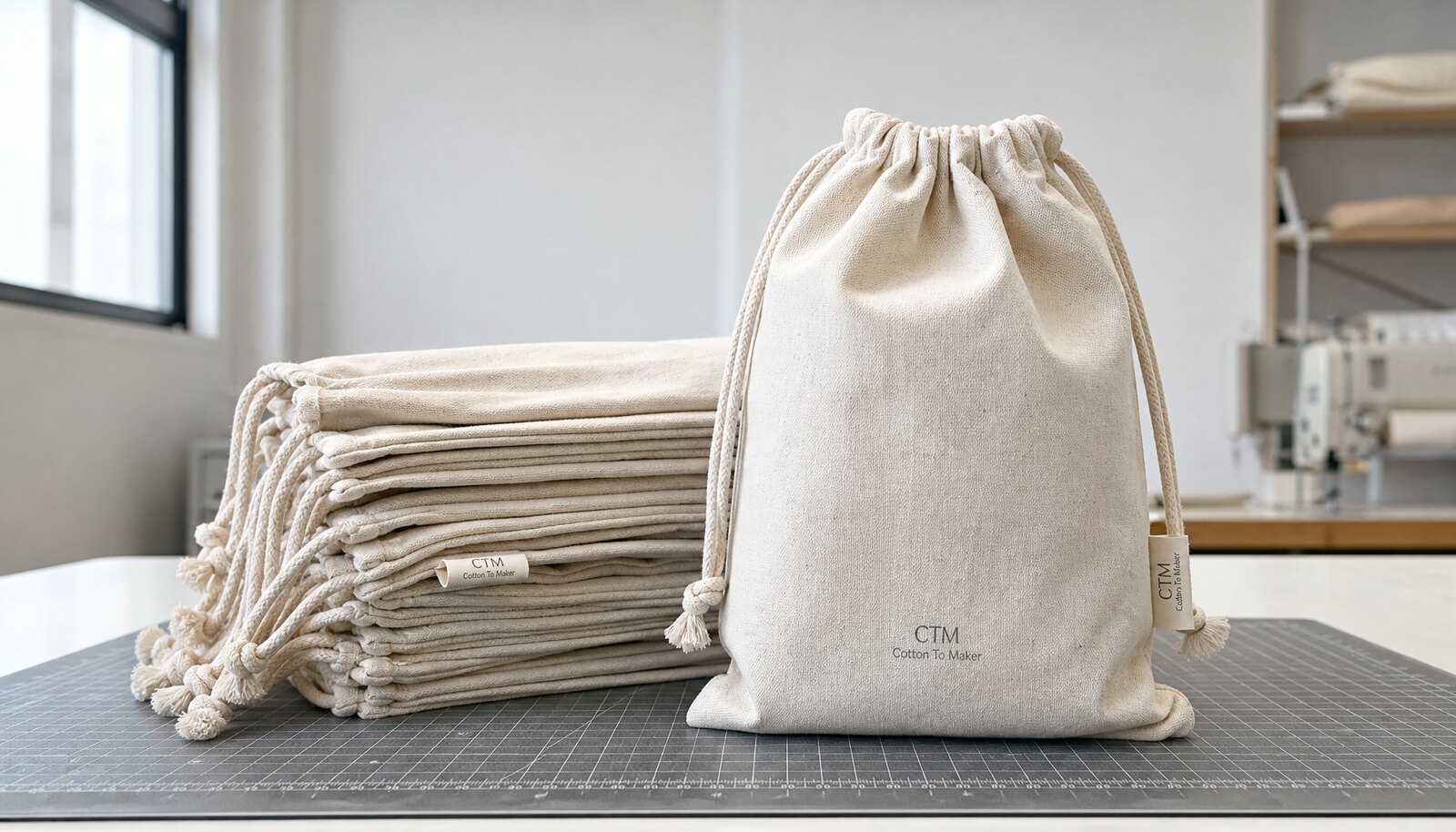
Why pouch lead time gets underestimated
A cotton drawstring pouch looks simple. That is exactly why lead time gets underestimated. In production, it is still a cut-and-sew item. Fabric has to be sourced or reserved, panels have to be cut, logos have to be printed or labels prepared, sewing has to be scheduled, threads trimmed, pieces inspected, cartons packed, and shipment documents prepared. None of these steps is unusually complex on its own. The delay usually comes from small decisions that are left open too long.
The biggest planning mistake is mixing up factory production lead time with usable in-hand lead time. A factory may quote production from sample approval. Your team may be thinking about the date pouches must arrive at a fulfillment center, conference venue, office, distributor, or kitting warehouse. Between those two dates sit sample transit, buyer review, final inspection, export packing, freight pickup, customs clearance, domestic delivery, and receiving appointments.
Corporate gifting makes the schedule less flexible. A conference date, employee onboarding drop, product launch, or year-end gift program rarely moves because pouch artwork was approved late. If the logo file is not final, screens cannot be made. If fabric shade is still under discussion, cutting should pause. If carton labels or barcode data are missing, finished goods can sit while the delivery window gets tighter.
A stronger RFQ separates the timeline into stages and lists the assumptions behind the date. Is the quote based on stock natural cotton, a standard pouch size, one-color screen print, standard cotton cord, bulk packing, and one destination? Or does it include custom dyeing, woven labels, individual polybags, multiple logo versions, and split shipments? Once those assumptions are visible, procurement can decide which choices are worth the time they consume.
- Treat the pouch as a cut-and-sew production item, not just a promotional accessory.
- Plan from the required in-hand or warehouse-receipt date, not the supplier's estimated sewing completion date.
- Ask suppliers to separate sample lead time, material lead time, bulk production time, inspection time, packing time, and freight time.
- Expect lead time risk to rise with custom dyeing, multiple logo versions, retail-style packing, barcode work, or split destinations.
Start with a reverse timeline
The practical method for a cotton drawstring pouches lead time planning guide for corporate gifting is simple: work backward. Start with the date goods must be physically available for kitting, event setup, warehouse receipt, or distribution release. Then subtract receiving time, domestic transit, customs clearance if importing, international freight, inspection, export packing, bulk sewing, printing, cutting, material preparation, sample approval, and artwork review.
This changes the conversation with suppliers. Instead of asking, 'Can you make this in four weeks?' ask, 'What is the latest date we can approve the golden sample and still have inspected, packed goods ready for pickup before our receiving window?' That question forces the critical path into the open. It also helps internal stakeholders see why a late brand decision can put delivery at risk.
Ownership matters just as much as the calendar. Marketing may own artwork, logo color, and placement. Procurement owns quotation comparison, PO release, payment terms, and supplier follow-up. The warehouse or kitting partner owns carton labels, barcode format, bundle quantity, and receiving appointments. Finance may control deposit timing. If any owner goes quiet, production can stall even when the factory has capacity.
Build the timeline with latest-safe dates, not only preferred dates. Set clear deadlines for artwork approval, physical sample approval, purchase order release, packing confirmation, inspection booking, freight booking, and warehouse receiving. If the order lands near peak gifting season, a public holiday period, or a factory shutdown, add buffer. A good timeline is not complicated. It just shows which decisions cannot slip.
- Work backward from warehouse receipt, kitting start, event date, or distribution release.
- Assign one owner each for artwork, purchase order release, packing data, freight, and receiving.
- Use latest-safe approval dates so stakeholders know where delay becomes real risk.
- Keep a fallback spec ready, such as natural cotton, one-color print, no custom trim, and bulk packing.
Specifications that change the schedule
Fast, reliable quoting depends on a complete specification. At minimum, the supplier needs finished size, fabric GSM, fabric color, construction, cord type, logo method, logo placement, order quantity, SKU split, and packing method. If those fields are missing, the supplier will fill the gaps with assumptions. Those assumptions may make the first quote look smooth, then create re-quoting, sampling delays, or quality disputes later.
Fabric weight is one of the first decisions to lock. For many corporate gifting pouches, 120-150 GSM cotton is a practical planning range. Around 120 GSM can work for light giveaways, sample bags, and budget-sensitive programs. Around 130-150 GSM usually gives better opacity and hand feel for welcome kits, cosmetics, stationery, tech accessories, or higher-value gift packaging. Heavier fabric may be useful for more robust reusable packaging, but it can increase material cost, sewing time, carton weight, and freight cost.
Size should be quoted as finished flat dimensions after sewing and pressing, not as approximate cut-panel dimensions. A pouch described as 10 x 12 inches does not provide 10 x 12 inches of usable internal space. Seam allowance and the drawstring channel reduce capacity. If the pouch must hold a notebook, bottle, apparel item, rigid box, cosmetic set, or bundle, send the actual product dimensions and ask for the minimum usable opening and internal height.
Construction choices also affect the schedule. A self-fabric channel with cotton drawcord is familiar and efficient for most pouch factories. Dyed-to-match cords, metal aglets, woven side labels, sewn patches, gussets, double drawcords, lining, reinforced bottom seams, or wash finishes can all be valid choices. They just need to be included in the original RFQ, before pricing and sample approval.
- Give finished width and height, measured flat after sewing and pressing.
- Use 120-150 GSM as a practical starting range, then adjust for product weight, opacity, and hand feel.
- Confirm whether the drawstring channel is included in total height and how much usable internal space remains.
- Avoid adding trims, gussets, labels, or custom cords after sampling unless the schedule has room.
Write tolerances before you need them
Cotton pouches are sewn products, so some variation is normal. The problem is not variation itself. The problem is discovering during inspection that the buyer and supplier had different ideas about acceptable variation. A 6 mm logo shift, a warmer fabric lot, or a 10 mm size difference can become a serious issue if the tolerance was never written down.
Finished-size tolerance should reflect pouch size and product fit. Many buyers use a tighter tolerance for small pouches and a wider one for larger pouches, such as +/-5 mm for small accessory pouches and +/-10 mm for larger gift pouches. Those numbers still need to be tested against the product. A pouch may meet a general size tolerance and still fail if the opening is too narrow for a rigid gift box.
Logo placement needs reference points. State the logo size and distance from the finished top edge, centerline, side seam, and drawstring channel. For many corporate gift pouches, a placement tolerance of +/-3 mm to +/-5 mm is practical. A small logo, tight brand lockup, or side label may need closer control. A large decorative print may allow slightly more movement without looking wrong.
Material tolerances should be equally clear. Agree the GSM range, shade standard, cord length tolerance, and visible-defect standard. Natural cotton may include seed flecks and small slubs, which can be part of the intended look. Dyed fabric should be checked against an approved lab dip or sample. Cord length matters more than buyers sometimes expect; uneven drawcords make a pouch look careless even when the sewing is technically sound.
- Write tolerances into the PO, spec sheet, or approved sample record.
- Use separate controls for finished size, logo placement, GSM, cord length, and shade.
- Measure pouches flat after sewing and pressing, using the same method at factory and inspection.
- Define cosmetic variation, functional rejects, and brand rejects before bulk production starts.
Choose the logo method with production in mind
Logo application is often the point where a simple pouch order becomes a schedule problem. Screen printing is usually efficient for one- or two-color corporate logos with clean shapes and solid areas. It works well on flat cotton panels and can be cost-effective at volume. It still needs artwork preparation, screen setup, strike-off or sample approval, drying or curing time, and placement control.
Screen print has limits. Fine type can fill in. Thin strokes can break. Two-color registration needs a realistic tolerance. Before approving artwork, ask the supplier for minimum line thickness, minimum text height, safe distance from seams, and safe distance from the drawstring channel. If the mark includes small legal copy or a detailed sponsor lockup, increasing the print size or changing the method may be the cleaner answer.
Heat transfer or digital transfer can be useful for gradients, many colors, complex artwork, or smaller runs where screen setup is not ideal. The tradeoff is surface feel and edge appearance. Transfers may sit differently on cotton than ink does. Inspect sample pieces for adhesion, lifting, cracking, visible film edges, and whether the finish suits the gift presentation.
Woven labels, side labels, and sewn patches follow a different timing path. They require label artwork, label production, delivery to the sewing line, and placement control during assembly. A side label can look subtle and premium, but the insertion point and tolerance need to be specified. For any branding route, provide vector artwork where possible, a color target, print or label size, placement coordinates, and a golden sample approval record.
- Use screen print for simple solid-color logos and repeat programs where consistency matters.
- Use transfer methods when artwork complexity justifies the change in hand feel.
- Use labels for subtle branding, but include label production and sewing placement in the schedule.
- Replace vague instructions such as 'center logo' with measurements from finished edges and centerline.
Compare MOQ and quotes on the same basis
MOQ is not only a supplier preference. It reflects setup time, material purchasing, cutting efficiency, print setup, sewing line planning, and packing complexity. A stock natural cotton pouch in a common size usually supports a lower MOQ than a custom dyed pouch with matching cord, woven label, several logo versions, and individual packaging.
Procurement should compare quotes line by line. One supplier may include screen charges, a sample fee, and bulk packing in the unit price. Another may show a lower unit price, then add screen setup, artwork adjustment, label production, barcode stickers, polybags, carton relabeling, rush handling, inland transport, or sample freight. The better quote is the one that is clear enough to evaluate, not always the one with the lowest first unit price.
MOQ also needs to be checked by SKU. A 10,000-piece program split across five pouch sizes, four logo versions, and several destinations may behave like many smaller production runs. Each version may need separate cutting, printing, counting, packing, carton marking, and inspection. Ask whether the MOQ applies per total order, per size, per fabric color, per print design, per cord color, per packing format, or per destination.
Price breaks should be weighed against the delivery date. A larger order can lower unit cost, but it can also add sewing days, carton volume, inspection time, and freight complexity. For event-driven corporate gifting, a lower unit price is not a win if the change pushes the order into air freight, missed receiving windows, or warehouse rework.
- Ask suppliers to quote the same size, GSM, construction, print method, packing method, and Incoterms.
- Separate unit price from setup, screen, sample, label, packing, inspection, inland, and rush charges.
- Confirm MOQ by total order and by SKU split.
- Compare landed cost and schedule risk, not only ex-factory unit price.
Use sampling to remove guesswork
Sampling is where a pouch order either gains control or loses a week. A digital mockup is useful for early layout discussion, but it cannot confirm GSM, shade, hand feel, finished dimensions, print opacity, seam quality, cord function, or actual product fit. For a new supplier, new artwork, new size, or brand-sensitive gift, a physical pre-production sample is the safer approval point.
A good sample review is hands-on and specific. Measure the finished pouch width and height with the pouch laid flat. Put the intended product inside and check the opening, usable internal height, and how the pouch closes around the contents. Compare the fabric feel and opacity against the requested GSM. Look closely at print coverage, sharpness, color, size, and placement. Pull the cords with moderate hand force to confirm the channel stitching holds and the knots do not slip into the channel.
Approval notes should answer practical questions. If the logo is 4 mm off center, is it acceptable? If natural cotton is slightly warmer than a previous lot, can the program accept it? If the cord diameter is different from the request but the function is good, is that a permitted substitution or a rejection? These decisions are much easier before bulk cutting than after finished goods are packed.
The golden sample represents the approved bulk standard. Ideally, the supplier keeps one and the buyer keeps one. If physical retention is not practical, keep clear photos of the front, back, inside seam, channel, cord end, logo close-up, measurement method, and packing. Bulk production should begin only when the pouch sample and packing instructions are aligned.
- Review size, product fit, GSM, shade, print, stitching, cord function, and packing during sample approval.
- Record allowed tolerances for size, logo placement, color, cord length, and material variation.
- Keep a golden sample or detailed photo record for factory, buyer, and inspection reference.
- Avoid approving bulk from artwork alone unless it is a proven repeat order with no spec changes.
Ask for the production path, not just a date
A strong RFQ asks the supplier to map the order from artwork review to shipment release. The useful stages are artwork review, sample making, sample transit, buyer approval, fabric reservation, cutting, printing or label preparation, sewing, trimming, internal QC, bulk packing, third-party inspection if used, export packing, and dispatch. Once those stages are visible, procurement can see where the schedule has room and where it does not.
Material readiness is often the hidden critical path. If the factory already has the exact cotton fabric, cord, and carton materials, production can move quickly after approval. If fabric must be dyed, washed, finished, or purchased from a mill, the calendar expands. The same is true for custom cords, woven labels, insert cards, barcode stickers, retail packaging, and special carton labels.
Clarify the printing sequence. Some factories print on cut panels before sewing, which can help with flatness and placement control but requires careful panel handling. Others print on finished pouches, which may be efficient for simple designs but can restrict print area near seams and channels. Buyers do not need to dictate the process, but they should understand how it affects safe print area, tolerance, and timing.
Inspection and packing belong inside the lead time, not after it. If a third-party inspection is required, the agency usually needs goods sufficiently completed and packed for sampling. If inspection finds defects, sorting, rework, replacement, or carton correction takes time. A realistic shipment-ready date includes internal QC, final packing, carton labeling, document preparation, and pickup availability.
- Request a staged schedule from artwork review through shipment release.
- Ask which materials are in stock and which require purchase, dyeing, label production, or custom packing procurement.
- Clarify whether printing happens before or after sewing and how that affects placement tolerance.
- Reserve time for inspection booking, corrective action, carton labeling, export documents, and freight pickup.
Plan packing around warehouse reality
Cotton drawstring pouches are lightweight, but packing choices can still change lead time, freight cost, and receiving accuracy. Bulk packing is usually the fastest option when pouches will be inserted into gift kits at a warehouse. Even then, buyers should define inner bundle quantity, master carton quantity, SKU separation, carton marks, and whether mixed cartons are allowed.
Individual polybags, barcode labels, tissue wrap, insert cards, suffocation warnings, retail stickers, or gift-set insertion create a different workload. These details may be necessary for e-commerce, store distribution, or highly controlled presentation. They also require material procurement, hand application, extra inspection points, and more carton space. If added late, they can delay goods that are already sewn and otherwise ready.
Warehouse teams usually prefer clean SKU separation. Mixed cartons may save some space at the factory, but they can slow receiving and create count disputes. A useful carton label includes purchase order number, item description, SKU, pouch size, color, logo version, quantity per carton, carton number, gross weight, net weight, and destination when relevant. If pouches ship directly to a kit assembler, use the assembler's receiving format.
Freight planning depends on carton data. Procurement and logistics teams need estimated carton dimensions, gross weight, net weight, total carton count, and packing density to compare courier, air, ocean, truck, or consolidated freight. A move from bulk packing to individual polybags can increase volume. A move from 120 GSM to 150 GSM can increase gross weight. These changes can affect landed cost and delivery timing even when the pouch unit price barely changes.
- Use bulk packing for warehouse kitting unless individual handling or retail presentation is required.
- Separate cartons by SKU, size, color, logo version, and destination when accuracy matters.
- Request carton dimensions, gross weight, net weight, quantity per carton, carton marks, and total carton count before shipment.
- Treat barcodes, insert cards, tissue, polybags, pallets, and labels as production requirements.
Build QC around brand and delivery risk
A clear QC plan protects both presentation and schedule. The point is not to over-engineer a simple pouch. The point is to define the measurable standards that matter for corporate gifting: material consistency, finished size, logo appearance, closure function, cleanliness, and packing accuracy. Without those standards, a supplier may consider goods acceptable while the buyer sees inconsistent sizing, weak stitching, off-center logos, or mixed cartons.
Start with material checks. Confirm GSM, color, hand feel, and visible defects before cutting when possible. Natural cotton may include seed flecks, small slubs, or minor shade variation, so the buyer should decide what level fits the intended brand presentation. Bleached white fabric should be checked for yellowing or lot mismatch. Dyed fabric should be compared against the approved lab dip or sample under consistent lighting.
Construction checks should focus on finished size, seam security, channel stitching, cord length, and closure function. Measure the pouch flat after sewing and pressing. Inspect side seams and bottom corners for skipped stitches, seam openings, loose threads, puckering, needle damage, and uneven trimming. Open and close sampled pouches to confirm the cords move smoothly and knots or ends do not pull through.
Branding checks should follow the approved artwork and golden sample. For screen print, inspect size, placement, color, opacity, pinholes, ink spread, smudges, and curing. For transfer, check edge marks, lifting, cracking, and adhesion. For labels, check straightness, placement, fraying, and stitch security. Packing QC should verify quantity per carton, carton marks, SKU separation, and total carton count. A well-made pouch can still create business problems if cartons are mislabeled.
- Define measurable tolerances for finished size, logo placement, GSM, fabric shade, cord length, and carton quantity.
- Inspect material, construction, branding, and packing rather than only final appearance.
- Use the golden sample as the reference for fabric, cord, print, stitching, and packing approval.
- Leave time after inspection for sorting, rework, replacement, or carton correction.
Specification comparison for buyers
| Spec decision | Recommended option | When it fits | Buyer risk to check |
|---|---|---|---|
| Fabric weight | 120-150 GSM cotton for most corporate gifting; 130-150 GSM when opacity and hand feel matter; agree a GSM tolerance such as +/-5% or another written range | Welcome kits, event giveaways, merchandise inserts, cosmetics, stationery, light apparel accessories, branded sample kits | Underweight fabric can look thin or reveal contents; overweight fabric can raise unit cost, sewing time, carton weight, and freight cost |
| Fabric color | Natural cotton or bleached white for fastest routing; custom dyed fabric only when brand color control is worth added approval and material time | Standard corporate gifting, employee onboarding kits, conference packs, retail sample packaging | Natural cotton varies by lot; bleached white can yellow if poorly stored; custom dyed cotton needs lab dip or shade approval and a written tolerance |
| Print method | 1-2 color screen print for simple logos; heat transfer or digital transfer for gradients or small color runs; woven label when a subtle sewn brand mark is required | Event logos, sponsor marks, employee gift branding, product launch kits, repeat merchandise programs | Fine text may fill in with screen print; transfers can change hand feel; labels add lead time, sewing operations, and placement tolerance risk |
| Logo placement | Specify print size and coordinates from finished top edge, side seam, and centerline; keep artwork away from channel, seams, and bottom fold | Programs where brand consistency matters across hundreds or thousands of pieces | A vague 'center front' instruction can cause off-center logos, seam interference, or brand-team rejection after bulk production |
| Closure style | Self-fabric channel with cotton cord; define cord diameter, color, draw direction, knot style, and cord length tolerance | Most B2B gifting, reusable merchandise packaging, welcome kits, sample sets | Weak channel stitching, uneven cord length, rough cut ends, or knots that pull into the channel can create functional failures |
| Bag size | Quote by finished flat dimensions after sewing and pressing; use common sizes when product fit allows, such as 6 x 8 in, 8 x 10 in, 10 x 12 in, or 12 x 16 in | Cosmetics, jewelry, notebooks, bottles, apparel inserts, tech accessories, multi-item gift bundles | Oversizing wastes fabric and carton volume; undersizing causes poor fit, repacking, product abrasion, or opening stress |
| MOQ route | Use stock fabric, standard size, one print color, and bulk packing for lower MOQ; expect higher MOQ for dyed fabric, custom cord, multiple logos, labels, or retail packing | Pilot gifts, uncertain demand, event orders, multi-region programs | Low MOQ quotes may hide setup fees, mixed lots, limited QC attention, or longer per-unit handling time |
| Sampling path | Artwork proof, pre-production sample, written golden sample approval, then bulk cutting; keep an approved sample or photo record for inspection | New supplier, new size, new artwork, brand-sensitive print placement, first order in a recurring program | Skipping physical approval can leave GSM, shade, fit, cord length, logo scale, and packing assumptions unresolved |
| Packing method | Bulk pack by SKU for warehouse kitting; individual polybag, barcode, insert card, tissue, or retail labeling only when required | Fulfillment centers, employee welcome boxes, conference kits, channel distribution | Special packing adds material procurement, manual labor, inspection points, carton volume, and receiving requirements |
Buyer checklist before sampling
- Define the pouch by finished flat dimensions after sewing and pressing. State width x height, acceptable size tolerance, whether the channel is included in height, and the minimum usable opening if the product fit is tight.
- Lock the cotton fabric specification before pricing: GSM target, allowed GSM range, weave or hand-feel expectation, natural/bleached/dyed color, pre-shrink or wash requirement if any, and shade approval standard.
- Specify the branding method before requesting firm pricing: screen print, heat transfer, digital transfer, woven label, sewn patch, or no branding. Include artwork file type, print size, print area, color target, and placement tolerance.
- Set practical tolerances in writing, such as finished size +/-5 mm for small pouches or +/-10 mm for larger pouches, logo placement +/-3-5 mm, and cord length tolerance appropriate to the bag size.
- State drawcord details: cotton or polyester cord, approximate diameter in millimeters, color, single-draw or double-draw closure, knot style, cord end finish, and whether metal or plastic aglets are prohibited.
- Confirm construction requirements: self-fabric channel width, seam type, stitch density target if required, reinforced stress points, bottom corner finishing, label insertion point, and loose thread trimming standard.
- Decide packing before sampling: bulk pack, bundle quantity, size-separated cartons, individual polybag, barcode sticker, suffocation warning, tissue wrap, insert card, gift-set insertion, palletization, or master-carton labeling.
- Build the timeline backward from the required in-hand date. Include artwork approval, sample making, sample transit, buyer review, material reservation, bulk production, inspection, export packing, freight, customs, domestic delivery, and warehouse receiving.
- Request a staged quote with unit price, setup charges, screen or tooling charges, sample charges, label charges, packing charges, estimated carton data, Incoterms, payment terms, production lead time, and shipment-ready date.
- Define QC checkpoints before production: fabric GSM check, shade review, finished-size measurement, print alignment tolerance, cord pull check, seam inspection, visual defect classification, carton count verification, and AQL or sampling plan.
Factory quote questions to send
- What exact cotton fabric are you quoting: GSM, weave, finish, color, stock status, and whether it is greige, natural, bleached, dyed, washed, or pre-shrunk?
- What finished pouch size is included in the quote, how is it measured, and what tolerance do you apply after sewing and pressing?
- Is the quoted MOQ per total order, per pouch size, per fabric color, per print design, per cord color, or per shipment destination? What changes if we split SKUs?
- Please separate unit price, screen/tooling charges, sample charges, artwork adjustment charges, label charges, packing charges, inland charges, and rush fees so quotes can be compared line by line.
- Which logo method are you assuming, and what are the print size limits, minimum line thickness, registration tolerance, recommended safe distance from seams, and drying or curing time?
- Can you provide a stage-by-stage schedule for artwork review, sample production, sample transit, buyer approval, fabric reservation, cutting, printing, sewing, final QC, packing, inspection, and dispatch?
- What parts of the schedule extend if artwork is approved late, PMS color changes, quantity increases, packing changes, or the order is split across several logo versions?
- Will you print before sewing or after sewing, and how does that process affect logo placement, maximum print area, and the safe distance from the drawstring channel?
- How will pouches be packed per inner bundle and master carton? Please provide estimated carton dimensions, gross weight, net weight, carton count, and carton marking format.
- What QC checks do you perform for GSM, shade, finished size, stitch security, print position, print rub resistance, cord insertion, cord length, defects, carton quantity, and mixed-SKU risk?
Quality-control points to confirm
- Fabric GSM tolerance should be agreed before bulk production. Use a measurable range, such as target GSM +/-5% or another written tolerance accepted by both buyer and supplier, instead of approving only 'cotton fabric'.
- Fabric shade should be checked against the approved sample, lab dip, or color standard under consistent lighting. Natural cotton may show seed flecks and lot variation; dyed cotton needs a written shade tolerance.
- Finished size should be measured flat after sewing and pressing. Measurements should include width, total height, channel width, opening width, and usable internal height where product fit is critical.
- Seam stitching should be even, secure, and free of skipped stitches, seam openings, puckering beyond the approved sample, loose threads, and needle damage. Inspect side seams, bottom corners, channel ends, and label insertion points.
- Cord function should be tested by opening and closing sampled pouches. Cord length should be consistent, knots should hold, cord ends should be clean, and knots or aglets should not pull into the channel during normal handling.
- Print registration, placement, and color should be checked against the approved artwork and golden sample. Define acceptable drift from centerline, top edge, and side seam before production starts.
- Print quality should be inspected for pinholes, ink spread, cracking, poor opacity, transfer edge marks, lifting, smudges, contamination, and inconsistent curing. For branded gifts, include a light dry rub check on sampled pieces.
- Visual defects should include stains, oil marks, excessive slubs, holes, fabric runs, shade panels mixed in one carton, packing dust, poor trimming, and visible creases that do not recover after normal handling.
- Carton packing should match the approved packing list. Verify SKU separation, bundle quantity, units per carton, carton marks, barcode labels if used, gross weight, net weight, total carton count, and destination labeling.
- Random carton inspection should include visual review, finished-size measurement, logo placement check, cord function check, count verification, and review of carton labels against the purchase order.