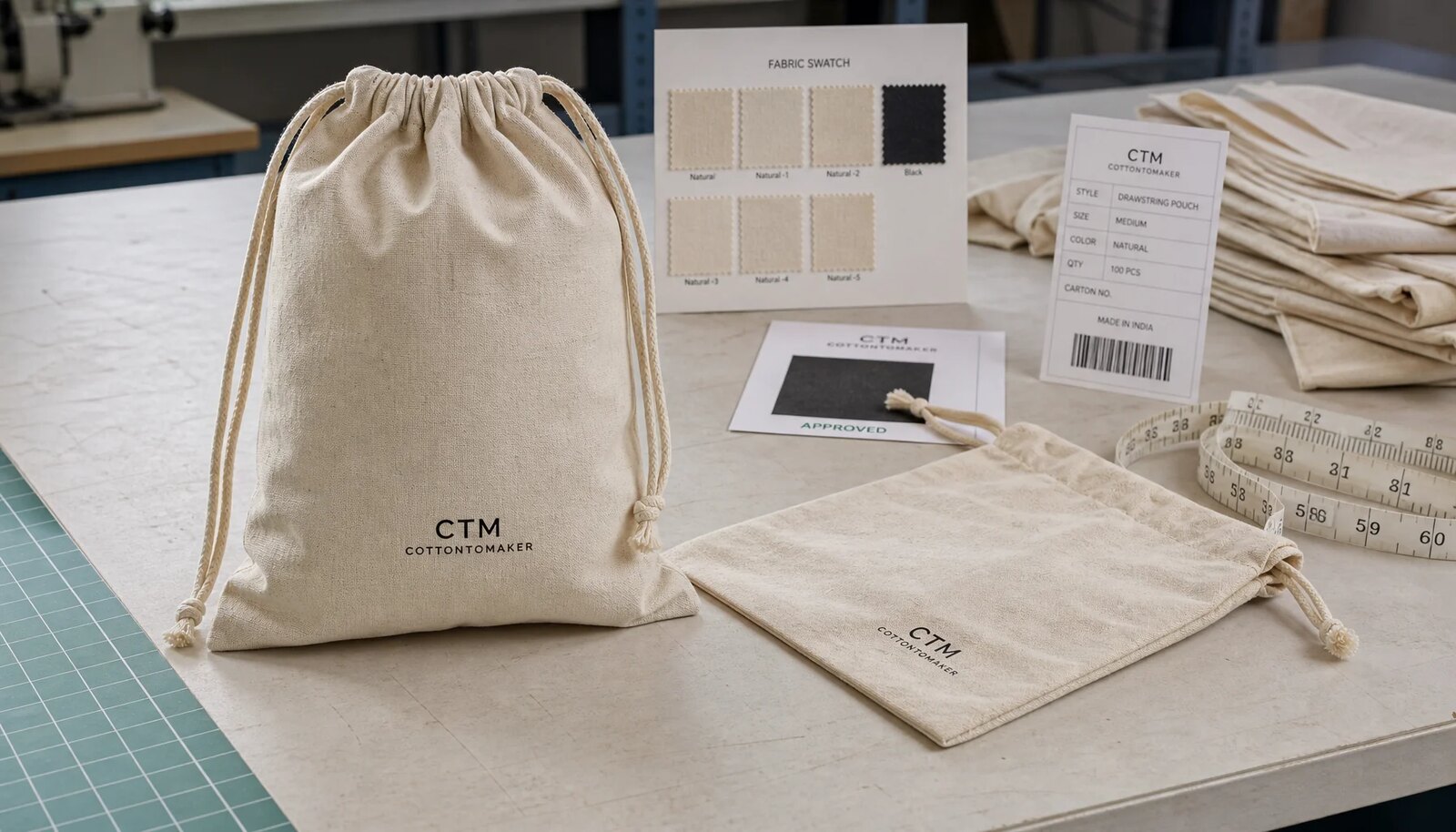
Start the clock at the real production start
The biggest lead time mistake with cotton drawstring pouches is simple: the buyer counts from the first quote, while the factory counts from final approval. A supplier cannot safely cut fabric, print logos, or book a sewing line from a rough size, a low-resolution logo, or a verbal plan. For procurement purposes, the production clock starts only when the final pre-production sample, final vector artwork, material specification, variant quantities, packing instructions, payment trigger, and written authorization are all complete.
For a simple custom pouch program, a realistic ex-factory production window is often about 25-40 days after final approval. That assumes available natural cotton, a standard flat construction, standard cord, one-color screen print, and flat bulk packing. Add dyed fabric, several logo versions, woven labels, hangtags, barcodes, individual polybags, property-level carton marks, or split-destination packing, and the plan should move closer to 35-55 days. Revisions can push it further.
Do not confuse production lead time with door-to-door delivery. A hotel retail launch also needs sample courier time, internal brand approval, inspection booking, export handling, international freight, customs clearance, inland trucking, warehouse receiving, and distribution to each property. For a resort opening, holiday gift shop launch, spa menu refresh, wedding season, or conference program, build the calendar with buffers instead of hope.
- Production start condition: final sample approval, approved artwork, confirmed quantities, complete packing instructions, and deposit or agreed payment trigger.
- Fastest route: natural 5-6 oz cotton, standard flat pouch, cotton cord, one-color screen print, no custom label, and flat bulk packing by SKU.
- Moderate route: several artwork versions, two-color print, inner packs by 50 or 100 pieces, and carton labels by hotel property or distributor SKU.
- Slower route: dyed cotton, lab dip approval, embroidery or heat transfer, woven labels, hangtags, barcodes, individual polybags, and split-destination packing.
- Planning rule: do not promise an in-store date until sample approval, production lead time, inspection date, freight mode, and receiving buffer are all visible.
Match GSM to the way the pouch will sell
A pouch placed in a guest room does not carry the same expectations as a pouch sold in a boutique gift shop with a candle, skincare set, or spa item inside. Hotel teams often describe the need as one packaging item, but fabric weight should be chosen by use: product weight, shelf presentation, handling frequency, reuse expectation, print opacity, and target landed cost.
As a working range, 3-4 oz cotton suits light dust bags, simple amenity covers, jewelry cards, and low-load packaging where compact packing matters more than body. For most hotel retail programs, 5-6 oz cotton, approximately 170-200 GSM, is the safer middle. It gives better shelf presence and print coverage while still folding flat and keeping freight volume under control. Heavy 8-10 oz canvas can raise perceived value for reusable packaging, but it also adds unit cost, carton CBM, sewing bulk, and drawstring stiffness, especially on smaller pouches.
Natural unbleached cotton remains popular for resort, spa, wellness, and eco-positioned retail. It looks relaxed and material-forward. It also varies. Seed flecks, slubs, yarn irregularities, and off-white shade differences are normal unless a cleaner fabric is specified and priced. If the pouch will sit under boutique lighting or carry a precise luxury logo, define how much natural character is acceptable near the print area before sampling.
- 3-4 oz cotton: light dust bags, amenity covers, jewelry cards, and small non-heavy inserts with low structure requirements.
- 5-6 oz cotton: hotel gift shop pouches, spa retail kits, toiletries, stationery, small candles, minibar bundles, and most balanced cost-to-presentation uses.
- 8-10 oz canvas: premium reusable packaging, heavier contents, travel accessory kits, and programs where the pouch itself is part of the retail value.
- Natural cotton: usually faster and simpler, but flecks, slubs, shade variation, and possible shrinkage should be approved.
- Bleached or dyed cotton: cleaner or brand-specific appearance, but requires lab dip or shade approval and realistic color tolerance.
- Procurement check: request actual GSM tolerance, not only nominal ounce weight, because fabric lots can vary.
Size the pouch around the product, not the chart
Pouch sizing should begin with the product being packed. A finished pouch may technically fit the item and still fail in daily operations if staff have to force the product through the opening, straighten the corners, and fight the drawstring closed. The drawstring tunnel also uses height, so the usable internal height is less than the finished flat height shown on a spec sheet.
For RFQs, state finished width x height in centimeters or inches and ask whether tolerance is measured after sewing and normal finishing. Send the real contents: rigid retail cartons, glass bottles, pump caps, candle lids, inserts, soap stacks, or grouped products. Include weight. Then define the desired fit: tight, standard, or loose. Tight can look neat but slows kitting and stresses seams. Loose is faster and more forgiving, but it may look oversized on shelf.
Construction matters too. A flat pouch is usually the fastest and most economical because cutting, sewing, and packing are straightforward. A boxed-bottom pouch can stand better and improve display, but it needs clearer technical drawings, extra sewing operations, and stricter dimensional checks. Very small pouches need extra attention because seam allowance, tunnel height, cord diameter, and logo area all compete for the same limited space.
- Ask the supplier to confirm finished size after sewing, not fabric cut size before sewing.
- Confirm usable internal height below the drawstring tunnel when the product must close fully inside the pouch.
- Allow insertion clearance for kitting speed, not just enough space for the product to be forced inside.
- Keep artwork away from side seams, bottom folds, and drawstring tunnels; agree a safe margin before sampling.
- Use one shared pouch size across several SKUs where possible to improve cutting efficiency and reduce MOQ pressure.
- Request a product-fit sample for rigid boxes, glass bottles, candles, multiple-item sets, or any product with sharp corners.
Choose the print method by risk, not habit
Screen printing is usually the most practical choice for cotton drawstring pouches in hotel retail. It works well for solid logos, property names, spa marks, resort graphics, and short retail messages. One-color printing on natural cotton is the cleanest route. Two or three colors can work, but every added color brings setup, registration, drying, and inspection risk.
Heat transfer has a different role. It can reproduce gradients, small multicolor graphics, and artwork that does not separate cleanly into screen colors. The tradeoff is handfeel and edge behavior. On textured cotton, the exact fabric should be tested for adhesion, cracking, edge lift, and plastic feel. Embroidery can look premium on heavier pouches, but it is slower and can pucker light cotton when backing, stitch density, or logo size is not controlled.
Most print problems are predictable. Fine reverse text fills in. Thin lines break. Solid areas show pinholes. Natural cotton makes colors look duller than coated paper. Placement can shift when operators load soft pouches by hand onto the print table. Reduce the risk by sending vector artwork, approving a strike-off on the actual fabric, defining print placement from fixed edges, and agreeing tolerances before bulk work begins.
- Use screen print for solid logos, simple line artwork, property names, short slogans, and repeat replenishment programs.
- Use heat transfer only after checking adhesion, edge finish, handfeel, cracking risk, and color on the exact cotton fabric.
- Use embroidery for premium reusable pouches or small marks on heavier fabric, not for very light cotton or dense large logos.
- Avoid fine reverse text, very small serif fonts, and delicate lines on heavy slub fabric because ink spread can close gaps.
- Define print size, print position, number of colors, Pantone references, number of sides, and safe distance from seams.
- Keep a signed printed sample so bulk inspection can compare opacity, registration, color, placement, and handfeel against a physical standard.
Control MOQ before variants multiply
Hotel retail programs often look simple at the total order level. Ten thousand pouches may sound efficient. The factory may see something else: separate lots for different properties, scents, spa ranges, welcome packages, room categories, or seasonal campaigns. MOQ is affected by fabric purchasing, cutting efficiency, print setup, sewing changeover, carton sorting, and warehouse handling.
The strongest procurement move is to standardize the base pouch. Keep one size, one fabric weight, one fabric color, and one cord color across as many SKUs as possible. Then vary only the printed artwork, hangtag, paper band, or insert. If several hotel properties need their own logos, the supplier may be able to cut and sew one base production lot, then separate versions at printing and packing. That keeps construction consistent and makes inspection easier.
Ask for variant-level pricing instead of one blended number. A low-volume artwork version can carry a higher effective cost because setup and packing control still exist. Separate unit price, sample fees, screen charges, setup charges, label costs, special packing charges, and sorting charges. For repeat programs, ask for first-order and repeat-order pricing so procurement can see which charges are one-time and which continue.
- Quote each variant separately by finished size, fabric weight, fabric color, cord color, artwork, print colors, label, packing method, and destination.
- Expect setup charges for different artwork, print colors, print positions, or labels, even when pouch size is unchanged.
- Ask whether small artwork versions can share the same base pouch production run and be separated only at printing or packing.
- Avoid multiplying SKUs unnecessarily; one stable pouch platform with artwork versioning is often more efficient than many custom sizes.
- Provide a property-by-property quantity matrix for hotel groups so the supplier can plan carton labels and avoid mixed shipments.
- For repeat programs, keep the base pouch stable and update only campaign print, hangtag, or retail insert where possible.
Use sampling to remove guesswork
A photo sample is not enough for hotel retail packaging. The approval path should prove how the fabric feels, how the drawstring closes, how the logo prints on real cotton, whether the product fits, and whether the packing method protects the goods. A practical sequence is fabric swatch approval, print strike-off, product-fit sample, and final pre-production sample made with approved materials and construction.
The print strike-off deserves special attention. Natural cotton has yarn texture, seed flecks, and absorbency, all of which change ink appearance. A Pantone reference on coated paper will not look identical on cotton. If brand color matters, approve a physical printed standard or define a realistic tolerance method. Some variation in natural fabric shade and ink absorption should be expected unless a more controlled fabric and print process is specified and paid for.
Sampling should also answer operational questions. Can staff insert the product quickly? Does the drawstring close without forcing? Does the logo remain visible after the pouch is filled? Does the pouch stand, slump, or wrinkle on the display fixture? Does the fabric become transparent under retail lighting? These are not small details. They affect labor cost, retail presentation, and guest perception.
- Fabric swatch approval: GSM, color, handfeel, transparency, fleck level, shrinkage expectation, and natural-imperfection tolerance.
- Print strike-off approval: logo size, ink color, edge sharpness, opacity, registration, print feel, and rub or adhesion performance if needed.
- Product-fit approval: actual item inserted, closure tested, seams checked under load, logo visibility reviewed, and packing speed considered.
- Pre-production sample approval: finished size, construction, seam quality, drawstring function, label placement, folding method, and presentation.
- Revised sample trigger: changes to fabric, artwork size, print method, cord, label, construction, or packing should be rechecked before bulk.
- Retention sample: factory, buyer, and inspector should keep the same approved reference for final inspection.
Write packing instructions early
Cotton drawstring pouches are often low unit value, so packing decisions can quietly change landed cost. Bulk flat packing is efficient when pouches will be used by a kitting warehouse, spa stockroom, distributor, or hotel operations team. Inner packs of 50 or 100 pieces improve counting and cleanliness. Individual polybags can help with retail-ready units, but they add labor, plastic, carton volume, and sometimes compliance review.
For hotel groups and distributors, mixed SKUs are the packing risk to watch. If one carton contains several property logos, pouch sizes, or kit versions without clear separation, receiving teams may spend hours sorting goods. Worse, the wrong pouch may be sent to a property. Packing instructions should define inner pack quantity, master carton quantity, carton label content, carton numbering, and whether goods are sorted by artwork, destination, property, kit, or distributor SKU.
Packing affects freight and appearance as well. Loose packing increases CBM and freight cost. Over-compression can wrinkle fabric, distort cords, or crush retail hangtags. Weak cartons can collapse during ocean freight or warehouse stacking. Before confirming landed cost, request pieces per carton, carton dimensions, gross weight, net weight, total carton count, and total CBM.
- Bulk flat pack: lowest cost and suitable for warehouse kitting, internal distribution, and replenishment stock.
- Inner polybag by 50 or 100 pieces: improves counting control and cleanliness with moderate added cost.
- Individual polybag: cleaner for retail-ready units but increases labor, plastic use, and carton volume.
- Hangtag, barcode, or price label: useful for gift shops, but must be quoted as a separate labeling operation.
- Destination carton labels: important for multiple hotels, concession stores, regional warehouses, or third-party kitters.
- Carton data to request: pieces per carton, carton dimensions, gross weight, net weight, carton count, and total CBM.
Build the calendar around gates and freight
A reliable hotel retail launch calendar works backward from the required in-store, in-room, or event date. Include internal artwork approval, supplier sampling, sample courier transit, sample review, bulk production, inspection, export packing, freight booking, customs clearance, local delivery, warehouse check-in, and property allocation. When one stage is compressed, the risk usually moves somewhere else.
If the pouches support a resort opening, holiday launch, wedding season, conference gift program, or spa menu refresh, protect the date with buffer. Fabric availability can change. Print queues can tighten before holidays. Ocean freight schedules can slip. Air freight can rescue some timing problems, but cotton pouches are bulky relative to unit value, so air cost can damage landed margin quickly.
After order release, ask for milestone visibility. A short weekly update can confirm fabric arrival, cutting start, print date, sewing completion, packing progress, and inspection-ready date. This is especially useful when the order includes several artwork versions or destination packing. It is much better to learn early that one property logo is delayed than to discover missing cartons at final inspection.
- Internal approval: allow 3-7 days when brand, retail, and property decision makers are aligned; longer when multiple teams comment.
- Factory sampling: often 5-10 days for simple natural cotton screen-printed pouches; longer for dyed fabric, embroidery, boxed bottoms, or revisions.
- Sample transit and review: allow 3-7 days depending on courier route and how quickly physical samples reach the approver.
- Bulk production: often 25-40 days after approval for standard custom orders; longer for complex variants, labels, and retail packing.
- Inspection and export handling: reserve several working days for inspection booking, rework if needed, carton sealing, and export documents.
- Freight and receiving: add international transit, customs clearance, local trucking, warehouse check-in, and allocation to properties.
Make RFQs easy to compare
The lowest quoted unit price is not always the lowest landed cost. A useful RFQ for cotton drawstring pouches includes material specification, finished size, print method, included print area, cord type, packing method, carton data, lead time, Incoterm, and variant-level pricing. Without carton CBM and gross weight, importers cannot compare ocean consolidation, courier, or air freight impact accurately.
Ask suppliers to quote in a structured format. Separate unit price, sample fees, screen charges, setup charges, special packing charges, labeling costs, carton sorting costs, inspection readiness date, and estimated shipping data. A bundled price may still be usable, but it gives procurement less control when quantities, artwork, or packing instructions change.
Clarify the production release conditions. Some suppliers will not start until deposit is received. Others may also require final artwork, final sample approval, carton marks, barcode files, and packing instructions. A purchase order alone may not release production if key files are missing. That distinction matters when the hotel retail team is working toward a fixed launch date.
- Essential quote line: item name, finished size, fabric type, GSM, fabric color, cord type, closure style, print method, print colors, quantity, unit price, MOQ, sample cost, and bulk lead time.
- Artwork details: print size, print position, number of sides, Pantone references, screen charges, setup charges, and limits before extra cost applies.
- Packing data: pieces per inner pack, pieces per carton, carton dimensions, gross weight, net weight, carton count, and total CBM.
- Commercial terms: Incoterm, payment terms, quote validity, sample approval process, deposit requirement, and production start condition.
- Cost change triggers: fabric dyeing, extra print colors, revised artwork, individual packing, barcode labels, carton sorting, rush production, split shipment, or smaller variant quantities.
- Landed-cost check: compare unit cost plus packing, inland handling, export charges, freight, duty, customs clearance, warehousing, and domestic distribution.
Set QC standards before cutting
Cotton drawstring pouches look simple, which is why defects are easy to underestimate. Common issues include size variation, crooked print, weak tunnel stitching, uneven cord length, stained fabric, wrong shade, and mixed artwork. Buyers should define acceptance criteria before bulk cutting and printing. The document does not need to be long, but it should tell the factory and inspector what matters for retail-facing hotel packaging.
For hotel retail, visible defects near the logo area should usually be controlled more tightly than minor natural cotton flecks away from the print. The inspection plan should include measurement checks, product-fit checks, drawstring pull function, print rub or adhesion checks where relevant, stitch security, shade comparison, packing count, and carton labeling. If the pouch will be sold with a product inside, test the actual product fit and closure on production samples, not only empty flat pouches.
Define defect severity before inspection day. Wrong logo, wrong size, open seam, broken cord, strong mildew odor, wet carton, incorrect carton label, or mixed property artwork is typically a major defect. A small natural fleck outside the logo area may be acceptable if natural cotton was approved. Agreeing this early reduces disputes and gives the inspector a practical basis for acceptance, rework, or rejection.
- Size tolerance: define flat width and height tolerance by pouch size, plus usable height below the drawstring tunnel where relevant.
- Print tolerance: define maximum position deviation and unacceptable defects such as bleeding, ghosting, smudges, pinholes, wrong color, or weak opacity.
- Stitching: no open seams, skipped stitches at stress points, seam slippage, broken thread, or loose threads visible on retail-facing areas.
- Drawstring: smooth closure, correct cord color and length, no jamming, no unintended fraying, and no cord detachment from the tunnel.
- Cleanliness: no mildew smell, oil marks, dirt stains, mixed fabric shades, heavy slubs in logo areas, water marks, or foreign fibers that affect appearance.
- Packing: correct SKU count, correct inner-pack quantity, correct carton label, and no mixed artwork unless the packing list clearly defines the mix.
- Inspection reference: use the approved pre-production sample, print strike-off, purchase order, packing instruction, and artwork file together.
Specification comparison for buyers
| Spec decision | Recommended option | When it fits | Buyer risk to check |
|---|---|---|---|
| Lead time planning basis | Start the schedule from written approval of the final pre-production sample, final vector artwork, deposit or agreed payment trigger, and complete packing instructions | Hotel gift shop launches, resort openings, spa retail replenishment, minibar bundles, welcome kits, conference gifts, and distributor programs with fixed receiving windows | Counting from inquiry or quotation date hides time lost to artwork cleanup, sample courier transit, internal sample review, deposit processing, public holidays, inspection booking, freight space, and possible rework |
| Standard production lead time | Plan about 25-40 days for simple custom production after approval; use 35-55 days when variants, labels, dyed fabric, or retail packing are added | Natural cotton, standard size, available fabric, one-color print, and flat bulk packing can stay closer to the shorter range | Lead time usually excludes international freight, customs clearance, inland delivery, warehouse receiving, and rework after inspection |
| Fabric weight for hotel retail display | Use 5 oz to 6 oz cotton, approximately 170-200 GSM, for most retail-facing pouches | Spa kits, toiletries, small candles, amenity retail sets, stationery, jewelry cards, minibar bundles, and gift-with-purchase packaging | 3-4 oz cotton may show transparency or poor shelf body; 8-10 oz canvas increases cost, carton volume, drawstring bulk, and sewing difficulty on small sizes |
| Fabric color and shrinkage control | Use natural unbleached cotton for speed; choose bleached or dyed cotton only when the retail concept needs a cleaner or brand-specific shade | Natural cotton suits resort, wellness, spa, and eco-positioned hotel retail programs with moderate shade tolerance | Dyed lots require lab dip approval and shade tolerance; untreated cotton may shrink if washed, so define whether the pouch is washable, reusable, or single-use packaging |
| Print method for logo and retail message | Use screen print for solid one to three color artwork; use heat transfer only for gradients or detailed multicolor artwork that cannot be separated cleanly | Screen print is practical for repeat hotel retail orders because setup is controlled, handfeel can stay soft, and print durability is easy to inspect | Fine reverse text can fill in on slub cotton; heat transfer may feel plastic and should be checked for adhesion, cracking, and edge lift |
| Drawstring material and closure style | Specify cotton cord for a natural feel or polyester cord for smoother sliding, bright colors, and stronger abrasion resistance | Cotton cord fits spa and wellness positioning; polyester cord fits bright seasonal colors, high handling, or faster closure performance | Cord diameter, cord length, tunnel height, and knot finish affect closure strength, carton thickness, and whether the cord cuts into the fabric tunnel |
| MOQ and variant structure | Standardize one base pouch size, fabric, and cord, then vary artwork or hangtag where possible | Hotel groups, distributors, and retail programs with several property logos, scent names, welcome-kit versions, or seasonal messages | Every size, fabric color, cord color, print color, label, barcode, and packing change can create a separate MOQ, setup charge, or sorting requirement |
| Sample approval path | Approve fabric swatch, print strike-off, product-fit sample, and pre-production sample before bulk cutting and printing | Retail-facing pouches, premium gift packaging, multi-property programs, and any pouch that holds a rigid product or branded retail set | Skipping a strike-off can hide ink absorption, weak logo contrast, registration drift, print placement error, and color tolerance problems until bulk is printed |
| Packing method | Use flat bulk packing by SKU with master carton labels; add inner packs, hangtags, barcodes, or individual polybags only when they solve a real receiving or retail need | Distributor warehouses, hotel gift shops, spa stockrooms, third-party kitters, and multi-property replenishment programs | Overpacking adds labor, plastic, CBM, and unit cost; loose mixed artwork creates receiving errors and re-sorting work |
Buyer checklist before sampling
- Define the pouch use: retail sale packaging, guest amenity pouch, spa kit, minibar bundle, welcome gift, conference gift, or gift-with-purchase. Load, cleanliness, display, and inspection standards are not the same for each use.
- Specify finished size in width x height, not fabric cut size, and state whether measurements are taken flat before or after ironing or pressing.
- Ask the supplier to confirm usable internal height below the drawstring tunnel, especially for bottles, candle cartons, soap stacks, boxed retail sets, and other rigid contents.
- Send dimensions and weight of the actual contents, including bottle caps, candle lids, rigid cartons, inserts, and product corners that may stress seams or print areas.
- Choose fabric weight by function: 3-4 oz for light dust bags, 5-6 oz for most hotel retail packaging, and 8-10 oz canvas only for premium reusable or heavier-content pouches.
- State cotton type clearly: natural, bleached, dyed, organic, recycled, conventional, pre-shrunk, or untreated. Each choice affects evidence requirements, shade approval, price, and lead time.
- Define acceptable natural cotton character, including seed flecks, slubs, shade variation, small yarn irregularities, and whether heavy flecks are allowed inside the logo area.
- Provide vector artwork, Pantone references, print size, print position, safe margin from seams and tunnel, number of print sides, and whether color must match a physical brand standard.
- Confirm drawstring type, color, diameter, approximate exposed length, tunnel height, knot or end finish, and one-side or two-side pull closure.
- Break the order by variant: each size, fabric color, cord color, artwork, print color, label, packing method, carton mark, and destination should have its own quantity.
Factory quote questions to send
- What fabric weights are available now for natural cotton drawstring pouches, and what GSM tolerance will apply to the bulk lot?
- Is the quoted size the finished flat size after sewing, and what width and height tolerance do you recommend for this pouch size?
- What is the usable internal height below the drawstring tunnel after sewing, and what tunnel height will be used?
- What seam allowance, stitch type, stitches per inch or centimeter, and reinforcement method are included at the side seams and drawstring tunnel?
- What is the MOQ per finished size, fabric color, cord color, print artwork, print color count, label version, packing method, and destination split?
- Which print method is quoted, how many colors are included, what maximum print area is included, and what screen, plate, setup, or color-change charges apply?
- Can you make a print strike-off on the exact production fabric before the pre-production sample, and how many days does it add?
- What Pantone reference or physical standard will be used for print approval, and what color variation is realistic on natural cotton?
- What is the sample lead time for fabric swatch, print strike-off, product-fit sample, pre-production sample, and revised sample if artwork or construction changes?
- What is the bulk production lead time after written approval and deposit, and does it include fabric sourcing, dyeing, cutting, printing, sewing, packing, and inspection readiness?
Quality-control points to confirm
- Finished pouch size should be measured flat at width and height against an approved tolerance, commonly plus or minus 0.5 cm for small pouches and plus or minus 1.0 cm for larger pouches unless a stricter standard is agreed.
- Usable internal height should be measured from the bottom seam to below the drawstring tunnel when the product must fit inside and close without forcing.
- Fabric GSM should be checked against the approved swatch and quoted tolerance, with shade, transparency, fleck level, handfeel, and weave character compared under consistent lighting.
- Seams should be straight and secure, with no open seams, skipped stitches, seam slippage, broken thread, excessive loose thread, needle damage, or puckering around the drawstring tunnel.
- Drawstring closure should pull smoothly from the specified side or both sides and should not jam, fray, break, detach, or cut into the tunnel under normal hand tension.
- Cord length, cord color, cord diameter, knotting, end finish, and closure direction should match the approved pre-production sample across inspected cartons.
- Print position should match the approved sample within the agreed tolerance, with clear edges, correct color, no ink bleeding, no ghosting, no smudging, no transfer marks, and no pinholes in solid areas beyond the agreed limit.
- Print rub resistance or heat-transfer adhesion should be tested when pouches will be handled repeatedly, packed against other printed surfaces, or sold as retail-facing packaging.
- Cotton pouches should be free from oil stains, mildew odor, dirt, foreign fibers, heavy slubs in logo areas, mixed shade panels, water marks, and visible contamination that affects retail appearance.
- Cartons should be labeled by purchase order, SKU, artwork, quantity, pouch size, fabric color, carton number, destination, and gross/net weight when orders are split across hotel properties or distributor warehouses.