The buying problem this checklist solves
Cotton drawstring pouches for artisan bakeries look simple, but the common failures are usually decided before the first carton is packed. A bakery buyer may approve a nice-looking sample, then receive bulk goods with thinner fabric, crooked logo placement, drawcords that jam, or mixed packing that slows distribution to stores. The purpose of this guide is to make the RFQ and inspection standard specific enough that different suppliers quote the same product and the final inspection has measurable acceptance points.
For procurement teams and importers, the biggest risk is comparing quotes that are not technically equal. One factory may quote 120 GSM natural cotton with a single-side print and bulk packing. Another may quote 180 GSM cotton, matched drawcord, pre-production approval, and export carton sorting. The cheaper quotation can become expensive when it produces weak shelf presentation, customer complaints, rework, or air freight for replacement stock.
- Use the same finished size, GSM, print size, packing quantity, and tolerance when comparing factories.
- Separate visual presentation requirements from functional requirements, because both affect cost and inspection.
- Treat the approved sample as the control standard, but support it with written tolerances and defect limits.
- Do not rely on the phrase natural cotton pouch; define the actual fabric, sewing, print, and packing details.
Choose fabric weight by pouch use
For bakery packaging, cotton fabric weight should match the product role. A small pouch for cookies, tea cakes, gift cards, or bakery merchandise can often use 140-160 GSM cotton. A larger bread pouch, gift bundle bag, or reusable retail pouch usually benefits from 180-220 GSM fabric because it holds shape better and feels more durable in the customer’s hand. Heavy canvas above 240 GSM may be useful for premium gift sets, but it increases sewing bulk, carton weight, and unit cost.
Natural cotton is not one fixed shade or one fixed handfeel. Unbleached cotton may show cotton seed specks and shade variation, which many artisan bakery brands accept as part of a natural look. If the brand requires a cleaner cream tone, bleached or dyed cotton should be specified. If the pouch will contact wrapped food only, normal packaging-grade cotton is common. If direct food contact is expected, the buyer must define the compliance requirements separately and not assume a standard promotional pouch qualifies.
- 120 GSM or below: low-cost promotional use, but weak opacity and lower perceived retail value.
- 140-160 GSM: practical for small bakery gift pouches, dry packaged goods, and lightweight retail inserts.
- 180-220 GSM: better for bread bags, reusable pouches, and premium bakery gift packaging.
- 240 GSM and above: stronger handfeel, but higher freight, slower sewing, and more visible folding creases.
Translate bakery branding into printable artwork
Most bakery pouch logos are best handled by screen printing when the artwork uses solid colors and moderate detail. Screen print gives good coverage on cotton, keeps cost predictable for repeat orders, and works well for logos, batch slogans, wheat graphics, and store names. For very detailed illustrations, gradients, or multiple small colors, heat transfer may be considered, but the buyer should review the handfeel and edge durability because some transfers feel less natural on cotton.
Artwork needs production limits. Very thin lines can disappear into the cotton weave, especially on unbleached fabric with slub texture. Large solid ink areas may feel stiff if the ink layer is heavy. A good RFQ should include vector artwork, Pantone color targets, print dimensions, placement from the top and side edges, and whether the print must remain visible when the pouch is filled and tied. Bakery packaging is often photographed on shelves, so logo position and pouch proportions matter as much as ink color.
- Keep fine lines at least 0.4 mm where possible for screen printing on cotton.
- Set logo placement from finished pouch edges, not from fabric cut edges.
- Request a print strike-off on the actual fabric or closest approved fabric before bulk printing.
- Define whether slight ink texture from the cotton weave is acceptable or a reason for rejection.
Set construction details that prevent returns
Drawstring pouch failures usually appear at the top channel and side seams. Bakery staff may open and close the pouch many times during packing, especially for gift baskets or seasonal assortments. If the top channel is too narrow, the cord will drag. If the side seam is not reinforced near the opening, pulling the cord can split the seam. A double-fold channel and secure stitching at stress points are small details that protect the order from early field complaints.
The finished size should be agreed after sewing, with the drawcord channel included in the height measurement unless stated otherwise. For example, if the pouch needs to hold a wrapped loaf, the usable inner height below the cord channel may matter more than total height. A pouch that meets total height but loses too much space to the channel can fail in actual bakery packing. Buyers should test the pouch with the real bakery product or a same-size dummy before approving the production sample.
- Define finished width, finished height, and usable inner height below the drawcord channel.
- Require secure seam locking at the upper side opening where cord tension is highest.
- Confirm cord length after knotting so both pull ends remain usable and symmetrical.
- Use the actual wrapped bakery product to test fill volume, closure, and shelf shape.
Understand MOQ logic before negotiating price
MOQ for cotton drawstring pouches is not only a factory preference. It is driven by fabric procurement, dyeing minimums, print setup, cutting efficiency, and line changeover time. If the buyer uses natural cotton stock fabric, one logo color, and a standard size, the supplier may quote a lower MOQ. If the order needs dyed cotton, several pouch sizes, different store logos, or many print colors, the real MOQ may rise because each variation creates separate material and production control work.
For bakery groups with multiple shop locations or seasonal product lines, one practical approach is to combine the same fabric and pouch size while changing only the printed logo or message. Another option is to keep one master pouch and use hangtags or stickered outer packaging for store-specific identification. These choices reduce unit cost and inspection complexity. When every size, color, and print changes at once, the order becomes several small production runs rather than one efficient bulk order.
- Lowest MOQ usually comes from stock natural cotton, standard cord, one size, and one-color print.
- Dyed fabric may require fabric batch minimums that are higher than the sewing MOQ.
- Multiple print artworks can share fabric only if size, color, and production timing are aligned.
- Small split orders should include clear packing labels to avoid mixed SKU cartons.
Build a sample approval path that catches defects early
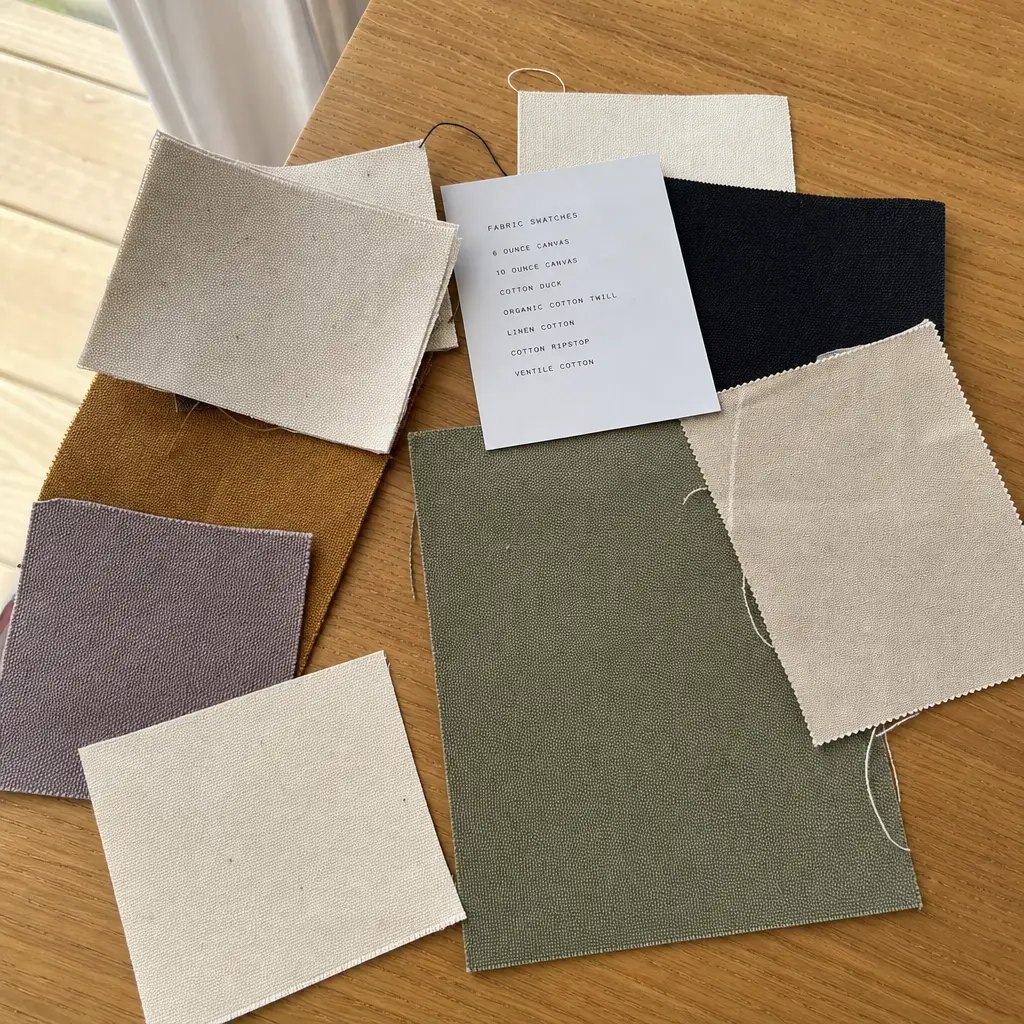
A single finished sample is not enough when the order depends on fabric shade, logo clarity, and pouch function. The sample path should start with fabric swatches, then a print strike-off, then a complete pre-production sample made with the intended fabric, cord, seam method, and packing fold. This sequence catches the expensive mistakes before bulk cutting. If the fabric shade is wrong, it is cheaper to reject a swatch than to reject printed and sewn pouches.
The pre-production sample should be measured, photographed, and signed off with notes. Buyers should not approve only a front-view picture. Measure the width, height, channel depth, cord length, print size, print placement, seam width, and overall weight. If the pouch will be folded in a certain way for retail packing, approve the folded presentation too. Many packaging disputes come from details that were visible in the sample but never written into the approval record.
- Approve swatches for GSM, shade, handfeel, and visible cotton specks before artwork is printed.
- Approve print strike-offs for ink color, edge clarity, opacity, and rubbing performance.
- Approve the pre-production sample for size, closure, seam strength, and actual fill test.
- Keep one sealed approval sample with the supplier and one with the buyer or inspection agent.
Use measurable inspection thresholds
Inspection should not depend on whether the pouch looks acceptable from a distance. The buyer should define what can be measured and what counts as a defect. Size tolerance, print position tolerance, stain limits, loose thread allowance, and seam defects should be agreed before production. For many pouch orders, a practical tolerance is plus or minus 5 mm for small pouches and plus or minus 8 mm for larger pouches, but the exact limit depends on the product fit and retail display requirements.
Fabric defects also need judgment. Natural cotton may contain small dark specks or minor slubs. If the bakery brand wants a rustic look, these may be acceptable within limits. Oil stains, large colored contamination, mildew smell, strong shade bands, and holes should not be accepted. Print defects should be judged for brand impact: a tiny ink pinhole in a background area is different from a broken brand name or crooked logo on the pouch front.
- Critical defects: mold smell, wrong artwork, unsafe contamination, unusable closure, or incorrect SKU packing.
- Major defects: wrong size beyond tolerance, broken seams, severe stains, poor print adhesion, or unreadable logo.
- Minor defects: small loose threads, slight natural cotton specks, or small wrinkles that do not affect saleability.
- Inspection sampling should pull cartons from different pallet positions, not only from the top layer.
Control packing before cartons leave the factory
Packing is often treated as an afterthought, but it affects receiving cost and damage risk. Bakery buyers may need pouches counted by store, by SKU, by seasonal set, or by retail display unit. If the supplier bulk packs all pouches randomly, the importer or distributor may spend extra labor sorting at the warehouse. The RFQ should state inner pack quantity, carton quantity, folding method, carton marks, barcode labels if needed, and whether mixed SKUs are allowed in one carton.
Cotton absorbs moisture, so export packing matters for sea freight and humid routes. A carton liner or polybag inner protection can reduce moisture exposure, but the buyer should balance sustainability requirements against transit risk. If the brand avoids individual plastic bags, request bundle packing with a master liner instead of single polybags. Cartons should not be overpacked, because compressed cotton pouches can arrive with deep creases that affect retail presentation.
- Use bundle packing by SKU when warehouse counting and store allocation matter.
- Use carton liners for moisture protection when shipping by sea or through humid ports.
- Define carton marks with PO number, SKU, color, size, quantity, gross weight, and destination.
- Request carton dimensions and gross weight in the quote to estimate freight and landed cost.
Plan lead time around real production steps
Lead time is not just sewing time. A cotton pouch order may include fabric sourcing, dyeing or bleaching, fabric relaxation, cutting, printing, ink curing, sewing, thread trimming, inspection, packing, and export booking. The schedule risk increases when artwork is late, color approval changes, or the buyer requests multiple SKUs with different materials. A realistic purchase plan leaves time for sample corrections before bulk production, not after the factory has already printed the full fabric batch.
For repeat bakery programs, buyers can reduce risk by locking a standard pouch body and updating only artwork or packing inserts. The first order should allow more time for sample development and tolerance agreement. Reorders can move faster when the same fabric source, drawcord, print method, and carton plan are repeated. However, even repeat orders need fabric shade confirmation because natural cotton and dyed cotton can vary from batch to batch.
- Sample development should include time for fabric swatch review and print strike-off revision.
- Bulk production should not start until pre-production sample approval is documented.
- Print curing and final packing should be included in the lead time, not treated as same-day tasks.
- Holiday bakery seasons require earlier booking because factories and freight channels get congested.
Compare quotes by landed value, not unit price
A useful quotation for cotton drawstring pouches should contain enough data to calculate landed cost and quality risk. Unit price alone does not show whether the supplier included the same GSM, print process, cord type, packing, inspection support, and carton specifications. A low quote may exclude sample revisions, use thinner fabric, or pack more units per carton than is practical for receiving. Buyers should normalize each quote before choosing a supplier.
The best comparison method is to create a one-page quote matrix. List fabric GSM, finished size, print method, number of print colors, drawcord type, MOQ, sample charge, production lead time, packing method, carton quantity, carton dimensions, estimated gross weight, payment terms, and inspection allowance. When those fields are visible, price differences become easier to explain. A supplier that gives complete quote data is often easier to manage than one that only replies with a fast unit price.
- Compare cost per usable approved pouch, not only cost per produced pouch.
- Include rework risk, sorting labor, and warehouse handling when packing is unclear.
- Review carton cube and gross weight because heavy GSM choices can change freight cost.
- Treat missing quote data as a sourcing risk, especially for multi-SKU bakery programs.
Specification comparison for buyers
| Spec decision | Recommended option | When it fits | Buyer risk to check |
|---|---|---|---|
| Fabric weight for bakery retail pouches | 140-180 GSM cotton for lightweight bread, cookie, or gift packaging | Works when the pouch carries dry bakery items, branded inserts, or reusable customer packaging without heavy load | Below 120 GSM can look transparent and lose shelf value; above 220 GSM may raise freight and make small pouches feel bulky |
| Fabric construction | Plain weave cotton with controlled shrinkage and smooth enough face for printing | Best for logo clarity, consistent sewing, and predictable pouch dimensions after finishing | Loose weave can distort print edges, shed lint, or create uneven seam allowance during sewing |
| Drawcord material | Cotton cord or flat cotton tape matched to the pouch color and channel width | Fits bakery brands that want a natural look and easy opening for retail staff and customers | Cord too thin cuts into the fabric channel; cord too thick slows packing and can jam after washing |
| Print method | Screen print for 1-3 solid colors; heat transfer only for detailed small artwork | Screen print suits most bakery logos, wheat icons, batch text, and reusable pouch messaging | Fine lines under 0.4 mm, low-contrast ink, or ink applied over slub fabric may fail visual approval |
| Pouch size tolerance | Set finished size tolerance at +/-5 mm for small pouches and +/-8 mm for larger bread pouches | Allows factory-realistic sewing tolerance while protecting retail shelf consistency | Only giving flat fabric cut size causes disputes because sewing loss and drawcord channel depth change final size |
| Seam and drawcord channel | Double-fold top channel with reinforced side seam lock at the opening | Useful when bakery staff open and close pouches repeatedly during packing or gift assembly | Weak bartack or open seam at the channel creates early tearing even if fabric GSM is acceptable |
| Packing method | Individual fold or bundle packing by SKU, with moisture barrier carton liner for sea freight | Fits importers combining multiple pouch sizes, logo colors, or bakery store allocations | Random bulk packing saves labor but increases counting errors, creasing, and mixed-color claims at destination |
| Sample approval route | Approve fabric swatch, print strike-off, and pre-production sample before bulk cutting | Best when color, handfeel, and logo placement matter to the bakery brand presentation | Skipping strike-off approval can lock in the wrong ink tone across the full lot before anyone sees the finished pouch |
Buyer checklist before sampling
- State the finished pouch size, not only the cut fabric size, and include allowed tolerance by SKU.
- Specify cotton GSM, weave, color, bleaching level, and whether the fabric must be pre-shrunk or unwashed natural cotton.
- Send print artwork as vector files with Pantone references, print size, placement from edges, and minimum line thickness.
- Define drawcord type, cord diameter or tape width, cord color, knot method, and whether both sides must pull evenly.
- Approve fabric swatch, print strike-off, and one complete pre-production sample before bulk cutting starts.
- Set seam strength and visual defect acceptance standards before inspection, including loose threads, skipped stitches, stains, and size variation.
- Confirm packing by SKU, inner quantity, carton quantity, carton marks, barcode or retail label needs, and carton moisture protection.
- Request quote data for fabric GSM, print method, MOQ by color and size, sample fee, production lead time, packing method, and shipping carton dimensions.
Factory quote questions to send
- Which cotton GSM options are available from stock, and which require greige fabric dyeing or special weaving?
- Is the quoted size the finished pouch size after sewing, or the fabric cutting size before seam allowance?
- What is the MOQ by pouch size, fabric color, and print color, and can multiple bakery logos share one fabric batch?
- Which print method is included in the quotation, and what artwork details would trigger a different print process or setup charge?
- What sample stages are included: fabric swatch, print strike-off, pre-production sample, or only one finished sample?
- What are the normal production lead time and the longest-risk processes, such as dyeing, print curing, or drawcord sourcing?
- How will pouches be packed for export, and what are the estimated carton size, gross weight, and quantity per carton?
- What inspection standard will the factory accept for AQL, size tolerance, color variance, seam quality, and print adhesion?
- Can the supplier provide photos or short videos from cutting, printing, sewing, trimming, and final packing for this order?
Quality-control points to confirm
- Fabric GSM should be verified by cutting and weighing a measured sample area, not judged only by handfeel.
- Finished pouch width and height should be measured flat after sewing, including the drawcord channel position agreed in the sample.
- Print adhesion should survive tape pull, moderate rubbing, and normal folding without cracking or ink transfer.
- Drawcords should pull smoothly from both ends without channel blockage, broken knots, or uneven cord length.
- Side seams should be straight, locked at stress points, and free of skipped stitches, burst seams, or exposed raw edges.
- Natural cotton should be checked for oil marks, dark specks, weaving slubs, and shade inconsistency against the approved swatch.
- Cartons should match the packing list by SKU and quantity, with carton marks readable and moisture protection suitable for the shipping route.
- Random inspection should include opening packed cartons, not only reviewing loose samples provided by the sewing line.