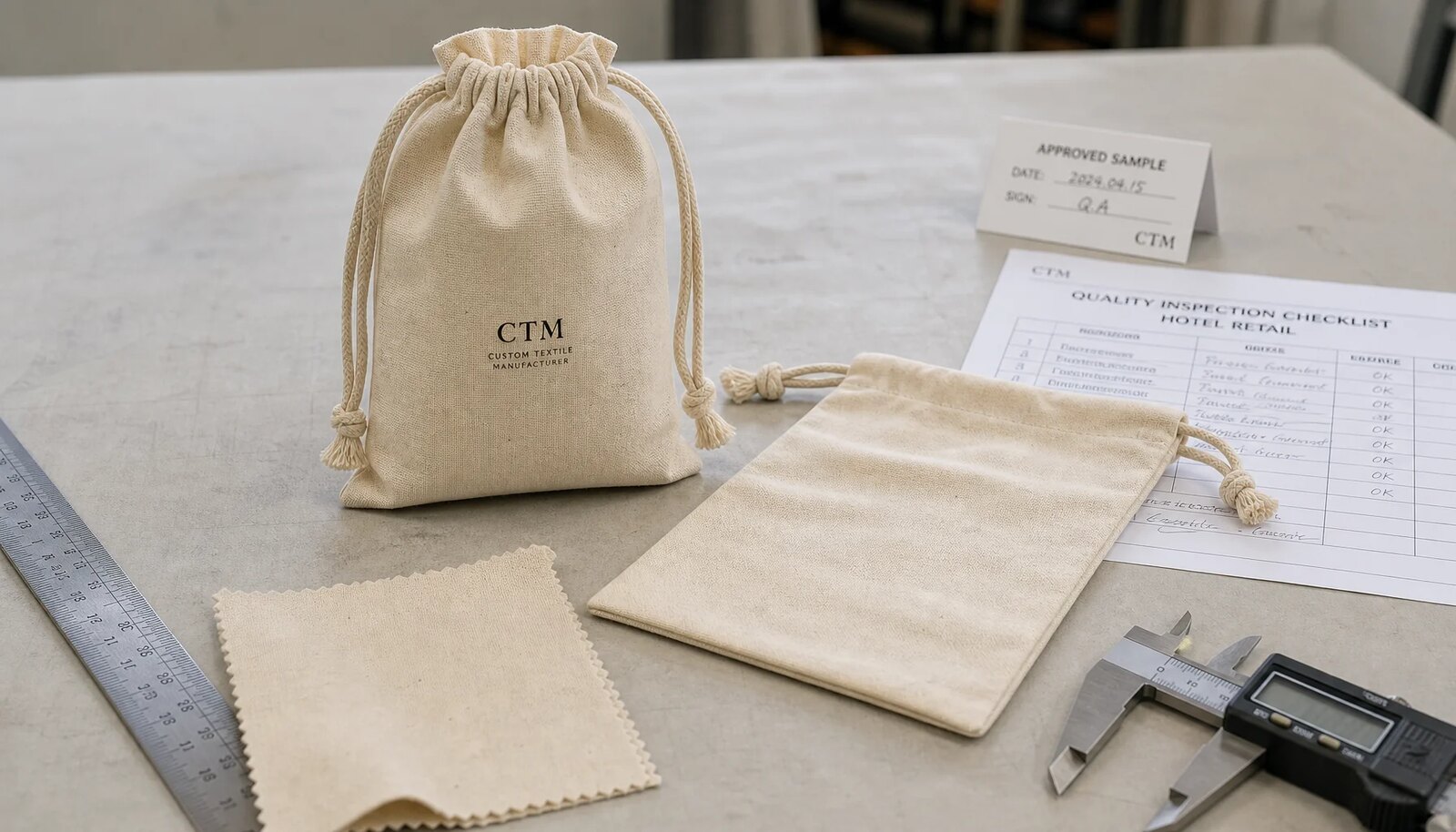
Start With The Hotel Retail Job
Cotton drawstring pouches are often treated as simple packaging, but in hotel retail they sit close to the guest experience. A pouch may hold spa products, jewelry, amenity refills, minibar wellness kits, candles, shaving sets, charging cables, or boutique accessories. The pouch affects perceived value before the guest touches the item inside.
Begin the buying brief with the retail role and contents rather than a catalog size. Paid retail packaging needs a cleaner face, tighter logo placement, and stronger carton control than an internal protective sleeve. A gift-with-purchase pouch may tolerate a softer handmade look, but it still cannot show stains, mildew, odor, loose drawstrings, or crooked branding.
The handling route matters. Factory-filled pouches need packing discipline and count accuracy. Distributor-filled pouches need predictable mouth opening and fast closure. Hotel staff need pouches that can be filled without special training. Guest-retained reusable pouches need stronger seams, comfortable cords, and a closure that still works after repeated pulls.
- Classify the pouch as retail packaging, amenity packaging, gift packaging, reusable packaging, or internal protection.
- Record contents, filled weight, hard edges, residue risk, and handling route before RFQ release.
- Apply stricter cosmetic standards when the pouch is sold, gifted, or shelf-displayed.
- Set different inspection priorities for factory-filled, kitting-line-filled, distributor-filled, and hotel-staff-filled programs.
- For multi-property programs, standardize the base pouch before approving property-specific logos.
Turn Contents Into Finished Size Specs
Finished size is the measurement procurement should control. Cutting size helps the factory plan production, but it does not prove the sewn pouch will fit. The purchase order should state finished width and finished height after sewing, the measurement method, and the tolerance for each size. For small pouches, ±3 mm to ±5 mm is often practical when confirmed by the supplier. Larger pouches may require ±5 mm to ±10 mm, but that range should be agreed before cutting.
Fit approval should use the real product whenever possible. If the final item is not available, use a dummy with matching length, width, thickness, weight, and corner profile. A pouch can pass flat measurement and still fail if the item strains the side seams, distorts the logo, or prevents the drawstring from closing cleanly.
Usable mouth opening deserves a separate specification. Total width can be correct while the opening feels tight because the channel is deep, the cord is thick, or the top edge puckers. This matters in hotel backrooms and third-party kitting, where small filling delays become labor cost.
Construction also changes fit. Bottom shape, seam allowance, channel height, cord exit placement, and seam type should be confirmed in the pre-production sample. For heavier sets, fill the pouch and lift it by the body and by the drawstring under normal handling pressure. Any seam opening, corner hole, or channel tearing is a functional failure, not a cosmetic issue.
- State finished size as width x height after sewing, measured flat and empty unless another method is written.
- Approve fit with the actual product or a realistic dummy, not only a ruler measurement.
- Specify usable mouth opening and channel height in addition to outside dimensions.
- Check filled appearance to confirm the logo remains presentable and the top closes neatly.
- Inspect bottom corners, side seams, and channel exits under filled weight for heavier retail sets.
Specify Cotton GSM, Weave, Shade, And Claims
Fabric choice sets look, durability, cost, and inspection standard. For light amenity items, jewelry, samples, and small accessories, 120-160 GSM cotton is commonly workable if opacity and hand-feel pass review. For heavier spa sets, accessory kits, or reusable retail pouches, 180-220 GSM usually gives more structure. Heavier fabric can work, but it may create bulky seams, slow gathering, increase sewing difficulty, and raise carton weight.
Avoid writing only cotton pouch in the RFQ. Name the cotton type, weave, GSM range, color process, hand-feel expectation, and documentation needs. Natural cotton, bleached cotton, dyed cotton, organic cotton, recycled cotton, and cotton blends behave differently in sourcing, MOQ, lead time, and inspection.
Natural cotton is popular for spa and wellness programs, but its character must be bounded. Seed flecks, small dark specks, slubs, and mild shade movement may support the intended look. Oil spots, mildew, colored fiber contamination, and strong odor do not. Approve the acceptable natural range with a physical swatch, not a vague description.
For dyed or bleached pouches, shade control becomes more formal. Use lab dips for custom color. Keep fabric lot records for multi-size programs and replenishment orders. If pouches from different lots will sit together on one shelf, ask the supplier to flag any visible shade movement before shipment.
If marketing will use organic, recycled, or low-impact claims, procurement needs documents that match the claim. Ask for the certificate type, scope, issuing body, material percentage if relevant, and whether transaction or lot documents are available. Do not rely on verbal sustainability statements for retail packaging claims.
- Use 120-160 GSM for light pouches when opacity and hand-feel pass sample review.
- Use 180-220 GSM for heavier or reusable pouches when the drawstring still closes smoothly.
- Approve natural cotton flecks and slubs by physical range, not generic wording.
- Require lab dips for custom dyed cotton before bulk dyeing or cutting.
- Request claim documents only for sustainability statements the hotel will actually make.
- Keep fabric lot records for multi-size retail families and reorder programs.
Make The Drawstring System Reliable
The drawstring is a functional system, not decoration. A pouch can use acceptable fabric and still fail inspection if the cord is rough, short, stained, mismatched, frayed, or difficult to pull. Cotton cord supports a natural material story. Flat cotton tape can improve grip on larger pouches. Synthetic cord may slide more easily, but it changes the look and should be a deliberate choice.
Cord size must match the channel and pouch size. Fine cord can suit jewelry or amenity pouches because it gathers neatly. Larger spa or accessory pouches may need thicker cord or tape so the guest does not feel a thin string cutting into the hand. Too much cord diameter creates stiff closure and puckering. Too little can cause knot slippage and a lower-value feel.
Specify finished loop length after assembly and knotting, not only cord cut length. Uneven loops look careless in retail trays, gift sets, and receiving photos. Define knot style, end finish, cord color tolerance, and whether pouches ship open, loosely closed, tied, bundled, or inserted into kits.
Channel exits are common failure points. Staff pull quickly during filling, and guests pull without thinking about seam stress. Inspect sampled pouches by opening and closing them several times, then pulling gently at both exits. Cord shedding, knot slippage, channel tearing, twisting, and pullout should be treated as functional defects.
- Define cord material, color, diameter or tape width, finished loop length, knot style, and end finish.
- Match cord thickness to channel width so the pouch closes without puckering or excessive friction.
- Reinforce channel exits and inspect them after repeated opening and closing.
- Reject frayed, stained, shedding, mismatched, short, or easily pulled-out cords.
- Specify whether pouches ship open, closed, tied, bundled, or inserted into kits.
Choose Branding By Artwork Risk
Most cotton drawstring pouches for hotel retail carry a hotel logo, spa mark, product message, or private-label design. Screen printing is often practical for one to three solid colors and repeated logos. The quote should state ink type, print size, screen charges, curing method, and placement tolerance.
Heat transfer can handle gradients, small text, and multi-tone artwork that is difficult to screen print. It must be approved physically because it can change hand-feel, gloss, and the natural look of cotton. Inspect transfers for edge lifting, cracking, poor adhesion, and color mismatch after packing contact.
Embroidery can look premium on heavier cotton, but it is not automatically better. On small or lightweight pouches, embroidery can pull fabric, distort the logo, create puckering, or leave bulky backing. Woven labels can solve print problems on textured fabric, but label edge finish, sewing accuracy, and placement tolerance become the main QC focus.
Artwork control should be measurable. Provide vector files, logo width and height, Pantone or brand color references, placement from fixed seams, minimum line weight, and acceptable tilt. If one logo appears on multiple pouch sizes, approve each layout separately. A mark balanced on a medium pouch may look oversized on a jewelry pouch and too small on a spa set pouch.
Print inspection should cover handling, not color alone. Ink should be dry, non-tacky, and unable to transfer to the back of the pouch or adjacent pouches under normal packing pressure. Inspectors should check opacity, pinholes, ghost marks, registration, edge sharpness, tilt, and distance from seams using a ruler.
- Use vector artwork with fixed logo dimensions and placement measured from seams or channel stitch lines.
- Approve a print strike-off on the actual production fabric before bulk printing.
- Set Pantone references, then approve printed color on cotton because fabric changes ink appearance.
- Check dry rub and packing contact with a clean white cloth where practical.
- Reject sticky, cracked, bleeding, ghosted, tilted, misregistered, or visibly off-center branding.
- Approve separate branding layouts for each pouch size in a retail family.
Quote The Program By SKU Complexity
MOQ is tied to production efficiency, not just total quantity. Fabric purchasing, dyeing minimums, cutting layouts, print setup, sewing line planning, trimming labor, certification paperwork, and packing configuration all affect cost. A small order with one natural fabric, one cord, and one logo may be easier than a larger order split across colors, sizes, labels, and property-specific artwork.
Hotel groups should source from a SKU matrix. The matrix should show finished dimensions, GSM, fabric color, cord color, print method, print colors, artwork version, quantity, packing format, barcode requirement, carton label data, and destination. This prevents suppliers from quoting different assumptions and helps procurement compare unit price, setup cost, sample cost, and lead time.
Freight assumptions should be visible early. Cotton pouches are light but bulky relative to value, so carton size, compression level, and CBM affect landed cost. A low unit price may lose its advantage if goods are overpacked, individually bagged without need, or placed in inefficient cartons. Request units per carton, gross weight, net weight, carton dimensions, and CBM before award.
Pilot orders can mislead if the full program will use different assumptions. Trial quantities may carry higher setup cost per unit, while bulk pricing may assume consolidated fabric, fewer artwork versions, or simpler packing. Ask what changes if quantities rise or fall, if property-specific logos are added, or if stock natural cotton becomes custom dyed cotton.
- Quote by SKU when multiple sizes, colors, or artwork versions are involved.
- Consolidate fabric color, cord type, print color, and packing format to reduce cost and variation.
- Ask which MOQ applies to fabric, dyeing, printing, sewing, and packing separately.
- Request carton data early because freight can change landed cost significantly.
- Separate setup charges, sample fees, barcode labels, certification documents, and packing upgrades.
- Confirm price impact before adding property-specific logos or custom dyed colors.
Use Samples As Control Documents
A sample should control production, not only win approval in a photo. The approved pre-production sample should use the intended fabric, GSM, cord, thread, print method, sewing construction, logo placement, and packing method. If any component is substituted, label it as a development sample and do not release bulk cutting until final materials are approved.
A useful approval path starts with fabric swatches for shade, GSM, weave, opacity, hand-feel, and natural fleck level. Next, approve a print strike-off on the chosen fabric. Finally, approve a complete pre-production pouch with final stitching, cord, branding, and packing. This sequence reduces risk for dyed cotton, natural cotton with visible flecks, and logos requiring tight brand color control.
Keep signed physical samples. Photos help communication, but they cannot fully show fabric hand, opacity, odor, cord movement, seam bulk, or shade under real lighting. The buyer should keep one reference sample, and the factory should keep a sealed matching sample near production. Both should connect to a written approval sheet with measured dimensions and tolerances.
The approval record should state what is accepted and what is rejected. If natural flecks are acceptable only within the approved swatch range, write it. If slight hand-feel variation is acceptable but stains are not, write it. If logo placement was approved for one pouch size only, do not allow that layout to apply automatically to the whole size range.
- Approve fabric swatches before bulk cutting when color, GSM, opacity, or flecks matter.
- Approve a print strike-off on actual cotton before bulk printing.
- Approve one full pre-production pouch made with final materials and construction.
- Record finished size, logo position, cord length, seam type, thread color, and packing format.
- Mark substitute samples clearly and do not treat them as production approval.
- Keep buyer and factory reference samples until the shipment is accepted.
Set AQL, Defect Classes, And Pass Rules
A cotton drawstring pouches for hotel retail quality inspection checklist is only useful if it defines pass and fail conditions. The inspection plan should cover finished size, fabric appearance, stitching, drawstring function, branding, stains, odor, shade consistency, loose threads, packing accuracy, and carton condition. Avoid purchase orders that say only good quality.
Many B2B buyers use final random inspection under an agreed AQL sampling plan. A practical starting point is General Inspection Level II for finished product appearance and workmanship, with tighter checks for critical safety or contamination issues. Common commercial settings are 0 critical defects, AQL 2.5 for major defects, and AQL 4.0 for minor defects, but the buyer should confirm values based on brand risk, order size, destination, and rework options.
Defect classification should match hotel retail impact. Critical defects include mold, sharp contamination, insect contamination, strong chemical or musty odor, hazardous foreign matter, and closure failure that makes the pouch unusable. Major defects include wrong artwork, wrong size affecting fit, open seam, broken drawstring, severe print misplacement, large visible stain, ink transfer, mixed SKU, or carton damage that compromises product condition. Minor defects include a short loose thread, slight approved natural slub, or very small cosmetic variation outside the main logo area when saleability is not affected.
Write pass/fail language before inspection. Any mold, sharp contamination, or strong odor should fail the affected carton or shipment according to the agreed plan. A pouch with an open seam, broken cord, unusable closure, or wrong logo should be counted as major. A stain visible on the retail face should be major; widespread or oily staining can justify shipment hold. Print rub that transfers visible ink to a white cloth during a simple dry rub check should be major unless a different lab test is specified.
Sampling checkpoints reduce expensive surprises. Check bulk fabric before cutting for shade, GSM, stains, odor, and approved fleck range. Check first printed panels for placement, curing, rub, and color. Check early sewing output for finished size, channel height, seam security, and cord function. Final random inspection should happen after goods are fully packed and at least 80 percent of cartons are complete, unless the buyer specifies another release point.
- Use 0 tolerance for critical defects such as mold, sharp contamination, insect contamination, and strong unusable odor.
- Treat open seams, wrong logo, broken drawstring, wrong size affecting fit, large stains, ink transfer, and mixed SKUs as major defects.
- Treat small loose threads or slight approved natural fabric variation as minor only when retail presentation is not affected.
- Use written tolerances for size, logo placement, cord length, shade range, and carton count.
- Agree sample size, AQL values, defect limits, and fail response before mass production starts.
- Add inline checks after fabric receipt, first print, early sewing, and before final packing for high-risk programs.
Inspect Fabric, Sewing, Print, And Function Together
Hotel retail inspection should judge function and presentation at the same time. A pouch may hold the product and still fail if the front face is dirty, the logo is crooked, the cord loops are uneven, or the packed shape looks crushed. Review the pouch as a guest would see it: front panel, branding area, drawstring line, side seams, bottom corners, and filled appearance when relevant.
Sewing inspection should cover stitch security and visual cleanliness. Side seams should be straight enough that the pouch does not twist. Bottom corners should not show holes, thread nests, or weak points. Channel stitching should be even, and exit points should resist normal pulling. Loose threads should be trimmed, especially on natural cotton where colored thread tails stand out.
Fabric cleanliness is a frequent hidden issue. Cotton can pick up cutting dust, oil spots, machine marks, loose colored fibers, mildew marks, or storage odor. Natural cotton may show approved flecks, but flecks are not the same as dirt, stains, or contamination. Open cartons and smell the goods because odor often appears only after packed pouches sit in closed cartons.
Function checks need physical handling. Open and close sampled units several times. Pull gently at the cord and channel exits. Insert the intended product or dummy. Confirm that the pouch fills without forcing, closes neatly, and keeps the printed area presentable when filled.
- Inspect the guest-facing front panel, logo area, drawstring line, seams, corners, and filled shape.
- Open and close sampled units repeatedly instead of relying on static photos.
- Pull gently at channel exits and side seams to detect weak stitching.
- Separate approved natural cotton character from stains, mildew, oil, or colored contamination.
- Measure print placement with a ruler from fixed seams or channel stitch lines.
- Document defects with photos showing scale, measurement, SKU, and carton source.
Control Packing, Cartons, Moisture, And Receiving Data
Packing is part of product quality for cotton drawstring pouches. Poor packing can create deep creases, dust exposure, damp odor, mixed SKUs, and receiving confusion. Define whether pouches ship flat, bundled, paper-banded, master-bagged, individually bagged, or inserted into another kit. The right choice depends on sustainability policy, warehouse process, local labor, and retail presentation needs.
Cotton pouches are often light but bulky, so carton planning affects landed cost. Request units per carton, carton dimensions, gross weight, net weight, and CBM before freight booking. Excessive compression can create fold lines hotel teams may not have time to steam out. Underfilled cartons may collapse in transit. Carton strength should match export handling and storage duration.
Moisture and odor control need direct checks because cotton absorbs humidity and surrounding smells. Finished goods should be stored off the floor, away from chemicals, food odor, damp walls, and open doors during rain. If desiccants are used, they should suit carton size and route conditions. Cartons should not feel damp, smell musty, or show water marks.
SKU control is essential for hotel groups, distributors, and retail launches. Carton labels should show purchase order, SKU, size, fabric color, artwork version, quantity, carton number, and gross weight if required. Barcode labels must be verified before shipment when the receiving system requires them. Mixed cartons should only be used when intentionally ordered, with assortment ratios stated on labels and packing lists.
- Pack by SKU unless assorted kits are explicitly ordered.
- Avoid excessive compression that creates deep cotton creases.
- Use clean inner protection that balances dust and moisture control with sustainability targets.
- Verify carton labels, barcode labels, packing list, count, carton number, and SKU data.
- Request carton dimensions, gross weight, net weight, units per carton, and CBM before booking freight.
- Reject damp cartons, musty odor, mixed SKUs, crushed cartons, and dirty inner packing.
Specification comparison for buyers
| Procurement decision | Typical specification range | Best use in hotel retail | Inspection risk to control |
|---|---|---|---|
| Finished size tolerance | Small pouches commonly ±3 mm to ±5 mm; larger pouches ±5 mm to ±10 mm only when approved | Amenity, jewelry, spa, minibar, and boutique retail pouches where product fit and shelf appearance matter | Measure finished sewn pouch width and height from agreed reference points. Cutting size alone is not a pass criterion. |
| Fabric GSM | 120-160 GSM for light items; 180-220 GSM for heavier retail sets or reusable pouches; higher GSM after closure testing | Matching pouch hand-feel to product value, opacity, contents weight, and reusable positioning | Low GSM can look transparent or flimsy. High GSM can create bulky seams, hard closure, higher freight weight, and poor gathering. |
| Cotton type | Natural, bleached, dyed, organic, recycled, or blended cotton as specified by buyer claim and compliance need | Wellness, spa, gift, accessory, and hotel shop programs with a defined brand look | Natural flecks require physical approval. Organic or recycled claims require named documents, scope, and transaction records where applicable. |
| Fabric shade control | Approved swatch, lab dip for dyed fabric, lot record, and acceptable shade band | Multi-property hotel groups and repeat orders where pouches sit together on shelves | Mixed lots can create visible shade breaks across sizes or replenishment orders. |
| Cord or tape | Cotton cord commonly 2-5 mm depending on pouch size; flat tape for larger or premium pouches | Guest-handled spa sets, reusable packaging, gift-with-purchase programs, and hotel boutique products | Inspect finished loop length, fray resistance, knot security, channel friction, shedding, color transfer, and cord pullout. |
| Branding method | Screen print for 1-3 solid colors; heat transfer for gradients or fine detail; embroidery or woven label after fabric testing | Hotel logos, spa marks, private-label retail lines, amenity packaging, and boutique merchandise | Control curing, rub resistance, edge sharpness, print opacity, placement tolerance, backing distortion, and logo scale by pouch size. |
| Seam construction | Lockstitch, overlock, French seam, or enclosed seam as approved; reinforced channel exits and bottom corners for heavier contents | Pouches handled by guests, warehouse teams, spa staff, and third-party kitting lines | Skipped stitches, thread nests, open seams, weak channel exits, and corner holes are common major defects. |
| MOQ structure | Quote by size, fabric color, cord color, print color, artwork version, packing style, and certification requirement | Hotel groups consolidating multiple property or retail SKUs into one procurement program | Small splits across many variants increase cost, shade variation, wrong-artwork risk, and mixed-carton errors. |
| Packing format | Flat packed by SKU, counted bundles, inner master bags or liners, carton labels, barcode labels if required | Hotel retail warehouses, spa stockrooms, distributors, and gift set assembly lines | Over-compression causes creases. Weak carton labeling causes receiving delays, short counts, mixed SKUs, and wrong allocations. |
Buyer checklist before sampling
- Define the pouch role: paid retail packaging, gift-with-purchase, in-room amenity holder, spa product pouch, jewelry pouch, minibar kit, accessory pouch, or reusable guest item.
- List exact contents, product dimensions, filled weight, hard edges, oil or powder exposure, and whether filling is done by factory, kitting line, distributor, or hotel staff.
- Specify finished pouch width and height after sewing, measured flat and empty unless another method is stated, with written tolerance for each size.
- Define usable mouth opening, channel height, seam allowance expectation, bottom shape, cord exit position, and whether the filled pouch must stand, hang, or lie flat.
- Select cotton type, weave, GSM range, color reference, shade tolerance, shrinkage expectation, and any certification requirement before final pricing.
- Approve physical swatches for shade, opacity, hand-feel, weave density, slub level, seed fleck acceptance, and print compatibility before bulk fabric cutting.
- Provide vector artwork with logo size, Pantone or brand color reference, print method, print position from fixed seams, minimum line weight, and placement tolerance.
- Confirm print testing expectations for dry rub, packing contact, light handling, and exposure to spa oils, bath salts, soap dust, cosmetic powder, or fragrance residue.
- Specify cord material, diameter or tape width, color, cut length, finished loop length, knot style, end finish, and pullout resistance expectation.
- Require a pre-production sample made with bulk-intended fabric, cord, ink, thread, sewing construction, logo placement, and packing method before mass production release.
Factory quote questions to send
- What exact fabric are you quoting: cotton type, weave, GSM range, color process, fabric width, and expected GSM tolerance after finishing?
- Is the material stock natural cotton, bleached cotton, custom dyed cotton, organic cotton, recycled cotton, or a blend, and what documents are available if claims are required?
- Can you provide swatches from the bulk fabric source and state whether replenishment orders may use a different lot or mill batch?
- What finished size tolerance, logo placement tolerance, cord length tolerance, and carton count tolerance will your internal QC use?
- Will the pre-production sample use the same fabric, cord, thread, ink, print method, sewing machines, and packing plan as bulk production? If not, list all substitutions.
- What is the minimum efficient quantity by pouch size, fabric color, print color, artwork version, cord type, and packing format?
- Which cost items are included separately: sample fee, screen charge, artwork adjustment, lab dip, certification document, barcode label, carton label, inspection support, and export carton?
- Which branding method do you recommend for this artwork and fabric, and what risks do you see for ink coverage, fine lines, registration, hand-feel, or distortion?
- How will you reinforce the drawstring channel exits, side seams, and bottom corners for the stated filled weight and expected guest handling?
- How do you prevent oil stains, fabric dust, mixed shade lots, odor absorption, damp cartons, wrong SKU packing, and cord color variation during production and storage?
Quality-control points to confirm
- Finished pouch width and height must be measured after sewing using the agreed flat-empty method; typical tolerances are ±3-5 mm for small pouches and wider only if approved for larger sizes.
- Usable mouth opening must be checked separately from total width because channel height, cord thickness, seam allowance, and puckering can restrict filling speed.
- Fabric GSM should be verified from production fabric or cut panels, not only from a sales swatch, because bleaching, dyeing, washing, and finishing affect weight and hand-feel.
- Fabric appearance must be inspected under consistent light for holes, oil spots, mildew, colored fiber contamination, heavy slubs, unapproved seed flecks, shade mixing, and abrasion marks.
- Logo placement should be measured from fixed reference points such as side seam, bottom seam, or channel stitch line; visual centering alone is not reliable.
- Print quality must be checked for curing, opacity, edge sharpness, color match, cracking, pinholes, ghost marks, ink smears, tackiness, migration, and transfer to adjacent pouches.
- Drawstrings must open and close smoothly without cord shedding, uneven friction, channel twisting, puckering, tearing, knot slippage, or cord pullout after repeated pulls.
- Side seams, bottom seams, and channel seams must show no skipped stitches, open seams, broken thread, unraveling, thread nests, or loose tails visible on the retail face.
- Cord length, cord color, knot size, and end finishing must remain consistent enough for pouches to align neatly in retail displays or assembly trays.
- Packing inspection must verify SKU separation, count accuracy, carton label data, barcode labels if required, inner protection, carton strength, dampness, odor, and compression level.